
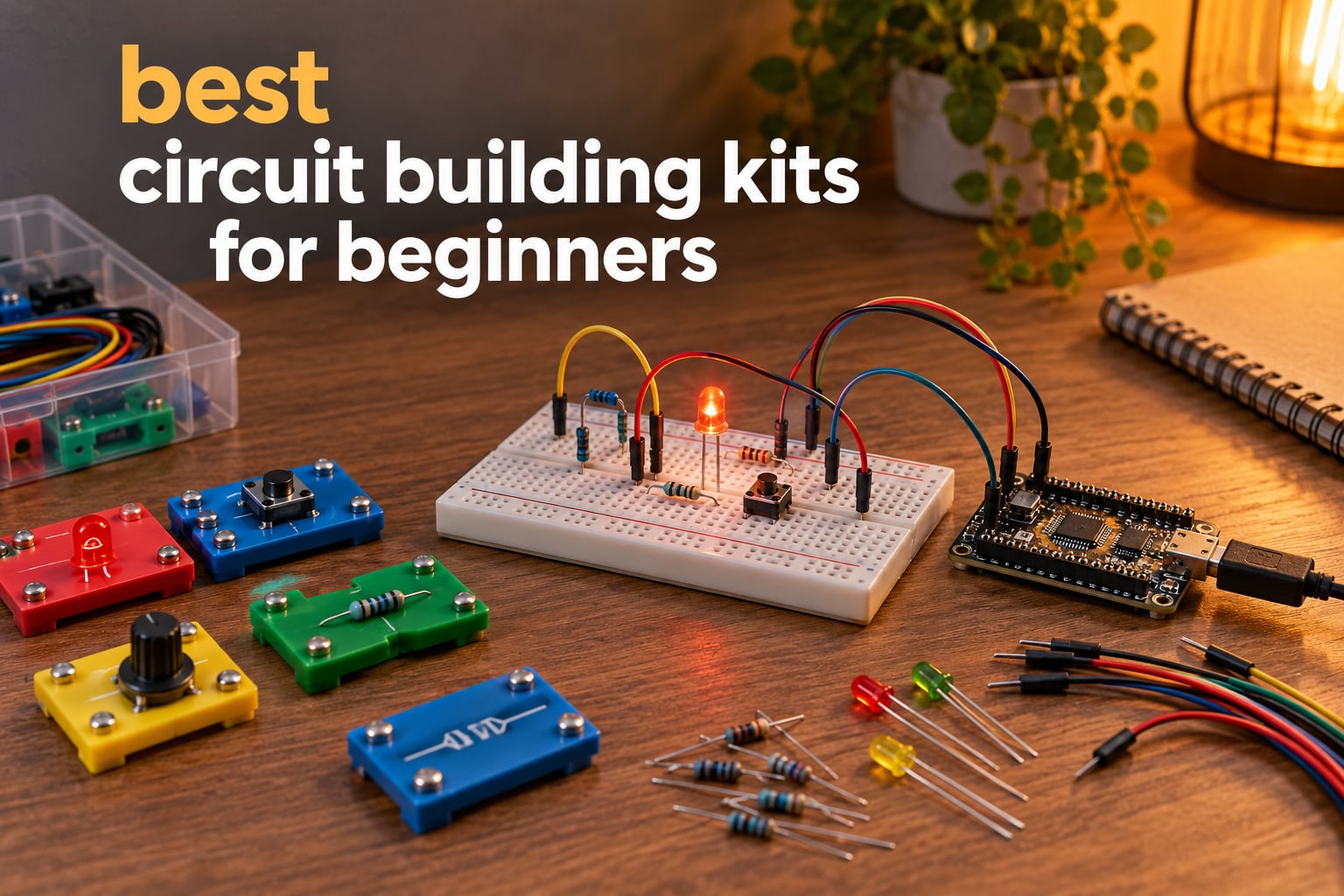
Most people who want to learn electronics do not need a lab bench. They need a box that makes something light up, beep, or spin on the first afternoon. That is the entire promise behind a beginner electronics kit, and it is the filter we used to pick the ten below.
We spent weeks reading through buyer reviews, comparing component counts, checking what each manual actually explains, and looking hard at what happens after the included projects run out. If you only want the short answer, the Snap Circuits Classic SC-300 is the kit we would hand to almost anyone. If you want to learn to write code that controls hardware, the ELEGOO UNO R3 kit is the better buy. Our snap circuit kit comparison goes deeper on the modular option.
Table of Contents
Top 3 Best Circuit Building Kits for Beginners in 2026


Circuit Building Kits Side by Side in 2026
Every kit below is one we would be comfortable recommending to a beginner, but they are built for very different people. The table puts the ten next to each other on the details that actually decide whether you will still be using the kit in three months.
| Product | Specifications | Action |
|---|---|---|
| Snap Circuits Classic SC-300 |
|
Check Latest Price |
| ELEGOO UNO R3 Super Starter Kit |
|
Check Latest Price |
 ELEGOO Mega 2560 Complete Kit ELEGOO Mega 2560 Complete Kit |
|
Check Latest Price |
 Snap Circuits Beginner SCB-20 Snap Circuits Beginner SCB-20 |
|
Check Latest Price |
 Snap Circuits Arcade SCA-200 Snap Circuits Arcade SCA-200 |
|
Check Latest Price |
 Playz Advanced Circuit Board Playz Advanced Circuit Board |
|
Check Latest Price |
 REXQualis Component Fun Kit REXQualis Component Fun Kit |
|
Check Latest Price |
 Science Kidz 188 Experiments Science Kidz 188 Experiments |
|
Check Latest Price |
 ELEGOO Electronic Fun Bundle ELEGOO Electronic Fun Bundle |
|
Check Latest Price |
 National Geographic Circuit Kit National Geographic Circuit Kit |
|
Check Latest Price |
1. Snap Circuits Classic SC-300 – the Best Overall Circuit Building Kit
SNAP CIRCUITS Classic SC-300 STEM Electronics Kit, 300+ Projects, Ages 8+
Ages 8+
300+ projects
No soldering
2.5 pounds
Pros
- Over 300 projects from light switches to AM radios
- No tools and no soldering required
- Manuals sequenced by difficulty
- Manufacturer supplies replacement parts
Cons
- Manual explains how to build but not deeply why circuits work
- Some plastic pieces reported fragile or loose-fitting
- Box is not sturdy for transport and no case is included
I put this kit first because it is the only one on this list where a total beginner can finish something on day one without a single dead end. Pieces are numbered and colour coded, they snap onto a plastic grid, and the box holds 60+ parts. There is no soldering iron, no software install and no wiring that can be reversed.
The project count is where this kit earns its reputation. It runs past 300 builds across two manuals, moving from a single LED to AM radios, burglar alarms and doorbells. Buyers describe months of repeat use rather than an afternoon, which is exactly the property you want from a kit that competes with television.
The instruction quality is genuinely good in structure. Projects are sequenced so difficulty climbs gradually, and the diagrams are large enough to follow across a table. What they do not do is explain the physics in depth. If you finish the manuals and want to know why a resistor of one value dims an LED more than another, this box will not answer that.
Durability is the other open question. Most long-term owners report solid hardware, and the manufacturer offers free replacement parts for worn pieces, which is rarer than it should be in this category. A minority of reviewers report plastic that feels fragile or does not snap securely, and the cardboard box is not built for a car trip.
What age and skill level it actually fits
The manufacturer lists ages 8 and up, and that is honest. A determined seven-year-old will manage it with help; a fourteen-year-old will still get value out of the later projects. For adults, it works as a confidence builder rather than a technical resource, and nothing about the plastic snaps should embarrass you.
When to skip it
Skip this kit if you want to control hardware with software. There is no microcontroller in the box and no way to add one, so the ceiling is a working circuit and nothing more. It is also the wrong choice if you are already comfortable reading a datasheet, because the theory stops well short of what you would use.
2. ELEGOO UNO R3 Super Starter Kit – Best for Learning to Code Circuits
ELEGOO UNO R3 Project Super Starter Kit with PDF Tutorial for Beginners
22+ lessons
Arduino UNO R3
Sensors and motors
1.2 pounds
Pros
- Huge component variety so no extra parts are needed
- Step-by-step PDF lessons build into self-designed projects
- Plug-in modules and pre-soldered LCD remove soldering
- Neat case with well-made components
Cons
- Documentation does not fully cover Arduino IDE setup on macOS
- UNO board runs out of I/O pins on larger builds
- A minority report a faulty breadboard power rail
This is the kit that turns a beginner into someone who can build something nobody has built before. The UNO R3 controller runs on 16 MHz with 2 KB of memory, and the box ships with an LCD1602 with a pre-soldered header, a breadboard power module, an ultrasonic sensor, a DHT11 temperature sensor, a joystick, an IR receiver and remote, an SG90 servo, a stepper motor with driver, a relay and a DC motor.
Twenty-two guided lessons walk through LEDs, temperature and distance sensing, servo and stepper motor control, and LCD and joystick input. Each one comes with example code you can edit. That is the difference from a snap-together kit: you change one line and the hardware responds, which is where real skill comes from.
Forum regulars on r/AskElectronics consistently point at Arduino kits as the genuine skills path, and the reason is this one. The concepts here – digital input and output, analog sensing, timing, motor control – transfer directly to any microcontroller you touch later. In our related kit roundups we treat this as the counterpart to the modular snap kits.
The friction is real, though. The PDF documentation does not fully walk through Arduino IDE installation on macOS, which is where a good share of stuck beginners quit. The UNO also runs out of input and output pins on ambitious builds, and a small number of buyers received a defective breadboard power rail or missing small parts. The manufacturer’s post-purchase support is generally praised when that happens.
Whether an adult should start here or with a kids kit
Adults on r/AskElectronics and r/diyelectronics often assume a beginner kit will feel childish. This one does not. It is built for engineering students and adult hobbyists, the sensors are the kind you will reuse forever, and nobody has to explain what a servo is in terms suitable for a seven-year-old.
What you need beyond the box
You need a computer, obviously, and you will want a multimeter early on. Add a second breadboard and a pack of jumper wires within a few weeks, because the first one gets tied up in whatever project you are stuck on. Budget for nothing else – the kit already covers modules, motors and displays.
3. ELEGOO Mega 2560 Complete Starter Kit – Best for Larger Builds
ELEGOO Mega 2560 R3 Project The Most Complete Starter Kit with Tutorial
Ages 13+
35+ lessons
200+ parts
2.2 pounds
Pros
- 54 digital I/O pins and 256 KB flash support bigger projects
- 200+ components spanning sensors
- displays and motors
- Pre-soldered modules and solderless breadboard
- Storage case and small-parts box for repeat sessions
Cons
- Component density can overwhelm an absolute beginner
- Manufacturer guidance of 13 and up is higher than most kits here
This is the UNO idea scaled up, and the scaling matters more than the marketing suggests. The Mega 2560 R3 board carries 54 digital I/O pins, 15 PWM outputs, 16 analog inputs, four hardware serial ports and 256 KB of flash. When a beginner kit tells you to unplug something to free a pin, this one tells you to pick a different pin.
The component list is 200+ pieces: an LCD1602, an RC522 RFID reader, a real-time clock, a DHT11, an HC-SR501 motion sensor, ultrasonic and water-level sensors, a GY-521 accelerometer, a MAX7219 LED driver, a keypad, a joystick, a relay, an SG90 servo and a stepper motor. Thirty-five guided lessons cover RFID access, environmental monitoring, motion and distance sensing and motor control.
Owners single out the storage case and labelled small-parts box as the feature that keeps projects going. A 200-piece kit that cannot be put away and found again becomes expensive decoration within a month. Here, you can close the lid and pick the build back up a week later.
The honest drawback is density. Two hundred components with a 13-and-up age recommendation makes this a better second kit than a first kit for most people. If you have never written a line of code, the pin count and the board size will feel like noise. Start with the UNO and move up when you hit the pin ceiling.
Who should buy this first
Buy it first if you already have one Arduino project behind you, if you are working through an electronics course that needs an RFID reader or a real-time clock, or if you plan to build something with several motors running at once. The four hardware serial ports alone justify it for anything involving multiple devices.
Where beginners get stuck
The lessons assume you already understand a breadboard row and a ground connection. Nobody is going to hand-hold you through why a circuit will not light up, so expect a slower first afternoon than with the UNO kit. Read the wiring diagram twice before powering anything, and keep the IDE example code open beside you.
4. Snap Circuits Beginner SCB-20 – Best for Ages 5 to 9
SNAP CIRCUITS Beginner SCB-20 STEM Electronics Toy for Kids Ages 5-9
Ages 5 to 9
21 unique projects
0.23 kg
Pros
- Child-friendly pieces snap together with no tools
- Extra childproofing for small engineers
- Includes a lighted color-changing fan
- Colorful age-appropriate illustrated manual
Cons
- Only 21 projects
- far fewer than larger Snap Circuits sets
- Scope stays at simple circuits without motors
- sensors or logic
Most parents who ask which kit to buy for a five-year-old end up with something too advanced, and this one is built for that age instead of watered down from a higher set. The pieces are larger and easier to handle, the base board is smaller, and the extra childproofing details matter more than they sound with small hands.
Twenty-one unique projects are honest in a way the larger numbers are not. A color-changing fan, simple light circuits and basic sound builds are the right vocabulary at this age. Parents and grandparents describe it consistently as a safe, engaging first introduction to electronics with clear colourful instructions.
On r/AskElectronics threads, Snap Circuits beginner sets get recommended most often for durability and expandability, and the criticism aimed at the family is that the instructions are drier and less explanatory than newer kits. That gap is sharpest here, because the projects stay at switch, light and sound level and the manual leans toward assembly steps over theory.
The real limit is quantity. Twenty-one projects will not hold a curious eight-year-old for months. The answer is not a different kit but a different plan: finish this one, then move to the SCB-20’s bigger sibling, whose parts stay compatible. That path is why we keep recommending this as a starting point rather than a destination.
Whether it is safe for a young child
It is built for ages 5 to 9 and runs on alkaline batteries, so there is no soldering, no mains power and no small sharp parts. That matters because the failure mode parents worry about most – a hot tool or a mains connection – simply is not part of this design. Supervise anyway, mostly to help with the snapping.
Where it falls short
There are no sensors, no motors beyond the fan and no logic, so a child ready for real electronics will plateau quickly. If you suspect the interest is genuine rather than a passing phase, skip to the Snap Circuits Classic and accept a higher age rating for a far longer runway.
5. Snap Circuits Arcade SCA-200 – Best for Game-Based Learning
SNAP CIRCUITS Arcade SCA-200 STEM Electronics Kit for Kids Ages 8+
Ages 8+
20+ games
200+ projects
Lifetime warranty
Pros
- Turns basic circuit skills into 20+ playable games
- Sound and lights keep kids engaged past the manual
- No soldering or tools required
- Lifetime warranty against manufacturer defects
Cons
- Narrower focus than the Classic kit with fewer general concepts
- Some buyers want more motor and sensor variety
The idea here is simple and it works: instead of asking a child to build a buzzer that beeps, you give them a game they want to win. Thirty-six pieces produce 20+ arcade-style games with sound and lights, across more than 200 unique projects in total.
Ratings in this group run high, and the game format is the reason. A child who has finished a manual and stopped building is a common failure, and this kit keeps hands busy after the projects end because the games are the projects. Pieces snap onto the same plastic grid system as the rest of the Snap Circuits range, so it pairs with other sets in the ecosystem.
Whether it teaches enough on its own
On its own, no. The scope is narrower than the Classic kit and fewer general electronics concepts get covered, because games concentrate on switches, timing and sound rather than on how components behave. It teaches wiring discipline and troubleshooting, which is real, but not much physics.
How to use it without wasting it
Treat it as the fun half of a two-part plan. Run the SCB-20 beginner set or the Classic alongside it so the theory is covered somewhere else, and let the games carry the motivation. The lifetime warranty against manufacturer defects also means a cracked piece is a phone call rather than a replacement purchase.
6. Playz Advanced Circuit Board – Best for a Standing Lab Board
Playz Advanced Circuit Board for Kids, Science Kits for Kids Age 8-12
Ages 8+
328+ experiments
64-page manual
4 pounds
Pros
- Over 328 experiments on one reusable wired board
- Covers lights
- sounds
- magnetism and AM/FM radio
- Experiments scale from simple to challenging
- Standing format keeps parts organised and visible
Cons
- Wired spring-clip connections are less reliable than snap or breadboard contacts
- Difficulty curve flattens after the first few projects
- Bulky 21.7 x 15.6 inch board needs its own space
This is the only board in the roundup that stays standing on a desk like a piece of lab equipment. Everything mounts to a wired board rather than a bag of loose modules, so experiments stay assembled until you deliberately take them apart. That format alone changes the character of play.
The range is the largest non-coded number on this list at over 328 experiments, covering lights, sounds, magnetism, touch controls and AM and FM radio builds, supported by a 64-page illustrated manual. The experiments scale from simple to challenging rather than repeating the same build with different parts.
Families like that the parts never scatter, and that the board doubles as something a child is proud to show. Ratings sit slightly below the snap-together kits for one reason: the wired spring-clip contacts are less reliable than snap or breadboard contacts, and a connection that will not hold is frustrating when you are eight.
The second drawback is the ceiling. Older children and adults tend to find the projects basic once the basics land, and at 21.7 x 15.6 inches the board is big enough that it will not tuck away in a cupboard. Plan where it lives before you unbox it.
Who this board suits best
It suits a family with one dedicated table, a classroom that wants a permanent demo surface, or a child who works better with a visible, ordered system than with loose parts. The standing format also makes it a good display piece in a homeschool setup that gets shown to other people.
Why we did not rank it higher
It teaches electronics as a sequence of demonstrations rather than as circuits you design yourself. Nothing here transfers directly to a breadboard or a microcontroller board, and the connection method is the least reliable in the roundup. It is a good first kit and a poor last one.
7. REXQualis Component Fun Kit – Best Breadboard Parts Box for Beginners
REXQualis Electronics Component Fun Kit w/Power Supply Module, Jumper Wire, 830 tie-Points Breadboard, Precision Potentiometer,Resistor Compatible with Arduino, Raspberry Pi, STM32
400+ components
830 tie-point breadboard
Power module
7.4 oz
Pros
- Over 400 components for broad prototyping coverage
- Resistors
- LEDs
- transistors and ICs packed and labelled separately
- Includes an 830 tie-point breadboard with USB power cable
- Datasheet and tutorial available from the maker
Cons
- No controller board
- so it needs a separate microcontroller for coded projects
- Online-only documentation instead of anything printed in the box
- Small footprint for complex builds
This is the kit that answers the most repeated question on electronics forums: boxed kit or loose components? This is the components answer. More than 400 pieces, including resistors, LEDs, transistors and integrated circuits that are individually packaged and labelled, which sounds like a small detail and changes everything when you are hunting for a 220 ohm resistor.
The breadboard is a genuine 830 tie-point solderless model with a power supply module and a USB power cable, which is the piece most component kits leave out. That combination means you can build a real circuit immediately with nothing but a battery or a USB port. Plenty of hobbyists treat this as a restock for a setup they already own.
What you do not get is a controller board, and that is the deal. With no microcontroller in the box, coded projects are impossible until you add one. For a beginner who wants to understand voltage, current and resistance by measurement rather than by following a game, that is a worthwhile trade. For a beginner who wants LEDs to blink, it is a dead end.
Documentation is online-only, downloaded from the maker’s site or requested through customer service. Plan for that before you start, because the datasheet and tutorial are what turn 400 loose parts into a learning resource instead of a box of unknowns.
Why experienced hobbyists recommend this path
Advice on r/AskElectronics and r/diyelectronics is consistent: real components on a real breadboard transfer to every later project, while a closed snap kit teaches you its own vocabulary and nothing else. This kit lets a beginner use the same resistors and capacitors that show up in real schematics, at a fraction of the cost of a full starter kit.
What it cannot do alone
It will not teach you programming, and there is no project book to walk you through a first circuit. If you are brand new and want guided steps, pair it with a beginner project kit rather than buying it as your only option. Once you own an Arduino board, it becomes the best value in this roundup.
8. Science Kidz 188 Experiments Set – Best for Raw Project Count
Science Kidz Electronics Kit – 188 Science Experiments Set for Kids
Over 188 projects
Snap-together parts
0.9 kg
Physics theme
Pros
- Over 188 snap-together projects with no extra tools
- Components compliant with US and EU toy safety standards
- Detailed colour manual with illustrated steps and educational notes
- Projects progress from simple to more challenging
Cons
- Snap contacts wear down with heavy repeated use
- Projects stay at basic switch
- light and sound level
- Manual focuses on assembly over the underlying science
If your priority is time spent building rather than time spent explaining, this set wins on raw volume. Over 188 circuit projects and science experiments, from a flying UFO to sound effects and light shows, all assembled from snap-together parts with no additional tools.
The colour manual with illustrated instructions and short educational notes is well made, and the projects are sequenced from simple to more challenging. Parents rate satisfaction high for casual STEM play, and the components are fully compliant with US and EU toy safety standards, which is worth checking if you are buying for a younger child.
Reading the project count honestly
188 is a real number, but it is not 188 unique ideas. Many are the same switch-and-light build with a different component swapped in, so the count measures permutations rather than concepts. Our advice: divide the headline figure by about three before you estimate how long the kit will hold attention.
Where it wears out
Snap-together contacts weaken with heavy repeated use, and a set this size gets rebuilt a lot. Projects also stay at the level of basic switches, lights and sound rather than sensors or logic, so it teaches less per build than the snap kits that cover fewer projects. Good for volume, weaker on depth.
9. ELEGOO Electronic Fun Bundle – Best Budget Component Starter
ELEGOO Electronic Fun Kit Bundle with Breadboard, 235 Items for Arduino
235 parts
400 tie-point breadboard
Power module
7.4 oz
Pros
- 235 parts at a very low entry price for breadboard work
- Breadboard tie points grip component leads firmly
- Resistors labelled in the packaging and parts fit a carry case
- Useful for expanding an existing Arduino or Raspberry Pi setup
Cons
- No controller board
- programming cable or wall adapter included
- Printed material is a component list rather than project instructions
- Small breadboard limits more complex builds
Two hundred and thirty-five parts including a 400 tie-point solderless breadboard, a power module, jumper wires, DuPont wires, a potentiometer, buttons, LEDs, resistors, capacitors, diodes, transistors and buzzers. That is the entire component vocabulary of basic electronics in one small case, at the lowest entry point in this roundup.
It also includes parts that teach something specific: a 74HC595 shift register for expanding outputs, a 4N35 optocoupler, PN2222 transistors and 1N4007 diodes. Those four teach more per component than a page of instructions could. Reviewers note firm breadboard contacts and well-sorted bags of parts as the things that hold up in daily use.
The promise of a tutorial is the recurring complaint. The printed material is a component flap, not step-by-step projects, and you need a controller board, a programming cable and a wall adapter separately. Budget for a board if you do not have one, and treat the missing instructions as part of the deal rather than a surprise.
For anyone who already owns an Arduino or Raspberry Pi setup, this is a restock rather than a starting point. The small breadboard is the limiting factor on bigger builds, but the case of labelled resistors and jumpers is genuinely useful at that size.
Is it worth it as a first purchase
Yes, with one condition: pair it with a project source. Because there are no instructions in the box, the value depends entirely on whether you are willing to follow a tutorial elsewhere. Buy it alongside an Arduino kit and the two together cover everything a first year of electronics needs.
Where to spend the money you saved
Put it into a multimeter rather than more parts. A meter lets a beginner measure resistance and confirm a connection, which converts a dead-end afternoon into a solved problem. It is the single most useful tool you can add to any of the kits on this list.
10. National Geographic Circuit Kit 120 Projects – Best for Video Instructions
National Geographic Circuit Kit for Kids with 120 Electrical Projects
Ages 8+
120+ projects
Video walkthroughs
2.7 pounds
Pros
- Over 120 projects including keyboards
- light shows and flying copters
- QR code opens kid-friendly video walkthroughs
- Snap-on wire connectors need no tools
- Highest five-star share in this group
Cons
- Snap-on wire connectors loosen or wear with frequent rebuilds
- Difficulty tops out at introductory circuit concepts
- No microcontroller or programming component
The thing that separates this kit from the other snap sets is the QR code that opens kid-friendly video walkthroughs alongside the printed manual. For a child who reads diagrams poorly or a parent who does not want to decode a wiring diagram, having someone demonstrate the build removes the single biggest cause of an abandoned project.
Over 120 projects and activities cover a keyboard mode that plays songs, a light show, a flying copter and a voice-amplifying sound system. Components connect with included snap-on wires and require no tools, and ratings carry the highest five-star share of any kit we reviewed.
The limitation is connector durability. Snap-on wire connectors loosen or wear with frequent rebuilds, and on a kit with 120 builds that is a real number of rebuilds. Difficulty also tops out at introductory circuit concepts, so the learning curve flattens earlier than the project count suggests.
There is no microcontroller or programming component, so a learner ready for coding outgrows it quickly. Components are designed for safety with a US-based support team, which matters more than it sounds if you are buying far from the manufacturer.
Why the video instructions matter more than they look
Forum complaints about instruction manuals being dry or confusing come up constantly, and the effect is always the same: a child gets stuck, cannot debug it, and stops. Video walkthroughs let a builder replay the exact step that failed, which is the difference between a ten-minute frustration and a finished build.
Where it fits against the Classic kit
The SC-300 has more parts, more projects and better expandability, so it wins on raw capability. This one wins on accessibility for a first-time builder who needs to be walked through it. If you can sit with the child for the first three projects, this is the better teaching tool.
How to Choose a Circuit Building Kit
Every kit on this list falls into one of four assembly categories, and that single fact predicts almost everything else about your experience. Pick the category that matches your patience, not the one with the biggest project number.
The four kit types explained
Snap-together modular kits use numbered, colour-coded parts on a plastic grid. No tools, no wiring errors, immediate results, and the clearest path for a child or a nervous adult. Breadboard kits give you real components – resistors, capacitors, diodes, transistors, LEDs, potentiometers, buzzers – pushed into a solderless breadboard with jumper wires, so nothing is fixed and everything is reusable. Microcontroller kits add a programmable board, usually an Arduino, so behaviour comes from code as much as from wiring. Soldering kits use a Veroboard or prototype PCB and a hot iron, which produces permanent hardware and real workmanship at the cost of adult supervision and a steeper first day.
Match the kit to the age and the patience
For ages 5 to 9, choose snap-together with childproofed parts. For ages 8 to 13, either a snap kit with a wide project range or a microcontroller kit if the child shows patience for reading instructions. For teens and adults starting from zero, a microcontroller kit teaches transferable skills; a breadboard component kit teaches measurement and real components. Reserve soldering kits for someone who already has a working circuit on a breadboard and wants it to last.
Audit the advertised project count
Project numbers are inflated, and the gap is easy to estimate. Divide the headline figure by roughly three to get genuine unique builds. Then check whether the kits that claim 300 or 328 projects use the same handful of modules rearranged, or genuinely different components. Look at the module count next to the project count – the SC-300 pairs 60+ pieces with 300+ projects, which tells you most of those builds are permutations.
Judge the manual before anything else
Instruction quality decides whether a kit gets used. Look for a manual that explains not just the assembly order but the reason a build works, and check whether there are video walkthroughs. Forum experience is consistent on this: children who cannot debug a failed build abandon the kit, and better instructions are the cheapest quality improvement available. Our model building kit picks cover the same manual-first principle from a different bench.
Boxed kit or loose components
The most common question on electronics forums has a clear answer. A boxed kit gives you guidance and a guaranteed first success. Loose components plus a breadboard give you the vocabulary of real electronics that transfers to every later project. The strongest path for an adult is to do both – one guided kit, then a component box – rather than choosing.
Tools and parts you will need on day one
Snap-together kits need nothing extra. Breadboard and microcontroller kits need a computer, spare jumper wires and eventually a second breadboard. Add a multimeter to any of them; it is what turns a mystery dead end into a measurable problem. Buy extra batteries for the battery-powered kits, and expect to replace them regularly. Our beginner kit bench guide covers the same starter-tool logic for build-at-home projects.
Safety, briefly
None of the kits here use mains power or exposed heat, and that is deliberate – it is what makes them safe for supervised children. Never let a child handle button cells or loose small parts unsupervised, and treat any soldering iron as an adult tool only, with ventilation and a proper stand.
What to Buy After Your First Circuit Kit
Almost nobody on these forums asks about the best starter kit twice. They ask what to buy next, and the answer follows the path you took. If you started with a snap-together kit, move up within the same ecosystem so your parts stay compatible, and add a microcontroller kit when the projects stop being enough. If you started on a breadboard, add a multimeter, then a controller board and a small sensor kit.
If you started with a microcontroller kit, the missing pieces are usually a soldering iron and perfboard, because you will eventually want a circuit that survives being picked up. No competitor roundup covers this transition, and it is where most beginner electronics projects stop being beginner. If you also like taking things apart to see what makes them work, our precision hand tool kit picks cover the same bench investment.
Frequently Asked Questions
What are some good electronic project kits for adults?
Adults should start with a microcontroller kit such as the ELEGOO UNO R3, because the sensors, motors and breadboard it includes are the same parts used in real projects, and the skills transfer directly. If you want to understand voltage and resistance by measurement rather than by following a guide, a breadboard component kit is the better first purchase. Adults rarely outgrow a snap-together kit, though it makes a good confidence builder for the first weekend.
What are the 6 types of electric circuits?
The six types usually taught are open, closed, short, series, parallel, and combination. An open circuit has a gap so nothing happens. A closed circuit completes the loop and current flows. A short circuit offers a low-resistance path, which is why it is a fault. Series sends current through one component after another, so one break stops everything. Parallel gives each component its own path, so each works independently. Combination mixes both in one circuit.
Should I start with Snap Circuits or Arduino?
Start with Snap Circuits if the builder is under about ten, impatient with instructions, or not ready for a computer. Start with Arduino if the builder is an older teen or an adult who wants to control hardware with code. The two teach different things: snap kits teach wiring discipline and troubleshooting, Arduino kits teach programming and sensor use. They are complementary rather than competing, and the parts are not interchangeable.
What should I buy as an electronics beginner – a kit or loose components?
Buy a guided kit first so your very first circuit works, then add a breadboard component box once you want to build outside the manual. Hobbyist forums consistently recommend that order, because a closed kit removes early frustration while a component box teaches the real vocabulary of resistors, capacitors, diodes and transistors that appears in every later schematic.
Do I need to know how to code before starting an electronics kit?
No, but you will need some patience for the Arduino-based kits. Those kits ship with example code for every lesson, so you can copy, paste, run and watch hardware respond before you understand a single line. That loop teaches the logic faster than any book. If coding feels like a barrier, start with a snap-together kit and come back to a microcontroller kit once you have handled a few working circuits.
Are electronics kits safe for kids?
The kits covered here are designed for children as young as five because they use batteries and snap connections rather than mains power or heat. Supervise younger children with small parts regardless. The main caution is soldering irons, which should be handled by adults only with ventilation and a proper stand. Also keep button cells and loose small parts away from children under three.
Final Verdict
If you want one kit that works for almost anyone, the Snap Circuits Classic SC-300 is our pick for 2026 – the widest project range, a manual sequenced by difficulty, and free replacement parts when a piece wears out. For an adult who wants to control hardware with code, the ELEGOO UNO R3 Super Starter Kit is the smarter investment, and the Mega 2560 kit is the step up once you outgrow its pin count.
Either way, buy one kit, finish the projects it includes, then add a breadboard and a multimeter. That is the path almost every experienced beginner on these forums actually took.