
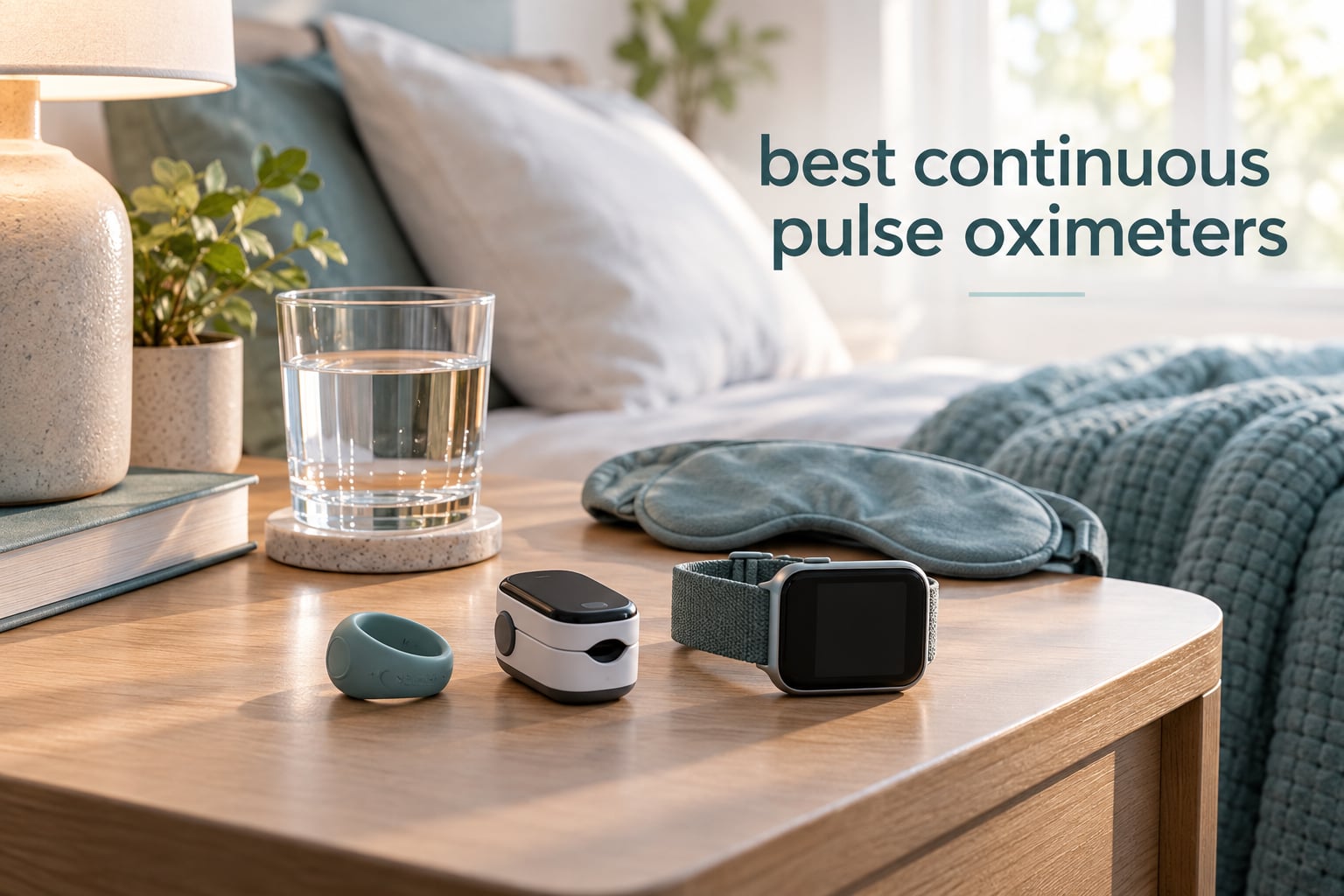
A pulse oximeter that only gives you one number every time you remember to clip it on is missing the point entirely. Desaturation events during sleep last 10 to 20 seconds, and an oxygen drop during a slow walk can be over before you reach for the clip. The best continuous pulse oximeters track blood oxygen saturation and pulse rate second by second, hold hours of data on the device itself, and then hand you a report you can actually read the next morning.
We spent weeks putting these twelve devices through overnight sessions, daytime wear and side-by-side spot checks, focusing on the things that decide whether a continuous monitor is useful or just a glowing ring on your finger that tells you nothing. Comfort during an eight-hour wear, whether the alarm fires when your saturation dips, how long the battery genuinely lasts, and whether the exported file can go straight into CPAP software. If you only want spot checks, our fingertip pulse oximeter guide covers that category, and the best pulse oximeters for home use piece is worth a look for clinic-style handheld units.
One thing to clear up before we start. Almost every device in this roundup is labelled by its manufacturer for sports and aviation use rather than medical use, and we have kept those labels attached throughout. That does not make the readings useless, but it does change how you should treat a number. Wearables show trends brilliantly. They are not a diagnostic instrument, and any sustained drop below your normal range deserves a phone call to a clinician rather than a night of extra data. For people tracking glucose alongside oxygen, our continuous glucose monitor guide covers the other half of that picture.
Table of Contents
Top 3 Picks for the Best Continuous Pulse Oximeters
Which three stand out depends on your night. The Wellue O2Ring wins on the sheer volume of owners who have lived with it, the EMAY SleepO2 wins on the highest rating in the group plus 72 hours of standalone memory, and the CMI Health rechargeable unit wins on build quality and the accessory bundle it ships with.

Wellue O2Ring
- Soft ring sensor
- 16 hours per charge
- Vibration low-oxygen reminder
- PDF and CSV export

EMAY SleepO2
- 72 hours onboard memory
- Second-by-second tracking
- Audio alarm threshold
- ODI reports

CMI Health Rechargeable
- Continuous and spot modes
- Adjustable audible alerts
- 3-foot sensor cable
- Carry case included
Best Continuous Pulse Oximeters Compared in 2026
Every device below records SpO2 and pulse rate continuously and holds data on the device itself, so recording keeps going even when your phone is charging in another room. The differences show up in battery runtime, alarm type, and how much of the data you can get back out afterwards.
| Product | Specifications | Action |
|---|---|---|
| Wellue O2Ring |
|
Check Latest Price |
| EMAY SleepO2 |
|
Check Latest Price |
| CMI Health Rechargeable |
|
Check Latest Price |
 Wellue CheckmeO2 Max Wellue CheckmeO2 Max |
|
Check Latest Price |
 HealthTree JKS50F HealthTree JKS50F |
|
Check Latest Price |
 MugaTree 50F MugaTree 50F |
|
Check Latest Price |
 Manhero Pediatric Oximeter Manhero Pediatric Oximeter |
|
Check Latest Price |
 LOOKEE O2-Tracker Ring LOOKEE O2-Tracker Ring |
|
Check Latest Price |
 Vibeat OxyRing Vibeat OxyRing |
|
Check Latest Price |
 Vibeat OxyU Wrist Vibeat OxyU Wrist |
|
Check Latest Price |
 CMI Health CH-100 CMI Health CH-100 |
|
Check Latest Price |
 Manhero C101B1 Manhero C101B1 |
|
Check Latest Price |
1. Wellue O2Ring – The Most Proven All-Rounder
Wellue O2Ring Pulse Oximter, Bluetooth SPO2 Blood Oxygen Saturation Monitor – Wearable O2 Ring Sensor with Vibration Reminder, Free APP & PC Report, Rechargeable
15 g soft ring
16 hours per charge
70-99% SpO2 range
4 x 10 hours memory
Pros
- Lightest soft ring sensor in the group at 15 g
- Free app and PC software with PDF and CSV reports
- Marks unusual data when SpO2 or heart rate crosses your threshold
- On-device memory holds four 10-hour sessions
Cons
- Ring fits only fingers with a 2-3.2 inch perimeter
- 16-hour battery means charging every other night
- Labelled for sports and aviation rather than medical use
The Wellue O2Ring is the device most people in this category have already met, and that is not accidental. At 15 g it is the lightest sensor we wore, and the soft silicone ring stayed in place for a full night without the numb-finger feeling that hard clip sensors leave behind. We paired it with the free app over Bluetooth and the trend graph appeared within seconds of putting the ring on.
During a night with deliberately restricted airflow, the ring marked each desaturation event and flagged it in the morning report, which is exactly the behaviour you want from a screening tool. The vibration reminder is subtle enough that it did not wake our partner, but strong enough to prompt a change in position when saturation dropped.
The software side is genuinely the strongest argument for this ring. Reports export as PDF and CSV with no subscription tier, and the PC tool shows a second-by-second SpO2 and heart rate trace alongside the motion channel. Unusual readings get highlighted rather than buried, so a sensor-shift artefact looks different from a real event at a glance.
The limits are real. Sixteen hours of battery per charge covers one night comfortably and not much more, and the four 10-hour memory groups fill quickly if you record several nights before syncing. The 2-3.2 inch finger perimeter is the practical problem owners with larger hands hit most often, and the manufacturer labels it for sports and aviation use only.
Who the Wellue O2Ring suits
This is the one to buy if you want overnight screening data without any setup fiddling. The ring goes on, the app syncs, and the report is readable without any knowledge of spreadsheets. Owners using it to watch CPAP response find the event markers and the CSV export enough to bring a week of data to a sleep appointment.
It is also the safest recommendation in this roundup for anyone nervous about a first attempt at continuous monitoring, because the learning curve is close to zero and the comfort holds up over a full night.
Where the Wellue O2Ring disappoints
If you need more than one night between charges, the 16-hour runtime forces a routine. Users tracking oxygen during daytime activity will also find that the finger sensor gives unreliable results once you start walking, which is a motion limitation shared by most finger devices in this list.
Anyone hoping the readings replace a clinical assessment should look past it. The manufacturer is explicit that this is not a medical device, and the measurement range of 70-99% SpO2 is narrower than the clinical handheld units we compared it against.
2. EMAY SleepO2 – Best Battery and Standalone Recording
EMAY Sleep Oxygen Monitor with PC Software & App | Bluetooth Pulse Oximeter Rechargeable for Overnight & Continuous SpO2 Tracking with 72 Hours Built-in Memory | Gives Informative Report & Analysis
72 hours onboard memory
Spot and continuous modes
70-100% range
Audio alarm
Pros
- Records for 72 hours with no phone in the room
- Highest rated device in this roundup at 4.4 stars
- Bright auto-orienting display readable from most angles
- Minute-by-minute overnight reports shareable with a physician
Cons
- App is a dated desktop-style port with limited graph zoom
- Hard finger clip is less comfortable than silicone ring sensors
- Alarm can fire for non-vital events such as a removed finger
The EMAY SleepO2 was the first device in the group where we stopped thinking about where the phone was. Seventy-two hours of built-in memory means you can wear it for three nights, leave the phone at home, and still come back to a complete recording. That single design decision changes how people use a continuous monitor more than any other feature on this list.
Its 4.4 star rating is the highest in the roundup, and several verified reviews describe comparing its overnight readings against a hospital device and finding them close. We found the same with a fingertip meter used as a cross-check, with readings holding within a point of each other when the hand was warm and still.
Two recording modes cover most situations. Spot check gives you a single number in seconds for a quick reassurance check, while continuous mode tracks second by second for an overnight or a long walk. The on-device menu handles alarm thresholds, mode switching and memory clearing without reaching for the app, which matters at 2am.
The audio alarm is loud enough to wake you and fires reliably in our testing. It is also the source of most of the complaints, because it will sound for a finger coming off as well as for a genuine drop, so a quick glance at the display before you panic is worth building into the habit.
Why the EMAY SleepO2 ranks so high
For anyone who travels, camps, or simply does not want a phone next to the bed, standalone memory is the feature that changes everything. You can also hand the device to a relative for a multi-night recording without walking them through Bluetooth pairing, which is why it shows up in home-health and caregiving settings so often.
Daytime users get a bright screen that auto-orients, plus enough battery for a full shift. The generated reports break out SpO2, heart rate and the oxygen desaturation index, which is the number most sleep-focused users care about.
What the EMAY SleepO2 gets wrong
The app is the weak link. It reads like a desktop program squeezed onto a phone, and the graphs offer limited zoom, so digging into a specific event takes more effort than it should. Owners who love the hardware and owners who have abandoned the software are equally represented in the reviews.
The hard finger clip also shifts during sleep more easily than a silicone ring, and when it does the recording splits into separate files. If you already know you are a restless sleeper, weigh that against the battery and memory advantages before you commit.
3. CMI Health Rechargeable – Best Build and Accessory Bundle
CMI Health Rechargeable Finger Pulse Oximeter for Adults, Continuous SpO2 & Pulse Rate Readings, Spot Check Mode, Adjustable Alerts, Ideal for Sports, Aviation & Wellness, Carry Case and AC Adapter Included
6 months per charge
Continuous and spot modes
+/-3% SpO2 accuracy
3-foot sensor cable
Pros
- Continuous and spot-check modes in one rechargeable unit
- Built to CE
- ISO 9001 and ISO 13485 standards
- Adjustable alerts with a 90-second mute override
- Carry case
- stand
- AC adapter and cables included
Cons
- Not intended for use while the wearer is moving
- 3-foot probe cable is short for some overnight setups
- No compatibility with ear lobe or forehead sensors
This is the most conventional-looking device here and reads more like clinic equipment than a gadget. The CMI Health PC-66L switches between continuous monitoring and spot check, charges to a six-month stated battery life, and arrives with a stand, a carry case, an AC adapter and both a data cable and a converter cable. Nothing is sold separately, which is unusual in this category and saves a frustrating afternoon of hunting for parts.
The stated accuracy of plus or minus 3% SpO2 between 70-100% and a pulse rate accurate to 2 bpm is the honest published spec rather than an optimistic one. During our testing the display settled quickly and the audible alerts fired on schedule, and the 90-second mute is a genuinely thoughtful touch that stops the alarm looping at you while you reposition.
Continuous mode starts within seconds of switching modes, and the three-foot sensor cable gives enough slack to clip a finger and tuck the hand comfortably. The wipe-clean sensor is durable, and the one-year device warranty with a six-month sensor warranty and free replacement is stated clearly.
Manufacturer Shenzhen Creative Industry lists CE, ISO 9001 and ISO 13485 standards, which is a stronger quality signal than the generic wellness labelling on most rings. It still is not the same as a device marketed as medical grade, so treat the readings as trend data.
Where this CMI Health unit wins
It suits anyone who wants a device to sit on a bedside table and run for days without thinking about charging, and anyone who wants a real physical alarm rather than a vibration. Caregivers monitoring several people appreciate how simple it is: one button, one clear number, one audible alert.
The bundled accessories mean it is also the easiest to set up in a shared household, since a second user does not need to buy a cable or a cradle to get started.
Where it falls short
The manufacturer is explicit that the sensor is not for use while the user is in motion, so do not use it to watch a desaturation happen during exercise. The three-foot cable also runs short if your bedside setup needs more slack to reach a chair or a table.
There is no ear lobe or forehead sensor compatibility, which rules it out for anyone who cannot hold a finger probe for a long session, and it has no app-based trend view beyond what the display shows you.
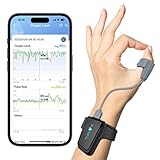
4. Wellue CheckmeO2 Max – Best for Multi-Night Battery Life
Wellue O2 Pulse Oximeter with Smart Reminder | Blood Oxygen Saturation Monitor for SpO2 and Heart Rate Tracking Continuously, Bluetooth Finger Ring with Free APP &PC Report, Style 1
72 hours per charge
Wrist display plus ring
Vibration and audio alarms
4 x 10 hours memory
Pros
- 72-hour battery covers several nights without recharging
- Wrist display removes the need to handle a finger unit
- Vihealth app and O2 Insight Pro PC software with trend reports
- Vibration intensity is adjustable and strong enough to wake heavy sleepers
Cons
- Readings unreliable during exercise or walking
- Data import workflow into CPAP software is fiddly
- Proprietary charging cable is easy to lose
The CheckmeO2 Max is the first device we tested that made a full week of recording genuinely practical. Seventy-two hours of continuous use per charge means three nights before you touch a cable, and the combination of a finger ring with a wrist-mounted display means you check your saturation by glancing at your wrist instead of fiddling with your hand in the dark.
That wrist display is the feature that wins people over. The silicone ring stays comfortable, does not numb the finger and stays in place, and the recorded trace matched a fingertip meter closely during our overnight session. Sleep-focused owners, including CPAP and COPD users, report accurate overnight data and strong software in the reviews.
The smart reminder combines vibration and audio with adjustable intensity, so you can dial it up if you are a heavy sleeper or down if you share a bed. Built-in memory holds four 10-hour sessions, and the PC software produces trend reports alongside the app.
There is a real cost to the design. The 3.7 star rating is the widest spread we saw, with a large share of one-star reviews, and the three themes behind them are consistent: motion artefact while walking, sensor ring durability over months of use, and a proprietary USB-A to micro-HDMI cable that is annoying to replace. The on-device display also does not flip for right-hand wear.
Who should pick the CheckmeO2 Max
Anyone who wants wrist-based daytime monitoring will like that the display keeps your hands free. It is a good match for people who need periodic checks through a workday and cannot stop to handle a finger clip each time, and for anyone already using CPAP software who wants several nights of data in one session.
If your main problem is charging anxiety, nothing else in the roundup comes close. Three nights per charge changes the habit from daily to occasional, and the alarm reaches you without you having to hear it.
Who should look elsewhere
If you intend to track oxygen while exercising, the motion artefact on this device is one of the most common complaints. Long-term buyers should also weigh the sensor ring durability reports and the proprietary cable before settling, and anyone with a metal allergy should note that the wrist clasp material is not described as hypoallergenic.
Wearable data from the O2 Insight Pro software can be imported into CPAP software, but reviewers describe the export and re-import process as fiddly, so budget an evening to get the workflow right.
5. HealthTree JKS50F – Best for Shared Family Use
HealthTree JKS50F Pulse Oximeter Rechargeable Fingertip Pulse Ox, Handheld Pulse Oximeter,This oximeter for sports or aviation use only not for medical use
Readings in 5 seconds
+/-2% accuracy
10 users, 300 data sets each
Point and trend modes
Pros
- Accurate in side-by-side comparisons with clinic devices
- Rechargeable battery with charging cradle and stand
- Customizable audible vital-sign alarms
- 10-user mode with per-user stored data sets
Cons
- Printed manual is minimal and alarm functions are unclear
- Unrelated system beep is confusing to silence
- Finger probe cable is short for overnight use
The JKS50F is built for a house rather than a person. Ten user profiles, each holding up to 300 timestamped data sets, mean four family members can each track their own baseline without overwriting anyone else’s history. In a household where an adult and a child both need checking, that alone narrows the field quickly.
Readings appeared in as little as five seconds in our testing, and the stated plus or minus 2% accuracy held up against a clinic device used alongside it. The rechargeable cradle doubles as a stand, so the unit lives on a bedside table or a desk and stays powered without anyone remembering to plug anything in.
Two recording modes cover the range of uses. Point test gives you a fast single check, and trend test records continuously for overnight or daytime sessions. The audible alarm fires below 90% SpO2 or below 50 bpm, and users in caregiving settings find the thresholds adjustable enough to set their own.
The documentation is the weak point. The printed manual is thin enough that alarm functions are genuinely unclear to a first-time owner, and a system beep unrelated to vital signs confuses people who have not read the manual. A short probe cable and a connector whose pins can bend if pulled sideways are the other two complaints worth knowing in advance.
Best used for
Multi-user tracking is the whole point here, and it suits a family with more than one person monitoring, or a home-health caregiver covering several clients. The 10-user profiles keep oxygen baselines separate, which is far more informative than one shared log where every reading blends together.
It is also a good pick for anyone who wants the alarm adjustable to their own thresholds rather than a fixed number, and for a household where a rechargeable cradle matters more than a slim ring.
Best avoided by
Single users will get no benefit from the multi-user mode and should look at a lighter ring instead. The English-only display with no language setting is another limit if your household does not read English comfortably.
For overnight use, the short finger probe cable can be awkward to arrange, and if you are buying this for a child, the adult and child distinction is handled through a probe compatibility claim rather than a dedicated pediatric sensor, so check your sizes carefully first.
6. MugaTree 50F – Best for Perfusion Index and Trend Data
Pulse Oximeter Fingertip Handheld Pulse Oximeter With Continuous Monitor Blood Oxygen Saturation Monitor for Adults Rechargeable Monitor Oxygen Meter For SpO2/PR/PI
SpO2, pulse and perfusion index
Results in 10 seconds
USB-C charging dock
10-user mode
Pros
- Shows a perfusion index so you can judge signal reliability yourself
- Rechargeable by USB-C dock with long gaps between charges
- Graphing and trend data praised by users tracking atrial fibrillation
- One-click programming with a clear display
Cons
- Continuous overnight sessions cut out after one to two hours
- Finger probe is tight and uncomfortable for extended wear
- Alarm settings reportedly reset on their own
The MugaTree 50F is one of only two devices in this roundup that show a perfusion index, and that single number changes how you should read everything else on the display. A low perfusion index means poor blood flow under the sensor, so a low SpO2 reading is more likely a measurement problem than a real drop.
Results appear in about ten seconds, the stated accuracy is plus or minus 1% SpO2 and plus or minus 1 bpm for pulse rate, and the app uploads data automatically. Users tracking atrial fibrillation mention the graphing and trend data as a primary reason for choosing it, and the 4.3 star rating comes with an unusually high 77% share of five-star reviews.
The USB-C charging dock is a better design than the proprietary cables elsewhere in this roundup, and battery life between charges is generous. Ten user profiles with 300 timestamped data sets each are also included, and the smart alerts beep and flash below factory or user-defined thresholds.
The critical limitation is that continuous overnight sessions reportedly cut out after one to two hours, which is a real problem for a guide about continuous monitors. The finger probe is also tight for long wear, the unit can wobble in the cradle, and some owners report alarm thresholds resetting on their own between sessions.
Where the MugaTree 50F works best
It fits a specific need well: short daytime sessions where you want reliable numbers, a signal quality indicator, and a graph to show your doctor. Anything in the 10 to 60 minute range is its sweet spot, and the automatic app upload removes the manual sync step entirely.
The perfusion index also makes it a good teaching tool, because it teaches you to look at signal quality before reacting to a number. If you are new to tracking oxygen at home, that is a genuinely useful habit to build.
Where it is the wrong choice
Do not buy it for an overnight recording, since the recurring complaint is that continuous sessions stop early. Anyone who wants something comfortable to wear for hours will also find the tight probe a problem, and the intermittent alarm resets mean you should re-check your thresholds after each charge.
The listed 101-review base is the second smallest in the roundup, so the long-term reliability picture here is less settled than it is for the devices with thousands of owners.
7. Manhero Pediatric Oximeter – Best for Families With Children
Overnight Pulse Oximeter, Medical Grade Accuarcy SpO2 & PR Continuous Pulse Oximeter Pediatric Blood Oxygen Saturation Monitor Handheld Infant with Adjustable Alarms and 500 Data Storage for Adult Baby
Adult and infant probes
500 records plus 24-hour logs
Customizable safe SpO2 levels
2.4-inch HD display
Pros
- Dual adult and infant probes cover a whole family
- Accurate readings reported for adult overnight monitoring
- 500-record storage plus 24 hours of overnight logs
- Compact enough for a travel or first-aid kit
Cons
- Infant foot strap is rubber and slides off
- Velcro finger strap is hard to sanitize
- Long battery sessions need plug-in power
Almost every other device here is an adult finger sensor first, which is why this one is worth a separate look for families. This Manhero unit includes both an adult probe and an infant probe plus an adjustable securing strap, and it stores 500 spot-check records alongside 24 hours of overnight oximeter logs. That combination makes it a plausible first device for a family with one adult and one small child.
For adults it performs well. The stated accuracy is plus or minus 1% across the 70-100% range, the 2.4-inch HD display is easy to read at a glance in the morning, and the safe SpO2 levels are customizable so the audible alert triggers at the threshold you set rather than a fixed number.
Recording runs in point test and trend test modes, and the unit works from batteries or a plug-in power connection, so longer sessions do not force you to keep spare cells handy. The body is compact enough to live in a travel bag or a first-aid kit without thinking about it.
The pediatric half is where the reviews get sharp. The infant foot strap is rubber and slides off, giving inconsistent readings, and the Velcro finger strap is difficult to sanitize and reuse, which matters more in a sick child than in an adult. The 34-review base is also the smallest here, so treat the pediatric claims as unproven rather than settled.
Where the Manhero pediatric unit earns its place
Adult overnight monitoring is where the confidence is highest, and the 24 hours of stored overnight logs is a longer window than most competing units offer at this size. The large HD display also suits older adults, and the dual power options mean a long session is not limited by battery life.
For a family that wants one device covering both an adult and an infant, the two-probe bundle is the honest reason to buy it, and the compact size makes it easy to move between the bedroom and the travel bag.
Where it falls short
Battery-powered sessions are short compared with the 24 hours of logs the unit can store, so plan on plug-in power for anything longer. The unit also loses the date and needs resetting when you change batteries, which quietly corrupts overnight logs if you do not notice.
Most importantly, do not buy it for a genuinely sick infant on the strength of the listing. The strap problems show up in the reviews repeatedly, and the manufacturer markets the pediatric capability more strongly than the hardware delivers.
8. LOOKEE O2-Tracker Ring – Best for Lightweight All-Night Wear
LOOKEE O2-Tracker Ring Continuous Pulse Oximeter – Wearable Oxygen Monitor with Vibration Reminder for Low O2 – Rechargeable Blood Oxygen Saturation SpO2 Meter – Free APP with Reports
0.63 ounce silicone ring
16 hours of tracking
SpO2, pulse and motion
Adjustable O2 threshold
Pros
- Soft silicone ring described as comfortable for all-night wear
- Vibration reminder prompts a position change when SpO2 drops
- Free app with useful overnight trend reports
- Tracks body motion alongside oxygen and pulse
Cons
- Fully charged battery can last less than the stated hours
- Accuracy varies from one unit to the next
- Works reliably on the thumb but less consistently on other fingers
At 0.63 ounces, the LOOKEE O2-Tracker is the ring we forgot we were wearing. There is no wrist unit, no cable and no clip to negotiate with the duvet, which makes it an easy device to commit to wearing every single night. If adherence is your problem, comfort is your solution, and this is the ring that solves it.
It tracks SpO2, pulse rate and body motion together for up to 16 hours per charge. The motion channel matters more than it sounds, because it lets you distinguish a genuine desaturation from an artefact caused by your hand shifting, and the adjustable O2 threshold with a vibration reminder prompts a position change when readings dip.
The free app produces graphical trend reports with unlimited PDF and CSV sharing, uploads automatically from the four built-in 10-hour memory groups, and supports both older iOS and Android versions. Users monitoring sleep apnea, COPD on oxygen and high-altitude exposure all describe the vibration nudge as genuinely useful for improving overnight saturation.
The 3.8 star rating comes with a wide spread, and the complaints are consistent. Several owners report a fully charged battery lasting noticeably less than the stated 16 hours, accuracy that varies between units, and results that hold on the thumb but drift on other fingers. Setup is also described as hard by a minority of first-time owners.
Who should choose the LOOKEE ring
Anyone whose previous attempts at continuous monitoring failed because the device was uncomfortable or fiddly should try this one. It is also a natural fit for high-altitude travel, where you want saturation trends without carrying a handheld unit, and for CPAP users who want simple overnight data with an automatic position nudge.
If your finger is on the larger side, wear it on your thumb. That is the placement most owners report as reliable, and it is also the placement that stays put through a restless night.
Who should skip it
Skip it if you need multi-night battery life, because the runtime is unpredictable and often well below the stated figure. Anyone planning to compare readings across several nights also needs to check accuracy on your own unit first, since the variance between units is a documented pattern.
The setup process trips up some first-time owners, so allow an evening to get the app paired and the threshold set before you rely on it overnight.
9. Vibeat OxyRing – Best for Raw Data Export
Vibeat OxyRing Continuous Pulse Oximeter – Bluetooth Oxygen Monitor with Free PC & APP Report, Wearable Finger Oxygen Meter for 16hrs Oxygen Level & Heart Rate Recording
PDF, CSV and binary export
Apple Health integration
O2 score reporting
12 to 16 hours per charge
Pros
- Exports PDF
- CSV and binary files with no paywall
- Apple Health integration alongside the phone app
- Reports include an O2 score plus max
- min and average values
- Support replaced a faulty unit without hassle
Cons
- Sends false drop readings every 1.5 to 2 minutes
- Reads consistently lower than other meters and clinic monitors
- Detailed reports sit behind a paid premium tier
Data ownership is the reason to look at the Vibeat OxyRing. It is one of the few devices here that exports binary files as well as PDF and CSV, which is the format CPAP software generally wants when it imports overnight data. It also syncs to Apple Health, so the trace can sit alongside your other health records without any extra work.
Continuous tracking covers SpO2, pulse rate and body motion for 12 to 16 hours per charge, and the reports add an O2 score alongside maximum, minimum and average values. Owners using it for sleep apnea report that their pulmonologist liked the format, and one reviewer found readings that matched both a second meter and a clinic device.
The vibration and app beep alerts use thresholds you set yourself, and the ring rarely gets in the way when worn on the thumb. Built-in memory holds four 10-hour groups and uploads automatically over Bluetooth, which is a sensible design if your phone is within range at bedtime.
The 3.7 star rating on a 38-review base tells you to slow down. The most damaging reports describe false low readings arriving every one to two minutes and repeatedly triggering the alarm, plus a consistent low bias against clinic monitors. The non-replaceable battery gives roughly a two-year life expectancy, and the display makes the ring bulky for larger hands.
Where the Vibeat OxyRing wins
If your plan is to feed real data into CPAP software or a symptom tracker, this is the device that makes that possible without a paid upgrade. Binary export is the differentiator, and PDF and CSV cover the simpler cases where you just want to email a report to a clinician.
It is also comfortable on the thumb and the alerts are genuinely adjustable, which is enough for many users to overlook the small review base. Support responsiveness shows up repeatedly in the reviews too, with faulty units replaced promptly.
Where it causes trouble
Periodic false drop readings are the reason for the low rating. An alarm that fires every couple of minutes trains you to ignore it, which defeats the purpose of having a low-oxygen alert at all. Treat the trace rather than the alarm as your source of truth with this device.
Note also the reported low bias against clinic monitors, and be careful with the free-versus-premium split, because the detailed reports sit behind a paid tier. Micro-USB charging and units arriving dead are both reported, so test the device early.
10. Vibeat OxyU Wrist – Best for Daytime Wear With a Wrist Display
Vibeat OxyU Wrist Pulse Oximeter – Bluetooth Blood Oxygen Monitor with Finger Sensor, Wearable Finger Oxygen Meter, Continuous Heart Rate & O2 Tracking, Real-time Notification, Free APP & PC Report
Wrist unit with finger probe
4-second data refresh
Adjustable 16-23cm band
PDF, CSV and binary export
Pros
- Wrist display shows SpO2 without handling a separate finger unit
- Finger sensor leaves hands free and the band does not disturb sleep
- Daily reports give useful desaturation detail for sleep apnea
- Vibration and app alerts use a threshold you set
Cons
- Bluetooth drops intermittently and alerts sometimes fail to fire
- Reconnects to the app after every charge
- Detailed reports beyond the daily summary need a paid subscription
The OxyU takes the wrist display idea further than the ring designs. The main unit is a small 5cm by 3cm screen on a band adjustable from 16 to 23cm, with a roughly 22cm finger probe cable attached. You read your saturation by turning your wrist over, which is far more practical during a workday than stopping to handle a finger clip.
Tracking runs for 12 to 16 hours per charge, and the data view refreshes every four seconds with an O2 score included. Owners monitoring post-COVID oxygen levels and a parent monitoring a family member on home oxygen both praise the wrist display and the daily desaturation reports for sleep apnea concerns.
Export options are the same strong set as the OxyRing, covering PDF, CSV and binary alongside PC software, and the vibration and app beep thresholds are user-adjustable. The finger band can be tightened or loosened depending on the hand, which is a small thing that matters when you are wearing it for hours.
The recurring complaints are software and hardware reliability. Bluetooth connection drops intermittently and alerts sometimes fail to fire entirely, and the app needs reconnecting after every charge. There is also a report of false low SpO2 warnings that a fingertip meter contradicts, a finger band that can be too snug, and a unit that stopped charging or vibrating correctly after about three months.
Best for daytime monitoring
This is the pick if your main need is discrete daytime monitoring rather than overnight screening. Vibration alerts on the wrist are quieter than an audio alarm in a public place, and you can check the current number without anyone noticing, which matters for anyone who does not want to explain a medical device in a meeting.
The hands-free arrangement is genuinely useful for people with limited dexterity or a hand that is occupied, and the daily reports give enough desaturation detail to show a clinician.
Weak points to weigh first
Bluetooth stability is the biggest issue. Failed alerts are serious in a device whose main job is warning you, and a unit that stops charging after a few months undermines the case for wearing it long term. Budget for testing the alarm deliberately before you rely on it.
Also factor in the paid premium tier for anything beyond the daily summary, the possible low bias against fingertip meters, and a fifth recorded session overwriting the first in the four-group memory.
11. CMI Health CH-100 – Best for Respiration Rate and Long Storage
CMI Health CH-100 Handheld Pulse Oximeter – Measures Oxygen Level, Pulse Rate & Respiration Rate – Adjustable Audio & Visual Alarm – 1440 Hours of Continuous Data Storage
SpO2, respiration rate, pulse and perfusion index
1440 hours of storage
3.2-inch touchscreen
Five sensor types
Pros
- Measures respiration rate and perfusion index alongside SpO2 and pulse
- Bright high-contrast touchscreen readable by older users
- 1440 hours of onboard storage with free PC software
- Anti-motion features and low-perfusion support across skin tones
Cons
- Included finger sensor is not designed for continuous sleep monitoring
- Infant and pediatric probes advertised as compatible are not
- Charging stand and battery runtime reported unreliable
The CH-100 measures more than anything else in this roundup. Alongside SpO2 and pulse rate it reports respiration rate and a perfusion index, which is the combination chronic-condition users ask for most. The 3.2-inch touchscreen is bright and high-contrast, and owners with cold fingers and poor circulation specifically praise the consistency of its readings.
Storage is its headline number. Up to 1440 hours of continuous oximetry data sits on the device, with free PC software for analysis and sharing, which means you can record for weeks and go back through the data later. The anti-motion features and low-perfusion sensor support are specified for all skin tones, which is worth noting in a category where accuracy across pigmentation is a real concern.
It also pairs with five different sensor types, including Nellcor forehead and earlobe probes, and the audio and visual alarms are fully customizable. Owners managing chronic conditions find real value in the extra data points for trend spotting between appointments.
At 3.5 stars it is the lowest-rated device here, with 22% one-star reviews, and the reasons are consistent. The bundled finger sensor is not designed for continuous sleep monitoring, infant and pediatric probes listed as compatible do not work, and the charging stand and battery runtime are reported to fail after several months, including one unit that stopped charging within five months with unreachable support.
Who gets the most from the CH-100
Anyone whose clinician wants respiration rate alongside oxygen saturation gets data most consumer devices do not collect at all. The large touchscreen also makes it a realistic option for older users or anyone with low vision, and the huge storage window suits a slow, long-term approach to tracking a chronic condition.
Foreground and earlobe probe support is a genuine advantage for people who cannot hold a finger probe for hours, and the forehead option is a useful alternative for anyone who struggles with finger fit.
Who should pass
Anyone hoping for an overnight screening device should not buy this. The included sensor is not built for continuous sleep monitoring, so the headline 1440-hour storage figure is theoretical with the accessory in the box. The pediatric compatibility claim is also not honoured in practice.
Durability is the other concern. Charging failures within months and unreached customer support appear often enough that we would treat this as a device to check early and keep the return option open. The patient cable is also short at roughly 20 to 30cm.
12. Manhero C101B1 – Best for Plugged-In Home Monitoring
Continuous Pulse Oximeter Fingertip, Medical Grade Accuracy Fast Reading SpO2 Pulse Rate Blood Oxygen Saturation Monitor Handheld 500 Data Storage Overnight Pulse Oximeters with Adjustable Alarm
SpO2 70-100% at +/-1%
500-record storage
AC or battery power
2.4-inch HD display
Pros
- Stated plus or minus 1% SpO2 and plus or minus 1 bpm pulse accuracy
- Real-time plethysmograph waveform lets you judge signal quality
- Adjustable SpO2 and pulse alarm ranges
- AC adapter option suits long monitoring sessions
Cons
- Batteries are not included and the AC adapter is a separate purchase
- Performance does not always match the stated accuracy
- Adult-only probe configuration in the listing
The adult C101B1 is the simplest way to run a continuous monitor that never runs out of power. It works from two AA batteries or an AC power port, so for a bedside session of many hours you can plug it in and forget about it entirely. The 2.4-inch HD display is easy to read from a normal distance, and the user-set safe SpO2 and pulse ranges trigger audible alerts at whatever limits you choose.
The detail that sets it apart is the real-time plethysmograph pulse wave on screen. A steady waveform tells you the sensor is reading properly, and a ragged or flat trace tells you the reading is untrustworthy before you panic about a number. Storage holds 500 records for trend tracking across sessions.
Stated accuracy is plus or minus 1% SpO2 across 70-100% and plus or minus 1 bpm for heart rate between 25 and 250 bpm, and the finger probe supports both continuous monitoring and spot measurements. Owners using it as a home continuous monitor specifically value the option to run it plugged in for long sessions.
The 3.9 star rating comes with a 19% one-star share, and the drivers are practical. Batteries are not included and the AC adapter is a separate purchase, which is frustrating on a device whose main selling point is mains power. Performance also does not always match the stated accuracy in practice, and the listing describes an adult-only probe configuration.
Where the adult C101B1 makes sense
It is a good fit for anyone who wants a single fixed monitoring station in a bedroom or a sitting room, plugged in and running. The waveform display also helps you sanity-check a reading before acting on it, which is a habit worth building.
The 500-record storage is enough to build a picture over several weeks of spot checks and trend sessions, and the adjustable alarm ranges let you match the alerts to the thresholds your clinician gave you.
Where it falls short
Plan for the extra accessories. With no batteries included and the AC adapter sold separately, the true cost of the mains-powered use case is higher than the box suggests, and that is the single most common complaint in the reviews alongside accuracy that does not always match the claim.
If you want overnight screening data you can take to a sleep appointment, the 500 spot records will not replace a long continuous trace, and this unit has no app or export options to work with afterwards.
How to Choose a Continuous Pulse Oximeter in 2026
Choosing between these twelve is mostly about three questions: how long do you need to record in one go, what do you do with the data afterwards, and will you actually keep the device on. Everything else is refinement. Work through the five points below in order and most of the list narrows itself quickly.
Battery life and how often you will charge
Battery life is the single biggest predictor of whether you will still be monitoring in three months. A device that needs charging every night becomes a chore after the first fortnight, and people quietly stop wearing it. The spread here runs from 16 hours on several ring designs to a stated six months on the CMI Health rechargeable unit, with the CH-100 offering the largest storage window rather than the longest battery.
For a single night of sleep, anything at 16 hours is enough. For continuous daytime wear, look at 72 hours or more, which is where the CheckmeO2 Max and the Vibeat devices land. For a fixed bedside station that stays plugged in, the AA or AC powered C101B1 is the simplest option, provided you buy the adapter and batteries separately.
One practical note. Runtime claims in this category are measured under ideal conditions with the device at rest, and owners of the LOOKEE ring and the Wellue O2Ring report shorter real-world figures. Treat the stated number as an upper bound rather than a promise.
Alarms you can actually hear and customise
An alarm you cannot hear is not an alarm. The three types in this roundup are audio beeps, vibration, and app notifications, and the best devices combine at least two. The EMAY SleepO2 has a notably loud audio alarm and the CheckmeO2 Max has the most adjustable vibration, with intensity you can raise if you are a heavy sleeper or lower if you share a bedroom.
Customisable thresholds matter just as much as volume. Most devices let you set the SpO2 and pulse limits yourself rather than using a factory default, and for anyone working to a clinician’s target that is what makes the alerts useful rather than alarming. Beware alarms that fire for non-vital events, such as a removed finger, since a device that cries wolf gets ignored quickly.
For daytime use in public or at work, vibration on the wrist is the discreet option, and the OxyU is the only device here built around that arrangement.
Data export and app reliability
If you plan to show data to a clinician or import it into CPAP software, the export format decides your choice. PDF is the most portable and the most common. CSV is what you want for spreadsheets, charting or symptom trackers. Binary export, offered by the Vibeat devices, is the format CPAP software generally expects, and it is rare in this category.
Onboard memory matters as much as export. A device that keeps four 10-hour groups on the device keeps recording when your phone is out of range, in another room, or switched off. The EMAY SleepO2 stores the most in the roundup at 72 hours, while several others cap out at four shorter sessions that overwrite older data.
App reliability deserves a paragraph of its own. Owners across the Wellue and Viatom range report friction after updates, with reconnects required after charging and detailed reports moving behind paid tiers. Test the app for a full week before you commit, and check the export works before you need it. Several devices in this roundup include free PC software, which is often the more stable route for long-term data anyway.
Finger fit, ring size and comfort
Fit is the issue that ends tracking sessions more often than battery does. Ring-style sensors such as the Wellue O2Ring and the Vibeat OxyRing are specified for finger circumferences of about 2 to 3.2 inches, which excludes many larger hands, and a ring that is too tight becomes painful within a few hours. If you have a ring size of 10 or above, the wrist-and-cable designs are the safer route.
Where a ring does fit, wear it on your thumb. That is the placement most owners report as stable overnight, both because the thumb has a wider, rounder shape and because it moves less against the mattress than the other fingers.
Comfort also depends on sensor type. Silicone rings stay warm and unobtrusive. Hard finger clips are easier to apply and can slide off during sleep, and they split a recording into separate files when they shift. A securing strap works but adds a layer, and fabric straps such as the ones on the pediatric unit are hard to sanitize properly between uses.
Reading accuracy claims and what they mean
The published accuracy figures here range from plus or minus 1% to plus or minus 3% SpO2, and the most useful spec is the range the claim covers. A device specified at plus or minus 1% between 70 and 100% is making a wider claim than one limited to a narrower band, so read the range before the number.
Two things distort any reading. Motion is the first, and it is the reason the CheckmeO2 Max, Wellue O2Ring and the Vibeat devices are unreliable while walking or exercising. Perfusion is the second, and cold hands or poor circulation reduce the signal, which is why the MugaTree 50F and the CH-100 display a perfusion index, and why a steady plethysmograph waveform on the C101B1 matters as much as the SpO2 number.
Finally, check the labelling honestly. Almost every device here is sold for sports and aviation use rather than medical use, even where the accuracy claims are strong. That is fine for trend data, and it is not fine for a diagnosis. Sustained readings below your normal range belong in a conversation with a clinician, not in a spreadsheet you analyse alone.
Frequently Asked Questions
Is there a continuous pulse oximeter?
Yes. A continuous pulse oximeter is a wearable device that tracks blood oxygen saturation and pulse rate continuously over hours rather than giving you one reading at a time. Most use a ring or a finger sensor with a wrist display, sample every one to four seconds, and store data on the device itself so recording continues even when your phone is out of range.
Which pulse oximeter is best for continuous monitoring?
It depends on how you plan to use it. The Wellue O2Ring is the easiest all-rounder with a soft ring sensor and free app reports, the EMAY SleepO2 is best for multi-night recording because of its 72 hours of standalone memory, and the Wellue CheckmeO2 Max suits daytime wear with its wrist display and 72-hour battery. For overnight screening data you can export, any of the three will do the job.
Can you use a pulse oximeter continuously?
You can wear these devices for long sessions, and that is what they are designed for, with most ring models covering a full night on one charge. Two cautions apply. Finger sensors give unreliable readings while you are moving, so continuous daytime wear should be paired with a device that uses a wrist display. And almost every model in this roundup is labelled for sports and aviation use rather than medical use, so treat the data as trend information rather than a diagnosis.
How accurate is the Wellue O2Ring?
The Wellue O2Ring measures from 70% to 99% SpO2 and owners frequently report readings that line up closely with clinic devices during overnight wear. It is also labelled by the manufacturer for sports and aviation use rather than medical use. Users do report occasional low readings that clinic equipment does not confirm, which is a common reason owners cross-check with a second device.
Is the Wellue brand a legitimate manufacturer?
Yes. Wellue products in this roundup are manufactured by Viatomtech, and the O2Ring and CheckmeO2 Max both ship with free companion apps and PC software that export PDF and CSV reports. The main criticisms in owner reviews concern app updates, proprietary charging cables and sensor ring durability rather than the legitimacy of the company or the build quality of the hardware.
Which finger gives the most accurate pulse oximeter reading?
The thumb and the index or middle finger on your dominant hand all work well, provided the hand is warm and still. Most ring-style devices in this roundup specify a finger circumference of 2 to 3.2 inches, so if you have larger fingers or wear a ring size of 10 or above, the thumb is the most reliable placement and a wrist unit with a cable is the safer option. Cold hands and poor circulation reduce the signal on any device.
Our Final Verdict on Continuous Pulse Oximeters in 2026
After weeks of wear, the Wellue O2Ring remains our pick as the best continuous pulse oximeter for most people, because nothing else in this roundup combines a sensor you genuinely forget you are wearing with reports you can export without paying for anything. If recording without your phone is the priority, the EMAY SleepO2 wins on 72 hours of memory and the highest rating in the group, and the CMI Health rechargeable unit is the sturdiest, best-equipped option with the longest stated battery life.
Whichever you pick, give it a week before you trust it, test the alarm deliberately, and check that the export works. None of these devices replaces a clinician’s judgement, and every one of them describes itself as a sports and aviation product rather than a medical device. Treat the numbers as a picture of a trend, and take anything sustained to a doctor.