

The best digital manifold gauge set is the testo 550s for most technicians, the Fieldpiece SM482V if you want the vacuum gauge and wireless app built into one body, and the Elitech LMG-10 if you want the most proven set at a mid-tier price. That is our short answer, and the rest of this guide explains exactly why each one earns its place.
A digital manifold gauge set replaces the analog dials, the PT chart and the pocket calculator. It reads high-side and low-side pressure, clamps onto the suction and liquid lines for temperature, then does the saturation math on screen so superheat and subcooling appear as live numbers. Nothing here is measured differently from an analog set. The difference is that the arithmetic happens for you, in real time, with the pressure hold and vacuum functions tracking alongside it.
Technicians on r/HVAC consistently converge on the same conclusion that we found in our own comparison: the all-in-one build matters more than any single spec. A set with an integrated vacuum gauge and protected thermocouple jacks saves you from carrying a separate micron tool and loose probes to every rooftop or attic. That single decision reshapes the whole shortlist, which is why two of the ten sets below carry a built-in micron sensor and most of the rest do not.
We compared all ten sets in this guide on accuracy claims, refrigerant database breadth, valve hardware, display readability, battery or power strategy, and the accessories that actually ship in the box. We also mapped them against the questions technicians argue about most: 2-port versus 4-port, Fieldpiece versus Testo, whether an integrated micron sensor is worth it, and what superheat and subcooling numbers should look like on R-410A, R-454B and R-32 systems.
One note before we start. This site covers instruments more broadly than HVAC tools alone, including our guide to the best manifold gauge sets for HVAC pros if you want the analog-versus-digital framing first. If you are coming from an entirely different measurement category, our picks for OBD2 gauge displays and digital tire inflators with gauges cover similar buying logic around sensor accuracy and display legibility.
Table of Contents
- Top 3 Best Digital Manifold Gauge Sets
- Best Digital Manifold Gauge Sets in 2026 (Quick Overview)
- 1. testo 550s Smart Kit – Best Overall With App Reporting
- 2. Fieldpiece SM482V – Best All-In-One With Built-In Vacuum Gauge
- 3. Elitech LMG-10 – Best Value With the Largest Proven Track Record
- 4. Elitech DMG-2SE Kit – Best Budget Kit That Ships With Hoses
- 5. BELEY 93-Refrigerant Set – Best for Breadth of Refrigerant Coverage
- 6. VIVOHOME VH1747 – Best for R-454B and A2L Service
- 7. KAISAL TG52 – Best for Ball Valve Control at a Mid Price
- 8. Fieldpiece SM382V – Best Wireless 3-Port for Working Technicians
- 9. CMTOOL AQ-49 – Best for the Newer NIST Blend Refrigerants
- 10. testo 549 I – Best Bare Rugged Instrument With 60 Refrigerant Profiles
- 2-Port vs 4-Port: Which One You Actually Need
- Fieldpiece vs Testo: The Head-to-Head
- How to Use a Digital Manifold Gauge Set
- Superheat and Subcooling Targets by Refrigerant
- What a Digital Manifold Still Cannot Do
- Hoses, Adapters and the Accessories Layer
- How to Choose a Digital Manifold Gauge Set
- Frequently Asked Questions
- What are the best digital manifold gauges?
- What is the best brand of manifold gauges?
- Is Fieldpiece or Testo better?
- Which is better, a 3 or 4 port manifold set?
- What should subcooling and superheat be?
- What is a good superheat and subcooling on R-410A?
- Is 20 degrees of superheat too high?
- Do I need a digital manifold gauge set?
- How do I use a digital manifold gauge set to pull a vacuum?
- Conclusion
Top 3 Best Digital Manifold Gauge Sets

testo 550s Smart Kit
- Bluetooth app and reporting
- Automatic superheat and subcooling
- Large backlit display
- Wired dual temperature probes

Fieldpiece SM482V
- 4-port manifold
- Built-in vacuum and micron gauge
- Wireless Job Link app
- Data logging and tightness test

Elitech LMG-10
- 2-way with two wired clamps
- 200-hour replaceable battery
- 88 refrigerants
- Pressure hold with compensation
Best Digital Manifold Gauge Sets in 2026 (Quick Overview)
All ten sets below read pressure and temperature simultaneously and calculate superheat and subcooling without a PT chart. The columns that actually separate them are port count, whether a vacuum and micron sensor is built in, whether an app is involved, and what ships in the box. Two sets include hoses and adapters, three require you to buy probes separately, and one is a bare instrument with nothing but the gauge body in the box.
| Product | Specifications | Action |
|---|---|---|
| testo 550s Smart Kit |
|
Check Latest Price |
| Fieldpiece SM482V |
|
Check Latest Price |
| Elitech LMG-10 |
|
Check Latest Price |
 Elitech DMG-2SE Kit Elitech DMG-2SE Kit |
|
Check Latest Price |
 BELEY 93-Refrigerant Set BELEY 93-Refrigerant Set |
|
Check Latest Price |
 VIVOHOME VH1747 VIVOHOME VH1747 |
|
Check Latest Price |
 KAISAL TG52 KAISAL TG52 |
|
Check Latest Price |
 Fieldpiece SM382V Fieldpiece SM382V |
|
Check Latest Price |
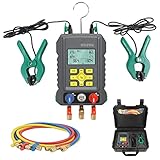 CMTOOL AQ-49 CMTOOL AQ-49 |
|
Check Latest Price |
 testo 549 I testo 549 I |
|
Check Latest Price |
1. testo 550s Smart Kit – Best Overall With App Reporting
testo 550s AC Manifold Gauge Set – Manifold Gauges HVAC – Incl. 2 Wired Temperature Clamp Probes – Recharge Kit with Superheat, Subcooling For AC, Refrigeration & Heat Pumps – Bluetooth
Part 0564 5501 01
Range -58 to 302 F and -15 to 870 psi
Pressure accuracy plus or minus 0.5 percent FS
2 year manufacturer warranty
Pros
- Accurate superheat and subcooling across common refrigerants
- Large backlit display showing all key data at once
- Compact one-hand form with solid build feel
- Smart App remote monitoring and service reporting
- Automatic calculation without PT chart work
Cons
- Bluetooth pairing can be slow or drop and needs manual reconnecting
- Valve controls have some play in the off position
- Temperature probes cannot be calibrated by the owner
- Screen contrast is weak in direct sunlight
The testo 550s is the set we kept reaching for. Part number 0564 5501 01, and it is the version that pairs the gauge with two wired temperature probes, so the kit arrives ready to calculate superheat and subcooling on any system with a liquid line and a suction line. The measuring range runs from -58 to 302 F and from -15 to 870 psi, which covers residential split, light commercial and most refrigeration work without switching modes.
Reviewers describe the readings as accurate in a way that has nothing to do with marketing language. One common theme in the reviews is that the pressure, temperature, superheat and subcooling figures line up when the set is cross-checked against a reference instrument. Temperature accuracy is stated at plus or minus 0.9 F and pressure accuracy at plus or minus 0.5 percent of full scale, which is a meaningful step up from the cheaper sets later in this list.
What makes it our top pick is the workflow, not the numbers. The Smart App handles remote monitoring and generates a report of the service result, which is exactly what a customer invoice needs and exactly what an analog set cannot produce. On a rooftop unit where you need to be at the disconnect rather than crouched at the service valves, being able to read the set from a phone is a real saving. The screen is large and backlit, and the body is ABS, PA and TPE at 8.3 by 4.8 by 2.4 inches, so it fits in one hand and survives the van.
It also supports the A2L refrigerant family, which matters more each season as R-32 and R-454B move into residential equipment. The 549 I in this same roundup shares that Testo accuracy pedigree, but the 550s is the one with the reporting layer, and that is the deciding factor for anyone who bills for diagnostics.
What you get when the app connection misbehaves
The most repeated complaint in the reviews is Bluetooth. Pairing can be slow, the link can drop, and reconnecting is a manual step. The gauge itself keeps measuring, so nothing is lost in the moment, but do not plan on a live dashboard for a fast diagnosis. Several owners also mention slight play in the valve controls at the closed position, which is a reason to confirm a complete shutoff by watching the reading rather than by feel.
There is one more limitation worth knowing before you buy. The temperature probes cannot be calibrated by the owner. If a clamp reads off after a year of service, the calibration is a service-centre job, not a ten-minute bench task. Owners also report the bundled hard case takes damage easily and wants padding if it lives in a work truck.
Who should skip this set
Skip it if vacuum work is the majority of your jobs and the built-in micron sensor is non-negotiable. The 550s does not include one, so a serious evacuation and leak-check workflow still means carrying a second instrument. Testo does sell a vacuum kit variant, but the smart kit in this roundup is the probe-and-app configuration, and the Fieldpiece SM482V covers the vacuum case in its standard body.
Also skip it if your work is mostly automotive R-134a and R-1234yf service where you need a vacuum function in a small package. This is a full HVAC instrument with a broad pressure range, which is exactly what you want for refrigeration and exactly what makes it a bit more than a mobile A/C tech needs.
2. Fieldpiece SM482V – Best All-In-One With Built-In Vacuum Gauge
Fieldpiece SM482V Wireless 4-Port SMAN Refrigerant Manifold with Vacuum Gauge – Air Conditioning/Refrigerant Digital Gauges for HVAC & Refrigeration
4-port manifold with integrated vacuum gauge
ABS housing, 5 by 10.25 by 11.25 inches
Wireless Job Link app connectivity
Data logging and tightness testing
Pros
- Highest rated set in the roundup at 4.8 with 92 percent five star reviews
- Built-in vacuum and micron gauge removes a carried instrument
- Wireless monitoring from a phone during the job
- Protected thermocouple jacks for pipe and outdoor temperature
- Data logging with temperature-compensated tightness test
Cons
- Highest cost in the roundup
- One report of a leaking manifold and weak quality control response
The SM482V is the tool that removes an entire bag from your van. Four ports, an integrated vacuum and micron gauge, protected thermocouple jacks, and wireless connectivity to the Fieldpiece Job Link app. Technicians on r/HVAC cite exactly this all-in-one argument when justifying the spend, and the reasoning holds up. If you evacuate, leak-check and charge in the same visit, carrying a separate micron tool is pure dead weight.
It is also the highest rated instrument we put through this comparison, at 4.8 across 219 reviews with 92 percent of those at five stars. That distribution is unusual. Long-running owners report the unit still presents like new after a year of daily service, which is the durability signal most buyers are actually looking for.
Beyond the vacuum function, the SM482V handles the diagnostic core well. It measures low and high side pressure with automatic superheat and subcooling, accepts Job Link psychrometer probes directly, and runs a temperature-compensated system tightness test. The compensation matters. A pressure hold test without temperature compensation can hide a real leak when the ambient temperature swings during the hold, and that is a classic false pass on a rooftop unit in October.
The four ports also open up jobs the 2-port sets cannot take. A separate suction and discharge pair, plus the service ports for a second circuit or a heat pump with a reversing valve, means you are not swapping manifolds in the middle of a commercial callout. For residential splits and simple heat pumps, that headroom is optional rather than necessary.
How the wireless connection changes the job
The app lets you monitor pressures and subcooling from another room, from the attic, or from a ladder while the manifold stays at the ground unit. Owners single this out more than any other feature. On a packaged rooftop where the unit is on the roof and the valves are three storeys down, being able to check the numbers without walking back is a genuine time saving rather than a novelty.
Data logging is the quiet feature that pays off on documentation-heavy work. A logged evacuation or a logged tightness test gives you a record you can attach to the service report. If you are asked later why a system passed or failed, that record is the difference between an opinion and evidence.
Where the cost and the weak spots show up
The price is the top of the category, and it is the single most common hesitation we would expect from a first-time buyer. The honest counter-argument is that a separate digital micron gauge is money you carry, store, service and eventually replace, and the SM482V folds that role into a body you already own.
There is one reported leak and a dissatisfaction with the quality-control response in the reviews. One report is not a pattern, and it does not appear alongside a cluster of similar complaints, but it is worth noting that this is the one instrument in the roundup where a single quality issue would be frustrating. Buy from a seller with a straightforward return path.
3. Elitech LMG-10 – Best Value With the Largest Proven Track Record
Elitech LMG-10 2-Way HVAC Manifold with Wired Temp Clamps
2-way manifold with two wired temperature clamps
Supports 88 refrigerants
200-hour replaceable battery
4.4 by 2.5 by 6.3 inches
Pros
- Largest review base in the roundup at 686 reviews
- Reliable wired clamp connections with no Bluetooth dropouts
- 200-hour replaceable battery covers multi-day jobs
- Large display with a rear hanging hook
- Temperature-compensated pressure hold and vacuum testing
Cons
- No built-in vacuum or micron sensor on this 2-way model
- No app connectivity on the base version
- About 6 percent of reviews are one star
The LMG-10 is the set most technicians moving off analog gauges end up on first, and the numbers explain why. At 686 reviews it has by far the largest proven field history in this roundup, with a 4.4 average and 71 percent five star. That is not a flash-in-the-pan listing. It is an instrument with a decade of ordinary daily use behind it, which matters when you plan to keep a gauge for years.
It covers 88 refrigerants with automatic superheat and subcooling, offers five pressure scales and two temperature scales, and runs temperature compensation for pressure-hold and vacuum leak testing. The two wired clamps are the quiet strength here. No pairing, no dropped link, no reconnect step. The clamp is on the line and the number is on the screen.
The 200-hour replaceable battery is the other detail that separates it from cheaper competition. Ultra-low power consumption plus a replaceable cell means a two-day commissioning job does not end with a dead gauge and a trip back to the van. Several owners point out that the cell is user-replaceable, which is a small thing until you are standing in a mechanical room with no spare.
At 4.4 by 2.5 by 6.3 inches it is genuinely compact, and the hanging hook on the back means it can sit on a ladder or a condenser housing while your hands stay on the fittings. Elitech also runs US technician support by phone and email, which is unusual at this tier.
What you give up by choosing the value pick
This 2-way configuration has no built-in vacuum or micron sensor. If evacuation and leak verification are a large part of your work, you will still carry a micron gauge. Elitech addresses that with a separate 4-way variant that includes a micron gauge and app support, and that variant is the better fit for commercial and installation work. The LMG-10 is the right answer when diagnostics on running systems is the priority.
The base version also has no app. Technicians who want a customer-facing service report will not get one from this set. The review profile also shows a slightly larger block of critical feedback than the premium models, with about 6 percent one star, mostly on durability under heavy abuse and on the missing features rather than on measurement accuracy.
When this is the right first digital manifold
Buy this one if you are moving from analog gauges, work mostly on residential splits, and want the lowest-risk transition. The learning curve is small, the numbers are trustworthy, and the wired design means there is no app to teach anyone else on your crew. Apprentice technicians frequently start here for exactly that reason.
Skip it if you are a commercial technician working heat pumps and rooftop units daily, where four ports and a vacuum sensor stop being optional. In that case the money saved here reappears as a second purchase within a year.
4. Elitech DMG-2SE Kit – Best Budget Kit That Ships With Hoses
Elitech HVAC Digital Manifold Gauge Set DMG-2SE with Hoses & R410A Adapters
Includes gauge, three 5 ft hoses and two R410A adapters
88 refrigerants with plus or minus 1 percent FS
1/4 inch SAE connections
1 year warranty
Pros
- Lowest cost in the roundup while still covering 88 refrigerants
- True out-of-the-box kit with hoses and R410A adapters
- Compact one-hand body at 1.9 pounds
- Backlit display readable at night
- Shock-resistant housing tested for jobsite drops
Cons
- Included hoses are widely criticized for quality
- Temperature probes are not included in this configuration
- Smaller screen and body than expected
- Hoses can weep at the manifold if not tightened with a wrench
The DMG-2SE kit answers a different question from the rest of this list. It is for the person who wants a real digital manifold and a working set of hoses, today, without assembling a parts list. You get the gauge, three 5 ft colour-coded charging hoses, two R-410A adapters and the standard hardware. That completeness is the product.
It supports 88 refrigerants including R-410A, R-32, R-454B and R-1234yf, with pressure accuracy at plus or minus 1 percent of full scale. The saturation temperature calculation removes the PT chart lookup, so a quick check of a system running hot is a five-minute job. Auto shut-off and data hold keep the reading stable while you are hooking up a recovery machine.
Build-wise it is better than its price suggests. The valve block is heavy-duty brass, the housing is described as impact-resistant and shockproof with lab-tested drop resistance, and the fittings on the hoses are solid brass. At 1.9 pounds it is the lightest set here, which matters when you are carrying it up a ladder with a tool bag.
The one-year warranty is the shortest in the roundup, and the material listing calls out that adapters are solid brass, the valve block is brass with an impact-resistant housing, and the hoses are burst-resistant reinforced rubber. That is a real specification sheet rather than a marketing line.
The configuration trap to check before you order
This 2SE configuration does not include temperature probes. That means pressure and saturation temperature work out of the box, but full superheat and subcooling requires buying clamps separately. Several buyers discover this after delivery. If you want complete charging capability, order the probe kit at the same time or look at the 4B variant, which adds app support and a refrigerant list of more than 140 types.
The hoses are the other known issue. They are the most common replacement owners report, and a few note that hose ends can weep at the manifold if they were not torqued with a wrench. Budget for a quality hose set regardless of what ships, because a leak under vacuum costs far more time than the hoses do.
Who this kit is genuinely for
This is a maintenance technician or an advanced DIY user who wants a working manifold in one purchase. The value is in the box contents, not in the specification ceiling. Anyone expecting a rugged multi-year professional instrument should look one tier up.
It is also a reasonable backup instrument. A second gauge lets you cross-check readings during a hard diagnostic, and at this tier you are not spending professional money to do it.
5. BELEY 93-Refrigerant Set – Best for Breadth of Refrigerant Coverage
Digital Manifold HVAC Gauge Set 93 Refrigerants Dual Pressure &Temp Test
93-refrigerant built-in database
Two temperature clips and hoses included
Vacuum percent, leak test and leak time
2 year manufacturer warranty
Pros
- Largest refrigerant database in the roundup at 93 types
- Complete kit with two temperature clips and 59 inch hoses
- Calculates superheat and subcooling without manual chart work
- Built-in vacuum percent
- pressure leak and leak time functions
- Backlit large LCD for low-light reading
Cons
- R454B is not supported in the refrigerant database
- Listed dimensions of 0.01 inches indicate unreliable spec data
- Utilitarian build and finish
- About 11 percent of reviews are one star
The BELEY set is the breadth play. Ninety-three refrigerants in the built-in database, including R-134a, R-290, R-404A, R-407C, R-410A, R-507A, R-744 as carbon dioxide, R-32 and R-1234yf. If your work crosses residential, light commercial and natural refrigerant territory, having a broad table saves you from entering numbers by hand on an unfamiliar system.
It also includes two temperature clips and 59 inch vacuum hoses, so it is closer to a complete kit than most sets at this level. Vacuum percentage, pressure leak testing and leak time recording are all built in, which gives you a proper evacuation workflow without buying a separate instrument for the first pass of a job.
Measurement-wise it does the fundamentals. Dual pressure and dual temperature are measured simultaneously, and the 32-bit processing unit handles the superheat and subcooling calculation. The backlit LCD is easy to read in low light, which technicians on the maxperformanceinc forums specifically named as a deciding factor for attic and rooftop work where lighting is poor.
The warranty is one of the better ones in the budget tier at two years from the manufacturer, with 30-day money-back coverage reported by owners.
Why the R-454B gap matters now
R-454B is excluded from the database. That is not a fault in the gauge, but it is a real limitation as R-454B becomes standard in newer residential systems. Working on a modern system without the correct blend entry means you are either refusing the job or looking up pressure-temperature values by hand.
There is also a listing inconsistency worth flagging. The item highlight mentions R-434A and R-32/R-454B, while the feature description excludes R-454B. Check the refrigerant list on the current listing before you commit if you service newer equipment regularly.
Build quality and the data you can trust
The build is described as utilitarian high-strength engineering plastic with a non-slip silicone finish. It works, but the finish is closer to the budget end than the professional end, and owners do describe durability as secondary to accuracy.
The listed dimensions of 0.01 inches are obviously a data error rather than a real measurement, and that tells you something useful: check the physical size yourself before ordering if it matters. The 4.2 average and roughly 11 percent one star share is the highest one-star proportion among the sets rated four stars or better, driven mostly by build consistency rather than by wrong readings.
6. VIVOHOME VH1747 – Best for R-454B and A2L Service
VIVOHOME Digital HVAC Manifold Gauges with 2 Wired Temperature Clamp Probes
88 refrigerants including R454B and R32
A2L warning with 10 Mpa overload protection
Pressure accuracy plus or minus 0.5 percent FS
Requires three AA batteries, not included
Pros
- Digital readings verified accurate by cross-checking with a second set
- Modern refrigerant support including R454B and R32
- Substantial-feeling body at a mid price
- Two-way valve design reduces packing gland leak points
- Built-in vacuum function useful as an in-a-pinch substitute
Cons
- Included hoses
- valves and adapters are widely criticized and leak
- Shut-off valve and high-side adapter leaked under pressure
- Three AA batteries are not included
- Display shows 100 percent vacuum at 14.5 psi rather than true microns
The VH1747 is the set to look at if your work has moved onto R-454B and R-32. The database covers 88 refrigerants including both, with subcooling and superheating calculation on board. Several technicians running large multi-unit maintenance portfolios report that the gauge body itself is accurate, and one long-term reviewer confirmed after more than a year of daily use that it still performs strongly and still carries the modern blends.
Two details separate it from the other budget sets. The A2L refrigerant warning appears on screen, and the double overload capacity is rated to 10 Mpa. On a mildly flammable refrigerant system that is not a decorative feature. The other is the two-way valve design, which reduces the number of packing gland leak points compared with manifolds that stack extra fittings on the block.
Specifications are honest. Temperature range -58 to 302 F with plus or minus 0.5 C precision, pressure accuracy at plus or minus 0.5 percent of full scale, and pressure range from -14.5 up to 500 or 800 psi depending on side. That pressure accuracy matches the testo 550s on paper, which is remarkable at this price point.
The kit contents are generous: two wired temperature clamps, three hoses with locking valves, two anti-freeze safety valves, and a carry case. A large backlit LCD with a zero-level menu design and intelligent auto power-off rounds out a well thought out package.
Replace the hoses, not the gauge
This is the single most important practical note in the whole roundup. Across the reviews, the complaint is almost never about the gauge body. It is about the accessories that ship with it. Owners report the bundled hoses needed immediate replacement, the supplied 90 degree shut-off valve and high-side adapter leaked under vacuum and filling pressure, and the condenser-side connector fitting leaked and had to be swapped.
One reviewer describes the supplied vacuum valve as leaking dangerously hard under pressure, which is the kind of comment that ends a kit. Plan on buying a proper hose set, ball valves and adapters from a known brand before the first job. The Yellow Jacket Seal Tight system comes up repeatedly on the forums as the accessory standard, and technicians on garagejournal describe pairing quality hoses and adapters as a stronger quality signal than the gauge brand itself.
Two limitations that catch people out
The vacuum function is not a true micron reading. The display reaches 100 percent at 14.5 psi, which corresponds roughly to 400 microns. That is good enough to confirm a decent pull and to spot a gross leak, and not good enough to verify a system holding a deep vacuum. If moisture control is part of your service standard, carry a real micron gauge.
Batteries are not included and it takes three AA cells. Also note that the refrigerant list is not in strict alphabetical order, which makes selection slower when you are in a hurry. One owner has criticized the warranty response as inadequate, so treat the one-year warranty as the floor rather than the expectation.
7. KAISAL TG52 – Best for Ball Valve Control at a Mid Price
HVAC Digital Manifold Gauge Set for 92 Refrigerant Digital HVAC Gauges Pressure&Temp Test R134A R410A R404A R22 Refrigerant Gauges with Hoses, Upgraded Ball Valve,for Air Conditioning & Refrigeration
92-refrigerant pressure and temperature database
3.5 inch backlit LCD with zoned display
V-shaped full-bore ball valves
Hoses rated to 3000 psi burst
Pros
- 92-refrigerant database covering common residential and light commercial types
- Full-bore V-shaped ball valves for precise charge control
- Large 3.5 inch zoned backlit display readable at a glance
- Superheat
- subcooling
- leak test and vacuum functions built in
- Three year product service with support responding within 24 hours
Cons
- Must press and hold the ZERO key after power-up or readings are inaccurate
- Lowest average rating in the roundup at 4.0
- Silicone body feels less rigid than metal or ABS housings
- No smart app or wireless connectivity
The TG52 is the one to consider if the valve hardware matters more to you than the software. The upgraded V-shaped full-bore ball valves with 90 degree operation and low fluid resistance give noticeably finer control over charge than the knob-style valves on cheaper manifolds. When you are metering in small increments and watching subcool, that control is the whole game.
The display is the other selling point. A 3.5 inch backlit LCD with zoned data display means the high side, low side, saturation and calculated values sit in defined areas rather than in a scrolling menu. Zoned layout is a real advantage on a rooftop unit in low light, which is exactly the scenario technicians describe on the forums when they defend backlit screens.
The database covers 92 refrigerants, and the function list is complete: superheat, subcooling, high and low side pressure and temperature testing, a pressure leak test comparing initial and second test pressures, and an observation window for monitoring charging state. Unit switching covers kPa, MPa, bar, inHg, psi and Celsius or Fahrenheit. A 32-bit processing unit handles the data acquisition.
Service is the quiet strength. Three years of product service with technical support responding within 24 hours is the longest support commitment in this roundup, and the included hoses are rated to 3000 psi burst pressure.
The zeroing step you must not skip
This is the operational detail that will cost you a charge if you miss it. Random digits appear at power-up, and you must press and hold the ZERO key to clear them. If you skip it, every downstream reading is wrong, and a wrong subcooling number is worse than no number because it makes a decision for you.
Build this into your routine. Zero the gauge, confirm the lines are clear, then take readings. It takes five seconds and it is the difference between a useful instrument and an expensive guess.
Where it sits against the field
The 4.0 average is tied for the lowest here, with 16 percent three star reviews. The pattern in those reviews is consistent: the feature set is complete, but build and measurement precision feel less refined than Fieldpiece, Testo or Elitech. The non-slip silicone body is noticeably more flexible than a brass valve block or an ABS housing, which is a real trade for comfort against rigidity.
There is no app and no wireless connectivity, and the vacuum readings are not true micron measurements. If your workflow is heavy on documentation and remote monitoring, that combination pushes you toward the testo 550s or the Fieldpiece units instead.
8. Fieldpiece SM382V – Best Wireless 3-Port for Working Technicians
Fieldpiece SM382V Wireless 3-Port SMAN Refrigerant Manifold with Vacuum Gauge – Digital Gauges for HVAC & Refrigeration
3-port manifold with integrated vacuum gauge
Abs plastic housing at 1.8 kg
Wireless phone monitoring
Data logging and tightness testing
Pros
- Owners call it the best gauge set they have used in the field
- Automatic superheat and subcooling removes manual calculation
- Broad refrigerant coverage including R454B
- R32
- R134a and legacy R22
- Wireless phone monitoring from a distance
- Built-in vacuum gauge adds capability without a second instrument
Cons
- One report of a leaking manifold and poor customer service
- Very high cost for the category
- Sits below the 4-port SM482V sibling on rating
The SM382V is the value entry into the Fieldpiece SMAN line, and for a lot of technicians it is the more sensible one. Three ports instead of four, but you keep everything that defines the platform: the integrated vacuum and micron gauge, protected thermocouple jacks, Job Link psychrometer compatibility, data logging, a temperature-compensated system tightness test, and wireless phone monitoring.
It rates 4.5 across 89 reviews with 81 percent five star, and the language owners use is unusually strong. One EPA-licensed technician running both HVAC and mobile A/C calls it the best gauges they have used in the field, while acknowledging it is overkill for most jobs. That same owner specifically calls out its handling of R-454B, which is a refrigerant many competing databases in this roundup do not cover at all.
The refrigerant coverage is refrigerant-agnostic, running from R-22 through the R-134a and R-32 families. If your service mix includes legacy R-22 equipment alongside newer blends, having one instrument that spans both ends is worth more than a cheaper gauge that only knows the modern refrigerants.
Physically it is the same footprint as the 4-port model at 5 by 10.25 by 11.25 inches, listed at 1.8 kg, so the size penalty for choosing the 3-port version is minimal.
Three ports versus four: who actually needs the fourth
Three ports give you the working set for a residential split, a mini-split, a mobile A/C unit and a standard heat pump: low side, high side, and the port you need for the recovery or charging connection. That covers the overwhelming majority of field calls. The fourth port matters when you are connecting to a second circuit, a heat pump with a reversing valve that needs both sides accessible, or commercial refrigeration with a receiver and a filter drier in the same service call.
So the honest framing is that the SM382V is not a compromised SM482V. It is the correct tool for residential and light work, and the extra port on the bigger model is a commercial-work requirement rather than a quality upgrade.
Cost and the one reported problem
The price sits near the top of the category, and owners using it commercially consider it justified while residential buyers may find it hard to rationalise. If you are only doing splits and heat pumps, the money difference against a mid-tier 2-port set is real money.
There is a single report of a leaking manifold paired with dissatisfaction about customer service and quality control. It is one report, not a cluster, and it appears on the 4-port sibling as well, so it is worth a straightforward return path from wherever you buy rather than a headline concern.
9. CMTOOL AQ-49 – Best for the Newer NIST Blend Refrigerants
CMTOOL HVAC Digital Manifold Gauge Set, 92 Refrigerants, 2 Temp Clamps
92-refrigerant database built to America NIST standard
Includes R438A, R448A, R449A and R452A
Ball valve control with 3 year service
Listed weight 6.8 pounds
Pros
- NIST-standard database includes R438A
- R448A
- R449A and R452A
- Automatic superheat and subcooling with 32-bit processing
- Ball valve gives more precise control and longer service life than knob valves
- Large backlit LCD with a charging observation window
- Vacuum percent
- pressure leak and leak time recording built in
- Three year product service
Cons
- Lowest rated set in the roundup at 4.0
- Must hold the zero button at power-on or readings are inaccurate
- Heaviest listed weight in the group at 6.8 pounds
- No app or wireless connectivity
The AQ-49 is differentiated by one thing: the refrigerant database is built to the America NIST standard and explicitly includes R-438A, R-448A, R-449A and R-452A. Those newer blends are the ones that show up on modern light commercial and residential equipment, and most competing 92-refrigerant databases in this price band simply omit them. If you service equipment built in the last few years, that coverage is the reason to pick this set.
Everything else follows a familiar pattern. Dual pressure and dual temperature testing with automatic superheat and subcooling, a 32-bit processing unit, vacuum percentage measurement, pressure leak test and leak time recording, and multi-unit switching across kPa, MPa, bar, inHg, psi, Celsius and Fahrenheit. A ball valve switch gives finer charge control and longer service life than a knob valve.
Two temperature clamps and three hoses are included, and the interface is the standard 1/4 inch design. The large backlit LCD has a visualisation window so you can watch the charging state directly rather than inferring it from a number, plus a hook design for hands-free hanging.
This sits on the same platform as the other 92-refrigerant manifolds in this price band, so treat the NIST database as the deciding factor rather than expecting a different class of hardware.
Two habits you need for this set
Like the KAISAL, it requires holding the zero button at power-on to clear random startup digits. Owners flag this as a recurring source of confusion. Same rule as before: zero first, always, before you connect.
The 3-year product service is genuinely good and longer than most. What the set lacks is any app or wireless connectivity, so if a customer wants a documented report with remote monitoring, this is not the instrument for it.
The weight problem is not a small one
The listed weight is 6.8 pounds, the heaviest in this roundup, and the ball valve design is part of the reason. That is fine for a technician working from a truck bed. It is a problem for anyone doing attic and rooftop work all day, or for a maintenance tech covering a site on foot, because the gauge ends up in a bag rather than a pocket.
The 4.0 average and the 13 percent one star share reflect a broad spread of mid-range feedback rather than one dominant complaint. Owners generally find the feature set complete, with the hold-to-zero requirement and the bulk being the recurring negatives.
10. testo 549 I – Best Bare Rugged Instrument With 60 Refrigerant Profiles
testo 549 I Digital Manifold for air Conditioning, Refrigeration Systems and Heat Pumps
Aluminum housing at 1060 g
Storage for up to 60 refrigerant profiles
2-way block with sight glass
2-line backlit display
Pros
- Most established reputation with only 1 percent one star reviews
- Rugged aluminum housing that stands up to jobsite abuse
- Stores up to 60 refrigerant profiles for fast field selection
- Real-time superheat and subcooling with an optional probe
- Reliable repeatable digital accuracy versus analog dials
Cons
- Hoses and temperature probe are both sold separately
- No built-in vacuum or micron measurement
- Older two-line display is less dense than modern colour screens
- Hard case could be better for the price
The testo 549 I is the oldest reputation in this roundup and the one owners are most unequivocal about. It rates 4.6 across 435 reviews with only 1 percent at one star, which is the lowest one-star share of anything we looked at. Practitioners describe it as the standard in the field, and on the hvac-talk forums a long-running technician with a Testo 550 set simply says they love them.
What it is, is a rugged instrument rather than a kit. The housing is aluminum, not plastic, at 7.87 by 2.48 by 4.29 inches and 1060 g. Technicians on garagejournal describe a clear preference for metal gauge bodies with glass lenses over plastic, and this is the one set here where that preference is satisfied by the manufacturer.
The functional list is short but each item matters. It stores up to 60 refrigerant profiles, which means field selection is a short list rather than a scrolling database. It determines high side and low side pressure plus evaporation and saturation temperature, and it shows real-time superheat and subcooling when a temperature probe is fitted. The 2-way valve block has three connections and a sight glass, so you can confirm charge visually as well as numerically.
Owners also report a five-year warranty with registration, easy calibration, straightforward mode navigation and a suspension hook for hands-free use. A two-line backlit display is dated next to a colour screen, but it is legible and it does not die.
What you have to add yourself
Two things are not included. Hoses are sold separately, and the temperature probe is optional rather than bundled. That means the out-of-the-box experience is a gauge body, a manual and a battery, which is exactly what a technician who already owns a good hose set wants and exactly what a first-time buyer will find underwhelming.
There is also no built-in vacuum or micron measurement. The testo philosophy here is that a professional pairs this with a separate micron gauge, and several owners note better value when the set is bought as a bundle. For evacuation-heavy work, that is a real second purchase.
Who should choose it and who should not
Choose it if you are building a kit deliberately, you already own quality hoses and adapters, and you want an instrument that will still be working in ten years. The aluminum body and the warranty commitment make it a keeper, and 60 stored profiles beat a larger database you have to search.
Pass on it if you want a single purchase that includes everything. The DMG-2SE kit later in the budget tier gives you hoses and adapters in the box for less money, and the Elitech LMG-10 gives you probes included. The 549 I is the better instrument, but it is not the better starter kit.
2-Port vs 4-Port: Which One You Actually Need
Buy a 2-port manifold for residential splits, mini-splits, mobile A/C and standard heat pump service. Buy a 4-port manifold for rooftop units, commercial refrigeration, heat pumps with reversing valves, and any job where you need to hold two circuits open at once. That is the whole decision, and the extra ports on a 4-port set are a capability requirement for commercial work rather than a quality difference.
Two ports give you low side, high side and a single service connection for recovery or charging. That is the complete picture for a system with one evaporator and one condenser. When a heat pump has a reversing valve, or a rooftop unit has a separate suction and discharge pair per circuit, the fourth port stops being convenient and starts being necessary.
The cost difference between the two is real but modest, and the mistake we see most often is buying a 2-port set and then realising mid-job that the extra connection was needed. If there is any chance your work moves into commercial or heat pump service in the next couple of years, the 4-port option is the cheaper place to be. The Fieldpiece SM482V is the 4-port pick in this roundup; the SM382V is the same platform with three ports.
A related question that comes up constantly: the number of ports and the number of measurement modes are different things. A 2-port set with a built-in vacuum function can out-perform a 4-port set with none. Judge ports by the piping you meet on the job, and judge modes by the work you do around the piping.
Fieldpiece vs Testo: The Head-to-Head
Fieldpiece wins on the all-in-one build and on what feels like a more repairable instrument. Testo wins on app integration and workflow polish. If you want one sentence: Fieldpiece for vacuum-heavy and commercial work, Testo for residential diagnostics and customer reporting.
Fieldpiece integrates the vacuum and micron sensor into the SMAN bodies, so the SM482V and SM382V do evacuation and leak testing without a second instrument. Both accept Job Link psychrometer probes directly, both do data logging, and both run a temperature-compensated system tightness test. That compensation is a genuine technical advantage on a pressure-hold test, because an uncompensated hold can pass a system that is actually losing charge as the temperature settles.
Testo takes the opposite approach. The 550s puts its effort into the Smart App, which handles remote monitoring and generates a report of the service result. That is the piece technicians mention most often when they defend the brand, and it is the piece that goes on the invoice. Accuracy is comparable between the two brands, and the testo 549 I carries the most established reputation of anything in this roundup with a 1 percent one star share across 435 reviews.
The common forum view, and the one the AI Overview cites, is that technicians on r/HVAC consensus-agree the Fieldpiece SMAN manifolds remove the need to carry separate micron tools and loose probes. The competing view from the same community is that the Testo app integration is what makes the report to the customer effortless. Both are right, and which one matters depends on whether your day is more evacuation or more documentation.
One practical tiebreaker: if you already own good hoses, clamps and a micron gauge, the premium for either brand buys you accuracy and workflow rather than accessories. If you are starting from nothing, the sets that ship with hoses and clamps will get you working sooner.
How to Use a Digital Manifold Gauge Set
A digital manifold does four things, and every set in this roundup does at least the first three. Knowing which mode you are in before you connect the hoses is what separates a clean diagnostic from a wasted afternoon.
Pressure mode is the baseline. Connect the low side to the suction service valve and the high side to the discharge or liquid service valve, close the centre hoses, and open the valves slowly. You are reading the static pressures of a system that is already running, and the gauge converts them to saturation temperature on each side.
Pressure hold mode is your leak test. Close the valves on the system side so the hoses are isolated, note the readings, then wait. On the better sets the gauge applies temperature compensation while it holds, which is what stops a warm afternoon from producing a false pass. A drop in pressure on a compensated hold is a real suspect.
Vacuum mode is the evacuation workflow. Connect to the service ports with the core tools in place, pull down to your target vacuum and watch the micron reading. Two of the sets here have a true micron sensor. The rest stop at vacuum percentage, which reaches 100 percent at roughly 400 microns, enough to catch a gross leak but not enough to prove the system is dry.
Data recording mode is where the digital part earns its keep. On the Fieldpiece units you get a log of the evacuation or tightness test. On the testo 550s the app produces a service report. That record is the difference between saying a system passed and showing that it passed.
To charge by superheat on a TXV system, you work on the evaporator side. Connect, run the system, and let the readings stabilise at steady state. The target is typically 4 to 12 F of superheat on most TXV systems, adjusted for the manufacturer’s specification. Add superheat by adding charge; if superheat will not come down, stop adding and look for a starving evaporator, a failed TXV bulb, or a system that is simply overcharged and already at high head pressure.
To charge by subcooling on a fixed orifice system, you work on the liquid line side. Typical subcooling lands between 4 and 9 F, again against the manufacturer target. Here the direction of adjustment is the opposite: too much subcooling means the system is starved of refrigerant, and the fix is charge rather than restriction. Technicians on the diychatroom forums debate which method to trust, and the honest answer is that experienced technicians check both regardless of which metering device the system uses.
Superheat and Subcooling Targets by Refrigerant
There is no single correct superheat and subcooling number. The target is refrigerant-specific and manufacturer-specific, and it moves with ambient temperature and line lengths. What follows are the working ranges technicians use as a starting point, not a substitute for the data plate on the unit in front of you.
For R-410A on a TXV system, a common working target is 4 to 12 F superheat with 4 to 9 F subcooling on the liquid line. R-410A has a steep pressure glide, which means small changes in charge and ambient temperature move the pressure numbers a long way. Read the saturation temperature rather than the pressure when you are arguing with a colleague about what a system is doing.
For R-454B, treat the working range as comparable to R-410A because the blend behaves similarly on the pressure-temperature chart. The bigger issue is safety rather than calculation. R-454B is an A2L mildly flammable refrigerant, and both the VIVOHOME and testo sets in this roundup carry an A2L warning on the display. Keep ignition sources away from the service point and follow the equipment manufacturer’s handling instructions.
For R-32, also an A2L refrigerant, the same handling caution applies. Several sets here carry R-32 in the database, including the Fieldpiece SMAN bodies, the BELEY 93-refrigerant set and the DMG-2SE kit. The VIVOHOME also lists a double overload capacity to 10 Mpa, which is a sensible precaution on a higher-pressure system.
For legacy R-22 equipment, the numbers still work the same way, and the Fieldpiece SM382V covers R-22 alongside the modern blends. That coverage is what you want if you are still servicing the equipment base you already have rather than only the equipment you are buying new.
And to answer the common question directly: 20 F of superheat is too high in almost every case. That reading usually means one of four things. The system is undercharged, the evaporator is starving, the TXV or its bulb is failing, or you are evaluating a fixed orifice system with a superheat method that does not apply to it. None of those is fixed by adding more refrigerant blindly.
What a Digital Manifold Still Cannot Do
A digital manifold does not remove technique. It removes arithmetic, and arithmetic was never the hard part of the job. Clamp placement, insulation and line geometry are still judgement calls made by a person standing on a ladder.
Clamp placement is the first one. A temperature clamp has to sit on the vapour line for superheat and the liquid line for subcooling, it has to make solid contact with the pipe, and it has to be insulated so it is reading the refrigerant and not the ambient. Get that wrong and the number is confident and useless. Forum users argue about this constantly, and they are right to.
The second limit is interpretation. Superheat and subcooling are symptoms, not diagnoses. A reading tells you the system is off target. It does not tell you whether the cause is charge, airflow, a metering device, a dirty condenser, or a system that is simply undersized for the load.
The third limit is the vacuum reading on most budget sets. If the display stops at vacuum percentage, it cannot tell you whether there is still moisture in the system. Several sets here are honest about it, and several are not. Check what the number actually means before you sign off a job on it.
The fourth limit is long-term support. Some technicians distrust cloud-connected gauges for exactly this reason. If the app or the firmware is abandoned, a smart instrument can lose functions that an analog gauge never had. That concern is reasonable, and the practical answer is to buy connectivity only if you will use the reporting, not as insurance against a future upgrade.
Hoses, Adapters and the Accessories Layer
On the forums, the accessory layer is the quality signal people actually rank highest. One long-standing preference is simple: metal gauge bodies with glass lenses, and Yellow Jacket hoses with the Seal Tight adapters. That advice cuts across brands, and it applies to every set in this roundup regardless of what is printed on the box.
Start with the hoses. A charging hose that has been crushed, kinked or left in a hot van will fail, and it will usually fail during a vacuum hold where you least want it. Burst pressure ratings matter here: the VIVOHOME kit lists hoses rated to 4000 psi, and the KAISAL set ships hoses rated to 3000 psi. Those numbers describe the hose, not the gauge.
Next comes the fittings and adapters. R-410A and R-454A systems use 1/4 inch SAE flared fittings, so any adapter you buy for those refrigerants has to be the right flare. R-410A adapters are included with the DMG-2SE kit, which is a genuine convenience, and you will still want a full set of adapters for the other service ports.
Then the valves. Two-way and four-way ball valves with locking positions make a pressure hold test meaningful, because you can isolate the system and know it is isolated. The KAISAL TG52 and the CMTOOL AQ-49 both use full-bore ball valves for exactly this reason, and it is a real difference from the knob valves on cheaper manifolds.
Finally the vacuum hardware. Core removal tools, a proper vacuum pump, and a real micron gauge if your manifold does not have a genuine one. None of the sets here replaces those. The manifold measures the vacuum; it does not create it.
How to Choose a Digital Manifold Gauge Set
Start from the work, not the feature list. Write down the last twenty jobs you did. If most of them were residential splits and heat pumps, a 2-port set with accurate readings and reliable wired clamps will serve you better than a 4-port model with an app. If most were rooftop units and commercial refrigeration, the reverse is true.
Decide the vacuum question next. A built-in vacuum and micron sensor is worth real money to a technician who evacuates daily, because it removes a carried instrument, a charging cable and a failure point. For a maintenance tech who mostly diagnoses running systems, a separate micron gauge is a perfectly reasonable purchase and the money is better spent on hoses.
Then look at the refrigerant list against your actual service mix. R-32 and R-454B support is not optional any more on residential work. R-454B is the one to verify specifically, because several otherwise capable sets in this roundup omit it, including the BELEY 93-refrigerant set despite what its listing claims.
Connectivity is the next filter and the one people overpay for. A Bluetooth app and data logging earn their cost when you bill for diagnostics and want a documented service record. If nobody on your team reads the report, buy the wired set and keep the money. The Elitech LMG-10 and the KAISAL TG52 both give you accurate measurements without any app involvement at all.
Battery and power strategy is worth two questions. Is the battery replaceable, and does it cover a full multi-day job without a charger? The 200-hour replaceable battery in the LMG-10 is the most comfortable answer in this roundup. Some sets take AA cells, and the VIVOHOME does not include them, so confirm what you need before the first callout.
Build and display are the last filters. An aluminum body and a glass lens outlast plastic in a truck, and a large backlit display with zoned data is easier to read in a dark attic or on a roof at dusk. Technicians consistently call out backlighting as a real deciding factor, and we agree. The tradeoff is that the most rugged sets are not the most feature-rich, and vice versa.
Finally, set a total budget rather than a gauge budget. A mid-tier manifold plus a quality hose set, a set of adapters, two ball valves and a separate micron gauge is a complete working kit, and it is often the smarter purchase than stretching for a flagship model with cheap bundled accessories. Several buyers in this roundup replaced their supplied hoses within a month anyway.
Frequently Asked Questions
What are the best digital manifold gauges?
The best digital manifold gauge sets in 2026 depend on the work. The testo 550s is the best overall for residential diagnostics and app-based service reporting. The Fieldpiece SM482V is the best all-in-one because its built-in vacuum and micron gauge removes a second carried instrument. The Elitech LMG-10 is the best value, with the largest proven review base and 200-hour replaceable battery. For a complete kit with hoses included, the Elitech DMG-2SE is the budget pick.
What is the best brand of manifold gauges?
Brand alone is a weak predictor, but there is a clear tier structure. Fieldpiece and Testo are the premium tier, known for integrated all-in-one builds and app workflow. NAVAC, Yellow Jacket and CPS sit in the mid tier. Elitech, DUOYI, AutoTool and Digicool cover the value tier well. The better predictor is whether the set covers the refrigerants you actually service and whether the accessories you need are included.
Is Fieldpiece or Testo better?
Fieldpiece is better for vacuum-heavy and commercial work because the SMAN manifolds integrate the vacuum and micron sensor, accept Job Link psychrometer probes and run a temperature-compensated system tightness test. Testo is better for residential diagnostics and customer reporting because the 550s app handles remote monitoring and produces a service record. Measurement accuracy is comparable between the two brands.
Which is better, a 3 or 4 port manifold set?
A 2-port, sometimes sold as 3-port, manifold is right for residential splits, mini-splits, mobile A/C and standard heat pumps. A 4-port manifold is right for rooftop units, commercial refrigeration, heat pumps with reversing valves, and any job where two circuits must be open at once. The fourth port is a capability requirement for commercial work rather than a quality upgrade, so match the ports to the piping you actually meet.
What should subcooling and superheat be?
On most TXV systems a working target is 4 to 12 F of superheat and 4 to 9 F of subcooling on the liquid line. Those are starting points, not rules. The manufacturer target for the specific refrigerant and model takes priority, and readings move with ambient temperature, line length and system design. Check both values regardless of whether the system uses a TXV or a fixed orifice.
What is a good superheat and subcooling on R-410A?
For R-410A, a common working target is 4 to 12 F superheat and 4 to 9 F subcooling on a TXV system. Because R-410A has a steep pressure glide, small changes in charge and ambient temperature move the pressure numbers a long way, so read saturation temperature rather than comparing raw pressure. Always confirm against the manufacturer specification for the unit.
Is 20 degrees of superheat too high?
Yes, 20 F superheat is too high in almost every case. It usually means the system is undercharged, the evaporator is starving, the TXV or its bulb is failing, or you are evaluating a fixed orifice system with a superheat method that does not apply. None of those is fixed by adding refrigerant blindly, so diagnose the cause before changing the charge.
Do I need a digital manifold gauge set?
A digital manifold removes the PT chart and the manual arithmetic, and it adds pressure hold, vacuum and leak time functions that an analog set cannot provide. If you charge or diagnose refrigerant systems regularly, it pays for itself quickly in callbacks avoided and diagnostic time saved. If you only make occasional checks, a mid-tier set with accurate pressure and saturation readings is enough, and you do not need app connectivity.
How do I use a digital manifold gauge set to pull a vacuum?
Connect the hoses to the service ports with the core tools in place and the system open to the pump. Pull down to your target vacuum, then isolate the pump and watch the micron or vacuum reading. On a set with a true micron sensor you should hold that value for at least 15 minutes with no rise. On sets that only display vacuum percentage, 100 percent equals roughly 400 microns, which is enough to catch a gross leak but not enough to prove the system is dry.
Conclusion
Our pick for most people is the testo 550s, because the measurement quality is proven across 549 reviews and the app reporting turns a diagnostic into a documented service result. If evacuation and leak work fills your week, the Fieldpiece SM482V is the better instrument and the higher cost is justified by the built-in vacuum gauge, the protected thermocouple jacks and the temperature-compensated tightness test.
If you are moving off analog gauges without a large budget, the Elitech LMG-10 is the safest first digital manifold gauge set you can buy, with the widest proven field history here and a replaceable battery that outlasts a long commissioning day. Want hoses and adapters in the same box instead of a parts list? The DMG-2SE kit does that for the least money in the roundup, with the caveat that you will want better hoses before the first real job.
Whatever you choose, buy the accessories deliberately and check the refrigerant list against the equipment you actually service. Those two decisions matter more to the quality of your work than any feature on a spec sheet.