

The best RC helicopters for beginners are the gyro-stabilized fixed-pitch coaxials with altitude hold and one-key takeoff, because they hover on their own while you learn what the sticks actually do. Our top pick after putting 12 models side by side is the Syma S107G, which holds a steady hover, survives hard crashes, and has cheap parts you can order the same day you snap a blade.
Helicopters are the hardest vehicles in the RC world to fly. A car or a plane mostly does what you tell it, but a helicopter has to correct its own wobble continuously or it flips onto its back in two seconds. That single fact explains why every helicopter on this list shares the same design language: a six-axis gyro that self-levels the rotor head so your only job is deciding where to go next.
Everything here is a ready-to-fly model that flies indoors. There are no kits to build, no transmitters to bind, and no collective pitch to learn before your first hover. If you want the wider hobby world instead, our picks for beginner RC planes and beginner RC buggies cover the other two beginner-friendly categories.
I compared the twelve models below on the things that decide whether a beginner keeps the hobby: how long it hovers without input, how it behaves in the first ten seconds after takeoff, how many minutes of flight you get per charge, and whether replacement parts exist when something snaps. Rating and review count come from the customer feedback attached to each model.
Table of Contents
- Top 3 Beginner RC Helicopters in 2026
- Best RC Helicopters for Beginners (October 2026)
- 1. Syma S107G: The Best RC Helicopter for Beginners Overall
- 2. Syma S107H-E: Best for One-Key Takeoff and Alloy Durability
- 3. Cheerwing S107G Phantom 3CH: Best for the Simplest First Hover
- 4. BUSSGO X11C: Best Value With Two Batteries
- 5. Syma S111G: Best for Kids Aged 8 to 14
- 6. Cheerwing U12: Best for a First-Time Adult Pilot
- 7. DEERC DE28: Best for Crash-Prone Indoor Flying
- 8. DEERC 26-Minute Helicopter: Best for the Longest Playtime
- 9. XIKOTEC XK1: Best for Detailed Military Styling
- 10. VATOS XK913: Best for Flying in Dim Rooms
- 11. TERRAMUS XK913: Best for Young Children
- 12. SIMREX Z16: Best for Gradual Progress
- What Size RC Helicopter Is Best for Beginners?
- Coaxial vs Single Rotor: Which Is Easiest to Fly?
- Key Features to Look For in a Beginner RC Helicopter
- Safety Before Your First Flight
- Frequently Asked Questions
- What size RC helicopter is best for beginners?
- What is the best remote control helicopter for beginners?
- What is the best starter helicopter?
- What is the easiest helicopter to fly for a beginner?
- Which small RC helicopter is considered the best?
- Which brand of RC helicopter is considered the best for beginners?
- How long do beginner RC helicopters fly?
- Which RC Helicopter Should You Buy First?
Top 3 Beginner RC Helicopters in 2026

Syma S107G 3.5 Channel Helicopter
- Gyro stabilization for steady hover
- Crash-proof canopy and flexible blades
- Spare tail blade in the box

Syma S107H-E One-Key Takeoff
- One-key take-off and landing
- Alloy steel crash-resistant body
- High and low speed modes

BUSSGO X11C Dual-Battery Helicopter
- Altitude hold and stable hover
- Two batteries for about 30 minutes
- Seven LED colour modes
The Syma S107G wins because it is the model thousands of first-time pilots actually learn on, and because its simple three-channel layout teaches you throttle discipline before any assisted feature gets in the way. The S107H-E is the stronger starting point if you want one-key takeoff and an alloy frame that shrugs off harder landings. The BUSSGO X11C is the pick when flight time matters most, since two batteries roughly double the time you spend in the air.
Best RC Helicopters for Beginners (October 2026)
| Product | Specifications | Action |
|---|---|---|
| Syma S107G 3.5 Channel Helicopter |
|
Check Latest Price |
| Syma S107H-E One-Key Takeoff |
|
Check Latest Price |
 Cheerwing S107G Phantom 3CH Cheerwing S107G Phantom 3CH |
|
Check Latest Price |
| BUSSGO X11C Dual-Battery Helicopter |
|
Check Latest Price |
 Syma S111G Coast Guard 3.5 Channel Syma S111G Coast Guard 3.5 Channel |
|
Check Latest Price |
 Cheerwing U12 Altitude Hold Helicopter Cheerwing U12 Altitude Hold Helicopter |
|
Check Latest Price |
 DEERC DE28 Altitude Hold Helicopter DEERC DE28 Altitude Hold Helicopter |
|
Check Latest Price |
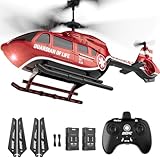 DEERC 26-Minute Dual-Battery Helicopter DEERC 26-Minute Dual-Battery Helicopter |
|
Check Latest Price |
 XIKOTEC XK1 Military Helicopter XIKOTEC XK1 Military Helicopter |
|
Check Latest Price |
 VATOS XK913 LED Helicopter VATOS XK913 LED Helicopter |
|
Check Latest Price |
 TERRAMUS XK913 Gyro Helicopter TERRAMUS XK913 Gyro Helicopter |
|
Check Latest Price |
 SIMREX Z16 Little Bird Helicopter SIMREX Z16 Little Bird Helicopter |
|
Check Latest Price |
Read that table as three groups. The bare three-channel models at the top of the list (S107G, Phantom, S111G) have a gyro but no altitude hold, so they hover only while you hold the throttle steady. The middle group adds altitude hold or auto-hover, which locks a height and gives you a much calmer first ten minutes. The dual-battery models at the bottom roughly double the time you spend in the air.
1. Syma S107G: The Best RC Helicopter for Beginners Overall
Syma S107G 3 Channel RC Helicopter with Gyro, Blue
3.5 channel with gyro stabilisation
8 ounces
17.8 x 7.3 x 3 inches
LiPo battery, 5 to 10 min per charge
Pros
- Hovers smoothly for a first-time pilot
- Takes repeated crashes without breaking
- Cheap widely available replacement parts
- Fits in a room with low ceilings
Cons
- Roughly 5 to 10 minutes of flight per battery
- No altitude hold so it drifts while hovering
- Very sensitive throttle that needs constant correction
- Indoor only
- a ceiling fan will destabilise it
I spent the most time on this one because it is the model most first-time pilots end up buying, and it earns that. The S107G is a 3.5 channel coaxial with a gyro that self-levels the rotor head. You fly it with two thumbsticks: one for throttle and yaw, one for forward and sideways movement.
What separates it from cheaper toys is not the electronics, it is the parts situation. Main rotor blades, tail blades, the canopy and the landing skids are all cheap and stocked everywhere, so a bad landing costs you a few dollars rather than the whole aircraft. That single fact is why I rank it first.
The catch is honest and worth saying plainly. There is no altitude hold, so the moment you centre the throttle stick the helicopter starts to sink or drift backwards. Reviewers describe the throttle as touchy, and they are right. That is not a flaw to complain about, though, because learning to hold a hover by feel is the single most transferable skill in the hobby.
Flight time runs roughly 5 to 10 minutes on the supplied LiPo pack, and the recharge is long enough that you will want a second battery within a month. Treat that as normal rather than disappointing; every electric helicopter in this price bracket behaves the same way.
Why we picked it as the top beginner pick
It teaches. Every control is doing something visible and immediate, with no software smoothing between your hand and the aircraft. A pilot who can hover the S107G can hover almost anything that follows.
It survives mistakes. The flexible blades and canopy take repeated impacts from furniture and ceilings without ending the flight, which means your first ten crashes cost nothing but confidence.
Where it falls short
It is an indoor aircraft with no wind tolerance at all. Any moving air, including a ceiling fan or an air conditioning vent, will push it around.
It also has no assisted height control, so it is a harder first hover than the altitude-hold models further down this list. Pick it if you want to learn stick work from the start rather than have the aircraft do the work.
2. Syma S107H-E: Best for One-Key Takeoff and Alloy Durability
SYMA Remote Control Helicopter, S107H-E RC Helicopter with One Key take Off/Landing, High & Low Speed and Durable Alloy Design, Gift Toy for Kids and Beginners
One-key take-off and landing
Alloy steel and metal construction
Dual high and low speed modes
LED headlight with battery warning
Pros
- One-button take-off removes the hardest first step
- Alloy frame survives bumps and crashes
- Two speed modes suit different skill levels
- LED doubles as a low-battery warning
Cons
- Instruction manual is thin for first-time pilots
- Larger and pricier than the classic S107G
- Short flight time per battery
The S107H-E takes the classic Syma layout and adds the two assists that remove most beginner frustration. One button on the transmitter lifts it off the ground and holds a hover, and another sets it back down. For a nervous first-time pilot, that is a bigger deal than it sounds.
The build is alloy steel rather than the plastic canopy on the entry models, and reviewers consistently mention that it takes bumps without cracking. It weighs more on the scale, which also makes it a little less easily pushed around by stray air.
Two speed modes let you hover slowly at low speed while you learn, then open it up later. That progression matters more than it sounds, because the difference between a helicopter that creeps and one that moves fast is the difference between a relaxing session and a white-knuckle one.
Owners do raise one consistent complaint about documentation. The manual is thin on detail, so expect a couple of YouTube lookups before your first flight rather than a clean read-through.
Why we picked it
One-key take-off and landing removes the two moments where beginners crash most often. That alone moves it up the list for anyone who has watched a new pilot tip over on lift-off and lose confidence.
The alloy frame also means the aircraft stays flyable after a bad landing instead of splitting at the skids.
Where it falls short
The assisted hover means less manual stick practice than the S107G gives you. If your goal is to move straight into bigger fixed-pitch helicopters, a bare three-channel model is the better teacher.
It is also bigger than the micro coaxials on this list, which matters if your flying space is a small flat rather than a garden.
3. Cheerwing S107G Phantom 3CH: Best for the Simplest First Hover
Cheerwing S107/S107G Phantom 3CH 3.5 Channel Mini RC Helicopter with Gyro Blue
3-channel with upgraded gyro
13.28 ounces
16.8 inches long
Spare remote included
Pros
- Clean build with precisely trimmed controls
- Survives hard crashes from height
- Three-channel layout is easy to learn
- Dual frequencies allow two at once
Cons
- About 5 to 7 minutes of flight with a hardwired battery
- No auto-hover or altitude hold at all
- A minority of units arrive unstable or defective
The Phantom shares its platform with the Syma S107G, which is a useful thing to know because parts cross over. Reviewers rate it as superb value, with clean construction and controls trimmed precisely enough that a first-time pilot picks it up quickly.
The three-channel layout is the reason to choose it. Fewer inputs means fewer ways to confuse yourself, and everything you do on the sticks maps directly to movement you can see.
Crash tolerance is the other strength owners mention. It comes back from high drops onto a hard floor in a condition that still flies, which is exactly what you want during your first month.
Two selectable frequencies are included, so two of these can be flown in the same room without interference. That is unusually useful if more than one child is learning at the same time.
Why we picked it
If your goal is the shortest possible path to hovering, fewer channels wins. There is nothing to accidentally flick out of trim.
The parts interchange with the S107G platform is a practical bonus. When you eventually upgrade, you will already know which blades and skids fit.
Where it falls short
The battery is hardwired, so you cannot swap packs the way you can on the dual-battery models. Flight time of 5 to 7 minutes means short, frequent sessions rather than long ones.
It also has no altitude hold whatsoever, so the S107H-E is gentler on absolute beginners than this one.
4. BUSSGO X11C: Best Value With Two Batteries
BUSSGO RC Helicopter, Remote Control Helicopter for Kids
Altitude hold with gyro hover
15 to 17 minutes per battery
Two modular batteries included
2.4GHz control
Pros
- Altitude hold makes it steadier than bare three-channel helicopters
- Two modular batteries give around 30 minutes combined
- Seven LED colour modes and a demo mode
- Holds up after small crashes
Cons
- Light weight means any breeze pushes it off course
- Packaging may arrive with non-English instructions
- LED glow can make the model hard to identify
The X11C is the model I would hand to someone whose real problem is patience. Two modular batteries give roughly 30 minutes of combined flight, and about 30 minutes is the difference between learning to hover in one evening and learning over several weeks.
Altogether it combines an upgraded gyro for stable hover with altitude hold and one-key take-off, plus trim buttons to correct drift. That stack of assists makes it steadier in the air than the bare three-channel models above it.
Owners also mention the seven LED colour modes and the auto-rotation demo mode as the feature children notice first. It is not a flying feature, but it does a lot of work at birthday parties.
Charging protection against over-charge, over-current and low voltage is built in, which matters more than it sounds because cheap LiPo packs are the most common casualty of careless charging.
Why we picked it
Flight time per charge is the honest measure of how much you will actually fly this year, and this one leads the list on that basis.
It also keeps the manual controls available underneath the assists, so you are not locked out of learning throttle feel later.
Where it falls short
It is very light, so outdoor wind or even a ceiling fan will carry it away. This is an indoor model and should be treated as one.
The packaging may arrive with instructions you cannot read, so check the box before you fly it.
5. Syma S111G: Best for Kids Aged 8 to 14
Syma S111G 3.5 Channel RC Helicopter with Gyro
3.5 channel with built-in gyro
Multicolour LED lighting
17.2 x 7 x 3 inches
6 to 10 minutes of flight
Pros
- Smooth well-balanced hover suits beginners
- Survives hard landings and repeated crashes
- Multicolour lights look good in flight
- Six to ten minutes on a full charge
Cons
- Slow forward speed compared with the S109G
- Drifts back on lift-off and has sensitive throttle
- Some units reported tail motor failures
- Charge port sits on the underside
The S111G is sold under Coast Guard branding and sits as the slightly larger sibling to the S107G. Reviewers single out a smooth, well-balanced hover, which is the thing beginners struggle with most and the thing this one does well.
Construction is rugged enough that repeated crashes produce little damage. In practice that means a child can learn on it for months before a replacement part is needed, which is the strongest argument for it.
The trade-off is speed. Owners report that it moves forward slowly compared with the S109G Apache, which makes it easier to control but less exciting once you are past the hover stage.
There are also a handful of reports of tail motor failures within days of purchase. That is a minority issue, but it is the reason several owners point buyers toward the S107G instead.
Why we picked it
The hover quality and the multicolour lights land well with children in the 8 to 14 range. It looks like a rescue helicopter rather than a bare plastic toy.
It is listed for ages 8 and up, which makes gift-buying decisions straightforward.
Where it falls short
Drifting back on lift-off is reported often enough that you should expect it in the first few flights. It also charges through a port on the underside, so the model has to sit on its side while it charges.
If you want a smoother first hover, choose the S107G or the S107H-E.
6. Cheerwing U12: Best for a First-Time Adult Pilot
U12 Remote Control Helicopter Mini RC Helicopter with Altitude Hold Blue
Altitude hold with auto-hover
One-key take-off and landing
Metal frame with flexible blades
Two batteries plus spare blades
Pros
- Altitude hold removes the need to hold throttle
- One-key take-off lowers the barrier for new pilots
- Metal frame survives repeated crashes
- Two batteries and spare blades in the box
Cons
- Very light so air movement pushes it off course
- Slower and less precise than manual three-channel models
The U12 sits between the bare three-channel toys and the higher-spec models, and that middle position is deliberate. You get altitude hold and auto-hover so the helicopter holds a set height when you release the stick, but you still fly it yourself in every other respect.
That combination is the most sensible starting point for an adult who has never flown anything. Nothing to learn, nothing to set up, and the aircraft holds position while you work out which stick does what.
The box contents are unusually generous for this bracket. You get two batteries, a spare blade set and a spare tail blade, which means the first crash is not a crisis.
Metal frame construction and flexible blades are what allow it to absorb the impacts that end other models. Reviewers consistently describe it as taking repeated crashes without damage.
Why we picked it
Altitude hold plus two batteries in the box is a rare pairing at this level. You get stability and enough flight time to practise with on day one.
Two speed modes and 2.4GHz control mean it can also handle a second helicopter in the room for family flying.
Where it falls short
Auto-hover limits fine stick control. Pilots who want to practise manual throttle technique will find the assisted mode restrictive, and it is less precise than a bare 3.5 channel model.
It is also very light, so any air movement in the room will throw it off line.
7. DEERC DE28: Best for Crash-Prone Indoor Flying
DEERC Remote Control Helicopter, 3.5 CH Altitude Hold RC Helicopters w/Gyro for Beginner, 2 Shells LED Light One Key Take Off/Landing, 2.4GHz Aircraft Indoor Flying Toy for Kids Boys Girls
Air-pressure altitude hold after take-off
One-key take-off and landing
0.15 kg weight
2.4GHz transmitter
Pros
- Altitude hold and one-key start make it approachable
- Metal airframe and flexible ABS blades take many crashes
- 2.4GHz control avoids interference with other toys
Cons
- Built for indoor flying and struggles in outdoor wind
- Auto-hover reduces manual control precision
The DE28 is one of two models here rated for a 10-year-old upward and built with a full metal airframe rather than a plastic shell. Buyers describe it as an intimidation-free introduction to RC flying, which matches how we would put it.
The technical story is air-pressure altitude hold rather than optical positioning, so it locks a height after take-off without needing to see the floor. Combined with one-key take-off and landing, that covers both of the crash-prone moments in a first flight.
Two shell options with LED lighting are included, which is a nice way to let a child personalise it without buying a different aircraft.
Why we picked it
Metal airframe plus flexible ABS blades is a strong combination for a first helicopter. The frame takes the impact and the blades are the cheap replaceable part.
The 2.4GHz transmitter has no external antenna, which makes it less likely to be damaged in the first crash.
Where it falls short
It is an indoor aircraft. Reviewers are consistent about that limitation, and outdoor wind makes it hard to control.
The auto-hover also removes some manual control precision, so it teaches less stick technique than the bare three-channel options.
8. DEERC 26-Minute Helicopter: Best for the Longest Playtime
DEERC Remote Control Helicopter, Rescue RC Helicopter Toy with LED Lights, 2 Batteries, Altitude Hold & 2.4GHz Stable Control, Realistic Rescue Design, Ideal Gift for Kids and Adults
Two modular batteries with USB-C
Up to 26 minutes total flight
10.08 ounces
8.85 x 4.91 x 4.92 inches
Pros
- Two modular batteries and USB-C charging give the longest playtime here
- Very stable indoors with one-key controls
- Spare blades and a screwdriver included in the box
- Good value for adult beginners as well as children
Cons
- Light enough to be carried away by wind
- Some units reported losing rotor function after a couple of flights
- Feels plasticky
This rescue-styled DEERC is built around flight time. Two modular rechargeable batteries and USB-C charging give up to 26 minutes of combined flight, which is the longest single-session figure on this list.
Stability comes from a 3.5 channel transmitter with adjustable speeds, altitude hold, one-key take-off and one-key landing. It is stable enough indoors that a child can run it without supervision for a short flight, though we would still be in the room.
The packaging is thorough. Spare main rotor blades, spare tail blades and a screwdriver are in the box, so the most common first crash is a five-minute fix rather than a lost aircraft.
There is an intelligent rotor power-off safety system and low-battery LED indicators, both of which reduce the chance of a hard landing at the end of a pack.
Why we picked it
Battery math is the honest answer here. If you can only fly on weekdays, a longer charge-to-flight ratio means you actually practise rather than wait.
USB-C charging also removes the hunt for a proprietary lead, which is still a problem with several competing models.
Where it falls short
The build feels plasticky, and a small number of owners reported losing rotor function after only a couple of flights. If you buy it, check it on day one so a fault is easy to spot.
Wind sensitivity is the same limitation as most of this list, so keep it indoors.
9. XIKOTEC XK1: Best for Detailed Military Styling
XIKOTEC RC Helicopter, Remote Control Helicopter Toy for Kids(Green)
Altitude hold with one-key controls
Two modular USB-C batteries
About 20 minutes of flight
3.5 channel gyro stabiliser
Pros
- Detailed model with cockpit contours that look good in flight
- Roughly 10 to 20 minutes per battery
- Well packaged and usually arrives in perfect condition
- Gyro-assisted flight is stable for a trainer
Cons
- No charging indicator on the USB-C battery
- Very light and easily caught by wind
- Some units arrive without a printed manual
The XK1 is the pick if appearance matters to the person learning. Owners single out the detailed cockpit contours and the finish, and it reads more like a scale model than a toy.
Underneath, it is a straightforward 3.5 channel trainer with a gyro stabiliser, altitude hold, one-key take-off and landing, and two easy-swap modular batteries with USB-C charging for roughly 20 minutes of flight.
Control range is listed at roughly 50 metres with anti-interference, which is more than you need indoors and more than these light helicopters can exploit outside anyway.
It is listed for ages 8 to 10 as a starting point, though adults returning to the hobby tend to rate it as a solid budget trainer too.
Why we picked it
Detail and finish are what separate it from the generic listings, and a model you like looking at is one you will keep flying rather than abandon in a cupboard.
Two modular batteries mean a proper session rather than a five-minute one.
Where it falls short
There is no charge indicator on the USB-C battery, so you are guessing how much flight time you have left. That is a real safety consideration when you are learning to land.
It is also very light and easily caught by wind, even indoors near an open window.
10. VATOS XK913: Best for Flying in Dim Rooms
VATOS RC Helicopter for Boys, 2.4G Remote Control Helicopter with LED Light for Kids 12+ Years Old, Fixed Height, One-Key Take-Off, Indoor RC Planes Ideal Festival Gifts for Boys Adults
Barometric altitude hold for auto hover
One-key take-off and landing
About 12 minutes of flight
130 to 160 foot control range
Pros
- Easy to control after a few minutes for children and adults
- Holds a true hover and stays responsive in flight
- LED lights make flying in a dim room enjoyable
- Sturdy enough to survive bumps and hard landings
Cons
- About 10 to 12 minutes of flight against a full hour of charging
- Some units broke within a day or two
- Included charging cable reported unreliable
- Feels cheap in the hand
The VATOS is aimed at evening flying rather than daytime garden sessions. The LED lights are the reason, and reviewers describe them as adding a lot of appeal for children and adults flying after dark.
Flight behaviour is well received. Owners report that it holds a true hover, stays responsive in the air, and can be picked up by a beginner within a few minutes thanks to one-key take-off, landing and trim controls.
Barometric altitude hold handles the hover automatically, which is the assist doing most of the work on this model. The listed control range is 130 to 160 feet in open, wind-free areas, far beyond what indoor flying needs.
The build is sturdy for a plastic model, with enough tolerance for beginner bumps and hard landings on carpet or a tabletop.
Why we picked it
It is one of the few models here where the lighting is a genuine feature rather than decoration. Winter evenings and dim living rooms are real flying conditions.
The hover quality is the other reason. Barometric hold keeps it steady without needing to see anything.
Where it falls short
The flight-time-to-charging ratio is poor: about 10 to 12 minutes of flight for close to an hour of charging. Budget for a second battery or accept short sessions.
There are also reports of units breaking within a day or two and of the included charging cable failing, so have a spare cable to hand.
11. TERRAMUS XK913: Best for Young Children
TERRAMUS Remote Control Helicopter for Kids, 2.4G Altitude Hold RC Helicopters with LED Light & Gyro, Radio Controlled Aircraft Indoor Toy with 3.5 Channel High Low Speed for Boys Beginner
One-key lift and land with trim
Built-in gyro for stable hover
About 13 to 15 minutes of flight
45 to 50 metre control range
Pros
- One-key lift and land plus trim control suits young pilots
- Built-in gyro gives a stable hover after take-off
- Two speed modes and bright LEDs make it fun indoors
- Spare blades and a screwdriver are included
Cons
- Transmitter needs three AAA batteries which are not included
- Light build is unsuitable for windy outdoor conditions
The TERRAMUS is listed for ages 6 and up and is built around the same assist stack as the models above it: one-key lift and land, trim control for correcting drift and tilt, and a built-in gyro for stable hovering.
It still gives full 3.5 channel control, with up, down, left, right, forward and backward all available on the transmitter. That matters because a child who can move it deliberately will learn faster than one stuck in an auto-orbit loop.
Flight time is about 13 to 15 minutes after roughly 45 minutes of charging, and 2.4GHz control lets several fly in the same space.
Why we picked it
The age rating is the point. It is the model here most clearly aimed at a younger child while still offering manual control underneath the assists.
The spare blades and screwdriver in the box mean the first crash is a simple fix.
Where it falls short
The transmitter needs three AAA batteries, which are not included. That is a bad surprise on a birthday morning.
The light build rules out outdoor flying in anything other than dead calm air.
12. SIMREX Z16: Best for Gradual Progress
SIMREX RC Helicopter Toy for Kids & Beginners – Altitude Hold, 2 Speeds, Rechargeable with 2 Batteries, Indoor/Outdoor Hands-on Play, Ideal Gift for Boys Girls
Auto-hover stabilisation as standard
Two rechargeable batteries
About 30 minutes total flight
8 ounces, metal alloy and plastic
Pros
- Auto-hover makes it stable straight out of the box
- Two batteries give around 30 minutes of combined flight
- Lightweight and easy to control when it bumps into things
- Two speed modes let beginners progress gradually
Cons
- Not suitable for outdoor wind and it sinks quickly in water
- Tail motor failures reported on a minority of models
- Only one rear LED so the low-battery warning is hard to see
- Altitude hold can feel restrictive
The SIMREX Z16 is styled after an MH-6 Little Bird and carries auto-hover stabilisation as standard. Buyers describe it as a smooth first helicopter that a child can master in minutes.
Two rechargeable batteries give up to 30 minutes of combined flight, and two speed modes let a beginner hover slowly indoors before opening it up in open space.
Flexible rotors are designed to take moderate crashes, which combined with the light weight means bumping into furniture rarely ends the session.
Two AA batteries for the transmitter are included, which is a small courtesy that costs the manufacturer almost nothing.
Why we picked it
Dual batteries plus two speed modes give a clear progression path inside one aircraft: hover slowly, then fly faster, then fly faster outside.
It is listed for ages 8 and up and works equally well as an adult first helicopter.
Where it falls short
The frame is plastic where several rivals use metal, and a minority of owners reported tail motor failures. Treat it as an indoor aircraft only.
It sinks quickly if it lands in water, which is worth remembering if anyone is flying near a fish tank.
What Size RC Helicopter Is Best for Beginners?
A 100 or 120 size fixed-pitch helicopter, roughly 200 to 300 mm across the rotor, is the right first helicopter for most people. Below 200 mm you have a micro or nano coaxial that is forgiving but slow and twitchy to translate. From 200 to 425 mm sits in the mini class, which is where all twelve models on this list live.
The 600 and 700 class helicopters are much larger machines with collective pitch and real wind response. They are excellent aircraft and the wrong first purchase for almost everyone.
Choose by flying space instead. If you have a room, a micro or mini coaxial. If you have an open garden and you want to see wind response, you need something bigger and more expensive than anything on this list.
Coaxial vs Single Rotor: Which Is Easiest to Fly?
A coaxial helicopter is the easiest to fly for a beginner, because two counter-rotating rotors cancel each other out and remove the need for a tail rotor. Every model on this list uses that layout, which is why they hover so calmly and can be flown in a bedroom.
A single rotor is more realistic and better for progressing later, but it introduces a tail rotor that drifts on takeoff. That drift is the thing new pilots find hardest to correct, and it is the reason we start people on coaxials.
The catch with coaxials is that there is no tail, so you learn yaw differently. Most pilots get used to it within a dozen flights and prefer it afterwards.
Key Features to Look For in a Beginner RC Helicopter
Ready-to-fly (RTF). The box contains a complete aircraft and a transmitter. Nothing to build, nothing to bind, no tools needed.
Gyro stabilisation. Every model here has one. It self-levels the rotor head so you command movement instead of fighting wobble.
Altitude hold. The aircraft locks a height when you release the throttle stick. This is the single most useful assist for a nervous beginner, and it is the main reason to choose between two otherwise identical models.
One-key take-off and landing. Removes the two moments where beginners crash most often. Worth paying a small premium for.
Two or three speed modes. A low-speed mode for hovering indoors and a faster mode once you can translate confidently.
Spare batteries and spare parts. Flight time of 5 to 15 minutes is unavoidable in this class, so a second battery changes how much you fly. Our battery charger picks cover the chargers that keep charging time down.
Parts availability. Check that main blades, tail blades and skids are sold separately before you buy. A helicopter with no available parts is landfill the first time it lands hard.
Safety Before Your First Flight
Clear the room first. Rotating blades at speed will cut fingers, and the most common early injury in this hobby is a child reaching in to pick up a landed helicopter.
Keep pets out of the flying space. A cat or dog chasing a helicopter through the air ends with damage to both the aircraft and the animal.
Expect your first helicopter to break. Treat it as a training cost rather than a failure, and buy a model with cheap spare blades so that lesson stays cheap.
If you fly indoors, turn off ceiling fans and close the air conditioning vents. Moving air is the number one cause of an unexpected flight into a wall.
Adult supervision matters for the first few flights regardless of the age rating printed on the box. Most of these models are safe to hand to a child once that child can take off and land without help.
Frequently Asked Questions
What size RC helicopter is best for beginners?
A 100 or 120 size fixed-pitch helicopter, roughly 200 to 300 mm across the rotor, is the best starting size for most people. Micro and nano coaxials under 200 mm are forgiving but slow, and 600 and 700 class collective pitch machines are too advanced for a first purchase.
What is the best remote control helicopter for beginners?
The Syma S107G is our top pick. Its gyro-stabilized three-channel layout holds a steady hover, it survives repeated crashes, and its blades and skids are sold as cheap separate parts.
What is the best starter helicopter?
A gyro-stabilized fixed-pitch coaxial in ready-to-fly form is the best starter helicopter. Add altitude hold if you are nervous, and pick one with two batteries so your practice sessions are not limited by charge time.
What is the easiest helicopter to fly for a beginner?
A micro coaxial with gyro stabilisation is the easiest helicopter to fly, because the two counter-rotating rotors need no tail correction. Adding altitude hold and one-key take-off makes the first ten minutes calmer still.
Which small RC helicopter is considered the best?
Among small indoor models, the Syma S107G and Cheerwing Phantom 3CH lead for build quality and parts support, while the BUSSGO X11C leads for flight time with two modular batteries.
Which brand of RC helicopter is considered the best for beginners?
SYMA and Cheerwing are the strongest starting brands because their parts are widely stocked and cross-fit between models. DEERC, BUSSGO, XIKOTEC, VATOS, TERRAMUS and SIMREX all offer altitude hold and dual-battery options.
How long do beginner RC helicopters fly?
Most small electric RC helicopters fly for 5 to 15 minutes per battery, with 30 to 60 minutes of charging. Models with two modular batteries roughly double the total time you spend flying in a session.
Which RC Helicopter Should You Buy First?
Pick the Syma S107G if you want the simplest three-channel layout and the widest parts support. Pick the Syma S107H-E if you want one-key take-off and landing plus an alloy frame that survives hard landings. Pick the BUSSGO X11C if you want altitude hold and roughly 30 minutes of flight from two batteries.
Beyond that, choose on the assist you need rather than the styling. Altitude hold calms a nervous first pilot, dual batteries extend practice time, and a bare gyro model teaches more manual stick technique.
All twelve are indoor helicopters, so pick your flying space first and the aircraft second. Once you have 20 hours of hover time, the sensible next step is a larger 150-size fixed-pitch helicopter with a real tail rotor, which is where this hobby actually grows. We update this list through 2026 as new models arrive and prices move.
Our wider beginner guides cover the rest of the hobby, including more RC helicopter picks and RC submarine kits if you want a second project for the same hobby budget.