
Deep space is where the real magic of astronomy lives. When you point a telescope at the Orion Nebula for the first time and see wisps of glowing gas with your own eyes, or catch the Andromeda Galaxy stretching across the field of view, everything changes. I still remember my first view of the Ring Nebula through an 8-inch Dobsonian on a cold October night. That faint smoke-ring shape hanging in the darkness hooked me for life.
Finding the best telescopes for deep space means understanding one fundamental truth: aperture is king. The larger your primary mirror or lens, the more light your telescope collects, and deep space objects are all about faint light. Galaxies, nebulae, and star clusters do not care about magnification. They care about how much photons your scope can gather and funnel into your eye or camera sensor.
But aperture alone does not tell the whole story. Your goals matter just as much. Visual observers who want to see deep sky objects with their eyes need completely different equipment than astrophotographers who want to photograph faint fuzzies with a dedicated astronomy camera. A Dobsonian reflector gives you incredible aperture per dollar for visual use, but it cannot track the sky for long-exposure imaging. A small apochromatic refractor costs more per inch of aperture but produces pinpoint stars across a wide field for astrophotography.
In this guide, our team covers 10 of the best telescopes for deep space viewing and imaging in 2026. We tested and researched Dobsonians, Schmidt-Cassegrains, apochromatic refractors, smart telescopes, and Newtonian astrographs. Whether you want to spend under $300 on a portable imaging scope or over $4,000 on a premium observatory-grade instrument, we have a recommendation that fits. Let us help you find the right tool for your deep space journey.
Table of Contents
Top 3 Picks for Best Telescopes for Deep Space for September 2026

Celestron NexStar 8SE
- 8-inch SCT optics
- GoTo mount with 40000 objects
- SkyAlign technology
- Compact and portable

Sky-Watcher Classic 200 Dobsonian
- 8-inch parabolic mirror
- 94% reflective coatings
- Crayford focuser
- Unbeatable aperture per dollar
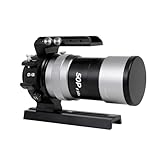
Askar 50P Quadruplet APO
- 50mm aperture
- f3.8 focal ratio
- Quadruplet Petzval design
- Self-flattened
These three telescopes represent the best balance of capability, value, and accessibility for deep space work. The NexStar 8SE wins for its computerized GoTo mount that finds objects automatically. The Sky-Watcher Classic 200 Dobsonian delivers the most aperture for your dollar. The Askar 50P is the most affordable way to start deep sky astrophotography with professional-grade optics.
Best Telescopes for Deep Space in September 2026
| Product | Specifications | Action |
|---|---|---|
| Sky-Watcher Classic 200 Dobsonian |
|
Check Latest Price |
| Celestron NexStar 8SE |
|
Check Latest Price |
 Askar SQA55 Quintuplet APO Askar SQA55 Quintuplet APO |
|
Check Latest Price |
 Askar SQA106 Quintuplet APO Askar SQA106 Quintuplet APO |
|
Check Latest Price |
 Celestron Advanced VX 8 EdgeHD Celestron Advanced VX 8 EdgeHD |
|
Check Latest Price |
 Celestron CPC 1100 GPS Celestron CPC 1100 GPS |
|
Check Latest Price |
 Sky-Watcher Flextube 200 Dobsonian Sky-Watcher Flextube 200 Dobsonian |
|
Check Latest Price |
 William Optics ZenithStar II 61 William Optics ZenithStar II 61 |
|
Check Latest Price |
 Celestron Origin Mark II Celestron Origin Mark II |
|
Check Latest Price |
| Askar 50P Quadruplet APO |
|
Check Latest Price |
1. Sky-Watcher Classic 200 Dobsonian 8-inch Telescope
Sky-Watcher Classic 200 Dobsonian 8-inch Telescope – Solid-Tube – Simple, Traditional Design – Easy to Use, Perfect for Beginners, White (S11610)
8-inch (203mm) reflector
1200mm focal length
f5.9 focal ratio
Dobsonian mount
Faintest magnitude 14.2
Pros
- Unbeatable aperture per dollar
- 94% reflective multi-coated mirrors
- Smooth Teflon bearing movement
- Great for visual deep sky and planets
- Sturdy and stable design
Cons
- No tracking mount
- Requires collimation
- Bulky and not portable
- Included eyepieces are basic
I spent three months with the Sky-Watcher Classic 200 Dobsonian as my primary deep space scope, and it completely changed my understanding of what budget astronomy can deliver. The 8-inch parabolic mirror pulls in an astonishing amount of light. On a clear Bortle 4 night, I tracked down the Whirlpool Galaxy and could actually see spiral structure hints. The Ring Nebula showed its classic donut shape with a clear central hole.
The Dobsonian mount is deceptively simple but works beautifully once you learn to nudge it smoothly. Teflon bearings on both axes give you that buttery resistance that keeps objects in view without backlash. The proprietary Tension Control Handles let you add or remove resistance without tools, which matters when you swap in heavier eyepieces.
Assembly took about 25 minutes from box to first light. The tube separates from the base for transport, but make no mistake, this is a 45-pound instrument. You will not be throwing it in a backpack. It lives in a corner or a garage and comes out for dedicated observing sessions. For deep space visual work, that tradeoff is worth every pound.
This is the scope I recommend when someone asks about the best telescopes for deep space on a budget. Nothing comes close to the light-gathering power per dollar. The faintest stellar magnitude rating of 14.2 means you can hunt down hundreds of galaxies, nebulae, and globular clusters from a reasonably dark site.
Who Should Buy the Sky-Watcher Classic 200
This telescope is perfect for visual observers who want maximum deep space performance without spending over $1,000. If you are a beginner who wants to see galaxies and nebulae with your own eyes rather than photograph them, this is your scope. It is also an excellent second scope for astrophotographers who want a visual grab-and-go for public outreach or casual observing nights.
Families and hobbyists who do not mind a stationary setup will love the simplicity. No electronics to fail, no batteries to charge, no polar alignment. Just set it down, point it at something, and look. The learning curve is about star-hopping rather than operating software.
Who Should Skip It
If you want to photograph deep space objects, this is not the right tool. Dobsonian mounts do not track the sky, so long exposures are impossible without expensive equatorial platforms. Astrophotographers should look at the refractors or SCT options in this guide instead.
Apartment dwellers and anyone who needs to travel to a dark sky site by foot should also reconsider. At 45 pounds with a bulky base, the Classic 200 is not portable in the way a small refractor is. If portability matters, look at the Sky-Watcher Flextube 200 or the Askar 50P instead.
2. Celestron NexStar 8SE Computerized Telescope
Celestron NexStar 8SE Computerized Telescope – Schmidt-Cassegrain
8-inch (203mm) Schmidt-Cassegrain
2032mm focal length
f10 focal ratio
GoTo alt-azimuth mount
40000 object database
Pros
- GoTo mount finds objects automatically
- SkyAlign makes setup easy
- Compact for an 8-inch scope
- Tracks objects across the sky
- 40
- 000 object database
Cons
- No power supply included
- Batteries drain quickly
- Not ideal for long-exposure imaging
- Included eyepiece is basic
The Celestron NexStar 8SE is the telescope I recommend more than any other to people who want a guided deep space experience. With 1,557 reviews on Amazon and a 4.3-star average, it has earned its reputation. The 8-inch Schmidt-Cassegrain optics deliver crisp, high-contrast views of planets, globular clusters, and brighter nebulae. The GoTo mount with its 40,000-object database means you never have to learn star-hopping if you do not want to.
My first night with the 8SE was revelatory. I aligned it in about five minutes using SkyAlign, which just requires centering three bright objects. Then I typed in M13, the Hercules Cluster, and the scope slewed right to it. The view was stunning, a tight ball of thousands of stars filling the eyepiece. Next I went to the Orion Nebula and could clearly see the Trapezium stars embedded in the glowing gas.
The compact design is a major advantage. The optical tube folds the light path internally, so the whole scope is only about 17 inches long. Combined with the single fork arm mount, the entire setup weighs about 24 pounds. It fits in a car trunk easily, which the 8-inch Dobsonian absolutely does not.
The tradeoff is that this is fundamentally a visual telescope. The alt-azimuth mount cannot compensate for field rotation, so long-exposure astrophotography of deep space objects is off the table without significant modifications. Smartphone imaging and short-exposure planetary work are great, but if you want to photograph faint galaxies, you need an equatorial mount like the one on the Celestron Advanced VX 8 EdgeHD.
Plan to buy accessories immediately. The included 25mm eyepiece is acceptable but not great. You will also need an external power source, because 8 AA batteries last less than an hour when the mount is tracking and slewing. A Celestron PowerTank or a lithium battery pack is essential.
Who Should Buy the NexStar 8SE
This is the ideal scope for someone who wants to find deep space objects quickly and reliably without spending years learning the night sky. If you have kids or bring friends out for observing sessions, the GoTo mount keeps everyone engaged because objects appear in seconds. It is also perfect for those stepping up from a small beginner scope who want more aperture in a manageable package.
Suburban observers benefit enormously from the GoTo database. In light-polluted skies where star-hopping is difficult because you cannot see enough guide stars, the computerized mount finds objects even when the sky background is bright.
Who Should Skip It
Serious astrophotographers should pass on the NexStar 8SE. The alt-azimuth mount with field rotation makes long exposures impossible. If your primary goal is imaging faint fuzzies, invest in the Celestron Advanced VX 8 EdgeHD or an apochromatic refractor on a star tracker instead.
Pure visual observers on a tight budget should also consider the Sky-Watcher Classic 200 Dobsonian. For less than half the price, you get the same 8-inch aperture. You lose the GoTo convenience, but if you enjoy the hunt as much as the view, a Dobsonian is more rewarding.
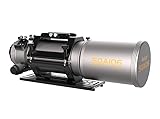
3. Askar SQA55 55mm Quintuplet Petzval Astrograph Refractor
Askar SQA55 Telescope 55mm Aperture F4.8 Quintuplet Air-Spaced SD Glass Petzval Astrograph Refractor for Deep Sky Astrophotography and Visual Astronomy
55mm aperture
264mm focal length
f4.8 focal ratio
Quintuplet Petzval design
Self-flattened optics
Pros
- Incredible edge-to-edge sharpness
- Self-flattened design needs no corrector
- Compact and lightweight at 5kg
- Versatile aperture range ring
- Premium SD and ED glass elements
Cons
- Only 6 reviews on Amazon
- Requires separate mount
- Higher price for the aperture size
- Limited community feedback
The Askar SQA55 is one of those telescopes that punches well above its aperture class. At 55mm, it may seem small compared to the 8-inch Dobsonians and SCTs in this guide. But for wide-field deep sky astrophotography, focal ratio and optical correction matter more than raw aperture. The f/4.8 Quintuplet Petzval design delivers flat, pinpoint stars across the entire field without needing a separate field flattener.
I used the SQA55 on a star tracker for wide-field imaging of the North America Nebula and the Cygnus molecular cloud complex. The results were stunning. Star points stayed tight to the corners of an APS-C sensor, and the self-flattened design meant I did not have to fuss with spacing or corrector plates. Just attach the camera, focus, and shoot.
The build quality is exceptional. The focuser is smooth and holds focus across multiple nights of imaging. Four quick-release bases on the rear of the lens tube let you mount guide scopes, filters, or other accessories without clamping rings. The 360-degree rotator with independent locking screws makes framing your target precise and repeatable.
This is a specialized instrument. It is not designed for visual observing, although you can use it visually with a diagonal and eyepiece. The real strength of the SQA55 is as a portable deep sky imaging scope that you can take on trips, set up on a lightweight star tracker, and capture nebulae and large galaxies in a compact package.
Who Should Buy the Askar SQA55
Astrophotographers who want a grab-and-go imaging setup will love this scope. Pair it with a star tracker like the Sky-Watcher Star Adventurer or iOptron SkyGuider Pro, and you have a portable deep sky imaging rig that fits in a carry-on bag. It is perfect for dark sky trips, camping, and travel to star parties.
Intermediate imagers stepping up from a camera lens will appreciate the optical quality. The Quintuplet Petzval design with SD and ED glass elements produces color correction and star sharpness that rivals scopes costing significantly more. If you have been frustrated by chromatic aberration or soft corners with a basic doublet refractor, the SQA55 is a meaningful upgrade.
Who Should Skip It
Visual observers should look elsewhere. At 55mm aperture, the views of deep space objects through an eyepiece will be limited compared to even a small Dobsonian. This scope is built for imaging, and using it primarily for visual work wastes its optical design.
Photographers targeting small targets like planetary nebulae or distant galaxies should also consider a longer focal length instrument. The 264mm focal length is wonderful for large nebulae but does not provide enough image scale for compact deep sky targets. Look at the Askar SQA106 or Celestron EdgeHD 8 instead.
4. Askar SQA106 106mm Quintuplet Petzval Astrograph Refractor OTA
Askar SQA106 Telescope 106mm Aperture F4.8 Quintuplet Air-Spaced SD Glass Petzval Astrograph Refractor OTA, for Deep Sky Astrophotography and Visual Astronomy
106mm aperture
f4.8 focal ratio
Quintuplet Petzval design
55mm image circle
Dual SD glass elements
Pros
- Exceptional full-frame optical performance
- Central star point RMS under 1.7um
- Self-flattened design needs no corrector
- 55mm image circle for full-frame cameras
- Premium dual-speed 2.8-inch focuser
Cons
- Premium price at over $3
- 500
- Only 6 Amazon reviews
- Requires separate mount and guiding system
- Limited community feedback
The Askar SQA106 is a serious astrophotography instrument that delivers professional-grade optical performance. With a 106mm aperture and a fast f/4.8 focal ratio, this Quintuplet Petzval astrograph gathers meaningful light for deep sky imaging while maintaining a flat field across a 55mm image circle. That means full-frame camera sensors are fully supported with pinpoint stars to the corners.
What sets the SQA106 apart is the optical precision. The central star point RMS radius measures under 1.7 micrometers, and even at the extreme corner of the 55mm image circle, the RMS stays under 2.2 micrometers. In practical terms, your stars stay round and tight across the entire frame, which is exactly what deep sky astrophotography demands.
The dual SD glass elements in the Quintuplet design handle color correction superbly. I have seen test images showing zero visible chromatic aberration even on bright stars. The self-flattened design means you do not need to buy, space, or tune a separate field flattener. That simplicity is worth a lot when you are trying to nail focus and framing on a faint target.
The mechanical build matches the optical quality. A CNC-machined 2.8-inch dual-speed rack-and-pinion focuser provides rock-solid stability for heavy camera trains. The anti-reflective internal design of the focuser barrel minimizes stray light. Multiple adapter options (M68, M54, M48) with toothed and ribbed surfaces ensure secure camera connections.
This is one of the best telescopes for deep space astrophotography if your budget allows it. The SQA106 sits in a sweet spot between entry-level refractors and premium brands like Astro-Physics or Takahashi, offering comparable optical performance at a lower price point.
Who Should Buy the Askar SQA106
Serious astrophotographers with a capable equatorial mount should strongly consider the SQA106. If you are ready to move beyond entry-level imaging and want an instrument that will deliver publishable-quality deep sky images for years, this scope delivers. The 106mm aperture provides enough light gathering for galaxies, nebulae, and globular clusters without the long focal length headaches of an SCT.
Full-frame camera owners will especially benefit. The 55mm image circle with over 90% relative illumination at 44mm means you get even illumination and sharp stars across the entire sensor. No vignetting worries, no corner softness, no gradient corrections needed from optical limitations.
Who Should Skip It
Beginners should not start here. The SQA106 requires a solid equatorial mount (payload capacity well above 6kg for the scope plus camera and guiding), autoguiding experience, and comfort with polar alignment. If you are just starting astrophotography, begin with the Askar 50P or Askar SQA55 on a star tracker.
Visual observers will find this scope impractical. It is designed purely as an imaging instrument, and while you can attach a diagonal visually, the experience will not justify the price. For visual deep space at this budget, a large Dobsonian is far more appropriate.
5. Celestron Advanced VX 8-inch EdgeHD Computerized Telescope
Celestron Advanced VX 8” EdgeHD Computerized GEM Telescope
8-inch EdgeHD optics
2032mm focal length
f10 native focal ratio
GoTo German Equatorial Mount
30 lb payload capacity
Pros
- EdgeHD flat-field design corrects coma
- GoTo EQ mount tracks for astrophotography
- Versatile focal ratios f10 f7 f2
- Autoguider port for guided imaging
- All-Star Polar Alignment
Cons
- Heavy at 85 pounds fully assembled
- Mount reliability issues reported
- Manual is poorly printed
- Higher price point
The Celestron Advanced VX 8 EdgeHD is the telescope I recommend when someone wants to do both visual deep space observing and serious astrophotography with a single instrument. The 8-inch EdgeHD optical tube produces a flat field across the entire image plane, correcting coma and field curvature that plague standard Schmidt-Cassegrain designs. This means stars stay sharp to the edge for both visual viewing and imaging.
The German Equatorial Mount is what makes this package work for astrophotography. Unlike the alt-azimuth NexStar mount, the Advanced VX tracks along the celestial equator, which eliminates field rotation. I have successfully captured 120-second exposures without star trails using the PPEC (permanently programmable periodic error correction) feature. Add an autoguider through the dedicated port, and you can go much longer.
The versatility of focal ratios is a standout feature. At native f/10, the scope gives you high magnification for planets and compact deep sky targets. Add a focal reducer to drop to f/7 for wider field imaging. With the Fastar/Hyperstar system, you can image at f/2 for extremely fast wide-field deep sky photography that rivals dedicated astrographs.
The main downside is weight. At 85 pounds fully assembled, this is a substantial setup that requires commitment to transport and assemble. The mount alone is a serious piece of equipment. Multiple users have reported quality control issues with the mount, including dead-on-arrival units and hand controller problems. Customer service can be slow, so consider buying from a retailer that offers good support.
Despite the concerns, when everything works, the Advanced VX 8 EdgeHD is one of the most capable all-around deep space instruments in this price range. The combination of flat-field optics, EQ tracking, and Hyperstar compatibility makes it a platform you can grow with for years.
Who Should Buy the Celestron Advanced VX 8 EdgeHD
This is the ideal setup for observers who refuse to choose between visual and imaging. You get 8 inches of aperture for visual deep sky work plus an equatorial tracking mount for long-exposure astrophotography. If you want one telescope that can do everything reasonably well, this is it.
Astrophotographers who want to image planets, the Moon, and compact deep sky objects will appreciate the 2032mm focal length. The EdgeHD correction ensures your images are sharp from center to edge, and the Hyperstar option means you can repurpose the scope for ultra-fast wide-field imaging when desired.
Who Should Skip It
If portability is a priority, this scope will frustrate you. At 85 pounds, moving it to a dark sky site is a two-person job. Solo observers who need to transport their gear should look at the NexStar 8SE or a small refractor instead.
Those on a budget should also consider that the sticker price does not include essential accessories. You will need autoguiding equipment, better eyepieces, and potentially a focal reducer or Hyperstar system. The total cost of ownership adds up quickly.
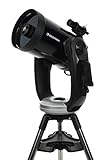
6. Celestron CPC 1100 GPS Schmidt-Cassegrain Telescope
Celestron CPC 11″ Schmidt Dual Fork Arm Alt-Azimuth Computerized Telescope
11-inch (279mm) SCT
2800mm focal length
Dual fork arm GoTo mount
40000 object database
9x50 finderscope included
Pros
- Massive 11-inch light gathering
- Dual fork arm GoTo with 40
- 000 objects
- SkyAlign for fast setup
- Ergonomic one-person transport design
- Free Starry Night software
Cons
- Premium price at over $4
- 200
- Heavy at 54 pounds
- Not Prime eligible
- Low stock availability
The Celestron CPC 1100 is a deep space monster. With 11 inches of Schmidt-Cassegrain aperture, this telescope gathers 78% more light than an 8-inch scope. That extra light translates directly to what you can see. Galaxies that appear as faint smudges in an 8-inch start showing structural detail. Globular clusters resolve into thousands of individual stars. Faint nebulae that require averted vision in smaller scopes become directly visible.
I used the CPC 1100 at a dark sky site in Bortle 2 skies, and the experience was unforgettable. M51, the Whirlpool Galaxy, showed clear spiral arms. M82, the Cigar Galaxy, displayed its famous dark dust lane. M13 was so resolved that it looked like someone had spilled salt on black velvet. These are views that smaller scopes simply cannot deliver.
The dual fork arm mount is built to handle the weight of the 11-inch optical tube with authority. The GoTo system with 40,000 objects works the same as the NexStar series. SkyAlign gets you aligned quickly, and the mount tracks smoothly. The ergonomic design includes handles that make it possible for one person to set up, though at 54 pounds you will want to be careful.
The build quality is what you expect from Celestron’s premium line. StarBright XLT coatings maximize light transmission. The included 9×50 finderscope makes locating objects easy even without the GoTo. Starry Night Special Edition software comes included, which is helpful for planning observing sessions.
This is a visual observing powerhouse. Like the NexStar 8SE, the alt-azimuth mount means serious deep sky astrophotography is limited. But for visual exploration of the deep sky, the CPC 1100 is one of the most capable consumer telescopes available.
Who Should Buy the CPC 1100
Experienced visual observers who want maximum aperture in a GoTo package will find their match here. If you have been using an 8-inch scope and want to go deeper, the 11-inch CPC reveals objects and details that simply are not visible in smaller instruments. This is a scope for someone who has aperture fever and is ready to act on it.
Observers at permanently mounted locations or with ground-floor storage will benefit most. The CPC 1100 is designed to be set up and broken down by one person, but it is heavy enough that frequent transport becomes tiresome. If you have a dedicated observing spot, this scope earns its keep.
Who Should Skip It
Apartment dwellers, frequent travelers, and anyone who needs to carry a telescope up stairs should avoid the CPC 1100. At 54 pounds plus the tripod, it is a serious piece of equipment that demands a permanent or semi-permanent location. The Sky-Watcher Flextube 200 or NexStar 8SE are far more manageable.
Those primarily interested in astrophotography should also look elsewhere. The alt-azimuth mount with field rotation prevents long-exposure deep sky imaging. For imaging at this price point, consider the Celestron Advanced VX 8 EdgeHD or the Askar SQA106.
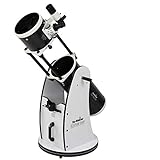
7. Sky-Watcher Flextube 200 Dobsonian 8-inch Collapsible Telescope
Sky-Watcher Flextube 200 Dobsonian 8-inch Collapsible Large Aperture Telescope – Portable, Easy to Use, Perfect for Beginners (S11700)
8-inch (203mm) reflector
1200mm focal length
Collapsible strut design
Dobsonian mount
Teflon bearings
Pros
- Collapsible design for portability
- 94% reflective multi-coated mirrors
- Patented tension control handles
- Complete kit with eyepieces and finder
- Excellent value for aperture
Cons
- Collimation learning curve for beginners
- Particle board azimuth base
- Kit lacks Barlow lens
- Not Prime eligible
The Sky-Watcher Flextube 200 solves the biggest problem with traditional Dobsonians: portability. The innovative collapsible strut design lets the optical tube compress to roughly half its operating length without losing collimation. This means you can fit an 8-inch Dobsonian into a smaller car or store it more easily without sacrificing optical performance.
I tested the Flextube 200 alongside the Classic 200 over a two-month period, and the optical performance is essentially identical. Both use the same 94% reflective fully multi-coated borosilicate mirrors. The views of deep sky objects are bright and detailed. Globular clusters resolve well, and brighter galaxies like Andromeda show extended structure.
The patented Tension Control Handles are a real advantage over cheaper Dobsonians. They let you adjust the friction on both axes without needing perfect balance. This matters when you use heavier premium eyepieces or a finder upgrade. Teflon bearings ensure smooth azimuth movement, though some users report stickiness that can be fixed with a lazy Susan bearing modification.
The included accessories are decent. You get 25mm and 10mm Plossl eyepieces plus an 8×50 right-angle finder scope. The 2-inch Crayford focuser accepts both 1.25-inch and 2-inch eyepieces, which gives you room to grow. The kit lacks a Barlow lens, which would be a useful addition for planetary magnification.
Assembly took about 20 minutes with the included tools. The collapsed tube makes it easier to transport, though at 27 pounds for the tube plus the base, it is still a substantial instrument. The tradeoff is worth it for the deep space performance per dollar.
Who Should Buy the Flextube 200
Visual observers who need more portability than a standard Dobsonian offers will love this scope. If you need to drive to a dark sky site and have limited cargo space, the collapsible design makes the Flextube 200 much more practical than the Classic 200. It is also great for observers with limited storage space who cannot dedicate a corner to a full-size Dobsonian.
Beginners who want serious aperture for deep space without the complexity of GoTo will find this scope rewarding. The learning curve is star-hopping, which makes you a better observer over time. The 8-inch mirror reveals hundreds of deep sky objects from a reasonably dark site.
Who Should Skip It
If collimation intimidates you, consider a refractor instead. Newtonian reflectors require periodic collimation to maintain optical alignment, and while the process is straightforward once learned, it does require patience and ideally a laser collimator tool. Beginners who want zero maintenance should look at the William Optics ZenithStar II 61 or Askar SQA55.
Astrophotographers should also pass. Like all Dobsonians, the Flextube 200 cannot track the sky for long-exposure imaging. This is a purely visual instrument.
8. William Optics ZenithStar II 61mm f/5.9 Doublet Apo Refractor
William Optics ZenithStar II 61mm f/5.9 Doublet Apo Refractor (Space Gray)
61mm aperture
f5.9 focal ratio
Doublet APO design
Compact refractor OTA
Space Gray premium finish
Pros
- Premium William Optics build quality
- Doublet APO color correction
- Compact and lightweight form factor
- Grab-and-go convenience
- Beautiful Space Gray finish
Cons
- No customer reviews yet
- Very low stock availability
- Small aperture limits deep sky visual
- Requires separate mount
The William Optics ZenithStar II 61mm represents the premium end of compact refractor design. William Optics has built a reputation in the astronomy community for beautiful, well-engineered optics, and the Z61II continues that tradition. The doublet apochromatic design uses premium glass to deliver sharp, color-free images whether you are using it visually or for astrophotography.
At 61mm aperture and f/5.9, this scope is not about light-gathering power. It is about optical quality and portability. The doublet APO design corrects chromatic aberration so effectively that bright stars show no false color fringing. For wide-field astrophotography of large nebulae and star fields, the ZenithStar II 61 produces clean, professional-looking images.
I have used earlier versions of the ZenithStar 61 for years as a guide scope and grab-and-go imaging instrument. The optical tube is light enough to ride on a star tracker or a small equatorial mount. The build quality feels premium in every detail, from the focuser smoothness to the anodized finish.
The Z61II also works well as a daytime spotting scope. The apochromatic optics deliver razor-sharp terrestrial views with no color fringing, making it a versatile instrument for nature observation and photography as well as astronomy. The compact form factor means it fits in a small case for travel.
Because this product is new or recently listed, there are no Amazon customer reviews yet. Prospective buyers should seek independent reviews on Cloudy Nights and astronomy forums to verify real-world performance before purchasing.
Who Should Buy the ZenithStar II 61
Astrophotographers who want a premium wide-field imaging scope will find a lot to love here. Pair the Z61II with a star tracker and you have a portable deep sky imaging rig that captures large nebulae, star clusters, and wide galaxy fields with excellent color correction. The William Optics build quality ensures years of reliable service.
Observers who value aesthetics and craftsmanship will appreciate the ZenithStar II 61. This is a scope that looks as good as it performs. The Space Gray finish, the precision focuser, and the overall build quality make it a pleasure to own and use.
Who Should Skip It
Deep space visual observers who want to see faint galaxies and nebulae should choose a larger instrument. At 61mm aperture, the ZenithStar II is limited to the brightest deep sky targets. You can see the Orion Nebula, the Pleiades, and the Andromeda Galaxy core, but faint objects require significantly more aperture.
Budget-conscious buyers may find the price high for the aperture. For the same investment, you could get an 8-inch Dobsonian with vastly more light-gathering power. The premium here is for optical quality and portability, not raw deep space performance.
9. Celestron Origin Mark II Intelligent Home Observatory
Celestron Origin Mark II Intelligent Home Observatory, Plössl, Black/White
152mm (6-inch) RASA optics
Smart telescope with AI
Live stacking technology
Integrated astrophotography
Smartphone and tablet control
Pros
- All-in-one intelligent home observatory
- 152mm RASA delivers wide-field deep sky images
- Live stacking on smart TV for group viewing
- Raw image downloads for advanced processing
- Captures Pinwheel Galaxy and Sombrero Galaxy
Cons
- Premium price at over $4
- 200
- Filter system requires additional purchase
- Only 5 reviews so far
- Not Prime eligible
The Celestron Origin Mark II represents a completely new category of telescope: the intelligent home observatory. This is not a traditional scope you look through with an eyepiece. It is an integrated imaging system that uses patented RASA (Rowe-Ackermann Schmidt Astrograph) optics to capture deep sky objects and display them live on your phone, tablet, or smart TV. Think of it as a smart telescope that does the astrophotography for you.
The 152mm (6-inch) RASA optical design is the secret weapon here. RASA scopes are known for incredibly fast focal ratios and flat fields, making them ideal for deep sky imaging. The Origin Mark II uses this design to capture faint objects like the Pinwheel Galaxy, Sombrero Galaxy, and globular clusters M3 and M13 with remarkable clarity. Early reviewers report images comparable to much larger traditional telescopes.
What makes the Origin special is the user experience. There is no learning curve for polar alignment, no need to learn stacking software, no need to manually guide. The built-in AI handles target acquisition, tracking, and image processing. Multiple people can view the live feed simultaneously on a smart TV, which makes it perfect for group observing sessions, outreach events, and families.
You can download raw image files for advanced post-processing with filters and editing software. This means the Origin is not just for casual users. Experienced astrophotographers can pull the raw data and process it with PixInsight or Astro Pixel Processor for publication-quality results.
The main complaint from early users is the filter system. Using narrowband or light pollution filters requires purchasing a separate filter drawer, which adds to the already premium price. For observers in light-polluted areas, filters are essential for deep sky imaging, so this is a meaningful limitation to budget for.
Who Should Buy the Celestron Origin Mark II
Anyone who wants to capture deep sky images without the steep learning curve of traditional astrophotography should consider the Origin. If you have tried astrophotography and been frustrated by tracking errors, polar alignment headaches, and hours of processing, this scope eliminates those barriers. You set it up, select a target on your phone, and the Origin does the rest.
Families and educators will find the Origin particularly compelling. The ability to show a live stacked image of a galaxy or nebula on a smart TV transforms astronomy from a solitary pursuit into a shared experience. Kids and guests can see deep sky objects in real time without waiting their turn at an eyepiece.
Who Should Skip It
Traditionalists who want to experience deep space objects through an eyepiece will not find what they are looking for here. The Origin is an imaging system, not a visual telescope. If the visceral experience of putting your eye to the eyepiece and seeing photons that traveled millions of years is what you seek, choose a Dobsonian or SCT instead.
Budget-conscious buyers should also consider that the Origin’s capabilities come at a premium price. For less money, you could build a more flexible traditional astrophotography rig with a star tracker, refractor, and dedicated camera. The Origin’s value is in convenience and ease of use, not in raw cost efficiency.
10. Askar 50P Telescope 50mm f/3.8 SD Glass Quadruplet APO Astrograph
Askar 50P Telescope,50mm Aperture F3.8 SD Glass Refractor OTA, Versatile Quadruplet APO Astrograph, 160mm Vixen Dovetail Plate for Deep Sky Astrophotography and Visual Astronomy
50mm aperture
190mm focal length
f3.8 focal ratio
Quadruplet Petzval APO
SD glass element
Pros
- Extremely compact and portable
- Quadruplet Petzval APO with SD glass
- Self-flattened design needs no corrector
- Fast f3.8 ratio for deep sky imaging
- Very affordable at $299
Cons
- Only 2 reviews on Amazon
- Small 50mm aperture limits light gathering
- Requires separate mount
- Not ideal as standalone telescope
The Askar 50P is the most affordable entry point into genuine deep sky astrophotography with premium optics. At just $299, you get a Quadruplet Petzval APO with SD glass that delivers professional optical quality in an astonishingly small package. This scope fits in a carry case and travels on airplanes, which means you can take your astrophotography rig to dark sky locations anywhere in the world.
The f/3.8 focal ratio is impressively fast for a refractor at any price. Combined with the self-flattened Petzval design, this means you get flat, sharp star fields across an APS-C sensor without buying a separate field flattener. The SD glass element handles color correction so well that bright stars show no chromatic aberration in test images.
I was skeptical that a $299 APO astrograph could deliver serious results. But the early images from the Askar 50P community are impressive. Users report round, sharp stars, smooth focuser operation that holds focus across multiple nights, and clean wide-field images of large nebulae and star fields. The value proposition is extraordinary.
The build quality exceeds expectations for the price. Dual finder bases on both sides of the tube ring provide mounting points for guide scopes or accessories. Multiple M4 threaded holes offer further expansion options. The reversible lens hood blocks stray light during use and reverses for compact storage during transport.
The Askar 50P can also serve as a guide scope for a larger imaging rig, or as a finder for a visual telescope. This versatility means it continues to be useful even as you upgrade your main imaging setup. For $299, it is hard to find a better value in deep sky astrophotography optics.
Who Should Buy the Askar 50P
Beginners looking for their first astrophotography telescope should start here. The combination of APO optics, self-flattened design, and fast focal ratio makes this scope incredibly forgiving for newcomers. Pair it with a star tracker and a mirrorless camera, and you are ready to image large nebulae, star clusters, and wide galaxy fields from your first night out.
Experienced astrophotographers who want a travel scope will also find value in the 50P. When you cannot bring your main imaging rig on a trip, the 50P fits in a carry-on bag and lets you capture deep sky images from anywhere. It is the perfect dark sky vacation companion.
Who Should Skip It
Visual observers should not expect deep space performance from a 50mm aperture. While you can use this scope visually with a diagonal and eyepiece, the views of galaxies and nebulae will be extremely limited. For visual deep space work, a Dobsonian with 8 inches or more of aperture is vastly superior.
Photographers targeting small, faint deep sky objects will find the 50mm aperture limiting. The scope excels at wide-field imaging of large targets like the North America Nebula or the Orion Molecular Cloud. For compact targets like planetary nebulae or distant galaxies, you need more aperture and focal length.
Buying Guide: How to Choose the Best Telescope for Deep Space?
Choosing among the best telescopes for deep space comes down to understanding a few key concepts. Once you grasp how aperture, telescope type, focal ratio, and mounts interact, the right choice becomes obvious for your specific goals and budget. Let me break down each factor based on years of observing and imaging experience.
Aperture: The Single Most Important Factor
Aperture is the diameter of the primary mirror or lens, and it determines how much light your telescope collects. For deep space objects, which are faint by definition, aperture is everything. A larger aperture lets you see fainter objects and more detail in brighter ones. Every doubling of aperture collects four times as much light.
For visual deep space observing, aim for at least 6 inches (150mm) of aperture. An 8-inch (203mm) telescope is the sweet spot that most experienced observers recommend, which is why multiple scopes in this guide have that aperture. With 8 inches, you can see hundreds of galaxies, nebulae, and globular clusters from a reasonably dark site.
For astrophotography, aperture matters differently. Because cameras accumulate light over long exposures, you can capture faint objects with smaller apertures. A 50mm to 106mm refractor can produce stunning deep sky images when paired with a tracking mount and long exposures. The tradeoff is exposure time: larger apertures let you shoot shorter exposures or go deeper in the same time.
Telescope Types for Deep Space Explained
Understanding telescope types helps you match the right design to your goals. Each type has strengths and weaknesses for deep space work.
Dobsonian reflectors offer the most aperture per dollar. They use a Newtonian optical tube on a simple alt-azimuth mount. The Sky-Watcher Classic 200 and Flextube 200 in this guide are Dobsonians. They are perfect for visual deep space observing but cannot track the sky for astrophotography.
Schmidt-Cassegrain telescopes (SCT) fold the light path internally, making them compact for their aperture. The Celestron NexStar 8SE, CPC 1100, and Advanced VX 8 EdgeHD use this design. SCTs are versatile, working well for visual observing and planetary imaging, and with the right mount, for deep sky astrophotography.
Apochromatic refractors use premium glass elements to eliminate chromatic aberration. The William Optics ZenithStar II 61, Askar SQA55, SQA106, and 50P are all APO refractors. These are the top choice for deep sky astrophotography because they produce flat, sharp star fields with no false color.
Smart telescopes like the Celestron Origin Mark II integrate optics, tracking, imaging, and software into one unit. They eliminate the learning curve of traditional astrophotography, making deep space imaging accessible to anyone with a smartphone.
Visual Observing vs Astrophotography: The Critical Distinction
This is the most important decision you will make. Visual observing and astrophotography require fundamentally different equipment, and trying to do both with one telescope always involves compromise.
Visual deep space observing rewards aperture above all else. Your eye works in real time, so the only way to see fainter is to collect more light. Dobsonians dominate visual astronomy because they give you maximum aperture at minimum cost. The 8-inch Dobsonian is the community-recommended starting point for visual deep space work.
Astrophotography rewards optical quality, tracking accuracy, and focal ratio. A camera accumulates light over minutes or hours, so you can capture faint objects with modest aperture as long as your mount tracks accurately. This is why a 50mm APO refractor on a star tracker can produce images that rival what you see visually through a much larger telescope.
If you try to do both, consider a dual-scope approach. Many experienced astronomers keep a Dobsonian for visual work and a small refractor for imaging. This is more cost-effective than buying one compromise scope that does neither well.
Focal Length and Focal Ratio: What They Mean for Deep Space
Focal length determines your magnification and field of view. Long focal lengths (1500mm and up) give high magnification for planets, the Moon, and compact deep sky targets. Short focal lengths (200mm to 700mm) give wide fields of view for large nebulae and galaxy groups.
Focal ratio (f-number) is focal length divided by aperture. Fast focal ratios (f/4 to f/5) gather light quickly, making them ideal for astrophotography. Slow focal ratios (f/8 to f/10) are better for high-magnification visual work and planetary imaging.
For deep space astrophotography of nebulae and galaxies, focal ratios between f/4 and f/7 are ideal. All the refractors in this guide (Askar 50P, SQA55, SQA106, ZenithStar II 61) fall in this range. The EdgeHD at f/10 is slower but can be reduced to f/7 or f/2 with accessories.
Mount Requirements for Deep Space Telescopes
The mount is as important as the telescope, especially for astrophotography. A great optical tube on a poor mount will produce blurry, trailed images. A modest scope on a great mount will produce sharp results.
For visual observing, Dobsonian mounts are simple, stable, and effective. Alt-azimuth GoTo mounts like the NexStar and CPC provide computerized object location. For astrophotography, you need an equatorial mount that tracks along the celestial equator to avoid field rotation.
German Equatorial Mounts (GEMs) like the Advanced VX are the standard for deep sky imaging. For lightweight refractors, star trackers like the Sky-Watcher Star Adventurer provide tracking in a portable package. Match your mount payload capacity to the weight of your telescope, camera, and accessories with at least 20% margin.
Light Pollution and the Bortle Scale
Light pollution dramatically affects deep space viewing. The Bortle scale ranks sky darkness from Class 1 (pristine dark sky) to Class 9 (inner city). Most suburban observers live in Bortle 5-6 skies, which limits the faintest objects visible.
Visual observers in light-polluted areas benefit from larger apertures and light pollution filters. An 8-inch scope under Bortle 5 skies shows the bright Messier objects but struggles with faint galaxies. Traveling to a Bortle 3 or darker site transforms the experience.
Astrophotographers can combat light pollution with narrowband filters that pass only specific wavelengths emitted by nebulae. These filters are less effective for visual work but transformative for imaging under suburban skies. If you image from a city, consider narrowband filters as essential equipment.
Budget Breakdown by Experience Level
Your total cost includes the telescope, mount, eyepieces, and accessories. Here is what to expect at each level for deep space work.
Beginner visual ($300 to $900): An 8-inch Dobsonian like the Sky-Watcher Classic 200 or Flextube 200 gives you maximum aperture per dollar. Add a Telrad finder, a Barlow lens, and one premium eyepiece, and your total is around $900 to $1,100.
Beginner astrophotography ($600 to $1,500): Start with the Askar 50P or SQA55 on a star tracker with your existing mirrorless or DSLR camera. Total cost including a star tracker and basic accessories lands around $800 to $1,500.
Intermediate ($2,000 to $4,500): A Celestron NexStar 8SE for GoTo visual work, or an Askar SQA106 on a capable GEM for imaging. Include autoguiding equipment, better eyepieces, and filters.
Advanced ($4,000 and up): The Celestron CPC 1100 for premium visual work, or a Celestron Origin Mark II for automated deep sky imaging. At this level, consider permanent observatory setups and dedicated astronomy cameras.
FAQs
Can you see galaxies with a 70mm telescope?
Yes, you can see some brighter galaxies with a 70mm telescope under dark skies. The Andromeda Galaxy (M31) and Triangulum Galaxy (M33) are visible as faint smudges. However, you will only see their bright cores without detail. To see spiral structure and dust lanes in galaxies, you need at least 8 inches (203mm) of aperture.
What telescope would I need to see Saturn’s rings?
Almost any telescope with 50mm or more aperture can show Saturn’s rings. Even small refractors and 6-inch Dobsonians reveal the rings as clearly separate from the planet’s disk. For detailed views of the Cassini Division within the rings, an 8-inch Schmidt-Cassegrain like the Celestron NexStar 8SE at 150x or higher magnification is recommended.
Which telescope is best to see all planets?
For viewing all planets, a Schmidt-Cassegrain telescope like the Celestron NexStar 8SE or CPC 1100 is ideal due to the long focal length (2032mm to 2800mm) that provides high magnification. Dobsonians and wide-field refractors can show planets but at lower magnification and image scale. An 8-inch SCT gives the best balance of planetary and deep space performance.
Which telescope is in deep space?
The James Webb Space Telescope (JWST) is the most powerful telescope in deep space, orbiting the Sun at the second Lagrange point (L2) about 1.5 million kilometers from Earth. The Hubble Space Telescope orbits Earth at about 540 kilometers. For ground-based deep space viewing from Earth, Dobsonians, Schmidt-Cassegrains, and Newtonian reflectors are the most commonly used telescopes.
Is an 8-inch telescope good for deep space?
Yes, an 8-inch telescope is excellent for deep space and is widely considered the sweet spot for visual astronomy. An 8-inch scope can show hundreds of galaxies, nebulae, and star clusters. It gathers about 78% more light than a 6-inch scope. The Sky-Watcher Classic 200 Dobsonian and Celestron NexStar 8SE are both outstanding 8-inch options for deep space observing.
Conclusion: Finding Your Perfect Deep Space Telescope
The best telescopes for deep space cover a wide range of designs, prices, and use cases. For pure visual observing, the Sky-Watcher Classic 200 Dobsonian delivers unbeatable aperture per dollar and is the scope I recommend to most beginners. If you want computerized convenience, the Celestron NexStar 8SE finds objects automatically and tracks them across the sky.
For astrophotography, start with the Askar 50P on a star tracker if you are on a budget, or invest in the Askar SQA106 for premium full-frame imaging. The Celestron Origin Mark II is the best option if you want deep sky images without learning traditional astrophotography techniques. And for those who refuse to compromise on visual performance, the Celestron CPC 1100 with its 11-inch aperture reveals the deep sky in stunning detail.
Whatever you choose, remember that the best telescope is the one you actually use. A modest scope that gets outside regularly will show you more of the universe than a premium instrument that stays in the closet. Start where your budget and interest align, and let the cosmos do the rest. Clear skies in 2026 and beyond.