
Understanding how Social Security benefits are calculated and when to claim is one of the most important financial decisions you will make as you approach retirement. For millions of Americans, these monthly payments form the foundation of their retirement income security. In fact, about 20% of Americans age 65 and older rely on Social Security as their sole source of income.
Your benefit amount is not arbitrary. It follows a specific formula based on your lifetime earnings, adjusted for inflation, and run through a calculation with progressive bend points. The age at which you choose to start collecting—anywhere from 62 to 70—can change your monthly payment by thousands of dollars.
I have spent years studying the Social Security system and helping people navigate their claiming decisions. In this guide, I will walk you through exactly how the Social Security Administration calculates your benefit, what the 2026 bend points mean for your wallet, and the key factors to consider when deciding the optimal age to file for benefits.
Table of Contents
How Social Security Benefits Are Calculated?
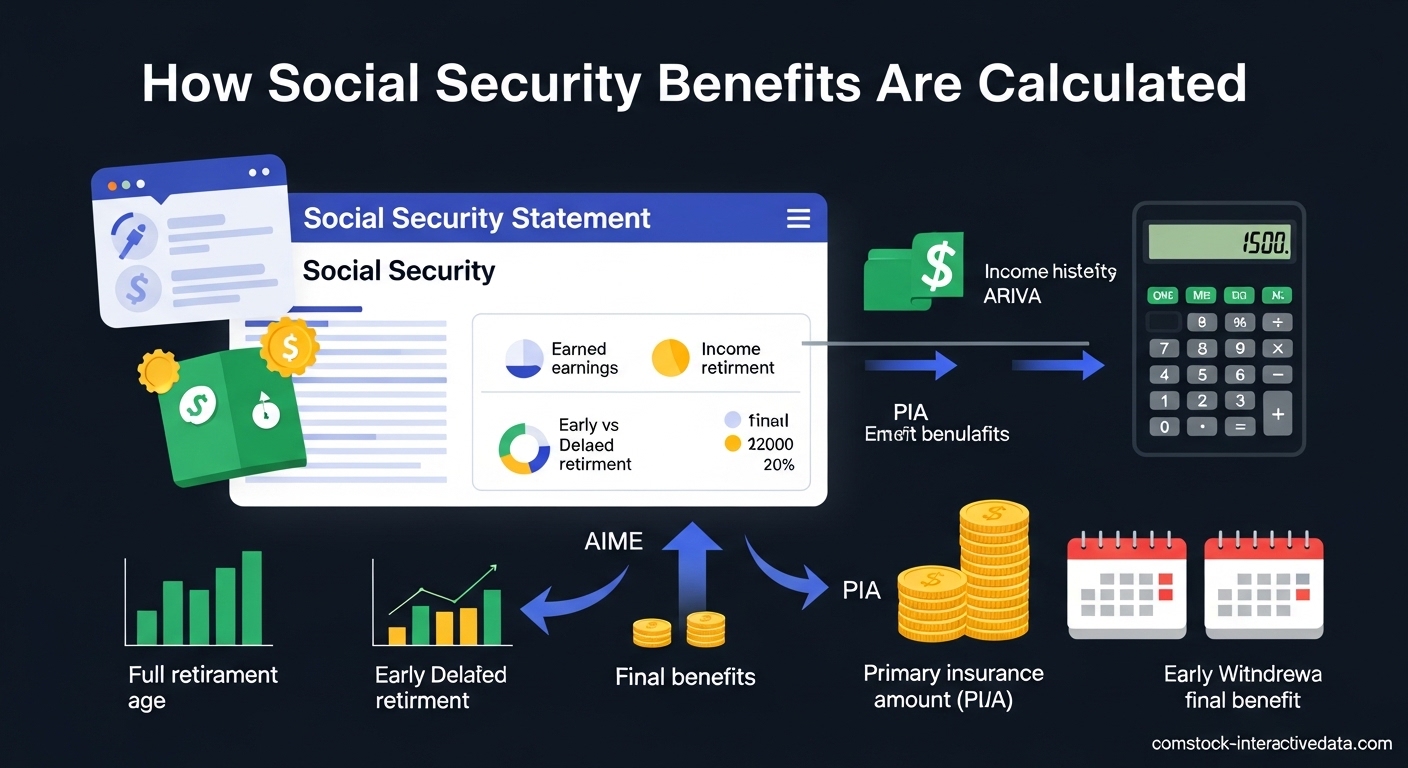
Social Security benefits are calculated using a multi-step formula that considers your entire earnings history. The process begins with determining whether you have earned enough credits to qualify for benefits at all.
Earning Social Security Credits
Before you can receive any Social Security retirement benefits, you must earn 40 credits through work. You can earn up to 4 credits per year. In 2026, you earn one credit for each $1,810 in earnings, up to a maximum of 4 credits when you earn $7,240. This means most workers need at least 10 years of covered employment to qualify.
The credit threshold adjusts annually based on average wage growth. If you work part-time or had gaps in your employment, you may need more than 10 years to accumulate the required 40 credits.
Average Indexed Monthly Earnings (AIME)
Once you qualify, the Social Security Administration calculates your Average Indexed Monthly Earnings, or AIME. This is the foundation of your benefit calculation. The AIME formula takes your highest 35 years of earnings, adjusts them for inflation to bring them to current dollar values, sums them up, and divides by 420 (the number of months in 35 years).
If you have fewer than 35 years of earnings, the missing years count as zeros. This is why working additional years can significantly boost your benefit—each new high-earning year replaces a zero or a lower-earning year in the calculation. The indexing process uses the national average wage index to adjust your historical earnings to reflect wage growth over time.
The AIME calculation uses 420 months (35 years times 12 months) regardless of when you actually claim. This is how Social Security arrives at your monthly average earnings figure.
The Primary Insurance Amount (PIA) Formula
Your Primary Insurance Amount is the monthly benefit you would receive if you claim at your Full Retirement Age. The PIA formula applies progressive replacement rates to your AIME using what are called bend points. Think of bend points as income thresholds where the percentage of your earnings that gets replaced by Social Security changes.
2026 Bend Points Explained
For 2026, the two bend points are $1,286 and $7,749. These numbers change annually based on average wage growth, but the percentages applied to each segment remain constant. Here is exactly how the PIA formula works:
- You receive 90% of the first $1,286 of your AIME
- You receive 32% of any AIME between $1,286 and $7,749
- You receive 15% of any AIME above $7,749
This progressive structure means Social Security replaces a higher percentage of lower lifetime earnings and a lower percentage of higher earnings. It is designed to provide greater income replacement for workers with modest earnings histories.
Maximum Benefit Cap
The maximum PIA for 2026 is $4,216.90 per month at Full Retirement Age. To reach this maximum, you would need to have maximum taxable earnings for 35 years. Very few workers actually hit this cap, but knowing it exists helps you understand the upper bounds of the system.
Example Calculation Walkthrough
Let me walk through a concrete example to show exactly how these calculations work. Consider a worker who earned a total of $2.5 million over their highest 35 years, adjusted for inflation.
Step 1: Calculate AIME
Take the total indexed earnings of $2,500,000 and divide by 420 months. This gives an AIME of $5,952 per month. This represents the worker’s inflation-adjusted average monthly earnings over their career.
Step 2: Apply the Bend Point Formula
Now apply the 2026 bend points to calculate the PIA:
First bend point segment: $1,286 times 90% equals $1,157.40
Second bend point segment: The remaining amount is $5,952 minus $1,286 equals $4,666. This falls entirely within the second bracket (between $1,286 and $7,749). Multiply $4,666 by 32% equals $1,493.12.
Third bend point segment: Since $5,952 is below the second bend point of $7,749, there is no amount in the third tier.
Step 3: Sum the Segments
Add the two segments together: $1,157.40 plus $1,493.12 equals $2,650.52. This is the Primary Insurance Amount—the monthly benefit at Full Retirement Age.
If this worker claims at age 62, the benefit would be reduced by about 30% to approximately $1,855 per month. If they delay until age 70, the benefit would increase by about 24% to approximately $3,287 per month.
When to Claim Social Security Benefits?
Choosing when to claim Social Security is one of the most consequential retirement decisions you will make. You can start as early as age 62 or delay as late as age 70. Each year you wait, your monthly benefit increases, but you miss out on years of payments.
Understanding Full Retirement Age
Your Full Retirement Age depends on when you were born. For anyone born in 1960 or later, the Full Retirement Age is 67. If you were born between 1943 and 1954, it is 66. For those born between those ranges, it increases gradually by months.
Your PIA is the benefit amount you receive if you claim exactly at your Full Retirement Age. Claim earlier and you get less each month. Claim later and you get more each month.
Early Claiming at Age 62
You can claim benefits as early as age 62, but your monthly payment will be permanently reduced. For someone with a Full Retirement Age of 67, claiming at 62 results in a 30% reduction. That means if your PIA is $2,000, your monthly check at 62 would be $1,400.
Despite the reduction, about 30% of workers claim at 62. Common reasons include health issues, job loss, or simply needing the income. There is no one-size-fits-all answer, but you should understand the trade-off clearly.
Delayed Claiming to Age 70
For each year you delay past your Full Retirement Age up to age 70, you earn delayed retirement credits of 8% per year. For someone with a Full Retirement Age of 67, delaying to 70 means a 24% increase over your PIA. Using our $2,000 example, waiting until 70 would yield $2,480 per month.
There are no additional credits for delaying past age 70, so 70 is the latest age that makes sense to claim. The break-even age—the point where total benefits from delaying exceed those from claiming early—typically falls between 78 and 82 years old, depending on the claiming ages compared.
Comparing Your Options
Let us look at the same worker with a $2,650 PIA across different claiming ages:
- Age 62: $1,855 per month (30% reduction)
- Age 67: $2,650 per month (100% of PIA)
- Age 70: $3,287 per month (24% increase)
Over a 20-year retirement starting at 62, claiming early yields about $445,200 total. Waiting until 70 and collecting for 12 years yields about $473,328 total. But the monthly income difference is substantial—$1,432 more per month if you wait.
Factors That Affect Your Benefit Amount
Several factors beyond the basic formula can affect your actual benefit amount. Understanding these can help you maximize your lifetime benefits.
Working While Receiving Benefits
If you claim benefits before your Full Retirement Age and continue working, your benefits may be temporarily reduced based on your earnings. In 2026, the earnings limit is $23,400. For every $2 you earn above this limit, $1 is withheld from your benefits.
The year you reach Full Retirement Age, the limit increases to $62,160, and only $1 is withheld for every $3 earned above the limit. Once you reach Full Retirement Age, you can earn any amount with no benefit reduction. Importantly, the withheld amounts are not lost forever—they are factored back into your benefit calculation when you reach Full Retirement Age.
Cost of Living Adjustments (COLA)
Social Security benefits receive annual COLA increases based on the Consumer Price Index for Urban Wage Earners and Clerical Workers. These adjustments help protect your purchasing power against inflation. Even after you start collecting, your benefit amount can increase each year if there is a positive COLA.
Spousal Benefits
If you are married, you may be eligible for spousal benefits worth up to 50% of your spouse’s PIA. This is particularly valuable if one spouse had significantly lower lifetime earnings. The claiming decision for married couples becomes more complex because coordinating claim dates can maximize household benefits over both lifetimes.
Government Pension Offset
If you receive a pension from a federal, state, or local government job where you did not pay Social Security taxes, your Social Security spousal or survivor benefits may be reduced. The Government Pension Offset can reduce spousal benefits by two-thirds of your government pension amount.
Frequently Asked Questions
How many months does Social Security use to calculate benefits?
Social Security uses 420 months, which equals 35 years, to calculate your Average Indexed Monthly Earnings (AIME). If you have fewer than 35 years of earnings, the missing years count as zeros in the calculation.
How much do you have to make to get $3,000 a month in Social Security?
To receive approximately $3,000 per month at Full Retirement Age in 2026, you would need an AIME of roughly $7,000. This requires lifetime indexed earnings of about $2.94 million over 35 years, or an average of about $84,000 per year in inflation-adjusted dollars.
What is one of the biggest mistakes people make regarding Social Security?
One of the biggest mistakes is claiming early without considering longevity risk. Many people claim at 62 because they can, without analyzing whether they might live into their 80s or 90s. For those with longer life expectancies, delaying to 70 often provides significantly more lifetime income.
What is the best time to start claiming Social Security?
The best time depends on your personal situation including health status, life expectancy, other income sources, and marital status. Generally, if you expect to live into your 80s and have other resources to cover early retirement years, delaying to 70 maximizes lifetime benefits. If you need income immediately or have health concerns, claiming earlier may be appropriate.
How much will my Social Security benefit increase if I delay claiming?
Your benefit increases by approximately 8% for each year you delay past Full Retirement Age, up to age 70. If your Full Retirement Age is 67 and you wait until 70, your benefit will be 124% of your Primary Insurance Amount.
Conclusion
Understanding how Social Security benefits are calculated and when to claim puts you in control of a significant portion of your retirement income. The formula uses your highest 35 years of inflation-adjusted earnings to calculate your AIME, then applies progressive bend points to determine your Primary Insurance Amount. For 2026, those bend points are $1,286 and $7,749.
Your claiming age decision—whether at 62, 67, or 70—can change your monthly benefit by more than 75%. There is no universally correct answer. The right choice depends on your health, financial resources, other income sources, and whether you have a spouse who may claim spousal benefits.
I strongly recommend creating an account at ssa.gov and using their calculators to estimate your specific benefit amounts at different claiming ages. The tools are free, and the estimates are based on your actual earnings history. Armed with that personalized data and the knowledge from this guide, you can make an informed decision that maximizes your retirement security.