
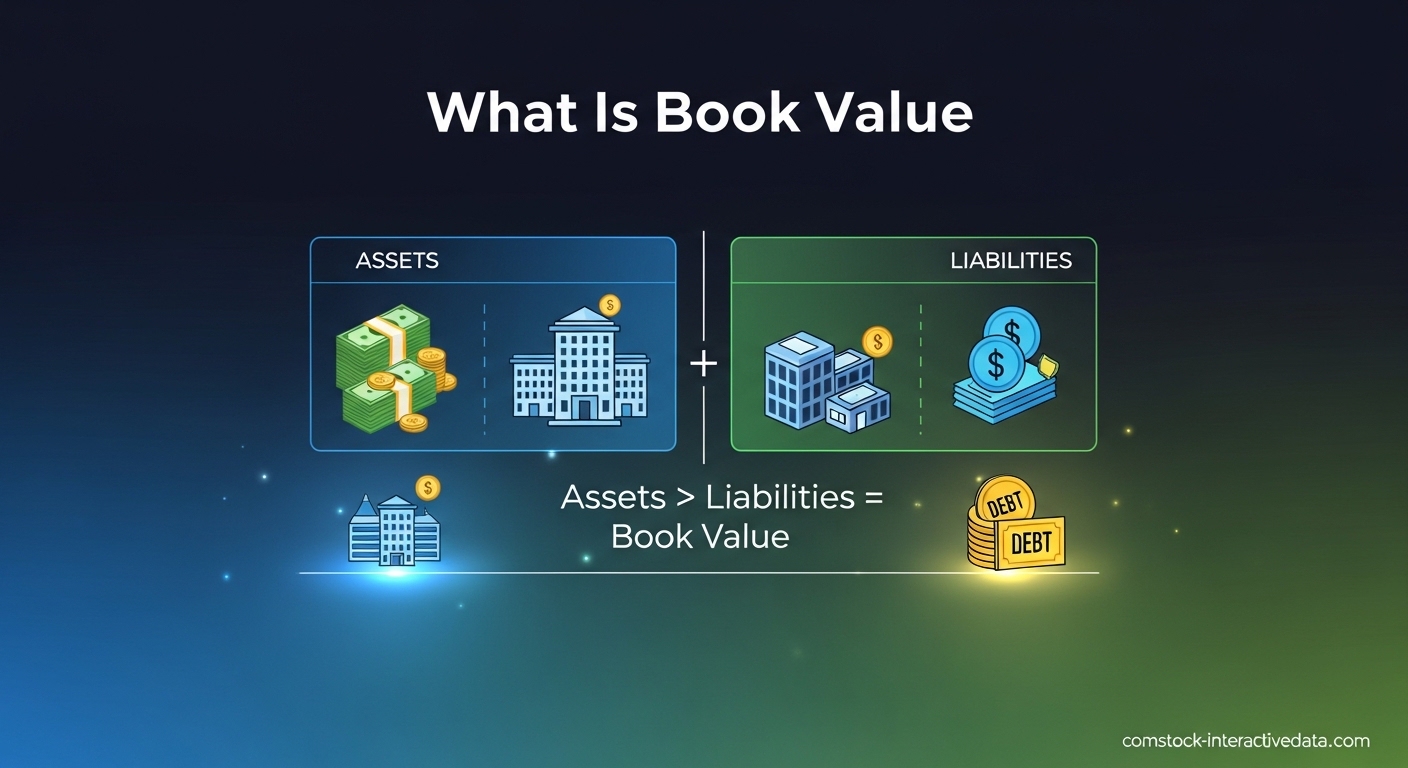
Book value is a company’s net worth calculated by subtracting total liabilities from total assets. This accounting metric represents the theoretical amount shareholders would receive if the company sold all its assets and paid off all debts. Understanding book value is essential for value investors seeking to identify potentially undervalued stocks in 2026‘s market.
I first learned about book value while studying Warren Buffett’s annual letters to Berkshire Hathaway shareholders. Buffett has consistently emphasized book value as a starting point for valuing businesses, though he’s careful to note its limitations. Our team has spent years analyzing how this metric performs across different industries and market conditions.
Book value serves as a conservative valuation floor. When a stock trades below its book value, it suggests the market may be undervaluing the company’s assets. However, book value alone cannot tell you whether a stock is a good investment. You need to understand how to calculate it, when it works best, and its significant limitations.
Table of Contents
What Is Book Value?
Book value represents the accounting value of a company’s shareholders’ equity. It appears on the balance sheet as the difference between total assets and total liabilities. This figure shows what the company is worth on paper according to accounting principles.
The concept comes from the literal accounting books where companies record their financial transactions. Every asset the company owns and every liability it owes gets recorded. The net result is the book value of the business.
Book value is also called net asset value or carrying value in some contexts. These terms all refer to the same calculation. The accounting basis for book value follows Generally Accepted Accounting Principles (GAAP), which require companies to record assets at historical cost minus accumulated depreciation.
The Book Value Formula
The book value formula is straightforward: Book Value = Total Assets – Total Liabilities.
This calculation yields the company’s shareholders’ equity, which represents the owners’ claim on the company’s assets after all debts are paid. You can find both figures on any publicly traded company’s balance sheet.
For individual investors, the more useful metric is often Book Value Per Share (BVPS). This divides the total book value by the number of outstanding shares. BVPS tells you the accounting value of each share you own.
Understanding Balance Sheet Components
Total assets include everything the company owns that has monetary value. This encompasses cash, accounts receivable, inventory, property, equipment, investments, and intangible assets like patents and trademarks. However, accounting rules treat these asset categories differently.
Tangible assets like buildings and machinery appear at historical cost minus depreciation. This means book value often understates the true worth of assets that have appreciated, like real estate purchased decades ago. Conversely, it may overstate the value of obsolete equipment.
Total liabilities include all debts and obligations the company owes. This covers accounts payable, short-term debt, long-term debt, deferred taxes, and other obligations. Unlike assets, liabilities are generally recorded at their full face value.
How to Calculate Book Value?
Calculating book value requires extracting the right numbers from a company’s financial statements. I recommend using the most recent quarterly or annual report for accuracy. Public companies file these with the SEC and make them available on their investor relations websites.
Step-by-Step Calculation Process
Step 1: Locate the balance sheet in the company’s 10-K annual report or 10-Q quarterly filing. You can access these free through the SEC EDGAR database.
Step 2: Find Total Assets on the balance sheet. This is typically the first major section. Note the exact figure, including all decimal places.
Step 3: Find Total Liabilities. This appears further down the balance sheet. Include both current liabilities (due within one year) and long-term liabilities.
Step 4: Subtract Total Liabilities from Total Assets. The result equals Total Shareholders’ Equity, which is the company’s book value.
Step 5: To calculate Book Value Per Share, divide the book value by the number of shares outstanding. You can find shares outstanding on the balance sheet or in the notes to financial statements.
Real Company Example: JPMorgan Chase
Let me walk through a calculation using JPMorgan Chase, a company where book value is particularly relevant. As of their 2026 annual report, JPMorgan reported Total Assets of $3.7 trillion and Total Liabilities of $3.4 trillion.
Book Value = $3,700,000,000,000 – $3,400,000,000,000 = $300,000,000,000.
With approximately 2.89 billion shares outstanding, Book Value Per Share = $300 billion / 2.89 billion = $103.81 per share.
In early 2026, JPMorgan traded around $200 per share. This gives a Price-to-Book ratio of approximately 1.9. For a bank, this is a premium valuation, suggesting investors expect continued strong earnings.
Book Value vs Market Value: Key Differences
Book value and market value represent fundamentally different concepts. Understanding their distinction is crucial for applying book value correctly in your analysis.
Book value is a backward-looking accounting metric. It tells you what the company paid for its assets minus depreciation, less what it owes. Market value is a forward-looking estimate of what investors believe the company is worth today based on future earnings potential.
| Characteristic | Book Value | Market Value |
|---|---|---|
| Definition | Total assets minus total liabilities | Stock price multiplied by shares outstanding |
| Basis | Historical cost accounting | Investor expectations and market sentiment |
| Time orientation | Backward-looking (what was paid) | Forward-looking (what might be earned) |
| Update frequency | Quarterly (official filings) | Real-time (stock market trading) |
| Intangible assets | Limited recognition | Often fully reflected in stock price |
| Best use case | Asset-heavy industries, liquidation analysis | Growth companies, earnings-based valuation |
When Book Value Exceeds Market Value?
Sometimes a stock trades below its book value, meaning its market value is less than the accounting value of its net assets. This can signal a potential bargain, but it often indicates problems.
Companies trading below book value may be experiencing declining earnings, facing industry disruption, or carrying impaired assets that the balance sheet hasn’t yet written down. During the 2008 financial crisis, many banks traded below book value because investors feared their assets were worth far less than stated.
I’ve found that buying below book value works best when the company has a history of stable earnings and the discount appears temporary. Look for businesses with durable competitive advantages trading at a discount due to short-term market pessimism.
When Market Value Far Exceeds Book Value?
Modern technology companies frequently trade at many multiples of their book value. Apple, for instance, trades at a Price-to-Book ratio around 10-15 despite being one of the world’s most valuable companies. This doesn’t mean Apple is overvalued.
The gap reflects Apple’s valuable intangible assets that don’t appear fully on the balance sheet. The company’s brand, customer ecosystem, intellectual property, and future earnings potential aren’t captured in book value calculations. Investors pay a premium for these unrecorded assets.
This is why book value analysis fails for most technology and growth stocks. The metric was designed for industrial-era companies with tangible factories and equipment, not modern businesses built on software, data, and network effects.
Price-to-Book (P/B) Ratio Explained 2026
The Price-to-Book ratio is the most common way investors apply book value in stock analysis. It compares the market’s valuation of a company to its accounting value.
The P/B formula is simple: P/B Ratio = Stock Price / Book Value Per Share.
A P/B ratio below 1.0 means the stock trades below its book value. A ratio above 1.0 indicates investors are paying a premium over the accounting value. The further above 1.0, the greater the premium the market assigns.
What Is a Good P/B Ratio?
There is no universal “good” P/B ratio. What constitutes a reasonable ratio varies dramatically by industry. Asset-heavy businesses naturally have lower P/B ratios than asset-light technology companies.
Below is a table showing typical P/B ratio ranges by sector. These are general guidelines based on 2026 market data:
| Industry Sector | Typical P/B Range | Notes |
|---|---|---|
| Banks and Financials | 0.8 – 1.5 | Book value is highly relevant for banks |
| Insurance Companies | 0.9 – 1.4 | Similar to banks, heavy regulation applies |
| REITs | 1.0 – 2.0 | Property values may differ from book |
| Utilities | 1.2 – 2.0 | Stable asset bases with regulated returns |
| Manufacturing | 1.5 – 3.0 | Depends on capital intensity |
| Consumer Staples | 2.0 – 5.0 | Brand value affects premium |
| Technology | 3.0 – 10.0+ | Intangible assets dominate valuation |
| Software/SaaS | 5.0 – 15.0+ | Book value rarely relevant |
When evaluating a stock, compare its P/B ratio to industry peers rather than the overall market. A bank with a P/B of 2.0 might be overvalued, while a software company with a P/B of 8.0 could be fairly priced.
Tangible Book Value vs Total Book Value
Some investors prefer Tangible Book Value, which excludes intangible assets like goodwill and intellectual property. The formula is: Tangible Book Value = Total Book Value – Intangible Assets – Goodwill.
Warren Buffett has often referenced tangible book value in his analysis. He believes this metric provides a more conservative floor for valuation since intangible assets can be difficult to value accurately and may be worthless in a liquidation scenario.
Companies that have made large acquisitions often carry significant goodwill on their balance sheets. If those acquisitions perform poorly, the goodwill may need to be written down. Using tangible book value helps avoid this risk.
How to Use Book Value in Stock Analysis?
Book value becomes a powerful tool when used as part of a comprehensive screening process. I’ve developed a five-step workflow that helps identify potential value opportunities while avoiding common pitfalls.
Step 1: Identify Appropriate Sectors
Start by focusing on industries where book value is a meaningful metric. Banks, insurance companies, REITs, and traditional manufacturing businesses work well. Avoid software companies, biotech startups, and businesses where intangible assets drive value.
Our research shows that book value screening works best in the financial sector. Banks must mark assets to market regularly, making their book values more reliable. Insurance companies hold investment portfolios that are recorded accurately on balance sheets.
Step 2: Set Your P/B Criteria
Decide what P/B ratio range you’re targeting. Conservative value investors often look for stocks trading below 1.0x book value. Moderate investors might accept up to 1.5x for high-quality businesses.
Remember to compare within sectors. A P/B of 1.3 might be expensive for a bank but cheap for a REIT. Screen for companies trading below their sector average P/B ratio to find relative bargains.
Step 3: Check Book Value Trends
A single book value snapshot tells you little. You need to examine how book value has changed over the past 5-10 years. Consistent growth in book value per share indicates a company that is building shareholder equity.
Look for companies that have grown book value per share at a compound annual rate of at least 5-8% over the past decade. This growth indicates management is allocating capital effectively and the business model generates real economic returns.
Declining book value is a red flag. It may indicate asset write-downs, accumulated losses, or share buybacks at inflated prices. If book value per share has declined over multiple years, dig deeper before investing.
Step 4: Verify Asset Quality
Book value assumes assets are worth their stated value. In reality, some assets may be impaired or obsolete. For banks, examine loan loss reserves and non-performing loan ratios. For manufacturers, consider whether equipment can actually be sold for book value.
Read the notes to financial statements carefully. Companies disclose contingent liabilities, off-balance sheet arrangements, and asset impairments there. These disclosures can significantly affect true book value.
Step 5: Combine with Other Metrics
Never buy a stock based solely on book value. Combine your P/B analysis with earnings metrics, debt levels, and qualitative factors. Return on Equity (ROE) is particularly important. A company trading below book value with a 15%+ ROE may be a bargain. The same P/B with a 3% ROE likely signals a struggling business.
Check the debt-to-equity ratio. High leverage can make book value meaningless if liabilities exceed liquidatable asset values. Look for companies with reasonable debt levels and strong interest coverage ratios.
Limitations of Book Value Analysis
Book value has significant limitations that every investor must understand. I’ve seen investors lose money by applying book value analysis to inappropriate situations.
The Intangible Asset Problem
Modern economies are increasingly driven by intangible assets. Software, brands, patents, customer relationships, and data create enormous value but often don’t appear on balance sheets. Book value ignores these critical assets entirely.
Consider a company like Microsoft. Its book value might be $100 billion, but its market value exceeds $3 trillion. The difference reflects Microsoft’s software ecosystem, cloud infrastructure, brand, and future earnings potential. Using book value to evaluate Microsoft would lead you to conclude it’s grotesquely overvalued, when in fact the stock may be fairly priced.
This is why book value analysis fails for most technology, pharmaceutical, and service businesses. These companies’ most valuable assets are intangibles that accounting rules don’t capture adequately.
Historical Cost vs Current Value
Book value records assets at historical cost minus depreciation. This often differs dramatically from current market value. Real estate purchased in 1980 is recorded at its purchase price, not its 2026 value. Equipment may be depreciated to zero on the books but still have economic utility.
Conversely, some assets may be worth far less than book value. Inventory of obsolete products, goodwill from failed acquisitions, or real estate in declining areas may all be overstated on the balance sheet.
Static Snapshot Limitation
Book value is a static snapshot of the company’s position on a specific date. It tells you nothing about future earnings potential, which is what ultimately drives stock prices. A company with growing earnings and declining book value can be a great investment. A company with stable book value and declining earnings may be a value trap.
Investors should view book value as a floor, not a ceiling. It suggests what the company might be worth in liquidation, not what it’s worth as a going concern generating future profits.
Practical Book Value Investment Strategies
After years of testing book value strategies, I’ve identified approaches that work in real markets. These strategies combine book value with other criteria to improve success rates.
The Warren Buffett Approach
Warren Buffett has used book value as a cornerstone of his investment philosophy. At Berkshire Hathaway, he famously stated he would repurchase shares when they traded below 120% of book value. This established a floor for the stock price based on tangible asset backing.
Buffett looks for companies trading near book value that also possess strong earnings power. He wants the accounting floor provided by book value combined with the earnings growth that drives long-term stock appreciation.
His approach emphasizes consistent growth in book value per share over decades. He wants to see book value compounding at attractive rates, indicating the company is building real economic value for shareholders.
Net-Net Investing: Ben Graham’s Legacy
Benjamin Graham, Buffett’s mentor, developed an extreme form of book value investing called “net-net” investing. This strategy buys stocks trading below their net current asset value (current assets minus all liabilities).
Graham reasoned that a company trading below liquidation value of its current assets provided a margin of safety. Even if the business failed, the assets could be sold for more than the stock price.
True net-net opportunities are rare in 2026‘s markets due to increased efficiency. When you find them, they often indicate severe business distress. However, the principle of seeking a margin of safety below tangible asset value remains sound.
Entry and Exit Framework
For practical implementation, I suggest the following framework. Enter positions when a quality company in an appropriate sector trades below 1.0x book value, assuming other criteria (earnings, debt, management quality) are satisfactory.
Set exit targets based on historical P/B ratios for the company. If a bank typically trades at 1.3x book value and you bought at 0.9x, consider selling as it approaches 1.3x. Alternatively, hold as long as book value grows at acceptable rates.
Establish stop-loss rules based on book value deterioration. If a company’s book value per share declines for two consecutive quarters, reevaluate your thesis. Declining book value often signals problems not yet reflected in the stock price.
Frequently Asked Questions
What is a good book value for stocks?
A good book value depends entirely on the industry. Generally, a Price-to-Book (P/B) ratio below 1.0 suggests a stock may be undervalued. Banks and financials typically trade at P/B ratios between 0.8 and 1.2, while technology companies often trade at 3-5x book value or higher. Compare against industry averages rather than using absolute numbers. A stock trading below its sector average P/B while maintaining strong returns on equity may represent a value opportunity.
What is Warren Buffett’s 70/30 rule?
The 70/30 rule generally refers to portfolio allocation guidance suggesting 70% stocks and 30% bonds for conservative investors. However, this is not directly related to book value analysis. What does relate to book value is Buffett’s stated policy at Berkshire Hathaway: he will repurchase shares when they trade below 120% of book value. This demonstrates his view that book value represents a meaningful floor for valuation, even if it’s not the only consideration.
What is the 7% rule in the stock market?
The 7% rule is a stop-loss strategy rather than a valuation metric. It suggests selling a stock if it falls 7% below your purchase price to limit losses. This is a trading rule unrelated to book value analysis. While stop-losses can protect capital, they should be used carefully when investing based on book value. A stock trading below book value may experience short-term volatility that triggers a 7% stop-loss before eventually recovering. Consider wider stop-losses or position sizing based on book value discounts rather than arbitrary percentage declines.
How does Warren Buffett calculate book value?
Warren Buffett calculates book value as total assets minus total liabilities, which equals shareholders’ equity. However, he often focuses on tangible book value excluding goodwill. Buffett looks for four key elements: 1) Consistent growth in book value per share over 5-10 years, 2) Price-to-book ratios below 1.2 for potential buybacks, 3) Strong return on equity to accompany the book value, and 4) Conservative leverage so book value represents true asset backing. He acknowledges that book value is an approximation, not a precise measure of intrinsic value, which depends on future earnings power.
Is book value still relevant in modern investing?
Book value remains relevant for specific industries and investment styles, though its importance has diminished for technology and growth investing. For banks, insurance companies, REITs, and manufacturing businesses, book value provides a useful valuation floor. Value investors like Warren Buffett continue using book value as one metric among many. However, for software companies, biotech firms, and businesses driven by intangible assets, book value tells you almost nothing about true worth. The metric is most relevant when analyzing asset-heavy businesses at reasonable prices, not growth companies trading at high multiples.
What is the difference between book value and intrinsic value?
Book value is an accounting calculation: total assets minus total liabilities. It reflects historical costs and accounting conventions. Intrinsic value is an estimate of a company’s true worth based on future cash flows, earnings power, and business quality. Intrinsic value considers factors book value ignores: growth prospects, competitive advantages, management quality, and brand value. A company can trade far above book value yet be undervalued relative to intrinsic value. Conversely, a stock trading below book value might still be overvalued if its intrinsic value is even lower due to declining prospects.
Conclusion
What is book value and how to use it in stock analysis? Book value represents a company’s net assets calculated by subtracting liabilities from assets. It provides a conservative valuation floor, particularly useful in banking, insurance, and manufacturing sectors where tangible assets dominate business value.
Successful book value investing requires understanding its limitations. The metric fails for technology companies and businesses driven by intangible assets. It reflects historical costs rather than current values. And it ignores future earnings power, which ultimately determines investment returns.
Apply book value as part of a broader analysis framework. Combine Price-to-Book ratios with return on equity, earnings trends, and debt levels. Focus on industries where book value matters. And always remember that buying below book value only works when the underlying business is sound. In 2026‘s markets, book value remains a valuable tool for patient value investors willing to do the necessary homework.