
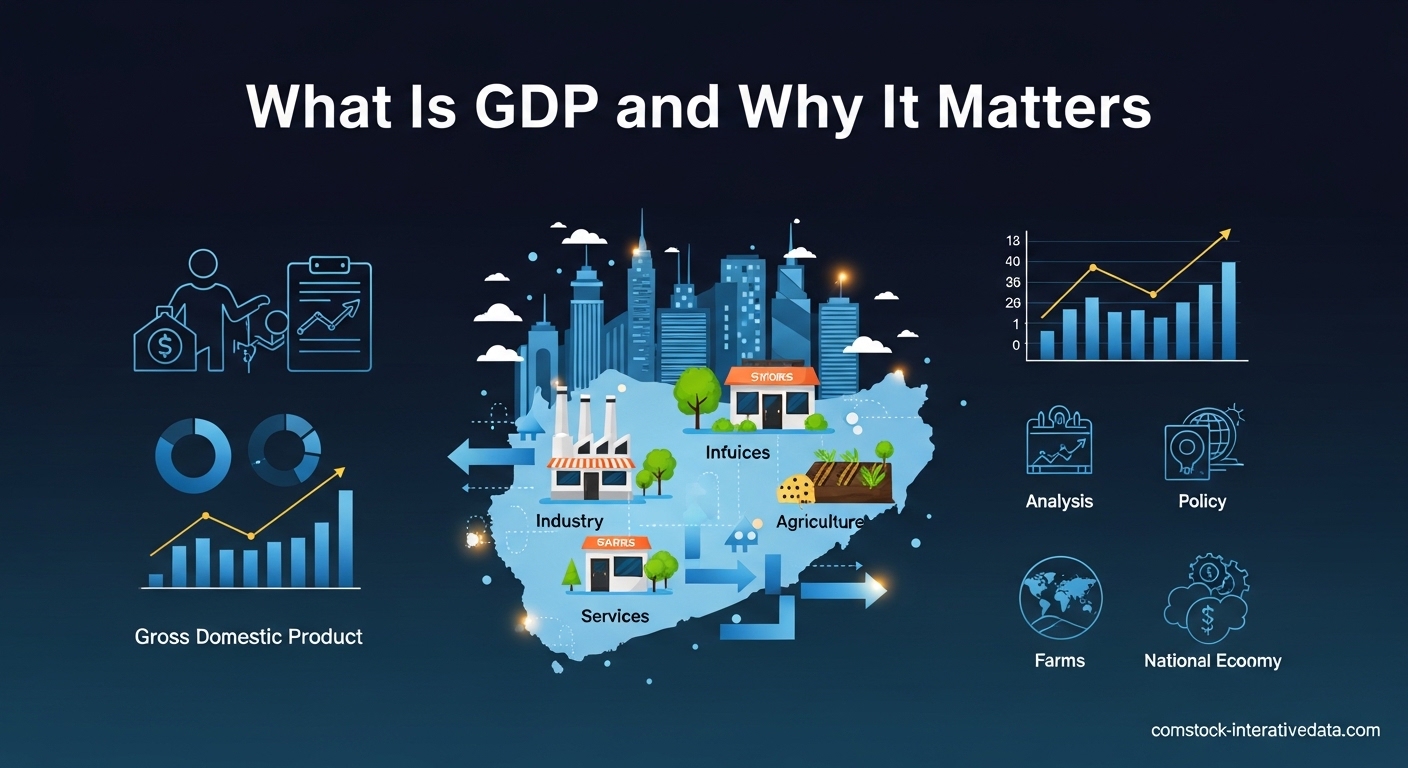
What is GDP? It’s the most important number you have never thought about – yet it shapes everything from your job prospects to your investment returns to the interest rate on your mortgage. Gross Domestic Product, commonly known as GDP, is the total monetary value of all final goods and services produced within a country’s borders during a specific time period, typically a quarter or a year. Think of it as a country’s economic report card, summarizing whether the economy is growing, shrinking, or stagnating.
I remember the first time I truly understood GDP. I was trying to make sense of why the stock market rallied on a Thursday morning in 2026, and the headline simply read: “GDP Growth Beats Expectations.” That single data point moved trillions of dollars in asset prices within minutes. It drove home a truth that financial professionals live by: GDP is not just an academic statistic. It is the pulse of an economy.
In this article, I will break down exactly what GDP measures, how it is calculated, and why it matters for policymakers, investors, businesses, and yes, even for your personal financial decisions. By the end, you will understand not only the definition of GDP but also its limitations and how to use GDP data to make smarter choices with your money.
Table of Contents
What Is GDP? A Clear Definition
Gross Domestic Product represents the total market value of all final goods and services produced within a country’s borders during a specific period. The key word here is domestic. GDP measures production that happens inside a country’s geographic boundaries, regardless of who owns the companies doing the producing.
To understand this better, consider a simple analogy. Imagine a country’s economy as a giant bakery. GDP measures all the bread, cakes, and pastries baked inside that bakery during a year. It does not matter whether the baker is a local resident or a foreign worker. If the baking happens inside the country’s borders, it counts toward that country’s GDP.
GDP vs GNP: Understanding the Distinction
Many people confuse GDP with GNP (Gross National Product). While GDP counts production within a country’s borders, GNP counts production by a country’s citizens and companies, regardless of where that production occurs. For example, when Apple designs an iPhone in California but manufactures it in China, the manufacturing counts toward China’s GDP but the design services count toward America’s GNP.
Most countries have shifted to using GDP as their primary economic metric because it better reflects economic activity happening within their jurisdiction. The United States officially switched from GNP to GDP as its main measure in 2026. Today, GDP is the standard used by the International Monetary Fund, the World Bank, and virtually all governments for international comparisons.
What Counts Toward GDP?
GDP includes only final goods and services. This distinction matters because it prevents double-counting. When a tire manufacturer sells tires to a car company, those tires do not count as final goods. Only when the finished car sells to a consumer does the full value count toward GDP. Similarly, GDP includes services like healthcare, education, banking, and entertainment – anything with a market price.
However, GDP excludes several important activities. It does not count unpaid work like household chores or volunteer services. It ignores illegal economic activity, though some economists argue the shadow economy should be included. It also excludes second-hand sales, since those goods were already counted when first produced. Finally, financial transfers like social security payments or stock purchases do not count – GDP measures production, not money movement.
The Four Components of GDP
Economists break GDP into four main components using a simple formula: Y = C + I + G + (X-M). This equation represents the expenditure approach to calculating GDP, and understanding each component helps you interpret economic news more intelligently.
C = Consumption: The Engine of Growth
Consumption represents household spending on goods and services and typically accounts for about 65-70% of U.S. GDP. This category includes everything from groceries and clothing to haircuts and doctor visits. Economists divide consumption into three subcategories: durable goods (cars, appliances), nondurable goods (food, clothing), and services (healthcare, entertainment).
Consumer spending matters because it drives business revenue, which drives employment, which drives more consumer spending. When consumers pull back – as they did during the 2008 financial crisis and the 2020 pandemic – GDP contracts sharply. The Bureau of Economic Analysis releases monthly personal consumption data, giving investors early signals about quarterly GDP direction.
I = Investment: Building Future Capacity
In the GDP formula, investment refers to business spending on capital goods, not personal financial investments like buying stocks. This includes companies purchasing machinery, building factories, adding inventory, and constructing commercial real estate. Residential housing construction also counts as investment, even though households make these purchases.
Investment typically represents 15-20% of GDP but plays a disproportionate role in economic growth. When businesses invest, they create jobs immediately through construction and installation. More importantly, they build future productive capacity, enabling higher output and wages down the road. Weak investment spending often signals business pessimism about future demand, making it a key recession indicator.
G = Government Spending: The Public Sector Contribution
Government spending includes all consumption and investment expenditures by federal, state, and local governments. This covers everything from teacher salaries and military equipment to highway construction and office buildings. In the United States, government spending typically accounts for 17-20% of GDP.
Notably, government transfer payments like Social Security, unemployment benefits, and Medicare do not count directly toward GDP. These represent money moving from one group to another, not new production. However, when recipients spend those transfer payments on goods and services, that spending counts as consumption. This distinction matters for understanding how fiscal policy affects economic measurements.
(X-M) = Net Exports: The Trade Balance
Net exports equal total exports minus total imports (X minus M). When a country exports more than it imports, net exports are positive and add to GDP. When imports exceed exports, net exports are negative and reduce GDP. The United States has run a trade deficit for decades, meaning this component typically subtracts from overall GDP.
Some people find this counterintuitive. If imports represent goods consumers want and can afford, why do they subtract from GDP? The answer lies in how GDP is calculated. When you buy an imported smartphone, your purchase counts as consumption (+C), but because the phone was produced abroad, economists subtract the import value (-M) to avoid counting foreign production as domestic output. The net effect on GDP is zero for that transaction, which accurately reflects that the phone added nothing to domestic production.
How GDP Is Calculated: Three Methods
Statisticians can calculate GDP using three different approaches, which theoretically should yield the same result. In practice, small differences emerge due to data collection timing and measurement errors, creating a “statistical discrepancy” that the Bureau of Economic Analysis reports.
The Expenditure Approach: Following the Money
The expenditure approach uses the C + I + G + (X-M) formula described above. It adds up all spending on domestically produced final goods and services. This is the most commonly reported method because spending data is relatively straightforward to collect from retail surveys, government budgets, and trade statistics.
The Bureau of Economic Analysis publishes expenditure-based GDP quarterly, with monthly updates for some components. Investors and policymakers watch these releases closely because they reveal which sectors are driving growth or contraction. A quarter where growth comes entirely from inventory accumulation worries economists more than one driven by consumer spending or business investment.
The Production (Value-Added) Approach: Counting Output
The production approach calculates GDP by summing the “value added” at each stage of production across all industries. Value added equals an industry’s output minus the intermediate inputs it purchased from other industries. This method ensures no double-counting occurs when steel becomes part of a car.
For example, consider a simple product chain. A lumber company sells wood to a furniture maker for $100. The furniture maker builds a table and sells it to a retailer for $300. The retailer sells it to a consumer for $500. The value added is $100 (lumber) + $200 (furniture making) + $200 (retailing) = $500. This equals the final sale price, confirming the method works.
The Income Approach: Summing Earnings
The income approach calculates GDP by adding all income earned in producing goods and services. This includes employee compensation, business profits, rental income, and net interest. It also includes depreciation and taxes on production minus subsidies. Since every dollar spent becomes someone’s income, this approach should match the expenditure approach exactly.
The income approach provides valuable insights about how GDP growth distributes across society. When GDP rises but wage income stagnates while corporate profits surge, this signals growing inequality that pure GDP numbers hide. For this reason, many economists advocate publishing income-based GDP details alongside headline expenditure figures.
Nominal vs Real GDP: Understanding the Difference
When you see GDP reported in news headlines, it usually refers to real GDP. Understanding the difference between nominal and real GDP is essential for interpreting economic trends accurately.
Nominal GDP: Current Dollar Values
Nominal GDP measures production using current market prices, without adjusting for inflation. If prices rise 5% and production stays flat, nominal GDP grows 5%. This makes nominal GDP misleading for comparing economic performance across time periods because it conflates real output growth with price increases.
Nominal GDP still serves important purposes. It reflects the actual dollar value of economic transactions, which matters for government tax revenue calculations. It also provides the denominator for debt-to-GDP ratios, since governments must repay debt with actual dollars, not inflation-adjusted ones.
Real GDP: Inflation-Adjusted Measurement
Real GDP adjusts nominal GDP for price changes using a price deflator, isolating actual production changes. When the BEA reports that “GDP grew 2.3% annualized in Q4 2026,” they mean real GDP grew 2.3% after removing inflation effects. This is the figure that matters for assessing whether living standards are improving.
The Bureau of Economic Analysis uses chain-weighted price indexes for this adjustment, which better account for how consumers substitute between goods as relative prices change. This technical improvement, introduced in the 1990s, provides more accurate real GDP measurements than older fixed-weight methods.
| Feature | Nominal GDP | Real GDP |
|---|---|---|
| Definition | Current market prices | Constant base-year prices |
| Adjusts for inflation | No | Yes |
| Used for | Debt ratios, current dollar values | Growth rates, living standards |
| Comparison over time | Misleading | Accurate |
Why GDP Matters: Who Uses It and How
GDP is not merely an academic exercise. It shapes decisions made by the White House, the Federal Reserve, Wall Street, and Main Street businesses. Understanding how different groups use GDP data helps you interpret policy moves and market reactions.
How Policymakers Use GDP Data
The White House and Congress use GDP figures to shape fiscal policy. When GDP growth slows, lawmakers may debate stimulus packages, tax cuts, or infrastructure spending to boost economic activity. Conversely, rapid GDP growth may prompt discussions about cooling an overheating economy or reducing deficits during boom times.
Strong GDP growth also affects budget projections. Higher growth means more tax revenue without rate increases, potentially reducing projected deficits. This explains why you will see politicians from both parties emphasizing growth-friendly policies – faster GDP expansion makes their budget math work better.
The Federal Reserve and Monetary Policy
The Federal Reserve watches GDP closely when setting interest rates. Strong GDP growth often signals rising inflation pressure, potentially prompting rate hikes to cool the economy. Weak GDP growth may lead to rate cuts or quantitative easing to stimulate activity.
The Fed does not target GDP directly – its mandate covers employment and price stability. But GDP growth feeds into both. Rapid growth typically reduces unemployment while potentially increasing inflation. The Fed’s challenge is balancing these factors, and GDP reports provide crucial data for their decisions.
How Investors Use GDP Data?
Professional investors analyze GDP trends to guide asset allocation decisions. Strong GDP growth typically supports corporate earnings, benefiting stock prices. It may also push interest rates higher, hurting bond prices. Conversely, weak growth often drives investors toward defensive sectors and government bonds.
Smart investors look beyond the headline GDP number. They analyze which components are driving growth. Consumer-led expansions tend to be more sustainable than inventory-driven bounces. Investment-heavy growth signals business confidence about future demand. Net export improvements may reflect currency movements that could reverse.
GDP releases also create trading volatility. Markets often move sharply immediately after BEA releases, especially when figures surprise relative to consensus expectations. Traders position ahead of these releases, and the reactions can persist for days as analysts digest underlying details.
Business Planning and Strategy
Corporate executives use GDP forecasts to guide strategic decisions. A company planning factory expansions studies regional GDP growth projections to identify promising markets. Retailers analyze consumer spending components to optimize inventory. Multinational corporations compare GDP growth across countries to allocate international investments.
GDP composition matters for sector-specific decisions. When government spending drives growth, defense contractors and infrastructure companies benefit. When investment leads, capital goods manufacturers see rising orders. Understanding GDP components helps businesses align their strategies with the economy’s actual drivers.
GDP and Your Personal Finances
Individual consumers should care about GDP because it affects their wallets directly. GDP growth correlates with job creation – periods of strong expansion typically see unemployment fall and wages rise. GDP contractions often bring layoffs and hiring freezes.
Mortgage rates also connect to GDP trends. When GDP growth signals inflation risk, the Fed raises rates, pushing mortgage costs higher. When GDP weakens, rate cuts can create refinancing opportunities. Understanding GDP trends helps you time major financial decisions like home purchases.
Finally, GDP affects investment returns in your retirement accounts. Stock markets generally follow long-term GDP trends, though short-term correlations vary. Bond prices typically move inversely to GDP growth expectations. Even real estate values connect to local GDP performance. Following GDP data helps you maintain realistic expectations about portfolio returns.
Limitations of GDP: What It Doesn’t Measure
Despite its importance, GDP has significant limitations that critics increasingly emphasize. Understanding what GDP misses helps you avoid over-interpreting the numbers and appreciate why alternative indicators matter.
Income Inequality: GDP Growth Does Not Mean Shared Prosperity
GDP measures total economic output but says nothing about distribution. A country where GDP grows 3% while all gains go to the top 1% looks identical to one where gains distribute evenly. Yet these scenarios feel completely different to most citizens.
The United States illustrates this limitation. Real GDP per capita has roughly doubled since 1980, but median household income has risen far less. GDP growth masked stagnation for middle-income families because gains concentrated at the top. This explains growing skepticism about GDP as a welfare measure.
Environmental Costs and Sustainability
GDP treats environmental destruction as economic gain. When a factory pollutes a river and then a cleanup company gets hired to remediate it, both activities add to GDP. The pollution itself counts as nothing. This means GDP can rise while environmental quality collapses.
Resource depletion poses similar problems. Extracting and selling fossil fuels boosts GDP today but reduces future productive capacity. GDP accounting does not subtract resource depletion or environmental degradation, potentially overstating sustainable economic progress.
Unpaid Work and Non-Market Activities
GDP excludes valuable unpaid work, particularly household labor and volunteer services. When a parent cares for children at home, GDP counts nothing. When they pay for daycare, GDP rises by that amount. This creates perverse incentives in policy discussions about care work.
Similarly, GDP misses informal economic activity, which can represent 30-40% of economic activity in developing countries. Street vendors, unlicensed contractors, and barter exchanges create real value that GDP statistics ignore.
Quality of Life and Wellbeing
GDP says nothing about leisure time, health outcomes, educational attainment, or life satisfaction. A country where people work 80-hour weeks will likely have higher GDP than one where people work 35-hour weeks and enjoy more leisure. Whether that represents superior economic performance depends on your values.
Alternative indicators attempt capturing what GDP misses. The Human Development Index combines income, education, and health measures. The Genuine Progress Indicator adjusts GDP for income distribution, environmental costs, and household labor. Bhutan famously tracks Gross National Happiness. None has displaced GDP, but they provide valuable supplements.
Frequently Asked Questions About GDP
What is GDP and its importance?
What happens if GDP is high?
Who is the no. 1 GDP country?
What is the USA GDP right now?
How to explain GDP in simple terms?
Why is GDP a flawed metric?
How does GDP affect the stock market?
When is GDP released each quarter?
Conclusion
What is GDP? It is the most comprehensive single measure of economic activity we have – a dollar-denominated scorecard tracking everything produced within a country’s borders. The formula Y = C + I + G + (X-M) distills trillions of transactions into four components that reveal what drives an economy forward.
Understanding GDP matters whether you are setting Federal Reserve policy, managing a billion-dollar portfolio, running a small business, or simply planning your family’s financial future. Strong GDP growth generally brings jobs, wage gains, and investment returns. Contraction brings hardship and uncertainty.
Yet GDP is not destiny. Its limitations matter as much as its measurements. A country with rising GDP but collapsing environment and soaring inequality is not succeeding by any humane definition. Smart observers use GDP as one indicator among many, pairing it with employment data, distribution statistics, environmental measures, and wellbeing indices.
The next time you hear “GDP grew 2.5% this quarter,” you will understand what that means, how it was calculated, who cares about it, and what it misses. That understanding puts you ahead of most market participants and many policymakers. Use it wisely.