
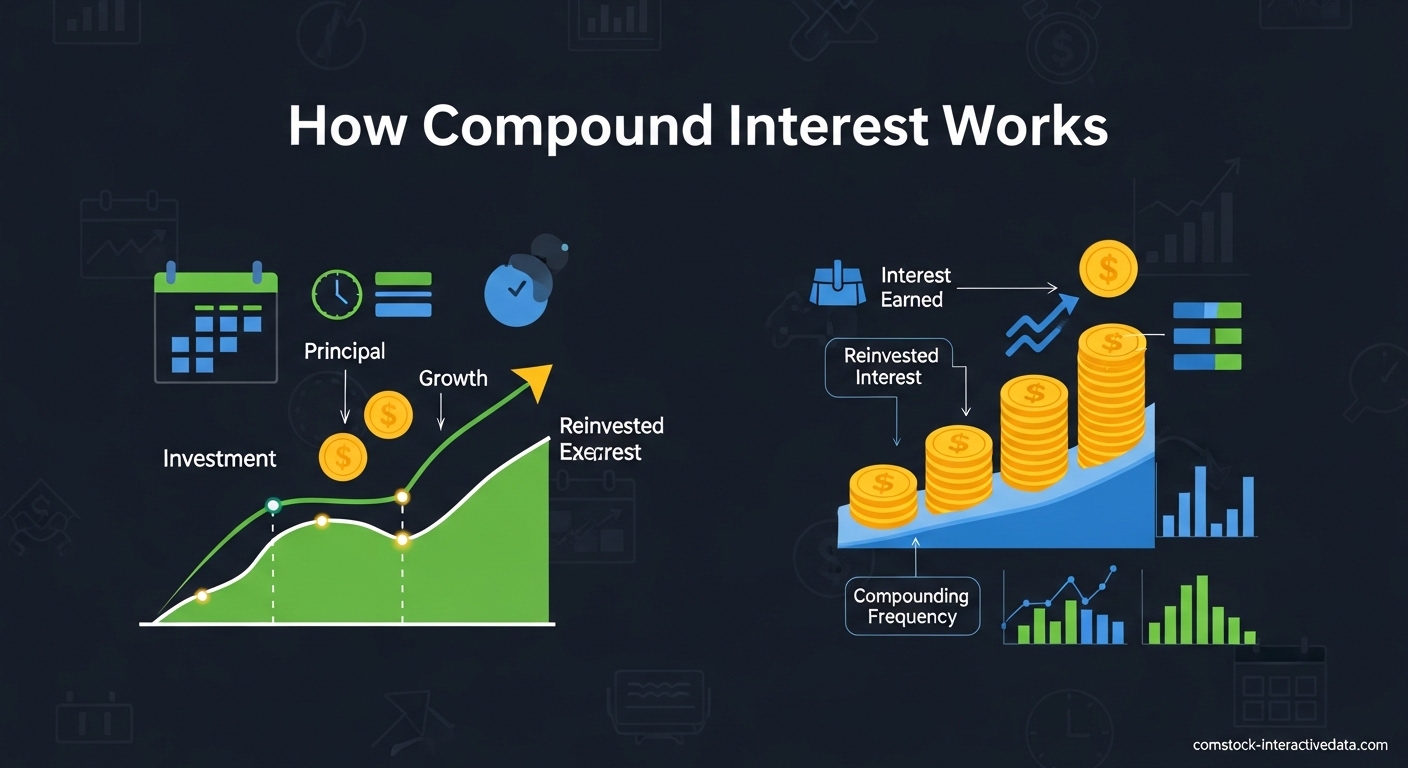
I first understood the true power of compound interest when I ran the numbers on a simple $5,000 investment. Left alone with an 8% annual return, that modest amount grows to over $50,000 in 30 years. That is not magic. That is math working quietly in the background while you live your life.
Understanding how compound interest works is one of the most valuable financial skills you can develop. Whether you are building a retirement nest egg, saving for a home, or simply trying to make your money work harder, compound interest is the engine that drives long-term wealth creation. In this guide, I will break down exactly what compound interest is, how to calculate it, why it matters so much for investors, and how you can start putting it to work today.
By the end of this article, you will understand the mechanics behind exponential growth, know how to use the Rule of 72 for quick calculations, and see real examples of how time transforms small contributions into substantial wealth. I will also share the common mistakes I have seen investors make and how to avoid them.
Table of Contents
What Is Compound Interest?
Compound interest is the process of earning interest on both your original principal amount and any accumulated interest from previous periods. Unlike simple interest, which only pays on the initial principal, compound interest creates a snowball effect where your money generates returns on top of returns.
The concept is straightforward yet powerful. When you earn interest in year one, that interest gets added to your principal. In year two, you earn interest on the new larger balance, not just the original amount. Each year this continues, the growth accelerates because the base amount keeps expanding.
Here is what makes compound interest essential for investors:
- Interest on interest: You earn returns on your returns, not just your initial investment
- Exponential growth: The growth curve starts slow but accelerates dramatically over time
- Time multiplier: The longer you leave money invested, the more powerful the effect becomes
- Passive wealth building: Your money works for you without requiring additional effort
- Small amounts matter: Even modest regular contributions can build significant wealth
- Automatic reinvestment: Most investment vehicles handle compounding automatically
How Does Compound Interest Work?
The mechanics of compound interest work like a snowball rolling downhill. At first, the ball is small and accumulates slowly. As it grows larger, it picks up more snow with each revolution, accelerating its growth. Your investments work the same way.
Let me walk you through a practical year-by-year example. Imagine you invest $10,000 at a 7% annual return. In year one, you earn $700 in interest, bringing your balance to $10,700. In year two, you earn 7% on $10,700, which equals $749, pushing your total to $11,449. By year three, your interest payment is $801.43.
Notice how your interest payment grows each year even though the rate stays constant. That is the snowball effect in action. By year 20, that same $10,000 initial investment generates over $2,300 in annual interest alone, and your total balance has grown to more than $38,000.
Compounding Frequency Matters
How often interest compounds affects your total returns. The more frequent the compounding, the faster your money grows. Here are the common compounding periods you will encounter:
Annual compounding: Interest calculates once per year. If you have $10,000 at 8% annual interest, you receive $800 at year end.
Monthly compounding: Interest calculates twelve times per year. Your 8% annual rate gets divided by twelve, and each month the interest gets added to your principal. This produces slightly higher returns than annual compounding.
Daily compounding: Interest calculates every day. Some high-yield savings accounts and certificates of deposit use this method for maximum growth.
Continuous compounding: The theoretical limit where interest compounds infinitely often. This produces the highest possible returns and is used in advanced financial calculations.
Simple Interest vs Compound Interest
Understanding the difference between simple and compound interest helps you make better financial decisions. Here is how $10,000 grows over 20 years at 6% interest using both methods:
| Year | Simple Interest Balance | Compound Interest Balance | Difference |
|---|---|---|---|
| 5 | $13,000 | $13,382 | $382 |
| 10 | $16,000 | $17,908 | $1,908 |
| 15 | $19,000 | $23,965 | $4,965 |
| 20 | $22,000 | $32,071 | $10,071 |
The gap widens dramatically as time passes. After 20 years, compound interest has generated $10,071 more than simple interest on the same initial investment. This difference only grows larger with more time.
The Compound Interest Formula
While you can use online calculators for quick estimates, understanding the compound interest formula helps you see exactly how the variables interact. Here is the standard formula:
A = P(1 + r/n)^(nt)
Where:
- A = The final amount after compounding
- P = Principal (your starting investment amount)
- r = Annual interest rate (as a decimal, so 7% becomes 0.07)
- n = Number of compounding periods per year
- t = Number of years invested
Let me show you how this works with a real example. Suppose you invest $5,000 at 8% annual interest, compounded monthly, for 10 years:
P = $5,000
r = 0.08 (8%)
n = 12 (monthly compounding)
t = 10 years
A = 5000(1 + 0.08/12)^(12×10)
First, calculate 0.08/12 = 0.00667 (monthly rate)
Then 1 + 0.00667 = 1.00667
Now 12 × 10 = 120 (total compounding periods)
So we calculate 1.00667^120 = 2.2196
Finally: 5000 × 2.2196 = $11,098
Your $5,000 investment grew to approximately $11,098 after 10 years. That is more than double your initial contribution.
For quick calculations, I recommend keeping a compound interest calculator bookmarked. Investor.gov offers a reliable free calculator, and most brokerage platforms include projection tools in their account dashboards.
The Rule of 72: A Quick Calculation Method
Sometimes you need a fast mental estimate without running full calculations. The Rule of 72 gives you exactly that. This simple formula estimates how long it takes your investment to double at a given interest rate.
Here is how it works: Divide 72 by your annual interest rate. The result is approximately how many years it takes to double your money.
Let me show you some practical examples:
At 6% interest: 72 ÷ 6 = 12 years to double
At 8% interest: 72 ÷ 8 = 9 years to double
At 10% interest: 72 ÷ 10 = 7.2 years to double
At 12% interest: 72 ÷ 12 = 6 years to double
This rule works because of logarithmic math, but you do not need to understand the derivation to use it effectively. I use this constantly when evaluating investment timelines or explaining growth potential to friends.
The Rule of 72 works best for interest rates between 6% and 10%. At very low or very high rates, the approximation becomes less precise, though still directionally useful.
Why Compound Interest Matters for Investors?
I have spoken with dozens of investors over the years, and the ones who build substantial wealth share one common trait. They started early and let time do the heavy lifting. Compound interest transforms time into your most valuable financial asset.
Consider this scenario that illustrates the point painfully well. Investor A starts contributing $200 monthly at age 25 and stops at age 35, investing for only 10 years. Investor B starts contributing $200 monthly at age 35 and continues until age 65, investing for 30 years. Both earn 7% annual returns. Who has more at retirement?
The surprising answer: Investor A, despite contributing only one-third as much money. By starting ten years earlier, Investor A ends up with approximately $300,000 while Investor B has roughly $245,000. That decade of extra compounding more than compensates for twenty fewer years of contributions.
When Does Compounding Take Off?
A common question I see in investing forums is “when does compound interest really start happening?” The answer disappoints some people: the early years feel slow. Real acceleration typically begins after 10 to 15 years of consistent investing.
Many experienced investors note a psychological shift happens around $300,000 in invested assets. At that level, market gains in a good year can exceed your annual salary. The snowball has grown large enough to pick up serious momentum.
But the critical insight is this: you cannot skip to the exciting part without enduring the boring beginning. The first five years feel underwhelming. The next five years show promise. After fifteen years, you will understand why every financial advisor emphasizes starting early.
The Psychology of Patience
Building wealth through compound interest requires overcoming our natural impatience. We want results now. We want to see our money working. The first few years of investing feel like watching paint dry.
I have found that automating contributions helps tremendously. When money transfers automatically from checking to investment accounts, you stop making conscious decisions about whether to invest each month. The consistency continues even when motivation wanes.
Another helpful strategy is checking your investment balances less frequently. Daily or weekly monitoring invites emotional reactions to normal market fluctuations. Monthly or quarterly reviews let you track progress without obsessing over short-term noise.
Real-World Examples and Calculations
Let me show you exactly how compound interest works with specific dollar amounts you might actually invest. These numbers use realistic market returns based on historical stock market performance.
$10,000 Invested: 10 and 20 Year Projections
Starting with a single $10,000 lump sum investment at different return rates:
At 5% annual return (conservative bonds/cash):
- After 10 years: $16,289
- After 20 years: $26,533
At 7% annual return (balanced portfolio):
- After 10 years: $19,672
- After 20 years: $38,697
At 10% annual return (stock-heavy portfolio):
- After 10 years: $25,937
- After 20 years: $67,275
Monthly Contribution Power
Now consider what happens when you add consistent monthly contributions. Investing $500 monthly at 8% annual return:
After 10 years: $91,473 (you contributed $60,000, interest added $31,473)
After 20 years: $296,473 (you contributed $120,000, interest added $176,473)
After 30 years: $745,180 (you contributed $180,000, interest added $565,180)
Notice how the interest portion accelerates. In the first decade, interest contributes about half as much as your deposits. By year 30, interest has contributed over three times your total contributions.
Where to Find Compound Interest?
Understanding compound interest is only useful if you know where to actually access it. Here are the primary vehicles that put compounding to work for everyday investors.
High-Yield Savings Accounts
These FDIC-insured accounts offer compound interest with minimal risk. Current rates typically range from 4% to 5% APY, with daily or monthly compounding. Perfect for emergency funds and short-term savings.
Certificates of Deposit (CDs)
CDs lock your money away for a fixed term, usually offering higher rates than savings accounts in exchange for reduced liquidity. Terms range from three months to five years, with longer terms typically offering better rates.
Retirement Accounts (401k and IRA)
These tax-advantaged accounts are where compound interest truly shines. Your contributions grow tax-deferred (or tax-free with Roth accounts), meaning every dollar of growth compounds without the drag of annual tax bills. Employer 401k matches add free money that compounds alongside your contributions.
Dividend Reinvestment Plans (DRIP)
Some stocks pay quarterly dividends. DRIP programs automatically use those dividend payments to buy additional shares. Now your dividends generate their own dividends, creating a compounding effect within your equity holdings.
Index Funds and ETFs
Broad market index funds do not technically pay “interest,” but they deliver compound growth through market appreciation and reinvested dividends. Historical S&P 500 returns average around 10% annually before inflation, demonstrating the long-term power of market compounding.
Pros and Cons of Compound Interest
Like any financial tool, compound interest has advantages and limitations. Understanding both helps you use it effectively.
Advantages
- Exponential growth potential: Small investments become substantial sums over decades
- Passive income generation: Money grows without requiring your active involvement
- Time advantage: Earlier starts dramatically reduce the total capital needed
- Automatic reinvestment: Most vehicles handle compounding without manual intervention
- Inflation protection: Growth typically exceeds inflation rates over long periods
- Wealth multiplier: Creates financial security and independence
Limitations and Risks
- Requires patience: Significant results take years or decades to materialize
- Market volatility: Investment values fluctuate; guaranteed returns only exist in savings products
- Opportunity cost: Money locked in long-term investments cannot address immediate needs
- Inflation impact: Real returns subtract inflation from nominal growth figures
The key insight is that compound interest works best for long-term goals. If you need money within five years, the power of compounding has not had time to overcome market volatility and inflation effects.
Common Mistakes to Avoid
Through years of investing and discussions with other investors, I have observed recurring mistakes that sabotage compound interest benefits. Here is what to watch out for.
Waiting Too Long to Start
The most expensive mistake is delaying. Every year you wait reduces your final outcome exponentially, not linearly. Someone who starts at 35 needs to contribute significantly more than someone who starts at 25 to reach the same endpoint.
Confusing Compound Interest with Compound Growth
Many beginners think the stock market guarantees compound interest like a savings account. It does not. Stock investments compound through growth and reinvested dividends, but the path is volatile. Some years show losses. The compounding happens over long timeframes, not smoothly each year.
Ignoring Fees and Expenses
Investment fees silently erode compounding returns. A 1% annual fee on a portfolio might sound small, but over 30 years it can reduce your final balance by tens of thousands of dollars. Choose low-cost index funds and be mindful of expense ratios.
Not Reinvesting Dividends
If you take dividend payments as cash, you break the compounding chain. Always select automatic dividend reinvestment unless you specifically need the income stream for living expenses.
Checking Too Frequently
Constant monitoring leads to emotional decisions. Market downturns trigger panic selling, locking in losses and interrupting compounding. Set a schedule for reviewing investments, perhaps quarterly or semi-annually, and stick to it.
Carrying High-Interest Debt
Compound interest works against you when you owe money. Credit card debt at 20% APR compounds faster than most investments grow. Pay off high-interest debt before aggressively investing, or you are running in place financially.
Frequently Asked Questions
How much will $10,000 invested be worth in 20 years?
At a 7% annual return, $10,000 grows to approximately $38,697 in 20 years. At 8%, it reaches $46,610. At 10%, it becomes $67,275. The exact amount depends on your rate of return and compounding frequency.
How long does it take to double $5,000 at a compound rate of 12% per year?
Using the Rule of 72, dividing 72 by 12 gives you 6 years to double your money. So $5,000 invested at 12% annual return grows to approximately $10,000 in 6 years.
At what point does compounding interest take off?
Compounding typically starts showing significant acceleration after 10 to 15 years. Many investors report a psychological shift when their portfolio reaches around $300,000, where annual gains can exceed salary income. The first 5 years often feel slow, but patience pays off as the snowball effect intensifies.
How much is $10,000 worth in 10 years at 5% annual interest?
$10,000 invested at 5% annual interest compounded annually grows to approximately $16,289 after 10 years. With monthly compounding, the final amount would be slightly higher at approximately $16,470.
What is the 8 4 3 rule of compounding?
The 8 4 3 rule illustrates how compounding accelerates over time. In the first 8 years of consistent investing, you might accumulate your first $100,000. The next $100,000 takes only 4 years. The third $100,000 takes just 3 years. Each subsequent $100,000 requires less time than the previous one.
How much is $1,000 worth at the end of 2 years if the interest rate of 6% is compound?
$1,000 at 6% compound interest annually grows to $1,123.60 after 2 years. In year one, you earn $60 interest. In year two, you earn $63.60 interest on the new $1,060 balance. The extra $3.60 comes from compounding.
How to turn $5,000 into $1 million?
Turning $5,000 into $1 million requires time and consistent additions. For example, starting with $5,000 and adding $500 monthly at 8% annual return reaches $1 million in approximately 34 years. The earlier you start and the more you contribute consistently, the faster you reach this goal.
Final Thoughts
Compound interest is not a get-rich-quick scheme. It is a get-rich-slow-and-sure system that rewards patience, consistency, and early action. How compound interest works is simple mathematics. Why it matters for investors is because it transforms modest, regular contributions into genuine wealth over time.
The most powerful insight I can share is this: you do not need a large income to build wealth. You need time, consistency, and the discipline to let compounding work undisturbed. A 25-year-old investing $300 monthly will likely outpace a 45-year-old investing $1,000 monthly by retirement age.
If you are just starting your investment journey, open a retirement account today. Contribute what you can afford, automate the transfers, and resist the urge to check balances constantly. In ten years, you will be amazed at the foundation you have built. In twenty years, you will understand why every financial expert calls compound interest the eighth wonder of the world.
Your future self will thank you for starting today.