
Generating consistent income from stocks you already own sounds like a dream scenario for most investors. A covered call strategy lets you do exactly that by selling options against shares in your portfolio. This approach has become increasingly popular among retail traders in 2026 as they seek yield in volatile markets.
Our team has spent years analyzing options strategies across different market conditions. We’ve seen covered calls work brilliantly during sideways markets and fall short during explosive rallies. This guide explains everything you need to know about what a covered call is, how the mechanics work, and whether this strategy fits your investing goals.
Table of Contents
What Is a Covered Call?
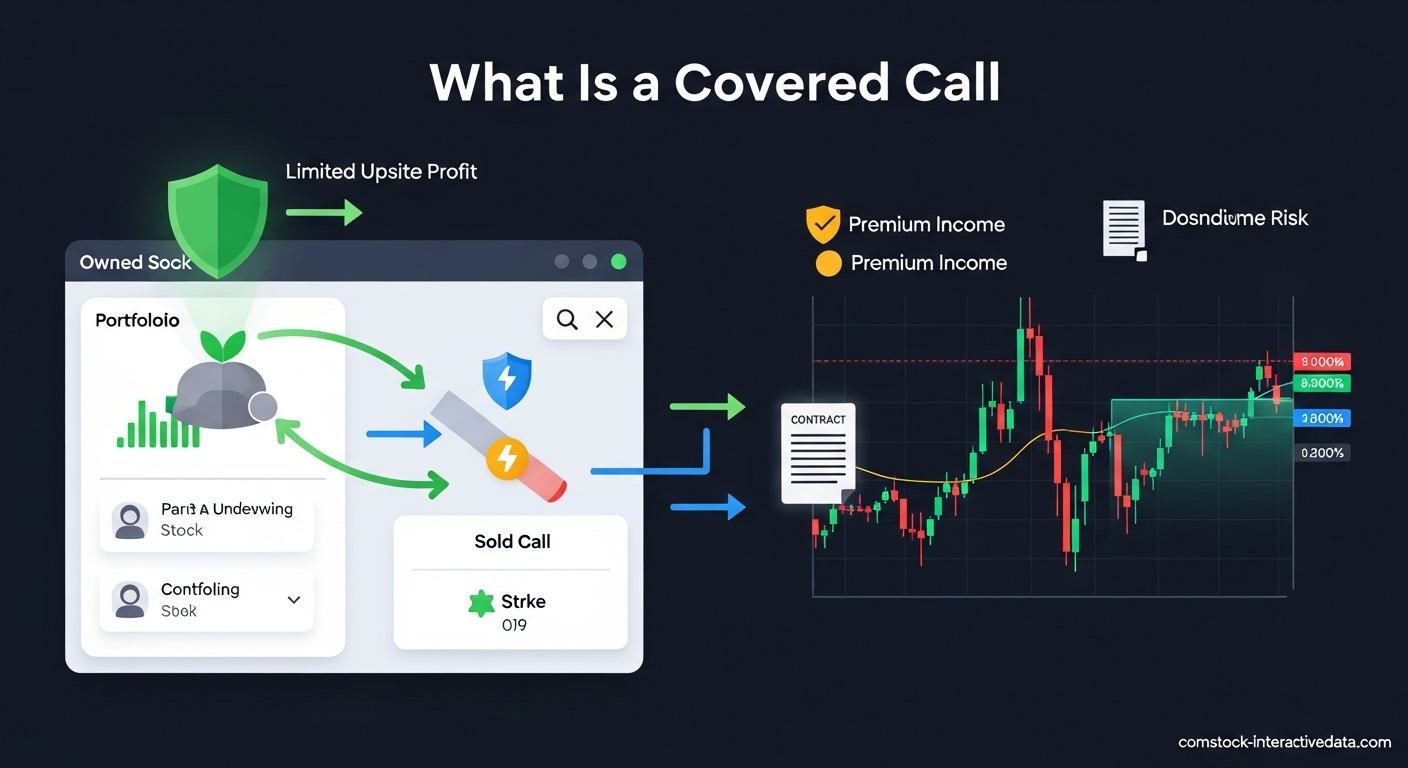
A covered call is an income-generating options strategy where an investor holds at least 100 shares of a stock and sells a call option on those shares to collect an option premium. The strategy is called “covered” because you own the underlying shares that would be delivered if the option buyer exercises their right to purchase.
Think of it as renting out your shares. You receive immediate payment (the premium) in exchange for giving someone else the right to buy your shares at a predetermined price (the strike price) before a specific date (the expiration date).
The strategy combines two positions: long stock (you own 100+ shares) and short call (you sell one call option). Each options contract represents 100 shares, which is why you need at least 100 shares to execute a covered call on a single contract.
Key Terms You Need to Know
Understanding covered calls requires familiarity with specific options terminology. The strike price is the agreed-upon price at which the option buyer can purchase your shares. The expiration date is when the option contract expires, typically weekly or monthly.
The option premium is the cash you receive immediately when selling the call. This premium is yours to keep regardless of what happens to the stock price. Assignment occurs when the option buyer exercises their right to purchase your shares, which happens automatically if the stock price exceeds the strike price at expiration.
When a stock trades above the strike price, the call option is “in the money.” When it trades below, the option is “out of the money.” These terms determine whether assignment is likely.
How Does a Covered Call Work?
The mechanics of a covered call involve four distinct steps that transform your stock position into an income-generating asset. Let me walk you through exactly how this strategy works from start to finish.
Step 1: Own the Underlying Stock
You must own at least 100 shares of a stock to sell one covered call contract. Most investors who use this strategy already hold positions in companies they believe in long-term. The shares serve as collateral, which is why no additional margin requirements apply.
Step 2: Sell a Call Option
Through your brokerage account, you sell a call option with a strike price above the current stock price. You choose both the strike price and expiration date based on your outlook and income goals. The premium deposits into your account immediately.
Step 3: Wait for Expiration
Between selling the option and expiration, three scenarios can unfold. The stock might stay below the strike price, allowing you to keep both your shares and the premium. The stock might rise above the strike price, resulting in assignment. Or the stock might drop significantly, reducing your position value despite the premium collected.
Step 4: Outcome at Expiration
If the option expires out of the money, you keep your shares and can sell another call for the next expiration cycle. If assignment occurs, your shares are sold at the strike price and you keep the premium. Either way, you retain the income generated from the premium.
Understanding Time Decay
One advantage of selling options comes from time decay, represented by the Greek letter theta. Options lose value as they approach expiration, all else being equal. This decay accelerates in the final 30 days, which is why many covered call sellers target 30-45 day expirations.
Time decay works in your favor as the option seller. Every day that passes without a major price movement erodes the option’s value, making it cheaper for you to buy back if needed or allowing it to expire worthless.
Covered Call Example with Real Numbers
Let me show you exactly how this works with a concrete example using a hypothetical position in Apple stock. These numbers illustrate the mechanics clearly without using actual current market prices.
The Setup
You own 100 shares of XYZ stock currently trading at $150 per share. Your cost basis is $140 per share, meaning you have an unrealized gain of $1,000.
You sell a call option with a $155 strike price expiring in 30 days. The option buyer pays you a $3.00 premium per share, or $300 total for the contract covering 100 shares. This $300 deposits into your account immediately.
Scenario 1: Stock Stays Below Strike
XYZ stock trades at $152 at expiration, staying below the $155 strike price. The option expires worthless because the buyer can purchase shares cheaper on the open market than exercising the option.
You keep your 100 shares now worth $15,200. You also keep the $300 premium. Your total position value increased from $15,000 to $15,500, representing a 3.3% return for the month excluding any dividends.
Scenario 2: Stock Rises Above Strike (Assignment)
XYZ stock rallies to $165 at expiration. Since this exceeds the $155 strike price, automatic assignment occurs. Your 100 shares are sold at $155 per share.
You receive $15,500 from the share sale plus the $300 premium, totaling $15,800. You bought the shares at $14,000, so your total profit is $1,800. However, you miss out on the additional gains above $155 since you no longer own the shares.
The opportunity cost here is $1,000 (the difference between $165 market price and $155 sale price, multiplied by 100 shares). This illustrates the primary risk of covered calls: capping your upside.
Scenario 3: Stock Drops Significantly
XYZ stock falls to $130 at expiration. The option expires worthless because no one would pay $155 for shares trading at $130. You keep the $300 premium, which partially offsets your unrealized loss.
Your shares are now worth $13,000, down $2,000 from the original $15,000. However, the $300 premium reduces your effective loss to $1,700. The covered call provided limited downside protection, but you still experienced a significant loss.
Maximum Profit and Loss Calculations
The maximum profit on a covered call equals the strike price minus the stock purchase price plus the premium received. In our example: ($155 – $140) x 100 + $300 = $1,800 maximum profit.
The maximum loss is substantial. If the stock falls to zero, you lose your entire stock value minus the premium collected. In our example: $14,000 cost basis – $300 premium = $13,700 maximum loss. Covered calls do not protect against catastrophic downside.
Advantages and Disadvantages of Covered Calls
Every investment strategy involves trade-offs, and covered calls are no exception. Understanding both sides helps you determine when this approach makes sense for your portfolio.
Pros: Why Traders Love Covered Calls
Income generation stands as the primary benefit. You receive cash immediately regardless of market direction. Many traders target 1-3% monthly returns from premiums alone, which compounds significantly over time.
Downside protection, while limited, helps cushion small drops. The premium you collect effectively lowers your cost basis. If you paid $50 per share and collected $1 in premium, your breakeven drops to $49.
Target price selling allows you to exit positions at prices you select. If you would happily sell at $60, selling a $60 strike call ensures you exit at that price while earning premium while you wait.
Psychological benefits matter too. Collecting premiums monthly creates positive reinforcement during sideways markets when buy-and-hold investors feel frustrated watching stagnant prices.
Cons: The Hidden Risks
The upside cap represents the most significant drawback. You forfeit gains above the strike price. In strongly trending bull markets, this opportunity cost stings. Many covered call sellers watch their stocks rally far beyond their strike prices, missing substantial profits.
Assignment risk creates emotional stress for investors attached to their holdings. Losing shares at what feels like the wrong time, only to watch the stock continue higher, frustrates even experienced traders.
Limited downside protection means you still face substantial risk in bear markets. The premium collected represents a small percentage of potential losses during significant corrections.
Tax implications require consideration. Assignment in taxable accounts creates a capital gains event. Frequent covered call writing can convert long-term holdings into short-term gains or trigger wash sale complications.
When Covered Calls Work Best?
Covered calls excel during neutral to modestly bullish market conditions. When stocks trend sideways with low volatility, premium collection provides returns while you wait. The strategy also works well for position exit at target prices.
High-quality dividend stocks make excellent covered call candidates. You collect both the dividend and the option premium, effectively doubling your income stream from the same position.
Individual retirement accounts (IRAs) particularly suit covered call strategies. The tax-deferred nature eliminates immediate tax consequences from assignment, and income generation matters more than capital appreciation in retirement accounts.
When to Avoid Covered Calls?
Strongly bullish markets frustrate covered call sellers. When you expect significant price appreciation, selling calls caps your returns prematurely. During explosive rallies, the opportunity cost often exceeds the premium collected by multiples.
Low volatility environments reduce premium values, making the strategy less attractive. When implied volatility drops, the income generated may not justify the upside cap risk.
Stocks you absolutely want to keep long-term may not suit covered calls. The assignment risk means you could lose shares you intended to hold indefinitely, potentially at unfavorable tax timing.
Advanced Considerations
Once you master basic covered calls, several advanced techniques can enhance your strategy. These approaches require more active management but offer additional flexibility.
Rolling Covered Calls
Rolling involves buying back the current short call and selling a new one with a later expiration or different strike price. Traders roll up and out when they want to keep shares that have risen near or above the strike price.
For example, if you sold a $50 strike call and the stock rises to $52, you might buy back the $50 call at a loss and sell a $55 call expiring next month. This gives you additional upside room while maintaining the income stream.
Rolling down rarely makes sense as it locks in losses. Rolling up and out extends your timeline but maintains the covered call structure when you want to retain ownership.
Weekly vs. Monthly Expiration Cycles
Most stocks now offer weekly options in addition to traditional monthly expirations. Weekly options provide faster premium decay and more frequent income opportunities. However, they require more active management and incur higher transaction costs.
Monthly options suit hands-off investors who prefer managing positions once per month. The 30-45 day sweet spot captures most time decay while requiring minimal attention.
Early Assignment Risk
While most assignment occurs at expiration, early assignment can happen anytime, particularly for deep in-the-money calls. The primary trigger involves dividends. If the remaining time value is less than the upcoming dividend, assignment becomes economically rational for the option holder.
Ex-dividend dates require special attention. Consider closing or rolling positions before the ex-dividend date if the call is in the money, unless you are willing to lose both the shares and the dividend.
Buy-Write vs. Over-Write
A buy-write involves purchasing 100 shares and simultaneously selling a covered call. This establishes both positions as a single transaction, often at slightly better net pricing.
An over-write applies to shares you already own. Most retail investors use the over-write approach since they sell calls against existing long-term holdings rather than establishing new positions specifically for covered calls.
Frequently Asked Questions
What is the downside of a covered call?
The main downside is capping your upside potential. If the stock price rises significantly above the strike price, your shares get called away at the strike price, causing you to miss gains above that level. You also face assignment risk where you might lose shares you wanted to keep, and the downside protection is limited to the premium amount, which may be small compared to potential stock losses.
Why would someone use a covered call?
Investors use covered calls primarily for income generation from stocks they already own. The strategy works well when you have a neutral to modestly bullish outlook and want to generate returns during sideways price movements. Covered calls also suit investors looking to sell shares at target prices, as the premium provides income while waiting for the target to be reached.
How do covered calls make money?
Covered calls make money through three potential paths: collecting and keeping the premium if the option expires worthless, earning the maximum profit if the stock gets called away above your cost basis, or reducing losses if the stock drops (since the premium partially offsets the decline). The premium is received immediately when you sell the call option.
Who pays the premium on covered calls?
The option buyer pays the premium to you, the option seller. When you sell a call option through your brokerage, the buyer’s account is debited the premium amount and your account is credited immediately. This premium is yours to keep regardless of whether the option gets exercised or expires worthless.
What is the most profitable covered call strategy?
The most profitable approach depends on market conditions, but generally involves selling out-of-the-money calls on stocks with moderate implied volatility. Target 30-45 days to expiration with strike prices 5-10% above the current stock price. This balances meaningful premium income against reasonable upside retention. Avoid deep in-the-money calls that cap too much upside or far out-of-the-money calls that pay minimal premium.
Why are covered calls a bad idea?
Covered calls become problematic when used in strongly bullish markets where capping upside costs more than the premium earned. They are also ill-advised on stocks you want to hold long-term but cannot afford to lose, or during periods of extremely low volatility when premiums do not justify the risk. Some investors find the complexity and assignment stress outweigh the income benefits.
What happens when a covered call is assigned?
When assignment occurs, your brokerage automatically sells your 100 shares at the strike price. The proceeds appear in your account, and you keep the premium originally received. You no longer own the shares or hold the short option position. Assignment typically happens automatically when the stock price exceeds the strike price at expiration.
Can you lose money on covered calls?
Yes, you can lose money on covered calls. While the premium provides some cushion, if the underlying stock drops significantly, your losses on the stock position will exceed the premium collected. For example, collecting a $200 premium on 100 shares does little to offset a $1,000 drop in the stock value.
Conclusion: What Is a Covered Call and How Does It Work
A covered call represents one of the most accessible options strategies for retail investors. By combining stock ownership with call option selling, you transform a passive holding into an active income generator. The strategy works particularly well in sideways markets where buy-and-hold investors grow frustrated with stagnant prices.
Success requires understanding the trade-offs. You gain immediate income through premiums but sacrifice upside potential above your chosen strike price. The best candidates include dividend-paying stocks in tax-advantaged accounts where you have neutral-to-modestly-bullish outlooks.
Before deploying real capital, consider paper trading covered calls to understand the mechanics. Track how different strike prices and expirations affect outcomes across various market conditions. Many experienced traders recommend starting with monthly expirations on positions you would happily sell at the strike price if assigned.
Covered calls do not suit every investor or market condition. However, for the right investor in the right environment, they provide a powerful tool for enhancing portfolio yield. Understanding what a covered call is and how it works positions you to make informed decisions about whether this strategy belongs in your investment toolkit in 2026 and beyond.