
Options delta explained is the foundation every trader needs before risking real capital in the options market. When I first started trading options, I made the mistake of focusing only on strike prices and expiration dates while completely ignoring what delta was telling me about my positions. That oversight cost me money until I finally understood that delta is the single most important Greek for predicting how my options would behave as stock prices moved.
Delta is one of the five options Greeks, alongside gamma, theta, vega, and rho. These Greeks measure different types of risk in options positions. Delta specifically tells you how sensitive your option is to price changes in the underlying stock or asset. Understanding this metric separates successful options traders from those who struggle with consistent losses.
In this comprehensive guide, I will walk you through everything you need to know about delta. You will learn what delta means, how to calculate its impact on your trades, why signs flip between long and short positions, and how to select the right delta values for your specific trading strategy. Whether you are buying calls for speculation, selling puts for income, or hedging an existing stock portfolio, delta is the number you need to watch.
Table of Contents
What Is Delta in Options?
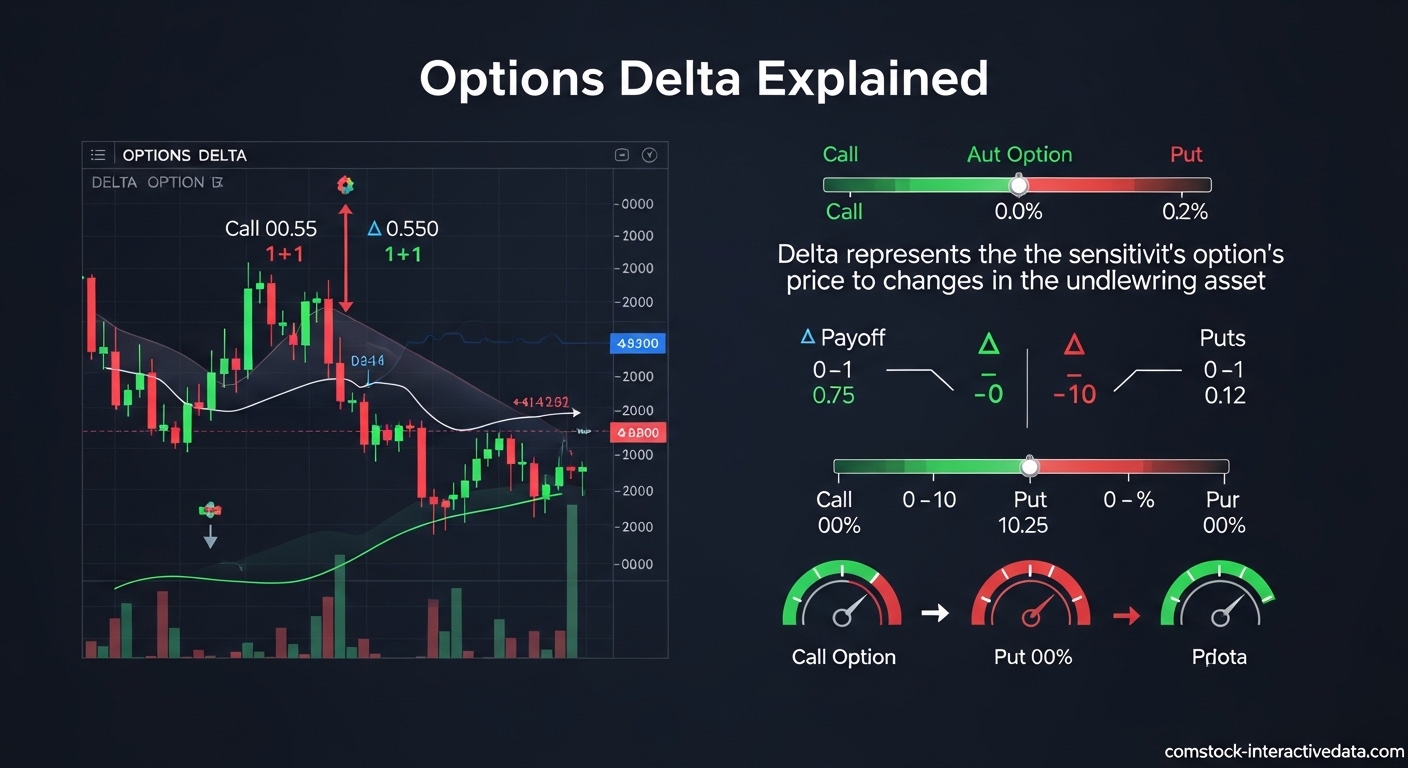
Delta is a measure of how much an option’s price is expected to change for every $1 move in the underlying stock or asset. Values range from -1 to +1, with positive deltas indicating bullish positions and negative deltas indicating bearish positions. A call option with a delta of 0.50 will theoretically increase by $0.50 for every $1 increase in the underlying stock price.
The delta value represents both price sensitivity and a rough approximation of the probability that an option will finish in-the-money at expiration. While delta is a theoretical estimate derived from pricing models like Black-Scholes, it provides traders with a practical framework for understanding directional risk. Your broker platform calculates delta automatically, updating it in real-time as market conditions change.
Delta Value Ranges by Moneyness
Delta values follow predictable patterns based on where the option strike price sits relative to the current stock price. This relationship, known as moneyness, directly impacts how much your option will move when the underlying asset changes price. Understanding these ranges helps you select appropriate options for your trading objectives.
| Moneyness | Call Delta Range | Put Delta Range | Probability (Approximate) |
|---|---|---|---|
| Deep In-The-Money (ITM) | 0.80 to 1.00 | -0.80 to -1.00 | 80-100% |
| In-The-Money (ITM) | 0.60 to 0.80 | -0.60 to -0.80 | 60-80% |
| At-The-Money (ATM) | 0.45 to 0.55 | -0.45 to -0.55 | 45-55% |
| Out-of-The-Money (OTM) | 0.20 to 0.45 | -0.20 to -0.45 | 20-45% |
| Deep Out-of-The-Money (OTM) | 0.00 to 0.20 | -0.00 to -0.20 | 0-20% |
At-the-money options typically hover near 0.50 delta for calls and -0.50 delta for puts because they have roughly a 50% chance of finishing in-the-money at expiration. As options move deeper in-the-money, their deltas approach 1.00 (or -1.00 for puts), meaning they behave more and more like the underlying stock itself. Deep out-of-the-money options carry deltas near zero because they have minimal probability of expiring with any value.
Delta as Share Equivalency
One of the most practical ways to understand delta is through the concept of share equivalency. An option contract with a 0.50 delta provides exposure similar to owning 50 shares of the underlying stock. This framework helps traders quickly gauge their directional risk without complex calculations.
If you own one call option contract with 0.75 delta on a stock trading at $100, your position behaves similarly to owning 75 shares of that stock for small price movements. This equivalency concept becomes essential when managing portfolio risk across multiple positions. Professional traders use this relationship to maintain consistent exposure levels when switching between stock and options positions.
How Delta Works in Options Trading?
Delta works by estimating the immediate price sensitivity of an option contract relative to the underlying asset. When you see a delta value on your trading platform, it represents the expected change in option premium for a $1 increase in the stock price. The same magnitude applies in reverse for price decreases, though the relationship is linear only for small moves.
The $1 Move Concept
Let me break down exactly how the $1 move calculation works in practice. Imagine you purchase a call option on XYZ stock with a delta of 0.60, and the option currently trades for $3.00 per contract. If XYZ stock increases by $1, your option should theoretically increase to approximately $3.60, all else being equal.
This calculation assumes no other variables change, which rarely happens in real markets. Time decay (theta), volatility shifts (vega), and interest rate changes (rho) all influence the actual premium change. However, for small stock movements over short time periods, delta provides a remarkably accurate estimate of option price behavior. Understanding this limitation prevents the common mistake of expecting delta to predict exact outcomes for large price swings.
Step-by-Step Delta Calculation Example
Here is how to calculate the expected profit or loss from delta on a standard options contract. Remember that one options contract controls 100 shares of the underlying stock, so you must multiply the delta by 100 to get the dollar impact.
Step 1: Identify the option delta from your broker platform. Let us use 0.40 delta for this example.
Step 2: Multiply the delta by the expected stock price move. For a $2 stock increase: 0.40 × $2.00 = $0.80 expected premium increase per share.
Step 3: Multiply by the contract multiplier (100 shares). $0.80 × 100 = $80 expected profit per contract.
Step 4: Account for contract quantity. If you own 5 contracts: $80 × 5 = $400 expected position profit.
This calculation gives you the theoretical estimate before factoring in other Greeks. The actual result may differ slightly depending on how long the stock takes to make its move and what happens to implied volatility during that period.
Delta Changes as Expiration Approaches
One critical aspect that many beginner traders overlook is how delta behavior changes as expiration approaches. This phenomenon, closely tied to gamma, significantly impacts options close to expiration. As time runs out, in-the-money options see their deltas move closer to 1.00 (or -1.00), while out-of-the-money options see their deltas shrink toward zero.
This acceleration happens because uncertainty decreases as expiration nears. An option that is clearly in-the-money with one day remaining has a very high probability of finishing in-the-money, so its delta approaches the maximum value. Conversely, an out-of-the-money option with little time left has minimal chance of recovering, so its delta collapses toward zero. Traders selling options (the theta gang approach) must pay special attention to this delta acceleration because short positions face rapidly changing directional risk in the final days before expiration.
Delta as Probability of Profit
Many traders use delta as a rough approximation for the probability that an option will finish in-the-money at expiration. While not mathematically precise, this rule of thumb provides practical guidance for strategy selection. A 0.30 delta option suggests approximately a 30% chance of expiring in-the-money.
This probability interpretation proves particularly valuable for options sellers. When you sell a 0.20 delta put option, you are collecting premium while accepting roughly an 80% probability of the option expiring worthless. However, remember that delta probability does not account for the magnitude of potential losses when the 20% chance of assignment occurs. High-delta options offer higher probability but also expose you to larger potential losses when trades move against you.
Long vs Short Positions: How Delta Signs Flip
Understanding how delta signs flip between long and short positions represents one of the most confusing concepts for beginner options traders. The directional risk of a position depends entirely on whether you bought or sold the option contract, not just on whether it is a call or put.
When you buy an option, your delta matches the standard values: positive for calls, negative for puts. When you sell an option, the delta sign flips because you have taken the opposite side of the trade. This sign reversal fundamentally changes your exposure to stock price movements and determines whether you make or lose money as the market moves.
Call Options: Long vs Short
Long call options carry positive delta, meaning you profit when the stock price rises. If you buy a call with 0.50 delta and the stock increases $1, your option gains approximately $0.50 in value. This creates a bullish position aligned with stock ownership.
Short call options carry negative delta because you have sold the contract to another trader. If you sell a call with 0.50 delta and the stock increases $1, you lose approximately $0.50 as the option you sold becomes more valuable. This creates a bearish or neutral income-focused position. Many theta gang traders sell out-of-the-money calls with deltas between 0.15 and 0.30 to generate income while betting the stock will not rise significantly.
Put Options: Long vs Short
Long put options carry negative delta, meaning you profit when the stock price falls. If you buy a put with -0.40 delta and the stock drops $1, your option gains approximately $0.40 in value. This creates a bearish position that profits from downside moves.
Short put options carry positive delta because you have taken the opposite side. If you sell a put with -0.40 delta and the stock drops $1, you lose approximately $0.40 as the put you sold becomes more valuable. This creates a bullish income position. The popular cash-secured put strategy involves selling puts with 0.20 to 0.30 delta, collecting premium while betting the stock will stay above the strike price.
Position Delta Comparison
| Position Type | Delta Sign | Directional Bias | Profits When Stock… | Common Strategy Use |
|---|---|---|---|---|
| Long Call | Positive (+) | Bullish | Rises | Speculation, leverage |
| Short Call | Negative (-) | Bearish/Neutral | Falls or stays flat | Income, covered calls |
| Long Put | Negative (-) | Bearish | Falls | Protection, speculation |
| Short Put | Positive (+) | Bullish/Neutral | Rises or stays flat | Income, wheel strategy |
Position delta becomes particularly important when you hold multiple options contracts on the same underlying stock. You can offset a long call position with a short call position, creating a reduced net delta exposure. This concept forms the foundation of delta neutral strategies and spread trading techniques that advanced traders employ to isolate specific risk factors.
Common Mistake: Ignoring Sign When Selling
The most frequent error beginners make involves ignoring the delta sign flip when selling options. A trader might sell a put thinking they are taking a bearish position because puts are “bearish instruments,” when in fact short puts have positive delta and create bullish exposure. This misunderstanding leads to unintended directional risk and unexpected losses when stocks decline.
Always remember that selling any option flips your delta sign and your directional exposure. If you want bearish exposure, you either buy puts (negative delta) or sell calls (negative delta). If you want bullish exposure, you either buy calls (positive delta) or sell puts (positive delta). Writing down your net position delta before entering trades prevents costly sign errors.
Practical Delta Examples for Real Trading
Theory becomes valuable only when applied to real trading scenarios. Let me walk you through four specific examples that demonstrate how delta works across different strategies and risk tolerances. These examples use realistic market conditions that you might encounter on any trading day.
Example 1: High Delta ITM Call as Stock Substitute
Imagine Apple (AAPL) trades at $180 per share, and you want bullish exposure without tying up $18,000 for 100 shares. You look at a call option expiring in 45 days with a $170 strike price, trading for $12.00 with 0.80 delta.
If AAPL rises to $185 (a $5 increase), your call should gain approximately $4.00 in value ($5 × 0.80), bringing the premium to $16.00. Your profit would be roughly $400 per contract ($4.00 × 100), representing a 33% return on your $1,200 investment. The same $5 move in 100 shares of stock would generate $500 profit but required $18,000 in capital.
This high-delta strategy works well for traders who want leverage while maintaining relatively predictable price behavior. The 0.80 delta means your option moves 80% as much as the stock, offering substantial participation in upside moves. However, theta decay works against you faster with ITM options, and you lose the full premium if the trade moves against you.
Example 2: Low Delta OTM Call for Speculation
Now consider a more aggressive scenario with the same AAPL at $180. You believe the stock will rally significantly after an earnings announcement, so you buy a $190 strike call expiring in 30 days for $2.50 with 0.30 delta.
If AAPL jumps to $195 after earnings, your delta will increase as the option moves closer to the money (gamma in action), but let us use the original delta for estimation. The $15 stock gain would theoretically add $4.50 to your option value ($15 × 0.30), plus additional gains from increased delta as the option moves ITM. Your $250 investment could easily double or triple on a favorable earnings move.
The low-delta approach offers massive leverage but with lower probability of success. This 0.30 delta suggests roughly a 30% chance of finishing in-the-money at expiration. Many traders lose money consistently buying low-delta options because the probability works against them over time. Reserve this strategy for high-conviction setups where you expect significant price movement.
Example 3: Short Put at 20 Delta for Income
Here is where the theta gang perspective becomes valuable. Instead of buying options, you decide to sell a cash-secured put on Microsoft (MSFT) trading at $350. You sell a $340 strike put expiring in 30 days for $3.00, with a delta of -0.20 (remember, short puts flip to positive delta for your position).
Your position delta is +0.20, meaning you have bullish exposure equivalent to owning 20 shares of MSFT. If MSFT stays above $340 through expiration, the put expires worthless and you keep the $300 premium (100 shares × $3.00). This represents roughly an 80% probability trade based on the delta.
The 16-20 delta range represents a sweet spot that many experienced option sellers target. This range provides meaningful premium income while maintaining a statistical edge. However, if MSFT drops to $330, you face assignment and must purchase 100 shares at $340, creating a $700 loss ($1,000 intrinsic value minus $300 premium received). Delta helps you understand that risk probability, but position sizing determines whether you survive the inevitable losses.
Example 4: Delta Selection by Risk Tolerance
Different traders should select different delta ranges based on their risk tolerance, account size, and trading objectives. Here is a practical framework for selecting appropriate delta values.
Conservative Traders (Income Focus): Target 10-20 delta when selling options. This provides high probability of success (80-90%) with limited directional exposure. Premium income is lower, but consistency improves. Conservative traders buying options should stick to 0.70+ delta ITM options for more predictable moves.
Moderate Traders (Balanced): Target 25-40 delta for a balance between probability and profit potential. This range works well for vertical spreads and iron condors. Buying options in the 0.40-0.60 delta range offers reasonable leverage without excessive risk of total premium loss.
Aggressive Traders (Speculation): Target 50+ delta when buying options for maximum directional exposure, or sell deep ITM options for maximum premium collection. This approach requires precise timing and acceptance of frequent losses balanced by occasional large gains.
Beginners should start with conservative delta ranges until they develop consistent profitability. High-delta options behave more predictably but cost more, while low-delta options offer lottery-ticket potential with poor odds.
Advanced Delta Concepts
Once you master the basics, several advanced delta concepts help you manage complex portfolios and sophisticated strategies. These ideas separate casual retail traders from professionals who treat options trading as a serious business.
Position Delta and Portfolio Risk
Position delta calculates the net directional exposure across all your options and stock holdings in a particular underlying asset. To calculate it, simply add the deltas of all long positions and subtract the deltas of all short positions, then multiply by the number of contracts and the option multiplier (typically 100).
Suppose you own 200 shares of SPY (delta +200), have sold two put contracts with -0.30 delta each (position delta +60), and bought one call contract with 0.40 delta (position delta +40). Your total position delta would be 200 + 60 + 40 = +300, equivalent to owning 300 shares of SPY. This number tells you exactly how much your portfolio will gain or lose for each $1 move in the underlying.
Professional traders monitor position delta continuously, adjusting holdings to maintain desired exposure levels. If you want reduced market exposure without selling your positions, you can add negative delta through put purchases or call sales. This granular control over directional risk represents one of the most powerful aspects of options trading.
Delta Neutral Strategies
Delta neutral describes a portfolio with a net position delta of zero, meaning you have no directional bias and profit from other factors like volatility changes or time decay. Achieving true delta neutrality requires ongoing adjustments because delta changes as the underlying stock moves (gamma effect) and as time passes.
The classic delta neutral strategy is the long straddle, where you buy both a call and put at the same strike price, usually at-the-money. The positive delta from the call offsets the negative delta from the put, creating near-zero net delta. You profit if the stock makes a large move in either direction, or if implied volatility increases significantly.
Iron condors represent another popular delta neutral approach favored by income traders. By selling out-of-the-money calls and puts while buying further out-of-the-money options for protection, you create a position that profits if the stock stays within a specific range. The net delta approaches zero when structured symmetrically, though most traders allow slight directional bias based on market opinion.
The Delta-Gamma Relationship
Gamma measures how much delta changes when the underlying stock moves $1. High gamma means your directional exposure changes rapidly, creating both opportunity and risk. Understanding this relationship helps you anticipate how your position delta will evolve as trades progress.
At-the-money options have the highest gamma, meaning their deltas shift most dramatically for small stock moves. An ATM option might have 0.50 delta today, but if the stock rises $3, that delta could increase to 0.70. This acceleration works in your favor when trades move correctly but amplifies losses when they move against you.
As expiration approaches, gamma increases for at-the-money options while decreasing for in-the-money and out-of-the-money options. This explains why delta changes accelerate near expiration for ATM positions. Traders holding short options face rapidly changing risk profiles in the final days before expiration, requiring close monitoring or early position closure.
The interaction between delta, gamma, and theta creates the dynamic environment that makes options trading both challenging and potentially profitable. Mastering delta is the necessary first step before these more complex relationships make sense.
Frequently Asked Questions About Options Delta
What is a good Delta for options?
The ideal delta depends on your trading strategy and risk tolerance. For buying options, 0.50-0.70 delta offers a balance between price movement participation and cost. For selling options, 15-30 delta provides good probability of profit while maintaining manageable risk. Conservative traders prefer 10-20 delta when selling, while aggressive speculators might buy 0.30 delta or lower for maximum leverage.
What does a Delta of 0.7 mean?
A 0.70 delta means the option’s price will theoretically change by $0.70 for every $1 move in the underlying stock. It also suggests approximately a 70% probability that the option will finish in-the-money at expiration. This high delta indicates the option is deep in-the-money and behaves similarly to owning 70 shares of the underlying stock.
What does 20 Delta mean in options?
20 delta (0.20 for calls, -0.20 for puts) indicates an out-of-the-money option with approximately a 20% probability of finishing in-the-money at expiration. The option’s price will change by roughly $0.20 for each $1 stock move. Many option sellers target 16-20 delta as it offers around an 80% win rate while providing meaningful premium income.
How to use Delta when trading options?
Use delta to assess directional risk, estimate profit or loss for stock moves, calculate position sizing, and gauge probability of profit. Check your net position delta to understand portfolio exposure. When buying, select delta based on desired leverage and probability. When selling, choose delta based on acceptable assignment risk and income goals. Monitor delta changes as expiration approaches since gamma affects delta over time.
Why does Delta change as expiration approaches?
Delta changes as expiration approaches because uncertainty decreases. In-the-money options see deltas move closer to 1.00 (or -1.00 for puts) as they become more certain to finish ITM. Out-of-the-money options see deltas shrink toward zero as expiration nears because their probability of recovering diminishes. This acceleration, driven by gamma, is most pronounced in the final week before expiration.
What is Delta Neutral?
Delta neutral describes a portfolio with zero net delta exposure, meaning the position has no directional bias to the underlying stock price. You achieve this by combining positive and negative delta positions that offset each other. Common delta neutral strategies include long straddles, iron condors, and hedged stock positions. True delta neutrality requires ongoing adjustments since delta changes as stock prices move.
What is the difference between long and short delta?
Long delta positions profit when the underlying stock rises, while short delta positions profit when the stock falls or stays flat. Buying a call creates long delta (positive). Selling a call creates short delta (negative). Buying a put creates short delta (negative). Selling a put creates long delta (positive). The sign flip for short positions confuses many beginners but is essential for proper risk management.
Conclusion: Mastering Delta for Trading Success
Options delta explained clearly is the foundation upon which all successful options trading rests. Throughout this guide, you have learned that delta measures price sensitivity, ranges from -1 to +1, and serves as both a risk metric and probability estimate. Understanding how delta signs flip between long and short positions prevents the costly mistakes that trap so many beginners.
The key takeaways are simple but profound. Delta tells you how much your option will move for each $1 change in the underlying stock. It approximates the probability of finishing in-the-money. Long calls and short puts create positive delta exposure, while long puts and short calls create negative delta exposure. Selecting the right delta range depends entirely on your risk tolerance and trading objectives.
As you continue your options education journey, remember that delta is just the beginning. Gamma, theta, vega, and rho all interact with delta to create the complex pricing dynamics that make options both challenging and rewarding. Consider exploring our future guides on the other Greeks to build a complete understanding of options risk management. Start applying these delta concepts to paper trades today, and watch how your trading decisions improve when you truly understand your directional exposure.