
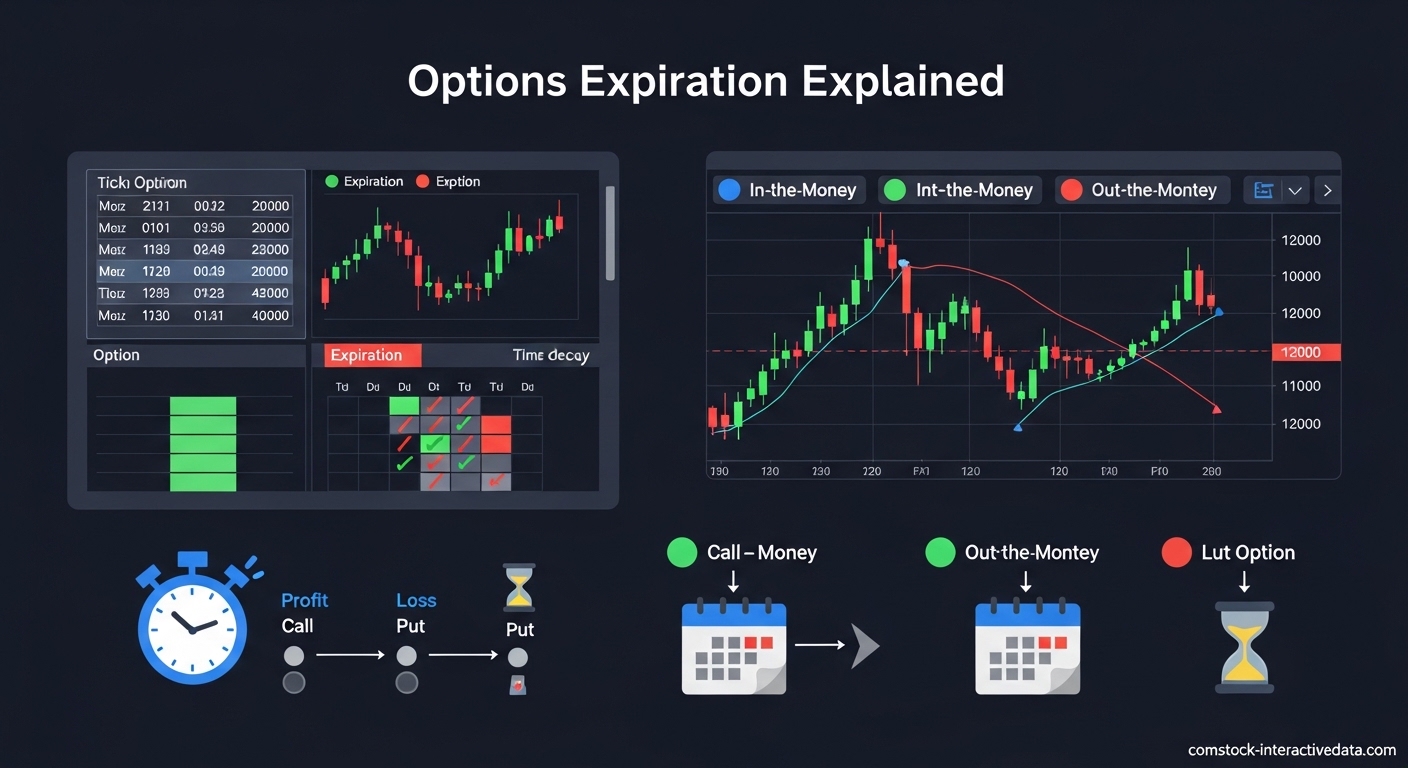
Options expiration is the date when an options contract ceases to be valid. At expiration, in-the-money (ITM) options are typically automatically exercised, while out-of-the-money (OTM) options expire worthless. The expiration date is predetermined when the contract is created and marks the deadline for the option holder to exercise their right to buy or sell the underlying asset.
Understanding options expiration is essential for every trader who works with derivatives. Whether you are buying calls to capture upside potential or selling puts to generate income, knowing exactly what happens when that expiration date arrives can save you from costly surprises. I have seen traders get caught off guard by unexpected assignments and margin calls simply because they did not fully grasp the mechanics of expiration day.
In this guide, I will walk you through everything you need to know about options expiration 2026. We will cover what happens to both call and put options at expiry, how automatic exercise works, the risks you need to manage, and practical strategies for handling expiration day.
Table of Contents
Key Takeaways
- Options expiration is the date when the contract becomes invalid and can no longer be exercised
- In-the-money (ITM) options are typically automatically exercised at expiration
- Out-of-the-money (OTM) options expire worthless and the premium paid is lost
- American-style options can be exercised any time before expiration; European-style only at expiration
- Pin risk affects short options holders when the underlying price lands near the strike price
- Time decay accelerates as expiration approaches, eroding extrinsic value
What Happens When Options Expire
When the expiration date arrives, the fate of your options contract depends entirely on its relationship to the underlying asset’s price. This relationship is commonly called “moneyness” in the trading world.
Understanding Moneyness: ITM, OTM, and ATM
An option’s moneyness describes whether exercising it would be profitable at the current market price. For call options, in-the-money (ITM) means the stock price is above the strike price. For put options, ITM means the stock price is below the strike price.
Out-of-the-money (OTM) is the opposite scenario. A call option is OTM when the stock price is below the strike price. A put option is OTM when the stock price is above the strike price.
At-the-money (ATM) describes when the stock price is essentially equal to the strike price. This is often the most dangerous zone for short option holders due to pin risk, which we will discuss later.
In-the-Money Options at Expiration
When options expire in-the-money, the Options Clearing Corporation (OCC) typically initiates an automatic exercise process. For standard equity options in the United States, this happens if the option has at least $0.01 of intrinsic value at expiration.
For a long call holder, auto-exercise means you will buy 100 shares of the underlying stock at the strike price per contract. For a long put holder, you will sell 100 shares at the strike price. This happens automatically unless you submit a “Do Not Exercise” (DNE) request to your broker before their cutoff time.
Here is a concrete example. Say you own a $50 strike call option on XYZ stock. XYZ closes at $55 on expiration Friday. Your option is $5 in-the-money, so it gets auto-exercised. You now own 100 shares of XYZ at $50 per share, for a total cost of $5,000 (plus the premium you originally paid).
Out-of-the-Money Options at Expiration
OTM options expire worthless on expiration day. No automatic exercise occurs. The option contract simply ceases to exist and is removed from your account.
For option buyers, this means the premium you paid is gone. That is the maximum loss you agreed to when purchasing the option. If you paid $200 for a call option that expires OTM, you have lost that $200.
For option sellers, this is typically the desired outcome. You collected the premium when you sold the option, and now you keep that entire amount as profit since the buyer’s right to exercise never materialized.
Physical Settlement vs Cash Settlement
Most standard equity options use physical settlement, meaning the actual shares change hands at exercise. Index options, however, typically use cash settlement.
With cash-settled options like SPX (S&P 500 Index options), you never receive shares. Instead, you receive (or pay) cash equal to the difference between the strike price and the settlement value of the index. This difference is multiplied by the contract multiplier, which is typically $100 for index options.
Call Options at Expiration
Call options give the holder the right to buy the underlying asset at the strike price. What happens at expiration depends on whether you are long (bought) or short (sold) the call, and whether it finishes ITM or OTM.
Long ITM Call at Expiration
If you own a call option that expires in-the-money, your broker will typically auto-exercise it. You will buy 100 shares per contract at the strike price.
Let us say you bought a $100 strike call for $3.00 ($300 total) on ABC stock. At expiration, ABC closes at $110. Your option is $10 ITM. You are automatically assigned 100 shares at $100 each, costing you $10,000. Since the shares are worth $11,000 in the market, your intrinsic gain is $1,000. Subtract the $300 premium you paid, and your net profit is $700.
If you do not want the shares, you must either sell the option before expiration or submit a DNE request. Most brokers require DNE requests by 4:30 PM ET or 5:00 PM ET on expiration Friday.
Short ITM Call at Expiration
If you sold a call option that expires in-the-money, you face assignment. This means you must sell 100 shares per contract at the strike price.
Suppose you sold a $50 strike call on DEF stock for $2.00 premium. DEF closes at $55 at expiration. The long holder exercises, and you are assigned. You sell 100 shares at $50. If you already owned the shares (covered call), they are called away from your account. If you did not own them (naked call), you are now short 100 shares at $50.
Naked call assignment is particularly risky because you must deliver shares you do not own. You will likely need to buy them in the market at the current price ($55 in our example), resulting in a $500 loss per contract. Subtract the $200 premium collected, and your net loss is $300.
Long OTM Call at Expiration
When your long call expires out-of-the-money, nothing happens. The option becomes worthless and disappears from your account.
You lose the entire premium paid. If you bought the call for $150, that $150 is gone. No shares change hands, no automatic exercise occurs. This is the maximum defined risk you accepted when purchasing the option.
Short OTM Call at Expiration
This is the ideal outcome for call sellers. The option expires worthless, and you keep 100 percent of the premium collected when you sold the option.
If you sold a call for $200 and it expires OTM, that $200 is your profit. No assignment occurs, no shares move, and your obligation as the option seller is extinguished.
Put Options at Expiration
Put options give the holder the right to sell the underlying asset at the strike price. The expiration outcomes mirror calls in many ways, but with opposite directional implications.
Long ITM Put at Expiration
If you own a put option that expires in-the-money, auto-exercise typically occurs. You will sell 100 shares per contract at the strike price.
Imagine you bought a $75 strike put on GHI stock for $2.50 ($250 total). At expiration, GHI closes at $68. Your put is $7 ITM. You are automatically exercised, selling 100 shares at $75 each.
If you already owned 100 shares, they are sold at $75. Since the market price is $68, you effectively sold them $7 above market value, capturing $700 in value. Subtract your $250 premium, and your net gain is $450.
If you did not own shares, your broker will likely create a short position of 100 shares at $75. You are now short the stock at $75, which can be profitable if the stock continues declining. However, short stock carries unlimited upside risk, so you need to monitor this carefully.
Short ITM Put at Expiration
Selling in-the-money puts at expiration means you will be assigned. You must buy 100 shares per contract at the strike price.
Say you sold a $50 strike put on JKL stock for $1.50 premium. JKL closes at $45 at expiration. The long holder exercises, and you are assigned. You must buy 100 shares at $50 each, for a total cost of $5,000.
Since the shares are worth $4,500 in the market, you have an immediate $500 paper loss. However, you collected $150 in premium when selling the put, so your net cost basis is effectively $48.50 per share ($50 minus $1.50 premium).
Put selling is often used as a strategy to acquire stock at a desired price. Many traders sell puts at strike prices where they would be happy to own the stock, collecting premium while potentially getting assigned shares at a discount to the current market price.
Long OTM Put at Expiration
When your long put expires out-of-the-money, it becomes worthless. You lose the premium paid, and no exercise occurs.
If you bought a put for $180 expecting a stock decline that never materialized, that $180 is your total loss. The option simply expires, and your account is debited nothing further.
Short OTM Put at Expiration
This is the put seller’s desired outcome. The option expires worthless, and you keep the entire premium collected.
If you sold a put for $150 and it expires OTM, you pocket that $150 as profit. No assignment occurs, and you have no further obligation. This is how many income-focused options traders generate regular cash flow.
Expiration Cycles Explained 2026
Not all options expire on the same schedule. Understanding the different expiration cycles helps you choose the right timeframe for your trading strategy.
Monthly Options
Monthly options are the traditional expiration cycle. They expire on the third Friday of each month. These were the only available expiration dates for decades and remain popular for longer-term strategies.
Monthly options typically offer the most liquidity for expiration dates beyond four weeks out. If you are selling cash-secured puts or covered calls as a monthly income strategy, these traditional monthly expirations often provide the best balance of premium collection and time efficiency.
Weekly Options
Weekly options expire every Friday (or Thursday if Friday is a holiday). They were introduced to give traders more flexibility in targeting specific events like earnings announcements or economic data releases.
Weeklies have exploded in popularity because they offer faster time decay and more precise event-based positioning. However, they also carry higher gamma risk, meaning price movements in the underlying have a more dramatic effect on the option’s value as expiration approaches.
LEAPS (Long-Term Equity Anticipation Securities)
LEAPS are long-dated options that expire more than one year in the future. They can have expirations up to three years out.
These are ideal for buy-and-hold investors who want to use options as a stock replacement strategy. Because they have so much time until expiration, LEAPS maintain significant extrinsic value and experience slower time decay than near-term options.
A LEAPS call can capture multi-year upside in a stock while requiring only a fraction of the capital needed to buy shares outright. However, the higher time premium means you pay more for this extended duration.
0DTE (Zero Days to Expiration) Options
0DTE options expire on the same day they are traded. These have become extremely popular for short-term speculation and hedging.
While 0DTE trading offers massive profit potential from small price moves, it also carries substantial risk. Time decay is at its maximum, and even small adverse moves can wipe out your position quickly.
The rise of 0DTE options on broad market ETFs like SPY and QQQ has changed market dynamics significantly. Expiration day volume now represents a substantial portion of total daily options activity.
Options Expiration Cycles Compared
| Expiration Type | Typical Duration | Primary Use Case | Risk Level |
|---|---|---|---|
| 0DTE (Zero Days) | Same day | Day trading, event hedging | Very High |
| Weekly | 1-4 weeks | Event-based strategies, income | High |
| Monthly | 1-3 months | Standard income strategies | Moderate |
| LEAPS | 1-3 years | Long-term stock replacement | Lower (time buffer) |
American Style vs European Style Options
The exercise rules differ significantly between American-style and European-style options. This distinction is critical for understanding when you can capture value from your options.
American Style Options
Most U.S. equity options are American-style. This means the holder can exercise the option at any time before or on the expiration date.
The flexibility of early exercise can be valuable in certain situations. For example, if you own a deep ITM call on a stock going ex-dividend, exercising early might allow you to capture the dividend payment. Similarly, exercising puts early can sometimes be optimal when interest rates are high relative to the time value remaining.
However, early exercise is generally rare because it forfeits any remaining time value. For most traders, selling the option to close the position is more profitable than exercising early.
European Style Options
European-style options can only be exercised at expiration. Index options like SPX, NDX, and RUT are typically European-style, as are many ETF options.
The inability to exercise early eliminates some strategic flexibility but also protects short option holders from early assignment. This is particularly relevant for cash-settled index options where physical delivery is impossible anyway.
European options often settle differently as well. Many cash-settled European options use an opening settlement price on the morning after expiration rather than the closing price on expiration day itself.
American vs European Style Options
| Feature | American Style | European Style |
|---|---|---|
| Exercise Timing | Any time before expiration | Only at expiration |
| Common Examples | Most U.S. equity options (AAPL, MSFT) | Index options (SPX, NDX, RUT) |
| Early Assignment Risk | Yes (especially around dividends) | No |
| Settlement Type | Usually physical | Usually cash |
Advanced Expiration Concepts
Beyond the basics of ITM and OTM outcomes, several advanced concepts can significantly impact your expiration day experience.
Pin Risk Explained
Pin risk occurs when the underlying asset’s price is near the strike price at expiration. This creates uncertainty about whether short options will be assigned.
Imagine you sold a $100 strike call. The stock is trading at $99.90 with 10 minutes until market close. If it closes at $99.90, your option expires worthless. But if it rallies to $100.10 in the final minutes, you face assignment.
This uncertainty is particularly problematic after hours. The official settlement price is determined at 4:00 PM ET market close, but after-hours trading continues. A stock at $99.50 at 4:00 PM could gap up to $101 after hours, potentially making options that seemed safe suddenly ITM.
For short option holders, pin risk is a major concern. You might go into the weekend thinking your short option expired worthless, only to find Monday morning that you have been assigned and now hold an unexpected stock position.
The best defense against pin risk is closing short options before expiration if the underlying is near your strike price. Paying a small premium to close the position eliminates the uncertainty entirely.
Do Not Exercise (DNE) Requests
Sometimes you may want to prevent automatic exercise of an ITM option. This is where Do Not Exercise (DNE) requests come in.
Common reasons for submitting a DNE request include avoiding a margin call from auto-exercise, preventing unwanted stock positions, or avoiding exercise fees that might exceed the small profit from a barely ITM option.
Most brokers require DNE requests by a specific cutoff time, typically between 4:30 PM and 5:30 PM ET on expiration Friday. Some brokers also charge fees for DNE submissions, so check your broker’s policy.
To submit a DNE, you typically contact your broker’s trade desk directly or use a specific option in your trading platform. Online DNE submission is not always available, so having your broker’s trade desk phone number saved before expiration day is wise.
Settlement Price Determination
The settlement price determines whether options are ITM or OTM. For equity options, this is typically the official closing price of the stock at 4:00 PM ET.
Index options often use different calculation methods. Some use the opening price on the morning after expiration. Others use a special calculation based on the opening trades of all component stocks.
Understanding your specific option’s settlement method is important for predicting whether auto-exercise will occur. The settlement price announcement often comes hours after the market closes, creating a period of uncertainty for expiration day traders.
After-Hours Price Risk
After-hours trading can significantly affect options expiration outcomes. While the official settlement price is typically set at 4:00 PM, after-hours price movements influence overnight sentiment and Monday morning opening prices.
For traders holding positions through expiration weekend, after-hours earnings announcements or news events can create substantial gap risk when markets reopen. A position that looked safe at Friday’s close might be dramatically different by Monday morning.
Time Decay and Expiration Value
Time decay, represented by the Greek letter theta, describes how an option loses value as time passes. This decay accelerates dramatically as expiration approaches.
Intrinsic vs Extrinsic Value
At expiration, an option’s value consists entirely of intrinsic value. This is the difference between the strike price and the underlying asset’s price, if that difference is profitable for the holder.
Before expiration, options also contain extrinsic value, sometimes called time value. This represents the possibility that the option could become more profitable before expiration. Extrinsic value is influenced by time remaining, implied volatility, and interest rates.
The closer you get to expiration, the less extrinsic value remains. In the final week before expiration, theta decay becomes particularly aggressive. Options can lose substantial value overnight, even if the underlying price does not change.
Theta Acceleration Near Expiration
The rate of time decay is not linear. An option with 30 days to expiration loses value more slowly than an option with 5 days to expiration.
In the final week, theta acceleration is extreme. An option might lose 50 percent of its remaining time value in a single day. For option buyers, this means your position must move in your favor quickly just to offset time decay.
For option sellers, accelerating theta is generally favorable. You collect the same premium while the time value erodes faster, increasing your probability of profit.
Pre-Expiration Checklist
Having a systematic approach to expiration week helps prevent costly mistakes. I recommend reviewing this checklist for every option position approaching expiration.
Seven Days Before Expiration
Review all positions expiring in the next week. Identify which are currently ITM, OTM, or near the money. Check your account buying power to ensure you can handle any potential auto-exercise scenarios.
Plan your exit strategy for each position. Decide in advance whether you will close early, let expire, or roll to a later expiration date.
Three Days Before Expiration
Monitor the underlying asset price relative to your strike prices. Consider taking action on any positions within 5 percent of the strike price to avoid pin risk.
Check for any upcoming events like earnings announcements or dividend dates that could affect the underlying price before expiration.
Expiration Day Morning
Review the overnight news and pre-market price action. Confirm your broker’s DNE request deadline for the day.
For any short options near the strike price, strongly consider closing the position in the morning session when liquidity is typically better.
Final Two Hours of Trading
Many experienced traders recommend closing any remaining short option positions by 2:00 PM ET on expiration Friday. Bid-ask spreads often widen dramatically in the final hour, making transactions more expensive.
Confirm all positions one final time before the 4:00 PM close. Submit any necessary DNE requests before your broker’s deadline.
Expiration Week Checklist
- 7 Days Out: Review all expiring positions and check buying power
- 3 Days Out: Monitor prices near strike levels, check for upcoming events
- 1 Day Out: Review overnight news, confirm DNE deadlines
- Expiration Morning: Assess pre-market action, close near-the-money shorts
- By 2:00 PM: Close remaining short options to avoid pin risk
- By 4:00 PM: Confirm final positions, submit DNE if needed
- After Hours: Monitor after-hours price movement for settlement surprises
Frequently Asked Questions
Do I lose money if my options expire?
If your options expire out-of-the-money (OTM), you lose the premium you paid for the contract. This is the maximum risk for option buyers. However, if options expire in-the-money (ITM), you typically profit from the intrinsic value, minus the premium paid. For option sellers, OTM expiration is profitable since you keep the collected premium.
How do options work when they expire?
At expiration, in-the-money (ITM) options are typically automatically exercised, resulting in either purchase/sale of the underlying asset (American-style) or cash settlement. Out-of-the-money (OTM) options expire worthless and no action occurs. The option holder loses the premium paid for OTM options.
What happens on options expiry date?
On the expiration date: (1) Options stop trading at market close (typically 4:00 PM ET), (2) The settlement price is determined based on the closing price of the underlying asset, (3) ITM options are automatically exercised if they have at least $0.01 of intrinsic value, (4) OTM options expire worthless and disappear from your account.
Are you supposed to let options expire?
You are not required to let options expire. Many traders choose to close positions before expiration to avoid risks like pin risk, unexpected assignment, or weekend exposure. However, letting OTM options expire worthless is a common and acceptable outcome for option sellers who keep the premium.
What happens when put options expire in-the-money?
When put options expire in-the-money: (1) Long puts are typically auto-exercised, resulting in selling shares at the strike price (or entering a short position if shares not owned), (2) Short puts result in assignment, requiring the seller to purchase shares at the strike price, (3) Cash-settled puts result in cash transfer equal to the difference between strike and market price.
Are options worth less closer to expiration?
Yes, options generally lose value as they approach expiration due to time decay (theta). This decay accelerates as expiration nears, particularly in the final weeks or days. The extrinsic (time) value component of an option’s price diminishes, leaving only intrinsic value at expiration.
Do call options become worthless after the expiration date?
Call options that are out-of-the-money at expiration become worthless and expire with no value. However, in-the-money call options retain their intrinsic value and are typically automatically exercised, converting into the underlying stock position at the strike price.
What time do options expire on expiration day?
Standard equity options typically expire at 4:00 PM ET on the expiration date, when the stock market closes. However, many brokers allow after-hours trading of the underlying stock, and some index options use a different settlement time or method. Check your specific contract specifications for exact timing.
Conclusion
Understanding options expiration is fundamental to successful options trading. Whether you are buying calls to capture upside, selling puts to generate income, or managing complex multi-leg strategies, knowing exactly what happens when expiration arrives protects you from unexpected outcomes.
The key principles are straightforward. In-the-money options are typically auto-exercised, converting to stock positions or cash settlements. Out-of-the-money options expire worthless, with option buyers losing their premium and sellers keeping theirs. American-style options offer exercise flexibility before expiration, while European-style options exercise only at expiration.
The risks like pin risk, after-hours price movements, and unexpected assignment can be managed with proper planning. Following the pre-expiration checklist, understanding your broker’s specific policies, and taking action before the final hours of expiration Friday will help you navigate options expiration with confidence.
Options trading carries significant risk, and expiration mechanics are just one component of a comprehensive trading education. Always review the Characteristics and Risks of Standardized Options document from the Options Clearing Corporation before trading options. This official disclosure document provides detailed information about the risks and mechanics of options trading.
With the knowledge from this guide, you are better equipped to handle expiration week decisions and avoid the common pitfalls that catch unprepared traders off guard.