
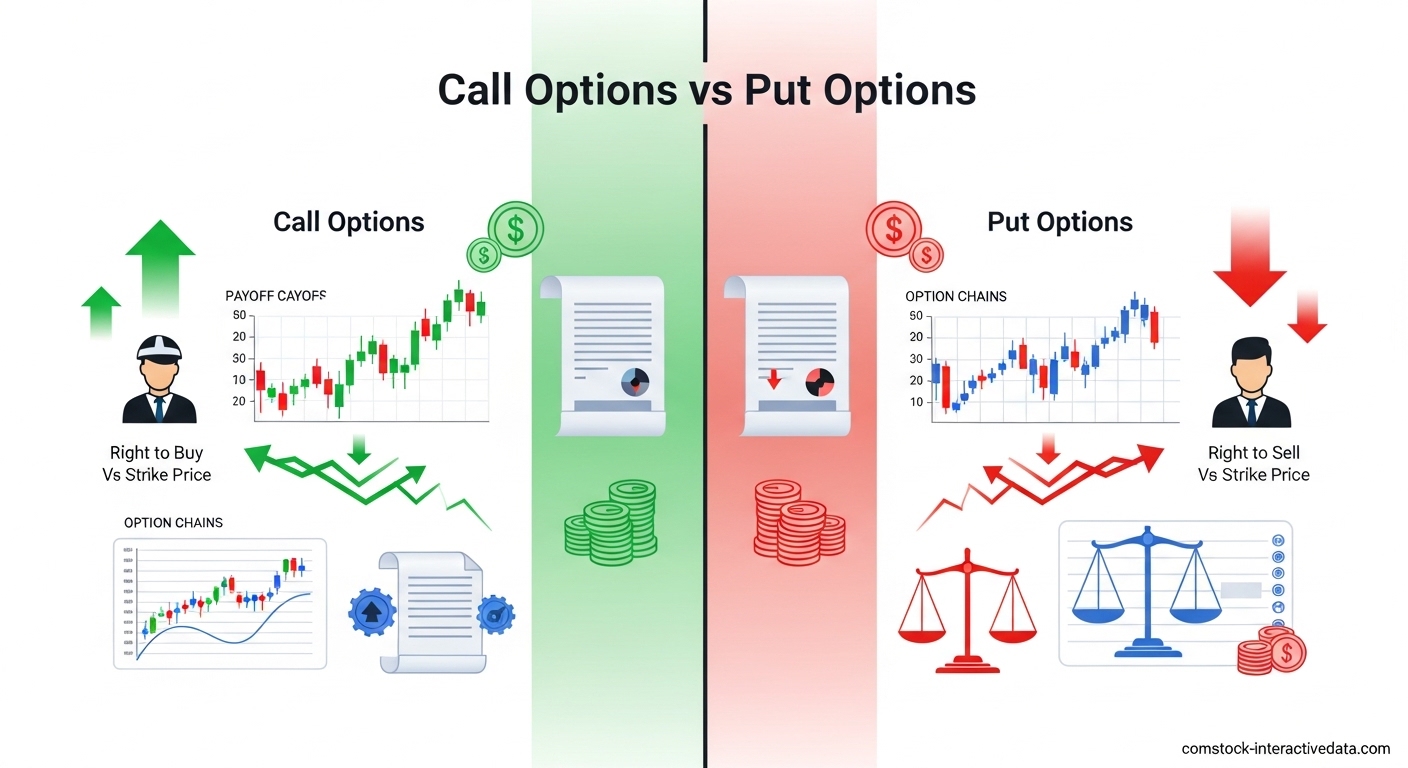
Call options give you the right to buy a stock at a specific price. Put options give you the right to sell a stock at a specific price. Understanding this fundamental difference is the first step to mastering options trading.
When I started learning about options, I felt overwhelmed by the jargon. Terms like strike price, premium, and time decay seemed designed to confuse beginners. But after studying how successful traders use these contracts, I realized the concepts are actually straightforward once you strip away the complexity.
This guide breaks down call options vs put options into plain English. You will learn exactly how each works, when to use them, and the risks involved. By the end, you will understand the four market perspectives that most beginners miss.
Table of Contents
Call Options vs Put Options: Quick Overview
The fastest way to understand the difference is to look at them side by side. This table shows how call and put options compare across the most important characteristics.
| Characteristic | Call Option | Put Option |
|---|---|---|
| Right to | Buy the underlying asset | Sell the underlying asset |
| Profitable when | Stock price rises above strike price | Stock price falls below strike price |
| Market sentiment | Bullish (expecting price increase) | Bearish (expecting price decrease) |
| Maximum profit (buyer) | Theoretically unlimited | Limited to strike price minus premium |
| Maximum loss (buyer) | Premium paid | Premium paid |
| Used for | Speculation, stock substitution, income | Hedging, speculation, portfolio protection |
Think of a call option like a coupon that lets you buy something at a fixed price. A put option is like insurance that lets you sell something at a guaranteed minimum price.
What Are Call Options?
A call option is a contract that gives you the right, but not the obligation, to buy 100 shares of a stock at a specific price (the strike price) before a specific date (the expiration date).
You pay a premium to purchase this right. If the stock price rises above your strike price, you can exercise the option and buy shares at the lower strike price. If the stock stays below the strike price, you simply let the option expire and lose only the premium you paid.
How Call Options Work in Practice?
Imagine you believe XYZ Company stock, currently trading at $50 per share, will rise to $60 within the next month. Instead of buying 100 shares for $5,000, you purchase a call option with a $55 strike price for a $2 premium per share ($200 total for the contract).
Each options contract represents 100 shares. This is called the contract multiplier. So when you see an option priced at $2, that actually costs you $200 to buy one contract.
Now let us look at what happens at expiration:
- If XYZ rises to $60: Your option is worth $5 per share ($60 market price – $55 strike price). You could exercise and buy 100 shares for $5,500, then immediately sell them for $6,000. Your profit would be $300 ($500 intrinsic value – $200 premium paid).
- If XYZ stays at $50: Your option expires worthless. You lose the $200 premium but nothing more.
- If XYZ rises to $70: Your profit jumps to $1,300 ($1,500 intrinsic value – $200 premium). This demonstrates the leverage options provide.
The break-even price for this call option is $57 per share ($55 strike + $2 premium). You need the stock to rise above this level to make a profit.
What Are Put Options?
A put option gives you the right, but not the obligation, to sell 100 shares of a stock at the strike price before expiration. Put options increase in value when the underlying stock price falls.
You pay a premium to buy this protection. If the stock price drops below your strike price, you can exercise the option and sell shares at the higher strike price. If the stock stays above the strike price, you let the option expire and lose only the premium.
How Put Options Work in Practice?
Suppose you own 100 shares of ABC Company that you bought at $80 per share. The stock is currently trading at $85, but you are worried it might drop to $70 due to an upcoming earnings report. You buy a put option with a $80 strike price for a $3 premium ($300 total).
This is called a protective put. It acts as insurance for your stock position. Here is what happens at expiration:
- If ABC drops to $70: Without the put, your shares would be worth $7,000 (down $1,000 from your $8,000 cost). But with the put, you can sell at $80. Your total position value is $7,700 ($8,000 from exercising the put minus $300 premium). Your net loss is only $300 instead of $1,000.
- If ABC stays at $85: Your put expires worthless. You lose the $300 premium, but your shares are still worth $8,500. You paid for insurance you did not need.
- If ABC rises to $95: You let the put expire worthless (losing $300) but your shares gained $1,500. You are still ahead by $1,200.
Think of put options as insurance policies. You pay premiums hoping you never need to use them, but they protect you from catastrophic losses when markets turn against you.
Key Differences Between Call and Put Options
Beyond the basic buy versus sell distinction, call and put options differ in several important ways. Understanding these differences helps you choose the right tool for your market outlook.
Profit Potential and Risk Profile
Call option buyers have theoretically unlimited profit potential. A stock can rise infinitely, so your gains from owning calls can be substantial if you pick the right direction.
Put option buyers have limited profit potential. A stock can only fall to zero, so the maximum profit is the strike price minus the premium paid. A put with a $50 strike can never be worth more than $50 per share ($5,000 per contract).
For option buyers, the maximum risk is always limited to the premium paid. Whether you buy calls or puts, you can never lose more than what you paid for the option contract.
Market Conditions That Favor Each
Call options work best in bullish markets or when you expect a specific stock to rise. They also benefit from high implied volatility, which increases option premiums.
Put options work best in bearish markets or when you expect a stock to decline. They also serve as portfolio insurance during uncertain times, often becoming more expensive when fear is high.
Time Decay Affects Both Equally
One characteristic calls and puts share is time decay. Options lose value as they approach expiration. This decay accelerates in the final 30 days before expiration.
If you buy either type of option and the stock price stays flat, you will lose money simply from the passage of time. This is why many beginners lose money on out-of-the-money options that never move in their favor.
The Four Market Participants: Understanding All Perspectives
Most beginners only think about buying options. But every option contract has two sides. Understanding all four market participants helps you grasp how options markets actually function.
Participant 1: Call Option Buyer
The call buyer pays a premium for the right to buy stock at the strike price. They are bullish, expecting the stock price to rise above the strike price plus premium before expiration.
Risk: Limited to premium paid.
Reward: Unlimited as stock rises.
Participant 2: Call Option Seller (Writer)
The call seller receives the premium and takes on the obligation to sell stock at the strike price if assigned. They are bearish or neutral, expecting the stock to stay below the strike price.
Risk: Unlimited if naked (no stock ownership). Limited if covered (owns the stock).
Reward: Limited to premium received.
Participant 3: Put Option Buyer
The put buyer pays a premium for the right to sell stock at the strike price. They are bearish, expecting the stock price to fall below the strike price minus premium before expiration.
Risk: Limited to premium paid.
Reward: Limited to strike price minus premium.
Participant 4: Put Option Seller (Writer)
The put seller receives the premium and takes on the obligation to buy stock at the strike price if assigned. They are bullish or neutral, expecting the stock to stay above the strike price. Many investors use cash-secured puts as a way to acquire stocks at lower prices.
Risk: Limited to strike price minus premium received (if stock goes to zero).
Reward: Limited to premium received.
Here is how all four participants compare in one view:
| Participant | Bias | Maximum Profit | Maximum Loss |
|---|---|---|---|
| Call Buyer | Bullish | Unlimited | Premium paid |
| Call Seller | Bearish/Neutral | Premium received | Unlimited (if naked) |
| Put Buyer | Bearish | Strike – Premium | Premium paid |
| Put Seller | Bullish/Neutral | Premium received | Strike – Premium |
When to Use Call Options vs When to Use Put Options?
Choosing between calls and puts depends entirely on your market outlook and your goals. Here are the specific scenarios where each option type makes sense.
When to Buy Call Options?
Buy calls when you expect a stock price to rise. This is the most straightforward use case. You want leverage on a bullish position without tying up capital to buy shares outright.
Calls also work well for stock substitution. Instead of buying 100 shares of a $500 stock for $50,000, you might buy a call option for $5,000. This frees up capital for other investments.
Another use case is speculating on earnings announcements or other catalysts. If you expect good news to drive a stock higher, calls let you profit from that move with defined risk.
When to Buy Put Options?
Buy puts when you expect a stock price to fall. This lets you profit from downward moves without the unlimited risk of short selling.
Puts are essential for portfolio protection. If you own a substantial stock position and want insurance against a market crash, put options act as a hedge.
Some traders also use puts to speculate on overvalued stocks they believe will decline. This is riskier but can be profitable when your analysis is correct.
Selling Options for Income
Selling call options against stocks you own (covered calls) generates income. You collect premiums monthly or weekly, boosting your returns in sideways markets.
Selling put options can be a way to buy stocks at discounts. If you want to own a stock at $50 but it trades at $55, sell a $50 put and collect premium while waiting. If the stock drops to $50, you buy it at your target price. If it stays above $50, you keep the premium.
Essential Options Terminology You Need to Know
Before you trade options, you must understand the vocabulary. Here are the key terms that appear in every options discussion.
Strike Price
The strike price is the predetermined price at which you can buy (call) or sell (put) the underlying stock. If you own a call with a $50 strike, you have the right to buy shares at exactly $50 per share, regardless of the current market price.
Premium
The premium is the price you pay to buy an option or receive when you sell one. Premiums are quoted per share but multiplied by 100 for the actual contract cost. A $2 premium means $200 per contract.
Premiums consist of two components: intrinsic value and extrinsic value. Intrinsic value is the amount the option is in-the-money. Extrinsic value (also called time value) is the remaining premium attributable to time and volatility.
Expiration Date
The expiration date is when the option contract expires. After this date, the option no longer exists. You must exercise, sell, or let it expire worthless before market close on this date.
Options typically expire on Fridays, though some stocks now have Monday and Wednesday expirations as well. Monthly options expire on the third Friday of each month.
In the Money, Out of the Money, At the Money
These terms describe the relationship between the strike price and the current stock price.
A call option is in the money (ITM) when the stock price is above the strike price. It is out of the money (OTM) when the stock price is below the strike. It is at the money (ATM) when the stock price equals the strike price.
A put option is in the money when the stock price is below the strike. It is out of the money when the stock price is above the strike.
Only in-the-money options have intrinsic value. Out-of-the-money options consist entirely of extrinsic value (time value).
American Style vs European Style
American-style options can be exercised at any time before expiration. Most US stock options are American style.
European-style options can only be exercised at expiration. Some index options use European style. Check your option specifications before trading.
Basic Options Strategies for Beginners
Once you understand calls and puts individually, you can combine them into strategies. These two basic strategies are the starting point for most options traders.
Covered Calls: Income Generation
A covered call involves selling call options against stock you already own. You collect premium income while holding the underlying shares.
If the stock stays below the strike price, you keep the premium and your shares. If the stock rises above the strike, your shares may be called away at the strike price. You still keep the premium, but you miss gains above the strike.
This strategy works best in sideways or slightly bullish markets. It reduces your cost basis on the stock but caps your upside potential.
Example: You own 100 shares of XYZ at $50. You sell a call with a $55 strike for $2 premium. If XYZ stays below $55, you keep your shares and the $200 premium. If XYZ rises to $60, your shares get called away at $55. Your total profit is $700 ($500 gain on stock + $200 premium).
Protective Puts: Portfolio Insurance
A protective put involves buying put options on stocks you own. This establishes a floor price below which your position cannot fall.
If the stock drops, your put gains value to offset the stock losses. If the stock rises, your put expires worthless, but you participate fully in the upside minus the premium paid.
This is essentially insurance. You pay premiums to protect against downside risk. Like all insurance, you hope you never need to use it.
Example: You own 100 shares of ABC at $100. You buy a put with a $95 strike for $3 premium. If ABC drops to $80, your put is worth $15 per share at expiration. Your total position value is $9,200 ($8,000 stock value + $1,500 put value – $300 premium). Your maximum loss is capped at $800 instead of the $2,000 you would have lost without protection.
Benefits and Risks of Trading Options
Options offer significant advantages over stock trading, but they also carry unique risks. Understanding both sides helps you use options responsibly.
Benefits of Options
Leverage is the primary benefit. Options let you control 100 shares of stock with a fraction of the capital required to buy those shares outright. A 10% move in a stock can produce a 50% or greater return on an option.
Defined risk for buyers is another advantage. When you buy an option, you can never lose more than the premium paid. This is different from short selling, which has unlimited loss potential.
Options also provide flexibility. You can profit from upward moves (calls), downward moves (puts), sideways markets (selling options), or volatility changes (spreads).
Risks of Options
Time decay works against option buyers. Every day that passes reduces the value of your option. If the stock does not move in your favor quickly enough, you can lose money even if you are directionally correct.
Leverage cuts both ways. While it amplifies gains, it also amplifies losses. A 10% move against you can wipe out most or all of your option premium.
Complexity is a hidden risk. Many beginners enter trades they do not fully understand. They fail to account for factors like implied volatility changes or early assignment risk.
Common Beginner Mistakes to Avoid
Based on discussions from trading forums, these are the mistakes that trip up most beginners:
Buying out-of-the-money options without understanding the odds. OTM options have low win rates. You need large price moves to profit, and time decay works against you.
Holding options too close to expiration. The final week before expiration sees rapid time decay. Beginners often watch profitable positions turn into total losses in the last few days.
Trading without an exit plan. You should know exactly when you will take profits and when you will cut losses before entering any trade.
Ignoring implied volatility. Options get expensive before earnings announcements. Buying at these peaks often leads to losses even when the stock moves in your direction.
Risking too much capital on single trades. Never trade with money you cannot afford to lose completely. Options can and do expire worthless regularly.
Real-World Examples: Numbers That Make Sense
Let us walk through complete scenarios with actual numbers. These examples show exactly how profits and losses work for both call and put options.
Call Option Example: Tesla (TSLA)
Suppose Tesla is trading at $200 per share. You believe it will rise to $220 within the next month after an upcoming product announcement.
You buy a call option with a $210 strike price expiring in 30 days. The premium is $5 per share, costing you $500 total ($5 x 100 shares).
Scenario 1 – Tesla rises to $225: Your option is worth $15 per share at expiration ($225 market price – $210 strike). You paid $5 premium, so your profit is $10 per share or $1,000 total. Your return is 200% on a 12.5% stock move.
Scenario 2 – Tesla rises to $212: Your option is worth $2 per share ($212 – $210). You paid $5 premium, so you lose $3 per share or $300 total. Even though you were directionally correct (stock rose), the move was not large enough to overcome the premium.
Scenario 3 – Tesla falls to $190: Your option expires worthless. You lose the entire $500 premium. This is your maximum loss.
Your break-even price is $215 ($210 strike + $5 premium). Tesla must rise above this level for you to profit.
Put Option Example: Apple (AAPL)
Apple is trading at $180 per share. You own 100 shares and are worried about a market correction. You buy a put option with a $175 strike price for a $3 premium ($300 total).
Scenario 1 – Apple drops to $165: Your put is worth $10 per share ($175 strike – $165 market price). You paid $3 premium, so your net profit on the put is $7 per share or $700. Your stock lost $1,500 in value, but the put gained $700. Your net loss is $800 instead of $1,500.
Scenario 2 – Apple stays at $180: Your put expires worthless. You lose the $300 premium. Your stock position is unchanged, so your portfolio is down $300 total for the insurance you bought.
Scenario 3 – Apple rises to $195: Your put expires worthless (loss of $300). But your stock gained $1,500. Your net gain is $1,200. The insurance cost you something, but you still came out ahead.
Your break-even protection starts at $172 ($175 strike – $3 premium). Below this price, the put more than pays for itself.
Frequently Asked Questions
Is it better to buy put or call options?
Neither is inherently better. Buy calls when you expect prices to rise. Buy puts when you expect prices to fall or want portfolio protection. The best choice depends entirely on your market outlook and investment goals.
What does a $20 call option mean?
A $20 call option means the strike price is $20. You have the right to buy 100 shares at $20 per share before expiration. The premium you pay is separate from this strike price. You profit if the stock rises above $20 plus whatever premium you paid.
What is the 3 5 7 rule in trading?
The 3 5 7 rule is a risk management guideline suggesting you risk no more than 3% of your capital on any single trade, limit open positions to 5% of total capital, and never have more than 7% of capital at risk across all open trades combined.
Does Warren Buffett use put options?
Yes, Warren Buffett has famously used put options. He sold cash-secured puts on stocks he wanted to buy at lower prices, collecting premiums while waiting. He has also used index put options to hedge Berkshire Hathaway’s portfolio during market uncertainty.
Can you lose money on call options?
Yes, you can lose 100% of your investment in call options. If the stock price stays below the strike price at expiration, the option expires worthless and you lose the entire premium paid. Time decay works against you every day the stock does not move in your favor.
What happens when options expire?
At expiration, in-the-money options are typically automatically exercised, meaning you buy (calls) or sell (puts) shares at the strike price. Out-of-the-money options expire worthless and disappear. You can also close positions before expiration by selling your options in the market.
Conclusion
Call options vs put options represent two sides of the same derivatives market. Call options give you the right to buy, making them ideal for bullish scenarios. Put options give you the right to sell, serving both bearish speculation and portfolio protection needs.
The key insight most beginners miss is that options have four market participants, not two. Every option contract involves a buyer and seller, each with different risk profiles and profit potential. Understanding all four perspectives helps you trade more effectively and avoid costly mistakes.
Before trading real money, consider paper trading to practice these concepts without risk. Most brokers offer virtual trading environments where you can test strategies using real market data. Spend time mastering the terminology, understanding time decay, and developing your exit discipline.
Options trading offers powerful tools for income generation, speculation, and risk management. Used wisely, they can enhance your investment returns and protect your portfolio. Used carelessly, they can lead to significant losses. The knowledge in this guide gives you the foundation to use options responsibly and profitably.