
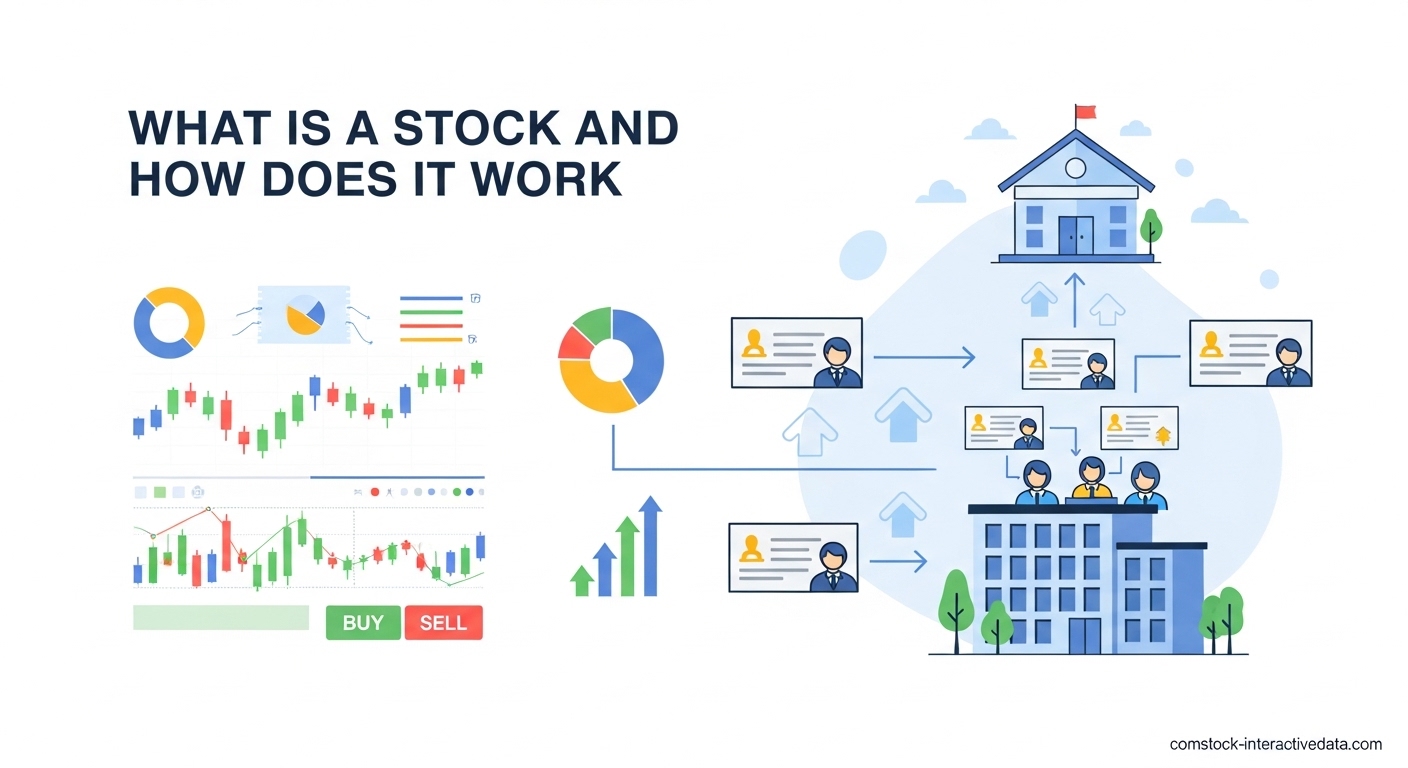
Imagine slicing a pizza into 100 pieces. If you own 10 pieces, you own 10% of that pizza. That is essentially what a stock represents. What is a stock and how does it work? It is a way for everyday people like you and me to own tiny pieces of real companies. When you buy a stock, you become a partial owner of that business.
Our team has spent years helping beginners understand the stock market. We have seen the confusion that surrounds this topic. Reddit communities like r/investingforbeginners are filled with people asking the same fundamental questions. This guide breaks everything down in plain language. We skip the financial jargon and focus on what actually matters for someone starting out.
Table of Contents
What Is a Stock?
A stock (also called shares or equity) is a security that represents fractional ownership in a company. When you buy stock, you become a partial owner of that business. Companies issue stocks to raise capital for growth, and investors buy shares hoping to profit.
The concept is straightforward. Companies need money to expand, hire people, or launch new products. Instead of borrowing from a bank, they sell small pieces of the company to the public. Each piece is called a share. When you own a share, you own a small fraction of everything the company owns, from its buildings to its patents.
Fractional Ownership Explained
Think of it like buying a rental property with friends. One person might own 40%, another 35%, and you might own 25%. Each owner gets a share of the rental income proportional to their ownership. Stocks work the same way, just on a much larger scale with companies that have millions or billions of shares.
When you own stock in Apple, for example, you technically own a tiny fraction of every iPhone sold, every Apple Store location, and every dollar Apple has in the bank. The more shares you own, the larger your ownership stake becomes.
Stocks vs Shares
You will hear people use “stocks” and “shares” interchangeably, and that is mostly fine. Technically, “shares” refers to individual units of ownership, while “stocks” is the broader category. If you own 50 shares of Microsoft, you hold 50 individual stocks (or shares) in that company.
How Stocks Work?
Stocks trade on exchanges, which are marketplaces where buyers and sellers come together. Think of a stock exchange like a farmers market, but instead of vegetables, people trade ownership in companies. The price changes based on how many people want to buy versus sell at any given moment.
Buying and Selling Stocks
When you want to buy a stock, you place an order through a brokerage account. A brokerage acts as the middleman between you and the stock exchange. Most brokerages now offer apps where you can buy stocks with a few taps on your phone.
Let us say you want to buy one share of a company trading at $50. You log into your brokerage app, search for the stock symbol, and place a buy order for one share. Within seconds, the transaction settles, and you officially own a piece of that company.
How Orders Get Executed?
Behind the scenes, your brokerage sends your order to the exchange. There are two main types of orders. A market order executes immediately at the current market price. A limit order only executes if the stock reaches a specific price you set. As a beginner, market orders are simpler and more common.
The entire process happens electronically in milliseconds today. When you hear about “high-frequency trading,” it refers to computer programs that buy and sell stocks in fractions of a second, capitalizing on tiny price differences.
Types of Stocks
Not all stocks are the same. Companies can issue different classes of stock, each with its own characteristics. Understanding the main types helps you make better investment decisions.
Common Stock
Common stock is what most people mean when they talk about buying stocks. If you own common stock, you get voting rights at shareholder meetings, typically one vote per share. You also receive dividends if the company pays them, though dividends are never guaranteed.
The big upside of common stock is its growth potential. If a company like Amazon or Tesla grows significantly, your shares can increase substantially in value. The downside is that if the company goes bankrupt, common shareholders are last in line to receive any remaining assets.
Preferred Stock
Preferred stock behaves more like a bond. Owners typically do not get voting rights, but they receive dividends before common shareholders. If the company liquidates, preferred shareholders get paid before common shareholders.
Preferred stock tends to be less volatile than common stock. The trade-off is lower growth potential. Investors often buy preferred stock for steady income rather than capital appreciation. Many beginners start with common stock since it offers more growth opportunity.
Other Classifications
Stocks also get classified by size and style. Large-cap stocks come from big companies with market values over $10 billion. Small-cap stocks come from smaller companies with more room to grow but higher risk. Growth stocks focus on companies reinvesting profits for expansion. Value stocks trade at lower prices relative to their fundamentals.
How Investors Make Money?
There are two primary ways stock investors generate returns. Understanding both helps you build a strategy that matches your financial goals.
Price Appreciation
The first way is through capital gains. This happens when you sell a stock for more than you paid. If you buy a share for $50 and sell it later for $75, you make $25 per share in capital gains. This is the most common way individual investors build wealth in stocks over time.
Historically, the S&P 500 has returned about 10% annually on average over long periods. That means $10,000 invested 30 years ago would be worth roughly $174,000 without adding any additional money. Compound growth is a powerful force.
Dividends
The second way is through dividends. Some companies share their profits directly with shareholders through regular cash payments. If a company declares a $2 annual dividend per share and you own 100 shares, you receive $200 per year just for holding the stock.
Dividends provide income without selling your shares. Many investors reinvest dividends automatically, using that cash to buy more shares. This compounds your returns over time. Companies like Johnson & Johnson, Coca-Cola, and Procter & Gamble have paid dividends consistently for decades.
Not all companies pay dividends. Young, fast-growing companies often reinvest all profits back into the business instead. Whether you prefer dividend stocks or growth stocks depends on your financial goals and timeline.
Stock Market Basics
The stock market is where all the buying and selling happens. Understanding its basics helps demystify how your investments work.
What Is the Stock Market?
The stock market is a network of exchanges where stocks are traded. It brings together millions of buyers and sellers daily, determining fair prices through supply and demand. Without this organized marketplace, finding someone to sell your shares to would be incredibly difficult.
When people refer to “the market” going up or down, they usually mean major indices like the S&P 500 or Dow Jones Industrial Average. These indices track groups of stocks to give a snapshot of overall market performance.
Major Exchanges: NYSE and Nasdaq
The New York Stock Exchange (NYSE) is the largest stock exchange in the world by market capitalization. Founded in 1792, it operates as a traditional auction market where stocks trade on a physical trading floor. Companies listed on the NYSE tend to be well-established blue-chip companies.
The Nasdaq is the second-largest exchange and operates entirely electronically. Tech giants like Apple, Amazon, Google, and Facebook trade on the Nasdaq. It tends to attract growth-oriented companies in the technology sector.
Market Indices
Indices like the S&P 500 track 500 of the largest US companies. The Dow Jones Industrial Average includes 30 prominent companies. The Nasdaq Composite includes all stocks listed on the Nasdaq exchange. When you hear that “the market is up 1%,” it usually refers to one of these indices gaining that percentage.
Risks of Stock Investing
Stocks offer significant wealth-building potential, but they come with real risks. Successful investors understand these risks and plan accordingly.
Market Volatility
Stock prices fluctuate constantly based on news, economic data, and investor sentiment. In 2020, the S&P 500 dropped 34% in just 33 days due to pandemic fears. It then recovered fully by August of that same year. Short-term volatility can be nerve-wracking, but long-term investors who stayed calm actually benefited.
Volatility is normal. The market has experienced drops of 10% or more roughly once per year on average. These corrections can be alarming, but they are also opportunities for investors with cash to deploy.
Company-Specific Risk
Individual companies can fail. When that happens, stockholders typically lose their entire investment. Think of companies like Blockbuster, Toys “R” Us, or Lehman Brothers. Investors who held their shares through bankruptcies lost everything.
This is why diversification matters. If you own 30 different stocks across various industries, the failure of any single company has limited impact on your overall portfolio.
Managing Risk Through Diversification
Diversification means spreading your money across different investments to reduce risk. The old saying “do not put all your eggs in one basket” applies directly to stock investing. Index funds that hold hundreds of stocks automatically provide diversification.
Many financial experts recommend that beginners start with low-cost index funds. These funds track market indices and offer instant diversification. You can own a piece of 500 companies with a single purchase. Over time, you can add individual stocks once you gain more confidence and knowledge.
Getting Started with Stocks
Starting your stock investment journey is easier than ever. The barriers to entry have essentially disappeared, and you can begin with surprisingly small amounts of money.
Opening a Brokerage Account
You need a brokerage account to buy stocks. Many brokerages now offer commission-free trading with no minimum deposits. Popular options include Fidelity, Charles Schwab, Vanguard, and TD Ameritrade. Even apps like Robinhood have attracted millions of beginners with their simple interfaces.
Opening an account takes about 10 minutes. You provide some basic information, link your bank account, and you are ready to start investing. Some employer retirement plans also give you access to stock investments through 401(k) accounts.
Your First Investment
The question we hear most is “is buying $10 of stock worth it?” Absolutely. Fractional shares let you invest any amount into expensive stocks. You can own a piece of Amazon or Google with just a few dollars. Starting small builds experience without taking big risks.
Many beginners make the mistake of trying to time the market or pick individual stocks immediately. Instead, consider starting with an index fund that tracks the broader market. This approach lets you learn while your money grows.
The key is to start. Waiting for the “perfect” time usually means never starting at all. Historically, staying invested for long periods has rewarded patient investors far more than trying to predict short-term movements.
Frequently Asked Questions
How does stock work for beginners?
Stocks work by giving you partial ownership in a company. When you buy shares through a brokerage account, you become a shareholder. You profit when the stock price increases (capital gains) or through dividends the company pays. The process is simple: open an account, fund it, search for a stock, and place a buy order.
Is buying $10 of stock worth it?
Yes, buying even $10 of stock is worth it. Fractional shares allow you to invest any amount into any stock, even expensive ones like Amazon or Google. Starting small helps you learn without risking significant money. The key is building the habit of investing regularly over time.
Can you make $1000 a month with stocks?
Making $1000 per month requires roughly $300,000 invested at a 4% monthly return rate, which is unrealistic for most people. However, building a portfolio over decades through consistent investing and reinvested dividends can generate substantial passive income. Focus on long-term growth rather than monthly income targets.
What is the best stock to put money in right now?
There is no single best stock for everyone. The right choice depends on your goals, risk tolerance, and time horizon. For beginners, low-cost index funds that track the S&P 500 are often recommended because they provide instant diversification. Consider consulting a financial advisor for personalized advice.
Conclusion
What is a stock and how does it work? It is a share of ownership in a company that trades on public exchanges. Stocks let everyday people participate in business ownership and wealth building. You can profit through price appreciation when companies grow or through dividends companies pay to shareholders.
Understanding stocks is the first step toward financial independence. Start with small investments, focus on learning, and resist the urge to check your portfolio constantly. The best investors think in decades, not days. Your future self will thank you for starting today.