
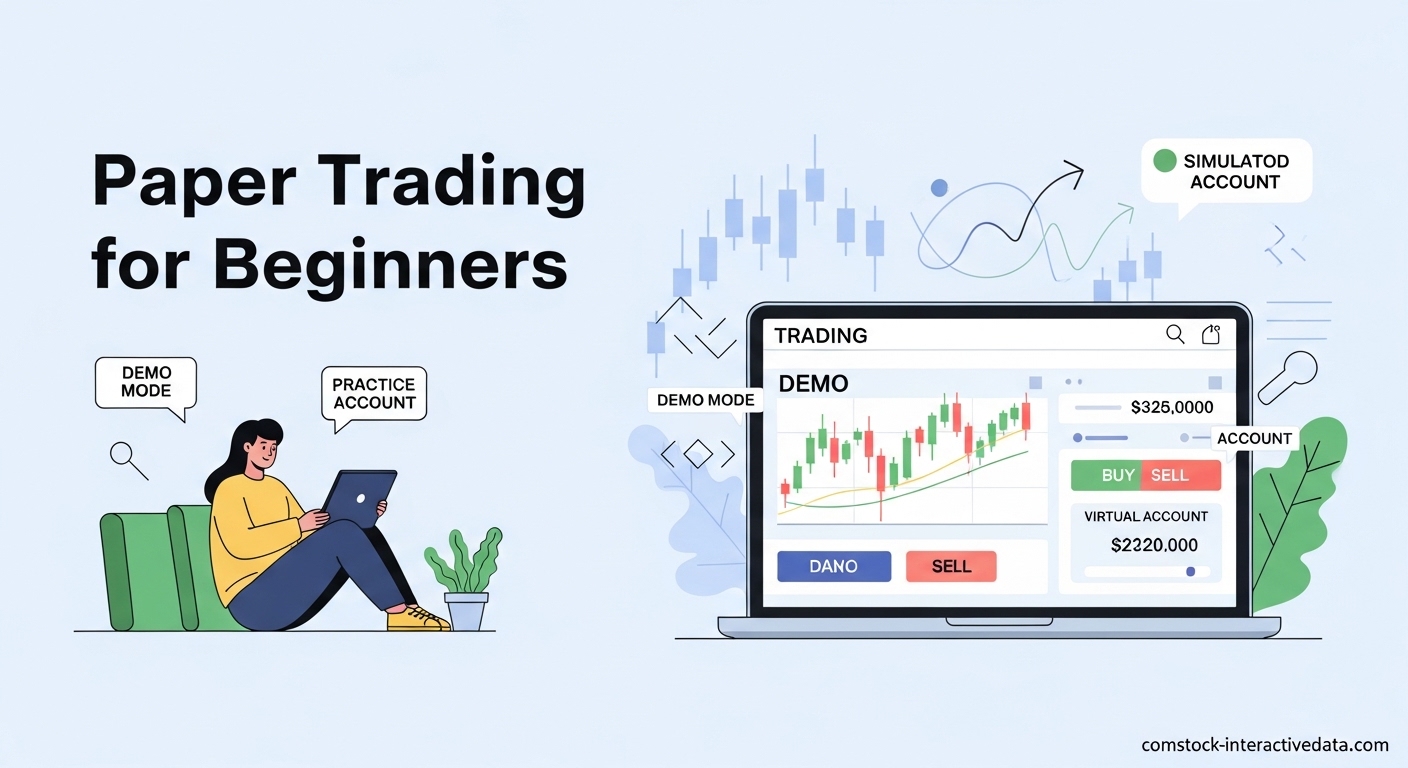
Paper trading is simulated trading where you practice buying and selling stocks, options, or other financial instruments using virtual money instead of real capital. You get access to real-time market data, charts, and order execution just like live trading, but without any financial risk. This makes paper trading for beginners the essential first step before risking a single dollar in the markets.
In this guide, I will walk you through everything you need to know about paper trading. You will learn exactly how it works, why it is crucial for beginners, the best platforms to use, common mistakes to avoid, and most importantly, when you will be ready to transition to real trading with actual money.
I have spent months researching trader forums, analyzing successful trader journeys, and compiling the statistics that every beginner needs to know. The data is sobering: research consistently shows that the vast majority of day traders lose money. Paper trading is your best defense against becoming another statistic.
Table of Contents
What Is Paper Trading?
Paper trading is a simulated trading environment where you execute trades with virtual (fake) money while receiving real-time market data and price movements. The term originated decades ago when aspiring traders would literally write down their hypothetical trades on paper to track performance. Today, sophisticated software platforms provide an experience nearly identical to live trading.
Think of paper trading like a flight simulator for pilots. No airline puts an inexperienced pilot in a real aircraft with passengers on their first day. They spend hours in simulators experiencing every possible scenario before touching the controls of an actual plane. Trading should be no different.
How Paper Trading Works?
When you open a paper trading account, the broker or platform gives you a virtual balance, typically starting between $100,000 and $1,000,000 in fake money. You can place market orders, limit orders, stop-loss orders, and use all the same tools available in live trading accounts.
The platform fills your orders based on real market prices and conditions. Your virtual portfolio tracks profits, losses, buying power, and margin usage exactly like a real account. You can trade stocks, options, forex, cryptocurrencies, and futures depending on the platform you choose.
What You Can Trade With Paper Trading?
Most paper trading platforms support multiple asset classes for comprehensive practice. Stocks are the most common starting point for beginners, allowing you to practice entries, exits, and position sizing.
Options trading simulation is available on advanced platforms like Thinkorswim and Schwab paperMoney. This is invaluable since options strategies can be complex and expensive to learn with real money. Forex and cryptocurrency paper trading is offered through specialized brokers and platforms like TradingView.
Why Beginners Should Start with Paper Trading?
If you are new to trading, paper trading is not optional. It is the foundation that separates future successful traders from those who blow up their accounts within weeks. Here is why every beginner needs to start with simulated trading.
The statistics on day trading failure are brutal and well-documented. Multiple academic studies, including research from the University of California and Brazil’s Federal University, have found that approximately 97% of day traders lose money over time. Only a tiny fraction achieves consistent profitability. Paper trading gives you a fighting chance to join that small successful minority.
Reason 1: Risk-Free Learning Environment
When you are learning to trade, you will make mistakes. Lots of them. You will misread charts, enter the wrong order type, chase breakouts that fail, and hold losers too long. These mistakes are educational goldmines when they cost you fake money. They are account destroyers when they cost you real money.
Paper trading lets you experience the full emotional cycle of winning and losing trades without the financial devastation. You can learn how to handle consecutive losses, manage winning streaks without getting cocky, and develop the discipline to follow your trading plan.
Reason 2: Build Skills Without Financial Loss
Trading is a skill that takes time to develop. Reading price action, recognizing patterns, managing risk, and executing orders efficiently are not innate abilities. They must be practiced and refined.
Paper trading provides the repetition necessary to build these skills. You can practice entering bracket orders, scaling into positions, and using hotkeys until they become second nature. By the time you trade with real money, these mechanical skills should be automatic.
Reason 3: Test Strategies Before Committing Capital
Every trader needs a strategy with defined entry rules, exit rules, and risk management parameters. But a strategy that looks good on paper or in a backtest may not work for your personality or in current market conditions.
Paper trading lets you test multiple strategies to find what fits your style. You can try day trading, swing trading, momentum strategies, or reversal plays. You will quickly discover whether you prefer high-frequency trading or holding positions for days. This discovery phase should happen with virtual money, not your savings.
Reason 4: Learn Platform Navigation and Order Types
Trading platforms are complex software with steep learning curves. Order entry windows, charting tools, scanners, and risk management features take time to master. In fast-moving markets, hesitation caused by not knowing where to click can cost you money.
Paper trading gives you unlimited time to learn your platform inside and out. You can practice placing market orders, limit orders, stop orders, and trailing stops without pressure. You will learn how to read Level 2 data, interpret time and sales, and customize your workspace for maximum efficiency.
Reason 5: Develop Emotional Discipline and Trading Psychology
Trading psychology is often the difference between success and failure. Fear and greed drive most trading mistakes. The fear of missing out (FOMO) causes chasing entries. The fear of loss causes exiting winners too early. Greed causes holding losers too long hoping they will recover.
While paper trading cannot fully replicate the emotions of risking real money, it is the first step in building psychological discipline. You can practice following your rules, accepting losses gracefully, and avoiding revenge trading. These habits are much easier to establish when the stakes are low.
Key Benefits of Paper Trading for Beginners
Paper trading offers specific advantages that make it the ideal starting point for anyone serious about learning to trade. These benefits go beyond simply avoiding losses.
- Risk-free strategy testing: Test any trading strategy without financial consequence. If a strategy fails, you learn from it without losing capital.
- Real-time market experience: Experience live market conditions, volatility, and price action in real-time rather than looking at historical charts.
- Platform familiarity: Master your trading software so execution becomes automatic when you transition to live trading.
- Performance tracking and analysis: Most platforms provide detailed statistics on your win rate, profit factor, average winner, and average loser.
- Backtesting capabilities: Some platforms allow you to replay historical market data and practice trading past sessions.
- Confidence building: Develop the confidence that comes from competence before risking your hard-earned money.
Limitations and Cons of Paper Trading
Paper trading is not perfect. Understanding its limitations will help you avoid the common trap of overconfidence when transitioning to live trading.
No Real Emotional Stakes
The biggest limitation of paper trading is that it cannot replicate the emotional impact of real money. When you lose $500 in a paper trade, you might shrug it off. When you lose $500 of actual money, your heart races, your palms sweat, and your judgment clouds.
This emotional difference affects decision-making in ways that are difficult to anticipate. You may find yourself hesitating to take valid setups, or revenge trading after losses, or refusing to cut losses because you cannot accept being wrong. These emotions must be managed with real money in ways paper trading cannot fully prepare you for.
Execution Differences
Paper trading fills are often more favorable than live trading fills. In simulated environments, your orders may fill instantly at the displayed price. In live markets, slippage occurs, especially in fast-moving or thinly traded stocks. You might get filled at a worse price than expected, turning a paper winner into a live loser.
Overconfidence Risk
Many traders experience consistent profitability in paper trading, then lose money immediately when going live. This creates dangerous overconfidence. Success with fake money does not guarantee success with real money. The skills transfer, but the psychology does not.
Psychological Transition Challenge
Even experienced paper traders often struggle with the transition to live trading. The moment real money is at stake, everything changes. Risk management rules that were easy to follow with virtual money suddenly feel restrictive. Position sizes that seemed reasonable now feel terrifying.
How to Get Started with Paper Trading?
Starting with paper trading is straightforward. Follow these six steps to begin your simulated trading journey today.
Step 1: Choose a Paper Trading Platform
Select a platform that matches your trading goals and experience level. For beginners, user-friendly platforms like Webull or TradingView work well. For more serious learners wanting professional-grade tools, consider Schwab paperMoney or Thinkorswim.
Step 2: Create Your Account and Access Virtual Funds
Most platforms offer paper trading with a simple sign-up process. You will typically receive instant access to a virtual balance between $100,000 and $1,000,000. No real money deposit is required.
Step 3: Set Up Your Virtual Portfolio
Configure your paper trading account to match what you plan to use in live trading. Set your virtual balance to a realistic amount you could actually deposit. Configure your risk per trade, typically 1-2% of your account balance. This creates realistic position sizing practice.
Step 4: Learn the Platform Interface and Tools
Spend time exploring the platform before placing any trades. Learn how to create watchlists, customize charts, and navigate the order entry window. Watch tutorial videos specific to your platform. The time invested here pays dividends later.
Step 5: Place Your First Paper Trade
Start small. Place a single trade with a clear plan: entry price, stop-loss level, and profit target. Document your reasoning before entering. Execute the trade and observe the outcome. Review what went right or wrong.
Step 6: Track Performance and Keep a Trading Journal
Every trade you make should be recorded in a trading journal. Note the setup, entry, exit, profit or loss, and emotional state. Review your journal weekly to identify patterns in your trading. This habit is essential for improvement.
Best Paper Trading Platforms for Beginners
TradingView: Excellent charting capabilities with a large community of traders sharing ideas. The paper trading feature integrates seamlessly with their renowned charting tools. Best for traders who prioritize technical analysis.
Webull: A user-friendly mobile and desktop platform popular with newer traders. The interface is clean and intuitive, making it ideal for beginners. Offers extended hours trading simulation.
Schwab paperMoney: Provides a professional-grade experience with $100,000 in virtual funds. Uses the same interface as Schwab’s live trading platform. Color-coded order windows (orange for closing, blue for opening) help prevent mistakes.
Thinkorswim by TD Ameritrade: The gold standard for serious traders. Offers advanced features like options chains, complex order types, and on-demand backtesting. Steep learning curve but unmatched capabilities.
Common Mistakes Beginners Make in Paper Trading
Most beginners waste their paper trading opportunity by making avoidable mistakes. Here are the biggest pitfalls to watch for.
Not Taking Paper Trading Seriously
The most common mistake is treating paper trading like a game. Traders take massive position sizes they would never use with real money, ignore their stop losses, and chase every momentum stock they see. This creates terrible habits that will destroy a live account.
Treat your virtual money as if it is real. Set the same risk limits, follow the same rules, and take the same position sizes you plan to use when trading live. The habits you build in simulation will carry over to real trading.
Ignoring Risk Management
Since there is no financial consequence, beginners often abandon risk management entirely. They let losses run far beyond their planned stop loss, hoping the trade will turn around. This teaches the dangerous habit of hoping instead of following rules.
Always set and honor stop losses in paper trading. The point is to practice the process, not to make fake money. Your goal is consistency and rule-following, not paper profits.
Overtrading and Chasing Every Move
Paper trading makes it easy to overtrade. With no commission costs and no financial risk, beginners often place dozens of trades per day, chasing every small price movement. This develops the bad habit of overtrading that leads to excessive fees and poor decision-making in live trading.
Trade only your planned setups. If the market is not offering valid opportunities according to your strategy, do not trade. Practice patience as much as you practice execution.
No Trading Journal or Performance Review
Beginners often skip the crucial step of recording and reviewing their trades. Without a journal, you cannot identify what is working and what is not. You will repeat the same mistakes indefinitely.
Document every trade with screenshots, entry reasoning, and emotional notes. Review weekly to spot patterns. This discipline separates future professionals from hobbyists.
Jumping to Real Money Too Quickly or Staying Too Long
Two opposite mistakes plague paper traders. Some jump to real money after a few winning days, completely unprepared for the psychological difference. Others paper trade for years, never gaining the courage to trade live.
The sweet spot is typically 3-6 months of consistent, profitable paper trading. Less than that and you have not built enough skill. More than 6-12 months and you risk developing analysis paralysis.
Tips for Successful Paper Trading
Follow these best practices to maximize the value of your paper trading experience.
- Treat virtual money as real: Set realistic position sizes and risk limits. If you would not risk $500 per trade with real money, do not do it with paper money.
- Keep a detailed trading journal: Record every trade with reasoning, screenshots, and emotional state. Review regularly for patterns.
- Focus on consistency, not home runs: Aim for small, consistent profits rather than trying to double your account. Consistency is what scales.
- Stick to 1-2 strategies maximum: Master one or two setups before expanding. Jack of all trades is master of none in trading.
- Practice emotional discipline: Even without real money, practice following your rules when you feel like deviating. This builds discipline.
- Use realistic position sizes: Trade the share sizes and dollar amounts you would actually use with your real account size.
When to Transition from Paper Trading to Real Trading?
Knowing when you are ready to trade with real money is crucial. Transition too early and you will likely lose money. Stay in paper trading too long and you may never make the leap.
The 3-6 Month Timeline
Based on trader forum discussions and professional recommendations, most beginners need 3-6 months of consistent paper trading before going live. This timeframe allows you to experience different market conditions, including volatile and slow periods.
Some traders with extensive market knowledge or finance backgrounds may be ready sooner. Others may need longer. The key metric is consistency, not time alone.
Consistency Metrics to Meet
Before transitioning to real money, aim for 2-3 consecutive months of profitability in your paper trading account. This should include at least 30-50 trades per month to be statistically meaningful.
Track your win rate, average winner size, average loser size, and profit factor. Your win rate should be above 50%, and your average winner should be larger than your average loser. A profit factor above 1.5 indicates a viable strategy.
Emotional Readiness Checklist
Beyond statistics, assess your emotional readiness. Can you follow your trading plan when bored? Can you accept a string of losses without deviating from your strategy? Can you avoid revenge trading? These psychological skills matter more than any metric.
Consider making a gradual transition. Start with a small live account using micro position sizes. Trade half your normal size for the first month. This bridges the gap between simulation and full live trading.
Signs You Are Not Ready Yet
If you are still making impulsive trades, ignoring your stop losses, or constantly changing strategies, you are not ready for real money. If paper trading feels like a game rather than practice, stay in simulation longer.
Similarly, if you have been paper trading for over a year and still hesitate to go live, you may need to address fear issues or reconsider whether active trading suits your personality.
Paper Trading vs Live Trading: Key Differences
Understanding the differences between paper and live trading prepares you for the transition. Here is what changes when real money enters the equation.
Psychological Impact of Real Money
The most significant difference is psychological. Every dollar in your live account represents real purchasing power. A $200 loss means $200 less for groceries, rent, or savings. This reality changes how you perceive risk and reward.
In paper trading, a losing streak is educational. In live trading, a losing streak is stressful and can affect your sleep, relationships, and decision-making. The emotional regulation required in live trading is an order of magnitude more difficult.
Execution Quality and Slippage
Live markets involve slippage, partial fills, and liquidity issues that paper trading often glosses over. In fast-moving markets, the price you see may not be the price you get. This can turn profitable paper trades into losing live trades.
Commission costs and fees also affect live trading results in ways paper trading cannot fully replicate. While many brokers now offer commission-free stock trading, options and futures still carry fees that impact profitability.
Emotional Responses: Fear, Greed, and FOMO
Fear of loss causes hesitation in live trading. You may see a perfect setup but fail to pull the trigger, watching the trade work without you. Greed causes you to hold winners too long, watching paper profits evaporate. FOMO drives you into trades you should skip.
These emotions exist in paper trading but at a much lower intensity. Prepare yourself for an emotional amplification when you go live.
Frequently Asked Questions About Paper Trading
Is paper trading good for beginners?
Yes, paper trading is excellent for beginners. It provides a risk-free environment to learn trading platforms, test strategies, and build skills without losing money. Studies show that 97% of day traders lose money, making paper trading essential preparation before risking real capital. Beginners should paper trade for 3-6 months before transitioning to live trading.
Is it true that 97% of day traders lose money?
Yes, academic research supports this statistic. Multiple studies from universities including UC Berkeley and Brazil’s Federal University have found that approximately 97% of individual day traders lose money over time. Only about 1% consistently profit, while 2% break even. This statistic underscores why paper trading is crucial before risking real money.
How to start paper trading for beginners?
To start paper trading, follow these steps: 1) Choose a platform like TradingView, Webull, or Schwab paperMoney. 2) Create a free account and access virtual funds (typically $100,000-$1,000,000). 3) Set up your virtual portfolio with realistic position sizes. 4) Learn the platform interface and tools. 5) Place your first paper trade with a clear plan. 6) Track all trades in a trading journal.
What is the 3 5 7 rule in trading?
The 3-5-7 rule is a guideline suggesting traders should not risk more than 3% of their account on a single trade, hold no more than 5 positions at once, and limit total daily losses to 7% of the account. This rule helps manage risk and prevents catastrophic account blow-ups from a single bad trading day.
Can you make $1000 a day with day trading?
While some experienced traders make $1000 per day, it is extremely rare for beginners. The 97% failure rate among day traders means most lose money rather than profit. Making consistent daily income requires years of experience, substantial capital (typically $25,000+), and exceptional skill. Beginners should focus on learning through paper trading rather than income goals.
Is $100 enough to day trade?
$100 is generally not enough for meaningful day trading. Pattern Day Trader rules require $25,000 minimum for US stock day trading. With $100, you would need extraordinary returns just to cover commissions and fees. Focus on paper trading to build skills first, then start with at least $2,000-$5,000 for swing trading or $25,000+ for active day trading.
Conclusion
Paper trading is the essential foundation every beginner needs before risking money in the markets. It provides a risk-free environment to learn platforms, test strategies, and build the skills that separate successful traders from the 97% who lose money.
Commit to at least 3-6 months of consistent paper trading before considering live trading. Use this time to develop your strategy, master your platform, and build the emotional discipline required for success. Keep a detailed trading journal, follow your risk management rules, and treat your virtual account as if it were real.
When you do transition to live trading, start small and scale gradually. The habits you build during paper trading for beginners will determine your success when real money is on the line. Start your paper trading journey today, your future self will thank you.