
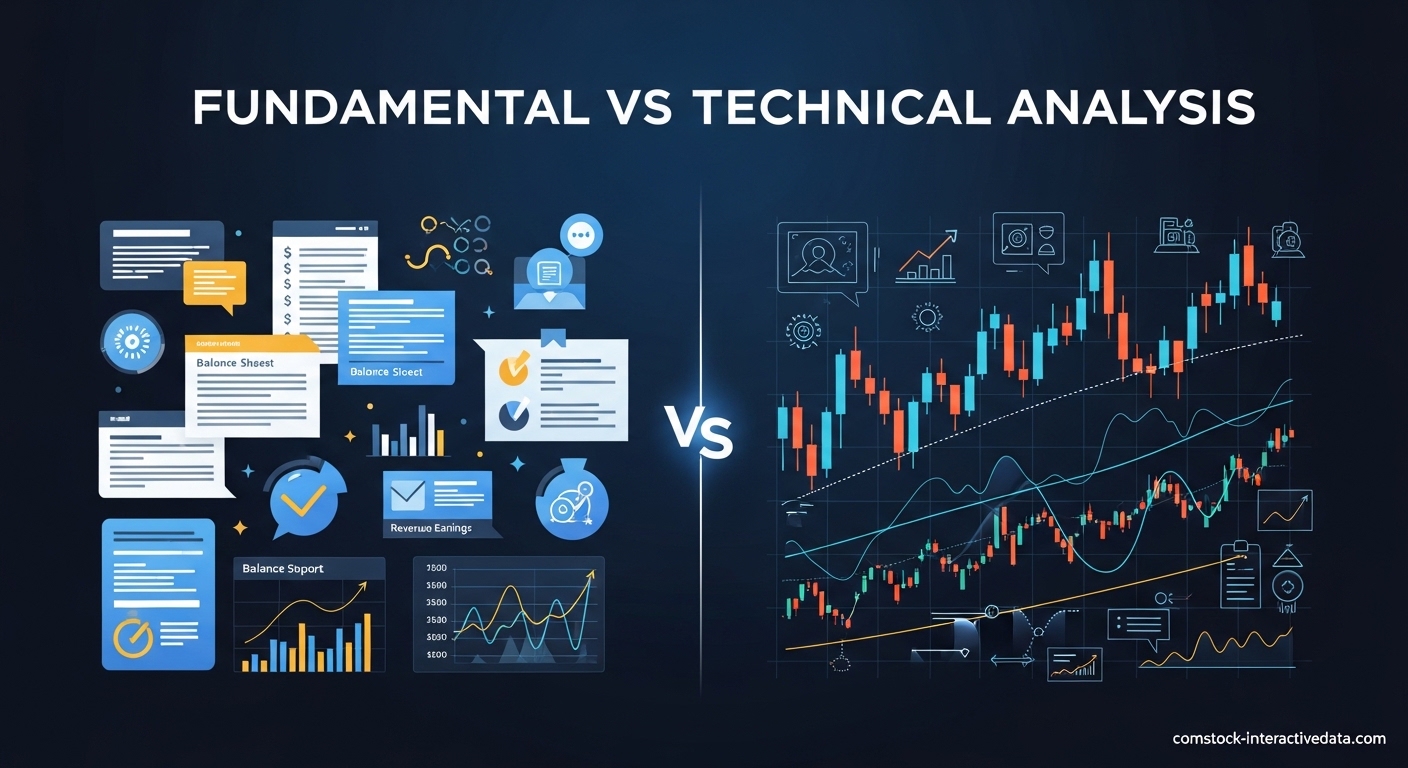
Fundamental analysis examines an asset’s intrinsic value by analyzing financial statements, economic indicators, and industry trends, while technical analysis focuses solely on price movements and trading patterns to predict future price action. These two approaches represent the foundation of modern investing and trading strategies, yet they operate on entirely different philosophies and serve distinct purposes in the financial markets.
I spent years confused about which approach to use when I first started investing. The forums and communities were filled with conflicting advice. Some traders swore by chart patterns and claimed fundamentals were worthless. Value investors dismissed technical analysis as astrology for traders. After losing money following each camp exclusively, I discovered that understanding both approaches was the real key to success.
This guide breaks down exactly what separates fundamental analysis from technical analysis. You’ll learn when each approach works best, why most successful investors use elements of both, and how to choose the right method for your goals. Whether you’re a long-term investor building wealth or an active trader seeking short-term opportunities, this comparison will help you make smarter decisions.
Table of Contents
What Is Fundamental Analysis?
Fundamental analysis is the process of evaluating a security’s intrinsic value by examining related economic, financial, and other qualitative and quantitative factors. Analysts study everything from the overall economy and industry conditions to the company’s financial health and management quality. The core belief is that a stock’s market price will eventually reflect its true underlying value.
When I analyze a company fundamentally, I start with the financial statements. The balance sheet shows what the company owns and owes. The income statement reveals profitability over time. The cash flow statement tracks actual money moving in and out. These documents tell the story of a company’s financial reality beyond what the stock price suggests.
The 5 Key Principles of Fundamental Analysis
Successful fundamental analysis rests on five core principles that guide the evaluation process. Understanding these principles helps you apply the methodology consistently and avoid common pitfalls.
Principle 1: Intrinsic Value Matters – Every asset has an underlying true value based on its ability to generate future cash flows. The goal is to calculate this intrinsic value and compare it to the current market price. When the market price falls below intrinsic value, you have a potential buying opportunity.
Principle 2: Financial Statements Tell the Truth – A company’s financial statements provide the most reliable data for analysis. The balance sheet, income statement, and cash flow statement reveal the company’s actual performance, not what management wants you to believe. Learning to read these documents is essential for any fundamental analyst.
Principle 3: Economic Context Shapes Performance – No company operates in isolation. Interest rates, inflation, GDP growth, and industry trends all impact a company’s ability to succeed. Understanding the broader economic environment helps you assess whether a company’s recent performance is sustainable.
Principle 4: Quality Management Drives Results – Companies are run by people, and the quality of leadership significantly affects long-term outcomes. Management’s track record, capital allocation decisions, and transparency with shareholders all factor into a complete fundamental analysis.
Principle 5: Margin of Safety Protects Against Errors – Popularized by Benjamin Graham, this principle suggests only buying when the market price is significantly below your calculated intrinsic value. This buffer protects you from analytical mistakes, market volatility, and unexpected events.
Essential Tools and Metrics for Fundamental Analysis
Analysts rely on specific tools and metrics to quantify their research and make comparisons between companies. These indicators help translate complex financial data into actionable insights.
The price-to-earnings (P/E) ratio compares a company’s stock price to its earnings per share. A lower P/E might indicate an undervalued stock, while a higher P/E could suggest growth expectations or overvaluation. Return on equity (ROE) measures how effectively management uses shareholder capital to generate profits. The debt-to-equity ratio reveals a company’s financial leverage and risk level. Dividend yield shows the income return relative to the stock price for income-focused investors.
Other important metrics include earnings per share (EPS) growth rates, price-to-book (P/B) ratios comparing market value to book value, and free cash flow generation. Economic indicators like GDP growth, unemployment rates, and central bank policies provide the macroeconomic context for individual company analysis.
Real-World Example: Analyzing a Company Fundamentally
Let me walk you through how I might analyze a fictional technology company called “DataTech Solutions.” First, I examine their most recent annual report. DataTech has a P/E ratio of 15 compared to an industry average of 25. This suggests the stock might be undervalued relative to peers.
Looking deeper, I find their ROE has consistently exceeded 18% over the past five years. Their debt-to-equity ratio sits at a conservative 0.3, indicating strong financial health. Revenue has grown 12% annually while maintaining stable profit margins. The management team has a clear capital allocation strategy and transparently communicates with shareholders.
Considering the broader context, the technology sector is expanding, and DataTech operates in a growing niche. However, rising interest rates might pressure their expansion plans. After calculating intrinsic value using discounted cash flow analysis, I estimate the stock is worth $120 while trading at $95. This 20% margin of safety meets my investment criteria.
Historical Foundation: Benjamin Graham and Value Investing
Fundamental analysis owes much of its theoretical foundation to Benjamin Graham, the father of value investing. His 1934 book “Security Analysis” established the systematic approach to evaluating securities based on their underlying business fundamentals rather than market speculation.
Graham’s most famous student, Warren Buffett, built his fortune applying these principles at Berkshire Hathaway. The approach has evolved over nearly a century, but the core philosophy remains unchanged. Buy quality businesses at prices below their intrinsic value, hold them for the long term, and let compounding work its magic.
What Is Technical Analysis?
Technical analysis evaluates securities by analyzing statistics generated by market activity, such as past prices and volume. Unlike fundamental analysts who study a company’s business, technical analysts focus exclusively on price movements and trading patterns. They believe that all known information is already reflected in the stock price, making the price action itself the most important data to study.
I remember my first experience with technical analysis. I opened a charting platform and saw candlestick patterns, moving averages, and dozens of indicators. It felt overwhelming at first. But once I understood that technical analysis is essentially the study of market psychology expressed through price and volume, everything clicked into place.
The 4 Pillars of Technical Analysis
Technical analysis stands on four foundational pillars that define the methodology and separate it from other analytical approaches. Understanding these pillars helps you apply technical analysis correctly and interpret its results properly.
Pillar 1: Price Discounts Everything – Technical analysts believe that all information, whether public or private, fundamental or psychological, is already reflected in the stock price. This means studying price action alone captures everything you need to know about a security.
Pillar 2: Prices Move in Trends – Markets tend to move in identifiable directions: up, down, or sideways. Once established, trends usually persist until something changes fundamentally. Technical analysts seek to identify these trends early and ride them until evidence suggests a reversal.
Pillar 3: History Tends to Repeat Itself – Market psychology drives price patterns that repeat across different time periods and securities. Chart patterns like head and shoulders, double tops, and triangles form because human emotions of fear and greed remain consistent over time.
Pillar 4: Volume Confirms Trends – Trading volume provides crucial confirmation for price movements. Rising prices on increasing volume suggest strong buying interest. Falling prices on high volume indicate intense selling pressure. Volume analysis helps distinguish genuine trends from false signals.
Essential Technical Analysis Tools and Indicators
Technical analysts use various tools to identify trading opportunities and manage risk. These range from simple visual pattern recognition to complex mathematical indicators calculated from price and volume data.
Moving averages smooth out price data to identify trend direction. The 50-day and 200-day moving averages are widely followed. When the 50-day crosses above the 200-day, it signals potential bullish momentum. Support and resistance levels represent price points where buying or selling pressure historically emerges. These levels help identify entry and exit points.
The Relative Strength Index (RSI) measures momentum on a scale of 0 to 100. Readings above 70 suggest overbought conditions, while readings below 30 indicate oversold conditions. MACD (Moving Average Convergence Divergence) tracks the relationship between two moving averages to signal momentum changes. Bollinger Bands measure volatility and help identify when prices reach extreme levels.
Understanding Chart Patterns
Chart patterns form when price action creates recognizable shapes that suggest future movement. These patterns reflect the ongoing battle between buyers and sellers and the psychology of market participants.
Candlestick patterns provide visual cues about market sentiment within specific time periods. A bullish engulfing pattern suggests strong buying pressure. A doji indicates indecision between buyers and sellers. Continuation patterns like flags and pennants suggest brief pauses before the trend resumes. Reversal patterns like head and shoulders or double tops warn that the current trend may be ending.
Historical Foundation: Charles Dow and Dow Theory
Technical analysis traces its origins to Charles Dow, founder of the Wall Street Journal and creator of the Dow Jones Industrial Average. In the late 19th century, Dow developed a series of principles about market behavior that became known as Dow Theory.
Dow’s observations about market trends, confirmation between indices, and volume relationships laid the groundwork for modern technical analysis. His work established that markets move in three phases: accumulation, public participation, and distribution. These principles remain relevant for today’s traders and technical analysts.
Fundamental Analysis vs Technical Analysis: Key Differences
Understanding the differences between fundamental and technical analysis helps you choose the right approach for your investment goals. While both aim to improve investment decisions, they operate on completely different philosophies and use different data sources.
Core Philosophy Comparison
Fundamental analysis assumes that every security has an intrinsic value determined by underlying business factors. The market may misprice securities in the short term, but prices eventually converge toward true value. This approach requires patience and a long-term perspective.
Technical analysis assumes that prices already reflect all available information. Rather than calculating intrinsic value, technicians study price movements to predict future direction. This approach works on any timeframe from minutes to years and can be applied to any traded security.
Data Sources and Focus
Fundamental analysts spend their time examining financial statements, economic reports, industry data, and management communications. They analyze revenue growth, profit margins, debt levels, and competitive positioning. The focus is on understanding the business itself.
Technical analysts focus exclusively on price and volume data from trading activity. They study chart patterns, indicator readings, and historical price behavior. No examination of financial statements or business operations is required. The focus is entirely on market behavior and participant psychology.
Time Horizon and Investment Style
Fundamental analysis naturally aligns with long-term investing horizons. Calculating intrinsic value and waiting for the market to recognize that value takes months or years. Value investors like Warren Buffett hold positions for decades.
Technical analysis works across any timeframe but is most commonly used for shorter-term trading. Day traders use technical analysis on one-minute charts. Swing traders might hold positions for days or weeks based on technical setups. Even long-term investors can use technical analysis for timing entry and exit points.
Comparison: Fundamental vs Technical Analysis
| Aspect | Fundamental Analysis | Technical Analysis |
|---|---|---|
| Primary Focus | Intrinsic value and business fundamentals | Price action and market trends |
| Data Sources | Financial statements, economic reports, industry data | Price charts, volume data, trading patterns |
| Time Horizon | Long-term (months to years) | Any timeframe (minutes to years) |
| Core Belief | Price eventually reflects true value | All information is already in the price |
| Primary Goal | Find undervalued investments | Identify optimal entry and exit timing |
| Investor Type | Value investors, long-term investors | Traders, short-term speculators |
| Key Metrics | P/E ratio, ROE, debt/equity, cash flow | Moving averages, RSI, MACD, support/resistance |
| Skill Required | Accounting, finance, economics | Pattern recognition, statistical analysis |
Pros and Cons of Each Approach
Both fundamental and technical analysis offer distinct advantages and suffer from specific limitations. Understanding these helps you set realistic expectations and choose the right tool for each situation.
Advantages of Fundamental Analysis
Fundamental analysis provides a logical framework for valuing investments based on actual business performance. When you understand a company’s financial health and competitive position, you can make confident long-term investment decisions. This approach has produced some of history’s most successful investors.
The methodology works exceptionally well for identifying quality businesses trading at discounts to their true value. During market crashes, fundamentals help you identify bargains when others panic. The approach also encourages thorough research, which naturally leads to better investment outcomes.
Fundamental analysis has strong academic support. The concept that stock prices eventually reflect underlying value is well-documented in financial literature. This gives investors confidence that their analytical work will be rewarded over time.
Limitations of Fundamental Analysis
Fundamental analysis requires significant time and expertise. Reading financial statements, understanding industry dynamics, and calculating intrinsic values demands accounting knowledge and ongoing research. Many individual investors lack the time or skills to perform thorough fundamental analysis.
The approach can be slow to generate results. A stock trading below intrinsic value might remain undervalued for years. Markets can stay irrational longer than investors can stay solvent. This time risk creates practical challenges for investors seeking quicker returns.
Fundamental analysis also struggles with certain asset types. Cryptocurrencies have no cash flows to analyze. Early-stage growth companies may have minimal financial history. During speculative bubbles, fundamentals can remain disconnected from prices for extended periods.
Advantages of Technical Analysis
Technical analysis can be applied quickly to any traded security. You don’t need to read annual reports or understand business models. This universality makes it accessible to beginners and efficient for active traders monitoring many positions.
The approach excels at timing decisions. Technical signals can identify optimal entry points for long-term positions or short-term trading opportunities. Risk management becomes more precise when you can set stop-loss levels based on chart support and resistance.
Technical analysis works across all timeframes and markets. The same principles apply to stocks, forex, commodities, and cryptocurrencies. Whether you’re a day trader or a long-term investor, technical tools can enhance your decision-making.
Limitations of Technical Analysis
Technical analysis faces criticism for lacking scientific rigor. Critics argue that pattern recognition is subjective and that historical patterns don’t guarantee future results. The efficient market hypothesis suggests that past price data cannot predict future movements.
The self-fulfilling prophecy effect cuts both ways. When enough traders act on the same signal, it can create temporary price movements. However, this also means that widely followed patterns can fail when too many traders expect them to work.
Technical analysis can generate false signals, especially in ranging or choppy markets. Over-reliance on indicators without understanding market context leads to whipsaws and losses. The abundance of available indicators can also lead to analysis paralysis.
When to Use Fundamental Analysis vs Technical Analysis?
Choosing between fundamental and technical analysis depends on your investment goals, time horizon, and market conditions. Many successful investors find that different situations call for different approaches.
By Investor Type and Goals
Long-term investors building wealth for retirement should emphasize fundamental analysis. Understanding business quality and valuation ensures you’re buying solid companies at reasonable prices. The approach aligns with holding periods measured in years or decades.
Active traders seeking short-term profits rely more heavily on technical analysis. Day traders and swing traders need precise timing that fundamentals cannot provide. Price action and momentum drive short-term movements more than underlying business value.
Value investors exclusively use fundamental analysis to find bargains. Growth investors combine fundamental research on growth potential with technical timing for entry. Income investors focus on fundamental metrics like dividend coverage and payout ratios.
Market Condition Considerations
Market conditions significantly affect which approach works better. Understanding these dynamics helps you adapt your strategy.
In bull markets, technical analysis often excels. Rising tides lift all boats, and momentum feeds on itself. Trend-following strategies capture gains while fundamentals might suggest caution. Technical signals help you stay with winning trades.
In bear markets, fundamental analysis provides crucial perspective. When prices fall across the board, fundamentals help identify which companies will survive and thrive. Technical analysis can generate false buy signals as trends continue lower than expected.
During sideways or ranging markets, neither approach works perfectly. Fundamentals might suggest value while prices stagnate. Technical indicators generate conflicting signals. Patience and selective application of both approaches become essential.
By Asset Type
Different assets lend themselves better to different analytical approaches. Stocks with established businesses and financial histories work well with fundamental analysis. Cryptocurrencies and highly speculative assets often require technical analysis since fundamentals may be unclear.
Commodities and currencies respond heavily to macroeconomic factors, making both approaches relevant. Index funds and ETFs tracking broad markets may benefit more from technical analysis since individual company research is less applicable.
Combining Fundamental and Technical Analysis
Most experienced investors and traders eventually realize that combining both approaches produces better results than using either alone. The synergy between understanding what to buy and when to buy it creates a powerful analytical framework.
Why Combining Approaches Works?
As the forum insights revealed, successful market participants often describe the relationship simply: fundamentals tell you why something can move, while technicals tell you when participation shows up. This captures the essence of how the two approaches complement each other.
Fundamental analysis excels at security selection but provides poor timing guidance. You might identify a great company trading below intrinsic value, but without technical analysis, you could watch it decline further before recovering. Technical analysis helps optimize your entry and exit points.
Conversely, technical analysis identifies timing opportunities but doesn’t tell you if a security is worth owning. A stock might show a perfect technical setup while the underlying business deteriorates. Fundamental analysis prevents you from buying into value traps or companies facing fundamental challenges.
Practical Integration Framework
Here’s a step-by-step approach I use to combine both methodologies effectively. This framework has helped me improve both my investment returns and risk management.
Step 1: Screen Fundamentally – Start with a universe of securities and apply fundamental criteria. Look for reasonable valuations, strong financial health, and quality business models. This narrows your focus to investments worth owning.
Step 2: Analyze Technically – Apply technical analysis to your fundamentally qualified list. Look for bullish trends, positive momentum, or oversold conditions suggesting a rebound. Identify support levels where you want to buy and resistance levels where you might take profits.
Step 3: Time Your Entry – Wait for technical confirmation before entering fundamentally sound positions. A stock meeting your value criteria becomes a buy when technical signals align. This patience often improves your entry price significantly.
Step 4: Manage Your Position – Use technical levels for stop-loss placement and profit targets. As fundamentals evolve, reassess your thesis. Technical signals can warn you when a position weakens even if your fundamental view remains positive.
Real Example: Applying Both Approaches
Let me illustrate with a real-world scenario. Suppose I’ve identified a consumer goods company through fundamental analysis. The P/E ratio of 16 is below the industry average of 22. Debt levels are conservative. Revenue has grown steadily at 8% annually for five years. The dividend yield is 3.2% with consistent payout growth. My fundamental work suggests intrinsic value around $85 while the stock trades at $72.
Now I turn to technical analysis. The stock has been in a downtrend for three months, falling from $85 to the current $72. The RSI shows oversold conditions at 28. The price is approaching a long-term support level at $70 that has held three times in the past two years. Volume has declined during the recent drop, suggesting selling pressure is exhausting.
Based on this combined analysis, I set a buy order at $71, just above the support level. My fundamental research tells me this is a quality business trading at a discount. My technical analysis suggests the selling pressure is ending and a bounce is likely. I place a stop-loss at $67, below the support level, in case the technical breakdown occurs despite my analysis.
Three months later, the stock has recovered to $78. My fundamental thesis remains intact, and the technical picture shows continued momentum. I’ve captured both the value opportunity and benefited from improved timing.
Common Beginner Mistakes to Avoid
Forum discussions reveal that many beginners struggle with the same pitfalls when learning either analytical approach. Understanding these mistakes helps you avoid costly errors and accelerates your learning curve.
Fundamental Analysis Mistakes
Beginners often focus on a single metric without considering the complete picture. A low P/E ratio seems attractive until you discover the company’s earnings are declining rapidly. Always examine multiple metrics and trends over time rather than isolated data points.
Another common error is ignoring the broader economic and industry context. A company might have excellent financials, but if its industry faces disruption or the economy enters recession, those fundamentals can deteriorate quickly. Context matters as much as the numbers themselves.
Many beginners also underestimate the importance of management quality. Financial statements show past performance, but management’s decisions determine future results. Researching leadership teams and their track records prevents investing in well-positioned companies led by poor capital allocators.
Technical Analysis Mistakes
Over-reliance on a single indicator leads many technical traders astray. No indicator works all the time, and combining multiple signals improves accuracy. Using RSI alone, for example, might keep you out of strong trending markets that remain overbought for extended periods.
Beginners often ignore the broader market trend when trading individual securities. A technically perfect setup in a stock often fails if the overall market is declining. Always consider market context and trend direction before acting on technical signals.
Analysis paralysis affects many technical traders who add too many indicators to their charts. When multiple indicators give conflicting signals, taking any action becomes impossible. Start with simple tools like trend lines, support/resistance, and one or two indicators. Master the basics before adding complexity.
The Critical Role of Risk Management
Perhaps the most important insight from forum discussions is that neither analytical approach saves you without proper risk management. Multiple traders shared that they lost money with both fundamental and technical analysis until they learned position sizing, stop-loss placement, and portfolio management.
Never risk more than you can afford to lose on any single position. Use stop-losses to limit downside regardless of how confident you feel in your analysis. Diversify across multiple positions and asset classes. These practices matter more than which analytical approach you choose.
Frequently Asked Questions
Are fundamental and technical analysis the same?
No, fundamental and technical analysis are completely different approaches. Fundamental analysis examines a company’s intrinsic value through financial statements and economic factors. Technical analysis studies price movements and trading patterns to predict future price action. They serve different purposes and appeal to different types of investors.
What is the 3 5 7 rule in trading?
The 3 5 7 rule refers to time-based trading principles suggesting that markets often make significant moves in cycles of 3, 5, or 7 periods (days, weeks, or months). Traders use this concept to anticipate potential trend changes or continuation patterns. While not a strict scientific rule, many technical analysts observe these time cycles in market behavior.
What are the 5 key principles of fundamental analysis?
The 5 key principles are: 1) Every security has an intrinsic value based on future cash flows, 2) Financial statements provide the most reliable data for analysis, 3) Economic context shapes company performance, 4) Quality management drives long-term results, and 5) A margin of safety protects against analytical errors. These principles guide value investors in identifying quality investments.
What are the 4 pillars of technical analysis?
The 4 pillars are: 1) Price discounts everything, meaning all information is reflected in the current price, 2) Prices move in trends that persist until broken, 3) History tends to repeat itself through recognizable patterns, and 4) Volume confirms the strength of trends. These pillars form the foundation of all technical analysis methods.
Which is better for beginners, fundamental or technical analysis?
Most beginners benefit from starting with fundamental analysis because it builds investing intuition about business value. Understanding financial statements and valuation creates a foundation for all investment decisions. However, beginners interested in active trading might start with basic technical analysis. Ultimately, learning both approaches produces the best long-term results.
Can you use fundamental and technical analysis together?
Yes, and many successful investors recommend combining both approaches. Use fundamental analysis to identify what to buy by finding quality investments trading at reasonable valuations. Use technical analysis to determine when to buy by optimizing entry and exit timing. This combination leverages the strengths of both methodologies while compensating for their individual weaknesses.
Conclusion
Fundamental analysis vs technical analysis is not a choice you must make permanently. These approaches serve different purposes and work better in different situations. Understanding both makes you a more complete market participant capable of adapting to changing conditions.
Fundamental analysis helps you identify what to buy by revealing the true value of businesses. Technical analysis helps you determine when to act by identifying optimal timing for your decisions. Together, they form a powerful framework that addresses both security selection and execution timing.
Start by learning the basics of both approaches. Practice fundamental analysis by reading financial statements and calculating basic valuation metrics. Study technical analysis by observing chart patterns and understanding indicator signals. Over time, you’ll develop intuition about which approach serves you best in different market conditions.
Remember that neither approach guarantees success without proper risk management. Position sizing, diversification, and emotional discipline matter more than your analytical methodology. The best analysis in the world cannot save you from poor risk management.
Your next step depends on your goals. Long-term investors should focus on building fundamental analysis skills first. Active traders might prioritize technical analysis. Everyone benefits from eventually mastering both approaches and learning to combine them effectively.