
A benchtop oscilloscope is a bench-mounted digital instrument that plots voltage against time, so you can see, measure and debug electrical signals. It shows amplitude, frequency, timing, noise and distortion that a multimeter or a logic analyzer simply cannot. If you are picking one for real work, this roundup of the best benchtop oscilloscopes for engineers covers the nine chassis worth the desk space, from a two-channel 200 MHz unit to a 12-bit model with a built-in function generator.
We compared these scopes on the specifications that actually change your results: bandwidth, sample rate, memory depth, channel count, waveform capture rate and whether the serial decoders are locked or sold as options. We also read what owners report after months of use, because the datasheet rarely mentions a loud cooling fan, a knob that overshoots, or a sample rate that halves the moment you switch on channel three.
Two things to settle before you read further. First, these are all mains-powered bench instruments with a real ground reference. If you need something that goes in a toolbox or runs off a battery, our guides to the best handheld oscilloscopes for portable troubleshooting and the best portable oscilloscopes cover that category instead. Second, if you are just starting out, many readers get more out of a scope plus a solid multimeter pairing than from a single expensive instrument. Last updated for 2026.
Table of Contents
Top 3 Best Benchtop Oscilloscopes for Engineers 2026
The three below cover the most common starting points: the best overall buy, the highest-rated four-channel option, and the cheapest serious entry point. The full table of all nine follows, then a review of each.
Siglent SDS1202X-E
- 200 MHz bandwidth
- 1 GSa/s sampling
- 14 Mpts memory
- Serial decode standard

All 9 Benchtop Scopes Side by Side in 2026
Every scope below is a bench chassis with its own time base and display, not a USB device that depends on a laptop. Read the channel count and memory depth columns together, because that pairing decides whether you can capture two signals at full fidelity or compromise on one.
| Product | Specifications | Action |
|---|---|---|
| Siglent SDS1202X-E |
|
Check Latest Price |
| Siglent SDS1104X-E |
|
Check Latest Price |
 Rigol DS1054Z Rigol DS1054Z |
|
Check Latest Price |
 Rigol DS1202Z-E Rigol DS1202Z-E |
|
Check Latest Price |
 HANMATEK DOS1102 HANMATEK DOS1102 |
|
Check Latest Price |
 Hantek DSO2D15 Hantek DSO2D15 |
|
Check Latest Price |
 Rigol DHO924S Rigol DHO924S |
|
Check Latest Price |
 Siglent SDS1104X-U Siglent SDS1104X-U |
|
Check Latest Price |
 FNIRSI 1014D FNIRSI 1014D |
|
Check Latest Price |
1. Siglent SDS1202X-E – 200 MHz Two-Channel Value Leader
Siglent Technologies SDS1202X-E 200 mhz Digital Oscilloscope 2 Channels, Grey
200 MHz bandwidth
2 analog channels
Up to 1 GSa/s
Up to 14 Mpts record length
Pros
- 200 MHz bandwidth in a two-channel bench chassis
- 14 Mpts of record length suits long captures
- Serial decode for IIC SPI UART RS232 CAN and LIN included as standard
- 7-inch display with 14 horizontal divisions
- Large owner base of over 1400 reviews
Cons
- Two analog channels limit concurrent capture
- No digital channels on the base model
- Functions sit deep in the menu tree
This is the scope I would put on a bench for a hardware engineer who needs to see fast edges without moving to a second instrument. At 200 MHz and 1 GSa/s in a two-channel chassis, it covers the majority of MCU timing work, most low-voltage power stages and the class of signal where a 50 MHz scope quietly flattens the edge you are trying to measure.
Reviewers treat it as the value reference point in this class. The large, bright display shows plenty of trace, the interface responds quickly and 14 Mpts of record length means a millisecond-scale burst is not chopped to a few hundred points.
The serial decoding is the detail that separates it from cheaper two-channel units. IIC, SPI, UART, RS232, CAN and LIN trigger and decode are standard rather than license-gated, which means you can catch a missing acknowledge or a corrupted frame without buying an add-on decoder.
Two channels is the trade-off that eventually shows. Bring-up on a switching regulator with input, output and switch node means one probe move, and capture rate drops to nothing while you do it. The small on-screen legend text and the menu depth are the other two complaints that appear most often.
Who the SDS1202X-E suits
An embedded engineer working on 8-bit and 32-bit MCUs, a technician chasing ring on a data line, or a student who has outgrown a pocket unit. Fourteen megapoints of memory at 1 GSa/s is enough to hold a full protocol burst in one acquisition, which is what makes the decode useful rather than decorative.
Pair it with a decent 10X passive probe. The bundled set works for probe compensation, but bandwidth-matched probes are where the extra resolution at 200 MHz comes from.
Where it falls short
If your work involves comparing four signals at once, or watching a digital bus alongside two analog rails, the channel count is the limit rather than the bandwidth. The menu layout also asks for a week of practice before it stops being irritating, and autoset is best treated as a starting point rather than an answer.
2. Siglent SDS1104X-E – Four Channels with a Dual ADC
Siglent Technologies SDS1104X-E 100Mhz Digital Oscilloscope 4 Channels Standard Decoder, Grey
100 MHz bandwidth
4 analog channels with dual ADC
Up to 1 GSa/s
IIC SPI UART CAN LIN decode
Pros
- Highest owner rating in this group at 4.8 stars
- Dual ADC keeps fast sampling on two channels with four enabled
- Serial decodes included without license keys
- Ethernet with a built-in web server for remote viewing
- Four probes with color rings included
Cons
- Select knob can overshoot into an adjacent menu
- Two channels share an ADC and drop to 500 MSa/s
- Bandwidth is software limited to 100 MHz
The reason this scope earns the highest owner rating in our group is not the 100 MHz bandwidth. It is the four analog channels combined with a dual-ADC architecture, which keeps fast sampling on two channels even when you have all four turned on. That single design decision removes the complaint we hear most often about budget four-channel scopes.
For day-to-day bench work the four channels change how you work rather than what you can see. I can put a supply rail, a control signal, a feedback node and a reference clock on screen at the same time instead of swapping a probe and losing the context.
The built-in web server over Ethernet is quietly important for lab work. You can open a browser on a laptop and view or control the scope on a large monitor without installing anything, which makes long logged sessions much easier to archive. The LCD also has adjustable grid brightness and trace intensity for dim rooms.
Two things temper that. The multifunction select knob is twitchy and can bounce into an adjacent menu item, and when all four channels are active the pair sharing an ADC samples at 500 MSa/s rather than 1 GSa/s. Reviewers also note that decoded data on slow serial messages refreshes more slowly than the raw trace.
Who the SDS1104X-E suits
Power and mixed-signal engineers who need four analog views at once, and anyone doing automotive bus work since CAN and LIN decode are standard. The optional 16-channel mixed-signal upgrade and optional generator module exist for FPGA and digital work, but check that option before committing, because the base package is analog only.
It is also a good first four-channel scope for a teaching lab, where several students need to compare timing between channels rather than each one working alone.
Where it falls short
One hundred megahertz is enough for slow digital edges but not for fast serial links or wide-bandgap switching transients. If your edges are in the tens of nanoseconds, the flat amplitude you see may be the scope rather than the circuit.
3. Rigol DS1054Z – The Four-Channel Entry Benchmark
Rigol DS1054Z Digital Oscilloscope, 50MHz, 4 Channel, 1GSa/s, Best Value
50 MHz bandwidth
4 analog channels
24 Mpts memory
30000 wfms/s capture rate
Pros
- Long-standing benchmark entry four-channel scope
- 24 Mpts memory is unusually deep for this bandwidth
- Serial trigger and decode for I2C SPI and RS232 included
- Intensity graded display reveals intermittent faults
- On-board help system for first-time buyers
- USB Host and Device plus LAN
Cons
- Cooling fan is audible on a quiet bench
- Single ADC drops sample rate as channels are added
- Multifunction knob is error prone
- Included probes are of modest quality
Long-time owners describe this scope as delivering professional measurement depth at a hobbyist price, and the specs back that up more than the marketing does. Twenty-four megapoints of memory and a capture rate of 30,000 waveforms per second are headline numbers on instruments costing several times more.
What makes it useful for first-time buyers is the intensity graded display plus record and playback of up to 60,000 frames. A rare glitch shows up as a brighter pixel path, and the frame history lets you scroll back to the acquisition where it happened instead of trying to catch it again.
Triggering is where it earns its keep on embedded work. Serial bus trigger and decode for RS232/UART, I2C and SPI are enabled from the box, along with FFT and filter functions for quick frequency-domain checks, and the on-board help explains the trigger types as you go.
The trade-offs are physical and electrical. The single ADC means sample rate falls as you enable more channels, the cooling fan produces noticeable white noise on a quiet bench, and the multifunction encoder can jump a step when pressed. Reviewers also rate the bundled probes as average.
Who the DS1054Z suits
Students, hobbyists moving up from a pocket scope, and lab buyers who need a reliable four-channel instrument for general electronics debugging and teaching. Fifty megahertz is comfortable for audio, slow sensor signals, relay and switching waveforms and 8-bit microcontroller work.
It is also a good second scope for a bench that already owns a high-bandwidth unit, because the four channels and deep memory handle the low-voltage and slow signals that are tedious on an expensive machine.
Where it falls short
Fifty megahertz is a real ceiling for anything with fast edges, and the single-ADC sample rate drop means two-channel measurements look better than four-channel ones. The fan noise and the encoder both wear on you over a full day.
4. Rigol DS1202Z-E – 200 MHz with 24 Mpts of Memory
RIGOL DS1202Z-E Digital Oscilloscope, 200MHz, 2 Channel, 1GSa/s Sampling
200 MHz bandwidth
2 analog channels
1 GSa/s sampling
24 Mpts memory depth
Pros
- 200 MHz bandwidth in a two-channel chassis
- 24 Mpts memory depth for long captures
- Large 7-inch 800x480 intensity graded display
- On-screen measurement suite shows dozens of values at once
- Hardware record and playback of 60000 frames
- Three-year warranty on the main unit
Cons
- Multifunction knob overshoots selections
- USB 2 export of a full capture is slow and ignores large flash drives
- Screen legends cannot be hidden
- Menu depth puts useful functions several levels down
This is the model to look at if bandwidth is the priority and two channels are enough. Two hundred megahertz with 24 Mpts of memory means you can hold a long burst at full sample rate and still zoom into one edge afterward, which is exactly the workflow for ringing and overshoot investigation.
Owners consistently praise the display and the measurement suite. The intensity graded color view works like a digital phosphor, and the on-screen readout shows dozens of amplitude, frequency, period and offset values simultaneously so you are not stepping through a menu to check each one.
Build quality and knob action feel more solid than the price suggests, and the one-button auto function locks onto most waveforms quickly. FFT, waveform playback, math functions and screen-to-file saving are all built in rather than optional.
The two recurring problems are the overshooting multifunction knob and data export. The USB 2 port makes pulling a full 24 Mpoint capture across to a computer slow, and large flash drives are not recognised, so plan on smaller saves or a network path for long records.
Who the DS1202Z-E suits
Embedded engineers chasing clock edges, I2C and SPI timing, and anyone working on low-voltage DC-DC stages where 200 MHz captures the switching node cleanly. Record and playback of up to 60,000 frames helps when the fault is intermittent.
The bundled main unit, probe, power cable and USB cable mean it is usable out of the box, which matters for a first bench scope.
Where it falls short
Two analog channels with an external trigger input is the ceiling. If you routinely need three rails and a logic reference on screen together, this is the wrong shape of instrument. The menu-driven interface also assumes some prior experience with scopes.
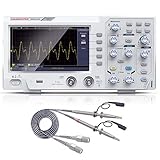
5. HANMATEK DOS1102 – Cheapest Way Into a Real Bench Scope
HANMATEK 110mhz Bandwidth DOS1102 Digital Oscilloscope with 2 Channels and Screen 7 inch / 18 cm, TFT-LCD Display, Portable Professional Oscilloscope Kit with 500 MS/s *2 Sampling Rate
110 MHz bandwidth
2 channels at 500 MS/s
7-inch 800x480 TFT
SCPI and LABVIEW support
Pros
- Lowest cost entry with a genuine bench chassis
- Lightweight 2.4-pound body with a 7-inch color TFT
- 30 automatic measurement functions
- Probe attenuation from 1X to 1000X
- SCPI compliant with LABVIEW communication
- Time base from 2 ns/div to 1000 s/div
Cons
- Record depth of at least 10K points is thin versus rivals
- 500 MS/s sampling leaves less headroom at the same bandwidth
- Hardware frequency meter stops at 20 MHz
- Lower overall owner rating
The DOS1102 exists for one reason: to give you a real bench scope with its own display and time base when the budget is the deciding factor. A 7-inch color TFT, 110 MHz of bandwidth and a 2 ns/div to 1000 s/div time base range cover more ground than the price band usually allows.
What reviewers like is the combination of 30 automatic measurement functions, cursor modes for voltage difference, time difference and combined delta, and a hardware frequency meter. The SCPI compliance and LABVIEW support matter more than they sound if you plan to automate measurements from a PC.
The two limits are memory and sampling. Record depth of at least 10K points per acquisition is shallow compared with the 14 to 24 Mpts of the models above, and 500 MS/s on each channel leaves less headroom at 110 MHz than 1 GSa/s rivals do.
Probe attenuation is selectable from 1X through 1000X, so a high-voltage probe can be used without a menu fight. The body weighs 2.4 pounds, which makes it easy to move between benches.
Who the DOS1102 suits
A first bench scope, a student building a teaching bench, or an engineer who wants a dedicated second instrument for a repetitive measurement station. At this level the portability and screen size matter as much as the bandwidth for quick checks at a bench or a desk.
For pure protocol work, remember that a logic analyzer still does that job better and cheaper. The scope earns its place when you need to look at analog shape, level and noise.
Where it falls short
Memory depth is the number to check against your workload. A long serial burst or a slow ripple measurement needs more points than 10K to stay useful when zoomed. The 4.4-star owner rating also reflects a visible share of critical feedback on measurement confidence.
6. Hantek DSO2D15 – 150 MHz for Repair and Ham Radio Work
Hantek DSO2D15 Digital Storage Lab Oscilloscopes150MHz Bandwidth 2CH
150 MHz bandwidth
2 channels
14 trigger modes
5 serial protocol decodes
Pros
- 150 MHz in a two-channel bench chassis
- 14 trigger modes and 5 protocol decodes standard
- Front-panel square wave output for probe compensation
- Solid build with a stable trace
- Variants available with an internal waveform generator
Cons
- Slow processor makes the display refresh lag
- Can lock up and need a power cycle if settings are misconfigured
- Measurement accuracy drops above roughly 5 MHz
- Front and rear USB share the same port hardware
The DSO2D15 is the pick for technicians and repair work, and it earns that through trigger coverage rather than headline bandwidth. Fourteen trigger modes and five serial protocol triggers and decodes are standard, and the front-panel square wave output makes probe compensation a ten-second job before every session.
It also holds a strong category position, ranking near the top of the lab oscilloscope listings, which tells you it is actually being bought and used rather than collected.
Reviewers in ham radio and coax repair work specifically praise it for FM deviation measurements and coax length work, which are practical examples of the 150 MHz bandwidth being put to use rather than sitting idle. Variants in the same family add an internal waveform generator.
The weaknesses are software-adjacent. The processor is slow enough that display refresh lags behind the action, the unit can lock up and need a power cycle if settings are misconfigured, and measurement accuracy falls off above roughly 5 MHz. Applying the current firmware update is the single biggest improvement reported by owners.
Who the DSO2D15 suits
Repair technicians, bench technicians and radio service benches that want a full-featured instrument with decoding rather than a minimal one. The standard decodes help with embedded repair too, where you need to confirm a bus is actually talking.
The front-panel calibration output is a small thing that pays off repeatedly on a shared bench, since it is the first step after a probe change.
Where it falls short
The slow processor is felt most when scrolling long records or updating the display during acquisition, and the shared USB port hardware means front and rear USB cannot be used at the same time. It also arrives without printed instructions, so budget time to download the manual.
7. Rigol DHO924S – 12-Bit Resolution and a Built-In Generator
RIGOL DHO924S Oscilloscope with Built-in Signal Generator, 250MHz, 12-Bit
250 MHz bandwidth
12-bit resolution
1.25 GSa/s
Up to 50 Mpts memory
Pros
- Only 12-bit scope in this group with visibly cleaner low-level traces
- 250 MHz and 1.25 GSa/s in a 3.92-pound chassis
- Built-in AFG plus Bode plot analysis
- 7-inch 1024x600 touchscreen that still works with the Flex Knob
- Browser-based Web Control needs no installation
- Low noise floor across all four channels
Cons
- Bode plot has no -3 dB marker and shows stray dots
- FFT does not accept cursors
- HDMI output can blank the display
- 16-channel digital probe is a separate purchase
This is the modern instrument in the group, and the 12-bit converter is the reason. An extra four bits of vertical resolution means roughly sixteen times the amplitude detail of an 8-bit scope, which shows up as a clean, quiet trace on ripple, low-level sensor signals and anything where you are looking for a small change on a large offset.
Everything around it is current hardware: 250 MHz across four channels, 1.25 GSa/s sampling, up to 50 Mpts of memory and an UltraAcquire mode rated at up to 1,000,000 waveforms per second with 256-level intensity grading. Waveform search and an event table are what you actually use to find the rare glitch in a long run.
The built-in single-channel arbitrary function generator with Bode plot analysis from 10 Hz to 25 MHz removes a piece of equipment from the bench. Loop response and frequency response work no longer needs a separate generator, which is a real saving in both bench space and setup time.
Connectivity is solid for lab use: USB Host and Device, LAN, HDMI, browser-based Web Control and standard SCPI commands. The 7-inch 1024×600 touch display still works with the physical Flex Knob, which matters because full touch-only operation is worse on a scope than on a phone.
Who the DHO924S suits
Power electronics engineers measuring ripple, noise and loop response, and anyone who has been fighting an 8-bit noise floor. Sixteen digital channels are available through an optional probe, so mixed-signal debugging is available but not included.
It also suits teams that script measurements, since Web Control and SCPI support make automated documentation workflows straightforward, and the compact VESA-mountable chassis frees bench space.
Where it falls short
The software is still catching up with the hardware. Bode plot does not mark the -3 dB point, FFT cannot use cursors, HDMI output has been reported to blank or lock the display, and the unit runs hot with all four channels and the generator active. Boot time is around 45 seconds.
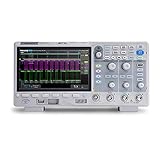
8. Siglent SDS1104X-U – Super Phosphor Glitch Hunting
Siglent Technologies SDS1104X-U 100MHz Super Phosphor Digital Oscilloscopes 4 Channels
100 MHz bandwidth
4 analog channels
Up to 1 GSa/s
14 Mpts record length
Pros
- Four channels removes constant probe swapping
- Super Phosphor intensity graded display highlights rare events
- Serial trigger and decode for IIC SPI UART CAN LIN standard
- 14 Mpts record depth with measurements on the full memory
- Quiet front-panel layout with physical knobs
Cons
- Cooling fan is loud and moves little air
- Position knobs feel insufficiently sensitive
- Startup takes about 15 seconds
- Smallest owner review base in this group at 100 reviews
The SDS1104X-U is built around one idea: making rare events visible. The Super Phosphor intensity graded display builds up persistence so an event that occurs once in a thousand acquisitions shows as a distinct brightness band rather than a single frame you missed.
Underneath that is a familiar and capable four-channel scope. Fourteen megapoints of record length with measurements computed on the full memory means cursors and statistics are based on the whole acquisition, not a decimated subset, and serial trigger and decode for I2C, SPI, UART, CAN and LIN is standard.
Owners who switched from older analog scopes mention the quiet, familiar front-panel layout as a reason it was easy to adopt. The physical knobs and buttons stay where you expect them, and no touchscreen learning curve is involved.
The complaints are physical. The cooling fan is described as aggressively loud for the amount of air it moves, the vertical and horizontal position knobs are not very sensitive for fine trace positioning, and startup takes around 15 seconds. With 100 owner reviews, the field feedback here is thinner than for the models above.
Who the SDS1104X-U suits
Technicians and hobbyists who chase intermittent faults where the whole problem is that the event is rare. Four analog channels at 100 MHz is a solid general-purpose configuration for repair work, and the standard decoders cover embedded troubleshooting.
It is also a reasonable lower-cost alternative to a similar four-channel Siglent if you can accept the fan noise during long sessions.
Where it falls short
The intensity display is the star, and the sampling chain around it is ordinary. With four channels active you will not get the dual-ADC behaviour of the model above, and the thin review base means there is less long-term owner evidence to lean on when something behaves unexpectedly.
9. FNIRSI 1014D – Scope, Generator and Meter in One Case
FNIRSI 1014D 100MHz Digital Oscilloscope, 2 Channel Oscilloscope 2-in-1
100 MHz per channel
2 channels
1 GSa/s sampling
Built-in DDS signal generator
Pros
- Scope
- signal generator and meter in one 3.46-pound unit
- One-button AUTO produces a viewable waveform almost instantly
- Low noise floor with no visible supply noise at 50 mV/div
- Compact footprint that fits beside a multimeter
- USB powerable for isolated working
- Includes 10:1 probes and a calibration screwdriver
Cons
- FFT readout gives nonsensical cursor values and no amplitude
- Generator output is fixed at 2.5 Vpp with no attenuation
- Manual is thin and contains no specifications
- True input maximum is 40 V at 1X
- Build feels light next to Siglent or Rigol instruments
The 1014D combines three instruments in one: a two-channel scope, a DDS function signal generator and a meter. Real-time sampling reaches 1 GSa/s, the generator covers 14 signal types with up to 1000 stored custom waveforms, and the body is small enough to sit beside a multimeter on a crowded bench.
Reviewers consistently single out one-button AUTO and the low noise floor. With no power supply noise visible at 50 mV/div, small signals stay readable, which is not something you can say for every instrument at this level.
USB power is a quietly useful feature. Running the instrument from a laptop or power bank isolates it from mains earth, which is safer when probing mains-derived circuits, and the included 10:1 probes plus a calibration screwdriver mean it is usable immediately.
The specification gaps are real. The FFT readout is effectively unusable because cursor frequency values are wrong and amplitude is not shown, the generator output is fixed at 2.5 Vpp with no attenuation, and the manual is thin and badly translated with no specifications section. The printed voltage rating on the connectors also overstates the real 40 V maximum at 1X.
Who the 1014D suits
First-time buyers, students and makers who want a single box that can also generate a test signal without a second piece of equipment. For classroom demonstrations of period, phase and Lissajous figures it does more per unit of bench space than anything else here.
It is also a reasonable take-anywhere companion for a technician who wants a self-contained signal source and display in a single case.
Where it falls short
Two channels, no protocol decoding and a fixed generator output put a ceiling on serious work. Reviewers report difficulty displaying and measuring a genuine 100 MHz signal, and a small share of arrivals have had defective screens or power buttons, so keep the return path open.
How to Choose a Benchtop Oscilloscope for Your Work
Most regret about a bench scope comes from matching the wrong number to the work. Here is the framework we use, in the order the decisions actually get made.
Bandwidth: three times your highest signal frequency
The rule of thumb is that scope bandwidth should be at least three times the highest frequency component you care about. That margin covers the roll-off at the -3 dB point so the amplitude and edge shape you measure are not already distorted by the instrument. A rise-time view of the same requirement is to pick a scope whose rise time is no more than about a third of your signal’s rise time.
In practice, 50 MHz covers audio, sensor signals, relays and slow switching stages. One hundred megahertz is comfortable for most 8-bit and 32-bit microcontroller work, CAN and LIN, and low-voltage power stages. Two hundred to 250 MHz is where you need to be for fast edges, SPI at higher clocks and moderate switching transients. Above that, wide-bandgap GaN and SiC devices, Ethernet and USB signal integrity work push you into the 1 GHz class.
Sample rate and record length
Sample rate is the number of readings per second the scope takes. At 1 GSa/s you have five samples on a 200 MHz signal, which is workable but not generous. Look for four to ten times the signal frequency as a practical target so edge shapes and overshoot are resolved rather than interpolated.
Memory depth decides how much time you can hold at once. Time captured equals record length divided by sample rate, so 14 Mpts at 1 GSa/s is about 14 ms of single-channel data. Deep memory is what lets you find a glitch in a burst without re-arming the trigger. Note that memory is usually shared: the Rigol DS1054Z, for example, holds 24 Mpts on one channel, 12 Mpts on two and 6 Mpts on three or four.
Channel count and the shared-ADC trap
Two channels is enough to measure a signal against its reference. Four channels is the practical minimum for power work, where you want input, output, switch node and current sense on screen together. This is the specification owners complain about most, because a scope with four channels on one converter still loses sampling rate as you add channels.
The dual-ADC design in the Siglent SDS1104X-E exists specifically to avoid that, keeping full sampling on two channels even with four enabled. Check the multi-channel sampling figure, not the headline single-channel number, before you commit.
Vertical resolution and noise floor
Bit depth sets how finely the converter can separate voltage levels. Most scopes in this group are 8-bit, which gives about 256 levels across the vertical range and puts a visible noise floor on small signals riding on a large offset. A 12-bit converter gives roughly 16 times the amplitude detail, which is why the Rigol DHO924S is the one to pick for ripple, low-level sensor work and anything where you are hunting for a small change.
Triggering, decoding and capture rate
Triggering is what keeps the display stable, and it is more important than bandwidth for day-to-day work. Edge, pulse width, timeout and window triggers cover most debugging. Beyond that, serial bus trigger and decode for I2C, SPI, UART, CAN and LIN is close to mandatory for embedded work, and it should be standard rather than license-gated.
Waveform capture rate in waveforms per second determines how many chances per second the instrument has to show you a rare fault. A scope capturing 30,000 frames per second with an intensity graded display will find glitches that a 1,000 frame per second scope never sees.
Which brand should you buy?
There is no single best brand, and the honest answer is that brand matters less than the tier you buy in. Siglent and Rigol dominate the value and feature-density end, where you get deep memory, unlocked decodes and large displays for a modest outlay. Keysight and Tektronix sit at the accuracy, RF and enterprise-support end, where the purchase is usually justified by a support contract and a calibration schedule rather than by features. Rohde and Schwarz covers European lab and compliance work. Hantek and HANMATEK fill the repair-bench tier, and B and K Precision occupies the calibration-adjacent middle.
Probes and the real cost of ownership
Your scope is only as good as the probe on the end of the cable, and probes are routinely the biggest hidden cost in this category. A standard 10X passive probe attenuates by ten and adds roughly 10 pF of capacitance, which rolls off fast edges and can turn a clean 20 ns rise into a slow ramp. Bandwidth-matched passive probes, differential probes for high common-mode voltage, and current probes for switch-node analysis are all separate purchases.
Then there is calibration. Consumer-grade scopes are calibrated at the factory and have no routine service interval, but a scope used for compliance, safety or customer-facing measurements needs periodic calibration with NIST traceability under an ISO/IEC 17025 lab, and that cost recurs. Budget for probes, a decent set of leads and any adapter cables before deciding you cannot afford a better instrument.
When a logic analyzer or a USB scope is the smarter buy
If you only need to know whether an I2C transaction was acknowledged or an SPI frame parsed correctly, a logic analyzer gives you sixteen channels of protocol decoding for a fraction of the price, and it will do it better. If your work is a single analog level and a frequency, a multimeter may be enough. And a USB scope is convenient for a laptop-only workflow, but it depends on the host machine, has no independent trigger and no isolated ground, so it is not a substitute for a bench instrument when you need trustworthy measurements.
Frequently Asked Questions
What is the best brand for oscilloscopes?
There is no single best brand, so match the maker to the tier and the task. Siglent and Rigol lead on value and feature density, giving you deep memory, unlocked serial decodes and large displays at modest outlays. Keysight and Tektronix lead on measurement accuracy, RF capability and enterprise support, which matters when a calibration schedule or a support contract justifies the cost. Rohde and Schwarz covers European lab and compliance work, Hantek and HANMATEK fill the repair-bench tier, and B and K Precision sits in the calibration-adjacent middle.
Is a 100 MHz oscilloscope enough?
For most engineering work, yes. The rule of thumb is to buy at least three times the bandwidth of your highest signal frequency, so 100 MHz comfortably covers 8-bit and 32-bit microcontroller buses, CAN and LIN, audio, sensor signals and most low-voltage power stages. Move to 200 or 250 MHz for fast edges, high-clock SPI and switching transients, and to 1 GHz or above for Ethernet and USB signal integrity or wide-bandgap GaN and SiC switching.
Is Siglent a Chinese company?
Yes. Siglent is a Chinese manufacturer, and so is Rigol, which is worth stating plainly rather than avoiding. What actually matters to a buyer is what happens after the purchase: global support coverage, calibration service availability in your region, firmware and PC software quality, and warranty and parts access. Siglent and Rigol scopes in this roundup ship with unlocked serial decodes and continuing firmware support, but check the local service network before you rely on a unit for production work.
What is a good beginner-friendly oscilloscope?
The Rigol DS1054Z is the easiest first bench scope to learn on. It gives you four analog channels, 24 Mpts of memory, serial decode for I2C, SPI and RS232, and an on-board help system that explains the trigger types as you use them. The two features that matter most for a beginner are reliable triggering and a readable display, and this scope has both. Higher bandwidth is worth little if the trigger cannot hold a steady trace.
Do I need a logic analyzer or an oscilloscope?
Use a logic analyzer when the question is whether a bus transaction happened correctly, because it gives you many protocol channels and better decoding than any scope in this roundup. Use an oscilloscope when you need to see analog shape: amplitude, rise time, ringing, noise, ripple or timing measured in volts and nanoseconds. Many engineers own both, because a scope tells you why the logic level is wrong while a logic analyzer tells you that it is wrong.
How often does an oscilloscope need calibration?
Consumer and education scopes have no routine service interval and are typically only checked when something looks wrong, though verifying against a known source once a year is sensible practice. If a scope is used for compliance, safety or customer-facing measurements, a periodic calibration from an ISO/IEC 17025 lab with NIST traceability is the right approach, and the interval is typically one to two years depending on how hard the instrument is used and stored.
Which Benchtop Scope Should You Buy?
The best benchtop oscilloscopes for engineers come down to workload, not prestige. For most hardware and embedded work, the Siglent SDS1202X-E is the pick: 200 MHz of bandwidth, 14 Mpts of memory and standard decoding for six serial protocols in a two-channel chassis that costs less than most entry instruments. It is the one we would put on a bench first.
Match the shape of the instrument to the job. Take the Siglent SDS1104X-E when four simultaneous analog views matter, because its dual ADC holds fast sampling where single-converter designs give it up. Choose the Rigol DS1054Z for a first bench or a teaching lab, where deep memory, frame history and on-board help matter more than bandwidth. For ripple and low-level signal work, the 12-bit Rigol DHO924S removes the noise floor that limits everything else in this list, and its built-in generator plus Bode plot save a second instrument.
Whatever you choose, buy it with the probe budget already planned. A 10X passive probe is the difference between measuring an edge and guessing at it, and a four-channel scope that drops its sample rate the moment you turn on the last channel is a false economy. Our guides to the best oscilloscopes for hobbyists and best handheld oscilloscopes cover the cases where a bench chassis is not what you need.