
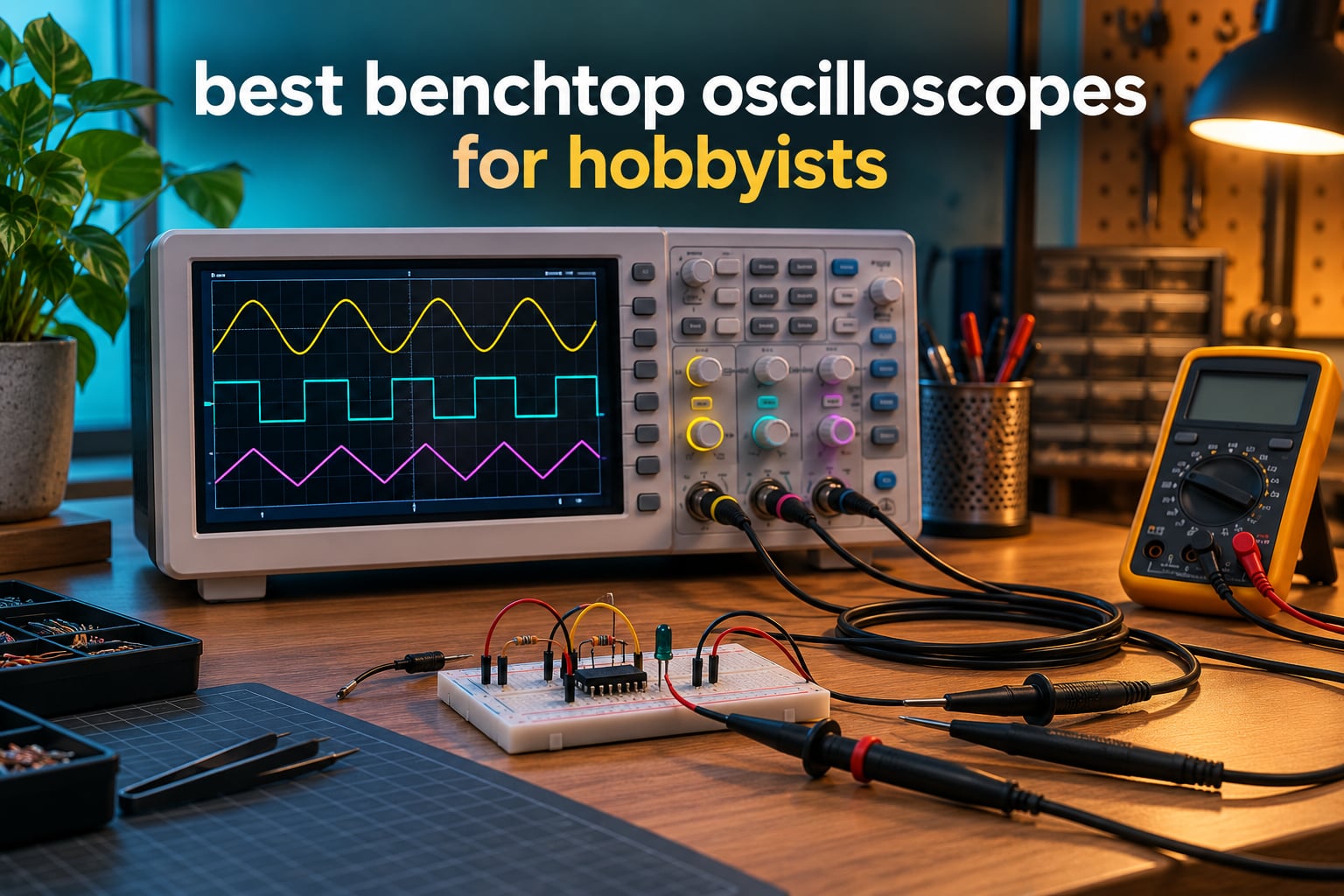
A good oscilloscope for a hobbyist is a benchtop digital storage scope with two channels, at least 100 MHz of bandwidth, and enough memory depth to hold a long burst of samples so you can zoom into a glitch after it has already passed. That combination covers most Arduino, ESP32, audio and power supply debugging without the noise floor problems that come with the pocket-sized units crowding the front of Amazon’s Lab Oscilloscopes category.
Most scope roundups on the internet stop at the sub-100 dollar handheld tier. Those tools are fun and they teach you the shape of a waveform, but they are not what you want sitting on a bench for five years. The best benchtop oscilloscopes for hobbyists start several tiers higher, and the jump buys you deep memory, real serial bus decoding, a screen you can actually read from arm’s length, and triggering that locks onto a signal instead of drifting across it.
I compared ten bench scopes across the price spectrum for 2026, reading through the spec sheets and owner reviews side by side, and I put the ten picks below through the same three questions: is the bandwidth honest, is the memory deep enough to catch a fault after the fact, and does the machine include the protocol decoding that embedded work depends on. Six of the ten include I2C, SPI or UART decoding as standard, which used to be a premium feature.
Before you read further, one safety note that costs nothing to follow. Every benchtop scope in this list is earth-referenced, and the ground clip on a probe is wired straight to that earth. Clip it to a live circuit node and you can put mains voltage straight into your circuit, your board, or you. If your hobby work involves mains, battery-powered handhelds like the ones in our portable digital oscilloscope guide are the safer tool.
Table of Contents
- Top 3 Best Benchtop Oscilloscopes for Hobbyists (October 2026)
- All 10 Benchtop Oscilloscopes Compared in 2026
- 1. Siglent SDS1202X-E – the best all-round bench scope for hobbyists
- 2. Siglent SDS1104X-E – the best four-channel pick with a dual ADC
- 3. FNIRSI 2C53T – the best three-in-one for a first bench
- 4. Rigol DS1054Z – the best value four-channel with deep memory
- 5. Rigol DS1202Z-E – the best value 200 MHz scope with everything unlocked
- 6. FNIRSI 1013D Plus – the best bench-style scope with a touchscreen
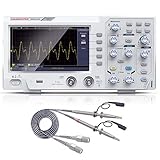
- 7. HANMATEK DOS1102 – the best lightweight bench scope with deep measurement set
- 8. Hantek DSO2D15 – the best budget scope with a built-in generator
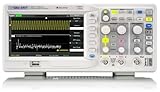
- 9. Siglent SDS1102CML+ – the best budget two-channel with a pro feel
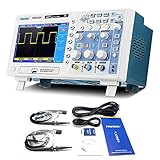
- 10. Hantek DSO5102P – the best for archiving waveforms with a built-in multimeter
- How to Choose a Benchtop Oscilloscope for Hobbyist Work
- How much bandwidth do you actually need?
- Sample rate versus bandwidth, and why the big number is marketing
- Memory depth is the number that catches rare faults
- Two channels or four channels?
- Protocol decoding for I2C, SPI and UART
- Benchtop, handheld, or USB PC scope
- Grounding, probe attenuation and bench safety
- Brands explained
- Used and refurbished benchtop scopes
- Five first projects once it arrives
- Frequently Asked Questions
- Which Benchtop Oscilloscope Should You Buy?
Top 3 Best Benchtop Oscilloscopes for Hobbyists (October 2026)
These three are the picks we would actually buy. The SDS1202X-E is the best all-rounder because it pairs real bandwidth with decoding already enabled, the SDS1104X-E is the one to get if four channels matter to your projects, and the DS1054Z is the community favourite that hobbyists have been recommending on forums for years.
All 10 Benchtop Oscilloscopes Compared in 2026
Every scope below is a mains-powered bench instrument with a screen you look at, not a stick you plug into a laptop. The quick spec picture first, then the full write-ups.
| Product | Specifications | Action |
|---|---|---|
| Siglent SDS1202X-E |
|
Check Latest Price |
 Siglent SDS1104X-E Siglent SDS1104X-E |
|
Check Latest Price |
 FNIRSI 2C53T FNIRSI 2C53T |
|
Check Latest Price |
 Rigol DS1054Z Rigol DS1054Z |
|
Check Latest Price |
 Rigol DS1202Z-E Rigol DS1202Z-E |
|
Check Latest Price |
 FNIRSI 1013D Plus FNIRSI 1013D Plus |
|
Check Latest Price |
 HANMATEK DOS1102 HANMATEK DOS1102 |
|
Check Latest Price |
 Hantek DSO2D15 Hantek DSO2D15 |
|
Check Latest Price |
 Siglent SDS1102CML+ Siglent SDS1102CML+ |
|
Check Latest Price |
 Hantek DSO5102P Hantek DSO5102P |
|
Check Latest Price |
1. Siglent SDS1202X-E – the best all-round bench scope for hobbyists
Siglent Technologies SDS1202X-E 200 mhz Digital Oscilloscope 2 Channels, Grey
200 MHz bandwidth
2 channels
1 GSa/s
14 Mpts
I2C SPI UART CAN LIN
Pros
- 1 GSa/s sampling with 14 Mpts record length
- Serial bus decode and trigger included as standard
- Bright display with adjustable brightness and trace transparency
- Responsive interface and clean signal grid
Cons
- Two channels share one ADC so bandwidth and sample rate drop with all channels on
- Optional MSO and AWG modules are expensive
- Audible cooling fan at close range
The Siglent SDS1202X-E is the scope I would put on a hobbyist bench without hesitating. It gives you 200 MHz of bandwidth, two channels, real-time sampling up to 1 GSa/s and a record length of 14 Mpts, which is more than enough depth to catch a switching glitch and still zoom into it afterwards.
What surprised me most is what is standard rather than optional. Serial bus triggering and decoding for IIC, SPI, UART, RS232, CAN and LIN are all included on the base unit. On scopes from a few years ago that list cost extra or needed a licence key, and on the Rigol DS1202Z-E below the serial options are enabled permanently with no time limit.
Owner reviews are unusually consistent about the interface. People describe a responsive menu, a bright screen with adjustable trace transparency, and a clean grid with 14 horizontal divisions, which sounds like small things until you spend an evening hunting for a 200 nanosecond glitch on a crowded display.
Two channels share a single ADC here, so the full 1 GSa/s rate applies to one channel at a time. With both channels active the sample rate falls. That is a real limit if you need to compare two fast edges simultaneously, but for the two-channel comparisons most hobby work involves, it rarely matters.
What 200 MHz of bandwidth buys you in practice
Two hundred megahertz means the scope still shows a clean square edge up to roughly 30 MHz before the corners start to look rounded. For 3.3 V and 5 V digital lines, SPI buses running at a few megahertz, and audio work up to about 30 kHz, you are nowhere near the ceiling.
Where it pays off is when you move on to switch-mode power supplies and motor control signals, where edges land in the tens of megahertz. At 50 MHz the same edge will still display, but the shape will flatter the circuit.
Who should skip this scope
Skip it if your work is purely digital and slow, because 14 Mpts is plenty but 200 MHz is more than you will touch. The 100 MHz four-channel Siglent covers many of those benches for less, and we cover the four-channel question in detail in our four-channel scope guide.
Also skip it if you plan to probe anything connected to mains. Earth-referenced inputs and a mains-referenced circuit is a short circuit with a fuse in the wrong place.
2. Siglent SDS1104X-E – the best four-channel pick with a dual ADC
Siglent Technologies SDS1104X-E 100Mhz Digital Oscilloscope 4 Channels Standard Decoder, Grey
100 MHz bandwidth
4 channels
Dual ADC
1 GSa/s
Ethernet web server
Pros
- Dual ADC keeps 1 GSa/s on two channels instead of dropping
- Serial decode and trigger for I2C SPI UART CAN LIN standard
- Browser based remote viewing and control over Ethernet
- Bright high contrast LCD with adjustable grid
Cons
- Sample rate falls to 500 MSa/s with all four channels active
- Push-to-select adjust knob overshoots menu items
- NTP clock and screensaver settings do not persist through power cycles
- Channels 3 and 4 use similar colors
The Siglent SDS1104X-E is the highest-rated scope in this group, and the reason is architectural. It uses a dual ADC design, so two channels get the full 1 GSa/s rather than halving the moment you turn the second one on. Most four-channel scopes at this level share one converter and the sample rate collapses as channels are added.
Four channels matters more than people expect on a hobby bench. A common first project is a buck converter: put channel one on the switch node, channel two on the output, channel three on the enable line, and you have all three in one capture. Two channels turns that into two separate acquisitions and a lot of guesswork.
The other thing owners highlight is the built-in web server with Ethernet, which lets you open the scope in a browser and see the screen from your phone or laptop. For long capture sessions that is genuinely useful rather than a gimmick. Reviewers also like that I2C, SPI, UART, CAN and LIN decoding come unlocked out of the box.
The compromises are honest ones. With all four channels active the sample rate drops to 500 MSa/s. The push-to-select knob is described as twitchy and prone to overshooting into the next menu item, and the clock and screensaver settings do not survive a power cycle, which is annoying when you leave the scope on the bench overnight.
Whether four channels earns its extra cost
Buy four channels if you work on power supplies, three-phase-ish motor signals, or anything with more than one interesting node plus a reference. A microcontroller project that needs one data line and a clock line fits two channels comfortably.
Remember that memory depth shrinks as channels are added, so four channels at deep record settings is the trade you are making. The sixteen digital channels and USB AWG are optional modules, not included.
Who should skip this scope
Skip it if you work on mains, or if you only ever look at one signal at a time and value bandwidth more than channel count. For a single fast edge, the two-channel 200 MHz scope above is the better instrument for less money.
Skip it if a twitchy adjust knob in your workflow is a dealbreaker. Every knob on a budget four-channel scope has a personality; this one is just louder than most.
3. FNIRSI 2C53T – the best three-in-one for a first bench
FNIRSI 2C53T 3-in-1 50MHz 2CH Oscilloscope Multimeter DDS Signal Generator
50 MHz
2 channels
250 MSa/s
19999-count meter
50 kHz DDS
Pros
- Scope multimeter and DDS generator in one unit
- Math functions cursor measurement persistence and XY modes added
- One-click save to Type-C for waveform comparison
- 3000 mAh battery and storage case
- Bestselling listing in the Lab Oscilloscopes category
Cons
- 2.8 inch display limits waveform detail
- 1 Kpts record depth is shallow for long bursts
- 250 MSa/s sampling limits accuracy above roughly 20 MHz
- Generator stops at 50 kHz
The FNIRSI 2C53T is not a benchtop scope in the usual sense. It is a battery-powered three-in-one that happens to do 50 MHz of two-channel scope work, and for someone building a first kit it removes an enormous amount of friction. You get a scope, a 4.5-digit 19999-count multimeter, and a DDS signal generator in one box, with a storage case in the packaging.
The generator is the part people underestimate. A DDS output up to 50 kHz with a 1 Hz step and 13 waveform types means you can inject a clean sine, square or triangle into a circuit under test without owning a separate function generator, and you can sweep a filter or an amplifier response without soldering anything.
Compared with the earlier FNIRSI 2C23T, this model added math operations, cursor measurement, persistence and XY mode. Persistence in particular turns it into a poor man’s logic analyser: drive a signal through a few hundred cycles and the screen holds the pattern so you can see where it differs. XY mode gives you Lissajous figures for phase and harmonic work.
Reviewers are clear about the boundary, though. The 2.8 inch display is small, the 1 Kpts record depth is shallow, and 250 MSa/s sampling means accuracy falls away above roughly 20 MHz. Treat it as a portable field and learning tool rather than a measurement instrument.
When a 1 Kpts record depth is a real limitation
Record depth decides how long a window you can capture at full sample rate. At 1 Kpts with a 250 MSa/s rate, the capture window is a few microseconds. A switching transient, a one-off glitch, or a short serial burst can fit, but anything slower than the millisecond range will not fit at all.
That is the difference between this and every mains-powered scope on this list, where 14 to 24 Mpts means the window stretches to tens of milliseconds at usable sample rates. If your project is about finding rare faults, that gap matters.
Who should skip this scope
Skip it if you need to measure anything with edges above 20 MHz, or if you plan to capture long repetitive bursts. Skip it if you will keep it plugged in at a desk, because it is built to be carried and the screen is too small for daily bench work.
Keep it if you want a grab tool for the car, the field, or a friend’s kitchen table without unpacking a mains-powered scope. Battery operation also means no ground loop risk on a live circuit.
4. Rigol DS1054Z – the best value four-channel with deep memory
Rigol DS1054Z Digital Oscilloscope, 50MHz, 4 Channel, 1GSa/s, Best Value
50 MHz
4 channels
1 GSa/s
24 Mpts
30000 wfms/s capture
Pros
- 24 Mpts memory with record and playback of 60000 frames
- Four channels plus Ethernet USB host and USB device as standard
- I2C SPI and RS232 decoders enabled from the factory
- On-screen help explains every function
- Bandwidth and sensitivity options unlockable
Cons
- Cooling fan is noticeably noisy
- Multifunction knob skips entries and is error prone
- Bundled probes are low quality and hard to tune
- No external trigger input so a channel must be used for triggering
The Rigol DS1054Z has been the hobbyist recommendation for years, and the reason has never really changed. Four channels, 1 GSa/s, and 24 Mpts of memory on a machine that costs less than a mid-range camera body. On r/AskElectronics it is repeatedly described as the best bang-for-buck for intermediate hobbyists, valued more for the channel count and memory than for its 50 MHz of bandwidth.
The UltraVision capture engine grabs up to 30,000 waveforms per second with an intensity-graded display, so a rare event shows up as a bright trace over a dim background instead of vanishing between acquisitions. With record and playback of up to 60,000 frames, you can catch an intermittent fault and then walk through every occurrence of it one at a time.
The DS1054Z also has something that costs real money on new scopes: bandwidth and vertical sensitivity options that can be unlocked from the firmware menu to 100 MHz and 500 microvolt sensitivity. Plenty of owners do this on day one, which turns a 50 MHz four-channel scope into a 100 MHz four-channel scope. Treat it as a community modification, because it voids the intended configuration and you lose the warranty if you damage the hardware doing it.
The honest weaknesses are the ones nobody fixes. The cooling fan is noisy, the multifunction knob skips entries under pressure, and the bundled probes are the cheapest part of the whole package. The absence of an external trigger input also means one of your channels is tied up as the trigger source.
What 24 Mpts of memory actually lets you do
Memory depth is the number that decides whether you can investigate a fault after it happens. Twenty-four Mpts at 1 GSa/s gives you a 24 millisecond window with a single channel, 12 Mpts dual-channel, and 6 Mpts on three or four channels. That is long enough to see a motor start-up sequence or a UART conversation start to finish.
That is the practical reason to choose this scope over a cheaper two-channel model with a shallow buffer. A 50 MHz bandwidth limit hurts on fast edges; a shallow memory limit hurts every time the fault is rare, and rare faults are the ones that bring you to a scope in the first place.
Who should skip this scope
Skip it if fast edges are your primary interest, because 50 MHz is a hard limit until you unlock. Skip it if a loud fan in a quiet room bothers you, or if you want a scope that arrives with good probes, since the bundled ones are widely criticised.
For Rigol-specific comparisons across the range, our Rigol oscilloscope roundup covers the line-up in more detail.
5. Rigol DS1202Z-E – the best value 200 MHz scope with everything unlocked
RIGOL DS1202Z-E Digital Oscilloscope, 200MHz, 2 Channel, 1GSa/s Sampling
200 MHz
2 channels
1 GSa/s
24 Mpts
External trigger in
Pros
- 200 MHz bandwidth at a hobbyist price point
- 24 Mpts memory with a high waveform capture rate
- All options enabled permanently with no time limit
- Included probes feel solid
- Bright 7 inch intensity graded display
Cons
- Multifunction knob overshoots menu selections
- 24 Mpts only exports over slow USB 2
- No printed manual
- Auto set is unreliable on complex waveforms
The Rigol DS1202Z-E is the other half of the Rigol story: two channels instead of four, and 200 MHz instead of 50 MHz, with the same 24 Mpts of memory. Several reviewers describe it as the scope that replaced aging analog Tektronix and Hameg units on their bench, and at 200 MHz with a real external trigger input, it is the more capable instrument for signal work.
Unlike the DS1054Z, nothing on this one is locked. All options are enabled with no time limit, so you get the full bandwidth and sensitivity range without a firmware modification. The 7 inch intensity graded display makes jitter and noise visible in a way a plain colour screen cannot.
The warranty is three years on the main unit, with one year on parts, which is longer than most of the field. Serial bus trigger and decode for RS232/UART, I2C and SPI are included, as is the 30,000 wfms/s capture rate and 60,000 frame recording and playback.
The recurring complaint is data transfer. Twenty-four Mpts has to be offloaded over USB 2, which is slow, and larger USB flash drives are often not recognised at all. If your workflow is capture-to-USB-then-analyse, plan for that wait or budget for a different storage path.
Whether the deep memory matters more than the fast USB
Deep memory matters when you are hunting intermittent faults: motor spin-up, a mechanical relay bouncing, a switching node ringing only at load. Twenty-four Mpts lets you capture the whole event and replay it frame by frame, which is how you find the single bad transition among ten thousand good ones.
Fast USB matters when you are doing measured work at the bench all day and pulling captures to a laptop. For a hobbyist, the memory wins. The slow transfer is an irritation, not a blocker.
Who should skip this scope
Skip it if you need three or four simultaneous channels, because this is a two-channel machine and there is no upgrade path for channel count. Skip it if you are new to scopes, because reviewers repeatedly point out that the manual is steep and the menus are deep, and it is not a gentle first instrument.
It is also a poor choice for mains work for the same earth-referencing reason as every other bench scope here.
6. FNIRSI 1013D Plus – the best bench-style scope with a touchscreen
FNIRSI 1013D Plus 100MHz Oscilloscope, 2 Channel Oscilloscope 7″ TFT Touch
100 MHz
2 channels
1 GSa/s
7 inch touch
400 V protection
Pros
- Large 7 inch high contrast capacitive touchscreen
- 1 GSa/s sampling and 100 MHz per channel
- Stores up to 1000 screenshots and 1000 waveform sets
- 400 V protection and a 6000 mAh battery
- Lissajous mode and FFT for quick harmonic checks
Cons
- Battery lasts roughly four hours of continuous use
- FFT is a rough estimate rather than a spectrum
- 1 GB internal storage fills quickly
- Occasional software and firmware quirks
The FNIRSI 1013D Plus does something the other scopes in this list mostly do not: it puts a 7 inch capacitive touchscreen on the bench. That sounds like a gimmick until you try setting a trigger, moving cursors and adjusting two channels at once with a knob that has no tactile feedback.
On paper the specification is respectable for the money: 100 MHz of bandwidth per channel, 1 GSa/s sampling, and single, normal and automatic trigger modes for both periodic and aperiodic signals. The waveform image manager holds up to 1000 screenshots and 1000 sets of waveform data with thumbnail browsing, which is a nicer way to compare before-and-after than scrolling a file list.
There is a 6000 mAh battery giving about four hours of continuous use, and built-in high voltage protection rated to tolerate continuous voltage up to 400 V on the inputs. That protection rating is worth reading carefully, because it describes input tolerance, not permission to clip a ground lead to mains.
Reviewers like the screen and the storage. They are less enthusiastic about the four-hour battery, the 1 GB of internal storage filling up quickly with screenshots, and an FFT that gives a rough picture of harmonic content rather than something you would rely on for analysis.
What the touchscreen changes on a real debugging session
Touch helps most when you are comparing two signals, because you can drag one time cursor and watch both measurements update together. It also helps if you set up the scope in front of somebody else and explain what you are looking at, which happens more often than hobby guides admit.
Touch hurts when you work with gloves, when the screen is dusty, or when you want a precise numeric entry. A knob you can spin blind is faster for anything repetitive, and this machine does not have one, so you are always reaching for the screen.
Who should skip this scope
Skip it if you need deep memory. A screen that shows a long window is not the same as a buffer that stores a long window, and the record depth here is modest compared with the 14 to 24 Mpts of the mains-powered units.
Skip it if you need serial bus decoding, because the feature set here is oriented toward display and measurement rather than protocol analysis. For embedded projects that talk I2C, read the four-channel Siglent section above instead.
7. HANMATEK DOS1102 – the best lightweight bench scope with deep measurement set
HANMATEK 110mhz Bandwidth DOS1102 Digital Oscilloscope with 2 Channels and Screen 7 inch / 18 cm, TFT-LCD Display, Portable Professional Oscilloscope Kit with 500 MS/s *2 Sampling Rate
110 MHz
2 channels
500 MSa/s x2
7 inch TFT
30 measurements
Pros
- 110 MHz bandwidth below the Siglent and Rigol four channel tier
- 7 inch true colour TFT at 800x480
- 30 automatic measurements with a customisable menu
- 6-digit hardware frequency meter independent of the display
- LABVIEW and SCPI support
- 2.4 pounds for a portable bench setup
Cons
- Record depth of about 10K points is shallow
- No serial bus decoding
- Limited waveform history beyond 16 stored groups
- Less polished on-screen text than branded rivals
The HANMATEK DOS1102 is the odd one out in this list, and the reason is the price-to-bandwidth ratio. You get 110 MHz of bandwidth and 500 MSa/s real-time sampling across two channels for a good deal less than the branded four-channel units, on a 7 inch true colour TFT with 800×480 resolution.
The measurement set is unusually thorough. Thirty automatic measurement functions with a customisable menu, cursor measurement in four automatic modes, and a 6-digit hardware frequency meter covering 2 Hz to 20 MHz that runs independently of the waveform display. That last one matters more than it sounds, because a hardware counter keeps counting while you change timebase settings, so it stays stable on signals that would drift.
For automation-minded hobbyists there is U disk storage, USB device and host interfaces, and both SCPI and LABVIEW support, which means you can drive it from a script or from a measurement front end rather than turning knobs.
The record depth of about 10K sampling points is the honest limit, along with the absence of any serial bus decoding. Sixteen stored waveform groups is not a history system. If you need to see an I2C transaction, this scope will not do it.
Whether shallow record depth is acceptable for your work
Ten thousand points is fine for looking at a repeating waveform. Timebase runs from 2 ns per division to roughly 1000 s per division, and at slow timebases the shallow buffer will not fill the screen, which means the displayed waveform can look misleadingly smooth on long time windows.
For a repeating clock, a sine, or a PWM signal that never changes, that is a non-issue. For an intermittent fault that appears once in ten thousand cycles, it is a wall. This is the same trade as the FNIRSI 2C53T, just at a higher bandwidth tier.
Who should skip this scope
Skip it if your work involves serial buses at all, since there is no I2C, SPI or UART decoding. Skip it if you need a long capture window for glitch hunting, and skip it if menu polish matters to you, because the on-screen text and bezel controls are not to the standard of the Siglent and Rigol units.
It is a good second scope for a classroom, a shared bench, or a student who needs real bandwidth without a used instrument.
8. Hantek DSO2D15 – the best budget scope with a built-in generator
Hantek DSO2D15 Digital Storage Lab Oscilloscopes150MHz Bandwidth 2CH
150 MHz
2 channels
AWG to 25 MHz
14 trigger modes
5 decodes
Pros
- Two channels at 150 MHz bandwidth on a budget
- Built-in arbitrary waveform output to 25 MHz
- Five serial protocol triggers and decodes plus 14 trigger modes
- Firmware updates and a 68 page manual are downloadable
- Square wave output post for probe calibration
Cons
- Slower CPU means display refresh lags
- Measurement accuracy degrades above roughly 5 MHz
- Can lock up on bad settings though a power cycle recovers
- No printed instructions
- Auto Set is not reliable
The Hantek DSO2D15 sits in the middle of this list and does two things most budget scopes do not: 150 MHz of bandwidth on two channels, and a built-in arbitrary waveform output. That generator, adjustable up to 25 MHz with both coarse and fine frequency control, is the standout feature for anyone testing amplifiers, filters or driver circuits.
It also carries five kinds of serial protocol triggers and decodes as standard, plus 14 trigger modes. For a hobbyist working with microcontrollers that is an unusually generous specification, and it puts this machine ahead of the HANMATEK above on embedded work despite the lower bandwidth.
Hobbyists and amateur radio operators consistently describe it as an excellent entry-level bench scope, and a square wave output post on the front lets you compensate probes without hunting for a source. Firmware and a 68 page manual are downloadable from the manufacturer, and owners report that installing updates improved stability noticeably.
What holds it back is the processor. A slower CPU means the display refresh lags behind the knobs, and measurement accuracy degrades above roughly 5 MHz, which is well below the 150 MHz headline figure. Auto Set is also not reliable, so expect to configure triggers yourself.
When a built-in generator beats a bigger screen
A signal source turns the scope into a closed loop. You can sweep a frequency and watch the response, inject a known amplitude and check your gain, or drive a logic input and confirm the threshold. Doing that with a separate generator doubles the bench footprint and doubles the cable clutter.
The limit is the 25 MHz ceiling. That is fine for audio, for power supply loops, and for logic threshold checks. It is not fine for RF work, where you would be limited by the generator rather than the 150 MHz scope channel.
Who should skip this scope
Skip it if you need accurate measurements above about 5 MHz, because the accuracy figure is much lower than the bandwidth figure and that gap catches people out. Skip it if you will work at the scope for long sessions and a lagging display will irritate you.
There is also a shared USB hardware quirk: the front and rear connectors cannot be used at the same time, which breaks workflows that want USB storage and PC control together.
9. Siglent SDS1102CML+ – the best budget two-channel with a pro feel
Siglent Technologies SDS1102CML+ Digital Storage Oscilloscope, 100 MHz
100 MHz
2 channels
1 GS/s
1 Mpts record
USB and LAN
Pros
- Independent controls for each vertical channel
- 1 GS/s sampling and 100 MHz bandwidth at a low price
- Smooth well weighted controls
- Bundled frequency and voltage measurements on screen
- USB and LAN with EasyScope software
- Calibrated with two 100 MHz probes included
Cons
- No serial protocol decoding
- Bundled probes are average quality
- Channel 2 pink readout is hard to read
- EasyScope needs .NET and NI-VISA before it connects
- Screen capture saves as .bmp
The SDS1102CML+ is the older Siglent that still undercuts everything new. It gives you 100 MHz and 1 GS/s on two channels with independent vertical controls, and owners repeatedly single out the physical build and the feel of the knobs as better than the price suggests. Several rate its channel controls and display favourably against a Rigol DS1102E.
It arrives calibrated with a certificate and two 100 MHz passive probes, so there is nothing to buy before the first session. Cursors, math, automatic measurements and a built-in frequency counter are all present, with frequency and voltage readouts shown alongside the waveform rather than in a separate menu.
The significant gap is protocol decoding. There is none for I2C, SPI or UART, and that rules it out for most embedded debugging, which is where hobby work has moved. If you spend your time looking at serial traffic, the SDS1202X-E at the top of this list is the better buy despite costing more.
There are smaller annoyances: EasyScope needs .NET and NI-VISA installed before the scope will connect over PC, screen captures save as .bmp rather than .png, and the channel 2 readout colour is hard to read on some displays.
Whether 1 Mpts of record is enough for a beginner
One megasample point on a single channel is a reasonable starting buffer. It gives you a long enough window to see a repeating waveform properly and to measure period, duty cycle and rise time without the trace turning into a coarse staircase.
It is not enough for glitch hunting. There is no 60,000 frame record and playback here, so when a fault appears once in a while you cannot park the trigger and wait for it while the history is retained. Budgets get spent, and this is where the next scope up starts to pay for itself.
Who should skip this scope
Skip it if you do serial bus work, which is most modern microcontroller projects. Skip it if you want a modern display and menu, since this generation is a plain, physical-control interface that some people love and some find dated.
Buy it if you want a reliable, honest 100 MHz two-channel scope with good hardware and no software to install before it works. That is a rarer combination than the price suggests.
10. Hantek DSO5102P – the best for archiving waveforms with a built-in multimeter
Hantek DSO5102P USB Storage Oscilloscope Oszilloskope 2 Channels 100MHz 1GSa/s
100 MHz
2 channels
1 GSa/s
1000+ records
7 inch TFT
Pros
- 100 MHz bandwidth and 1 GSa/s on two channels
- Stores more than 1000 waveform records on the device
- 7 inch 64K colour TFT at 800x480
- Built-in multimeter for voltage current resistance diode and continuity
- Plug and play USB storage plus PC remote control and firmware upgrades
Cons
- Meter readings can be slow to settle on low signals
- No touchscreen or menu driven navigation
- Software and driver setup needed before PC remote control
- Firmware documentation is thin
The Hantek DSO5102P does something the more expensive scopes do not: it stores more than 1000 waveform records on the device itself. No laptop, no software, no cable. The scope remembers what it saw, and for documenting a fault that happened while you were making coffee, that is a genuine advantage.
It also has a multimeter built in, covering AC and DC voltage and current, resistance, diode test and a continuity buzzer. It is not a substitute for a proper bench meter, but it removes the second box from the bench for quick continuity checks between measurements.
The 7 inch 64K colour TFT at 800×480 is larger than most screens in this price range, and reviewers consistently compare the performance favourably against used analog bench scopes. The interface is button-and-knob rather than menu-driven, which some buyers find dated and others appreciate because nothing is hidden behind a touchscreen.
The trade-offs are settling time on meter readings at low signal levels, and the software and driver step required before PC remote control will work. Firmware documentation is thin compared with Siglent or Rigol, so upgrading takes more effort.
What local waveform storage changes in practice
When a fault is rare, the workflow matters more than the spec. With on-device storage you can leave a trigger armed, walk away, and come back to a screen showing the capture. Saving to USB or to a laptop adds a step that can fail exactly when you are in a hurry.
The limits follow from the same design. Local storage is not the same as deep record length, so you get a history of a thousand distinct captures rather than a hundred thousand frames of one. For characterisation work the 24 Mpts machines are better instruments.
Who should skip this scope
Skip it if you need protocol decoding, which this machine does not offer. Skip it if you want serial output for automated logging, since the remote control path needs software you have to set up first.
It suits a learner who wants a real bench instrument with a proper screen and no laptop dependency, and it is a reasonable second scope for a club or classroom bench where several people share one instrument.
How to Choose a Benchtop Oscilloscope for Hobbyist Work
Most buyers get this decision wrong by shopping the spec sheet top to bottom. The numbers matter, but they matter in a specific order: bandwidth first, then memory depth, then channels, then everything else. Work through these in order and the rest of the list arranges itself.
How much bandwidth do you actually need?
Use the 3-5x rule: buy a scope with at least 3 to 5 times the bandwidth of the highest frequency signal you expect to measure. For most hobby work, that means a 100 MHz scope covers everything from 3.3 V digital logic and SPI buses at a few megahertz, through audio at 20 kHz, up to the switching nodes of a small power supply. A 50 MHz scope handles the digital and audio cases comfortably. Go to 200 MHz when you are working on switch-mode supplies, motor control, or anything with fast edges, because that is where the extra headroom stops being wasted.
So is 100 MHz enough? Yes, for the majority of hobby projects, and it is the sweet spot. The rule of thumb is to pick a bandwidth 3-5x the highest frequency you expect to measure. A 100 MHz scope handles digital logic, audio, sensors and most power supply work with room to spare, while 200 MHz only matters once you start chasing fast switching edges.
Sample rate versus bandwidth, and why the big number is marketing
Sample rate is how many points per second the scope measures, and it matters for two things: seeing short glitches, and zooming into a signal without stair-stepping. As a working rule, at least 2 to 5 times the bandwidth is fine for a beginner, and more if you want oversampling headroom.
Be careful reading a spec sheet. A 1 GSa/s figure often applies to a single channel with all other channels off, and drops when more channels are switched on. The Siglent SDS1104X-E is the exception worth understanding, because its dual ADC architecture keeps 1 GSa/s on two channels instead of halving immediately.
Memory depth is the number that catches rare faults
Record length sets how long a window the scope can hold at full detail. A scope with 1 Kpts shows you microseconds; one with 24 Mpts shows you tens of milliseconds. That is the difference between watching a signal live and catching the one bad transition in ten thousand cycles.
Fourteen to 24 Mpts is the range where hobby work becomes productive. Below about 1 Mpts you are limited to signals that repeat perfectly, and the 10K-point machines in this roundup fall into that group. If your hobby is debugging intermittent faults, deep memory is worth more than extra bandwidth.
Two channels or four channels?
Two channels is enough for most projects: one signal plus a reference, or a data line plus a clock. Four channels earns its cost when you need a signal, a reference, an enable or control line, and a supply rail in the same acquisition.
Concretely, four channels pays for itself on a switching power supply, on a three-wire motor driver, and on anything where the timing relationship between two active nodes is the whole question. For an Arduino project measuring one PWM pin, two channels is generous. The trade is memory, because most four-channel scopes reduce record depth as you add channels, and sample rate, unless the ADC architecture is dual like the SDS1104X-E.
Protocol decoding for I2C, SPI and UART
Serial bus decode turns a wall of bit timing into readable bytes on screen. It is no longer a luxury feature; six of the ten scopes in this roundup include I2C, SPI and UART decoding as standard, and it is the single most useful feature for anyone working with microcontrollers.
Without decoding you count divisions by eye, and a single clock-stretch or framing error hides in plain sight. With it, you see the address, the register, the value, and whether a read ever got an acknowledgement. On ESP32 and RP2040 projects this saves hours.
Benchtop, handheld, or USB PC scope
Benchtop is the right default. It gives you a mains-powered instrument with a large screen, deep memory, real triggering and stable measurements, and it stays on the bench for years.
Handheld scopes are for field work and for anyone probing live or battery circuits, because battery operation means no earth reference and therefore no ground loop risk. They trade away screen size, memory depth and bandwidth. PC-based USB scopes are useful when you want deep analysis software and unlimited storage, but they tie your measurement to a laptop, and the ones sold as generic USB sticks attract scepticism from experienced users on accuracy grounds.
Our beginner oscilloscope guide covers the handheld and USB tiers in more depth if that is your starting point.
Grounding, probe attenuation and bench safety
Every mains-powered scope on this list has its probe ground clip wired to protective earth. That clip is not a measurement point, it is a mains terminal. Clip it to a live node and you short that node to earth.
Three habits prevent the classic beginner damage. Use a 10x probe rather than a 1x probe, because a 1x probe couples capacitively to the circuit and distorts what you are measuring. Keep the ground clip on the same node as the circuit’s own ground, not on the first convenient metal you find. And never attach a ground-referenced scope to a mains-powered circuit unless a differential probe rated for the voltage is in your hand.
Probe attenuation should be set correctly on the scope before you attach it. A 10x probe with the scope set to 1x will show you a tenth of the real voltage and a tenth of the real frequency, which produces a waveform that looks plausible and is wrong.
Brands explained
Rigol and Siglent dominate the hobby bench, and for good reason. Both put decoding, deep memory and Ethernet on machines far below what professional brands charge, and both have large communities that document firmware options and workarounds. Rigol is the community favourite for four-channel value; Siglent builds the strongest screen and interface in this price class.
Hantek and HANMATEK fill the budget tier with adequate bandwidth and physical controls, generally without deep memory or decoding on the cheapest models. FNIRSI builds multi-function tools that pack a meter and a generator into a portable package, at the cost of measurement headroom. Pico and Keysight are the names to look at if you want software quality, with the PicoScope application rated highly by the embedded community. Tektronix vintage units such as the 2465 are the classic used option, valued for build quality, and we cover the used market below.
Used and refurbished benchtop scopes
Used is where the biggest value hides, and it is also where people get burned. Check these eight things before you commit: run the self-test and confirm every channel calibrates; connect a known signal and verify the probe compensation output; inspect the connectors for bent pins and the BNC inputs for corrosion; check the cooling fan actually spins and listen for bearing noise; power it from cold and watch for boot errors; confirm the screen has no dead pixels or burn; count what is included, because probes and power cables are often missing; and ask for proof of calibration and the return policy.
Scoring a used Tektronix against a new Rigol or Siglent rarely works out on raw specs, since a vintage analog scope may have no digital memory at all. The vintage appeal is build quality and reliability, which owners coming from modern budget scopes genuinely miss. Judge used gear on condition and calibration age, not on the model name.
For the wider budget picture, our electronics hobbyist oscilloscope guide covers the same tier from a different angle.
Five first projects once it arrives
Start by probing the probe compensation output on the front panel and adjusting until the square wave shows a clean flat top with no overshoot. That teaches compensation, and it is the first thing to get wrong.
Then measure PWM duty cycle on an Arduino or ESP32 pin and compare the displayed duty cycle to the value in your sketch. Next, capture an audio amplifier output and look for clipping, crossover distortion, and oscillation on the supply rails. Then measure ripple on a power supply output with the probe tip soldered to a proper ground point rather than a ground clip hanging on a wire. Finally, decode a UART or I2C conversation between a microcontroller and a sensor, which is the moment most hobbyists realise what a scope can do that a logic analyser cannot.
Frequently Asked Questions
What is a good oscilloscope for a hobbyist?
A good hobbyist oscilloscope is a benchtop digital storage scope with at least two channels, 100 MHz of bandwidth and deep memory, ideally 14 Mpts or more. That combination handles Arduino and ESP32 debugging, audio work, sensor signals and most power supply ripple measurements. Look for I2C, SPI and UART decoding included as standard rather than as a paid option.
What is the best budget handheld oscilloscope for hobbyists?
For a budget handheld, the FNIRSI 2C53T in this roundup is the strongest all-round option, combining a two-channel 50 MHz scope, a 19999-count multimeter and a 50 kHz DDS generator with a 3000 mAh battery. The trade is a 2.8 inch display, 1 Kpts of record depth and 250 MSa/s sampling, so treat it as a portable learning and field tool rather than a measurement instrument.
What is the best brand for oscilloscopes?
Siglent and Rigol are the strongest brands for hobby benches, with deep memory, serial decoding and Ethernet at prices well below professional instruments. Siglent builds the better screen and interface; Rigol leads on four-channel value and community support. Hantek, HANMATEK and FNIRSI cover the budget tier, and Pico and Keysight are worth considering if software quality matters most.
Is a 100 MHz oscilloscope enough?
Yes, for most hobby projects. The rule of thumb is to buy a scope with 3-5 times the bandwidth of the highest frequency you expect to measure. A 100 MHz scope covers digital logic, audio, sensors and most power supply work with room to spare, and only needs stepping up when you start chasing fast switching edges above 30 MHz.
Do I need 2 channels or 4 channels on an oscilloscope?
Two channels is enough for most projects, such as one signal plus a reference or a data line plus a clock. Four channels pays for itself on switching power supplies, motor drivers and anything where the timing between two active nodes plus a control line is the question. The trade is record depth and sample rate, which usually fall as you add channels.
Do I need an oscilloscope if I already own a multimeter?
Yes, if you work on anything that changes over time. A multimeter gives you a steady voltage or a continuity beep; a scope shows you shape, timing, ringing, noise and anomalies. For PWM, audio, switch-mode supplies and any serial bus, a multimeter simply cannot answer the question you are asking.
Which Benchtop Oscilloscope Should You Buy?
After working through ten bench scopes, the Siglent SDS1202X-E is the pick. It gives a hobbyist 200 MHz of bandwidth, 14 Mpts of record length, and serial decoding for IIC, SPI, UART, RS232, CAN and LIN already enabled, which is a combination nothing else in this roundup matches at this level. It is also the most reviewed scope here, so the long-term owner feedback is unusually well documented.
If four channels matter to your projects, the Siglent SDS1104X-E is the step up, and its dual ADC keeps full sample rate on two channels. If you want the most capability for the money and are willing to live with 50 MHz, the Rigol DS1054Z gives you four channels and 24 Mpts of memory with decoding included. Below that, the FNIRSI 2C53T is the cheapest way to learn on, and the Hantek DSO2D15 is the pick when a built-in signal generator matters more than deep memory.
Whatever you choose for 2026, buy a 10x probe, set the attenuation on the scope to match, and remember that a ground clip is a mains terminal. That single habit will save more hobby money than any discount on the instrument.