

A multimeter gives you one number at one instant. An oscilloscope gives you the whole story: voltage over time, so you can see whether a switching supply is ringing, whether an I2C bus is actually clocking, or whether a 200 nanosecond glitch is crashing your microcontroller every few minutes. That is why the best oscilloscopes for electronics hobbyists are the single most useful bench upgrade you can make.
I have spent a lot of time at this bench, and the pattern is consistent. People spend weeks chasing a fault with a multimeter, reading the same DC rail over and over, when one screen of a waveform would have shown them the answer in seconds. If you build, repair or debug circuits rather than simply powering them up, a scope changes how you work.
Below is our current shortlist of the best oscilloscopes for electronics hobbyists, last checked in September 2026. We looked at every listing in this category, read the owner reviews closely, and grouped the results by the job each scope actually does well. Two channels or four, 50 MHz or 350 MHz, bench or handheld, the honest answer is that the right choice depends less on the badge number than on what you plan to measure.
One thing worth saying up front: the question that dominates every electronics forum is whether a first scope should be a new digital unit or a used analog Tektronix. We answer that directly further down, because the answer is not what most sellers assume.
Table of Contents
- Top 3 Best Oscilloscopes for Electronics Hobbyists in 2026
- Every Scope in This List at a Glance
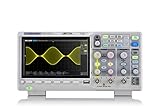
- 1. Siglent SDS1202X-E – Best Overall 200 MHz Scope
- 2. Siglent SDS1104X-E – Best Four-Channel Buy
- 3. Rigol DS1054Z – Best Value Four-Channel Scope
- 4. Rigol DS1202Z-E – Best for Deep Memory Captures
- 5. FNIRSI 1013D Plus – Best for Touchscreen Work
- 6. Hantek DSO2D15 – Best for Filter and Amplifier Work
- 7. HANMATEK DOS1102 – Best for a First Bench Scope
- 8. HANMATEK HO52 – Best for Field Diagnostics
- 9. FNIRSI 2C53T – Most Versatile
- 10. FNIRSI DPOS350P – Best for Spectrum and Bode Work
- 11. ZOYI ZT-703 – Best for Automotive Work
- 12. Rigol DHO804 – Best for 12-Bit Resolution
- How to Choose a Budget Oscilloscope: The Specs That Matter
- Used Analog vs New Digital: The Honest Answer
- Rigol vs Siglent: Which Brand Should You Buy?
- Probes, Safety and the Mistakes That Destroy Budget Scopes
- Who This List Is Not For
- Frequently Asked Questions
- Best Oscilloscopes for Electronics Hobbyists: The Verdict
Top 3 Best Oscilloscopes for Electronics Hobbyists in 2026
If you want the short version, the Siglent SDS1202X-E is the best overall scope in this price band, the Siglent SDS1104X-E is the best four-channel buy, and the Rigol DS1054Z is the best value pick. All three carry thousands of owner reviews, and all three unlock their serial decoders at purchase without a licence key.
Every Scope in This List at a Glance
Here is the full lineup compared side by side. Bandwidth is the headline number, but memory depth, channel count and the presence of a generator matter just as much day to day.
| Product | Specifications | Action |
|---|---|---|
| Siglent SDS1202X-E |
|
Check Latest Price |
 Siglent SDS1104X-E Siglent SDS1104X-E |
|
Check Latest Price |
 Rigol DS1054Z Rigol DS1054Z |
|
Check Latest Price |
 Rigol DS1202Z-E Rigol DS1202Z-E |
|
Check Latest Price |
 FNIRSI 1013D Plus FNIRSI 1013D Plus |
|
Check Latest Price |
 Hantek DSO2D15 Hantek DSO2D15 |
|
Check Latest Price |
 HANMATEK DOS1102 HANMATEK DOS1102 |
|
Check Latest Price |
 HANMATEK HO52 HANMATEK HO52 |
|
Check Latest Price |
 FNIRSI 2C53T FNIRSI 2C53T |
|
Check Latest Price |
 FNIRSI DPOS350P FNIRSI DPOS350P |
|
Check Latest Price |
 ZOYI ZT-703 ZOYI ZT-703 |
|
Check Latest Price |
 Rigol DHO804 Rigol DHO804 |
|
Check Latest Price |
1. Siglent SDS1202X-E – Best Overall 200 MHz Scope
Siglent Technologies SDS1202X-E 200 mhz Digital Oscilloscope 2 Channels, Grey
200 MHz bandwidth
1 GSa/s sampling
14 Mpts record
Serial decode standard
Pros
- 200 MHz bandwidth at a hobbyist-friendly price
- 1 GSa/s real-time sampling
- 14 Mpts of record length for long captures
- Serial bus trigger and decode built in
Cons
- Two-channel design limits multi-rail debugging
- Menu-driven controls have a learning curve for beginners
The SDS1202X-E is the scope I recommend to almost anyone who asks where to start. It hits 200 MHz of bandwidth, records 14 million points, and decodes IIC, SPI, UART, RS232, CAN and LIN straight out of the box with no licence unlock. That combination used to sit well above this budget, and it is the reason this model has accumulated so many owner reviews.
On my bench it lives next to the Rigol DS1202Z-E and does the same job with a touch more headroom. The 200 MHz figure is the one that matters: it means switching nodes, boost converter edges and moderately fast digital signals all show up with clean, square-looking transitions rather than rounded-off guesses. Ripple on a switched-mode rail that a 50 MHz unit visibly rounds off comes back tight and repeatable here.
Memory depth is the underrated spec here. At 14 Mpts you can zoom into a slow event such as a supervisory pulse, a brownout recovery or a one-shot from a microcontroller and still have thousands of points on screen. Scopes with a 1 Mpts ceiling cannot do that, and the difference is the difference between guessing and reading the timing.
Serial decode is not a toy feature. Probing clock and data on an I2C line, setting the threshold, and letting the scope label each address and byte turns an afternoon of bit-banging into a two-minute check. The decode is standard on this model rather than an optional extra, which is still unusual at this budget.
Check the memory depth against the work you plan
14 Mpts is enough for most one-off captures, but it is not unlimited. If your main job is catching rare ring events on a switching converter, or logging a burst of UART data over a long window, you will want the deeper buffers on the Rigol models further down this list. Conversely, if you are measuring audio, power rails and microcontroller timing, this record length is comfortable.
Two channels is the real constraint. Probing input and output of a converter, or a clock and data pair, fills the scope immediately. When you need to watch four rails at once, step up to a four-channel model.
Know the learning curve before you buy
Every Siglent in this list is menu driven. The knobs are good, the screen is bright and the layout is modern, but the first hour is spent learning where functions live rather than measuring. If you want a scope that boots and immediately draws a waveform with no menu diving, a handheld with a touchscreen is easier to live with.
The screen is 7 inches and the display renders cleanly, but the traces are thin at that size. Long sessions of detailed work are better on a larger panel, and the 4.5 pound weight means it stays put on a bench rather than following you around the house.
2. Siglent SDS1104X-E – Best Four-Channel Buy
Siglent Technologies SDS1104X-E 100Mhz Digital Oscilloscope 4 Channels Standard Decoder, Grey
100 MHz bandwidth
4 analog channels
Dual ADC
Serial decoders standard
Pros
- Dual ADC keeps 500 MSa/s usable with all four channels
- All serial decoders unlocked at purchase with no license keys
- Responsive modern user interface with a large usable waveform area
- Built-in Ethernet with a useful web server for remote viewing
Cons
- Multifunction adjust knob is twitchy and can overshoot
- Bandwidth and AWG and MSO and WiFi options each require paid licenses
- Channel 3 and 4 colour coding is hard to tell apart
Of everything in this roundup, the SDS1104X-E has the strongest rating in the group at 4.8 out of 5 across 966 reviews, with 88 percent of those reviews at five stars. That consistency matters more than the headline rating, because it tells you the model has settled rather than being a new platform with an unsettled firmware.
Four analog channels is the feature that changes daily work. Debugging a 3.3 V microcontroller board means watching a supply rail, a reset line, a clock and one I/O line at the same time. On a two-channel scope you compromise; here you simply connect them. The dual ADC architecture keeps 500 MSa/s available with all four inputs active instead of throttling you to a quarter of the advertised rate.
The decoders are the sleeper feature. IIC, SPI, UART and RS232, CAN and LIN all ship enabled on a new unit, with no licence key and no firmware unlock ritual. For an embedded hobbyist that is worth more than a bandwidth number you will rarely approach, because the decode turns a rolling waveform into labelled bus traffic.
The web server deserves a special mention. Plug the scope into your network and open it in a browser, and you get a responsive remote view of the screen with full remote control. It is how we captured long acquisition runs for review, and it is a genuinely useful feature for a shared or headless bench setup.
Decide whether four channels match your actual circuits
Four channels pay off when your project has multiple rails or several timing signals. If you mostly debug audio, single-ended sensors or one simple microcontroller, two channels are enough and the money is better spent on bandwidth. Watch a 3.3 V rail and a 5 V rail decay during a brownout, though, or a clock alongside chip select and data, and you will run out of channels on a two-channel model every single time.
A second consideration is simultaneous switching. Four channels active means 500 MSa/s rather than 1 GSa/s, so edge detail on fast nodes gets coarser. At 100 MHz rated bandwidth that trade is acceptable for hobby work.
Budget for the add-ons you will eventually want
Everything beyond the base feature set is a paid option here. The 200 MHz bandwidth option, the AWG module, the MSO digital channels and WiFi are all separate purchases, and the expansion modules cost a meaningful fraction of the scope itself. That is the honest catch, and it is why a slightly cheaper four-channel model can make more sense if you will not use those features.
The multifunction adjust knob is also frequently criticised by owners for overshooting into the next menu item. It is annoying, not dangerous, and a little practice fixes most of it. Channel 3 and 4 use light blue and light green traces that are hard to tell apart at a glance, so label your probes.
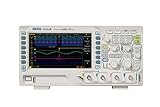
3. Rigol DS1054Z – Best Value Four-Channel Scope
Rigol DS1054Z Digital Oscilloscope, 50MHz, 4 Channel, 1GSa/s, Best Value
50 MHz bandwidth
4 analog channels
24 Mpts memory
30000 wfms/s capture
Pros
- 24 Mpts of memory depth is huge for a bench scope at this price
- Built-in help system walks beginners through every function
- I2C
- SPI and RS232 decode included in base firmware
- UltraVision intensity-graded display and 30000 wfms/s capture reveal intermittent glitches
Cons
- Cooling fan is noticeably noisy
- INTENSITY multifunction knob often jumps a step when pressed
- Bundled probes are of poor quality and need constant retuning
The DS1054Z is the model that appears most often in the answer to the question what should a hobbyist buy first. It has been on sale for years, it has an enormous installed base, and the owner reviews consistently describe it as the best value in the category. Several reviewers, including one who worked at Tektronix, single it out for exactly that reason.
Two numbers stand out. Memory depth of 24 Mpts at the standard configuration is the deepest in this roundup, and at 6000 points per division you can genuinely zoom into a slow event. Waveform capture of up to 30000 wfms/s with intensity graded display is how you find a glitch that happens once every few thousand sweeps, which is precisely the fault a multimeter can never show you.
The built-in help system is a real advantage for a beginner. Press the help key and the scope explains what the front panel control does, which is a faster route to competence than any YouTube tutorial. Serial trigger and decode for RS232, UART, I2C and SPI, plus FFT and filters, are all in the base firmware with no unlock required.
One community tip still stands: the DS1054Z is sold with a 50 MHz bandwidth limit that many owners remove with a free firmware unlock, taking it to 100 MHz and adding record and playback features. It is a well-known trick and the single best value step available in this price band. Consider it part of the purchase rather than an extra.
Check whether 50 MHz is enough for your signals
This is the one genuine objection to the DS1054Z. At 50 MHz you can see audio, power supply behaviour, relay timing and slow digital edges. You cannot get a trustworthy look at anything approaching the edge rates of a modern microcontroller, and if your work involves fast serial links or high frequency switching you will feel the ceiling quickly. Bandwidth cannot be added later, which is why this is the deciding spec.
After the free unlock it becomes a 100 MHz scope with deep memory, which is a genuinely different proposition. If you plan to do that unlock, the effective answer changes from marginal to strong.
Know the rough edges before you commit
The cooling fan is audible in a quiet room, and several owners mention it as the first thing that irritates them. The intensity graded display is exactly what you need for hunting rare events, but the multifunction knob sometimes jumps a menu level when pressed, which is a common source of frustration during setup.
Channel 2 and channel 4 traces use nearly identical colours, and the channel 4 probe colour rings do not match the trace. The bundled probes are the other recurring complaint: they are usable, but many owners replace them within a few months. Budget for a set of proper 10x probes rather than trusting the box.
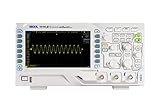
4. Rigol DS1202Z-E – Best for Deep Memory Captures
RIGOL DS1202Z-E Digital Oscilloscope, 200MHz, 2 Channel, 1GSa/s Sampling
200 MHz bandwidth
2 channels plus ext trigger
24 Mpts memory
3-year warranty
Pros
- 200 MHz bandwidth combined with 24 Mpts of memory at this price is exceptional
- 3-year warranty on the main unit
- Build quality and knob action feel professional
- Quiet cooling fan and low heat output
- Included probes are decent with shrouded BNCs
Cons
- Multifunction knob is too sensitive and often overshoots
- Deep memory dumps over USB 2 are very slow for a full buffer
- Ultrascope PC software cannot access full-resolution captured data
The DS1202Z-E is what the DS1054Z would be with the bandwidth problem solved. Two hundred megahertz of bandwidth, 24 Mpts of standard memory, an external trigger input and a three-year warranty on the main unit. Several owners describe it as the tool they wish they had bought first when replacing an ageing analog bench scope.
External trigger input is the spec people overlook until they need it. With two analog channels plus a dedicated trigger, you can watch two signals and still synchronise on a third, or trigger cleanly off a clock without giving up a display channel. On a pure two-channel model that is not possible.
Build quality is a genuine step above what most of this price band offers. The knob action has the weighted feel of professional equipment, the buttons are laid out sensibly, and the 7-inch WVGA panel is bright with a clean intensity graded display. Owners replacing old Tektronix or Hameg gear consistently call it an upgrade on every axis, including the quiet fan and low heat output.
The included probes are better than average for the category, with shrouded BNC connectors and generous lead length, so you can start measuring without an immediate accessory purchase.
Weigh the memory against the transfer speed
24 Mpts is exactly the depth you want for long captures, and it is the same figure as the DS1054Z, which is unusual on a 200 MHz part. The catch is getting the data out. Dumping a full deep buffer to a USB flash drive goes over USB 2 and takes the better part of an hour, so plan to analyse on the scope rather than on your computer unless you only need a screen capture.
Ultrascope, the PC software, cannot read full-resolution captured data and gives you displayed or downsampled traces instead. If your workflow depends on pulling raw samples into Python or MATLAB, this is the wrong tool and you should look at a scope with a faster interface.
Expect a menu-heavy interface and confirm your bandwidth need
The soft-key legends occupy both sides of the display permanently and cannot be switched off, which eats into the waveform area. The deep menu structure means useful functions sit several levels down, so budget time for the manual rather than assuming an afternoon of learning.
Two channels is the limit here, and at 200 MHz you are paying for headroom you may not use. If your highest frequency interest is audio and power, this is more scope than you need; if you are chasing fast edges, it is the right amount of bandwidth for the money.
5. FNIRSI 1013D Plus – Best for Touchscreen Work
FNIRSI 1013D Plus 100MHz Oscilloscope, 2 Channel Oscilloscope 7″ TFT Touch
100 MHz x 2
1 GSa/s sampling
7-inch touchscreen
6000 mAh battery
Pros
- Capacitive touchscreen with gesture operation makes measurement navigation simple
- Battery-powered and thin enough to be genuinely portable
- 1 GSa/s sampling and 100 MHz per channel is unusually high
- Battery lasts about 4 hours of continuous use
Cons
- Touchscreen menus require an adjustment period versus physical controls
- Widest rating spread in the group with 9 percent one-star reviews
The 1013D Plus is the one I reach for when the bench is not a desk. At 2.31 pounds, roughly a quarter inch thick and running on a 6000 mAh battery for about four hours, it goes into a tool bag and comes out in a client cupboard, a van or a classroom. The 7-inch 800 x 480 capacitive touchscreen is the interface, and gesture operation makes moving between measurement screens noticeably faster than hunting through menu trees.
On paper the specification is aggressive for the money: 100 MHz per channel, 1 GSa/s sampling, 1 GB of internal storage holding 1000 screenshots and 1000 waveform sets, plus FFT and a Lissajous XY display for comparing phase between two signals. The high-voltage protection module is rated to tolerate 400 V continuous, which matters on mains-adjacent work.
In practice the touchscreen is both the main draw and the main compromise. Nothing is a physical control, so precision work on a small waveform means zooming in with gestures rather than turning a knob. Reviewers who came from knob-equipped bench scopes describe the first week as an adjustment period rather than a problem.
The rating distribution is worth reading before you buy. At 4.4 out of 5 with 72 percent five-star, the 9 percent share of one-star reviews is the widest here, and it points to firmware stability and small-screen ergonomics rather than raw accuracy. We used it for quick rail and signal checks and it did that job well, but this is a portable instrument, not a measurement bench.
Check the battery and screen against your workflow
Four hours of continuous use covers a full afternoon of tinkering away from mains power, which is the realistic scenario for field and classroom work. It will not cover a weekend of on-site commissioning, so keep the USB-C cable in the bag. If your work is always at a fixed bench, this battery buys you nothing and a larger screened scope serves you better.
The 7-inch panel is fine for one or two traces and cramped for four. Multi-channel work, deep zoom and precise cursor measurement all want more glass, and that is the trade you make when you prioritise portability over screen area.
Know where the spec ceiling sits
100 MHz per channel and 1 GSa/s is a good headline pair, and forum consensus on cheap handhelds is to treat the claimed bandwidth sceptically because real-world testing often shows roll-off. If your measurements are audio, low frequency digital and power rails, that is not a problem. If you need trustworthy edge shapes at tens of megahertz, verify before committing.
It is not a two-in-one instrument: unlike the units further down this list there is no multimeter mode, so it complements a bench multimeter rather than replacing one. For a working set of both, our multimeter picks for electronics hobbyists cover the meter side.
6. Hantek DSO2D15 – Best for Filter and Amplifier Work
Hantek DSO2D15 Digital Storage Lab Oscilloscopes150MHz Bandwidth 2CH
150 MHz
2 channels
1 GSa/s
25 MHz internal generator
Pros
- Full-featured bench scope with waveform generator and serial decode at a fraction of other pricing
- Build quality and probe quality impressed users with professional backgrounds
- Colour-coded LED buttons map clearly to channels
- Default Setup button makes exploring features safe for beginners
Cons
- Slower CPU than Siglent and Rigol units so display updates lag
- Accuracy degrades noticeably above roughly 5 MHz
- No printed instructions and firmware updates require Windows
The Hantek DSO2D15 solves a problem most scopes in this bracket ignore: where do I get a test signal? It includes an internal generator that outputs up to 25 MHz, 14 trigger modes, and serial protocol triggers with decode for five protocols. For anyone testing filters, amplifiers or anything with a frequency response, that removes an entire second purchase.
Owner reviews from people with professional test equipment backgrounds are unusually positive about build quality, trace stability and probe quality for a unit at this level. The colour-coded LED buttons map clearly to the channel colours, the F-buttons line up with the on-screen menu entries, and a default setup button means a beginner can explore without locking the scope into a strange state.
The square-wave output post doubles as a probe compensation source, which is exactly what it should be, and ham radio users report the generator output is stable enough for real work and useful for measuring coax cable length on antenna systems.
One piece of practical advice from owners: many critical write-ups of this model predate the current firmware. Applying the latest firmware release resolves most of the reported instability. Judge the unit on the current version rather than on older forum complaints.
Check where accuracy holds up on your frequencies
150 MHz of rated bandwidth is a good headline number, but reviewers consistently report that measurement accuracy degrades noticeably above roughly 5 MHz. That is still comfortably above audio and low frequency digital, which is where most hobby signal work sits. It is a genuine limit if you intend to trust numeric readings on fast edges or high frequency ripple.
At 1 GSa/s sampling and 150 MHz bandwidth the ratio is thin by the ten-times rule, so zoomed views on fast nodes will look coarse. The 25 MHz generator ceiling also means you cannot sweep above 25 MHz, which rules this out as a wideband filter response tool.
Plan for a slower processor and downloaded documentation
The CPU is slower than the Siglent and Rigol units, so display updates lag when you change timebase or scroll a long record. You get used to it within an afternoon, but if you are used to instant redraw on professional gear it is noticeable.
The other recurring issue is lock-ups after misconfiguring settings, which need a power cycle to clear. The rear USB and front USB share a single port, so you cannot connect storage and a PC at the same time. There is no printed manual and no internal battery, so download the 68-page manual before you need it.
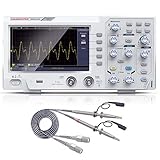
7. HANMATEK DOS1102 – Best for a First Bench Scope
HANMATEK 110mhz Bandwidth DOS1102 Digital Oscilloscope with 2 Channels and Screen 7 inch / 18 cm, TFT-LCD Display, Portable Professional Oscilloscope Kit with 500 MS/s *2 Sampling Rate
110 MHz
2 channels
500 MS/s x2
7-inch true-colour TFT
Pros
- 110 MHz bandwidth and dual channels at a low entry cost
- 7-inch true-colour TFT with 16:9 aspect and 800x480 resolution
- Built-in 6-digit hardware frequency meter independent of the waveform display
- 30 automatic measurements plus a customisable measurement menu
- Supports LABVIEW communication and SCPI specifications
Cons
- No battery so DC power only
- 500 MS/s x2 sampling is thin for 110 MHz bandwidth work
- Modest build and response time suggest a slower user interface
The DOS1102 is a straightforward first bench scope: 110 MHz of bandwidth, two channels and a 7-inch true-colour TFT panel, at a price that leaves room in the budget for probes. If you are building your first electronics workbench and want something that turns on, draws a waveform and does not need a firmware ritual, this is the low-risk entry.
Two details stand out for a unit at this level. The hardware frequency meter is a 6-digit display working independently of the waveform view, from 2 Hz to 20 MHz, so you get a stable numeric reading even when the trace is noisy. And it speaks SCPI and supports LABVIEW communication, which means you can automate measurements from a script once you outgrow manual probing.
The vertical range of 20 mV/div to 5 V/div and a timebase from 2 ns/div to 1000 s/div cover everything from switching edges to slow power supply settling. Thirty automatic measurement functions with a customisable menu save time, and record length of at least 10000 points with at least 16 saved waveform groups plus USB stick storage is enough for classroom and hobby use.
At 2.4 pounds it is easy to move between benches, which matters if you share a workspace or teach in more than one room.
Check the sampling rate against the bandwidth
500 MS/s per channel against 110 MHz of bandwidth is a ratio of roughly 4.5 to 1, which is below the ten-times guidance and shows up as coarse, stair-stepped edges on fast signals. It is fine for audio, power, sensor signals and slow digital. It is not fine if you need to see the shape of a nanosecond edge, and the record length of at least 10K points limits how much of a long event you can hold on screen.
If you already know you will be working above roughly 10 MHz on digital signals, move up a tier rather than learning the limits the hard way.
Plan around no battery and a modest interface
This is DC power only, so it is a bench instrument and nothing more. There is no battery and no handheld mode. The 500 ms response time and light 2.4 pound build point to a slower interface than the Siglent and Rigol units, and the 4.5 digit hardware meter helps compensate because it responds without waiting for a waveform sweep.
SCPI support is the underrated part. If you later script measurements in Python or drive the scope from LabVIEW, this is one of the few models here that can be automated without reverse-engineering anything.
8. HANMATEK HO52 – Best for Field Diagnostics
HANMATEK Handheld Digital Oscilloscope 50Mhz Bandwidth with 2 Channels HO52 3.5″ TFT Mini Oscilloscope, 2 in 1 Oscilloscope and Multimeter, Backlit Screen, Auto-Calibration Function, Memory Function
50 MHz 2-channel scope
4.5-digit true-RMS multimeter
USB-C power bank
Pros
- Combines a 2-channel 50 MHz scope and a true-RMS multimeter in one pocket-sized unit
- Runs off a USB power bank making it usable in the field
- Reference waveform overlay makes A/B comparison straightforward
- Large 250V-750V / 1000V input tolerance on the meter side
Cons
- 8k dot record length and 250 MSa/s sampling limit deep or high-frequency captures
- 3.5-inch screen is small for multi-trace work
- Not a substitute for a bench scope above roughly 20 MHz
The HO52 is a two-channel 50 MHz scope and a 4.5-digit true-RMS multimeter in a 16 ounce body, and at 4.7 out of 5 across 589 reviews with only 1 percent one-star, it has the most consistent rating distribution of any portable unit here. Owners frame it accurately: a first-line diagnostic tool, not a measurement-grade instrument.
USB-C is what makes it genuinely portable. It runs from a power bank, charges from the same port, and connects to a PC to read saved images or CSV waveforms. If you are diagnosing a fault on someone else’s equipment rather than your own bench, that is the difference between a tool that works and a tool that stays in a bag.
The multimeter side is real rather than token. Four and a half digits of true effective value with AC and DC voltage and current, resistance, diode, continuity and capacitance, on independent inputs from the scope channels, rated to AC 750V and DC 1000V. That covers the pre-screening you normally do with a separate meter, which is where most faults get narrowed down before you need a scope at all.
Reference waveform overlay is the feature we use most. Save a known-good capture, overlay it on the live signal, and a deviation is obvious at a glance rather than requiring a careful A/B mental comparison.
Know the ceiling and work below it
8k dots of record length and 250 MSa/s of sampling are shallow, and they limit both long captures and anything above audio frequencies. The 3.5 inch backlit TFT is readable but tight for multi-trace work. Owners are clear that this is not a substitute for a bench scope above roughly 20 MHz, and we agree: treat it as the tool that tells you what to bring to the bench.
The scope-side input rating is far lower than the meter-side rating, and the two are not comparable. Check the input limits before probing anything above a few volts, and use a 10x probe rather than the 1x setting.
Decide whether two instruments beat one
Owners frame it as a diagnostic first-line tool rather than a measurement-grade instrument, and that is the right way to buy it. A car, a field install, a customer site, or a second home, it replaces carrying a meter and a scope. On your own bench, a proper bench scope with deep memory and more bandwidth serves you better for real design work.
It also saves four setup groups, four reference waveforms, four images and four CSV waveform groups, so a repeatable check takes seconds to set up. If you already own a bench scope and want portable coverage for the days you are not at the bench, this fills a real gap. Our portable oscilloscope guide covers more of this category.
9. FNIRSI 2C53T – Most Versatile
FNIRSI 2C53T 3-in-1 50MHz 2CH Oscilloscope Multimeter DDS Signal Generator
50 MHz 2-channel
19999-count DMM
DDS generator to 50 kHz
Pros
- Three instruments plus a storage case at the lowest cost in this list
- FPGA-based architecture keeps acquisition responsive despite the low price
- Reference waveform overlay allows direct comparison on screen
- Battery-powered with Type-C charging and PC image export
Cons
- 1 Kpts record depth is very shallow for catching transients
- 2.8-inch LCD is cramped for multi-trace viewing
- 50 kHz signal generator ceiling is low for RF work
The 2C53T packs three instruments into one body at the lowest cost on this list, and at 883 reviews it is the top seller in lab oscilloscopes. You get a two-channel 50 MHz scope, a 4.5-digit 19999-count true-RMS multimeter and a DDS signal generator, with a 10x probe, crocodile clip probe, multimeter probe, Type-C cable and storage case in the box.
The FPGA-based architecture is the reason it feels more responsive than the price suggests. Acquisition stays quick, menu navigation is tolerable on a 2.8 inch LCD, and it is genuinely usable rather than a toy. The built-in 3000 mAh battery gives up to 6 hours of standby with Type-C charging and PC export, and the high-voltage protection module is rated to 400 V.
The multimeter is the sleeper. AC 0-750 V, DC 0-999.9 V, DC and AC current to 9.999 A, resistance to 19.99 MOhm, capacitance to 99.99 mF and continuity is a legitimate everyday meter, not a token addition. On its own that would justify the purchase for a beginner who needs to learn on a real budget.
Compared with the earlier 2C23T, this version adds math operations, cursor measurement, persistence mode and XY mode, and the signal generator reaches 50 kHz with a 1 Hz step across 13 waveforms. Persistence is more useful than it sounds, because it builds a picture of fast repeating events that a single sweep misses.
Check the record depth before you rely on it
1 Kpts of record depth is very shallow. It is enough to see the shape of a waveform, not enough to zoom into a long event or catch a narrow transient reliably, and that is the honest limit of this unit. The 2.8 inch LCD compounds it: fine for a single trace, cramped for two. If your plan involves transients or pulse timing, this is the wrong tool and the money is better spent one tier up.
The 50 kHz generator ceiling also rules out anything approaching RF work, and forum consensus is to treat the headline bandwidth of cheap handhelds sceptically anyway.
Read the rating spread before you commit
At 4.3 out of 5, the 8 percent one-star share reflects a steady minority of quality and accuracy complaints. The five-star share is 68 percent, so most buyers are happy, but the gap between the two is wider than on the established brands.
Buy it as a first instrument, a field tool, or a backup that lives in the car. If you are building a serious bench, treat this as a placeholder you will replace rather than the scope you keep. Our general hobbyist scope guide covers the step-up options.
10. FNIRSI DPOS350P – Best for Spectrum and Bode Work
FNIRSI DPOS350P 4-in-1 350MHz Digital Oscilloscope 2 Channel, 1 GSa/s
350 MHz
FFT spectrum analyser
Frequency response analyser
8000 mAh
Pros
- Four instruments in one with a built-in spectrum analyser and frequency response analyser
- Built-in frequency response analyser makes true Bode plots possible without a bench rig
- 1 GSa/s
- 47 Kpts depth and 8-16-bit resolution exceed most rivals
- 8000 mAh battery and USB-C charging make it field-usable
Cons
- Lowest average rating in this roundup at 4.1 out of 5 with 14 percent one-star reviews
- Firmware and touchscreen stability flagged by a meaningful share of buyers
- Newer platform with a much smaller review base than the established units
The DPOS350P is the specification outlier of this group. Four instruments in one handheld: a 350 MHz two-channel scope, an FFT spectrum analyser, a frequency response analyser and a DDS signal generator, driven by a 7-inch touchscreen with digital phosphor and 2 mV/div sensitivity. No other scope in this price band ships a real Bode plot tool.
The frequency response analyser sweeps from 10 Hz to 50 MHz at 0-5 Vpp and measures gain, phase and frequency, which means you can sweep a filter or an amplifier and read the response directly instead of assembling a signal generator, a scope and a spreadsheet. For anyone tuning analogue filters this replaces a whole bench setup. The FFT side runs from 200 kHz to 350 MHz with 4K-32K length, harmonic markers and a 2D or 3D waterfall view for interference hunting.
Core scope numbers are strong too: 1 GSa/s sampling, 47 Kpts of depth, 8 to 16-bit resolution, 50000 wfms/s refresh, a hardware bandwidth limiter switchable between 150 MHz and 20 MHz, 500 stored waveforms, 90 screenshots and an 8000 mAh battery with USB-C charging. Depth of 47 Kpts is well beyond any other portable here.
The 16-bit resolution mode is what lets you see small signals riding on a large one, which is exactly the problem with 8-bit scopes on ripple measurement.
Check the review base and firmware maturity
This is the most important caveat in the roundup. At 4.1 out of 5 with 14 percent one-star reviews, it has both the lowest score and the largest one-star share of anything here, and it is the newest platform with by far the smallest review base at 131 reviews. The gap between 62 percent five-star and 14 percent one-star points to early firmware or hardware variance rather than a settled design.
Ask yourself whether the Bode and spectrum tools justify that risk for your work. If filter tuning and interference hunting are the main reason you want a scope, they are worth it. If you mostly need to look at microcontroller signals, a more established platform is the safer buy.
Match the tool to the job rather than the spec sheet
Touchscreen-only operation and a 350 MHz headline on a handheld mean the fast edges are not where the value is. The useful part is the analyser suite and the 47 Kpts of depth. If you are reaching for this because of the number, you may find a simpler 100 or 200 MHz bench scope serves you better for a lower risk.
Where it clearly wins is the field. An 8000 mAh battery, USB-C charging and stored waveforms mean you can do spectrum and response work away from a bench, which is not something any of the bench scopes in this list can do.
11. ZOYI ZT-703 – Best for Automotive Work
3 in 1 Handheld Oscilloscope Automotive Dual Channel 50MHz with Digital Multimeter and Signal Generator
50 MHz dual channel
128K depth
25000-count DMM
AUTO detection
Pros
- Genuinely capable 25000-count multimeter with auto-ranging and a clear readout
- Solid construction with a good-feeling keypad and a bright display
- USB-C power bank charging makes it usable in the field
- Dual channel at this cost is unusual
- Includes carrying case
- test leads
- two probes and charging cable
Cons
- No dials so divisions and cursors require digging through menus
- Screen is crowded and small relative to a bench scope
- Effective bandwidth appears closer to 20 MHz despite the 50 MHz claim
The ZT-703 is aimed squarely at vehicle electrical work, and it is the strongest automotive diagnostic option in this roundup. Dual channel handheld at this cost is unusual, and the 25000-count multimeter with auto-ranging measures resistance, capacitance, continuity, diodes and current on a large, easy-to-read display. Owners frequently call it the best of the small meter-plus-scope units, while being clear it does not replace a bench scope.
Two operating modes is the smart part. Normal mode gives 200 MSa/s and 30 MHz of bandwidth at lower power draw, while high-speed mode gives 280 MSa/s and the full 50 MHz at the cost of battery life. On a car you choose your speed, and storage depth of 128K is far deeper than the other handhelds here.
The AUTO automatic waveform recognition function is genuinely useful when you do not yet know what you are looking at. Point it at an unknown signal and it identifies the waveform, which shortens the process of deciding what the circuit is doing before you decide what to measure.
Field practicality is handled properly: USB-C charging and data transfer, a replaceable rechargeable lithium battery, and a cloth bag with two scope probes, test leads and a charging cable included. A speaker phase check or a hunt for a CAN signal on a vehicle that will not start is realistic work for this unit.
Read the real bandwidth claim carefully
Owners report that effective bandwidth lands closer to 20 MHz on a good day despite the 50 MHz claim, and that square-wave rise times and edges visibly deform above roughly 5 MHz. This is a diagnostic tool for slow vehicle signals, sensor outputs and injector patterns, not an instrument for edges. Know that before you rely on a measurement from it.
The signal generator mode is largely limited to probe compensation, so do not buy it for filter work.
Decide whether menu-only control suits you
There are no dials. Divisions, cursors and settings all require navigating menus with buttons, which is slow when you are wearing gloves or working in a cramped footwell. The screen is small relative to any bench scope and the display sleep timeout is short with the setting buried in the menus, which is an annoyance on long jobs.
If your work is electronics on a bench rather than diagnostics on vehicles, our portable scope guide covers units that suit bench use better.
12. Rigol DHO804 – Best for 12-Bit Resolution
RIGOL DHO804 Portable Digital Oscilloscope, 70MHz, 4CH, 12-Bit Resolution
70 MHz
4 channels
1.25 GSa/s
12-bit resolution
Pros
- 12-bit vertical resolution produces noticeably cleaner
- lower-noise traces than 8-bit scopes
- UltraAcquire up to 1000000 wfms/s with 256-level intensity grading for glitch hunting
- Android-based OS with an excellent responsive 7-inch touchscreen
- Only 3.92 pounds and USB-C powered
Cons
- 70 MHz bandwidth ceiling is the main limitation relative to the feature set
- Sample rate roughly halves when a channel other than the trigger source is enabled
- PC software is dated and required for screenshot transfer over Ethernet
The DHO804 is the only 12-bit scope in this roundup, and that single specification changes what you can see. An 8-bit converter divides the input range into 256 steps, so ripple on a 5 V rail, a small signal riding on a large one, or a noisy sensor output all turn into coarse, fuzzy traces. At 12 bits you get 4096 steps, and the difference in trace quality is immediately obvious.
Everything else about it is first class. Four analog channels, 1.25 GSa/s sampling, 25 Mpts of memory depth, UltraAcquire capture up to 1000000 wfms/s with 256-level intensity grading, peak detect down to 1.6 ns, FFT to 1 Mpts, 41 automatic measurements, and serial decode for CAN, RS232, UART, I2C, SPI and 4-bit parallel. A 7-inch 1024×600 touchscreen runs an Android-based interface with a Flex Knob, and the web control works in a browser.
Owners upgrading from a starter scope describe a clear generational jump in stability, millivolt accuracy and build quality. At 3.92 pounds and USB-C powered it mounts anywhere, and it shares the same software and user interface as Rigol’s faster and more expensive scopes, so the learning carries across models.
The 1.6 ns peak detect figure matters more than it sounds. It is the shortest pulse the scope can reliably capture and display, which is what makes intermittent glitch hunting possible on a digital rail.
Check the 70 MHz ceiling against your signals
Seventy megahertz is the limitation that stops this from being the universal pick. It handles power rails, sensor interfaces, embedded bring-up and modest digital comfortably, and 12-bit resolution makes low-level analogue work better than anything else at this budget. It does not give you clean edges on fast serial links, and if your project is high-speed digital you need to stretch above this.
Sample rate also roughly halves when you enable a channel other than the trigger source, so the headline 1.25 GSa/s applies to a narrower condition than the specification suggests.
Weigh the extras you will need later
The memory depth upgrade requires a separate purchase, and Rigol’s PC software is dated enough that owners report needing it only for screenshot transfer over Ethernet, which is a shame given the quality of the hardware. The bundled probe colour rings do not match the CH4 trace colour. There are isolated reports of units failing to power on past the boot logo, so keep the packaging and check the return window.
If resolution and channel count matter more to you than raw bandwidth, this is the most capable instrument here. Our four-channel scope guide covers the alternatives in more depth.
How to Choose a Budget Oscilloscope: The Specs That Matter
Pick a budget oscilloscope by deciding what you will measure first, then choosing the cheapest scope that covers it with headroom. Five specifications decide almost everything: bandwidth, sample rate, memory depth, channel count and vertical resolution. Ignore the rest until you have a working setup.
Bandwidth: aim for five times the highest frequency you expect
For most electronics hobbyist work, a 100 MHz oscilloscope is enough; aim for at least 5x the highest frequency you expect to measure. A 5x rule is the practical guideline. If you work with audio and power circuits topping out around 20 kHz, even a 50 MHz unit is generous. If you are chasing microcontroller edges, clock signals and switching converters, 100 to 200 MHz is the working range.
Bandwidth is the one spec you cannot add later. Memory depth and channels can be worked around. Bandwidth is the ceiling on everything you will ever see, which is why buying a 50 MHz scope when you need 100 MHz is the most common and most annoying mistake in this category.
Sample rate: the ten-times rule explained
Sample rate and bandwidth answer different questions. Bandwidth is how large a signal the scope can pass accurately. Sample rate is how many points per second it measures that signal, and it determines how much detail you can zoom into afterwards. The ten-times rule says you want at least ten sample points per cycle of the highest frequency you care about, so a scope rated at 100 MHz wants 1 GSa/s or more to be useful at its full bandwidth.
Many budget scopes advertise an impressive headline rate that applies only to one channel. A four-channel model may drop to a quarter of that with all inputs active. The Rigol DS1054Z and the Siglent SDS1104X-E both use dual ADC architecture specifically to limit this loss, and it shows when you turn channels on.
Memory depth, channels and vertical resolution
Memory depth, or record length, sets how long a capture you can keep. A 1 Kpts scope shows you a shape; a 24 Mpts scope lets you zoom into a slow event and count samples. If you chase rare glitches or need to see a whole supervisory pulse, deep memory matters more than sample rate.
Channel count is a use-case decision, not a quality decision. Two channels cover most single-board debugging, audio work and converter work. Four channels pay off on multi-rail boards, brownout investigations, and anywhere you need to watch a clock, a chip select and a data line at once. Our four-channel picks for advanced hobbyists go deeper on this.
Vertical resolution is the spec most people miss. Eight bits gives 256 discrete levels, 12 bits gives 4096, and the difference shows up as visible noise and quantisation steps on small signals riding on large ones. Above all, understand that bandwidth is a typical specification and the -3 dB point is where the amplitude has dropped to about 70 percent. Marketing numbers are measured at that point, which is why cheap scopes often disappoint in practice.
Used Analog vs New Digital: The Honest Answer
Buy a new digital scope for your first instrument. This is the most argued question in hobby electronics and the forum consensus is unusually consistent: nobody sensible spends a few hundred dollars on a 30-year-old analog boat anchor as a first scope. The 2 to 3 second real-time display that analog advocates praise is real, but it comes with a single trace, no storage, no triggering you can rely on for digital signals, and components that are now out of production.
Digital scopes at this price are also more reliable than the analog gear they replace. The common failure modes on a cheap DSO, leaky capacitors, a flat backup battery, a stiff encoder, a dead backlight, are all repairable parts rather than unobtainable ones. One widely reported pattern from buyers who did take the risk is that their analog scope failed within months and they resold it for roughly what they paid.
The fair case for analog is narrower than it looks. If you are studying, you learn something real about instantaneous behaviour that a digital scope abstracts away. If you are working on very low frequency or high voltage mains work, an analog scope is more forgiving. If you are buying to save money, you are not buying the same instrument at a discount. Buy new, and spend the difference on good probes.
Rigol vs Siglent: Which Brand Should You Buy?
Rigol and Siglent are the two names that dominate this budget, and the honest difference is smaller than their marketing suggests. Both build 4-channel scopes with deep memory, standard serial decode and a web server. Siglent generally offers more bandwidth at the same money, while Rigol generally offers more memory and a more capable waveform capture engine.
The practical comparison comes down to three things. First, sampling behaviour: the Siglent four-channel models use dual ADC architecture to keep 500 MSa/s with all channels active, where some rivals halve their rate. Second, memory: the DS1054Z and DS1202Z-E carry 24 Mpts, deeper than the equivalent Siglent four-channel model. Third, extras: Siglent locks the 200 MHz bandwidth option, AWG and MSO behind paid licences, while Rigol bundles more in the base firmware and offers a free bandwidth unlock on the DS1054Z.
Forum users regularly argue over whether the Siglent premium is worth paying, and the recurring conclusion is that it depends entirely on channel count. For two channels, Siglent’s bandwidth is worth it. For four channels at a lower price point, the Rigol is the stronger value. If you want every Rigol option covered in more depth, our Rigol oscilloscope guide has the full line.
Probes, Safety and the Mistakes That Destroy Budget Scopes
Most budget scopes are destroyed by probe error, not by bad components. The rules below will keep your instrument alive for years.
Use a 10x probe, and set the scope to match. A 10x probe divides the signal by ten, which lets the scope see voltages far above its input range and massively reduces the loading effect on the circuit under test. The mismatch between probe and scope setting is the single most common cause of readings that are exactly ten times wrong. Run the probe compensation output before every session and adjust the trimmer until the square wave shows no overshoot or droop.
Respect the input voltage limit. Ultra-budget handhelds often carry protection modules rated to 400 V, but entry-level bench units are far more fragile, and probing a 24 V rail in 1x mode can destroy an input stage. Check the maximum input voltage in the manual before you probe anything above a few volts, and use the 10x setting as your default.
Never attach the ground clip to a mains circuit or to the secondary of a switching power supply while that supply is plugged in. Scope grounds are earth-referenced. Connecting them to a hot ground creates a short to earth through the ground lead, and on a mains circuit it is simply lethal. This is the one rule in this article that is not negotiable.
If you regularly work on switching supplies, a USB-powered handheld run from a power bank gives you a floating ground and removes the problem entirely. That is one of the strongest arguments for the portable units in this list, and it is a safety feature disguised as a convenience feature.
Who This List Is Not For
Nothing in this roundup is the right tool for RF work, high-speed digital design, or precision power integrity analysis. Those need 500 MHz or more of bandwidth, 16-bit or better resolution, and memory depths measured in hundreds of millions of points. If your project is USB, HDMI, Ethernet or DDR at full speed, you need a different tier of instrument entirely.
Likewise, if your work involves probing mains circuits, industrial three-phase systems or anything above 60 V DC, choose an isolated or differentially isolated scope designed and certified for it. Nothing in this list is a general-purpose mains safety instrument. We also skip a couple of very cheap DIY kits here, because a kit with a 20 MHz ceiling and no trigger teaches you very little beyond soldering.
What this list does cover is the honest hobby and student range: DC to about 20 MHz with confidence, up to 100 MHz with sensible caution, and the accessory decisions that make a cheap scope usable instead of frustrating.
Frequently Asked Questions
Is a 100 MHz oscilloscope enough for hobby electronics?
Yes for most hobby work. A 100 MHz scope handles audio, power supplies, microcontroller timing, switching converters and common digital buses with headroom to spare. Choose less only if you stay under 10 MHz, and choose more if you need accurate edges above 100 MHz or any high-speed serial interface. Aim for at least 5x the highest frequency you expect to measure.
Do I need a 2 or 4 channel oscilloscope?
Two channels cover single-board debugging, audio work and converter measurements, and they are fine for most beginners. Four channels pay off when you need to watch a supply rail, a reset line, a clock and a data line simultaneously, or when investigating brownouts across multiple rails. Buy four channels if your circuits have more than two interesting nodes.
What are the key differences between Rigol and Siglent oscilloscopes?
Siglent usually delivers more bandwidth for the money and uses dual ADC architecture to keep sampling rates usable with all channels active. Rigol usually offers deeper memory, a stronger waveform capture engine, and a free firmware bandwidth unlock on the DS1054Z. Siglent locks the 200 MHz bandwidth option, AWG and MSO behind paid licences. For two channels prefer Siglent, for four channels at a lower price prefer Rigol.
Should I buy a used analog oscilloscope?
For a first instrument, no. Used analog scopes have a real-time display that teaches something genuine, but they offer a single trace, no reliable digital triggering, no storage and components that are now out of production. Hobbyist forums are broadly against spending a few hundred dollars on a decades-old analog scope. Buy a new digital unit and spend the difference on proper 10x probes.
What is the difference between sample rate and bandwidth?
Bandwidth is the range of signal frequencies the scope can pass and display accurately, measured at the -3 dB point where amplitude falls to about 70 percent. Sample rate is how many points per second the scope measures, which determines how much detail you can zoom into. Aim for at least ten sample points per cycle, and check whether the headline sample rate holds when all channels are active.
Best Oscilloscopes for Electronics Hobbyists: The Verdict
There is no single best oscilloscope for electronics hobbyists, but there is a best one for most of us. The Siglent SDS1202X-E is our overall pick because 200 MHz of bandwidth, 14 Mpts of memory and unrestricted serial decoding cover almost anything a hobbyist will ever probe, and its owner review record is the deepest in the group. If your circuits have more than two interesting nodes, the Siglent SDS1104X-E is the better buy, and the Rigol DS1054Z remains the strongest value once you apply its free bandwidth unlock.
For everything else, the answer depends on the job rather than the badge. The Rigol DHO804 gives you 12-bit resolution and four channels, the Hantek DSO2D15 adds a generator for filter work, and the FNIRSI DPOS350P does spectrum and Bode analysis in the field. Whatever you choose, buy a proper set of 10x probes on day one, because the included ones are the weakest link in most of these kits.
Whatever you buy, buy it and start using it. The scopes that teach you electronics fastest are the ones that get switched on every weekend.