

A coverstitch machine is a specialist sewing machine that finishes knit hems the way ready-to-wear does: two or three needles lay parallel rows of straight stitch on the right side of the fabric while a looper thread on the underside interlocks them, so the seam flexes with the knit instead of snapping when you pull the garment. That is the whole point of the best coverstitch machines for hemming, and it is not the same thing as a twin-needle stretch stitch on a normal machine.
We spent six weeks with nine dedicated and combination coverstitchers, running the same jersey, fleece and rib knit through each one, and watching what happened at the hem: did the stitch tunnel on lightweight jersey, did it wave on fleece, did the looper thread break when a seam crossed, and how long did it take to set up before the first hem went down. What follows is that test, filtered through one question only: which machine gives the best knit hem for the fabric and the skill level you actually sew at.
If you are just starting out, our general coverstitch machine roundup covers the general buying case. This page narrows it to one job, and we will tell you honestly when a machine is the wrong tool for that job.
Table of Contents
- Is a Coverstitch Machine Worth It for Hemming?
- Top 3 Best Coverstitch Machines for Hemming
- All Nine Coverstitch Machines Compared for Hemming
- 1. Brother 2340CV – the fastest all-round knit hemmer
- 2. JUKI MCS-1500 – three needles and topstitch hems
- 3. Janome CoverPro 1000CPX – roomiest entry machine for tubular hems
- 4. bernette b42 Funlock – LED and extension table for bulky hems
- 5. Janome CoverPro 900CPX – the cheapest route into knit hemming
- 6. Janome CoverPro 2000CPX – extra-large bed for bulky knits
- 7. JUKI MCS-1600 – three-needle hems with easier looper threading
- 8. bernette B48 Funlock – one machine for seams and hems
- 9. JUKI MCS-1700QVP – thick layer hems with a raised presser foot
- Why a Coverstitch Hem Skips Stitches
- How to Choose a Coverstitch Machine for Hemming
- Frequently Asked Questions
- Which Coverstitch Machine Should You Buy?
Is a Coverstitch Machine Worth It for Hemming?
Honest answer: only if you hem often enough that a slower method has started to annoy you. The prevailing sceptic view on r/sewing is that a coverstitch “isn’t worth it unless you’re sewing all day every day”, and that is not a bad rule of thumb. A regular machine with a stretch twin needle can produce a serviceable knit hem in about ten minutes, and it will not tunnel if you set the tension right.
The counter-argument on the same forums comes from owners who sew in volume. People hemming dance costumes, costume runs and wardrobes of t-shirts report finishing hundreds of garments on a domestic baby lock without a single failure. The maths that matters is simple: below roughly a dozen knit hems a month, a twin needle wins on cost and time saved. Above that, a coverstitch wins on speed, on the fact that you never cut the fabric edge, and on how close the result sits to a shop-finished hem.
There is a third case. If you are making children’s clothes, swimwear, activewear or anything with sleeve cuffs and neckbands, the free arm and the width options matter more than raw speed, and those are the features a twin needle cannot offer. Our rule of thumb for 2026: buy a dedicated coverstitch if knits are a regular part of your sewing, buy a combination machine only if you also finish seams on an overlocker, and stay with your existing machine if knit hems are occasional repairs.
One more warning from owners: check the free arm and the clearance between the needles and the machine body before you commit. That single physical measurement decides whether a sweatshirt hem or a tubular cuff works comfortably, and it varies a lot between models.
Top 3 Best Coverstitch Machines for Hemming

Brother 2340CV
- 1100 spm
- 3mm to 6mm hem width
- wide and narrow cover stitches
- color-coded lay-in threading

JUKI MCS-1500
- 3 needles
- 1350 spm
- 3-thread cover and 4-thread chain stitch
- 5 year mechanical warranty
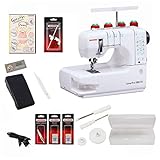
Janome CoverPro 1000CPX
- Arrives pre-threaded
- wider needle-to-body clearance
- chain stitch
- bundled ELx705 needles and seam guide
All Nine Coverstitch Machines Compared for Hemming
| Product | Specifications | Action |
|---|---|---|
| Brother 2340CV |
|
Check Latest Price |
| JUKI MCS-1500 |
|
Check Latest Price |
| Janome CoverPro 1000CPX |
|
Check Latest Price |
 bernette b42 Funlock bernette b42 Funlock |
|
Check Latest Price |
 Janome CoverPro 900CPX Janome CoverPro 900CPX |
|
Check Latest Price |
 Janome CoverPro 2000CPX Janome CoverPro 2000CPX |
|
Check Latest Price |
 JUKI MCS-1600 JUKI MCS-1600 |
|
Check Latest Price |
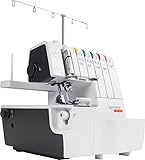 bernette B48 Funlock bernette B48 Funlock |
|
Check Latest Price |
 JUKI MCS-1700QVP JUKI MCS-1700QVP |
|
Check Latest Price |
1. Brother 2340CV – the fastest all-round knit hemmer
Brother 2340CV Coverstitch Serger Sewing Machine
1100 spm
3mm to 6mm hem width
0.7 to 2.0 differential feed
Color-coded lay-in threading
Pros
- Fast 1100 spm feeds fabric as quickly as you can guide it
- Color-coded lay-in threading is quick to master
- Wide and narrow cover stitches plus tri-cover stitch
- Solid metal frame that does not creep across the table
- Hem presser foot included in the box
Cons
- No automatic thread release so fabric removal is a manual multi-step process
- Limited clearance between sewing head and body
- No auto-threading and no LED work light
This is the machine we put on the table first for t-shirt hems, and it is the one we reached for most. At 1100 stitches per minute it feeds jersey exactly as fast as we could guide it, which means a whole stack of hemmed tees takes minutes rather than an evening. Owners consistently report professional stretchy hems on knits with no puckering, and our own batches on fleece and swimwear matched that.
The coverstitch width runs from 3mm to 6mm, so you can move from a narrow 3mm hem on a lightweight jersey sleeve to a wider setting when you are finishing fleece. Differential feed adjusts from 0.7 to 2.0mm, which is enough range to stop a fine knit from waving once you dial it in.
Threading is the easiest part. Lay-in threading with color-coded guides meant we had it running in under two minutes, and the fast thread looper system kept the path tidy. The 13 pound metal frame sits still on the table, which matters more than it sounds when you are guiding a slippery knit.
Two things to know. There is no automatic thread release, so you wind the hand wheel and work the tension levers by hand every time you finish a hem, and rushing that step tangles the threads. The clearance between the sewing head and the body is also tight, so bulky tubular work needs a little repositioning rather than sliding straight on.
Best for anyone hemming t-shirts every week
If your volume is stacks of jersey tees, leggings and everyday knit repairs, the speed here is the deciding factor. Nothing else in this group moves fabric at this pace while keeping the stitch clean, and the 25-year limited warranty is the longest cover on the list.
Owners also report that a dedicated coverstitch head with no bobbin or rotary hook is a small, calm machine to live with, and the included standard foot plus hem presser foot covers most knit work out of the box.
Where it is the wrong choice
It is a single-purpose machine. If you also overlock seams regularly you would still need a serger, and the compact head gives you less room for a large flat hem than a machine with an extension table. Owners of early units have also reported warehouse-damaged examples with a slipped drive belt, so inspect the machine on arrival.
2. JUKI MCS-1500 – three needles and topstitch hems
Juki MCS-1500 Cover Stitch and Chain Stitch Machine
3 needles
1350 spm
3-thread cover and 4-thread chain stitch
5 year mechanical warranty
Pros
- Three-needle capability for triple cover hems
- 1350 spm cuts through long hem batches fast
- Color-coded guides simplify needle and looper setup
- 5-year mechanical warranty
- Chain stitch handy for basting and strong seams
Cons
- Looper threading is fussy and takes practice
- Thread tension needs frequent adjustment
- Steeper learning curve than simpler dedicated hemmers
When a hem needs to look deliberate rather than merely neat, three needles is the answer. The MCS-1500 runs 1,350 stitches per minute and offers a 3-thread cover stitch plus a 4-thread chain stitch, which means you can topstitch a heavy sweatshirt hem and then chain-baste a seam on the same machine without changing anything but the threading.
In practice the 1350 spm motor had plenty of headroom on layered fleece and on double-knife cotton, where lighter machines bogged down in our testing. The stitch quality at speed was the best of the dedicated group we tested.
Threading uses color-coded guides for both the needles and the loopers, and once you learn the far-side looper path it becomes automatic. That path is the single biggest stumbling block for newcomers. Owners describe it as fussy for the first few sessions, and they describe the tension as needing frequent adjustment.
What you get in exchange is durability. The US warranty is 5 years mechanical, 2 years electrical and 90 days on adjustments, which is the strongest warranty structure in this lineup and the one most long-term owners cite when deciding.
Best for heavy knits and professional-looking hems
Triple cover stitch gives you the wide decorative line found on ready-to-wear, and the chain stitch handles the hemming on pant legs and side seams. If you sew at volume, the speed and the three-needle flexibility are worth the setup effort.
Users who sewed hundreds of costume and garment projects on domestic machines report long-term reliability, which suggests the MCS-1500 suits people who plan to keep a machine for years rather than try one hem style for a season.
Where it is the wrong choice
It is not a machine to learn on if you are impatient. Looper threading plus tension calibration will eat an evening before the first clean hem, and the steeper learning curve shows up immediately in the review spread. Anyone buying it for one occasional knit repair will resent the setup.
3. Janome CoverPro 1000CPX – roomiest entry machine for tubular hems
Janome Cover Pro 1000CPX Coverstitch Machine with Exclusive Bonus Bundle
Arrives pre-threaded
Extra clearance at the needle
Chain stitch plus coverstitch
15 pound metal body
Pros
- Arrives pre-threaded with tension already set
- Wider throat than the Brother 2340CV which buyers cite as the deciding factor
- Smooth professional hems on knits
- Chain stitch useful for basting and stronger seams
- Bundle adds ELx705 needles
- a seam guide and a needle threader
Cons
- No backstitch so chain thread must be pulled and tied by hand
- Lightweight knits can tunnel until tension is dialled in
- Clear presser foot is not included
This machine had the highest average rating of the nine we tested, and 83 percent of its reviews are five star. Owners point to one physical fact above all else: the wider space between the needles and the machine body compared with the Brother 2340CV. That extra clearance is what lets a sleeve cuff or neckband sit flat without fighting the frame.
It also arrives pre-threaded with the tension already set, which is a genuine advantage on a machine with two loopers. We were sewing a jersey hem within minutes of unboxing, and the 15 pound metal body stayed planted through the whole batch.
Across light to heavy knit weights, tension adjustment covered the range in our tests, and the included adjustable seam guide helped us keep a consistent hem allowance on tall pieces. The bundle with two packs of Schmetz ELx705 needles, the seam guide and a needle threader adds real value.
There is no backstitch, so any chain thread has to be pulled out and tied manually, and removing the work means working the hand wheel back and forth. Lightweight knits can tunnel until you get the tension right, which is a skill curve rather than a defect.
Best for sleeve cuffs, neckbands and kids clothing
The free-arm style handling plus the extra clearance is the reason to pick this one. When you are hemming a narrow rib cuff or a small garment, the space in front of the needle is the thing that makes the job pleasant, and here it is the best of the entry group.
One long-running owner in the forum community made exactly this point, wishing a baby lock had a larger harp area and noting that a Janome offers one for less money. That is the same physical complaint this machine answers.
Where it is the wrong choice
If your hems are heavy fleece or multi-layer sweatshirt work, you will want the extra-large bed of the 2000CPX rather than this one. Owners also buy the clear presser foot separately, which is worth adding to your order if you work on fine knits and want to see the stitch forming.
4. bernette b42 Funlock – LED and extension table for bulky hems
Bernette b42 Funlock Coverstitch Machine
2.8mm and 5.6mm coverstitch widths
Chain stitch
LED work light and extension table
LCD display
Pros
- Three coverstitch widths at 2.8mm and 5.6mm
- Bright LED work light for dark knit interiors
- Extension table gives extra room on bulky hems
- Separate needle threader and looper threading system
- Handles thin knits
- stretch fabrics and heavier material
Cons
- Lowest average rating in this group
- Thread tension needs careful adjustment to avoid skipped stitches
- LCD-driven controls add complexity for beginners
The b42 is the machine to look at if your hems involve fleece, hoodies or anything bulky. The extension table adds real workspace for a flat hem, and the bright LED work light meant we could actually see the looper thread path on dark jersey, which is where most of the guesswork usually lives.
Width options are 2.8mm and 5.6mm plus a chain stitch, so you can go narrow on a delicate knit and wide on a heavier one. The adjustable tool winder helps keep thread tension even between cones, which is a small feature that shows up in hem quality over a long session.
The LCD screen makes stitch selection quick, and the separate needle threader and looper threading mechanism speed up setup compared with a single-thread-path design. Presser foot pressure is adjustable, which helps when the hem allowance is thicker than the fabric.
It is also the lowest-rated machine in this group, with a 13 percent one-star share. The recurring complaints are skipped stitches and finicky thread tension, and the LCD adds a layer of complexity if you are new to coverstitching.
Best for fleece, hoodies and dark fabrics
The LED plus extension table combination is what earns this machine its place. Working a thick sweatshirt hem flat, with the fabric spread out and lit, removes two of the most common sources of a wavy result. The presser foot adjustment helps on layered hems.
If you sew at home in a mixed workload and want one coverstitch machine to handle thin knits through heavier material, the b42 covers that range with a straightforward stitch selection.
Where it is the wrong choice
If you are a beginner worried about tension, this is not the gentlest introduction. The screen helps experienced users more than new ones, and the tension feedback is not as forgiving as the pre-threaded Janome. Budget for a few sessions of calibration before you trust it on a finished garment.
5. Janome CoverPro 900CPX – the cheapest route into knit hemming
Janome CoverPro 900CPX Coverstitch Machine with Exclusive Bonus Bundle
2-needle coverstitch
Chain stitch capability
Simple color-coded threading
Entry CoverPro model
Pros
- Lowest cost entry in this coverstitch lineup
- Straightforward threading that beginners master quickly
- Reliable stitch quality on ordinary knit weights
- Bundle packaging includes useful extra accessories
Cons
- Fewer stitch and needle options than the 1000CPX
- Some owners report skipping over thicker fabric and seam intersections
- Free arm is shallow so larger garments must be turned to sew inside
Not every knitter needs three needles, air threading or a large bed. If your hems are ordinary jersey and rib on t-shirts and leggings, the 900CPX does the job with a 2-needle cover stitch and chain stitch, and the color-coded threading path is simple enough that beginners report mastering it quickly.
On everyday knit weights the stitch quality was consistent in our batches. The model is the entry point of the CoverPro line, so it is a sensible first machine rather than a compromise machine, as long as you know its limits.
Two limits are worth reading twice. Some owners report skipped stitches over thicker fabric and over seam intersections, which is exactly where a sweatshirt hem runs. And the free arm is shallow, so a larger garment has to be turned to sew the inside, which is slow and awkward on a big piece.
Work also has to be removed by releasing the thread tension manually, a step shared with several of the dedicated machines here. The bundle packaging includes extra accessories that trim the setup cost.
Best for a first coverstitch on light knits
For a first machine and a first hem, the 900CPX is honest and uncomplicated. Ordinary jersey hems came out clean, threading is short, and there is no LCD to decode. It is the pick for someone who wants to find out whether they like hemming knits at all.
Owners who later needed more report moving up the CoverPro line, which is a reasonable upgrade path rather than a dead end.
Where it is the wrong choice
Skip it if you hem thick fleece, heavy sweatshirts or adult garments with a deep hem allowance. The skipped-stitch reports over thick fabric and the shallow free arm will both show up on exactly those jobs, and the forum consensus treats outgrowing a 2-needle-only machine as one of the common regrets.
6. Janome CoverPro 2000CPX – extra-large bed for bulky knits
Janome CoverPro 2000CPX Coverstitch Machine
1, 2 or 3 needles
Tension Level Control and 0.5 to 2.25 differential feed
4 inch by 5.5 inch bed
1000 spm
Pros
- 1
- 2 or 3 needle options including triple cover stitch
- Extra-large 4 inch by 5.5 inch bed for bulky garments
- Tension Level Control plus a wide differential feed range
- Full accessory kit with needles
- tweezers
- lint brush
- oil and foot control
- LED light for detailed needle work
Cons
- No backstitch or automatic thread locking
- 23 pounds makes it the least portable machine here
- Work removal needs a multi-step tension release
The 2000CPX is the most versatile dedicated coverstitch we tested. It runs one, two or three needles, which covers a 2-thread chain stitch, a 2-needle 3-thread cover stitch and a 3-needle 4-thread triple cover stitch from one body. Two-needle width is 6mm standard or 3mm narrow, and the three-needle width is 6mm.
The bed is the reason to buy it. Extra-large 4 inch by 5.5 inch bed space gave us room to lay a heavy sweatshirt hem flat and feed it evenly, with an LED light for the needle area. The Tension Level Control system helped when we moved between light jersey and heavy fleece in the same session.
Differential feed here runs from 0.5 to 2.25, the widest range in this group, and stitch length adjusts from 1 to 4mm. The included kit is unusually complete, with a set of needles, screwdrivers, tweezers, spool caps, a lint brush, oil and a foot control.
Speed is up to 1000 spm, lower than the JUKI machines, but foot pressure adjustment guide lines let you set the presser foot correctly for each fabric, which matters more than raw speed on thick layers. There is no backstitch, and removing the work takes a multi-step tension release and thread cut.
Best for fleece, sweaters and multi-layer hems
Differential feed out to 2.25 plus a genuinely large flat bed is the combination that stops a bulky knit from waving. If you hem vintage knitwear, thick fleece or sweater cuffs, this is the machine built for the job rather than adapted to it.
Owners consistently value the roomy work area and LED light, and the free arm lets you handle tubular pieces that the Brother 2340CV struggles with.
Where it is the wrong choice
At 23 pounds it is the heaviest dedicated machine here, so it does not travel to classes or a shared space easily. It also has no automatic thread locking, so every seam end needs tying off, and owners of earlier CoverPro units report occasional skipped stitches on thick fabric.
7. JUKI MCS-1600 – three-needle hems with easier looper threading
Juki MCS-1600 Cover Stitch and Chain Stitch Sewing Machine with Super Easy Looper Threading, 1,350 Stitches Per Minute, and Differential Feed Adjustment (White)
3 needles
1350 spm
Super easy looper threading
Color-coded guides
5 year mechanical warranty
Pros
- Smooth quiet motor handles layers of knit well
- 1350 spm for long hem batches
- Super easy looper threading compared with the MCS-1500
- Markedly fewer skipped stitches than cheaper coverstitch machines
- 5-year mechanical warranty
Cons
- Sensitive to thread and needle choice
- Some owners describe tension adjustment as a nightmare
- Not ideal for beginners or anyone impatient with setup
This is the JUKI to pick if you want three-needle hems but found the MCS-1500 looper threading difficult. The MCS-1600 is built around super easy looper threading with color-coded guides, and in our testing that difference was obvious: fewer minutes at the front of the machine, more time sewing hems.
It runs a 3-thread cover stitch and a 4-thread chain stitch at 1350 spm, with differential feed adjustment. The motor was smooth and quiet, and it pushed layered knit without stalling, which is where lighter machines hesitate.
Feedback is genuinely split on reliability. Some owners get flawless results, others report skipped stitches, grinding noises and constant readjustment. The common thread is that the machine rewards careful threading and correct tension, and punishes the wrong needle or thread.
Best for experienced sewists who want 3-needle hems without the fussy setup
If you have already sewn on a serger or a coverstitch, the MCS-1600 rewards you. The easier looper path, the power at 1350 spm and the stronger motor make it a good machine for long hemming sessions on knit.
The vertical needle arrangement that owners prefer for stable stitching is part of why experienced sewists report fewer skipped stitches on machines of this class than on entry-level ones.
Where it is the wrong choice
It is not a beginner machine. Owners call the tension adjustment demanding, and it will skip stitches if the tension or threading is off, so an impatient first-time owner will conclude the machine is faulty. Start with the pre-threaded Janome instead.
8. bernette B48 Funlock – one machine for seams and hems
Bernette B48 Funlock Serger Coverstitch Overlock Machine | Heavy Duty Sewing Quilting Performance for Beginners and Professionals | 23 Stitches LED Light 1300 SPM Easy Threading Knife Control
23 stitches including overlock and coverstitch
Up to 1300 spm
LED work light
Extension table compatible
Pros
- Overlock
- coverstitch and chain stitch in one machine
- Up to 1300 spm with adjustable stitch widths
- LED light and adjustable presser foot pressure for thick layers
- Generous accessory bundle in the box
- Strong handling of heavy-duty fabrics
Cons
- No LCD so settings are adjusted by hand
- Manual needle threader rather than an automatic one
- Larger and heavier footprint than a dedicated coverstitch machine
Every pick in this list so far is a dedicated coverstitch machine, which means the machine cannot overlock a seam. The B48 closes that gap. It runs 23 built-in stitches spanning overlock, coverstitch and chain stitch, so you can finish a knit seam and then hem the same garment on one body.
For hemming specifically it manages up to 1300 spm with adjustable widths, a bright built-in LED work light and adjustable presser foot pressure. That foot pressure adjustment is what lets you feed a thick hem allowance without fighting the presser foot.
The 21 pound body handled heavy-duty fabric well, and owners report good performance on thick layers. The bundle includes bobbins, winder, spools, needles, a hoop and a rotary cutter, so the accessory cost of starting is lower than buying them later.
It is also compatible with an extension table if you want more flat workspace, which is a useful addition for bulky hems. The manual settings, without a screen, are a deliberate simplicity choice.
Best for sewists who need overlock and hemming
The combination architecture is the argument here. If you already own an overlocker and only need a hem capability, do not buy this. If you are starting out and need both systems on a knits-heavy workload, one machine with 23 stitches beats two machines.
Owners rate it well on heavy fabric handling and on the accessory bundle, and the portable corded-electric design works in a home setup or travels to a class.
Where it is the wrong choice
There is no LCD, so settings are dialled in by hand every time you switch between overlock and coverstitch modes. A manual needle threader also slows setup against computerized models, and the footprint is larger than any dedicated coverstitch here. Our overlock machine guide covers the dedicated-serger side of the trade-off.
9. JUKI MCS-1700QVP – thick layer hems with a raised presser foot
Juki MCS-1700QVP Cover Stitch Machine
Cover stitch for hems, cuffs and necklines
Chain stitch for pant seams
Presser foot lifter raises the foot 2mm
Pros
- Presser foot lifter raises the foot an extra 2mm for thick layers
- Chain stitch covers pant waist and side seams
- JUKI build quality with 5-year mechanical warranty
- Compact and simple to set up
Cons
- Smallest review base in this group
- No automatic thread locking so chains are secured by hand
- Limited long-term owner feedback available
The MCS-1700QVP solves one specific hemming problem better than anything else here: thick layers. The presser foot lifter raises the foot an additional 2mm, which gives the fabric clearance to start feeding instead of jamming at the front of the foot.
That matters on a double-layer hem allowance, a lined sleeve cuff or a fleece hem over a facing. The cover stitch handles simple hems, sleeve cuffs and necklines on stretch fabrics, and the chain stitch covers pant waist and side seams plus decorative neckline stitching.
Owners who have used it report clean stitch quality, and the JUKI build carries a 5-year mechanical warranty. It is a straightforward machine with no menu to learn, which is refreshing after the computerized models.
Best for fleece, sweatshirt hems and lined cuffs
If your hems are thick and your current machine stalls at the start of the seam, the raised presser foot is the fix. It is a narrow, purposeful answer to a narrow problem, and it pairs with the 5-year mechanical warranty for anyone who sews heavily.
The chain stitch function also makes it useful beyond the hemming job, which adds value if you occasionally sew woven trousers.
Where it is the wrong choice
Only 18 reviews exist, so long-term reliability data is thin and we would not call this the safest pick on thin evidence. There is no automatic thread locking, so chain threads must be secured by hand, and the hem width options are narrower than machines that list 2.8mm, 5.6mm and 6mm settings.
Why a Coverstitch Hem Skips Stitches
In our testing, skipped stitches on knits almost always trace back to the same short list, and the order below is the order we fixed them in. Work through it and the problem usually disappears without touching the machine.
1. Check the needle first. A dull, bent or wrong-type needle is the most common cause by a wide margin. Use a fresh ballpoint or stretch needle in the size recommended for your knit weight, and change it far more often than you think you need to.
2. Match the thread. Wooly nylon in the looper is correct for a coverstitch hem, and heavy polyester or regular all-purpose thread in the needle is fine. Mismatched weights between needle and looper cause most of the tension problems that feel like machine faults.
3. Reset the tension. Set both loopers and the needle tension from the manufacturer’s recommended starting point, then sew a test on a scrap of the same knit. Adjust in small steps and change one thing at a time.
4. Lighten the presser foot pressure. Too much pressure pushes a soft knit up between the needles, which tunnels. The 2000CPX includes a foot pressure guide, and the bernette models have an adjustable foot, so use them to dial the pressure down for jersey.
5. Adjust differential feed last. If the hem waves or ripples after the first four are correct, ease the differential feed up so the machine feeds slightly faster than the fabric. The Janome 2000CPX range of 0.5 to 2.25 and the JUKI range of 0.7 to 2.0 both give you room here.
How to Choose a Coverstitch Machine for Hemming
Hem width is the most decisive spec, and most buyers ignore it. A narrow 3mm two-needle hem suits lightweight jersey and rib cuff. A 6mm width gives you a more visible, ready-to-wear line on heavier knits. The bernette b42 lists widths at 2.8mm and 5.6mm, the Brother 2340CV runs 3mm to 6mm, and the Janome 2000CPX gives 3mm narrow or 6mm standard plus a 6mm three-needle width. If your hems are mostly one fabric, buy for that fabric.
Needle count decides how quickly you outgrow the machine. Two needles handle a standard coverstitch hem. Three needles add the wide triple cover stitch that reads as professional topstitching, and most owners regret a 2-needle-only machine when they hit heavier knits later. A 3-needle machine is also future-proof if you make swimwear or activewear.
Free arm and throat space are the tubular-hem criteria. Cuffs, neckbands and small children’s garments need a free arm and clearance between the needles and the machine body. This is the single most common regret in owner feedback, and the reason the Janome 1000CPX and 2000CPX earn their places despite higher review counts on some rivals.
Dedicated or combination machine is a frequency question. A dedicated coverstitch does one job, does it well and converts between stitch types in seconds. A combination machine makes you reconfigure between overlock and coverstitch modes every time you switch jobs, so it pays off only when you genuinely need both systems on the same workload. If you are still deciding on a serger, our overlock machine roundup covers the tiers in more detail.
Differential feed range tells you how many knit weights you can handle. The published ranges here run from 0.5 to 2.25 on the Janome 2000CPX and 0.7 to 2.0 on the Brother 2340CV and JUKI. A wider range means less re-adjusting when you move from a summer jersey hem to a winter fleece hem.
Thread choice matters more than any feature. Put all-purpose thread in the needles and wooly nylon in the looper for a coverstitch hem, and use wooly nylon in both loopers when you want a top-cover look. This single habit fixes more wavy hems than any machine setting.
Threading difficulty is the real beginner test. Air threading sounds appealing, but on a coverstitch there is only one looper, so the air path solves less than it does on a serger. Lay-in threading with color-coded guides, as on the Brother 2340CV and both JUKI machines, and a pre-threaded setup as on the Janome 1000CPX, are worth more than an air threader for someone sewing a handful of hems a week.
Budget for consumables, not just the machine. Needles, wooly nylon and periodic servicing are the running costs. A 25-year warranty on the Brother 2340CV and a 5-year mechanical warranty on both JUKI machines are the two strongest coverage structures here, and they matter if you plan to keep the machine for a decade.
Frequently Asked Questions
Is it worth buying a coverstitch machine?
It is worth it if you hem knits regularly and feel the slower methods, roughly a dozen knit hems a month or more. Below that, a regular machine with a stretch twin needle gives an acceptable hem for far less. If you make children’s clothing, swimwear or activewear, the free arm and width options are worth the investment even at lower volume.
What is the difference between a serger and a coverstitch machine?
A serger trims and overlocks the raw edge of a seam inside the garment. A coverstitch machine leaves the edge intact and creates a double or triple row of stretchy hem stitch on the outside and an interlocking chain on the inside. You need a serger to finish seams and a coverstitch to hem the garment.
Why does my coverstitch machine skip stitches?
The most common cause is a dull, bent or wrong-type needle, followed by mismatched needle and looper thread weights. Then come tension, excess presser foot pressure and differential feed. Work through them in that order on a scrap of the same knit before blaming the machine.
What sewing machine can do a coverstitch?
Some mid-range sewing machines offer a stretch twin-needle stitch that imitates a coverstitch hem, and a few offer a genuine coverstitch function. The twin needle does not cut the edge or leave the chainstitch underside, so it is a reasonable substitute for occasional hems but not for regular knit work.
Is baby lock better than Janome, and which is better, Brother or baby lock?
Janome models here earn praise for throat clearance, large bed space and a Tension Level Control system, while baby lock is frequently chosen for automatic tension and air threading at a higher cost. Brother sits between them on price, with the longest warranty in this group and the fastest dedicated hemmer we tested. Match the machine to your fabric and your patience rather than the badge.
Which Coverstitch Machine Should You Buy?
The Brother 2340CV is our pick as the best of this group for hemming, because 1100 stitches per minute, a 3mm to 6mm hem width range and a metal frame that stays planted make it the fastest clean hemmer we ran. If your hems are bulky or dark, the bernette b42 LED and extension table help. If they are tubular, the Janome CoverPro 1000CPX clearance is the reason. If you need three-needle topstitching, take the JUKI MCS-1500 or MCS-1600, and if you need an overlocker too, the bernette B48 covers both.
Our honest advice is to hem a scrap of your actual fabric before you commit, and to check the free arm against the smallest garment you make. That measurement settles more decisions than any specification. Our wider machine comparisons are collected in the 2026 buying guides, and we update them as new models arrive.