
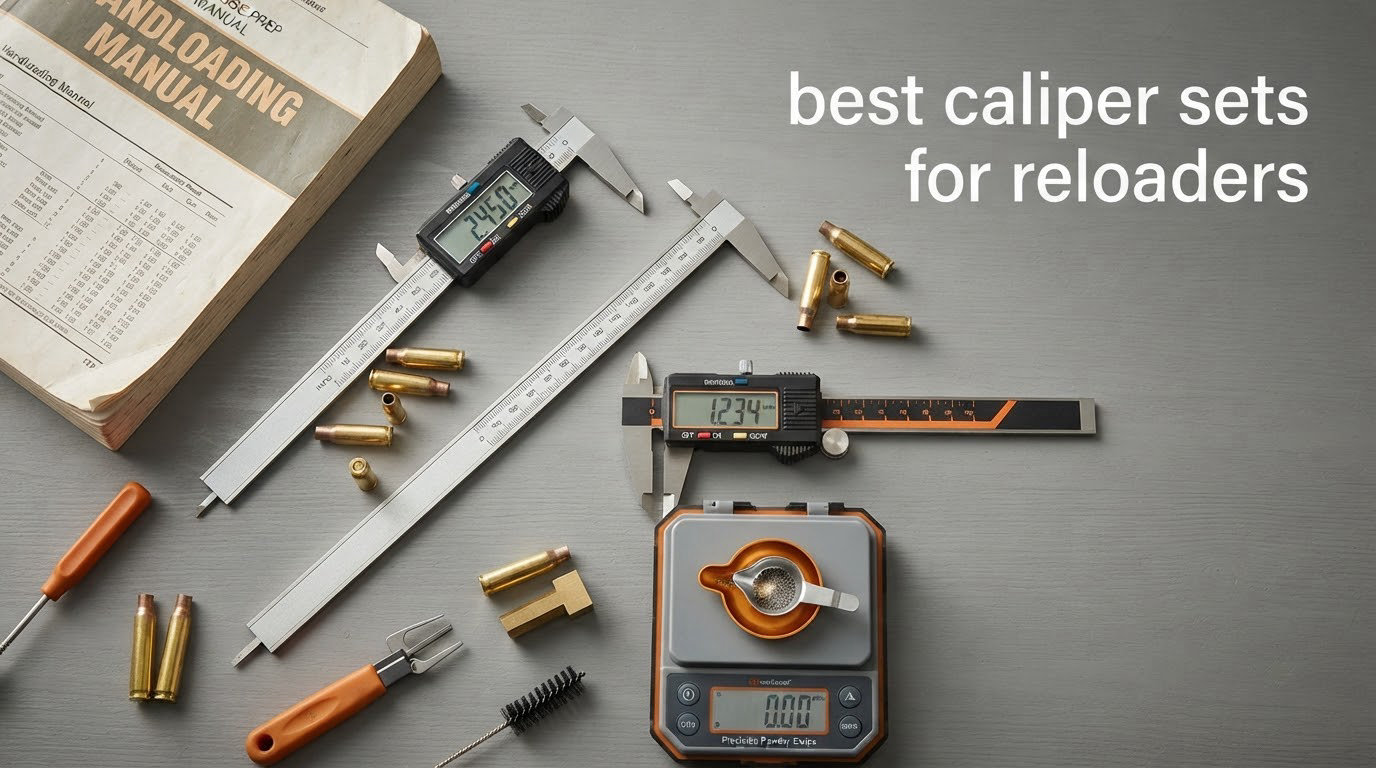
Most reloading calipers promise a thousandth of an inch, and most of them deliver it on a clean bench on a good day. The difference between a mediocre caliper and one you can trust for case length, cartridge overall length and bullet seating depth comes down to zero return, jaw condition, and whether the tool is absolute scale or a relative one that needs re-zeroing every time you open the case.
That is what this roundup is about: the best caliper sets for reloaders, chosen on measured accuracy, construction and the small details that decide whether a tool is still accurate after two years of case lube, shell casing and powder residue. We compared 12 calipers across the digital, dial and vernier formats, checking range, stated accuracy, resolution, power source, case included and the complaints that actually show up in long-term ownership reviews rather than the first-week impressions.
One caveat belongs in the first few hundred words because it changes what you are buying. Resolution is not accuracy. A digital caliper can display 0.0005 inch and still be only good to plus or minus 0.001 inch across its range, and a reloader who treats that display as truth will resize brass short or seat bullets deep without ever knowing it. Calipers tell you where you are; a micrometer tells you where you should be.
A reloading caliper set, in the sense most people mean the phrase, is a measurement toolkit rather than a single tool. The caliper is the centerpiece, and it works best alongside a case length gauge, a neck shoulder gauge, a headspace comparator and a bore gauge. We cover the calipers here in depth and tell you which of those companion tools solve the problems a caliper cannot.
Everything below was last checked in 2026. Model numbers are listed so you can match the exact tool, not a lookalike listing.
Table of Contents
- Top 3 Picks for the Best Caliper Sets for Reloaders
- All 12 Best Caliper Picks at a Glance in 2026
- 1. iGAGING Absolute Origin 6 Inch Digital Caliper – Best Overall for a Reloading Bench
- 2. Starrett 3202-6 Dial Caliper – Best Premium Mechanical Caliper
- 3. Fowler 54-101-150-2 Xtra-Value Cal – Best Value Digital Caliper for Reloading
- 4. Mitutoyo 505-742J Dial Caliper – Best for Precision Case Work
- 5. iGAGING 6 Inch Dual Scale Fraction Dial Caliper – Best for Fractional Readouts
- 6. Fowler 52-008-706-0 Premium Dial Caliper – Best for Brass Dust and Debris
- 7. Frankford Arsenal Electronic Caliper – Budget Pick Building a First Bench
- 8. Accusize P920-B216 Black Face Dial Caliper – Best Dial Contrast Under Bright Light
- 9. Hornady 0-6 Inch Dial Caliper – Best for Warranty-Backed Bench Use
- 10. General Tools 142 Plastic Dial Caliper – Best for Beginners for Light Bench Duties
- 11. Lyman 7832212 Stainless Caliper – Best Reloading-Brand Vernier Option
- 12. Mitutoyo 505-738 Carbide Jaw Dial Caliper – Best for Carbide Jaws and Layout Work
- Digital vs Dial vs Vernier: Which Type Suits Which Reloader
- Resolution vs Accuracy: Why You Still Need a Micrometer
- How to Spot a Fake Mitutoyo (and Other Counterfeit Calipers)
- 6 Inch vs 8 Inch Calipers: Matching Caliper Length to Your Cartridges
- How to Verify Your Caliper Is Actually Accurate
- When Calipers Are the Wrong Tool
- Care and Maintenance: Keeping the Jaws Clean So the Tool Returns to Zero
- How to Choose a Reloading Caliper Set
- Frequently Asked Questions
- The Verdict
Top 3 Picks for the Best Caliper Sets for Reloaders

iGAGING Absolute Origin 6in Digital
- Absolute Origin zero retention
- 0-6 inch / 150mm range
- 0.001 inch accuracy
- SPC/USB data output
- IP54 sealed

Starrett 3202-6 Dial Caliper
- 0.001 inch accuracy over 0-6 inch
- Positive split-gear anti-backlash
- Lock screw holds reading
- No batteries
- Fitted case

Fowler 54-101-150-2 Xtra-Value
- 0.001 inch accuracy
- 0.0005 inch resolution
- Inside/outside/depth/step
- One-click conversion
- 2 CR2032 cells
All 12 Best Caliper Picks at a Glance in 2026
This table is the fastest way to narrow the field. Type, range and power source matter more to a reloader than they do to a machinist, because the deciding questions are whether the tool returns to zero, whether the jaws stay clean in a reloading room, and whether you can measure a long cartridge without shifting the caliper in your hands.
| Product | Specifications | Action |
|---|---|---|
| iGAGING Absolute Origin 6in Digital Caliper |
|
Check Latest Price |
| Starrett 3202-6 Dial Caliper |
|
Check Latest Price |
| Fowler 54-101-150-2 Xtra-Value Cal |
|
Check Latest Price |
 Mitutoyo 505-742J Dial Caliper Mitutoyo 505-742J Dial Caliper |
|
Check Latest Price |
 iGAGING 6in Dual Scale Fraction Dial iGAGING 6in Dual Scale Fraction Dial |
|
Check Latest Price |
 Fowler 52-008-706-0 Premium Dial Fowler 52-008-706-0 Premium Dial |
|
Check Latest Price |
 Frankford Arsenal Electronic Caliper Frankford Arsenal Electronic Caliper |
|
Check Latest Price |
 Accusize P920-B216 Black Face Dial Accusize P920-B216 Black Face Dial |
|
Check Latest Price |
 Hornady 0-6 inch Dial Caliper Hornady 0-6 inch Dial Caliper |
|
Check Latest Price |
 General Tools 142 Plastic Dial Caliper General Tools 142 Plastic Dial Caliper |
|
Check Latest Price |
 Lyman 7832212 Stainless Caliper Lyman 7832212 Stainless Caliper |
|
Check Latest Price |
 Mitutoyo 505-738 Carbide Jaw Dial Mitutoyo 505-738 Carbide Jaw Dial |
|
Check Latest Price |
1. iGAGING Absolute Origin 6 Inch Digital Caliper – Best Overall for a Reloading Bench
iGAGING Absolute Origin 0-6″ Digital Caliper, IP54 Stainless Steel, SPC/USB Output Port, Inch & Metric Modes, Case, Manual
0-6 inch / 150mm range
0.001 inch accuracy
Absolute Origin zero retention
IP54, 2 C cells
Pros
- Absolute Origin keeps the zero reference when powered off
- SPC/USB port logs readings to a spreadsheet or CAD
- IP54 protection against brass dust and moisture
- High-contrast LCD readable in a dim room
- Protective case and manual included
Cons
- Battery powered
- so a dead cell ends a session
- 0.001 inch accuracy is the practical limit for fine case trim work
Absolute Origin calibration is the reason this is the first pick. A conventional digital caliper measures from whatever point you zeroed at, and that reference lives in volatile memory, so powering the tool down can cost you your zero. The iGAGING Absolute Origin keeps the origin internally, which means you can put the caliper in its case between measuring sessions and come back to the same reference.
On the bench that plays out simply. You close the jaws on a case, lock the reading, put the caliper down to trim, and come back to it later without re-zeroing first. Reviewers with long ownership histories describe that zero retention as the feature that keeps them from distrusting the tool, and the review base reflects it: 4.6 stars across more than 1800 ratings, which is the largest sample of any caliper we evaluated.
The SPC/USB output port is the sleeper feature. Reloaders who run batches of ammunition can push each cartridge overall length reading straight into a spreadsheet instead of writing numbers on a notecard, which turns gauging from a memory test into a record. It is also the reason iGAGING keeps coming up as a recommended brand on reloading forums, where buyers point out that purchasing through an industrial distributor such as Grizzly gives them a supply chain they trust for authenticity.
Construction is stainless steel with an IP54 rating, which covers dust ingress and splashing moisture. That is not full immersion protection, but on a reloading bench it is the difference between a tool that survives brass dust and powder residue and one that does not. Two C cells power it, a change most owners make rarely.
What you gain by owning an absolute scale caliper
The zeroing step is the small friction that most reloaders do not notice until they notice it. You close the jaws, press zero, measure, open, then close the jaws again for the next case, and every one of those cycles is a chance to introduce a small inconsistency from jaw pressure or a dirty contact face. An absolute origin removes the re-zero step entirely, so the caliper measures the same way the first time and the hundredth time.
Resolution here is 0.001 inch with stated accuracy of 0.001 inch over a 0-6 inch range, which is the honest specification for a caliper in this class. Treat that as the true limit of the reading, not as five significant digits of laboratory truth.
When to choose something other than this caliper
If you measure primarily in metric, or you load a lot of rimfire and shotgun shells where the work is high volume and low tolerance, the absence of a battery option can matter. Mechanical tools never fail because a cell died mid-session, and a dial caliper will sit in a drawer for a decade and still read true as long as the jaws are wiped clean.
This is also a 6 inch model. Long rifle cartridges such as the .338 Lapua and the 30-06 are handled awkwardly when the beam is short, because you end up repositioning the tool instead of holding the round steady. If those are your cartridges, read the sizing section below before you settle.
2. Starrett 3202-6 Dial Caliper – Best Premium Mechanical Caliper
Starrett Dial Caliper, Adjustable Bezel, 0-6″ Range, .001″ Grad
0-6 inch range
0.001 inch accuracy
Split-gear anti-backlash
16 ounces
Pros
- Split-gear design keeps the reading from shifting as the jaws close
- Lock screw holds a reading without drift
- Calibrated and matched against gauge blocks
- Hardened stainless frame and measuring surfaces
- No batteries to fail
- Fitted case included
Cons
- Imperial-only scale on this model
- Heavier and bulkier than a digital
- Fine adjustment roll can feel loose on some units
The Starrett 3202-6 is the mechanical answer to the digital battery question. It measures the same 0-6 inch range at a stated 0.001 inch accuracy, and it does it with a positive split-gear design that resists backlash as the jaws close on a case. Once you close onto a case and take the reading, the reading stays there.
At 4.6 stars across more than 1000 ratings, it is the most established mechanical option here, and the review pattern is consistent: smooth traversing gear, an easy-to-reach lock screw, and a heavy, solid feel in the hand. One detailed reviewer checked the dial against a higher-grade reference on 1-2-3 gauge blocks and reported on-the-money readings below 2 inches with very slight drift above that, which is normal for any instrument and worth knowing before you judge it.
Forum reloading threads repeatedly name Starrett when the question is which dial caliper to own, and the reasoning is the same one this tool embodies. A mechanical caliper has no state to lose. Clean the jaws, close them, and the tool returns to zero, which is precisely the failure mode that makes cheap digital calipers untrustworthy after a season of shell casings and case lube.
The fitted case matters more than it sounds. A caliper that lives loose in a drawer collects the dust that causes binding, and a case is the cheapest insurance against the drift that comes with it. The dial face is graduated to 0.001 inch with a white background for readability under bench lighting.
Why a dial caliper keeps winning on the reloading bench
Two reasons. First, tactile feedback: you feel the jaws contact the case, so you can feel the moment you are squeezing brass rather than measuring it. Second, permanence: a mechanical tool has no battery, no contacts and no firmware, so it works the same in five years as it does today.
The tradeoff is readability. Reading a dial to the thousandth takes practice, and at extreme viewing angles the numerals on a small dial are harder to read than a backlit LCD. Recipients with declining eyesight often move to a digital for that reason alone.
Limitations worth knowing before you buy
This model is imperial only. If your load data is in metric, or you neck up for a European chambering, you will be converting by hand for every reading.
Beating is a fair criticism to check at purchase. A caliper that has been dropped can develop backlash you can feel when you close the jaws gently. Cycle it from fully open to fully closed a few times and listen for the gear catching. Also note that Starrett builds a longer 0-12 inch variant, and reviewers report that version can read slightly high on larger dimensions from jaw positioning alone.
3. Fowler 54-101-150-2 Xtra-Value Cal – Best Value Digital Caliper for Reloading
Fowler 54-101-150-2, Xtra-Value Cal Digital Caliper With 0-6″/150MM Measuring Range,Blue
0-6 inch / 150mm range
0.001 inch accuracy
0.0005 inch resolution
2 CR2032 cells
Pros
- Zero position is stable and holds across sessions
- Two common CR2032 cells last about a year
- Inside
- outside
- depth and step measurement
- High-contrast LCD with hold button
- Protective case included
- One-year warranty
Cons
- LCD is hard to read at extreme angles
- No manual off switch beyond a 10 minute auto shutoff
- Slider action is not as smooth as a premium brand out of the box
The Fowler Xtra-Value Cal is the answer for a reloader who wants a true digital readout with a stable zero without paying a machinist brand premium. It measures 0-6 inch and 150mm, holds 0.001 inch accuracy with 0.0005 inch resolution, and covers inside, outside, depth and step measurement with the two jaw sets and depth rod.
Multiple owners with multi-year ownership histories report that the zero holds, that readings are repeatable when cross-checked against dial calipers, and that the tool has survived repeated drops in a shop setting while staying accurate. At 4.6 stars across more than 800 ratings, it has the second-deepest review base in this group, and at least one owner uses it specifically for reloading components.
Battery choice is a small but real advantage over the two C cells used by the iGAGING Absolute Origin. CR2032 coin cells are available at any hardware store or drugstore, last roughly a year, and cost almost nothing. A dead battery on a reloading bench is a five-minute delay rather than a lost afternoon.
One-click inch to millimeter conversion and a zero reset at any point on the scale make it flexible for mixed load data. The hold button freezes a reading so you can set the caliper down without losing the number, which is how we would measure case length across a batch of newly resized brass.
What you give up compared with a premium digital
Two things. The slider action is not as smooth out of the box as a higher-end instrument, so closing the jaws requires a little more care, and there is no manual off switch beyond the 10 minute auto shutoff. Neither is a real problem on a bench, but both are visible if you are used to a machined feel.
Reviewers also flag readability at extreme viewing angles. The display uses large, high-contrast numerals and reads well directly in front of you, so this matters only if you work with the case low and off to one side.
Who should buy this instead of the picks above it
Buy the Fowler if you are building a first bench and want a digital caliper you will not feel you overpaid for. The accuracy spec matches the more expensive digital options on this list, the batteries are cheap, and the review history says the zero is stable over years rather than months.
Skip it if your work is case trim to a specific trim length on magnum rifle brass, where finer increments and repeatability start to matter more than price. In that case a dial caliper at 0.001 inch graduations gives you a steadier visual reference for small corrections.
4. Mitutoyo 505-742J Dial Caliper – Best for Precision Case Work
Mitutoyo 505-742J Dial Caliper, 0.1″ per Rev, 0-6″ Range, 0.001″ Accuracy
0-6 inch range
0.001 inch accuracy
0.1 inch per revolution dial
4.54 g listed weight
Pros
- Highest average rating in the group at 4.7 stars
- Repeatable with effectively no backlash after cycling to 6 inch
- Crisp dial that users read to about half a thousandth
- Battery-free and always ready
- Lock screws on the bezel and sliding jaw
Cons
- Fitted case ships with no foam padding
- Thin plastic hinge piece instead of a barrel hinge
- Included case needs padding added by the owner
The 505-742J is the best-rated caliper we evaluated, at 4.7 stars with 86 percent of ratings at five stars. It is a 0-6 inch dial caliper with 0.001 inch accuracy, a 0.1 inch per revolution dial, and lock screws on both the dial bezel and the sliding jaw.
What owners notice first is repeatability. Reviewers describe cycling the caliper out to 6 inches and back and finding no perceptible backlash, which matters when you are chasing a difference of a few thousandths on case length. The dial face has been redesigned with a satin chrome finish to cut glare, and one user reports interpolating between graduations by eye to about 0.0005 inch.
There is a practical tip that comes up repeatedly in the reviews and is worth repeating: wipe away the shipping oil with a lightly oiled cloth. Fresh out of the case, the action can feel heavier than it should, and cleaning the beam and rack is what restores the smooth feel owners describe. One reloader notes this tool holds up better against reloading-branded calipers from the same aisle.
It is also battery-free, so it works the moment you pick it up. Owners describe passing shop calibration checks on arrival and zeroing on every cycle since, which is the behavior you want from a tool that decides how long your brass is.
How much precision a reloading dial caliper can actually give you
More than most reloaders expect, if the jaws are clean. The dial turns one full revolution per 0.1 inch and is marked at 0.001 inch, so you are reading a needle against a moving beam while the jaws are closed. Steady hands and a wiped contact face produce readings you can trust to the displayed graduation.
What it cannot give you is better than the mechanism allows. Real accuracy across a 0-6 inch range is plus or minus 0.001 inch, and no amount of careful reading changes that. This is why experienced hands pair a caliper like this with a micrometer for final verification.
Long-term concerns to check at purchase
The hinge on this model uses a thin plastic piece rather than a barrel hinge, and reviewers flag it as the part most likely to be the weak point over decades. Treat it as the first thing to inspect on a used example, and do not store the tool with the jaws forced closed.
The fitted case arrives with no foam padding, so the jaws can knock against each other in transit. Adding foam or a small block to keep the jaws apart is a two-minute fix that prevents the dings that show up later as inconsistent readings. Object in the bag, and the preservative packet in the bag is a mild handling caution worth heeding.
5. iGAGING 6 Inch Dual Scale Fraction Dial Caliper – Best for Fractional Readouts
iGaging Dial Caliper 6″ Fractional & Decimal Inch Combination Dual Scale
0-6 inch range
0.01 inch and 1/64 inch dial
Decimal and fractional scales
Stainless steel
Pros
- Reads 1/64 inch fractions directly on the dial
- No calibration needed out of the box
- Zero holds with no free play
- No batteries
- Protective case included
Cons
- 0.01 inch resolution is far too coarse for cartridge case length
- Small dial face is hard to read for aging eyes
- Case has three difficult clip points
This dial carries two scales on one face: decimal inches and 1/64 inch fractions. That is the whole appeal. If your load data is in fractional inches, you stop doing mental conversion on every case, which removes a class of error that is easy to make and hard to notice.
It needs no calibration out of the box, and one reloader verified it against calipers three decades old and called it right on the money. Zero holds with no free play in the dial or the slide lock, and the stainless steel body means no batteries to fail. At 4.6 stars across 650 ratings, the fractional niche is well filled at the budget end of the dial market.
The honesty here is that the resolution is 0.01 inch, or 1/64 inch. That is an order of magnitude away from what cartridge case length work requires, and several reviewers say so plainly. This is a caliper for woodwork, general shop measuring and coarse reloading checks, not for deciding how much to trim off a case.
One owner lightly deburred the sharp edges out of the box and reports it performs like his costlier dial caliper. That is worth doing if you buy it, and it is the reason the tool feels cheaper than its price suggests for a few minutes after opening.
Where a fractional dial genuinely helps
General shop work and layout tasks where you think in 1/64 inch increments, and any reloading job where your data is fractional. The dual scale removes the conversion table lookup, and the adjustable bezel lets you zero at any point so the fractional reading is the reading you take.
It also works as a second, coarse instrument on a bench that already has a fine one. Comparing a reading against a 1/64 inch dial is a quick sanity check that your fine caliper is not reading something absurd.
Why it will not do the job you probably bought it for
Case length, cartridge overall length and bullet seating depth are all measured in thousandths, and a 0.01 inch resolution cannot resolve them. If those are your measurements, this tool is a rounding instrument at best and will send you looking for a problem that is not there.
Two smaller friction points: the dial is small, so numerals are hard to read if your eyesight is not what it was, and the case has three clip points that reviewers find genuinely difficult to open. If the tool lives in the case, the second issue is the one you will notice.
6. Fowler 52-008-706-0 Premium Dial Caliper – Best for Brass Dust and Debris
Fowler 52-008-706-0, Premium Dial Caliper With 0-6″ Measuring Range (White)
0-6 inch range
0.001 inch accuracy
White 0.1 inch dial
Covered rack
Pros
- 0.001 inch graduations on a large white dial face
- Covered rack keeps brass dust and debris out of the gear
- Knurled lock screw holds the measurement
- Thumb roller allows one-handed operation
- Storage case and manual included
Cons
- Dial-only design gives no metric graduation
- Imperial-only scale requires conversion for metric work
The covered rack is the feature that sets this model apart for reloading. An exposed rack on a dial caliper collects brass dust, powder residue and shell casing debris, and once that happens the sliding action goes rough and readings become less repeatable. This model shields the rack, which is exactly the failure mode a reloading bench creates.
Everything else is conventional and good. It measures 0-6 inch at 0.001 inch accuracy with a white dial face graduated at 0.1 inch per revolution and 0.001 inch, a beam engraved at 0.10 inch, a knurled lock screw, two jaw sets plus a depth rod, and a 4.6 star average across more than 600 ratings with 79 percent at five stars.
The white dial is worth a note. Under warm bench lighting a white face with dark markings stays legible where a dark face can wash out, and that is the same reason the black-face option later in this list appeals to other people. It is a preference, not a quality difference.
Owners use the thumb roller one-handed, which is genuinely useful when you are holding a case in the other hand and cannot brace the caliper against anything. The stainless steel body and the 1-year warranty round out a tool that feels like shop equipment rather than an accessory.
How to keep a dial caliper reading true in a reloading room
Wipe the jaws and the beam before and after every session, and keep the tool in its case between uses. A mechanical caliper that returns cleanly to zero is reliable; the same caliper with a dry shell casing wedged in the rack is not, and you will blame the tool for the error.
Store it with the jaws slightly open rather than fully closed. Closing the jaws under spring force for months is what produces the light binding that makes a caliper feel wrong before it reads wrong.
Which reloaders should look elsewhere
Anyone whose load data is metric. This is an imperial-only dial with no millimeter graduation, so every metric measurement means a conversion, and conversions are where reloading errors hide.
It is also not the tool for recording data across a batch. There is no hold function and no output port, so a run of 200 cartridge overall length readings means writing numbers down as you go. For batch gauging, a digital with a hold button or an output port is a better fit.
7. Frankford Arsenal Electronic Caliper – Budget Pick Building a First Bench
Frankford Arsenal Electronic Caliper with LCD Display and Case for Reloading
0-6 inch range
0.001 inch accuracy
Alloy steel body
Large LCD readout
Pros
- Purpose-built measurements for case length
- neck and base diameters
- overall length and primer pocket depth
- Large LCD numerals stay readable as eyesight changes
- Zero holds well enough that recalibration is rarely needed
- Long-term owners report a previous pair lasting many years
- Heavy-duty protective case included
Cons
- Can drift a few thousandths over time and need periodic re-zeroing
- Battery life reported as short by at least one owner
- Less accurate than a machinist-grade instrument
Frankford Arsenal builds this caliper around reloading measurements specifically: case length, neck and base diameters, overall cartridge length and primer pocket depth, with SAE to metric conversion over a 0-6 inch range at a stated 0.001 inch accuracy. That list is the manual’s own logic, and it is why the tool feels like it was designed for the job rather than adapted to it.
Owners describe the large LCD numerals as the reason they bought it, particularly as eyesight declines, and report that the zero holds so well that recalibration is rarely needed. One long-term owner reports a previous pair lasting thirteen years, which is a stronger longevity signal than most first purchases earn.
Several owners state plainly that it is accurate enough for brass case measurement, and the review pattern at 4.6 stars across more than 600 ratings is enthusiastic about how much it speeds up bench work. For a first reloading bench, the combination of a readable display, a relevant measurement list and a heavy-duty case is hard to beat.
The honest limitation comes from the same reviews. This is alloy steel rather than stainless, and owners report the tool can drift by 0.002 to 0.003 inch over time and need periodic re-zeroing. For work where a few thousandths changes the outcome, that is a real constraint.
Why beginners get the most out of this caliper
Because the failure mode of a beginner is usually measurement, not technique. If you size brass a few thousandths short or seat bullets deeper than your load data assumes, the pressure and velocity you are working from are not the ones you planned, and the group size is the first thing that suffers. A caliper with a large, obvious readout makes those dimensions quick to check and quick to correct.
Beginners also tend to measure the same five things repeatedly: case length after resizing, neck diameter, overall cartridge length, bullet seating depth and primer pocket depth. Those are exactly the measurements this tool is specced for, which means the manual answers the questions you will actually ask.
Where it stops being enough
It is not the tool for match precision rifle loading or for fine case trimming. A caliper that can drift a few thousandths and needs re-zeroing will eventually give you a reading you do not trust, and once you stop trusting the number you stop using the tool.
Budget for a micrometer before you need one. If your plan includes match loads, precise neck sizing, or verifying bullet seating depth on a single-digit basis, the marginal value of a better caliper is small compared with the marginal value of a micrometer. Track the drift, re-zero when you see it, and plan the micrometer for the work that needs it.
8. Accusize P920-B216 Black Face Dial Caliper – Best Dial Contrast Under Bright Light
Accusize Black Face Dial Caliper 0-6 in x 0.001 in, P920-B216
0-6 inch range
0.001 inch accuracy and resolution
Black dial face
Covered rack
Pros
- Black dial face gives strong contrast under bench lighting
- 0.001 inch per revolution graduation with direct reading
- Lapped jaw measuring faces
- Satin chrome finish with crisp engraving
- No batteries
Cons
- Black markings can wash out in bright light for some readers
- Less established brand with a smaller review base
The Accusize P920-B216 is a 0-6 inch dial caliper with 0.001 inch accuracy and 0.001 inch resolution, and the distinguishing feature is the face: black, with high-contrast markings and direct reading to a thousandth at 0.001 inch per revolution.
That dial choice is a genuine preference with a real argument behind it. A black face with light markings stands out in a dim or warm-lit reloading room, which is where most people work, and it does not glare the way a polished white face can under a bright bench lamp. The satin chrome finish and crisp engraved graduations support the same goal.
Construction details show care for a mid-priced tool. The rack is covered, which keeps brass and case debris out of the gearing, and the jaw measuring faces are lapped rather than simply ground. Inside, outside, depth and step measurement are all handled by one tool, and there is no battery, so the zero never needs re-establishing after storage.
It holds a 4.6 star average with a 78 percent five-star share, but across 218 ratings rather than the hundreds some competitors carry. That smaller base is worth factoring into your confidence: less long-term data exists to tell you how the tool ages.
How to read a 0.001 inch dial without fooling yourself
Close the jaws on the part, then read the dial, not the beam. The dial turns one thousandth per graduation at 0.001 inch per revolution, so the needle position is the measurement and the beam shows only the larger fraction. Reading the beam mid-sweep is how people end up a few thousandths off.
Apply steady, light pressure. Brass cases deform slightly under a hard grip, and a case pressed hard between the jaws can read a fraction smaller than it really is. Rest the caliper on the bench surface and close gently until the jaws just touch.
Reasons to skip this one
If you work in very bright light, some reviewers report the black markings are harder to read than a white face, which is the exact inverse of the reason to buy it. Try one in your own bench lighting if you can.
If you are buying a first reloading caliper and want the deepest review history and the most established support behind it, a better-known brand with a larger sample is the safer bet. This tool is not wrong, it is simply less documented.
9. Hornady 0-6 Inch Dial Caliper – Best for Warranty-Backed Bench Use
Hornady Dial Caliper, 050075-6 Inch Stainless Steel Shock-Resistant Dial Caliper Measuring Tool with Storage Case – Measure Reloading Supplies Inside, Outside, Depth, & Step to .001 Inch Accuracy
0-6 inch range
0.001 inch accuracy
0.1 inch per revolution dial
Stainless steel
Pros
- Aimed at reloading measurements including case length
- primer pocket depth and overall length
- Reliably returns to zero
- Lock knob holds the measurement
- Stainless steel construction
- Backed by a lifetime warranty
Cons
- The listing title says digital but the product is a mechanical dial
- Imperial-only dial requires conversion for metric
- One owner received a scratched and stiff unit
One thing to clear up before anything else: despite the listing title, the Hornady is a mechanical dial caliper, not an electronic one. It has a 0.1 inch per revolution dial with a pointer accurate to 0.001 inch, a beam that reads up to 6 inches, and stainless steel construction. Owners confirm this in reviews, and a few buyers have been confused enough by the listing to mention it.
What the confusion hides is a good tool for its purpose. Several owners call out specifically that it reliably returns to zero, which is the trait that matters most on a bench where the jaws get handled a hundred times a session. The top knob locks the measurement and the bottom knob releases the dial face to zero, so the control scheme is simple to learn.
The measurement coverage suits reloading directly: case and bullet length, inside and outside diameters, primer pocket depth and overall cartridge length. Several owners read to roughly half a thousandth in practice and pair the tool with an electronic caliper, using the dial for the readings that matter most.
The warranty is the standout for a bench tool. A no-risk lifetime warranty from an established reloading brand is unusual in this category, and it removes most of the risk of buying a secondary caliper for specific jobs. A storage case is included, which as noted earlier is not a minor accessory.
Who benefits most from a reloading-branded caliper
Someone who wants the measurement list and the zeroing controls to be obvious without reading a manual, and someone who would rather have a warranty behind the tool than the lowest possible spec sheet. The reloading branding means the intended measurements are the ones the tool is specced for.
It also makes a sensible second caliper. A handloader who owns an electronic caliper can add this as a mechanical backup, which means no battery conversation and an independent second opinion on a measurement you do not trust.
Points to weigh before ordering
The imperial-only dial is the main limitation for anyone working in metric. You will convert by hand for every reading, and conversion is exactly where small reloading errors get introduced.
Quality control on arrival is worth a minute. One reviewer received a scratched, cloudy and stiff unit that looked returned rather than new. Check the action and the display of the dial face as soon as it arrives, because that unit is the exception rather than the rule and it is easy to return. The negative reviews here cluster around handling rather than the design.
10. General Tools 142 Plastic Dial Caliper – Best for Beginners for Light Bench Duties
General Tools 142 Plastic Dial Caliper, 0-6″ Range, .01″ & 1/64″
0-6 inch / 152mm range
0.01 inch and 1/64 inch dial
Fiberglass plastic
2.9 ounces
Pros
- Survives drops
- travel and spills over years in practice
- Reads 1/64 inch directly with a color-coded bezel
- Very light at 2.9 ounces for one-handed use
- Freewheeling friction roller for smooth reading
- Molded case included
Cons
- 0.01 inch resolution is far too coarse for cartridge case measurement
- Not a machinist-grade instrument by any measure
- Dial cover can pop off with use
This is the lowest-rated tool in the group at 4.3 stars across 157 ratings, and we include it because it is genuinely useful for the right job and genuinely wrong for the wrong one. It measures 0-6 inch and 152mm with 0.01 inch and 1/64 inch dial graduations, a color-coded adjustable bezel for reading fractional inches, and a fractional conversion table printed on the back.
Durability is its real strength. Owners report it surviving drops, travel and spilled coffee over years, and several buy a second one as a backup because they get misplaced. At 2.9 ounces it is easy to use one-handed, and the freewheeling friction roller makes readings smooth.
The body is fiberglass reinforced plastic, which is why it is nearly indestructible in practice and also why it is not a precision instrument. Accuracy is rated at plus or minus 0.5 percent, and several reviewers state plainly that it suits woodworking and household measuring rather than cartridge length work.
It fits light duty, high-volume measuring where a steel caliper would risk damage. A case gauge check you do twice, a rough comparison of two cases, a general shop task: those are appropriate uses, and for them the tool is a good deal.
What this caliper can and cannot measure for a reloader
At 0.01 inch resolution, it cannot resolve case length, cartridge overall length or bullet seating depth, which are all thousandth-scale measurements. A 0.01 inch tolerance is wider than the entire acceptable variation in most reloading work, so a reading from this tool tells you almost nothing about whether your brass is correct.
What it can do is give you a quick coarse comparison. If one case is obviously longer than another, this will show it. It cannot tell you by how much, and it should not be the tool that decides how you set your press stops.
How to use it without fooling yourself
Treat it as a second instrument, never as the reference. If a cheap caliper and a good caliper disagree, the good one is right, and the cheap one is telling you nothing you needed to know.
Two practical notes. The dial cover can pop off with use, and there is no millimeter scale on the dial itself, only on the bar, so metric readings require reading the bar rather than the dial. Both are manageable if you know them in advance.
11. Lyman 7832212 Stainless Caliper – Best Reloading-Brand Vernier Option
Lyman 7832212 Stainless Caliper
0.001 inch accuracy
Stainless steel body
Adjustable zero
12.8 ounces
Pros
- Recommended by multiple owners for reloading work
- Adjustable zero lets you watch the dial as you close
- Zero holds truer than the electronic calipers owners had before
- Solid heavy stainless build with a hard case
- Locking mechanism for repeated measurement
Cons
- Slider action can feel stiff until broken in
- Dial plastic covering scuffs easily
- Vernier-style reading is slower than a digital readout
The Lyman 7832212 is a stainless steel caliper rated to plus or minus 0.001 inch with an adjustable zero reference and a locking mechanism for measuring multiple pieces in a row. It is a reloading-brand tool aimed squarely at the same job as the Frankford Arsenal, and owners recommend it for exactly that reason.
What the reviews like most is the adjustable zero, which lets you follow the dial as you close the measurement instead of only reading the settled result. Several owners say the zero holds truer than the electronic calipers they used before, which is a meaningful comparison from people who owned both.
The build is heavy for a caliper at 12.8 ounces, with a solid stainless body and a hard plastic storage case. A hard case is the right call for this tool, because the dial covering scuffs easily and a scuffed dial is hard to read in exactly the dim bench light where you need it.
At 4.4 stars across 94 ratings, the review base is the second smallest in this group, and the 9 percent one-star share reflects a complaint about retailer handling rather than the instrument. Owners have verified it against known-dimension items and against other dial calipers, and several rebuy the tool.
Vernier versus dial versus digital: what changes at the bench
A vernier caliper puts a sliding scale against a fixed beam and asks you to find a matching line, which is the slowest read of the three formats. The dial caliper replaces that judgment with a needle against a marked face, and the digital replaces it with numerals. The Lyman lands in the middle: mechanical, dependable, and slower to interpret than a screen.
Vernier formats remain a sensible choice when you want no battery and a simple reading, or when you prefer to verify a digital measurement independently. They are less convenient when you are gauging a hundred rounds and writing down numbers.
What to watch on this model
The slider can feel stiff until it is broken in. Work it through its full travel a few times when it arrives rather than judging it in the first minute, because the action is what you will live with for years.
Keep it in the hard case. The dial plastic covering scuffs easily, and an unprotected dial is the first thing to degrade on this tool. Also expect imperial reading with no metric scale, so metric load data means conversion work.
12. Mitutoyo 505-738 Carbide Jaw Dial Caliper – Best for Carbide Jaws and Layout Work
Mitutoyo 505-738 D6 inch TXWW Dial Caliper, ID, OD Carbide, 0.1 inch /Rev, 0 inch -6 inch .001 inch 6 to 7.9 Inches
Carbide-tipped jaws
0-6 inch range
0.1 inch per revolution dial
Titanium nitride coated
Pros
- Carbide jaw tips stay sharp for scribing layout lines
- One reviewer verified the dial against a ring gauge ID to within a tenth of a graduation
- Very smooth sliding action with clean lock-in
- Titanium nitride coating resists wear and reduces friction
- Meets U.S. Federal Accuracy Specifications
Cons
- The most expensive option in this group by a wide margin
- Carbide tips are brittle if the tool is dropped
- Bulky next to a standard 6 inch caliper
- One owner reported a unit that stopped returning to zero
The 505-738 is the premium instrument in this roundup and the only one with carbide-tipped jaws. Carbide stays sharp where hardened steel rounds off, which matters if you scribe layout lines or work where a dinged jaw edge would change your reading.
Everything else is engineered to the same standard. The sliding surfaces carry a titanium nitride coating for wear resistance and lower friction, the dial movement is redesigned for ultra-smooth sliding with minimized backlash, and the satin chrome finish cuts glare. The dial is graduated at 0.1 inch per revolution, and the tool meets or exceeds U.S. Federal Accuracy Specifications.
Verification is where this class earns its cost. One reviewer checked the dial against a ring gauge inside diameter and came within a tenth of a graduation. Another reports two decades of service from the same model, handing a unit down rather than replacing it, which is about the strongest longevity evidence a tool can produce.
Inside and outside diameter measurement is the carbide jaw’s home use. On a reloading bench the inside jaws check neck and base diameters without the edge wear that a steel jaw picks up from hard brass, and a fitted case is included.
Who actually needs carbide-tipped jaws
Scribers, machinists, gunsmiths and anyone who scribes layout lines or measures hardened surfaces. Carbide holds an edge through work that would round a steel jaw, and the titanium nitride coating keeps the sliding action consistent as the tool ages.
For pure cartridge measurement, the carbide tips buy less than you would expect. A caliper that contacts a brass case or a jacketed bullet is not being asked to scribe a line, and a well-maintained hardened steel jaw reads the same dimension just as accurately.
Reasons this is the wrong buy for most benches
Cost, first and simply. It is several times the price of a standard dial caliper in this roundup, and the accuracy you gain over a good steel dial is smaller than the jump in price suggests.
Carbide tips are brittle in a way hardened steel is not. A dropped tool can chip a tip, and a chipped tip reads wrong in a way that is not obvious. It is also bulkier than a standard 6 inch caliper, which matters on a crowded bench. One owner did report a unit that stopped returning to zero after a week, so check the zero return on arrival.
Digital vs Dial vs Vernier: Which Type Suits Which Reloader
Digital calipers are the fastest to read and the easiest to use one-handed, and they handle mixed imperial and metric data with one button. They are the right default for a first bench, for gauging batches of ammunition, and for anyone whose eyesight is not what it was. Their weakness is state: a battery, a zero, and a memory that can lose both.
Dial calipers are mechanical, tactile, and immune to battery failure. You feel the jaws contact the case, so you can feel overpressure before it becomes a wrong number, and the tool works the same after a decade in a drawer. They are the right choice for precision case work, for trim operations, and for anyone who prefers a steady visual reference over numerals. They read imperial only on most of the models here.
Vernier calipers sit between the two. They are mechanical and dependable but ask you to match lines on a sliding scale, which is the slowest read of the three. They make sense when you want a no-battery tool that verifies an electronic measurement independently.
One more distinction matters. Absolute scale calipers, like the iGAGING Absolute Origin, keep their zero reference internally. Relative scale digital calipers lose it when powered down. For a reloader measuring in sessions, that difference decides whether you re-zero every morning.
Resolution vs Accuracy: Why You Still Need a Micrometer
Resolution is the smallest digit a display can show. Accuracy is how close that reading is to the truth. A caliper showing 0.0005 inch has a resolution of half a thousandth, and every caliper in this roundup is rated at 0.001 inch accuracy, meaning the last digit is frequently decorative.
This is the single most common misunderstanding on reloading forums, and experienced hands treat it as the most important caveat in the whole discussion. Use cheap calipers to get close, then use a good micrometer when it actually matters. The caliper finds the neighborhood; the micrometer tells you the address.
For reloading specifically, a micrometer earns its place on seating depth and on verifying case length at the tolerance level your load data requires. Calipers still do the bulk of the work, because most reloading dimensions are checked to a few thousandths and no more. Buy the micrometer when you start chasing differences smaller than your caliper can prove.
How to Spot a Fake Mitutoyo (and Other Counterfeit Calipers)
Counterfeit calipers are a real problem on marketplaces, and forum reloading threads raise it repeatedly, usually in connection with used Mitutoyo listings. The checks below are the ones experienced owners describe using, and they take about two minutes.
- Check the certificate of conformity. Genuine Mitutoyo product ships with a certificate of conformity carrying the model number and the manufacturer’s inspection record. No certificate is a strong warning sign.
- Look at the back sticker. On a genuine tool the label is crisp and fits flat. Counterfeits frequently show a worn, reprinted or hand-applied label, which is the detail experienced buyers check first.
- Inspect the jaws closely. Genuine jaws are lapped and even. Dings, grinding marks, uneven contact faces or a jaw that rocks when closed are signs of a tool that has been used hard or rebuilt.
- Check the display for scratches and haziness. A scratched or cloudy LCD on a supposedly unused tool suggests a returned or refurbished unit relisted, and on a used purchase it suggests the seller did not describe the condition honestly.
- Compare against an authorized distributor. A wide price spread between a marketplace listing and an industrial distributor is the clearest signal that a product is not coming through a legitimate channel. Brands with transparent supply chains, sold through established industrial distributors, are the simplest way to avoid the problem entirely.
- Verify zero return immediately. Close the jaws on a clean flat surface. A genuine, undamaged caliper returns to zero. One that does not has either been damaged or is not what it claims to be.
Buying new from an authorized channel removes almost all of this risk. Buying used is fine if you apply the checklist and expect some wear, but do not expect a used tool to perform like a new one until you have verified it.
6 Inch vs 8 Inch Calipers: Matching Caliper Length to Your Cartridges
Every caliper in this roundup is a 0-6 inch model, and that is the right size for most reloading. Standard rifle cases, bottleneck cartridges, handgun cases and shotgun shells all fit comfortably inside a 6 inch beam, and the shorter beam is lighter and easier to control in the hand.
An 8 inch caliper earns its place when you load long cartridges, where a 6 inch beam forces you to reposition the tool rather than the round. Cartridge families where beam length becomes a practical issue include the .338 Lapua, the 30-06, the 6.5 Creedmoor and 6mm BR. The extra reach lets you measure a full-length round in one stable placement, and it also gives you depth rod extension for longer work.
Forum reloading threads treat 8 inches as the recommendation for long-bore precision rifle work, and the logic is the same one we use here. If you are constantly shrugging a 6 inch caliper around a magnum round to get a clean read, you are trading measurement stability for a smaller tool.
The cost of waiting is low if your cartridges are short, because a 6 inch caliper remains perfectly capable. The cost of guessing wrong is higher, because a caliper that cannot be placed steadily is a caliper that gives you an inconsistent reading.
How to Verify Your Caliper Is Actually Accurate
Do this before you trust a number, and again whenever the tool has been dropped, cleaned roughly, or starts returning a reading you do not like. It takes five minutes.
- Check the zero return. Wipe the jaws and the beam clean, then close them gently on a flat surface. The reading should return to zero every time. A caliper that does not return to zero consistently cannot be trusted at the thousandth level, whatever the display says.
- Measure at several points, not just at zero. Run the jaws across the full range and watch for drift. A caliper that reads true at zero and off by a thousandth at 3 inches is common as wear accumulates, and it will affect your case length readings without you noticing.
- Check against a known standard. If you have gauge blocks, a set of known-dimension rings, or even expander mandrels of known sizing, use them. This is the check experienced owners recommend, because it compares your caliper against something you already trust rather than against its own specification.
- Cross-check against a second instrument. If you own a dial caliper and a digital caliper, measure the same case with both. Agreement between two different mechanisms is much stronger evidence than either reading alone.
- Wipe, oil the rack lightly, and re-check. Case lube and solvent residue are the main reasons cheap calipers lose accuracy. Cleaning the jaws and the beam often restores a surprising amount of accuracy on its own.
Repeat the routine every few months, and always after a drop. The most common reloading error is not a bad technique; it is a caliper that quietly stopped being true and nobody checked.
When Calipers Are the Wrong Tool
Some of the most important reloading measurements cannot be made with a caliper at all, and reaching for one when a gauge exists is a common and avoidable mistake.
Headspace. Headspace is a length measurement taken with a headspace gauge against a specific chamber, and a comparator reads the difference between the gauge and your chamber. A caliper tells you how long a case is; it cannot tell you how much room that case has in a barrel.
Neck diameter and taper. A caliper measures neck diameter at a point, but neck taper and shoulder bump are shape measurements. A neck shoulder gauge is built for that job, and it is the tool that tells you whether your neck angle matches what the bullet wants.
Bore diameter. A bore gauge gives actual bore diameter. A caliper can tell you the caliber of your bullet, which is not the same number and is not interchangeable with it.
Concentricity and consistency. A comparator is the tool for whether your loads agree with each other. Calipers measure one round at a time and say nothing about how much your batch varies.
Knowing the boundary makes the caliper more valuable, not less. It is the right tool for case length, cartridge overall length, bullet seating depth, trim length verification, neck and base diameter spot checks, and quality control on finished rounds.
Care and Maintenance: Keeping the Jaws Clean So the Tool Returns to Zero
Almost every accuracy complaint we found traces back to contamination rather than wear. Case lube, powder residue, brass dust and shell casing debris all end up in the jaws and on the beam, and a caliper that measures a contaminated surface measures the contamination too.
Wipe the jaws and the beam after every session with a lint-free cloth. Owners on multiple forums describe this habit as the difference between a caliper that returns to zero and one that does not, and it is free.
For digital calipers, replace the cell on a schedule rather than waiting for a dead readout, and keep spare cells of the right type with the tool. A battery dying mid-session is a small annoyance; a battery dying in the middle of a pressure check is worse.
Store every caliper in its case, with the jaws slightly open rather than forced shut. A case prevents the dings that cause binding, and leaving the jaws relaxed prevents the long-term stress that makes a tool feel stiff.
For mechanical calipers specifically, keep the case closed and the dial covered. A scuffed dial is hard to read in exactly the low light where you need it most.
How to Choose a Reloading Caliper Set
Start with the measurements you actually make. Case length, cartridge overall length, bullet seating depth, neck diameter, trim length and primer pocket depth cover most handloading, and any caliper in this roundup handles all of them.
Next, choose the format. Digital for speed, mixed units and batch gauging. Dial for tactile feedback, no batteries and steady thousandth readings on case work. Vernier for a no-battery tool that independently verifies a digital. If you can only buy one and you are new, buy digital; if you already have one, a dial is the better second instrument.
Then check the things that are not on the spec sheet. Does it return to zero? Does it come with a case? Is the battery type something you can buy at a hardware store? Does it have a lock screw or hold function so you can record a reading without holding the caliper in the air?
Finally, match the length to your cartridges and buy from a channel you trust. Six inches covers most handloading; eight inches is the right call for long precision rifle cartridges. And wherever you buy, treat the certificate of conformity and the zero return as non-negotiable.
Frequently Asked Questions
What are the best calipers for reloading?
The best caliper sets for reloaders combine a 0-6 inch range, 0.001 inch accuracy, a case that keeps the jaws protected, and a tool that returns to zero reliably. Our top pick is the iGAGING Absolute Origin digital, which retains its zero reference when powered off. The Starrett 3202-6 dial and the Fowler 54-101-150-2 digital are strong alternatives depending on whether you prefer mechanical or electronic.
What is the best digital caliper for reloading?
The iGAGING Absolute Origin is the best digital caliper for reloading because its absolute origin calibration keeps the zero reference even when the tool is powered off, so you do not re-zero between measuring sessions. It measures 0-6 inch and 150mm at 0.001 inch accuracy, includes an SPC/USB output for logging readings, and carries an IP54 rating for a brass-dusty bench.
Are digital or dial calipers more accurate?
In theory the two are equal, since both are rated at 0.001 inch accuracy in this roundup. In practice a good dial caliper feels steadier for small adjustments because the needle position is visible while the jaws are closed and there is no battery or electronics in the measurement path. A digital wins on speed, unit conversion and batch recording. Choose accuracy-critical case work as dial and convenience as digital.
Are there fake Mitutoyo?
Yes, and it is a well-documented problem on marketplaces. Six checks catch most counterfeits: verify the certificate of conformity, inspect the back label for wear or reprinting, examine the jaws for dings and uneven contact faces, check the display for scratches on a supposedly new tool, compare pricing against an authorized industrial distributor, and confirm the jaws return to zero. Buying from an authorized channel removes nearly all of the risk.
What is the most accurate caliper for reloading?
The most accurate caliper is the one whose stated accuracy matches reality at your working range, which is why the Mitutoyo 505-742J dial and the Starrett 3202-6 both sit at 0.001 inch with strong long-term ownership records. For work finer than a caliper can prove, no caliper is the answer: add a micrometer for seating depth and tight tolerance case length.
Do I need 6 inch or 8 inch calipers for reloading?
Six inches covers pistol cases, shotgun shells and most standard rifle cartridges, and the shorter beam is lighter and easier to control. Eight inches is worth having for long cartridges such as the .338 Lapua, the 30-06, the 6.5 Creedmoor and 6mm BR, where a short beam forces you to reposition the caliper instead of the round. If you keep shifting the tool to get a reading, you need the longer beam.
The Verdict
For most handloaders, the iGAGING Absolute Origin is the best caliper set companion to build a bench around, because its zero survives being switched off, it logs readings to a spreadsheet, and more than 1800 ratings describe the same stable behavior. If you prefer mechanical, the Starrett 3202-6 is the premium pick and the Fowler 52-008-706-0 is the smarter one when brass dust is the bigger worry.
Wherever you land, remember the two rules that decide whether any of these tools is worth owning: judge resolution and accuracy as separate things, and verify zero return on a regular schedule. Add a micrometer when your work gets finer than a thousandth, and keep the caliper clean.
These are the best caliper sets for reloaders in 2026, reviewed against the dimensions that decide whether a handload is built to its data. Check current pricing on each tool, and verify the model number before you order.