
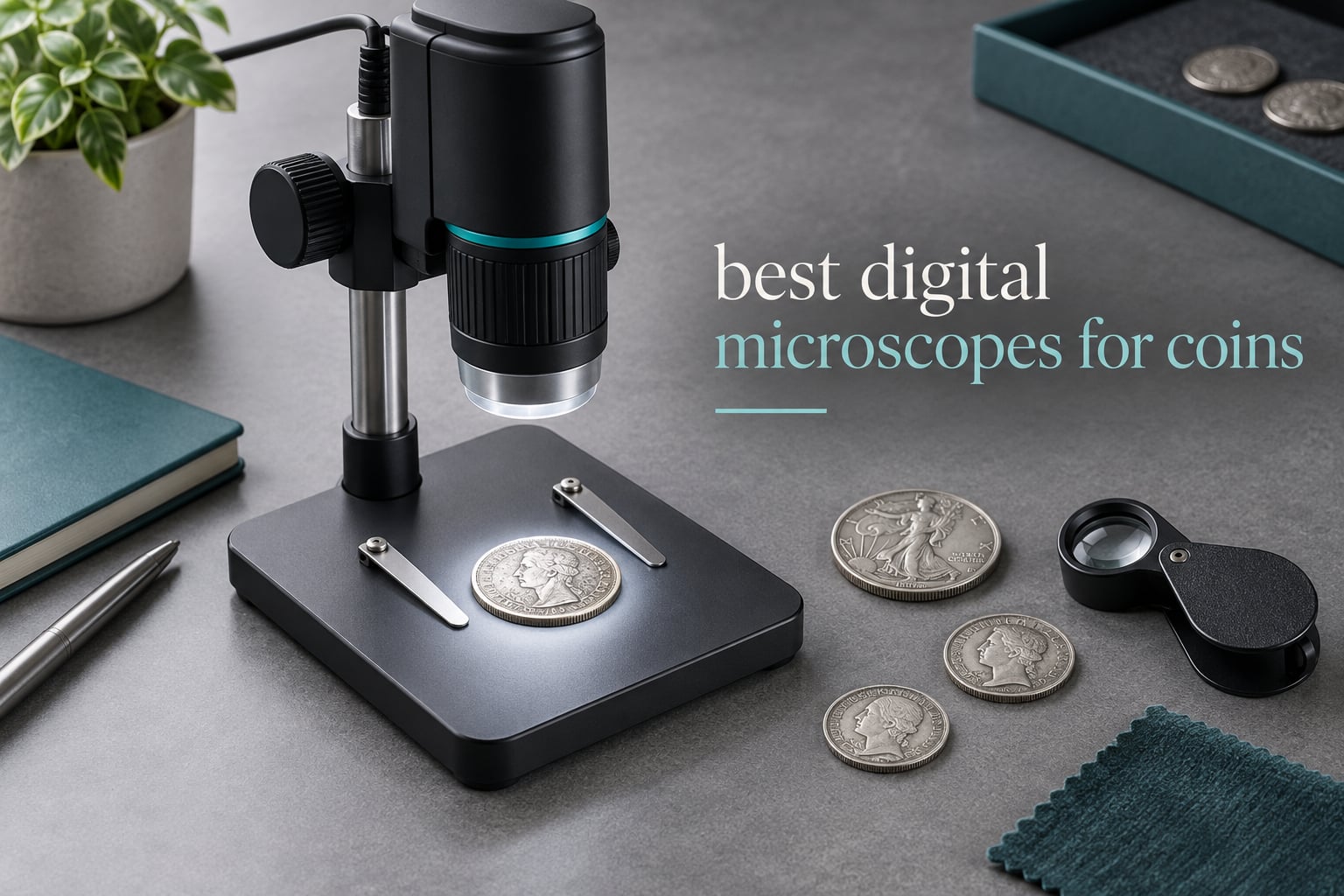
Ask ten coin collectors what they use to check a mint mark, and you will get ten answers. A loupe, a phone camera, a stereo scope, a USB microscope, a handheld unit with a screen bolted to the top. The honest truth is that the best digital microscopes for coins are not the ones with the biggest number on the box. They are the ones that give you an honest image, steady lighting, and a working distance that actually fits the coin in front of you.
That is what we sorted through here. We looked across twelve digital coin microscopes with built-in screens, weighing this roundup by what the specifications actually promise, what buyers report after weeks of use, and where each unit falls short. If you want the broad picture of microscope types first, our general microscope roundup covers the hardware side. This list stays narrow: scopes you point at a coin.
One piece of numismatic context shapes everything below. The Numismatic Guaranty Company has long held that magnification beyond roughly 5x is unnecessary for variety attribution, and the Cherrypickers Guide is widely associated with a 7x loupe standard for die variety work. Digital microscopes land on the useful side of that line because they let you work hands-free, photograph what you see, and store a record with the coin. Higher magnification is a tool for diagnosis, not a grading standard.
Table of Contents
Top 3 Best Digital Microscopes for Coins in 2026

Elikliv EDM4
- 4.3 inch 720P LCD
- Up to 1000x magnification
- 8 adjustable LED lights
- PC view for Windows and Mac

AOPICK 307-B
- 4.3 inch 1080P LCD
- 50X-1000X range
- Built-in storage for 200 photos
- 8 adjustable LED lights
The Elikliv EDM4 takes the top spot on evidence, not on spec sheet flash. It carries the largest body of owner feedback in this group, and that feedback keeps pointing at the same three things: a screen large enough to read dates without squinting, lighting you can steer, and a battery that survives a sorting session away from a desk.
The TOMLOV DM9 earns the premium slot for anyone who photographs as much as they inspect. A metal base, a 7-inch screen and a 16GB card in the box remove the three friction points that trip up most entry-level scopes. The AOPICK 307-B is the pick if you want the most capable inspection setup for the least money, with 1080P imaging and internal storage as its standouts.
All 12 Digital Microscopes for Coins Compared
| Product | Specifications | Action |
|---|---|---|
| Elikliv EDM4 4.3 Inch LCD Coin Microscope |
|
Check Latest Price |
| AOPICK 307-B 1080P LCD Coin Microscope |
|
Check Latest Price |
 TOMLOV DM4W Microscope with Weighing Scale TOMLOV DM4W Microscope with Weighing Scale |
|
Check Latest Price |
 PalliPartners 43XWJ-33 Digital Coin Microscope PalliPartners 43XWJ-33 Digital Coin Microscope |
|
Check Latest Price |
 WKR 367 4.3 Inch LCD 1080P Coin Magnifier WKR 367 4.3 Inch LCD 1080P Coin Magnifier |
|
Check Latest Price |
 Elikliv EDM4 Weighing 8+2 Light Coin Microscope Elikliv EDM4 Weighing 8+2 Light Coin Microscope |
|
Check Latest Price |
 SKYEAR 376 Coin Microscope with Fine Focus SKYEAR 376 Coin Microscope with Fine Focus |
|
Check Latest Price |
 TOMLOV TriL110 3-Lens 10 Inch Digital Microscope TOMLOV TriL110 3-Lens 10 Inch Digital Microscope |
|
Check Latest Price |
 AOPICK Inskam382 Handheld Coin Magnifier AOPICK Inskam382 Handheld Coin Magnifier |
|
Check Latest Price |
 Aikokkl MK5 LCD Coin Microscope with Side Lights Aikokkl MK5 LCD Coin Microscope with Side Lights |
|
Check Latest Price |
| TOMLOV DM9 7 Inch 1200X Coin Microscope |
|
Check Latest Price |
 Elikliv EM4K 4K Coin Microscope Elikliv EM4K 4K Coin Microscope |
|
Check Latest Price |
12 Best Digital Microscopes for Coins Reviewed
1. Elikliv EDM4 – 4.3-Inch LCD With the Largest Review Base
Elikliv Microscope, Digital Coin Microscope 1000x with Lights, EDM4, 4.3”
4.3 inch 720P LCD
Up to 1000x
8 adjustable LED lights
Windows and Mac PC view
1.1 pounds
Pros
- Large 4.3 inch LCD reduces eye and neck strain in long sessions
- Eight adjustable LED lights for even illumination
- Works standalone or as a USB microscope on Windows and Mac
- Rechargeable battery gives about 3 hours of cord-free use
- Height adjustable stand makes framing straightforward
Cons
- Magnification changes with camera distance rather than true optical zoom
- Memory card not included for photo or video capture
- Menu navigation is not intuitive without the manual
I spent a long stretch with the EDM4 as my sorting station, mostly because the 4.3-inch panel is the difference between leaning in and sitting back. Sorting is work you repeat hundreds of times, and the screen size is what decides whether that repetition stays comfortable or turns into a squint. Reading dates and mint marks on it felt unhurried rather than deliberate.
The eight adjustable LED lights are more useful than the 1000x figure. Being able to drop a light to one side and lift the others changed how a worn planchet looked to me. Shadow appeared where there had been flat grey metal, and surface texture that looked clean under even light suddenly showed its work.
The dual-mode setup is what makes this the most flexible scope in the roundup. Standalone, it works at a coin show or a kitchen table with no laptop in sight. Plugged into Windows or a MacBook, the same sensor becomes a PC-viewable microscope, which is when focus stacking and measurement start to matter.
Battery life of about 3 hours is a full sorting evening and not much more. The 1.1 pound weight and the 8.58 by 6.97 by 3.35 inch footprint make it easy to move between the safe, the desk and a club meeting without any thought about it.
Who the EDM4 suits
This is the scope for a collector who sorts a lot, shoots occasionally, and does not want a second device on the desk. Just over 10,000 reviews is a large sample, and the pattern in them holds up: screen size, lighting and the battery are the reasons people are happy.
It is equally a good first digital microscope for anyone moving up from a 10x loupe, because the learning curve is basically zero. There is no eyepiece to learn to focus and no software to configure before the first look.
Where the EDM4 falls short
Capture is the weak point. Without a memory card in the box, recording anything means buying a card first, and internal storage is not the alternative some buyers assume. Plan for that before you set up, not after.
Magnification is distance-dependent rather than a true optical zoom, so framing the same coin at two powers means adjusting the stand height and re-focusing. If your workflow needs rapid switching between overview and detail, a fixed-arm design costs you a few seconds every time.
2. AOPICK 307-B – 1080P Imaging and Built-In Photo Storage
Digital Coin Microscope 1000X, 4.3″ LCD Coin Magnifier with Screen for Error Coins, 1080P USB Microscope with 8 Adjustable LED Lights, Photo & Video, Built-in Storage, Compatible with Windows/MacOS
4.3 inch 1080P LCD
50X-1000X
Storage for about 200 photos
USB-C rechargeable
414 g
Pros
- 1080P LCD makes dates and mint marks easy to read
- Eight adjustable LED lights reduce shadows
- Internal storage holds around 200 photos
- Works standalone or on Windows and macOS
- Rechargeable battery gives about 3.5 hours
Cons
- Light stand can vibrate while focusing
- Short working distance means large coins may not fit one frame
- Printed booklet uses very small type
- Not an instrument for cell level viewing
The 307-B is the one I would hand to someone who wants a real step up from a loupe without turning the purchase into a project. 1080P on a 4.3-inch panel is a genuine jump from the 720P screens that dominate this price band, and the difference shows on lettering edges where the rim curves away.
Internal storage for roughly 200 photos is the feature I did not expect to care about and now rely on. It means quick documentation of a find does not need a card, a cable or a laptop, which is exactly the moment when a coin is fresh out of a roll and you want the record to exist.
TF card expansion up to 64GB handles the long tail, so the internal memory is a convenience rather than a ceiling. USB output to Windows and macOS turns it into a PC-viewable scope the moment you want a bigger image, and the rechargeable battery covers about 3.5 hours.
The 30 degree real angle of view is generous for a scope this size. It means you can sit at an angle to the screen rather than directly in front of it, which matters when the coin is under the lens and your head is not.
Who the AOPICK 307-B suits
Beginners and anyone building a roll-hunting setup will get the most from this one. It is a complete inspection station in a single box, and the internal storage removes the most common reason new scopes sit unused.
Collectors who work at a desk with a laptop nearby can use the USB mode as a second screen, which is genuinely useful when you want to photograph a whole coin and crop into a detail on a large monitor.
Where the AOPICK 307-B falls short
The stand is light and can vibrate while you focus, and vibration turns into softness at higher powers. Steady hands help, but a weighted base is the hardware answer and this does not have one.
Working distance is short. Large coins may not fit in a single frame, which is a real limitation if your collection includes silver eagles or dollars. The included booklet is also printed in very small type, so budget a few minutes with online documentation before you start.
3. TOMLOV DM4W – The Coin Microscope That Also Weighs Your Coin
TOMLOV DM4W Microscope with Weighing Scale: 4.3″ Digital Coin Magnifier
0.1g scale to 300g
4.3 inch IPS screen
10X-200X
8 inch stand with metal rod
Pros
- Only scope here with an integrated weighing scale
- IPS screen stays readable at wide viewing angles
- Eight inch stand with metal support rod gives real working space
- Battery operation works at shows and field checks
Cons
- 10X-200X ceiling is lower than the 1000x claims here
- Needs the TOMLOV coin scale app for readings
- Costs more than comparable screens without a scale
Weight is one of the fastest authenticity checks in numismatics, and a separate pocket scale on the same desk is one more thing to put down and pick up. The DM4W folds a 0.1 gram scale reading up to 300 grams into the base, in grams, ounces and carats, and it is the only scope in this roundup that does.
The scale response is quick, and the metal base plate keeps a coin from shifting while it settles. For a collector who is always weighing and always looking, having both in one workflow removes a real amount of friction.
The 4.3-inch IPS panel at 500 cd per square meter with a 178 degree viewing angle is easy on the eyes, which matters during a long weighing and sorting session. The 8-inch stand with its built-in metal support rod gives more space under the lens than most 4.3-inch units, and the objective is achromatic.
USB output to macOS or Windows gives a larger live view when you need it, and the built-in LED magnifier lighting covers ordinary inspection. This is a working tool for a working collection rather than a novelty.
Who the DM4W suits
This is for the collector whose method includes weight. If you sort by eye and weight together, the combination here is hard to beat at this size, and the two-year style of physical design will survive being moved around.
Dealers doing buy-ins where weighing and inspection happen back to back will find the single-device workflow worthwhile. So will anyone who grades a lot and wants a fast preliminary screen before a submission.
Where the DM4W falls short
The 10X to 200X ceiling is well below the 1000x figures on competing listings. In practice that ceiling is not a real loss, since useful coin detail stops being useful long before 200x, but buyers who shop on the headline number tend to be disappointed anyway.
Weighing readings depend on the TOMLOV coin scale app, which is one more thing to install and configure. And the scale is the reason this costs more than a comparable screen without one, so if you never weigh, that money buys nothing.
4. PalliPartners 43XWJ-33 – 32GB Card In The Box
PalliPartners Digital Microscope for Coins with Light HD Screen
32GB microSD card included
4.3 inch HD LCD
50X-1000X
4-5 hour battery
Two year warranty
Pros
- 32GB microSD card included at this price point
- Rechargeable battery supports 4-5 hours of use
- Focus stays reasonably sharp as magnification rises
- Metal bracket for stable hands-free shooting
- Works handheld or bracketed
Cons
- On-device photo button jostles the scope and blurs frames
- Focus wheel is touchy so sharpness varies between shots
- Sensor resolution is low so settings above 5MP add little
- Some units had a bent card holder
Storage is the headline here. A 32GB microSD card in the box is genuinely unusual in a scope at this level, and it means video and photo capture work the day the unit arrives. Most competitors in this group make you buy a card first, and reviewers consistently call that out as a reason to look elsewhere.
The battery is the other quiet strength. Four to five hours of rechargeable lithium runtime is the longest in this roundup and comfortably covers a full show floor or a long evening at the desk. Combined with the 0.55 kg weight, it is a genuinely portable kit.
The 4.3-inch LCD runs 1080p or 720p from a 2.0 megapixel camera, and eight adjustable LED lights with slide-switch brightness give you control over how a reflective surface reads. The metal bracket holds the body steady for hands-free shots, which is where the capture experience is won or lost.
Buyers here often report better colour and detail than costlier branded units, which is a good reminder that sensor branding tells you very little. The two-year manufacturer warranty is also longer than most in this group.
Who the PalliPartners suits
Collectors who move between locations will like it. Show floor, club night, home desk, with no card purchase and no charger anxiety. It is a sensible take-everywhere unit rather than a fixed station.
Anyone cataloguing a growing collection will value the included storage. Fitting a whole roll of finds onto the card without a laptop in the loop changes how much you actually document.
Where the PalliPartners falls short
Capture stability is the recurring problem. Pressing the on-device photo button jolts the scope, and a jolt at 200x is a blurred frame. Use the bracket and a short delay, or plan on shooting over USB instead.
The focus wheel is touchy, so sharpness varies between shots, and the 2.0 megapixel sensor means anything above 5MP in the settings adds nothing. This is a comfortable inspection scope, not a documentation one.
5. WKR 367 – 1080P Colour That Collectors Single Out
WKR Coin Microscope, 4.3″ LCD USB Digital 1000X 1080P Coin Magnifier
4.3 inch 1080P LCD
50X-1000X
8 adjustable LED lights
Aluminium rear slide rod
Pros
- Colour depth and image quality praised above similarly priced scopes
- Aluminium rear slide rod adds real durability
- Adjustable stand makes framing and focus straightforward
- Standby mode extends battery between sessions
- Works with Windows and Mac
Cons
- Battery charges slowly and can sit for many hours
- Needs re-adjusting for every new coin
- USB cable is short for desktop use
- Magnification described as good rather than strong
Colour is the thing collectors talk about most when describing this one. Silver toning, warm copper, the greenish cast on an old bronze, none of it is neutral, and a scope that flattens or shifts colour gives you a different coin than the one in your hand. Reviewers single out the colour reproduction here as better than the price suggests.
That matters most on toning and patina, where the eye is judging gradients rather than edges. A 1080P live image on a 4.3-inch panel at 50X to 1000X gives you enough resolution to see a toning band shift across a field.
Build quality is a step above the usual for this size. The aluminium rear slide rod takes the load of height adjustment, and a plastic body that survives that is a body that lasts. The adjustable stand makes framing a new coin quick once you learn where the sweet spot is.
Internal storage holds about 200 photos with memory card expansion when you outgrow it, and Windows and Mac viewing means the same sensor works as a PC microscope. Standby mode stretches the battery between inspection sessions rather than only during them.
Who the WKR 367 suits
If your collection is judged on colour, this is the one to look at first. Bronze, toned silver and copper ages are where colour fidelity does the most work, and this is where the reviews are strongest.
It is also a good general-purpose scope for the mixed bag of hobbies that share a desk. Coins, stamps, soldering and small electronics all benefit from a screen you can angle toward yourself.
Where the WKR 367 falls short
Charging is slow. Reviewers describe leaving it on for many hours, so plan charging around your workflow rather than expecting a top-up between coins.
It also tends to need re-adjusting for each new coin, which is the same fixed-arm issue several units here share, and the short USB cable is awkward with a desktop tower under a desk.
6. Elikliv EDM4 Weighing – Side Lights That Kill Proof Coin Glare
Elikliv Coin Microscope with Weighing Scale, Digital Magnifier 8+2 Lights
0.1g scale to 300g
10 LED lights including 2 side
12MP photos
4.3 inch IPS screen
Pros
- Integrated 300g scale at 0.1g resolution speeds sorting and authenticity checks
- Two extra side lights cut glare on proof and mirror coins
- 4.3 inch IPS screen with 178 degree angle suits older collectors
- 12MP stills and 1080P video are enough for listing photos
- Metal base plate keeps coins steady
Cons
- Focus needs adjusting whenever magnification changes
- Focus ring is touchy and several moving parts are plastic
- Advertised magnification overstates real-world figures
- Micro SD card for capture is not included
This is the unit I would want if proof and mirror surfaces make up a real share of the collection. Ten LED lights means eight around the lens plus two mounted at the side, and those two extras are the entire point. Raking light from the side is what breaks up the flat reflection a proof surface throws back at a ring array.
Combine that with the integrated 0.1 gram scale and you have a check-and-weigh station in one body. Weight readings resolve in 0.1 seconds on a stable metal base plate, and the 0.1 gram resolution up to 300 grams is fine enough for a wear check or a counterfeit screen.
Image capture is unusually capable for this class. A 12 megapixel sensor and 1080P video produce images good enough for listing photos, which is where most budget scopes fall away entirely. Real-time PC view over USB works on both Windows and Mac.
The 4.3-inch IPS panel at a 178 degree viewing angle is comfortable, and that wide angle helps older collectors who would rather not sit square to a small screen. Battery runtime of about 3 hours covers a solid session, and the ABS body keeps the weight at 16 ounces.
Who the EDM4 Weighing suits
Proof collectors, mirror-finish silver, and anyone who photographs a lot for sale. The side lights plus 12MP capture cover both inspection and documentation without a second device.
It is also a strong first scope for a collector whose interest is expanding from dates and mint marks into errors and authenticity questions, because the scale answers half of that question automatically.
Where the EDM4 Weighing falls short
Focus has to be reset whenever magnification changes, so this is not a continuous zoom in the practical sense. The focus ring is touchy and some of the moving parts are plastic, which is where the long-term durability questions come from.
Be aware that the advertised magnification range does not match what the lens actually delivers, and the micro SD card for capture is not included. Judge it on the lighting and the scale, not on the number.
7. SKYEAR 376 – Coarse and Fine Focus for Tricky Surfaces
4.3″ Digital Microscope for Adults, SKYEAR Coin Microscope 1000X Magnification with 8 Ajustable LED Fill Lights, USB Microscope for Windows/MacOS, Coin Collection Supplies-Black
4.3 inch HD LCD
Coarse and fine focus
50X-1000X
8 dimmable fill lights
2-in-1 design
Pros
- Separate coarse and fine focus controls speed up getting a sharp image
- Eight dimmable fill lights cut shadows and dark spots
- Convertible handheld and stand design works anywhere
- USB powered and PC compatible for a larger viewing area
Cons
- Internal storage holds only about 100 photos
- Video capture needs an SD card bought separately
- Magnification less usable at the top of the 1000x range
- Lightweight plastic body feels basic
Focus control is where most digital coin scopes frustrate people, and this one addresses it directly. Separate coarse and fine rings mean you can get close fast, then dial in the last increment without losing what you already set. On a raised device or a worn rim, that difference is the difference between a usable frame and a wasted one.
The eight dimmable fill lights are the other half of the story. Dimming rather than switching off is what lets you handle a proof surface or a dark patina without blowing out the highlights or losing the shadows.
It handles 50X to 1000X with 1080P photo and video capture, and the 2-in-1 design lets you work handheld at a show or on the stand at the desk. USB connection to Windows and macOS with PC software capture gives a bigger view when you want one.
Internal storage is limited to roughly 100 photos, and an SD card is needed for video. That is a small quota for a collector, so treat the internal memory as a scratchpad rather than an archive.
Who the SKYEAR 376 suits
Collectors working on surface condition rather than identification. Hairline scratches, cleaning lines, rim wear and handling marks all need precise focus, and coarse plus fine rings make that easier than a single control.
It is also a good travelling companion. The convertible handheld and stand design means the same unit covers a table at home and a case at a show without a separate pocket scope.
Where the SKYEAR 376 falls short
Storage is the practical limit. About 100 photos runs out quickly on an active collection, and video capture needs a card purchased separately, so budget for that before the first session.
At the very top of the stated 1000x range the image is less usable, and the lightweight plastic body does not have the solidity of a metal-stand unit. Treat the headline magnification as an upper bound rather than a working range.
8. TOMLOV TriL110 – Three Lenses and Full-Coin Framing
TOMLOV TriL110 3-Lens Digital Microscope 2500X Full View Coin Magnifier 10″
Three lenses 2X-2500X
10.1 inch IPS screen
24MP stills and 2K video
12.6 inch stand
Pros
- Rotating three lens barrel switches between coin soldering and biological views
- Tall 12.6 inch stand and large base frame whole coins
- A bright 10.1 inch IPS screen with 24MP stills and 2K video
- Separate bottom light suits slide work
- Wireless remote avoids shake on capture
Cons
- Height adjustment is coarse and the head can slide down
- Focus hard to hold sharp across the frame with soft corners
- Some units reported stand light failure and a jamming rail
- Lenses lack mounting threads for third party optics
Frame size is the problem this solves. A 12.6-inch stand on a 7 by 8 inch base gives you room to pull back far enough to hold a whole coin in the picture, which is exactly what a documentarian needs. Most 4.3-inch units in this roundup cannot do that with a large coin at all.
The 10.1-inch IPS screen is the largest here, and at 24 megapixels with 2K video the capture quality is a genuine step up. For full-coin documentation, being able to see the entire piece and then crop into a detail afterwards changes the whole workflow.
The three-lens barrel is unusual and more useful than it sounds. A coin lens at 2X to 1000X covers full-coin framing, a soldering lens at 10X to 1500X has a longer bracket, and a biological lens reaches 2000X to 2500X. Twelve lens LEDs, two gooseneck side lights and a slide bottom light cover most lighting situations.
Wireless remote capture avoids touching the body, which is the simplest way to solve the shake problem. USB and TV or HDMI output let you push the image to a bigger display for group viewing.
Who the TriL110 suits
Photographers and cataloguers who need the entire coin in one frame, especially for large denominations. The stand height and base size here are unmatched in this roundup.
Collectors who share a bench with other work will get more from the three-lens barrel than most. It is also a sensible choice for someone who wants one instrument for coins and small electronics rather than two separate devices.
Where the TriL110 falls short
It is the heaviest unit here at 2 kg and the least forgiving of a knock. Height adjustment is coarse, and if the knob is fully unlocked the head can slide down, which is a bad moment when you are holding a valuable coin underneath.
Focus stays hard to hold sharp across the full frame, with soft corners on flat subjects, and a small number of owners report stand lights failing and the rail jamming within weeks. The lenses also lack mounting threads, so third-party optics need an adapter.
9. AOPICK Inskam382 – Pocket-Sized for the Show Floor
Microscope with Lights, Handheld Digital Coin Magnifier for Collectors
2 inch HD LCD
10x-1000x fixed focus
8 LEDs three brightness levels
0.2 kg body
Pros
- Pocket sized at 0.54 lb for show floor and outdoor checks
- Three brightness levels handle uneven lighting and surface wear
- One-handed operation is simple enough for any age
- Can double as a general purpose flashlight
Cons
- 2 inch screen is the smallest here and tires long grading sessions
- SD card needed for capture and not included
- Fixed focus design means repositioning instead of true zoom
- Lowest average rating in this roundup
Everything about this one is a trade for size. At 0.2 kg and 4 by 2 by 5 inches it goes in a pocket and works one-handed, which is what makes it useful standing up on a show floor where a desk unit is not coming with you.
Three brightness levels on the eight built-in LEDs is a simple control that turns out to matter. Brightness is how you handle an unevenly worn coin, and a single on or off does not give you that.
It runs 10x to 1000x with a 30 degree angle of view and a 2-inch high-definition LCD, and it connects over USB to Windows or a Mac for real-time viewing. Photo and video recording go to an SD card, which is not included.
The fixed-focus design means you frame by moving the device rather than by turning a control, which is fine for a quick look and slow for long study. It also works as a general flashlight, an oddly useful side effect when a coin needs checking in a dim dealer case.
Who the Inskam382 suits
Roll hunters and show visitors. It answers fast questions at a dealer table or under a display case where a full station is impractical, and it will not weigh down a pocket or a bag.
It is also a sensible first tool for a family or a club, since one-handed operation is genuinely easy to hand around and the flashlight function removes any hesitation about taking it anywhere.
Where the Inskam382 falls short
The 2-inch screen is the smallest in the roundup, and it is the first thing you feel after an hour of grading. Buy it as a portable companion to a desk scope, not as a replacement for one.
An SD card is required for any capture and is not included, and fixed focus means no true zoom. It also carries the lowest average rating here, with a flatter distribution of scores than the leaders, so expectations should be set accordingly.
10. Aikokkl MK5 – Detachable Side Lamps for Relief Lighting
Aikokkl 4.3″ LCD Digital Coin Microscope with 2 Side Lights
8 built-in LEDs plus 2 detachable side lamps
4.3 inch LCD
Up to 1000x
USB Type-C PC mode
Pros
- Detachable side lamps give directional relief light that a ring cannot
- Marketed directly for doubled dies and repunched mint marks
- Bracket height knobs and a large focus wheel make sharpening straightforward
- USB Type-C PC camera mode works on Windows and Mac
Cons
- Cannot frame an entire large coin in one frame
- Micro SD card required for saving and not included
- Smallest review pool in this roundup
Lighting is the whole pitch here, and it is the right one. Two detachable auxiliary side lamps give you directional light that you can move around the coin, and raking light from the side is how you get a hairline scratch or the raised edge of a doubled die to cast a shadow. A ring of LEDs firing straight down cannot do that.
The manufacturer markets this directly at doubled dies, repunched mint marks and scratch checks, which tells you the design intent. The 8 built-in LEDs handle general work and the two side lamps handle diagnosis.
Mechanically it is straightforward. A large silver focus wheel plus bracket height knobs give you coarse and fine positioning, and the achromatic objective is the better class of lens for colour work. USB Type-C PC camera mode works with Camera or HiView on Windows and Photo Booth on Mac.
Capture runs 1080P video with 10 megapixel stills to a microSD or TF card up to 32GB, and the card is not included. The 178 degree viewing angle on the 4.3-inch panel keeps the image readable when you are not sitting square to it.
Who the MK5 suits
Error and variety hunters. If your interest is in doubled dies, repunched mint marks, clashing strikes and fine surface marks, adjustable side lighting is the feature that changes what you can see, and this is the clearest version of it here.
It is also a good second opinion device. When a mark looks odd under a ring light, moving two side lamps around the coin tells you quickly whether you found something or fooled the light.
Where the MK5 falls short
It cannot frame an entire large coin such as a Morgan dollar or a silver eagle in one shot. The manufacturer is upfront about that, which is worth respecting, but it does rule the unit out for full-coin documentation.
A microSD card is needed for saving and is not included, and at 143 reviews this carries the smallest feedback pool in the roundup. Judge the lighting design on its merits rather than expecting a long track record.
11. TOMLOV DM9 – 7-Inch Metal-Body Workhorse
TOMLOV DM9 7″ Digital Microscope: 1080P 1200X Coin Microscope Magnifier, 12MP Ultra-Precise Focusing LCD Soldering Microscopes for Adults, PC View, 16GB
7 inch LCD
Up to 1200x
12MP camera and 1080P video
8.5 inch metal stand
16GB card included
Pros
- Metal base and stand stay steady for consistent coin photos
- 7 inch screen with 1200x covers dates mint marks and scratches
- 16GB card included so capture works out of the box
- Eight LEDs plus two repositionable gooseneck lights cut glare
- A wired remote triggers capture without touching the screen
Cons
- Magnification changes with stand height so focus resets each time
- Aluminium build and 7 inch screen add bulk
- No integrated weighing scale
The DM9 is the unit I would put in the middle of a collection that does a bit of everything. A 7-inch LCD at 12 megapixels and 1080P video gives enough room and detail for both inspection and documentation, and the aluminium alloy body means it stays put while you work.
Steadiness is the theme. A solid metal base and an 8.5-inch metal stand with smooth height adjustment mean your coin does not shift or your frame does not shake between shots. That is what makes repeatable images possible.
Lighting is properly adjustable: eight built-in LEDs plus two flexible gooseneck lights you can position to cut glare and shadows. Goosenecks are the single most useful upgrade over a fixed ring, and combined with a light barrier they cover the reflective-surface problem well.
The 16GB microSD card is included, so capture works immediately, and the wired remote lets you trigger a shot without touching the screen. Windows and Mac PC connection gives a larger real-time view whenever you want one.
Who the DM9 suits
Collectors who photograph and inspect in equal measure. The 7-inch screen suits long grading sessions, the goosenecks solve proof and slab glare, and the included card removes the most common setup complaint.
Anyone moving up from a 4.3-inch plastic handheld will notice the difference immediately in build feel and image stability. It also doubles usefully for small electronics work.
Where the DM9 falls short
Magnification is changed by raising or lowering the stand, so focus has to be reset every time you change power. If you move between overview and detail constantly, that adds up over a session.
The aluminium build and 7-inch screen add bulk compared with the small plastic models, and there is no integrated weighing scale, so weight checks need a second device.
12. Elikliv EM4K – 4K Video and 52MP Stills
Elikliv EM4K 4K Coin Digital Microscope, 8″ 52MP HDMI Soldering Microscopes
4K UHD video at 30fps
52MP stills
8 inch 100 percent sRGB IPS screen
HDMI and USB output
Pros
- 4K video and 52MP stills give the highest resolution here
- Full sRGB coverage keeps surfaces and toning colours accurate
- HDMI output shares easily to a TV or large monitor
- 10 inch stand with extendable base frames whole coins
- Remote control captures without shaking the unit
Cons
- Heaviest unit in the roundup at 5 pounds
- Highest magnification needs a close working distance
- Smallest review pool among the premium picks
If resolution is the goal, this is the ceiling in the roundup. 4K UHD video at 3840 by 2160 and 30 frames per second, with 52 megapixel stills at 9600 by 5400. That is enough detail to crop into a mint mark from a full-coin frame and still have pixels to work with.
The screen is where the difference becomes visible. A 1280 by 800 IPS panel with full sRGB, 99 percent RGB, 400 HDR and 99 percent NTSC coverage means what you see on the screen is close to what a print will show, which matters for anyone grading on colour.
HDMI and USB output push the image to a PC, a monitor or a television, which makes group review and shop-floor demonstration straightforward. A 10-inch stand with a base extendable to 6.3 inches gets the whole coin in frame, and the achromatic objective is the right lens class for this level of work.
A 16GB microSD card, a remote control and a light barrier come in the box, and a built-in rechargeable battery keeps it usable away from a desk. As with the other gooseneck-equipped units, the remote is the answer to capture shake.
Who the EM4K suits
Anyone producing images for sale, auction listing or certification. 4K video and 52MP stills are the specs that make a full-coin image useful for later cropping, and the wide-colour screen supports judging toning honestly.
Dealers and graders will get the most from the HDMI output, since it turns the microscope into a display anyone in the room can look at.
Where the EM4K falls short
It weighs 5 pounds, the heaviest here, and it is built as a fixed-station instrument rather than a portable one. The built-in battery helps but does not change the character of the unit.
At the top of the 2x to 2000x range you need a close working distance, and at 198 reviews it has the smallest feedback pool among the premium picks. Buy it for the resolution and the colour, not for the magnification figure.
Digital or Stereo: Which Microscope Type Suits Coin Work
This is the debate that runs through every coin forum, and the honest answer is that the two types do different jobs. Experienced collectors tend to keep a stereo scope for looking and a digital scope for recording, and the NGC chat boards are full of people describing exactly that pairing.
A stereo microscope gives you true three-dimensional depth perception through binocular viewing. When you tilt a coin under a stereo scope, raised lettering separates from the field and a scratch shows its depth. That perception is why professionals lean on optical instruments for variety attribution, and no digital screen fully replicates it.
A digital microscope gives you a screen, a record and a camera. You can enlarge, annotate, measure, focus stack and store the image next to the coin. You can also share it, and you can work with gloves on or without bending over an eyepiece for hours.
Our practical read is that the split is by task. Inspection and attribution favour optical. Documentation, cataloguing, sharing and hands-free work favour digital. If you want context on the hardware side, our benchtop digital microscope roundup covers the larger fixed-stand format in detail.
Buying Guide: How to Choose a Digital Microscope for Coins
Work through these four decisions in order and most of the wrong choices disappear. Each one below is a question worth answering before you read a single product listing.
Pick the frame size before the magnification number
Decide the largest coin you own and check that the manufacturer frames it in one shot. Units with a tall stand and a wide base, such as the TOMLOV DM9 and TriL110, handle large formats. Compact 4.3-inch handhelds handle small denominations well and large ones poorly.
If you also want a full-coin photograph, a frame that fits the whole piece is non-negotiable. Nothing else in the spec sheet matters as much as that.
Decide whether you inspect, photograph, or both
Inspection is easier. Anything with a usable screen and adjustable lighting will do it. Photography is where megapixels, video resolution, output options and stability start to separate the units, and where a 7-inch or larger panel begins to earn its size.
If capture matters, check the storage situation before anything else. Several units here need a memory card bought separately, and one in this roundup includes a 32GB card. That single detail changes the first ten minutes of use more than any other spec.
Match lighting to the coins you actually collect
Proof and mirror surfaces need angled light. Worn, circulated and textured coins need even light. If your collection is graded, remember the plastic holder adds two more reflective surfaces, and glare will follow you until you can position the source off-axis.
Look for the word side or gooseneck in the lighting description rather than counting LEDs. Eight lights around the lens and two at the side is a meaningfully different tool from eight lights around the lens.
Check what is included before you buy a memory card twice
Memory card, remote, light barrier, USB cable and Windows or Mac support all vary. Our USB digital microscope guide covers the computer-connected format in more depth if that is the direction you are leaning.
Also confirm the warranty length and whether the device is battery or mains powered. Battery units suit shows and travel, mains units suit a fixed desk. Neither is better, but the wrong one gets used less.
Coin Photography Workflow: Focus Stacking and Polarizing Filters
Few competitors cover this properly, and it is where a digital microscope earns its keep. A coin is a three-dimensional object on a flat background, so no single focus plane covers a raised portrait and a recessed date. That is the whole reason stacking exists.
Connect the scope to a computer over USB, fix the coin on a flat surface, and shoot a sequence of frames while walking the focus through the coin from top to bottom. Take ten to twenty frames at small focus steps, and keep the lighting and camera position completely fixed between shots. Then run the set through a focus stacking tool that blends the sharpest region from each frame. The result is a coin that is sharp from rim to rim.
Overlapping frames are what make it work. Each frame needs to cover part of what the previous one held sharp, so a coarse focus step loses information. A manual focus ring helps here, which is another argument for the coarse and fine controls on units like the SKYEAR 376.
Glare is the other half of the problem, particularly on proof and mirror finishes. A polarizing filter over the light source cuts reflection at the source, and rotating it until the highlight disappears reveals surface detail underneath. Because most of these scopes light from above, angle the light first and polarize second, and hold the light fixed while you rotate the filter.
For graded coins, work with the slab in place and expect softer results. The plastic holder scatters light, and there is a limit to what any filter can recover. Photograph a raw coin for research, and photograph the slab for documentation, rather than trying to make one image do both jobs.
Frequently Asked Questions
What kind of microscope is best for looking at coins?
Most collectors end up using two tools. A stereo microscope is better for three-dimensional inspection and variety attribution, and a digital microscope is better for documentation, cataloguing and hands-free work. If you want one device only, a digital scope with adjustable side lighting and a frame that fits your largest coin is the more flexible choice.
What is the best magnification for looking at coins?
Useful magnification runs from about 10x to 60x on most digital coin microscopes. Around 10x frames a whole coin, 20x to 40x reads mint marks, dates and doubled dies, and higher powers are for hairline scratches and rim wear. Numismatic grading standards generally do not require high magnification, so treat 1000x labels on a listing as an upper bound rather than a working range.
Which digital microscope is best for coin collectors?
The Elikliv EDM4 is the strongest all-round choice, with a 4.3 inch 720P screen, eight adjustable LED lights, USB viewing on Windows and Mac and about three hours of battery. For photography the TOMLOV DM9 offers a 7 inch screen, a metal stand and included storage, and for proof coins the Elikliv EDM4 Weighing adds side lights and a built-in scale.
Is a stereo microscope better than a digital microscope for coins?
A stereo microscope is better for judging depth, relief and surface texture because you view the coin in three dimensions. A digital microscope is better for storing images, measuring features, annotating finds and working without bending into an eyepiece. Experienced collectors usually keep both, using the stereo scope to look and the digital scope to record.
What should I look for in a microscope for mint marks and errors?
Look for adjustable side or gooseneck lighting, because raking light from the side is what makes a doubled die, repunched mint mark or hairline scratch cast a visible shadow. Also check working distance and frame size so a whole coin fits, and confirm whether a memory card is included for saving images.
Conclusion: The Scope to Buy for Coins in 2026
The Elikliv EDM4 is the pick for most people reading this. Its 4.3-inch screen, eight adjustable LED lights, USB viewing on Windows and Mac and roughly three hours of battery cover the whole range of coin work, and the size of its owner feedback base gives unusual confidence for a product at this level.
Choose the TOMLOV DM9 if photography matters as much as inspection, the Elikliv EDM4 Weighing if you work with proofs or care about weight, the TOMLOV TriL110 if you need whole large coins in frame, and the Elikliv EM4K if resolution is the priority. Whichever you pick, judge it on lighting, frame size and what comes in the box rather than on the magnification printed on the box. Check the latest options for each before you buy, and pick the one whose frame fits the coins you actually own.