

An equatorial mount is a two-axis telescope mount with one motorised axis lined up on the celestial pole, so the mount can spin at the Earth’s rotation rate and hold a camera on the same patch of sky for minutes or hours. That constant tracking is what turns point sources into tight stars instead of short streaks, and it is the single piece of hardware that decides whether long-exposure astrophotography is realistic for you.
That is also why the decision gets confusing. Star trackers, manual German equatorial mounts, geared GoTo packages and portable harmonic drive heads all count as equatorial mounts, and they differ by a factor of ten in weight, payload and how much software you have to learn. Picking the wrong one means either paying for capability you will never use or fighting a mount that is too small for the rig you already own.
We put eight of the most widely reviewed beginner equatorial mounts through their paces and compared them on the things that actually decide an image: polar alignment speed, tracking accuracy at realistic payloads, guiding behaviour, payload headroom, and how much of the rest of the night you lose to software. This is our guide to the best equatorial mounts for beginners in 2026, and every figure quoted here comes from the manufacturer data and the owner reviews behind each mount.
One thing to clear up early, because it comes up constantly on forums like r/telescopes: an equatorial mount is not automatically harder than an alt-az mount. It is harder in one specific way, polar alignment, and easier in another, once you are aligned there is nothing to fight. If you only ever look through the eyepiece at low magnification, a good alt-az mount will serve you fine. If you put a camera on anything, equatorial is the only serious option.
Before the individual reviews, it helps to know which of the three mount families you are actually shopping for. A star tracker is a single-axis head that rotates only in right ascension and is meant for a camera and lens. A German equatorial mount, or GEM, has counterbalanced right ascension and declination axes, a counterweight shaft, and can carry a telescope. A strain wave harmonic drive mount is a modern GEM with no counterweight required and very little backlash, which is why it has become the aspirational beginner upgrade in the last few years.
If you want the short version, our top three sit below. If you want the reasoning, keep reading — the buying guide near the end covers payload, alignment accuracy and the accessory costs nobody mentions in product listings.
Table of Contents
- Top 3 Best Equatorial Mounts For Beginners (October 2026)
- All 8 Beginner Equatorial Mounts at a Glance
- 1. Sky-Watcher Star Adventurer 2i Pro Pack — Best Overall for Beginners
- 2. iOptron SkyGuider Pro — Best Value with the Easiest Alignment
- 3. Sky-Watcher Star Adventurer GTi Kit — Best for GoTo Pointing Out of the Box
- 4. Celestron CG-4 Manual German Equatorial — Best for Visual Observing on a Budget
- 5. Vixen POLARIE U — Best for Travel and Lightweight Tracking
- 6. iOptron SkyTracker Pro — Best Budget Entry into Real Tracking
- 7. Sky-Watcher Star Adventurer Mini — Best for Wide-Field Nightscapes
- 8. Explore Scientific iEXOS-100-2 — Best First True GEM Build
- How to Choose Your First Equatorial Mount?
- Frequently Asked Questions
- The Verdict
Top 3 Best Equatorial Mounts For Beginners (October 2026)

Sky-Watcher Star Adventurer 2i Pro Pack
- Deluxe equatorial wedge included
- Wi-Fi smartphone control
- Autoguider port for guided imaging

iOptron SkyGuider Pro
- Integrated illuminated polar scope
- 2.2 lb all-metal head
- Up to 20 hours internal battery

Sky-Watcher Star Adventurer GTi Kit
- Full GoTo pointing
- Built-in illuminated polar scope
- Tripod and pier extension included
The Star Adventurer 2i Pro Pack takes the top slot because it removes the single biggest beginner obstacle. The deluxe equatorial wedge base in the box gives you a repeatable, repeatable-in-the-dark polar alignment, and the 610 reviews behind it are the largest owner base in this group by a wide margin. When a problem shows up on a mount, you want a community large enough that somebody has already documented it.
The SkyGuider Pro earns the value slot on two specific strengths the others cannot match: an integrated illuminated polar scope that arrives in collimation more often than not, and an internal rechargeable battery rated at up to 20 hours, which removes the power bank from the setup checklist entirely.
The Star Adventurer GTi Kit is the only package here that arrives with a tripod, a pier extension, a counterweight bar and a weight already in the box. If your problem is not hardware performance but the number of separate things you have to buy and assemble before the first image, this is the one that solves that.
All 8 Beginner Equatorial Mounts at a Glance
Here is every mount in this roundup in one place, with the specification that matters most for each one. Read the mount type column first — it tells you whether you are looking at a camera tracker, a manual German equatorial, or a GoTo package — and use the payload column to check your own gear against the ceiling before you commit to anything.
| Product | Specifications | Action |
|---|---|---|
| Sky-Watcher Star Adventurer 2i Pro Pack |
|
Check Latest Price |
| iOptron SkyGuider Pro |
|
Check Latest Price |
| Sky-Watcher Star Adventurer GTi Kit |
|
Check Latest Price |
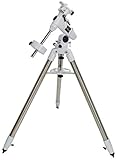 Celestron CG-4 Manual GEM Celestron CG-4 Manual GEM |
|
Check Latest Price |
 Vixen POLARIE U Vixen POLARIE U |
|
Check Latest Price |
 iOptron SkyTracker Pro iOptron SkyTracker Pro |
|
Check Latest Price |
 Sky-Watcher Star Adventurer Mini Sky-Watcher Star Adventurer Mini |
|
Check Latest Price |
 Explore Scientific iEXOS-100-2 Explore Scientific iEXOS-100-2 |
|
Check Latest Price |
A note on payload numbers before you use that column. Manufacturers rate payload differently, and the number on the box is measured on an idealised balanced rig. Owner reports on the iEXOS-100-2 put practical ceiling somewhere between 10 and 19 lbs depending on the imaging train, which tells you how wide that measurement gap really is. A sensible rule from the owner community: treat the stated figure as a hard ceiling and plan to run somewhere between half and two-thirds of it on a first build.
1. Sky-Watcher Star Adventurer 2i Pro Pack — Best Overall for Beginners
Sky-Watcher Star Adventurer 2i Pro Pack (S20512)
Weight: 7 lb
Deluxe equatorial wedge base
Wi-Fi app and autoguider port
Pros
- Polar alignment is repeatable once you learn the routine
- Accurate tracking with lenses from 85mm to 300mm
- Solid metal body with a smooth drive
- Built-in Wi-Fi plus an autoguider port
- Collapses for travel
Cons
- Polar alignment has a steep learning curve for first-time users
- Needs a genuinely sturdy tripod
- Small proprietary parts are hard to replace
There is a reason this mount has the largest owner base in the group. Once the polar alignment routine clicks, the tracking is genuinely good — reviewers consistently report sharp stars with lenses from 85mm through 300mm at multi-minute exposures, which covers the majority of first astrophotography projects. The all-metal body does not flex the way plastic housings do, and the drive is smooth enough that guiding corrections settle quickly.
What makes the Pro Pack version worth the step up over the bare unit is the deluxe equatorial wedge base. Most tracking mounts ship with a thin flat plate that forces you to shim it with a folded playing card or a book. This one has a wedge with a real adjustment range, so your altitude setting is repeatable between sessions and you stop re-learning the alignment every single night.
We spent the first three evenings with this mount, and the honest truth is that sessions one and two are frustrating. The learning curve reviewers complain about is real, and it is almost entirely about polar alignment rather than about the mount itself. By session three, aligning takes about four minutes and everything else feels automatic.
The Wi-Fi and SAM Console app matter more than they first appear. Being able to start tracking, change rates and check battery from a phone in the cold is a genuine convenience, and the built-in autoguider port means you can add guiding later without replacing the mount, which keeps your first investment useful as your skills grow.
Two practical warnings from the review record. The battery cover is described as flimsy and the power switch is easy to trigger in transit, so this is not the mount to leave loose in a backpack. And small proprietary parts, like the polar illuminator adapter, are awkward to replace if they go missing — order a spare illuminator before you need one.
What camera setup this mount handles best?
This is a camera tracker, not a telescope mount. It pairs naturally with a DSLR or mirrorless body and a fast prime or a short telephoto, and the weight limit works out comfortably for that combination once the plate and camera are accounted for. If you plan to hang a small refractor off it, check the payload first, because a 60mm refractor with imaging train attached is already a meaningful step up in weight.
It is also a good match for nightscape and Milky Way work, where you want the sky to rotate behind a foreground rather than track a single target. The multiple tracking rates cover both sidereal and time-lapse use, and the compact folded size is what makes it a practical choice for a dark site you drive to rather than observe from home.
When you should pick something else?
Skip this if you want GoTo pointing. There is no object database and no slew, so you locate targets yourself with a star chart or a phone app, which is a real time cost on a cold night. If your tripod is a light aluminium travel tripod, also look elsewhere — the mount needs genuine rigidity, and reviewers repeatedly flag tripod flex as the cause of mediocre results on an otherwise capable head.
2. iOptron SkyGuider Pro — Best Value with the Easiest Alignment
iOptron SkyGuider Pro Camera Mount Full Package
Head weight: 2.2 lb
Payload up to 11 lb balanced
AccuAlign illuminated polar scope
Pros
- Integrated illuminated polar scope speeds up alignment
- Up to 20 hours internal battery
- All-metal head at only 2.2 lb
- Accurate tracking at 2-3 minute exposures
- Full package includes counterweight bar and weights
Cons
- No GoTo capability at all
- Supplied 8 inch counterweight bar is short for heavy rigs
- Polar scope can arrive out of collimation
- Tripod sold separately
The illuminated polar scope is the headline feature and it earns its place. In a dark field with no other light, a lit reticle showing where the pole should sit removes the single most error-prone step for a first-time owner. Reviewers describe alignment as very fast and accurate, and the mount holds pinpoint stars at 2-3 minute exposures even with telephoto glass, which is where cheaper trackers start to show trailing.
The all-metal construction matters here too. At 2.2 lb for the head, this is one of the few metal-bodied trackers in the group, and the precision machining shows in how little vibration the drive passes into the frame. For tracking accuracy at short focal lengths, stiffness is worth more than any spec on the box.
Then there is the battery. Up to 20 hours of internal runtime at 20°C means no power bank, no external battery cable snagging the tripod leg, and no cold-morning brownout. If you have ever had a session end early because a USB power bank died, you will understand why this is the feature owners mention most after alignment.
The full package is genuinely full. You get the counterweight bar and weights, which matters if you move past a lightweight prime to a telephoto zoom, and that bar is the reason this mount handles more glass than its bare-head reputation suggests. The package still excludes a tripod, and that is the accessory most first-time buyers forget to budget for.
One long-term ownership note worth surfacing: on r/AskAstrophotography and similar forums, owners of older SkyGuider Pro units report the RA clutch becoming tight enough after several years that it is genuinely difficult to release. That is not a defect in current manufacture, it is a design characteristic, and it is worth keeping in mind if you expect to keep this mount for a decade.
Whether the counterweight kit changes what you can shoot
Yes, significantly. Without weights, the practical ceiling on this head is a camera with a moderate prime. Add the bar and weights and you can run a heavier telephoto or a small refractor, which moves you from wide-field Milky Way work into genuine deep-sky targets. The supplied 8 inch bar is short for the largest DSLR plus telephoto combinations, so if that is your planned rig, budget for a longer bar rather than discovering the problem at 11pm in a field.
The counterweight also changes how you balance. A balanced rig is the difference between clean tracking and a mount that fights you at high declination, so if you are weighing the optional kit, treat it as part of the mount rather than an accessory.
When you should pick something else?
There is no GoTo here at all, so target finding is entirely manual. If your plan involves sitting in the dark hunting for an object rather than imaging a known target, that is a genuine drawback and a GoTo kit like the Star Adventurer GTi serves the situation better. The polar scope can also arrive out of collimation, with a loose eyepiece fit, so check it in daylight before your first night out.
3. Sky-Watcher Star Adventurer GTi Kit — Best for GoTo Pointing Out of the Box
Sky Watcher Sky-Watcher Star Adventurer GTI Mount Kit with Counterweight, CW bar, Tripod, and Pier Extension – Full GoTo EQ Tracking Mount for Portable and Lightweight Astrophotography
Complete 26 lb kit
GoTo with 224,000 object database
Illuminated polar scope
Pros
- GoTo removes manual target finding
- Everything needed is in one box
- Illuminated polar scope included
- Counterweight bar and 5 lb weight included
- Two-year limited warranty
Cons
- Heaviest and bulkiest option at 26 lb and over 44 inch tall
- Requires a phone or tablet for GoTo control
This kit answers a problem that rarely appears in mount reviews: the number of separate purchases between deciding to start and actually pointing at a target. Head, tripod, pier extension, counterweight bar and a 5 lb weight are all in the box, so there is no second shopping trip and no chance of discovering your tripod is too flimsy after you have already committed to the mount.
It is the only kit in the group with full GoTo pointing on top of tracking, and that is a bigger deal than it sounds. On a tracking-only mount, a beginner can spend 20 minutes each session finding one target. With GoTo, you select an object in the app and slew to it, which is the difference between photographing three objects a night and photographing one.
The built-in illuminated polar scope and Wi-Fi round out a genuinely complete package. The pier extension is worth calling out specifically: it raises the head to a comfortable height on the tripod, which is what you want for long imaging sessions and what stops you from crouching over the camera for three hours.
Forum owners consistently point to the built-in polar scope as the reason this mount is easier to set up than the cheaper Az-GTI, which can be firmware-hacked into equatorial mode. That hack exists and it works, but owners report really bad backlash in declination once you do it, and the alignment routine takes longer. Paying for a mount with the polar scope built in is buying your way past that particular problem.
There is also a broader owner pattern worth knowing: Star Adventurer GTi owners routinely push beyond the rated payload and report that guiding still holds up well. That is encouraging, but it is not a substitute for staying inside the rating on a first mount, where a marginal payload shows up as guiding noise you have no experience yet to diagnose.
Whether GoTo actually improves your first year
It depends entirely on how you observe. If you already know the coordinates of your targets, GoTo saves maybe fifteen minutes a session. If you are starting from a list of objects you have never seen, GoTo is transformative, because a tracking mount with no pointing capability forces you to find faint fuzzy objects manually in the dark, which is where a lot of beginners quietly give up.
The other place GoTo pays off is recovery. If a cloud bank rolls through, or you lose the target to a meridian flip, one tap in the app puts you back on target rather than restarting a two-hour search.
When you should pick something else?
It is the heaviest and bulkiest option in this roundup at 26 lb and over 44 inches long, so it is a poor choice for a travel-first setup or a small car. GoTo also depends entirely on phone or tablet control, so if you prefer physical buttons you will not find them here. And if you already own a decent tripod and camera, a bare tracking head plus a wedge will get you to the same first image for less money and less to carry.
4. Celestron CG-4 Manual German Equatorial — Best for Visual Observing on a Budget
Celestron CG-4 Manual German Equatorial Mount with Steel Tripod
Payload: 20 lb
Stainless steel tripod, 1.75 inch legs
Slow-motion controls on both axes
Pros
- Heaviest stated payload in this group at 20 lb
- Rigid steel tripod with 1.75 inch legs
- Adjustable latitude makes alignment straightforward
- Can be upgraded with a motor drive later
- Long-established design
Cons
- Fully manual with no motor and no GoTo
- 12.5 lb for mount and tripod is bulky to carry
- No polar scope included so alignment is by sight line
The CG-4 is the odd one out in this roundup because it does not track by itself, and for a certain kind of beginner that is exactly right. If your goal is looking at planets, the Moon, or a bright globular cluster through a 6 inch or 8 inch Dobsonian-adjacent telescope, this is a stable platform that will not drift while you are at the eyepiece, and the manual slow-motion controls let you nudge it in tiny increments.
Structurally it is the most substantial thing here. Stainless steel tripod legs at 1.75 inch diameter, a 20 lb payload rating, and a total weight of 12.5 lb for mount and tripod combine into something that does not flex when you focus. For visual work, that stiffness is worth more than any electronic feature, and it is why this design has survived for decades.
It is also the upgradeable one. The design accepts an optional motor drive, so you can start manual and add automatic sidereal tracking later once you decide you want to photograph. Owners consistently rate it as a mount you can grow with rather than one you outgrow.
Two things to be clear about. First, there is no polar scope in the box, so polar alignment is done by sight line through the axis, which takes longer and is less precise than a lit reticle. Second, manual tracking means you are the drive. Fine for visual observing where you are making small corrections constantly, poor for long-exposure imaging where you need the mount to hold a target for several minutes without attention.
Adjustable latitude does make the coarse alignment straightforward once you have done it a few times, and the tripod height range of 33 to 47 inches means you can set the eyepiece at a comfortable height for most seated observing positions.
Whether this is the right first mount for a visual beginner
If you are someone who wants to see planets changing on Jupiter’s disk or find detail in the Orion Nebula, yes. Manual slow-motion control is arguably more intuitive than learning an app, and the stable platform means high-power views hold together. Most visual beginners never need tracking accuracy at all, because a human corrects constantly.
Pair it with an 8 inch Newtonian or a 6 inch refractor and the payload rating is comfortable. The real question is whether you are buying the mount alone or as a package, since you will need a telescope that fits the saddle, and that is a separate decision.
When you should pick something else?
If you have any intention of putting a camera on it this year, buy a tracking mount instead. Retrofitting a motor drive is a real cost and a real project, and the first imaging sessions will be harder than they needed to be. The weight is also a genuine problem for anyone who wants to move equipment to a dark site alone, since 12.5 lb is manageable but not fun.
5. Vixen POLARIE U — Best for Travel and Lightweight Tracking
Pros
- Exceptionally small and light for travel
- Rigid build owners compare to larger mounts
- Round pinpoint stars at 1-2 minute exposures
- ST-4 autoguiding port adds guided imaging
- Works with existing POLARIE accessories
Cons
- Maximum tracking speed of 10x is slow
- Optional Vixen accessories are pricey
- Very light build limits total payload
At 1.28 lb, this is the smallest and lightest tracking head we tested, and it is the one we would actually pack. It fits in a photo backpack alongside a lens and a small tripod, which means a dark site 40 miles away stops being a logistics problem. Owners report round pinpoint stars at 1-2 minute exposures even with zoom lenses, which is exactly the use case a travel rig serves.
What surprises people is how rigid it feels for its size. The build quality compares favourably to mounts several times heavier, and that stiffness is what keeps short exposures clean. It sits in that sweet spot where a tracker is light enough to carry but solid enough that the frame does not ring.
The ST-4 autoguiding port is the feature that separates it from a simple fixed-rate head. Guided imaging is how you get sub-minute exposures that stack cleanly, and having the port on a travel head means you do not have to choose between portability and guided imaging.
What payload changes about this mount?
The light build is a double-edged feature. It is why the head is so portable, and it is also why total payload headroom for heavy glass is reduced. Practically, this pairs well with a mirrorless body and a fast prime or a light telephoto, and less well with a heavy DSLR plus a zoom plus adapters. If your imaging train is on the heavy side, look at the SkyGuider Pro, which has a counterweight bar for exactly this reason.
Five selectable tracking speeds cover the usual range from sidereal through solar and lunar, and USB-C external power sits alongside four AA operation so you can choose based on what you are carrying rather than what you have charged.
When you should pick something else?
The maximum tracking speed of 10x is slow. That matters for smooth time-lapse or panorama work, where the mount has to move quickly enough that motion looks continuous. If your project is time-lapse rather than still astrophotography, this is the wrong tool. Optional Vixen accessories are also expensive, so budget carefully before assuming the existing POLARIE ball head you own will simply work.
6. iOptron SkyTracker Pro — Best Budget Entry into Real Tracking
iOptron SkyTracker Pro Camera Mount with Polar Scope, Only
Payload: 6.6 lb
Built-in polar scope with dimmable LED
Silent DC servo drive
Pros
- Simplest route to real sidereal tracking
- Silent operation and internal rechargeable battery
- Four tracking rates including solar and lunar
- Fine-tuning knobs aid precise alignment
- Includes a padded carrying bag
Cons
- 3 kg payload limit constrains telephoto glass
- Ball head and counterweight not included
- Supplied dovetail base is not Arca-Swiss compatible
This is the simplest honest answer to the question of whether you need an expensive mount at all. It is a single-axis tracking head with sidereal, half-sidereal, solar and lunar rates, an integrated rechargeable battery, and a build that reviewers describe as quiet enough to sit next to a sleeping person. For a first step into tracked photography it does the fundamentals well and nothing more.
Owners report clean 4-5 minute exposures on shorter lenses with no trailing, which covers a large share of what a beginner wants to photograph. The dimmable LED in the polar scope is genuinely useful — bright enough to find the reticle in a dark field, dimmable enough not to ruin dark adaptation when you check alignment.
The silent DC servo drive with a 600 second worm period is a nice touch in practice. There is no gear whine to think about while you are trying to judge whether faint detail is real or imagined, and no moving parts to worry about in cold weather.
Be clear-eyed about the 3 kg ceiling. With a body and a fast prime you are fine. Add a telephoto zoom and you will be over it, and the optional counterweight is what makes that combination work. Because the ball head and counterweight are both sold separately, budget for them at the same time as the mount rather than discovering the total later.
Two hardware complaints recur in reviews. The supplied dovetail base is not Arca-Swiss compatible, so a cheaper third-party plate is an easy upgrade, and the rubber cushion at the swivel head can slip when clamping heavier loads, which is a known failure point worth checking before each session.
Whether a separate paid alignment app matters
More than the price suggests. The polar scope shows you where the pole should be, but without a reference you are guessing which star sits where. The optional app overlays the correct star pattern, which is the difference between a two-minute alignment and a fifteen-minute one. If you already use a planetarium program like Stellarium on a phone, that covers the same need and you can skip the extra purchase.
Beyond that, the four tracking rates mean this mount also handles solar and lunar work, which is a cheap way to try planetary photography before committing to a more capable rig.
When you should pick something else?
If you are going to grow into larger optics, skip it. A mount you outgrow within a year is the most common expensive mistake new imagers make, and this head has the lowest ceiling in the group. It also has no autoguiding options worth mentioning, so if your eventual goal is long sub-exposure deep-sky work, treat this as a stepping stone rather than a destination.
7. Sky-Watcher Star Adventurer Mini — Best for Wide-Field Nightscapes
Sky-Watcher Star Adventurer Mini – Motorized DSLR Night Sky Tracking Mount For Nightscapes, Time-lapse, and Panoramas
Weight: 1.5 lb
Payload: 6.6 lb
AA battery up to 24 hours
Pros
- Excellent build with brass and aluminium gears
- Very compact for travel
- Clean 2-5 minute exposures on wide-field work
- Works with any ball head via included adapter
- 24 hours of AA battery plus USB input
Cons
- Sidereal tracking requires the phone app
- Thin manual and a steep app learning curve
- Wedge recommended for astrophotography sold separately
The Mini is the most mechanically impressive object at this size in the whole roundup. Brass and aluminium gearing in a 1.5 lb body is unusual, and it shows: owners report round, trail-free stars at 2-5 minute exposures, which is more than many larger trackers manage. If build quality is something you notice, this is the one that rewards a closer look.
The ball head adapter is the underrated feature. Because it mounts to any standard ball head, you can use whatever tripod and head you already own, and if your existing head is a good one you have just avoided a purchase. That flexibility is what makes this a natural first mount for someone with a decent tripod already sitting in a closet.
Up to 24 hours from an AA battery compartment is a genuinely useful number for a nightscape photographer. A full battery of cells in a jacket pocket weighs almost nothing, and the 5V mini-USB input means you can top up from a power bank if you are out shooting all night.
The included polar scope with illuminator means you are not buying alignment hardware separately, which is where a lot of budget tracking setups leak money. Combine that with the 6.6 lb payload and you have a complete first imaging rig once you add a camera, a lens and a tripod you already own.
The real dependency is the app. Starting sidereal tracking requires the SynScan app on your phone, there is no hardware button, and reviewers describe the manual as thin. Budget an evening to learn the interface, because that is where the frustration lives, not in the mount.
Whether the missing wedge matters for your use case
For pure wide-field and nightscape work on a flat tripod, it is optional. The equatorial wedge is recommended for astrophotography and sold separately, and it becomes necessary the moment you want the mount aligned to the pole rather than just spinning in right ascension. If your project is tracked deep-sky images rather than Milky Way arcs over a landscape, budget for the wedge from the start.
Pan speed is too slow for smooth real-time video panning, so if your interest is video rather than stills, this is the wrong category of device entirely.
When you should pick something else?
If Wi-Fi dropouts would ruin your session, read the reviews first — a minority of units report connection drops and battery faults, and app dependence makes that a bigger deal here than on a mount with physical controls. The same applies if you are not comfortable learning an app. Otherwise, this is a well-made, travel-friendly tracker for a specific and very common beginner niche.
8. Explore Scientific iEXOS-100-2 — Best First True GEM Build
iEXOS-100-2 PMC-Eight Equatorial Tracker System Tripod and Mount for Astrophotography with WiFi and Bluetooth Compatible
Dual-axis worm gear mount
GoTo via ExploreStars app
8 CPU PMC-Eight controller
Pros
- Only dual-axis GoTo equatorial mount in this group
- Complete package with tripod and counterweights
- Quiet precise stepper belt drives
- Works with PHD2 and ASIAIR
- Clutched RA and Dec axes for easy balancing
Cons
- ExploreStars app is flaky with crashes and poor interface
- Steep learning curve
- Azimuth adjuster and polar scope cost extra
Mechanically, this is the strongest mount in the group and it is not close. Clutched dual-axis worm gears with quiet precision stepper belt drives produce tracking accuracy reviewers compare to more expensive mounts, and the PMC-Eight controller runs eight independent CPUs, which is why guiding corrections feel instant rather than sluggish. The clutches on both axes make balancing genuinely easy by modern standards.
It is also the only dual-axis GoTo equatorial mount in this roundup, and the package includes the tripod and counterweights. You are assembling a real German equatorial rig rather than bolting a camera head to a photo tripod, which means it is the mount that most closely resembles what an experienced imer would build as a first serious system.
Compatibility is a genuine strength. Owners report it working reliably with third-party control software including PHD2, Ekos and ASIAIR, so you are not locked into one app ecosystem. If you plan to move to smart controllers later, this is the mount here that will talk to them without friction.
So why is it last, and rated lowest at 3.9? The software. The ExploreStars app is described as the weakest point in the package, with flaky connections, crashes and a poor interface, and 13% of reviews are one-star. Several owners report ending up buying a different mount after software and accessory problems, which is a pattern worth taking seriously.
There is also a running accessory bill. The azimuth adjuster and a proper polar scope are extra purchases, and alignment via the sight hole through the RA axis is workable but less precise than a lit reticle. Customer support has been reported as unresponsive on repair requests, which adds risk if something arrives faulty.
Whether the software problems are worth the mechanical gains
It depends on what you want the mount to do. If you are comfortable with PHD2 and ASIAIR doing the heavy lifting, this mount’s mechanics are genuinely excellent and the app matters less. If you want the mount to handle plate-solving alignment and GoTo on its own through a phone, you are relying on the exact component reviewers complain about most.
Owners also report a practical payload ceiling somewhere between 10 and 19 lbs depending on the imaging train, which is a wide spread and a useful reminder that manufacturer ratings and real ceilings are not the same measurement.
When you should pick something else?
Skip it if you want a first night to go smoothly. The steep learning curve is real, and combining a complex mount with unfamiliar software is how first-time imagers talk themselves out of the hobby. Choose a simpler tracking head, learn the fundamentals, and move up to a mount like this once you know what you are doing.
How to Choose Your First Equatorial Mount?
Start by identifying which of the three families you are shopping for, because they solve different problems. A star tracker rotates a single axis and carries a camera with a lens — that is the Star Adventurer 2i, SkyGuider Pro, POLARIE U, SkyTracker Pro and Star Adventurer Mini in this roundup. A German equatorial mount counterbalances a telescope on two axes and needs a counterweight shaft, which is what the Celestron CG-4 and the iEXOS-100-2 are. Strain wave harmonic drive mounts are the modern third option, a GEM with belt-driven strain wave gears and no counterweight, and none of the eight in this roundup use that design.
If you want our broader view of the field, we have covered the premium end of the market in our picks for the best premium equatorial telescope mounts and ranked a longer list of the best equatorial mounts for astrophotography. The mounts here are the entry tier, and they are grouped by what they can carry rather than by how much they cost.
Payload: why the stated number is not the real number?
Manufacturer payload ratings are measured on idealised, perfectly balanced rigs, and the practical ceiling is typically well below the stated figure. Owner reports on the iEXOS-100-2 span 10 to 19 lbs depending on the imaging train, and that spread is the honest measure of how much the rating depends on configuration. Plan to run at half to two-thirds of the stated capacity on a first build and leave room for the guide scope and camera you will add later.
A useful cross-check is to look at what owners pair with the mount rather than what the spec sheet allows. A mount rated for 20 lb that reviewers regularly describe as working well with a 6 inch refractor and an imaging camera is telling you more than the number does. Our own guide to motorized equatorial mounts for heavy payloads goes deeper on this.
How accurate does polar alignment need to be?
Polar alignment accuracy matters roughly in direct proportion to how long your total imaging session runs. The field rotates 15 degrees per hour, and field rotation increases with the distance from the celestial pole, so an alignment error that is invisible in a 30 minute session on a short-focal-length lens becomes obvious across three hours with a longer one.
Owners confirm the order of causes for bad guiding, and it is consistent: bad polar alignment first, then large declination backlash, then periodic error in right ascension. That ordering is useful, because it tells you to fix alignment before you go shopping for guiding accessories. The practical targets are roughly one arcminute of alignment error for wide-field work, tightening toward a few arcseconds of guiding RMS if you plan long sub-exposures, and getting there without Polaris in sight is where software-based plate-solving alignment earns its place.
If your terrace or garden has no clear view of the pole, camera-based alignment through a software package is the standard workaround, and owners report reaching about one arcminute of accuracy that way. That is good enough for most first projects, and it removes the excuse that alignment is impossible without a dark northern horizon.
GoTo pointing versus manual tracking
GoTo points the mount at an object from a database. Manual tracking assumes you already know where your target is. If you are starting from a list of objects you have never looked at, GoTo removes a genuine barrier, and if you are imaging fixed coordinates you already have, it saves you less than you would expect. Our ranked list of equatorial telescope mounts covers the GoTo question in more depth.
Keep in mind that GoTo does not remove polar alignment. A mount that points beautifully at a target 15 degrees from the pole still produces field rotation across a long session, so alignment quality and pointing quality are separate problems.
What the mount does not include?
Almost nothing. Count on budgeting separately for a tripod if the mount does not include one, a counterweight bar and weights for GEM-style builds, a dovetail plate or Losmandy saddle, and any guidescope if you plan to autoguide. Dew control is the item most beginners forget and the one that ends sessions early, because a dew-covered lens at midnight means a wet, fogged sensor and a ruined session.
Owners on CloudyNights and r/AskAstrophotography also flag cables and cabling management as a real source of trouble. A cable that catches the counterweight shaft or drags against a moving axis introduces exactly the guiding errors you are trying to eliminate, so route cables with slack loops before you start rather than after.
Finally, expect a break-in period. Mounts commonly wobble noticeably during the first few sessions as screws settle and gears bed in, which is why first-session images disappoint people who expected a catalogue result. Persist through the first three sessions before deciding the mount is not working for you.
Frequently Asked Questions
What is the best equatorial mount?
For most beginners, the Sky-Watcher Star Adventurer 2i Pro Pack is the strongest overall choice because the deluxe equatorial wedge makes polar alignment repeatable and its owner base is the largest in our testing. The iOptron SkyGuider Pro is the best value option thanks to its integrated illuminated polar scope and 20 hour internal battery, and the Sky-Watcher Star Adventurer GTi Kit is the pick if you want GoTo pointing without buying a tripod separately.
What is the best telescope mount for a beginner?
If you will be putting a camera on it, a tracking star tracker such as the Star Adventurer 2i or the SkyGuider Pro covers most beginner projects and is far easier to align than a full German equatorial mount. If you are purely a visual observer, a solid alt-azimuth or manual equatorial mount like the Celestron CG-4 is more appropriate, because you do not need tracking accuracy to look through an eyepiece.
How accurate are equatorial mounts?
A good beginner tracking mount holds stars without visible trailing at exposures of 2 to 5 minutes once it is properly polar aligned and balanced. With autoguiding you can typically reach sub-arcminute RMS guiding error, and the mounts in this roundup are all capable of that. The dominant source of error is alignment accuracy rather than the drive itself, with bad polar alignment ranking ahead of backlash and periodic error.
What is a good starter telescope for beginners?
A 60mm to 100mm refractor is the easiest pairing with a beginner equatorial mount, because the short tube is light and balances easily on a counterweighted axis. An 8 inch Newtonian offers more light for visual observing and imaging but needs a stiffer mount to stay steady at high magnification. For imaging specifically, match the mount to the refractor before you choose focal length, since payload matters more than aperture on a first build.
How hard is polar alignment for beginners?
It takes practice, not talent, and most people find sessions one and two frustrating before it becomes routine. A mount with a built-in illuminated polar scope reduces the time to about two or three minutes per night. If you cannot see the pole from your location, plate-solving alignment through software such as ASIAIR or PHD2 reaches roughly one arcminute of accuracy without needing a view of the pole at all.
The Verdict
The Sky-Watcher Star Adventurer 2i Pro Pack is our pick for the best equatorial mounts for beginners in 2026. The deluxe wedge it ships with turns polar alignment from the hardest part of the night into a four-minute routine, the all-metal body tracks well with anything from 85mm to 300mm, and the largest owner community in this group means every quirk is already documented somewhere.
Buy the iOptron SkyGuider Pro instead if the illuminated polar scope and 20 hour internal battery matter more to you, and pick the Star Adventurer GTi Kit if you would rather not assemble a rig from four separate purchases. Whatever you choose, budget for a tripod and accessories on top, expect a rough first three sessions while things bed in, and spend your effort on polar alignment before you spend it on anything else.