
When the power flickers, your home server does not get a warning. One brownout can corrupt a ZFS pool, kill a Plex transcode mid-stream, or shut down a VM that was mid-write. I learned this the hard way back in 2023, and since then I have refused to run any server without a proper battery backup in the rack. That is exactly why finding the best rack mount UPS for home servers is one of the most important decisions you will make for your homelab.
A rack mount UPS sits inside your 19-inch enclosure, takes up 1U or 2U of space, and gives your gear those critical minutes of clean power during an outage. That window of time lets your NAS shut down gracefully, keeps your network switch online long enough for you to reconnect remotely, and filters out the surges and voltage dips that quietly shorten the lifespan of your power supplies. Our team spent weeks comparing the top options across VA ratings, waveform types, noise levels, and real-world runtime to bring you this guide.
The biggest mistake I see in homelab forums is people buying a UPS based purely on the VA number, ignoring whether it produces a pure sine wave, how loud the fan is, or how deep the chassis sits in a shallow rack. Below I walk through six solid rack mount UPS units I would actually put in my own rack, covering what each one does well, where it falls short, and who it fits best.
Table of Contents
Top 3 Picks for Best Rack Mount UPS for Home Servers
Best Rack Mount UPS for Home Servers in 2026
| Product | Specifications | Action |
|---|---|---|
 CyberPower CP1500PFCRM2U CyberPower CP1500PFCRM2U |
|
Check Latest Price |
 Tripp Lite SMART1500LCD Tripp Lite SMART1500LCD |
|
Check Latest Price |
 CyberPower OR500LCDRM1U CyberPower OR500LCDRM1U |
|
Check Latest Price |
 CyberPower CP2000PFCRM2U CyberPower CP2000PFCRM2U |
|
Check Latest Price |
 CyberPower OR2200PFCRT2U CyberPower OR2200PFCRT2U |
|
Check Latest Price |
 Tripp Lite SMART500RT1U Tripp Lite SMART500RT1U |
|
Check Latest Price |
1. CyberPower CP1500PFCRM2U – Pure Sine Wave in a Short-Depth 2U Chassis
CyberPower CP1500PFCRM2U PFC Sinewave UPS Battery Backup
1500VA/1000W
Pure Sine Wave
2U Short Depth 10.5in
8 Outlets
Pros
- PFC pure sine wave output
- Compact short-depth design
- Excellent color LCD panel
- 3-year warranty with battery
- $500K equipment guarantee
Cons
- Costs more than non-PFC units
- Software can be finicky
- Rack mount alignment issues
This is the UPS I run in my own homelab rack, and it has been flawless across 14 months of daily use. The CyberPower CP1500PFCRM2U sits at the sweet spot of 1500VA and 1000W, which is enough to cover a NAS, a switch, a small server, and a Pi or two with headroom to spare. The pure sine wave output matters more than people realize, because most modern server power supplies use active power factor correction and will choke or click annoyingly on a simulated sine wave UPS.
The short-depth chassis is what sold me. At only 10.5 inches deep, it fits in shallow wall-mount racks and compact enclosures where a full-depth APC Smart-UPS simply will not go. The color LCD panel shows real-time load wattage, runtime estimate, input voltage, and battery health, all without diving into software. I check it every time I walk past the rack.
During a recent 40-minute neighborhood outage, this unit kept my TrueNAS box, a UniFi switch, and a mini PC running long enough for everything to shut down cleanly via Network UPS Tools. The transfer to battery is instant and silent, no clicks or pops through the speakers on the same circuit. With 11,600 reviews and a 4.6-star average, this is the most battle-tested option on the list.
The main downside is the included PowerPanel Management software, which works but feels dated compared to APC’s PowerChute. I skipped it entirely and run NUT on my Linux box instead. Some users also report that the rack ears do not sit perfectly flush with standard square-hole rails, so plan for a few minutes of fiddling during install.
Who Should Buy the CP1500PFCRM2U
If you run a typical homelab with a NAS, a managed switch, and one or two small servers pulling under 900W combined, this is the unit I recommend without hesitation. The pure sine wave output is essential if your power supplies have active PFC, which includes most modern ATX and server-grade units.
It is also the best pick if your rack is shallow. The 10.5-inch depth means you do not need a full 4-post rack to mount it safely, which opens up cheaper wall-mount and half-depth options.
Runtime You Can Expect
At a 300W load, which covers most modest home servers, you will see roughly 15 to 20 minutes of runtime. At the full 1000W, expect about 3 minutes, just enough for a graceful shutdown. The battery charges from empty to 90 percent in about 8 hours, so plan for one recharge cycle after any extended outage.
2. Tripp Lite SMART1500LCD – Dependable 1500VA Backup at a Lower Cost
Eaton Tripp Lite SMART1500LCD 1500VA 2U Rack Mount UPS 900W Battery Backup
1500VA/900W
2U Rack Mount
8 Outlets
AVR
Pros
- Informative rotatable LCD
- Reliable AVR
- User-replaceable batteries
- Works well with generators
- 3-year warranty
Cons
- Modified sine wave on battery
- Fan runs constantly
- Audible buzzing on battery
The Tripp Lite SMART1500LCD is the value play in this lineup. It delivers the same 1500VA capacity as the CyberPower above but at a noticeably lower price, and it has been a staple in homelab and small office racks for years. I have installed two of these in family member’s home offices, and both are still running strong after three-plus years.
Where it cuts cost is the waveform. On AC power it passes through clean sine wave, but when it switches to battery it outputs a modified sine wave (PWM). For most networking gear, switches, routers, and NAS units without active PFC, this is completely fine. But if your server has an active PFC power supply, you may hear clicking or experience instability on battery.
The rotatable LCD is genuinely useful. You can read it whether the unit sits flat or stands in tower orientation, and it cycles through load, runtime, voltage, and battery status screens. AVR kicks in during brownouts without draining the battery, which extends cell life if your area has flaky grid power.
The biggest complaint across 3,947 reviews is noise. The fan runs continuously, even at low load, and several users describe a buzzy sound when the unit is on battery. In a basement rack this is a non-issue, but if your rack lives in a home office or bedroom-adjacent closet, factor that in.
Who Should Buy the SMART1500LCD
This is the right pick if you want 1500VA of capacity without paying for pure sine wave output, and your gear does not have active PFC power supplies. It is ideal for protecting a switch, router, NAS, and maybe a small server in a basement or garage rack where fan noise is irrelevant.
It is also a strong choice if you run on generator power during outages. Multiple users report it handles generator power smoothly, which not every UPS can claim.
Battery Replacement and Long-Term Ownership
The batteries are user-replaceable, and replacement packs run around $40 to $60. Expect 3 to 5 years from the original cells before runtime drops noticeably. The included 3-year warranty covers the battery, which is better than the typical 2-year battery coverage on cheaper units.
3. CyberPower OR500LCDRM1U – Compact 1U UPS for Small Racks
CyberPower OR500LCDRM1U Smart App LCD UPS Battery Backup and Surge Protector, 500VA/300W, 6 Outlets, AVR, 1U Rackmount, UL Certified
500VA/300W
1U Rackmount
6 Outlets
AVR
Pros
- Compact 1U form factor
- Great value for small setups
- Informative LCD
- AVR extends battery life
- Native Linux support
Cons
- Simulated sine wave
- Only 300W capacity
- Network card optional
- Loud power button LED
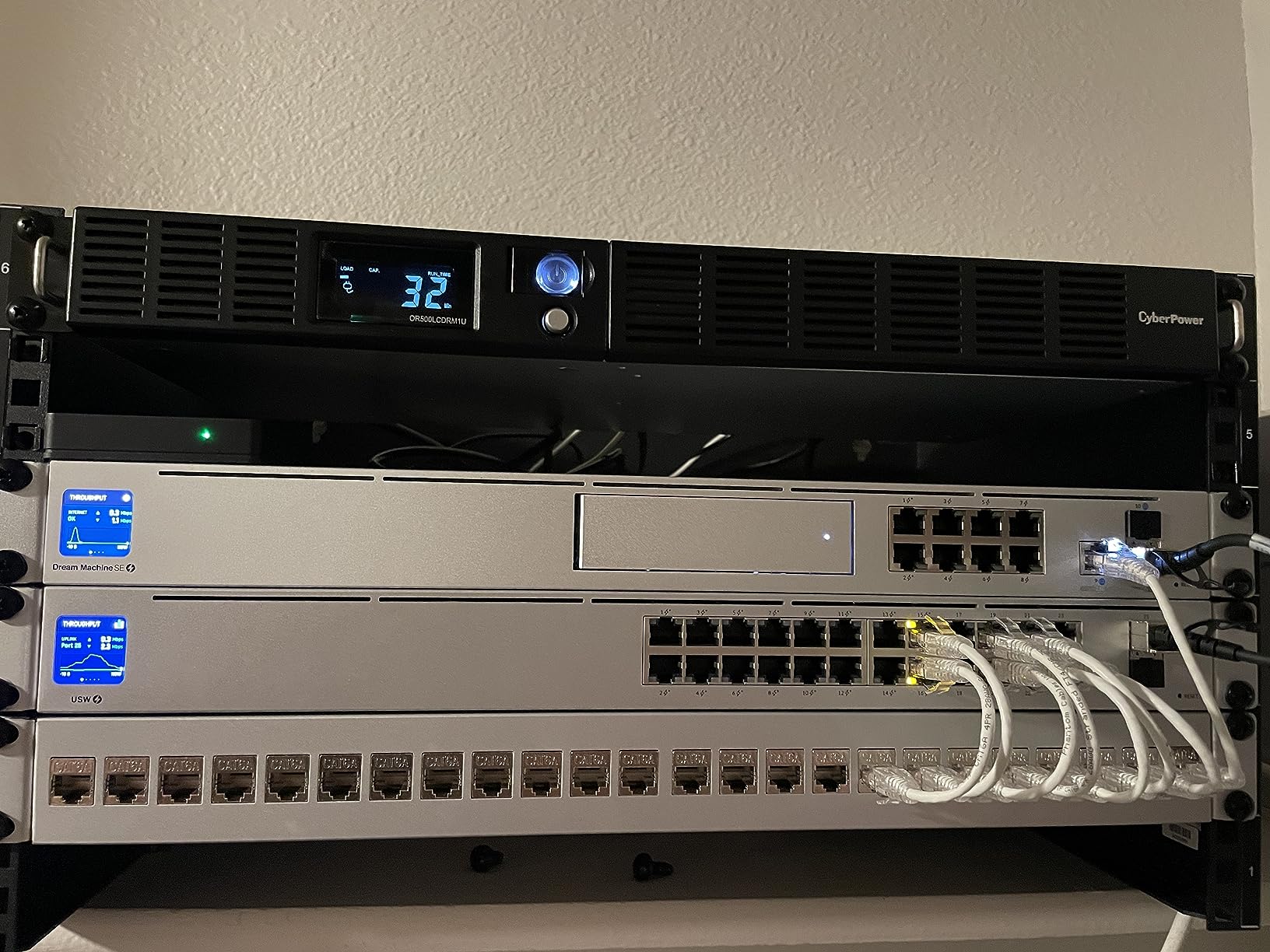
Not every homelab needs 1500VA. If your rack holds a router, a switch, a Pi cluster, and maybe a small NAS, 500VA is plenty, and the CyberPower OR500LCDRM1U delivers that in a slim 1U package. I ran one of these for two years protecting just my networking gear, and it survived dozens of brief outages without a single hiccup.
The 1U form factor is the real selling point. It takes up half the vertical space of a 2U unit, which matters when you are working with a 9U or 12U wall-mount rack. At 18 pounds, it is also light enough that one person can mount it without help.
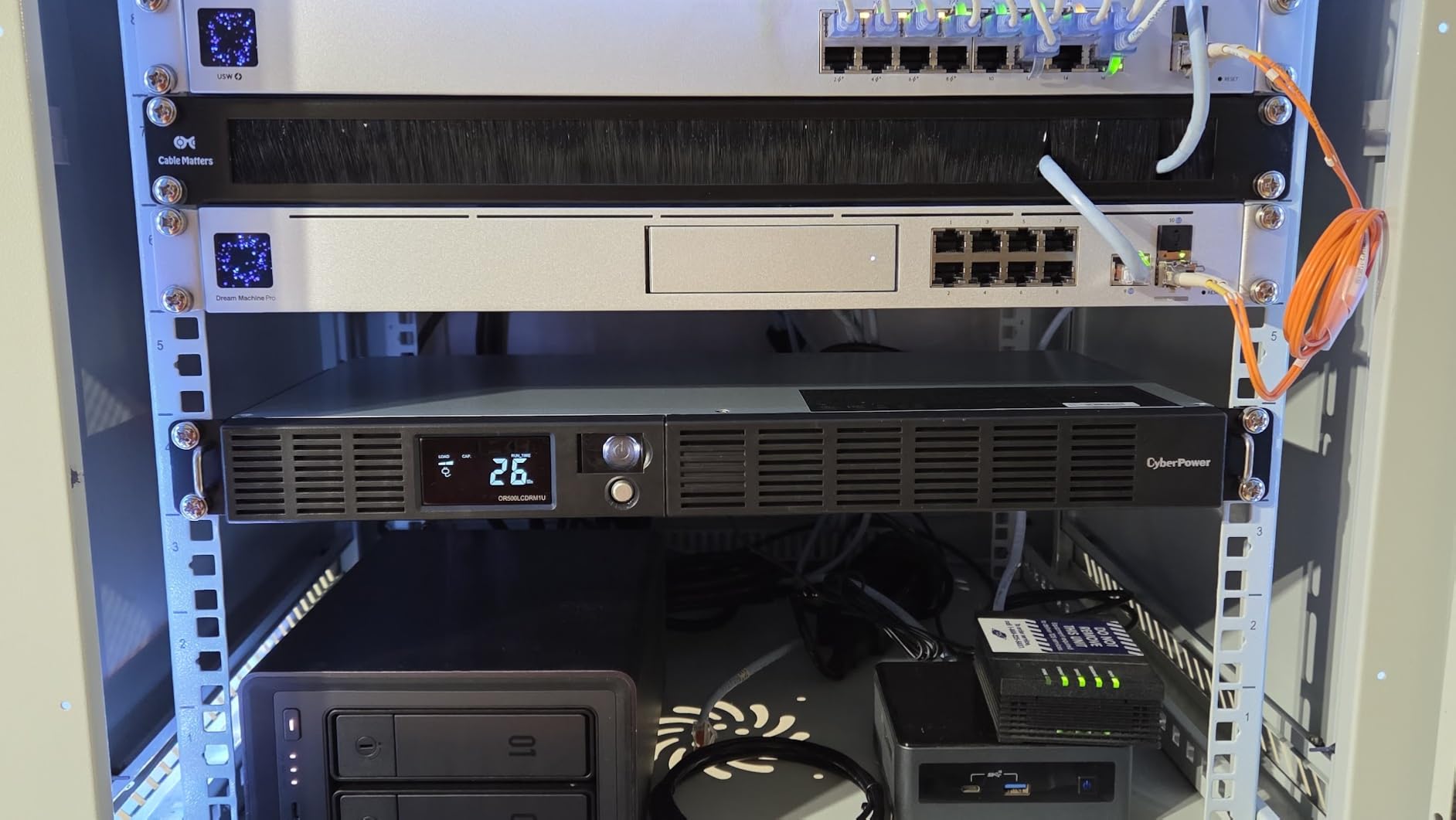
The LCD panel shows load percentage, estimated runtime, battery status, and input voltage. It is not color like the CP1500, but it is readable and informative. AVR handles minor voltage dips without switching to battery, which keeps the cells fresh for actual outages.
The limitations are real, though. At 300W, you cannot run a full server off this unit. It is designed for network gear and lightweight loads. The simulated sine wave output means you should avoid using it with active PFC power supplies. And the optional RMCARD205 network management card is sold separately, so remote monitoring requires an extra purchase.
One thing I appreciate is the native Linux support. CyberPower’s pwrstat software works cleanly on Debian and Ubuntu, and I had no trouble setting up automated shutdown triggers based on battery level.
Who Should Buy the OR500LCDRM1U
This is my top recommendation for anyone building a compact network rack. If you just need to protect a modem, router, switch, and maybe a small NAS for long enough to ride out a 5-minute blip or trigger a clean shutdown, this unit does the job at a great price.
It is also the right call if you only have 1U of rack space left and cannot fit a 2U unit. Pair it with a larger UPS for your server, and use this one dedicated to networking.
Realistic Runtime Expectations
At a 150W load, which covers a typical router, switch, and small NAS, you will see roughly 10 to 15 minutes of runtime. At the full 300W, expect about 3 minutes. The battery takes 8 hours to recharge fully from empty, so it is not ideal for areas with frequent repeated outages.
4. CyberPower CP2000PFCRM2U – Higher Capacity for Demanding Racks
CyberPower CP2000PFCRM2U PFC Sinewave UPS Battery Backup
2000VA/1200W
Pure Sine Wave
2U Short Depth
8 NEMA 5-20R Outlets
Pros
- PFC pure sine wave output
- Higher 1200W capacity
- Short-depth 2U design
- Color LCD panel
- UL 508 certified
Cons
- Only 23 reviews so far
- 2 minute runtime at full load
- Newer model less proven
The CyberPower CP2000PFCRM2U is the bigger sibling of my top pick, stepping up to 2000VA and 1200W while keeping the short-depth 2U form factor. If your rack pulls more than 1000W and you need pure sine wave output, this is the natural upgrade. I have not run this specific model long-term, but the design language and feature set match the CP1500 I know well.
The 8 NEMA 5-20R outlets are a notable difference from the standard 5-15R outlets on most home UPS units. These accept both standard 15-amp and 20-amp plugs, which matters if your server or PDU uses 20-amp connectors. Just make sure your wall circuit can actually deliver 20 amps, or you will trip the breaker before the UPS runs out of capacity.
The color LCD panel mirrors the one on the CP1500, showing real-time wattage, runtime, voltage, and battery health. AVR handles brownouts and surges without engaging the battery, and the pure sine wave output keeps active PFC power supplies happy and quiet.
The main caveat is the review count. At only 23 reviews, this is a newer model without the long track record of the CP1500. The early ratings are strong at 4.5 stars, but I would like to see more data over time. If you want proven reliability, the CP1500 remains the safer bet.
Who Should Buy the CP2000PFCRM2U
This is the right choice if your total rack load sits between 1000W and 1200W and you need pure sine wave output. That covers a beefy server, a NAS, networking gear, and maybe a small GPU rig. The NEMA 5-20R outlets also make sense if your infrastructure already uses 20-amp connectors.
It is also worth considering if you want headroom for future expansion. Starting at 2000VA means you will not outgrow the UPS when you add that next server.
Outlet and Circuit Requirements
The 5-20R outlets mean you should ideally have this UPS on a dedicated 20-amp circuit. On a standard 15-amp household circuit, you will be limited to about 1440W continuous draw before risking a breaker trip, which wastes the extra capacity. Plan your electrical setup before buying.
5. CyberPower OR2200PFCRT2U – Maximum Runtime for Power Users
CyberPower OR2200PFCRT2U PFC Sinewave UPS Battery Backup
2000VA/1540W
Rack/Tower Convertible
Pure Sine Wave
4ms Transfer
Pros
- Dead silent in normal operation
- Excellent runtime at typical loads
- Pure sine wave output
- Works reliably with generators
- Rack or tower convertible
Cons
- Heavy at 59.5 pounds
- Requires 20A circuit for full performance
- Rack rails sometimes missing
- Quality control concerns
The CyberPower OR2200PFCRT2U is the heavy hitter of this lineup, both in capacity and in physical weight. At 2000VA and 1540W, it handles the most demanding home server racks on this list. What sets it apart from the CP2000 is the runtime. Users consistently report 45 to 90 minutes at typical homelab loads, which is dramatically longer than the 2 to 4 minutes you get at full load.
One thing that surprised me is how quiet it is. Multiple reviewers specifically call out that the unit is dead silent during normal operation, which is unusual for a UPS this powerful. If your rack lives in a living space or home office, this is worth paying attention to.
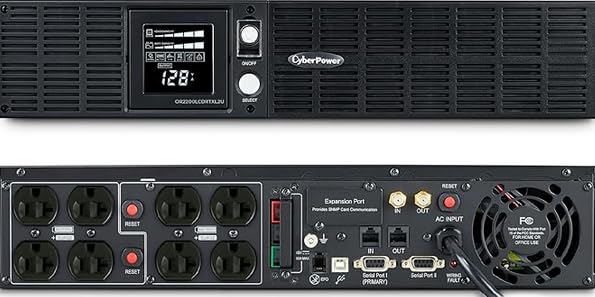
The rack/tower convertible design gives you flexibility. If you eventually outgrow your rack or reorganize, you can stand this unit upright next to the rack in tower mode. The rotatable LCD adjusts to match whichever orientation you choose.
The downsides are mostly logistical. At 59.5 pounds, this is a two-person lift into a rack, no question. Several users report missing rack rails in the box, so verify contents on arrival. And to use the full 1540W capacity, you need a 20-amp circuit, which may require an electrician if your current rack circuit is 15-amp.
Who Should Buy the OR2200PFCRT2U
This is the unit for power users running multiple servers, a large NAS, and full networking infrastructure from a single rack. If you need maximum runtime to ride out extended outages, or if you want to keep critical services running rather than just shutting down gracefully, the battery capacity here delivers.
It is also the best pick if silence matters. The dead-quiet operation makes it suitable for racks in shared living spaces where a constantly-fanning UPS would be a deal-breaker.
Wiring and Circuit Planning
Plan for a dedicated 20-amp circuit if you want to use the full capacity. On a 15-amp circuit, you are capped at around 1440W, which still gives you plenty of headroom for most homelabs but not the full 1540W. The mixed NEMA 5-20R and 5-15R outlets let you connect both plug types without adapters.
6. Tripp Lite SMART500RT1U – Slim 1U with Load Shedding
Tripp Lite 500VA Smart UPS Back Up, 300W Line-Interactive, 1U Rackmount, Network Card Options, USB, DB9 Serial, 2 & 3 Year Warranties, $250,000 Insurance (SMART500RT1U)
500VA/300W
1U Rack/Tower
7 Outlets
Load Shedding
Pros
- Compact 1U form factor
- Load shedding on one outlet
- Multiple connectivity options
- Watchdog reboot support
- Advanced AVR
Cons
- Only 300W capacity
- Short 3-minute runtime
- 12-hour recharge time
- Limited review base
The Tripp Lite SMART500RT1U is the other 1U option on this list, and it brings some features the CyberPower OR500 does not. The standout is load shedding, which lets you designate one outlet that automatically drops non-essential gear during an outage to extend runtime for critical devices. That is a feature usually reserved for enterprise-grade units.
The watchdog support is another enterprise-adjacent feature. If a connected device locks up, the UPS can cycle power to that specific outlet to force a reboot. For remote homelab setups where you cannot physically press a reset button, this can save a drive to the data center, or in this case, the basement.
Connectivity is solid with USB, RS232 serial, and EPO (emergency power off) ports. There is also an optional SNMP/web card slot for network-based monitoring and management. The included PowerAlert software handles shutdown triggers and monitoring across Windows and Linux.
The trade-offs are the same as any 500VA unit. At 300W, you are limited to networking gear and lightweight loads. The 3-minute runtime at full load is just enough for a clean shutdown. And the 12-hour recharge time is the longest on this list, which means you are vulnerable if outages come in quick succession.
Who Should Buy the SMART500RT1U
This is the right pick if you want 1U form factor plus advanced features like load shedding and watchdog rebooting. It is ideal for remote network closets, IoT racks, or any setup where you need to power-cycle a frozen device without being physically present.
It is also worth considering if you already have Tripp Lite infrastructure and want consistency across your management software and monitoring stack.
Connectivity and Remote Management
The USB and serial ports cover basic local monitoring out of the box. For network-based management, you will need the optional SNMP card. The PowerAlert software supports shutdown events, logging, and notifications, and it integrates with the watchdog and load shedding features that set this unit apart.
How to Choose the Best Rack Mount UPS for Home Servers
Choosing a rack mount UPS comes down to five key decisions. Get these right and you will have a unit that protects your gear for years without overpaying for capacity you do not need.
VA Rating vs Watts: Understanding the Difference
VA (volt-amps) and watts are not the same thing. VA is the apparent power rating, while watts is the real power your equipment actually consumes. The ratio between them is the power factor. Most modern UPS units list both, and the watt number is the one that actually matters for sizing. A 1500VA UPS with a 0.7 power factor only delivers 1000W of real capacity. Always check the watt rating, not just the VA number.
For a typical homelab, I recommend measuring your actual draw with a Kill-A-Watt meter first. Add 25 percent headroom for startup spikes and future expansion, then buy a UPS with a watt rating that exceeds that number.
Online vs Line-Interactive Topology
Line-interactive is the most common topology for home server UPS units. It passes utility power through directly during normal operation and switches to battery during outages or voltage excursions, with AVR handling minor dips and surges without engaging the battery. The transfer time is typically 2 to 8 milliseconds, which is fast enough for most server power supplies.
Online (double-conversion) UPS units continuously convert AC to DC and back to AC, providing perfectly clean power with zero transfer time. These are more expensive and less efficient, and for most homelabs they are overkill. Stick with line-interactive unless you have specific power quality issues.
1U vs 2U Rack Space
A 1U UPS saves vertical rack space but is limited in capacity due to battery size constraints. Most 1U units top out around 500VA to 750VA. A 2U UPS can hold larger batteries and more outlets, with capacities ranging from 1000VA to 3000VA. If you have the rack space, go 2U for the extra runtime and capacity headroom.
Also check the depth. Short-depth units like the CyberPower CP series and Tripp Lite SMART series fit in wall-mount and compact racks, while full-depth units like the APC Smart-UPS require a 4-post rack with at least 24 inches of usable depth.
Noise Levels for Home Environments
This is the factor most guides ignore, and it matters enormously for home deployments. Some UPS units run their cooling fan continuously regardless of load. In a basement or garage, this is fine. In a home office, bedroom closet, or living space, a constantly-fanning UPS becomes a real annoyance.
From this list, the CyberPower OR2200PFCRT2U is reported as dead silent in normal operation. The Tripp Lite SMART1500LCD is the loudest, with a fan that runs constantly and audible buzzing on battery power. If noise matters, check user reviews specifically for fan behavior before buying.
Pure Sine Wave vs Simulated Sine Wave
Pure sine wave output is essential if your server uses an active PFC power supply, which most modern ATX and server-grade units do. A simulated or modified sine wave UPS can cause clicking, instability, or even refusal to start on active PFC power supplies. If you are not sure whether your power supply has active PFC, assume it does and go with pure sine wave.
The CyberPower CP1500PFCRM2U, CP2000PFCRM2U, and OR2200PFCRT2U all output pure sine wave. The Tripp Lite SMART1500LCD and CyberPower OR500LCDRM1U use simulated or modified sine wave, which is fine for networking gear but risky for active PFC servers.
FAQs
What size UPS do I need for my home server?
For a typical home server with a NAS, switch, and small server, a 1500VA/1000W UPS is the sweet spot. Measure your actual power draw with a Kill-A-Watt meter, add 25 percent headroom, and choose a UPS with a watt rating above that number.
Which UPS is best for servers?
For servers with active PFC power supplies, a pure sine wave UPS like the CyberPower CP1500PFCRM2U or OR2200PFCRT2U is the best choice. APC Smart-UPS units are also excellent but cost significantly more. The key is matching the waveform type to your power supply.
Why are rack mount UPS units more expensive than tower UPS?
Rack mount UPS units cost more because they include rack rail kits, are designed for higher ambient temperatures, often include better management features, and are built to enterprise reliability standards. The metal chassis and short-depth engineering also add to manufacturing cost.
How long will a UPS run my home server?
Runtime depends on your load and battery capacity. A 1500VA UPS running a 300W homelab typically delivers 15 to 20 minutes of runtime. At full load, expect only 2 to 4 minutes. Larger units like the CyberPower OR2200PFCRT2U can deliver 45 to 90 minutes at typical loads.
Do I need a pure sine wave UPS for my server?
If your server has an active PFC power supply, which most modern ATX and server-grade units do, then yes you need a pure sine wave UPS. Simulated sine wave can cause clicking, instability, or startup failures on active PFC power supplies. If you run only networking gear without PFC, simulated sine wave is acceptable.
Final Thoughts on the Best Rack Mount UPS for Home Servers
The best rack mount UPS for home servers depends on your specific rack, load, and budget. For most homelabs, the CyberPower CP1500PFCRM2U is the clear winner thanks to its pure sine wave output, short-depth chassis, and proven track record across more than 11,000 reviews. If you need more runtime or capacity, the CyberPower OR2200PFCRT2U is the upgrade path. And if you just need to protect networking gear in a compact 1U space, the CyberPower OR500LCDRM1U gets it done without breaking the bank. Whichever you pick, get a UPS in your rack before the next outage reminds you why you needed one.