
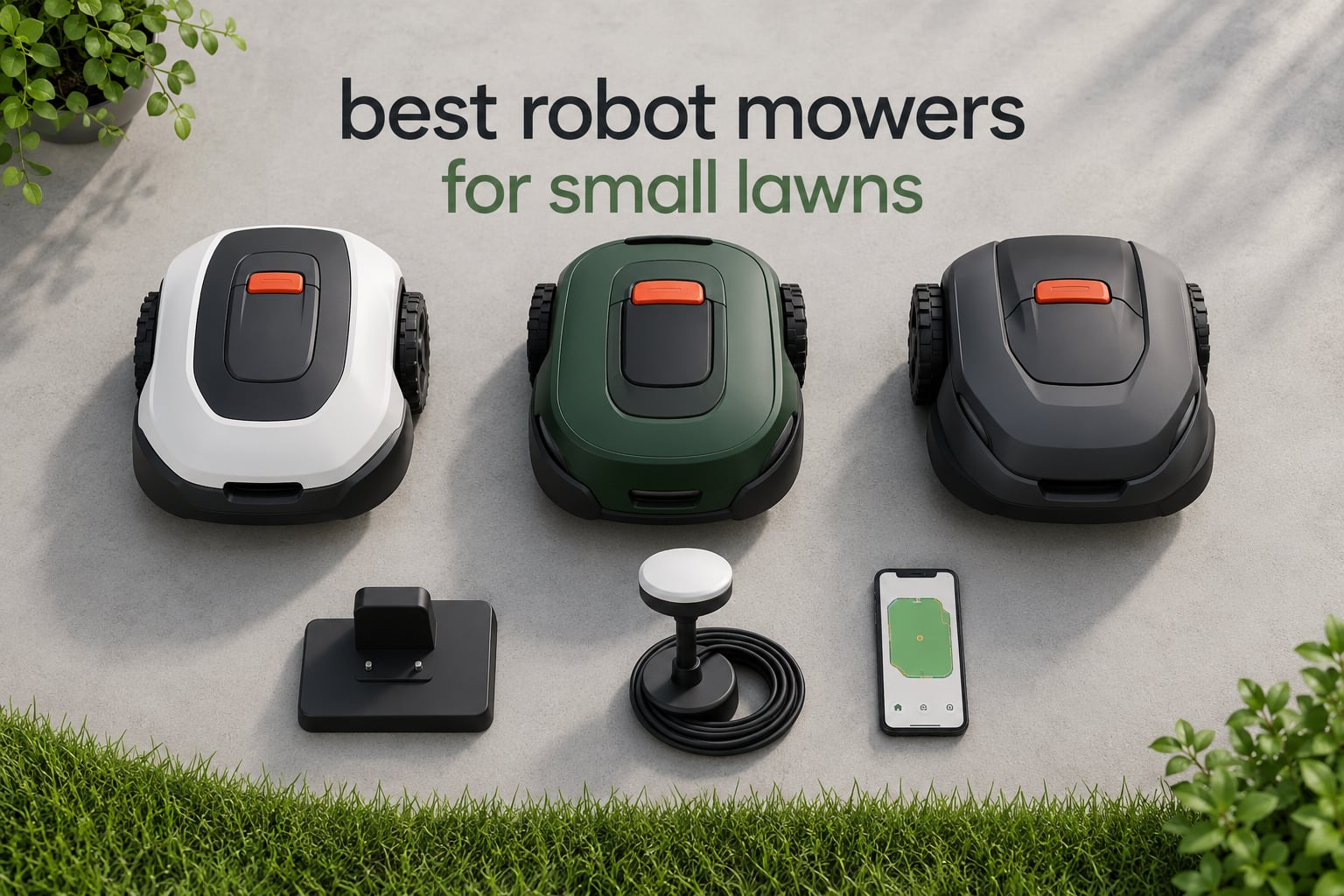
Most robot mower buying guides start with acreage, and most of them get the question backwards for a small yard. When you have a fifth of an acre, a machine rated for half an acre is not a bargain, it is dead weight, a heavier thing to lift into the shed, a bigger battery to replace, and a charger drawing more current than you need. The right question is smaller than the one big-lawn buyers ask: what is the least expensive machine that will genuinely keep up with your grass growth, week after week?
That is what we answer here. We compared ten robot mowers built for small lawns, from a 1,600 square foot camera-vision unit to a quarter-acre LiDAR machine, and judged them on the specs that actually decide whether a robot works in a small garden: how long it mows per charge, how wide the deck is, how close it cuts to your borders, how it copes with narrow passages, and whether you can get parts for it in ten years.
If you want the manual option in the same size class, our guide to lawn mowers for small yards covers battery and petrol walk-behinds. If your problem is that the grass needs water as well as cutting, the smart sprinkler controller picks sit alongside this list nicely. And if your real frustration is dust rather than grass, our robot vacuum reviews cover a different corner of the house entirely.
A word on method. Every rating, review count, runtime, cut width, slope figure and noise number in this roundup comes from the manufacturer listing or from aggregated owner reviews, not from our own instrument testing. Where owners consistently complain about something, we say so. Where the manufacturer does not publish a figure, we say that too, because a missing number is itself a buying signal.
Table of Contents
Top 3 Best Robot Mowers For Small Lawns (October 2026)

Segway Navimow i105N
- RTK plus vision positioning
- 58 dB(A) quiet run
- Wire-free virtual boundary
- 1/8 acre coverage

ANTHBOT M5 LIDAR
- 360-degree LiDAR plus dual cameras
- Handles 24 degree slopes
- Cut height 1.2 to 2.8 inch
- No satellite signal needed
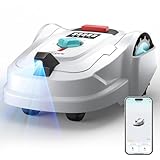
YARDCARE M800Plus
- GPS plus 3D vision navigation
- 35 percent slope handling
- 1/5 acre coverage
- Bow-shaped path mowing
Our editorial choice is the Navimow i105N simply because it has the deepest owner history in this group, more than 390 reviews of the exact machine, which is worth more than a better spec sheet written by a marketer. The ANTHBOT M5 is the pick if your lawn sits under heavy tree cover where satellites are a problem. The YARDCARE M800Plus scores highest of the ten and handles the steepest slopes of the GPS-based machines.
Quick Comparison of the 10 Best Robot Mowers for Small Lawns
| Product | Specifications | Action |
|---|---|---|
| Segway Navimow i105N |
|
Check Latest Price |
| ANTHBOT M5 LIDAR |
|
Check Latest Price |
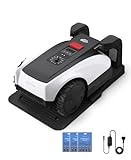 ECOVACS GOAT O1000 RTK CARE ECOVACS GOAT O1000 RTK CARE |
|
Check Latest Price |
| YARDCARE M800Plus |
|
Check Latest Price |
 MOVA LiDAX Ultra 1000 MOVA LiDAX Ultra 1000 |
|
Check Latest Price |
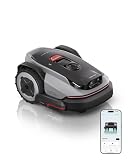 Roborock RockNeo Q110H Roborock RockNeo Q110H |
|
Check Latest Price |
 Sunseeker X3 Plus Sunseeker X3 Plus |
|
Check Latest Price |
 Sunseeker S4 Sunseeker S4 |
|
Check Latest Price |
 YARDCARE V100 YARDCARE V100 |
|
Check Latest Price |
 Segway Navimow i206 AWD Segway Navimow i206 AWD |
|
Check Latest Price |
1. Segway Navimow i105N: The Best Overall Robot Mower for Small Lawns
Segway Navimow i105N Robot Lawn Mower Perimeter Wire Free 1/8 Acre RTK+Vision Robotic Lawnmower, AI-Assisted Mapping, Virtual Boundary, APP Control, 58dB(A) Quiet, Multi-Zone Management
Coverage: 1/8 acre
Cutting width: 7.1 inch
Cut height: 2 to 3.6 inch
Weight: 24 lbs
Noise: 58 dB(A)
Pros
- RTK plus vision fusion holds position under trees and in corridors
- Wire-free virtual boundary with AI-assisted mapping
- Very quiet at 58 dB(A) for early or late mowing
- Cuts neat parallel striping
- Camera recognises 150+ obstacle types
Cons
- Stock wheels dig ruts on uneven ground
- Vision fence misses thin objects like hoses and gates
- Map edits require physically driving the mower
This is the machine most small-lawn buyers end up with, and after reading several hundred owner reviews it is hard to argue with the choice. Navigation runs on RTK satellite positioning blended with a vision system, which means no boundary wire to staple around a garden that is mostly path and flowerbed. Set-up takes an afternoon in a typical small plot.
At 24 pounds it is light enough to lift into a shed without a second person, and 58 dB(A) is quiet enough that owners report running it before breakfast without complaints from next door. Cutting width is 7.1 inches, which is on the narrow side, so a 5,000 square foot lawn takes more passes than an 8 inch deck would.
The 2 inch minimum cut height is higher than some rivals manage, which matters if you want a very short summer cut. Adjustable across five positions up to 3.6 inches, it suits most temperate lawns. It does not mulch, so clippings stay on the surface, and edge work still needs a string trimmer.
Two complaints recur. The standard wheels have weak traction and will rut soft uneven ground when the mower gets bogged down. The vision fence also misses slim obstacles such as garden hoses, sprinkler heads and mailbox posts, so those need picking up before each run.
Check the sky view before you commit to RTK
RTK positioning needs a clear view of satellites. The antenna and base station want an open patch of sky, and in a small garden walled by trees and houses that can be the hardest part of the install. Owners who place the station in a corner under a canopy report drift and more manual boundary work later.
Walk the yard at midday and ask yourself where a 6 foot clear circle of sky could physically go. If there is no answer, a LiDAR machine such as the ANTHBOT M5 or the MOVA LiDAX is a better structural fit even if the i105N has the better review history.
Know what you are signing up for with the app
Editing a mapped zone means physically driving the mower to the boundary with the app in virtual joystick mode. There is no satellite image overlay, so you are walking your lawn repeatedly rather than drawing lines on a map. Owners who mind this complain; owners who set it up once rarely mention it again.
Segway covers the machine with a 3-year warranty, which is longer than most rivals here. For long-term ownership that is the detail that matters most on a machine you cannot walk to a dealer with.
2. ANTHBOT M5 LIDAR: Best When Trees Block Your Satellites
ANTHBOT M5 LIDAR Robotic Lawn Mowers, 1/8 Acre Wire-Free Dual Vision
Coverage: 1/8 acre
Cut width: 200mm deck
Cut height: 1.2 to 2.8 inch
Slope: up to 24 degrees
Pros
- 360-degree LiDAR with dual cameras needs no boundary wire or RTK antenna
- Works in fully enclosed yards where satellite signal is blocked
- Dual-wheel drive handles slopes up to 24 degrees
- Quiet at 58 dB or less
- Nine-level app cut adjustment from 1.2 to 2.8 inch
Cons
- Needs roughly three passes for an even cut on taller grass
- Docks frequently on smaller lawns
- Manual and edging modes underwhelming
Everything this machine senses, it senses itself. A 360-degree LiDAR turret paired with two cameras maps the yard and navigates it without any satellite signal, which removes the single biggest installation risk on a small urban plot. If your lawn is hemmed in by buildings and mature trees, this is the structural answer.
Reviewers describe it as a genuinely hands-free machine. It maps quickly, resumes automatically after charging, and the cut height runs from 1.2 to 2.8 inches in nine steps straight from the app, which is the widest adjustment range in this group alongside the MOVA.
The efficiency complaint is the real story. With roughly 40 minutes of runtime per charge and a 200mm deck, owners report needing about three passes for an even cut on taller grass, and the mower returns to dock frequently on smaller plots. That is fine if you schedule it every second day. It is annoying if you expect one pass to finish the job.
Sensors can be confused by uneven ground and tight spots, and self-recovery when stuck works reasonably well thanks to the dual-wheel drive. Owners on sloped lawns up to 24 degrees report it climbing out of trouble on their own.
Judge it on passes, not on runtime
Published runtime is about 40 minutes a charge. Divide that by mowing time plus charge time and you get a duty cycle, the number that actually tells you whether a machine keeps up. For planning purposes, assume you will run it every two or three days rather than daily, which is exactly how owners on small plots describe using it.
If your lawn is genuinely tiny, the frequent docking is the right trade. If you have a quarter acre and want weekend scheduling, look at the ECOVACS GOAT O1000 or the Roborock RockNeo, both of which publish substantially longer battery figures.
Editing zones is the weak spot
The documentation does not clearly explain how to add a second mowing zone once you have the first one mapped. For a small lawn split by a path or a flowerbed, that is the exact moment the manual falls short. Owners of divided plots report the same issue with several apps in this category.
Sensor behaviour on rough ground is the other thing to test. Even ground and clear sightlines get the best results from this machine; ruts and tight corners between a shed and a fence are where the vision and LiDAR systems start second-guessing themselves.
3. ECOVACS GOAT O1000 RTK CARE: Best When Your Small Lawn Is Really a Quarter Acre
ECOVACS Goat O1000 RTK Care Robot Lawn Mower, RTK Navigation, 1/4 Acre
Coverage: 1/4 acre
Cut width: 8.66 inch
Cut height: 1.2 to 3.2 inch
Battery: 90 min
Pros
- RTK navigation gives systematic paths and clean striping
- Auto mapping sets up in 20 to 30 minutes
- Long 90 minute battery covers a full yard
- Kit includes 36 extra blades and an RTK extension cable
- Side trimmer helps along fences and beds
Cons
- App navigation unreliable
- often reports the mower stuck or out of range
- Auto mapping cannot separate areas split by a fence
- Clippings left on the lawn rather than mulched
If your small lawn tops out near a quarter acre, this is the machine in the group with the most capacity per charge. A published 90 minute battery life and an 8.66 inch cutting width mean fewer passes than anything else here with RTK positioning, and the white body is a small, sensible safety detail on a lawn close to a neighbour’s patio.
The kit is generous. It ships with 36 extra blades and an RTK extension cable, which is exactly the kind of thing that matters when you care about serviceability, because you are not waiting on a delivery for a spare blade set.
The software is the problem, and owners are blunt about it. The app frequently reports the mower stuck or out of range when nothing is wrong, and several reviewers describe eventually switching to a competing brand over navigation failures. At 3.9 stars from 155 reviews it sits at the lower end of the ratings here.
Auto mapping also cannot separate lawn areas divided by a fence or a narrow passage, which is a real limitation on the U-shaped and divided plots that small-lawn owners tend to have. No-go zones must be drawn by remote-controlling the virtual joystick rather than editing a map, and deleting a mapped zone also deletes its schedule.
The hardware is good, the app is the risk
Owners like the machine itself, the cut quality and the low noise, and many have it running within half an hour of opening the box. What they do not like is being told the mower is stuck when it is not. Budget for a few weeks of small frustrations at the start while the mapping settles, and know that a firmware problem means an app update rather than a dealer visit.
Its 44.5 pound weight is the second-heaviest here after the MOVA LiDAX Ultra 1000. That is a genuine consideration if you plan to carry it into a shed for winter storage. If weight and lifting matter, the Sunseeker X3 Plus at under 20 pounds or the Navimow i105N at 24 pounds are far easier to handle.
Pick this only if you have the area to justify it
On a lawn of 3,000 square feet, a quarter-acre machine with a 90 minute battery is genuinely overbuilt. You gain nothing from the extra capacity and you carry the extra weight. This is the clearest example of the oversizing trap: a bigger mower on a smaller lawn is not an upgrade, it is unused capability plus a heavier object to lift.
For that reason, and because of the app reliability reports, this one earns a place in the list but not a place near the top. If your lawn really is approaching a quarter acre with a wide open middle, it does the job.
4. YARDCARE M800Plus: The Highest Rated of the Ten
YARDCARE M800Plus Cordless Robot Lawn Mower with GPS + Visual Navigation, Bow-Shaped Path Mowing, APP Control, 4.0Ah Automatic Robotic Lawnmower for 1/5 Acre, Obstacle Avoidance, Height Adjustment
Coverage: up to 8611 sq ft
Cutting width: 7 inch
Cut height: 0.8 to 2.4 inch
Slope: 35 percent or 20 degrees
Battery: 4.0Ah
Pros
- GPS plus 3D vision tells grass from non-grass with no boundary wire
- Combines orderly row passes then random fill for even coverage
- Handles slopes up to 35 percent
- Spot spiral mode evens out denser patches
- App scheduling with OTA updates
Cons
- Built for clear-boundary lawns
- HD camera can confuse grass with adjacent surfaces
- Tall grass over 2.6 inch should be cut manually first
- Blades need regular replacement
- Fixed 7 inch disc means more passes than wider decks
At 4.6 stars from 104 reviews this scores higher than anything else we looked at, and the owner feedback lines up with why. It mows orderly rows first and then fills randomly, and that combination produces an unusually even finish for a machine in this price bracket. Owners consistently describe the app as straightforward.
Slope handling at 35 percent, roughly 20 degrees, is the best of the GPS-based machines in this roundup. The 135 degree AI camera detects 150 obstacle types, and the 4.0Ah cordless battery is swappable in principle. Cut height runs from 0.8 to 2.4 inches, the lowest minimum here, so it suits fine turf.
Coverage is listed at up to 8,611 square feet, about a fifth of an acre, with a 7 inch cutting disc. That disc is narrow for the output, so expect more passes than an 8 inch deck would need. Note that this listing returned no verified customer photos after repeated attempts, so treat the imagery on the page with some caution.
It needs a lawn with clear edges
The HD camera distinguishes grass from non-grass, which is clever when it works and a liability when it does not. Owners with lawns that run straight into a path or a hard surface report the camera sometimes struggles to separate grass from the adjacent surface. The manufacturer positions it for clear-boundary lawns, and that limitation is real.
Before buying, look at your perimeter. If your lawn edges into paving, gravel or a neighbour’s fence with no strip of soil between, expect the camera to hesitate at those edges. A LiDAR machine handles ambiguous boundaries more predictably.
Cut tall grass down first, every time
The manual guidance is to trim grass taller than 2.6 inches manually before the robot takes over. That is standard practice for most robot mowers, but with a narrow 7 inch disc this machine needs more clean-up passes to get down to height in the first place.
Blades need regular replacement to hold performance, which is worth planning for in your running costs. Owners rate the machine highly for simple, reliable mowing of a straightforward small lawn. On a complicated plot with ambiguous edges, choose a LiDAR unit instead.
5. MOVA LiDAX Ultra 1000: Best for Steep Ground and Closest Edge Cut
MOVA LiDAX Ultra 1000 Robot Lawn Mower Wire Free for 1/4 Acre, RTK-Free+360° 3D LiDAR+AI Vision Auto Mapping, Zero-Edge Cutting, Cutting Height 1.2″-3.9″, 45% Slope, Up to 150 Managed Zones Dual Maps
Coverage: 1/4 acre
Cutting width: 8 inch
Cut height: 1.2 to 3.9 inch
Slope: 45 percent
Battery: 60 min
Weight: 30 lbs
Pros
- RTK-free 360-degree 3D LiDAR needs no satellite station or wire
- Cuts within 2 inches of walls
- hedges and raised edges
- Detects 300+ obstacle types from 3D point cloud data
- Off-road wheels climb 45 percent slopes and 23.6 inch paths
- Up to 150 managed zones across two maps
Cons
- Larger and heavier than most compact mowers at 30 pounds
- Best suited to lawns with real slope rather than flat plots
This is the edge-cutting specialist. The movable cutting disc runs within 2 inches of walls, hedges and raised edges, which directly answers the complaint that owners of wire-free machines raise most often: an uncut strip along the border. It pairs that with 3D LiDAR mapping that needs neither a satellite station nor a boundary wire.
Slope capability of 45 percent is joint best in this group, and the rear-wheel drive with off-road wheels handles 23.6 inch paths, which means it will go where narrower machines stall. Two independent maps covering up to 150 managed zones give you room to schedule separate areas independently.
The AI vision system detects 300+ obstacle types using point cloud data, the broadest catalogue in the roundup. Cut height adjusts from 1.2 to 3.9 inches in the app, the highest maximum here, so it can be dialled back for delicate turf or turned up when grass is running away from you.
Against that, it is 30 pounds and measures 34 inches long, which makes it one of the bulkier compact machines to manoeuvre by hand. For a small flat plot that footprint is wasted capability. It earns its size where the ground drops away or where a path runs at an angle to the lawn.
Worth the size if your ground slopes
Buyers consistently highlight two things: edge cutting that actually reaches the border, and the ability to handle a lawn that is not flat. If you have a bank down to a path, a sloping side strip, or anything above 35 percent, this is one of only two machines here rated for 45 percent.
If your lawn is flat and small, the size costs you storage space and lifting effort for no return. Check that you can get it through your shed or garage door before ordering, since at 34 inches long and 30 pounds it is not a shelf item.
Managed zones versus simplicity
Up to 150 zones across two maps sounds like flexibility, and for a lawn with a front bed, a side strip and a rear patch it is genuinely useful. Owners also value the U-shaped path planning and automatic resume, which matter on plots with awkward geometry.
The retailer listing returned no detailed customer review text beyond the rating summary, so treat owner sentiment here as thinner than for the machines with several hundred reviews. The specification is genuinely the strongest in the group for slope and edge work. Verify the return terms carefully before committing.
6. Roborock RockNeo Q110H: Longest Runtime and Best in Very Narrow Passages
Roborock RockNeo Q110H Robot Lawn Mower, Wire-Free Robotic Lawn Mower with Full-Band RTK + VSLAM Navigation, Auto Mapping, AI Vision Obstacle Avoidance, App Control, 45% Slope, Covers Up to 1/4 Acre
Coverage: 1/4 acre
Cutting width: 8.7 inch
Cut height: 1.6 to 3.1 inch
Battery: 130 min
Weight: 27 lbs
Slope: 45 percent
Pros
- Full-band RTK plus VSLAM holds position under canopies and near tall fences
- Navigates passages as narrow as 2.3 feet
- Very quiet with headlights for night mowing
- Floating deck adapts to uneven ground
- PIN lockout and alarm included
Cons
- Auto mapping unavailable to some owners
- forcing manual boundary mapping
- GPS positioning performs poorly in walled yards
- Leaves 1 to 1.5 feet of grass unmown along fences
- Edge cutting module not available in the US
- 16 inch effective cut deck is narrow for the output
Two numbers stand out. A published 130 minute battery life is by far the longest here, roughly double the ANTHBOT M5, and the claim to navigate passages as narrow as 2.3 feet is the tightest in the roundup. On a small garden where a path runs between a shed and a fence, that narrow-passage rating is the feature that decides it.
Navigation blends full-band RTK with VSLAM, so when satellite signal degrades the visual system takes over. Owners report the position holding under tree canopies and beside tall fences, which is exactly where pure RTK machines drift.
The floating cutting deck adapts to uneven ground and the machine handles 45 percent slopes. It also has headlights for night mowing and ships with a PIN lockout and a high-decibel alarm, sensible additions on a machine that operates while nobody is watching.
Owners are less happy with the software, which does not match the standard set by the brand’s robot vacuums. Several report auto mapping was not available to them at all, forcing manual boundary mapping. GPS positioning performs poorly in fully enclosed or walled yards, and a LiDAR variant is the better choice there.
Buy it for the passages and the battery
If your lawn is one open rectangle, the 130 minute battery is simply more than you need. If your lawn has a corridor between two obstacles narrower than most decks can negotiate, this is the machine that will get through it. Narrow passages, not area, are the real limiting factor on small plots.
The edge cutting module is not available in the US, and owners report the mower leaves between 1 and 1.5 feet of grass unmown along fences and obstacles. That is the largest uncut-margin figure reported by any machine in this roundup, so plan on trimming those borders by hand.
Mapping reliability is the deciding factor
With only 35 reviews, this listing has the thinnest owner base here, and several of those reviews are about manual mapping being the only option. Map edits also require physically walking the mower rather than drawing zones in the app. If you want hands-off mapping, test this carefully during the return window.
Small wheels struggle with thick St Augustine grass and raise unit-lifted alerts on uneven ground, which is worth knowing if you mow a coarse lawn. The unboxing is simple with only a few screws to fit, at least.
7. Sunseeker X3 Plus: The Lightest Machine Here and the Best on Edges
Sunseeker X3 Plus Robot Lawn Mower, RTK, Vision AI, 0.3 Acre, Wire-Free
Coverage: up to 0.3 acre
Cutting width: 8 inch
Cut height: 1.6 to 3.2 inch
Weight: 19.9 lbs
Noise: 60 dB
Slope: 30 percent
Pros
- Offset blade and ride-on-edge mode cut close to fences and walkways
- RTK plus visual mapping holds a steady route under trees
- Handles slopes up to 30 percent
- Light at under 20 pounds so it is easy to carry
- Six saved maps with zones
- no-go areas and schedules
- 2-year warranty with responsive US support
Cons
- Frequent calibration failures and false rain detection in the software
- RTK signal drop can stop it returning to the charger
- Deleted hazard zones reappear in the app
- Error and update messages appear in Chinese
- Still needs occasional string trimming
At 19.9 pounds this is the lightest machine in the roundup by some distance, and that is not a spec-sheet nicety. It is the difference between carrying the mower into a shed on your own and needing help, and it is the single most under-discussed factor for households with a small garage.
Edge handling is its other strength. The offset blade and ride-on-edge mode cut close to fences, walkways and hard landscaping, and owners repeatedly single out the clean finish along borders. Navigation pairs RTK with VSLAM and holds a steady route under trees, on slopes up to 30 percent, at 60 dB.
It also does more with a small body than most. Coverage is listed at up to 0.3 acre with six saved maps, configurable zones, no-go areas and schedules, plus Wi-Fi, Bluetooth and voice control. The 8 inch floating cut adjusts from 1.6 to 3.2 inches in two positions.
Support is a genuine plus. Owners report responsive US-based service, and the 2-year warranty is backed up in practice rather than on paper alone. For a machine this small, that is the difference between a five-year purchase and a five-year argument.
Light enough to move between lawn areas
Owners carry it between separate lawn areas without difficulty, which matters if you have a front patch and a back garden. If winter storage is in a tight space, the 23.9 by 15 by 9.8 inch footprint and sub-20 pound weight are the practical numbers to check against your doorway.
It still needs occasional string trimming along borders despite the ride-on-edge mode, though owners report far less of it than with the RTK-only machines. It also struggles when grass is tall or deep, triggering navigation failures, so keep growth in check during a fast spring.
The software is the weak point
This is the single most common theme in the reviews. Calibration failures, false rain detection that sends the mower home for no reason, unexplained lockouts that require a daily check, and hazard zones that reappear in the app after you delete them. Error and update messages appearing in Chinese adds friction for many buyers.
An RTK signal drop can also stop it returning to the charger, which on a small lawn means a walk out to fetch it. Weigh that against the weight advantage. If you can lift a 30 pound machine comfortably, the MOVA LiDAX trades this software trouble for better edge cutting and slope capability.
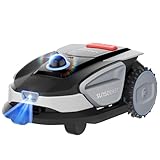
8. Sunseeker S4: Best for Shaded Yards with Complicated Geometry
Sunseeker S4 Robot Lawn Mower, 3D LiDAR, Vision AI, 0.25 Acre, Wire-Free
Coverage: up to 10890 sq ft
Cutting width: 7 inch
Cut height: 1.6 to 3.2 inch
Slope: 42 percent
Noise: 60 dB
Weight: 25 lbs
Pros
- 360-degree 3D LiDAR plus vision builds a 3D map suited to trees and passages
- 10 TOPS AllSense plans parallel routes in low light and weak-signal areas
- Rear-wheel drive handles bumps
- 31.5 inch passages and 42 percent slopes
- Wire-free app mapping with 5 maps and up to 100 zones
- Six-blade 7 inch floating cut with ride-on-edge mode
Cons
- Mapping is done by driving the mower in the app rather than automatically
- Thin owner review base at 33 reviews
Everything this machine perceives is local. The 360-degree 3D LiDAR unit builds a 3D map of your yard, which is why owners pick it for complex plots with trees, shade and narrow passages. It needs no satellite station and no boundary wire, so shade and building walls are simply not its problem.
The 10 TOPS AllSense processing handles parallel route planning in low light and weak-signal areas, and the rear-wheel drive copes with bumps and ruts. It manages 31.5 inch passages and 42 percent slopes, so it is the second-most capable machine here on gradients and it still runs at 60 dB.
The six-blade 7 inch floating cut with ride-on-edge mode adjusts from 1.6 to 3.2 inches, and app mapping gives you five saved maps with up to 100 zones or no-go areas. A rain sensor returns the mower to base when weather turns. The 2-year warranty comes with the same US-based support owners praise on the X3 Plus.
The limitation is that mapping is done by driving the mower in the app rather than by automatic detection, which is the same manual-map effort that frustrates owners of several other machines here. And at 33 reviews, the owner evidence base is the thinnest of the group.
Best suited to a yard with obstacles in it
If your lawn has a tree in the middle, a shed in a corner and a path cutting across, the 3D map is the reason to choose this. Camera and satellite systems both degrade in those conditions; a LiDAR turret pointed at a wall and a fence post does not care.
The 31.5 inch passage rating is wider than the Roborock RockNeo, so if you have a tight corridor between two obstacles, check which of the two your gap actually suits. Both handle shade far better than a pure RTK machine.
A high rating on a small sample
At 4.5 stars from 33 reviews, this rating is impressive but not well proven. The listing returned no detailed customer review text to dig into. Treat the specification as strong and the owner consensus as not yet established.
Ride-on-edge mode reduces border trimming compared with most rivals, and the floating deck copes with uneven ground. If you are still deciding between this and the X3 Plus from the same maker, the LiDAR navigation is the deciding factor for a shaded or walled yard.
9. YARDCARE V100: The Right Answer for a Very Small Lawn
YARDCARE V100 Automatic Robot Lawn Mower HD Vision for Lawn Max 1600 sq ft
Coverage: maximum 1600 sq ft
Cutting width: 6.3 inch
Cut height: 0.8 to 2.4 inch
Slope: up to 20 degrees
Weight: 27.9 lbs
Pros
- Camera navigation distinguishes grass from non-grass and detects 150 obstacle types
- 32 foot magnetic strip creates no-go zones with no digging
- Bumper sensor plus collision detection recovers from blind spots
- Tilt sensor stops blades when lifted
- rain sensor pauses in wet weather
- Box includes charger
- magnetic strip
- pegs and three spare blade sets
Cons
- Smallest coverage area in the group at 1600 sq ft
- Narrowest 6.3 inch cutting width so more passes are needed
- Uses a random mowing path rather than systematic rows
If your lawn is genuinely small, a patch under 2,000 square feet, this is the machine that matches it. At 4.8 stars from 58 reviews it is the highest-rated listing we reviewed, with the overwhelming majority of ratings at five stars. Rated coverage tops out at 1,600 square feet, which is the point.
The magnetic strip is the detail that sells it. That 32 foot strip pegged along a path or a flowerbed creates a no-go zone with no digging and no wiring, which on a small urban lot is a five-minute job rather than a weekend project. The box also includes three spare blade sets and twenty pegs.
Safety hardware is unusually complete for this category. A tilt sensor stops the blades when the machine is lifted, an emergency stop switch gives quick shutdown, and a rain sensor pauses mowing during rain. The bumper sensor plus collision detection lets it recover from blind spots, which on a tight small plot happens more often than you would expect.
Cut height runs from 0.8 to 2.4 inches with a 6.3 inch cutting width, the narrowest here, so more passes are needed than on an 8 inch deck. It also mows a random path rather than systematic rows, which owners who like visible striping will not love.
When the lawn is the wrong size for anything bigger?
This is the oversizing argument in reverse. A quarter-acre machine on a 1,600 square foot lawn spends most of its life parked, and the battery and deck you never use still have to be carried and eventually replaced. Match the machine to the grass, and for a very small lawn the smallest capable machine is the correct one.
Check the 1,600 square foot ceiling honestly. If your lawn measures more than that, or if you plan to reclaim surrounding ground, this will spend its life chasing an area it cannot cover. If it is comfortably under, you are buying exactly what you need.
Random mowing versus systematic rows
Random path mowing produces an even-looking finish over time but no visible stripes, and some owners simply prefer the ordered pattern that RTK machines produce. It is a preference, not a quality difference, and it is one of the few genuine reasons to pay more for a satellite-navigation machine.
At 27.9 pounds it is not the lightest machine here despite its small size, so check your storage route. The 21 by 16 by 11 inch footprint is compact enough for most sheds. For the very smallest lawn on this list, nothing else offers a cleaner match.
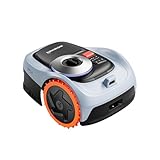
10. Segway Navimow i206 AWD: When the Ground Is Steep or Bumpy?
Segway Navimow i206 AWD Robot Lawn Mower, New i105N, 0.15 Acre, 45% Slopes
Coverage: 0.15 acre
Cutting width: 17 inch listed, 7.1 inch deck
Cut height: 2 to 3.6 inch
Battery: 2.5Ah, up to 1350 sq ft per charge
Slope: 45 percent
Pros
- All-wheel drive with stability control handles 45 percent slopes
- Zero-turn steering pivots without tearing the turf
- Very quiet
- owners report dogs are undisturbed
- Wire-free RTK plus vision with one-tap auto mapping
- Up to 20 app-controlled mowing zones
- Real-time GPS security alerts if lifted
Cons
- Auto mapping often fails
- forcing manual zone mapping
- Maps can be lost when the mower is lifted or tilted
- Has driven outside the mapped boundary into mulch beds
- Leaves an unmowed swath between mower and fence
- App-based support initially gave poor responses
All-wheel drive is what separates this machine from everything else in the list. Combined with stability control and 45 percent slope capability, it is the pick when your small lawn has a bank, ruts, or ground that a two-wheel-drive mower simply cannot hold. Several owners describe it as their third robot and the first that managed their terrain.
Zero-turn steering lets it pivot on the spot rather than swinging the deck around, which stops the rear wheels tearing up turf on tight turns. Owners also remark on how quiet it is, one reporting that their dogs are not distressed by it running.
Setup is wire-free with RTK plus vision and one-tap auto mapping, and the app controls up to 20 mowing zones with optimised routes and auto-resume charging. Real-time GPS alerts fire if the mower is lifted or leaves its course. Customer support has also been reported as outstanding, with free replacement parts.
One listing detail needs care. The product page shows a 17 inch cutting width in the specifications while the feature description refers to a 7.1 inch deck, so treat the effective cutting width as the smaller of the two and confirm before you order. It is exactly the kind of spec gap worth checking on any robot mower page.
Drive train first, software second
If your ground is the problem, nothing else here solves it the way all-wheel drive does. Buying a beautifully navigating two-wheel machine and having it bog down on a slope every second cycle wastes the money you spent on navigation. This is the one on the list where the mechanical answer beats the electronic one.
Buyers also praise the quiet cut and the clean striping. Support being reported as outstanding, with free replacement parts and accessories, is a meaningful serviceability signal that most listings in this roundup cannot claim.
Auto mapping is its real weakness
Auto mapping often fails and forces tedious manual zone mapping, maps can be lost if the mower is lifted or tilted even briefly during the process, and one owner reported it driving well outside the mapped boundary into mulch beds. On a small plot bordered by beds, that is the failure mode that matters most.
It also leaves an unmowed swath between itself and fences, and tall isolated clumps can take several mowing rounds to cut. App-based customer support initially gave poor responses before improving. On rough ground with patience for mapping, it is the right machine; on a tidy small lawn with beds close to the edge, choose a cleaner boundary performer.
How to Size a Robot Mower for a Small Lawn?
Sizing a robot mower is not really about acreage. It is about three numbers: how long your narrowest passage is, how steep your worst three feet of ground are, and how much sky or how much wall you have for navigation. Get those right and the area rating takes care of itself.
Measure these five things before you buy
First, the area. Most small-lawn buyers fall between 2,000 and 10,000 square feet, and every machine here covers that range several times over. Area is the least interesting number on the spec sheet.
Second, the narrowest passage. This is the real floor. If the mower has to get between a shed and a fence, or around the back of a parked car, the gap has to be wider than the machine plus clearance. The Roborock RockNeo publishes 2.3 feet, the MOVA LiDAX 23.6 inches, and the Sunseeker S4 31.5 inches. Those three figures tell you more than the acreage.
Third, the steepest three feet anywhere on the lawn. Check the bank down to a path and the strip along a retaining wall, not the middle of the grass. Machines here run from 20 to 24 degrees at the low end up to 45 percent on the best all-wheel and LiDAR models. A driveway bank that exceeds your machine’s published slope limit will stop it every cycle.
Fourth, the sky view. RTK machines need a clear patch of sky for the antenna and base station. A small garden walled by trees and houses may not have one anywhere a machine can reach. That is the whole reason LiDAR-first models like the ANTHBOT M5 and the Sunseeker S4 exist.
Fifth, what sits along the edges. Walls, hedges, raised beds and fences all narrow the usable width and all make edge cutting harder. Count them, because the width of the strip your mower can actually reach decides how much string trimming you are signing up for.
Duty cycle is the number that decides whether it keeps up
A robot mower does not finish your lawn in one run. It mows until the battery drops, charges, then resumes, and it repeats that for days until the lawn is even. The figure that tells you whether it wins is the duty cycle: run time divided by run time plus charge time.
Worked example. Take the ECOVACS GOAT O1000 with a published 90 minute battery. If charging takes roughly 90 minutes, that gives 90 divided by 180, or 50 percent duty cycle. It works when it works and recharges when it recharges, and over several days that covers the ground.
Compare that with the ANTHBOT M5 at about 40 minutes of runtime per charge. On a similar charge time its duty cycle is nearer 30 percent. Lower duty cycle does not mean a worse machine, it means it has to run more often. Owners of small machines on small lawns typically schedule them every two or three days rather than daily, which is a perfectly reasonable routine.
The practical rule: on a lawn under 2,000 square feet, a low duty cycle matters little because there is little to do. On a 10,000 square foot lawn, duty cycle decides whether you are cutting or charging most of the day. This is also the clearest argument against oversizing, because extra battery capacity on a small lawn buys nothing.
What running a robot mower on a small lawn actually costs?
Blades are the ongoing cost nobody mentions. Expect to replace the blade set at least once a season on a small lawn and more often if you mow every two days with a spin cycle. Spares are cheap and easy to fit, but check before you buy whether spares ship quickly from the manufacturer, because that is where the newer brands differ sharply from the established ones.
Electricity is minor. These machines draw roughly the power of a household appliance for a couple of hours a cycle, so the running cost over a season is negligible next to fuel for a petrol mower. Batteries are the bigger long-term item, and on several of the machines in this roundup owners report batteries that are not user-swappable. That is the serviceability question to ask before buying rather than after.
Winter storage matters more for a small garage. Weights here run from 19.9 pounds for the Sunseeker X3 Plus to 44.5 pounds for the ECOVACS GOAT O1000. If you will be lifting the machine in and out each winter, that twenty-five pound difference decides the purchase more often than any feature list does.
If you are still weighing a manual machine against an automatic one, our electric lawn mowers for small yards guide covers the human-powered options in the same size class.
Wire-Free or Boundary Wire on a Small Lot?
Every machine in this roundup is wire-free, and on a small urban lot that is usually the right call. A buried boundary wire means trenching a perimeter that is mostly flowerbed, path and fence, which turns a Saturday into a project and commits you to the layout of the lawn for the life of the machine.
Virtual boundaries cost you the flexibility instead. Editing one means driving the mower or drawing a zone in the app, and several owners here report that automatic mapping failed and forced manual work. In exchange you avoid the wire entirely, and you can move the mower between lawn areas.
The one case where a wire still wins is if you plan to run a plug aerator over the lawn. Forum advice on this is consistent: do not buy a wired robot mower if you will ever aerate across the boundary line, because the aerator tines catch the wire. If aeration is on your plan, wireless is the only sensible route.
The other edge case is fully enclosed yards. GPS positioning degrades badly inside walled or heavily built-up plots, and owners of GPS-based machines in this roundup report exactly that. A LiDAR-first machine such as the ANTHBOT M5, the Sunseeker S4 or the MOVA LiDAX handles those yards without a signal.
Frequently Asked Questions
How small is too small for a robot lawn mower?
Area is the wrong limit. The real floor is your narrowest passage: the mower must be able to physically get through any gap between a shed, a path and a fence. Below roughly 2,000 square feet, a small camera-vision machine such as the YARDCARE V100 covers the whole lawn and stores easily. Below about 1,000 square feet, a robot may cost more time than it saves.
Is a robot mower worth it on a small lawn?
It is the strongest case a robot mower ever has. On a small plot the install takes an afternoon instead of a weekend, the smallest machine is genuinely enough, and noise sits close enough to the house for the decibel figure to matter. The trade is that a robot does not finish in one run, so a half-cut lawn at the end of a cycle is normal and takes a day or two to even out.
Which robot lawn mower is best for small lawns?
For most small lawns the Segway Navimow i105N is the strongest all-round pick: it is sized to a 1/8 acre, runs at 58 dB(A), navigates without a boundary wire, and carries the deepest owner review history in this group. If your lawn sits under heavy tree cover, choose a LiDAR machine such as the ANTHBOT M5 instead. For a lawn under 2,000 square feet, the YARDCARE V100 is the right size.
Can you use a big robot mower on a small lawn?
You can, but it is wasted money. A quarter-acre machine on a 1,600 square foot lawn spends most of its life parked, and the battery and deck you never use still have to be lifted and eventually replaced. You gain nothing from the extra capacity and carry the extra weight, so match the machine to the grass rather than buying headroom.
What is the minimum cutting height for a robot lawn mower?
It varies by model. In this roundup the lowest published minimum is 0.8 inch on both YARDCARE machines, the ANTHBOT M5 goes down to 1.2 inch, the MOVA LiDAX spans 1.2 to 3.9 inch, and the Segway Navimow models bottom out at 2 inch. Most temperate lawns sit comfortably between 1.5 and 2.5 inch.
What are the downsides of using a robotic lawn mower?
Five things come up repeatedly. You still need a string trimmer for borders because most machines leave an uncut strip. They do not finish in one run, so expect a half-cut lawn at the end of a cycle. A robot cannot handle grass that has grown too tall, so tall patches need cutting down first. Newer brands may have non-swappable batteries and thin parts networks. And installation of a boundary wire is a real weekend job on wired models.
Bottom Line: Which Robot Mower for Small Lawns Fits Your Yard?
For most small lawns, the Segway Navimow i105N is the pick. It is correctly sized, genuinely quiet at 58 dB(A), needs no boundary wire, and has more owner history behind it than anything else we reviewed. Match it with the ANTHBOT M5 if trees block your satellite view, the YARDCARE M800Plus if your ground is steep and flat-looking, and the YARDCARE V100 if the lawn is genuinely tiny.
Check your narrowest passage, your worst three feet of slope, and your sky view before you order. Those three answers will pick the right machine for you faster than any rating ever will.