
I remember staring at my first property analysis spreadsheet, completely baffled by this “cap rate” number everyone kept talking about. The realtor kept saying “6.2 cap” like it was supposed to mean something profound to me. It didn’t.
Here’s what I eventually learned: cap rate is simply the annual return percentage you’d earn on a property if you bought it with all cash. No mortgage, no leverage, just pure income divided by price. Understanding cap rate explained changed how I evaluate every investment property I look at today.
In this guide, I’ll walk you through exactly how cap rate works, how to calculate it correctly, what makes a “good” cap rate in different markets, and the costly mistakes I’ve seen investors make when using this metric. Whether you’re analyzing your first rental or your fiftieth, this framework will help you make smarter decisions.
Table of Contents
What Is Cap Rate? (Simple Definition)
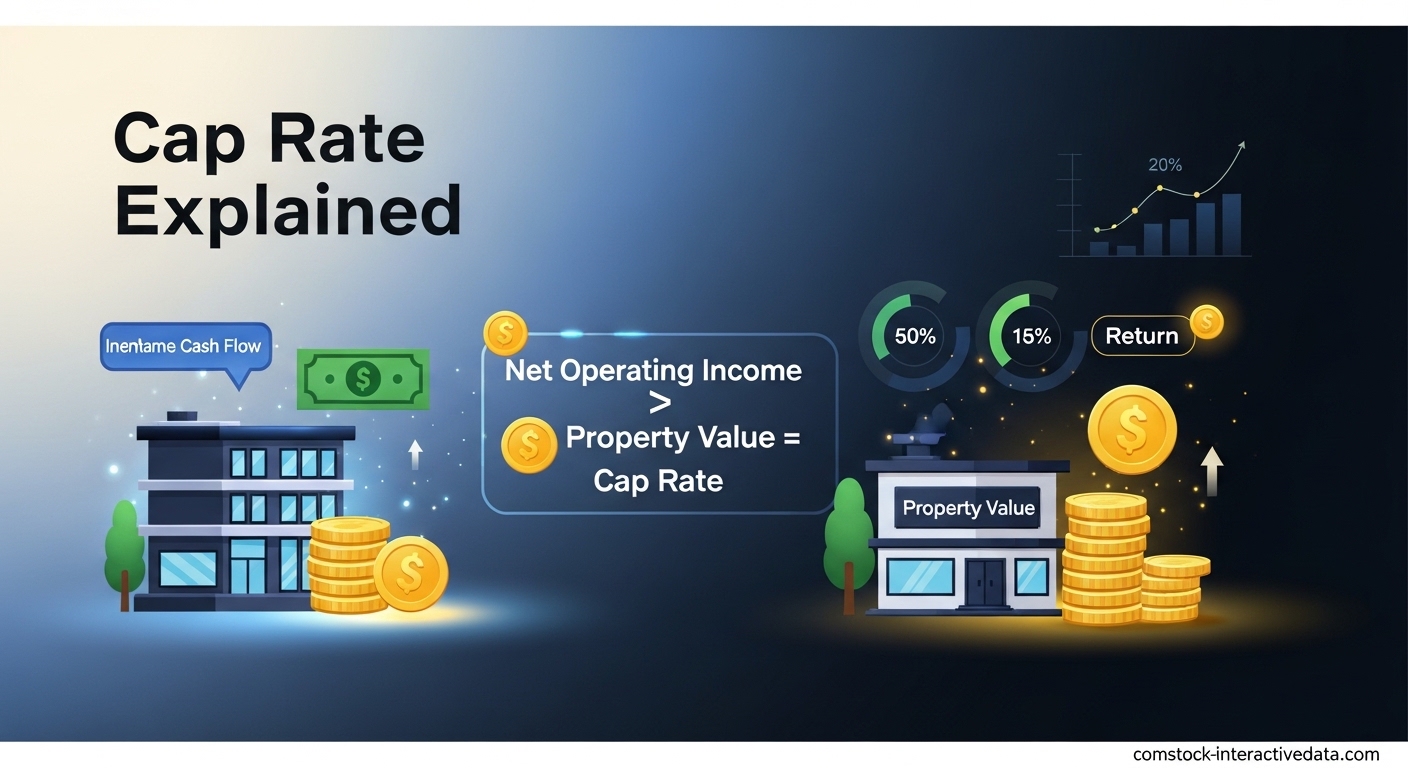
Cap rate (short for capitalization rate) measures the annual rate of return on a real estate investment property based on the income it generates. You calculate it by dividing the property’s net operating income by its purchase price or current market value.
The result is expressed as a percentage. A 7% cap rate means the property generates annual income equal to 7% of its purchase price. This assumes you bought the property entirely with cash and had no mortgage payments.
Cap rate strips away financing complications and shows you the property’s pure earning power. Two investors using different loan terms can look at the same cap rate and have a common ground for comparison. That’s why it’s so widely used in commercial real estate and multifamily investing.
The Cap Rate Formula: How to Calculate It
The cap rate formula is straightforward, but getting the inputs right requires attention to detail. Here’s the basic equation:
Cap Rate = Net Operating Income / Purchase Price
The challenge most new investors face is accurately determining the net operating income (NOI). This isn’t just your rental income. It’s your rental income minus all operating expenses.
NOI includes:
- Gross rental income (actual rent collected)
- Minus property taxes
- Minus insurance
- Minus maintenance and repairs
- Minus property management fees
- Minus utilities (if landlord-paid)
- Minus vacancy allowance (typically 5-10%)
NOI specifically excludes:
- Mortgage principal and interest payments
- Capital expenditures (major improvements)
- Depreciation (accounting expense, not cash)
- Owner’s personal income taxes
The key is using actual operating numbers, not what the seller claims or what you hope to achieve. I always request trailing twelve-month financials and verify expenses independently.
Cap Rate Calculation Example: Step-by-Step
Let me show you exactly how this works with a real-world example. Last year, I evaluated a fourplex in a midwestern market. Here’s how I calculated the cap rate:
Step 1: Calculate Gross Income
Each unit rents for $900 per month. That’s $3,600 monthly or $43,200 annually.
Step 2: Account for Vacancy
This market averages 7% vacancy. 7% of $43,200 = $3,024. Effective gross income = $40,176.
Step 3: Subtract Operating Expenses
- Property taxes: $4,200
- Insurance: $1,800
- Maintenance/repairs (8% of EGI): $3,214
- Property management (10% of EGI): $4,018
- Utilities (common area): $1,200
Total operating expenses: $14,432
Step 4: Calculate NOI
$40,176 (effective gross income) minus $14,432 (operating expenses) = $25,744 NOI.
Step 5: Calculate Cap Rate
The seller asks $320,000. Cap rate = $25,744 / $320,000 = 8.0%.
That 8% cap rate tells me this property generates $8 in annual income for every $100 invested. I can now compare this against other properties in the same market.
Another Example: Lower Cap Rate Market
Compare that to a similar fourplex I looked at in San Diego. Rents were $2,200 per unit ($8,800 monthly, $105,600 annually). After 5% vacancy and operating expenses, NOI came to about $58,000. Purchase price: $1,200,000.
Cap rate = $58,000 / $1,200,000 = 4.8%.
Same property type, very different cap rate. This illustrates why you can’t compare cap rates across markets without understanding local dynamics.
What Is a Good Cap Rate?
The most common question I hear is some variation of “what cap rate should I target?” The honest answer: it depends on your market, risk tolerance, and investment goals.
Generally, cap rates fall into these ranges:
Primary Markets (Major metros like NYC, San Francisco, LA)
- Typical range: 3.5% – 5.5%
- These markets offer stability and appreciation potential
- Lower returns reflect lower perceived risk
Secondary Markets (Austin, Nashville, Charlotte, Phoenix)
- Typical range: 5.5% – 7.5%
- Balance of growth potential and current yield
- Where many investors focus in 2026
Tertiary Markets (Smaller cities, rural areas)
- Typical range: 7% – 10%+
- Higher yields but typically less appreciation
- Often more management-intensive
Property Type Matters Too
- Multifamily (apartments): Generally 4% – 8%
- Retail: 5% – 9%
- Office: 5% – 10%
- Industrial: 4.5% – 8%
- Hotels: 8% – 12%
A 6% cap rate might be excellent in Manhattan but mediocre in Memphis. You must compare against similar properties in the same market. I track cap rates by submarket and property class to know what “market rate” actually is.
Cap Rate and Risk: Is Higher Always Better?
Many investors assume higher cap rates mean better deals. That’s dangerously incomplete. Cap rate reflects risk as much as return.
When Low Cap Rates Make Sense
Prime properties in growing markets often trade at 4-5% cap rates. This isn’t necessarily bad. These properties typically:
- Have stable, long-term tenants
- Appreciate consistently (3-5% annually)
- Require minimal management
- Hold value during downturns
Your total return = cap rate + appreciation. A 4.5% cap rate with 4% annual appreciation beats an 8% cap rate with zero appreciation over a 10-year hold.
When High Cap Rates Signal Problems
Be wary of properties with cap rates significantly above market. An 11% cap rate in a 7% market often indicates:
- Deferred maintenance issues
- Tenant problems or high turnover
- Declining neighborhood
- Environmental or structural concerns
- Overstated income or understated expenses
I passed on a 12% cap rate property last year because the building needed $80,000 in immediate HVAC and roof work. The “high” cap rate evaporated once real expenses were factored.
The Risk Premium Concept
Think of cap rate as the risk-free rate plus a risk premium. The 10-year Treasury (roughly 4-5% historically) represents a risk-free baseline. Real estate cap rates typically add 2-6% on top for the additional risks of property ownership.
Cap Rate vs. Other Investment Metrics
Cap rate is useful, but it’s not the only metric you need. Here’s how it compares to other key measurements:
Cap Rate vs. Cash-on-Cash Return
Cap rate ignores financing. Cash-on-cash return includes your mortgage. If you buy that 8% cap rate property with a 20% down payment and leverage, your cash-on-cash return might be 12-15%. I use cap rate to evaluate the property itself and cash-on-cash to evaluate my specific deal structure.
Cap Rate vs. Total ROI
Cap rate only measures income. Total ROI includes appreciation, principal paydown, and tax benefits. A 5% cap rate property in a growing market might deliver 12-15% total annual returns when you factor in everything.
Cap Rate vs. IRR (Internal Rate of Return)
IRR is the gold standard for measuring returns over time. It accounts for all cash flows, timing, and your exit. Cap rate is a snapshot; IRR is the movie. Use cap rate for quick screening, IRR for detailed analysis.
When to Use Each Metric
- Use cap rate: Comparing properties, quick screening, market analysis
- Use cash-on-cash: Evaluating your actual cash investment return
- Use total ROI: Understanding complete wealth building
- Use IRR: Comparing across different investment types or hold periods
Factors That Affect Cap Rates
Understanding what drives cap rates helps you predict where they’re headed and identify mispriced opportunities.
Location Quality
Properties in dense, supply-constrained markets command lower cap rates. Manhattan apartments trade at 4% while similar buildings in Buffalo might be 7%. Location stability reduces risk, which reduces required returns.
Property Condition and Age
Newer buildings with modern systems trade at lower cap rates because they have fewer surprise expenses. A 1980s building with original HVAC will trade at a higher cap rate (or should) because buyers factor in capital costs.
Tenant Quality and Lease Terms
Credit tenants on long-term leases reduce risk. A CVS pharmacy on a 10-year lease might sell at a 5.5% cap rate, while a similar building with month-to-month local tenants trades at 8%.
Interest Rate Environment
Cap rates historically correlate with the 10-year Treasury yield. When rates rise, cap rates typically follow. In 2026, we’re watching this relationship closely as the Fed adjusts policy.
Supply and Demand Dynamics
High demand with limited supply compresses cap rates. When capital floods into real estate (like we saw in 2021-2022), buyers accept lower returns, driving cap rates down.
Cap Rate Compression and Expansion
These terms describe how cap rates move over time and directly impact property values.
Cap Rate Compression
Compression occurs when cap rates decrease (fall from 7% to 5%). This happens when:
- Interest rates drop
- More capital competes for deals
- Market perception of risk decreases
Compression increases property values. A building generating $50,000 NOI is worth $1 million at a 5% cap rate versus $714,000 at a 7% cap rate. That’s a 40% value increase from cap rate movement alone.
Cap Rate Expansion
Expansion is the opposite – cap rates rise (from 5% to 7%). This occurs when:
- Interest rates increase
- Investors demand higher risk premiums
- Market outlook worsens
Expansion destroys property values using the same math in reverse. This is why experienced investors track cap rate trends, not just current levels.
Why This Matters for Your Strategy
Buying in compressed markets (low cap rates) assumes they’ll stay low or compress further. That’s a risk. I prefer buying at market cap rates or slightly above, giving me margin if rates expand.
5 Common Cap Rate Mistakes Investors Make
I’ve made several of these mistakes myself. Learn from my errors:
Mistake 1: Using Pro Forma Instead of Actual NOI
Sellers love to show “pro forma” numbers – what the property “could” earn with their expert management. These are fantasy. Always use actual trailing 12-month financials. I once bought based on pro forma that was $8,000 higher than actual NOI. Never again.
Mistake 2: Ignoring Capital Expenditures
Cap rate uses NOI, which excludes major capital items like roofs and HVAC. A property with a new roof deserves a different cap rate than one needing $40,000 in repairs. Adjust your purchase price or expected cap rate for near-term capex.
Mistake 3: Comparing Different Property Types
A 6% cap rate on a single-family rental is very different from a 6% cap rate on a retail strip center. Different risk profiles, different tenant bases, different expense structures. Only compare apples to apples.
Mistake 4: Not Verifying Expenses
Sellers underreport expenses. They forget management fees (“I self-manage”), underestimate repairs, or exclude utilities. I verify every major expense line item with actual bills or market estimates.
Mistake 5: Ignoring Value-Add Opportunity
A property with below-market rents shows a lower cap rate than its potential. If tenants are paying $700 and market is $900, the current 5% cap rate might become 7% once you raise rents. Calculate both “as-is” and “stabilized” cap rates.
How Investors Actually Use Cap Rate?
Theory is nice, but here’s how I and other investors use cap rate in practice:
Property Screening and Filtering
I set minimum cap rate thresholds by market. If I’m targeting Cleveland at 8%+ and a listing shows 6%, I probably pass unless there’s clear value-add potential. This saves enormous time.
Quick Valuation Method
If I know market cap rates are 7% and a property generates $40,000 NOI, I can quickly estimate value: $40,000 / 0.07 = $571,000. This helps me spot underpriced listings or know my offer range.
Market Comparison Tool
I track cap rates across markets to identify where capital is flowing. When I see Phoenix cap rates compressing from 6% to 5%, I know prices are rising faster than rents. That might signal a market getting overheated.
Negotiation Leverage
If comparable sales show 7% cap rates and a seller’s property is listed at 6%, I have objective data to support a lower offer. “Based on recent sales, this property should trade at $X for a market-rate return.” Facts beat feelings in negotiation.
Portfolio Benchmarking
I calculate the blended cap rate across my portfolio quarterly. If it’s declining, I’m either buying lower-yielding properties or my markets are compressing. Either way, I know to adjust strategy.
When NOT to Use Cap Rate?
Cap rate has limitations. Don’t use it for these situations:
Vacant Land or Value-Add Properties
Properties with no current income have no calculable cap rate. A building that needs $200,000 in renovation before leasing isn’t fairly valued by its current (near-zero) cap rate.
Short-Term Holdings (Under 5 Years)
Cap rate assumes a going-concern, perpetual hold. If you’re flipping in two years, focus on total profit potential and exit cap rate assumptions, not current yield.
Personal Residences
Your primary home generates no rental income, so cap rate doesn’t apply. Use different metrics for evaluating homes you live in.
Development Projects
Ground-up construction has no NOI until completion. Use development pro formas and target yields, not cap rates.
Properties with Complex Income Streams
Hotels, parking garages, or properties with significant percentage rent arrangements might need more sophisticated analysis than simple cap rate.
Practical Cap Rate Evaluation Framework
Here’s the exact process I follow when evaluating properties using cap rate:
Step 1: Verify Actual NOI
Request T-12 (trailing 12 months) financials. Verify rent roll against bank deposits. Confirm expense categories match reality. Reject pro forma numbers unless you can achieve them immediately.
Step 2: Research Market Comparables
Find 3-5 recent sales of similar properties in the same submarket. Calculate their cap rates from public data or ask brokers. This establishes your baseline.
Step 3: Adjust for Property-Specific Factors
Does this property have better or worse location than comps? Newer or older systems? Better or worse tenant quality? Adjust your target cap rate accordingly.
Step 4: Factor in Your Return Requirements
If you need 8% cash-on-cash returns and plan to use 70% leverage, you might target 7%+ cap rates depending on your interest rate. Work backward from your goals.
Step 5: Consider Total Return Picture
A 5% cap rate in a 4% growth market might beat an 8% cap rate in a stagnant market over your hold period. Model the full scenario, not just current yield.
Market-Specific Cap Rate Reference
Here’s what I’m seeing in major markets as of 2026:
| Market Tier | Example Cities | Multifamily Cap Range | Retail Cap Range |
|---|---|---|---|
| Gateway/Primary | NYC, SF, Boston, DC | 3.5% – 5.0% | 4.5% – 6.0% |
| Strong Secondary | Austin, Nashville, Denver, Seattle | 4.5% – 6.0% | 5.5% – 7.0% |
| Emerging Secondary | Phoenix, Tampa, Charlotte, Raleigh | 5.0% – 6.5% | 6.0% – 7.5% |
| Tertiary/Smaller | Indianapolis, Memphis, Cleveland | 6.0% – 8.0% | 7.0% – 9.0% |
| Rust Belt/Value | Detroit, Buffalo, Pittsburgh | 7.0% – 10.0% | 8.0% – 12.0% |
These ranges move with interest rates and market sentiment. Use them as directional guidance, not absolute rules.
Frequently Asked Questions
What is a good cap rate for investment property?
A good cap rate depends on your market and goals. Generally, 4-5% is typical for primary markets like NYC or San Francisco, 5.5-7.5% for secondary markets like Austin or Nashville, and 7-10%+ for tertiary markets. What matters most is comparing against similar properties in the same market, not chasing arbitrary numbers.
What is the 7% rule in real estate?
The 7% rule suggests that properties should generate at least 7% cap rate to provide adequate cash flow cushion for vacancies, maintenance, and unexpected expenses. While popular on forums, this rule is market-dependent. A 7% cap rate might be excellent in San Diego but below average in Cleveland. Use market comparables rather than fixed rules.
What does a 7.5% cap rate mean?
A 7.5% cap rate means the property generates annual net operating income equal to 7.5% of its purchase price. If you bought a property for $400,000 with a 7.5% cap rate, it would produce $30,000 in annual net operating income. This assumes an all-cash purchase with no mortgage.
What does a 9% cap rate mean?
A 9% cap rate indicates higher potential returns and typically higher risk. The property generates annual net operating income equal to 9% of its value. For a $300,000 property, that’s $27,000 annual NOI. Markets with 9% cap rates often have lower appreciation expectations or higher perceived risk than 5-6% cap markets.
What is the 3 3 3 rule in real estate?
The 3 3 3 rule refers to evaluating properties based on three scenarios: 3% appreciation, 3% rent growth, and 3% inflation. It helps stress-test investments across different economic conditions. Some investors also use it to mean having 3 months reserves, 3 exit strategies, and 3 ways to add value.
Is a 7.6% cap rate good?
A 7.6% cap rate is generally solid for most markets outside of major gateway cities. In secondary markets like Phoenix, Tampa, or Austin, this would be considered a good cap rate. In tertiary markets, it might be average. In Manhattan or San Francisco, it would be exceptionally high and warrant investigation into potential problems.
What is considered a good cap rate for investors?
Most investors target cap rates between 5% and 10%, depending on their strategy. Cash-flow-focused investors often prefer 7% and above. Appreciation-focused investors might accept 4-6% in growth markets. The key is that your cap rate must exceed your cost of capital (loan interest rate) for positive leverage to work.
Is a 7% cap rate good or bad?
A 7% cap rate is generally good for cash flow investors. It provides a reasonable return while typically allowing for professional property management and maintenance reserves. Whether it’s good for you depends on your market – it’s excellent in coastal California, average in Texas markets, and potentially low in Rust Belt cities where 8-10% is common.
Is 4.5% a good cap rate?
A 4.5% cap rate can be good in the right context. In appreciation-heavy markets like San Diego or Seattle, 4.5% with 4-5% annual appreciation creates solid total returns. However, if you’re solely dependent on cash flow or in a flat market, 4.5% may not provide adequate returns after expenses and reserves. Evaluate total return, not just cap rate.
Conclusion
Cap rate explained simply is this: a snapshot of your property’s income-generating power relative to its price. It’s one of the most important tools in real estate investing, but it’s not the only tool you need.
Use cap rate to screen properties quickly, compare deals within the same market, and understand whether you’re paying a fair price for expected income. Remember that a good cap rate in Phoenix differs from a good cap rate in Pittsburgh. Compare apples to apples.
Don’t fall in love with high cap rates without understanding why they’re high. And don’t dismiss lower cap rates in growth markets without calculating total return including appreciation. The investors who thrive long-term are those who use cap rate as part of a complete analysis, not as a shortcut to avoid thinking.
Now that you understand how cap rate works, start tracking cap rates in your target markets. Build your own database of comparable sales. The more you practice these calculations, the faster you’ll spot good deals and avoid expensive mistakes.