
Imagine selling a rental property for a $400,000 profit and keeping an extra $95,000 in your pocket instead of handing it to the IRS. That is exactly what happened to a client of mine last year. He used a strategy that most real estate investors know about but few fully understand: the 1031 exchange.
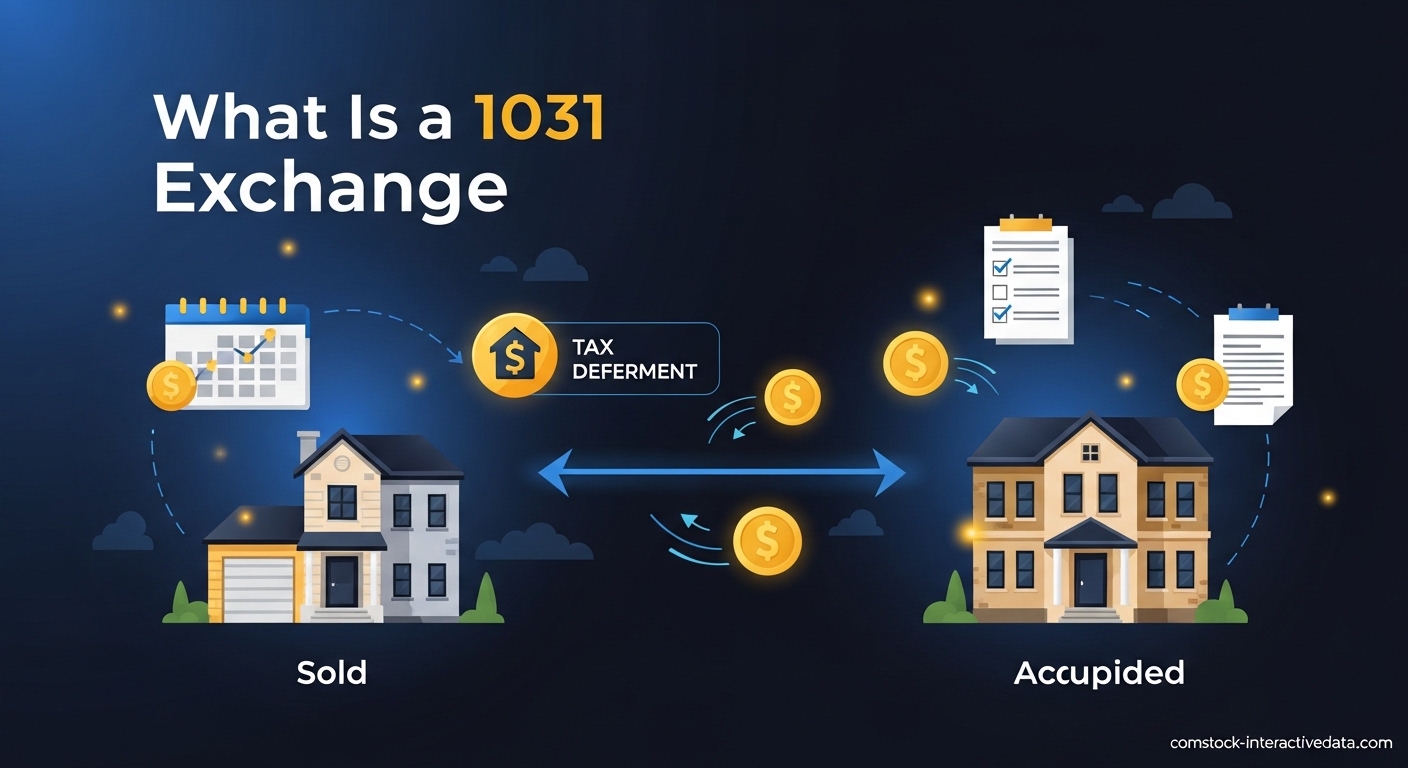
So what is a 1031 exchange? In simple terms, it is a provision in the IRS code that lets you sell an investment property and reinvest the proceeds into a new like-kind property while deferring all capital gains taxes. You are essentially swapping one property for another without triggering the tax bill that normally comes with a profitable sale.
This article breaks down exactly how a 1031 exchange works, the strict rules you must follow, and most importantly, how much money you can actually save. Whether you are a seasoned investor or selling your first rental property, understanding this tax strategy could be worth tens of thousands of dollars.
Table of Contents
What Is a 1031 Exchange? (Simple Definition)
A 1031 exchange gets its name from Section 1031 of the Internal Revenue Code. It is also called a like-kind exchange, a Starker exchange, or simply a tax-deferred exchange. All these terms describe the same process: selling one investment property and buying another without paying capital gains taxes at the time of the sale.
The key word here is deferred. A 1031 exchange does not eliminate your tax obligation permanently. It delays it. The idea is that you can keep rolling your gains into bigger and better properties throughout your lifetime. Eventually, if you sell without doing another exchange, you will pay the taxes. However, many investors hold properties until death, at which point their heirs receive a stepped-up basis and the deferred taxes effectively disappear.
The concept is straightforward. You sell a property that has appreciated in value. Normally, you would owe capital gains tax on that appreciation. Instead, you use a special process to transfer the proceeds directly into a new property. The government treats this as a continuation of your original investment rather than a taxable sale.
How Does a 1031 Exchange Save You on Taxes? (With Real Numbers)
Here is where most articles get vague. They tell you that 1031 exchanges save taxes but do not show you exactly how much. Let me fix that with a real-world scenario.
Say you bought a rental property 10 years ago for $300,000. You have taken $80,000 in depreciation deductions over the years. Now you are selling it for $700,000. That gives you a $400,000 gain. Here is what happens with and without a 1031 exchange:
Scenario A: Regular Sale (No 1031 Exchange)
- Federal capital gains tax (20% for high earners): $80,000
- Depreciation recapture tax (25%): $20,000
- Net Investment Income Tax (3.8%): $15,200
- State capital gains tax (5% example): $20,000
- Total tax bill: $135,200
- Cash remaining to reinvest: $264,800
Scenario B: 1031 Exchange
- Federal capital gains tax: $0 (deferred)
- Depreciation recapture tax: $0 (deferred)
- Net Investment Income Tax: $0 (deferred)
- State capital gains tax: $0 (deferred)
- Total tax bill today: $0
- Full $400,000 equity available for reinvestment
The difference is staggering. By using a 1031 exchange, you keep the entire $400,000 working for you instead of sending $135,200 to various tax authorities. That gives you significantly more purchasing power for your next property.
The Power of Deferred Taxes
Deferring taxes is not just about keeping money today. It is about compound growth. That extra $135,000 you kept can buy a bigger property that generates more rental income and appreciates more over time. Over 20 years, that difference could compound into hundreds of thousands of additional dollars.
Some investors call this the buy, borrow, die strategy. You buy properties, exchange up to bigger ones over your lifetime, borrow against them for cash if needed, and hold until death. Your heirs get the properties at a stepped-up basis, which means the deferred taxes never get paid. The wealth transfers to the next generation tax-free.
The 1031 Exchange Process: Step-by-Step
A 1031 exchange follows a specific sequence. Skip a step or get the timing wrong, and you could lose the tax benefits entirely. Here is exactly how it works:
Step 1: Decide to Sell Your Investment Property
You cannot exchange your primary residence or vacation home. The property must be held for investment or business use. Rental properties, commercial buildings, vacant land held for appreciation, and even certain leasehold interests all qualify.
Step 2: Hire a Qualified Intermediary Before Closing
This is critical. A Qualified Intermediary, also called an Exchange Accommodator or QI, is a neutral third party who handles the exchange paperwork and holds your sale proceeds. You must engage the QI before you close on the sale of your relinquished property.
If you receive the proceeds directly, even for a day, the exchange is blown. The IRS considers that constructive receipt, and you will owe taxes on the full gain. Your QI creates the legal structure that keeps the transaction valid.
Step 3: Close the Sale (Proceeds Go to the QI)
When your property sells, the funds transfer directly to your Qualified Intermediary, not to you. The QI holds the money in a segregated account until you are ready to purchase your replacement property. You cannot touch, borrow against, or benefit from these funds during the exchange period.
Step 4: Identify Replacement Property Within 45 Days
The clock starts ticking the day you close on your relinquished property. You have 45 calendar days to identify potential replacement properties in writing to your QI. This is not a suggestion. It is a hard deadline.
You have three options for how many properties to identify:
- The 3-Property Rule: Identify up to 3 properties regardless of value. This is what most investors use.
- The 200% Rule: Identify unlimited properties as long as their total fair market value does not exceed 200% of your relinquished property value.
- The 95% Rule: Identify unlimited properties of any value, but you must acquire 95% of the total identified value.
Step 5: Close on Replacement Property Within 180 Days
You must complete the purchase of your replacement property within 180 days of selling your original property. This deadline is absolute. Weekends and holidays count. The IRS does not grant extensions for missed deadlines.
Step 6: File Form 8824 With Your Tax Return
When you file your taxes for the year of the exchange, you must submit IRS Form 8824 to report the transaction. This form documents the properties exchanged, the timeline, and the deferred gain. Your tax preparer or CPA should handle this, but make sure they know about the exchange.
Critical 1031 Exchange Rules You Must Follow
The IRS is strict about 1031 exchanges. One mistake can invalidate the entire transaction and trigger a massive tax bill. Here are the non-negotiable rules:
Like-Kind Property Requirement: The replacement property must be like-kind to the relinquished property. Fortunately, like-kind is surprisingly broad for real estate. You can exchange an apartment building for a shopping center, raw land for a rental house, or a commercial property for multiple residential units. Almost any real estate for any real estate works. The key is that both must be held for investment or business use.
Same Taxpayer Rule: The taxpayer who sells the relinquished property must be the same taxpayer who acquires the replacement property. If you own the old property in an LLC, the new property must be acquired by that same LLC. You cannot sell as an individual and buy as a corporation without triggering taxes.
Equal or Greater Value Rule: To defer 100% of your taxes, the replacement property must have a purchase price equal to or greater than your relinquished property. Additionally, you must reinvest all of your net equity from the sale. If you buy a cheaper property or pull cash out, that difference is called boot and becomes immediately taxable.
No Boot Received: Boot is any non-like-kind property received in the exchange. This includes cash you receive, mortgage debt relief that exceeds your new debt, or personal property included in the deal. Any boot triggers partial taxation.
Qualified Intermediary Required: You cannot handle the exchange yourself. You cannot have your attorney or CPA act as the intermediary if they have represented you in the past two years. The QI must be an independent third party.
Types of 1031 Exchanges
While most people think of the classic sell-then-buy scenario, there are actually four main types of 1031 exchanges. Understanding your options gives you more flexibility.
Delayed Exchange: This is the most common type, accounting for about 95% of all exchanges. You sell your property first, the QI holds the proceeds, and you buy the replacement property within the 180-day window. The delayed structure gives you time to find the perfect replacement.
Reverse Exchange: In a reverse exchange, you buy the replacement property before you sell your relinquished property. This is useful when you find the perfect deal but have not sold your current property yet. The mechanics are more complex and expensive because an Exchange Accommodation Titleholder must hold the new property temporarily, but it is a powerful tool when timing is tight.
Simultaneous Exchange: This is the original form of 1031 exchange where the sale of the old property and purchase of the new property happen on the same day. While theoretically simple, simultaneous exchanges are rare today because coordinating two closings perfectly is extremely difficult.
Improvement or Build-to-Suit Exchange: This type allows you to use exchange funds to construct improvements on the replacement property before you take title. You can essentially build your perfect property using tax-deferred dollars. The construction must be completed within the 180-day exchange period, which makes this option challenging for major projects.
When Should You Consider a 1031 Exchange?
A 1031 exchange is not always the right move. Here are the scenarios where it makes sense, and a few where it does not.
Consider a 1031 exchange when:
- You want to upgrade to a larger or better-located property with more income potential.
- You want to diversify by exchanging one property for several smaller ones in different markets.
- You want to consolidate multiple properties into one easier-to-manage asset.
- You are relocating and want to move your investment to a new geographic area.
- You want to exchange into a property type with better long-term prospects, like trading residential for commercial.
- You are building an estate plan and want to pass appreciated properties to heirs with stepped-up basis.
A 1031 exchange might NOT be right when:
- You need the cash from the sale for personal expenses or other investments outside real estate.
- The property has depreciated and you have a tax loss you want to claim.
- You are near the stepped-up basis threshold already and plan to hold until death.
- The exchange costs and complexity outweigh the tax benefits on a small gain.
- You want to convert the property to a primary residence soon.
Frequently Asked Questions
What is the downside of a 1031 exchange?
What is the 2 year rule for 1031 exchange?
What is the 95% rule in a 1031 exchange?
Will 1031 exchange be eliminated in 2026?
Can I use a 1031 exchange for my primary residence?
What happens if I sell my replacement property later?
Final Thoughts: Is a 1031 Exchange Right for You?
A 1031 exchange is one of the most powerful tools available to real estate investors. The ability to defer capital gains taxes, depreciation recapture, state taxes, and the Net Investment Income Tax can save you tens or even hundreds of thousands of dollars on a single transaction. Those savings compound over time as you exchange into larger, more profitable properties.
However, the process is complex and unforgiving. Miss the 45-day identification deadline by even one day, and your exchange fails. Choose the wrong Qualified Intermediary, and your funds could be at risk. Attempt to handle the exchange yourself, and you will likely create a taxable event.
If you are considering selling an investment property, speak with a Qualified Intermediary before you list the property. The best QIs will walk you through the process, help you understand your options, and ensure every deadline is met. Also consult with your CPA or tax advisor to model your specific tax savings and confirm an exchange aligns with your overall financial strategy.
This article is for educational purposes only and does not constitute tax, legal, or financial advice. Tax laws change frequently, and individual circumstances vary. Always consult with qualified tax professionals and a reputable Qualified Intermediary before proceeding with any 1031 exchange transaction.