
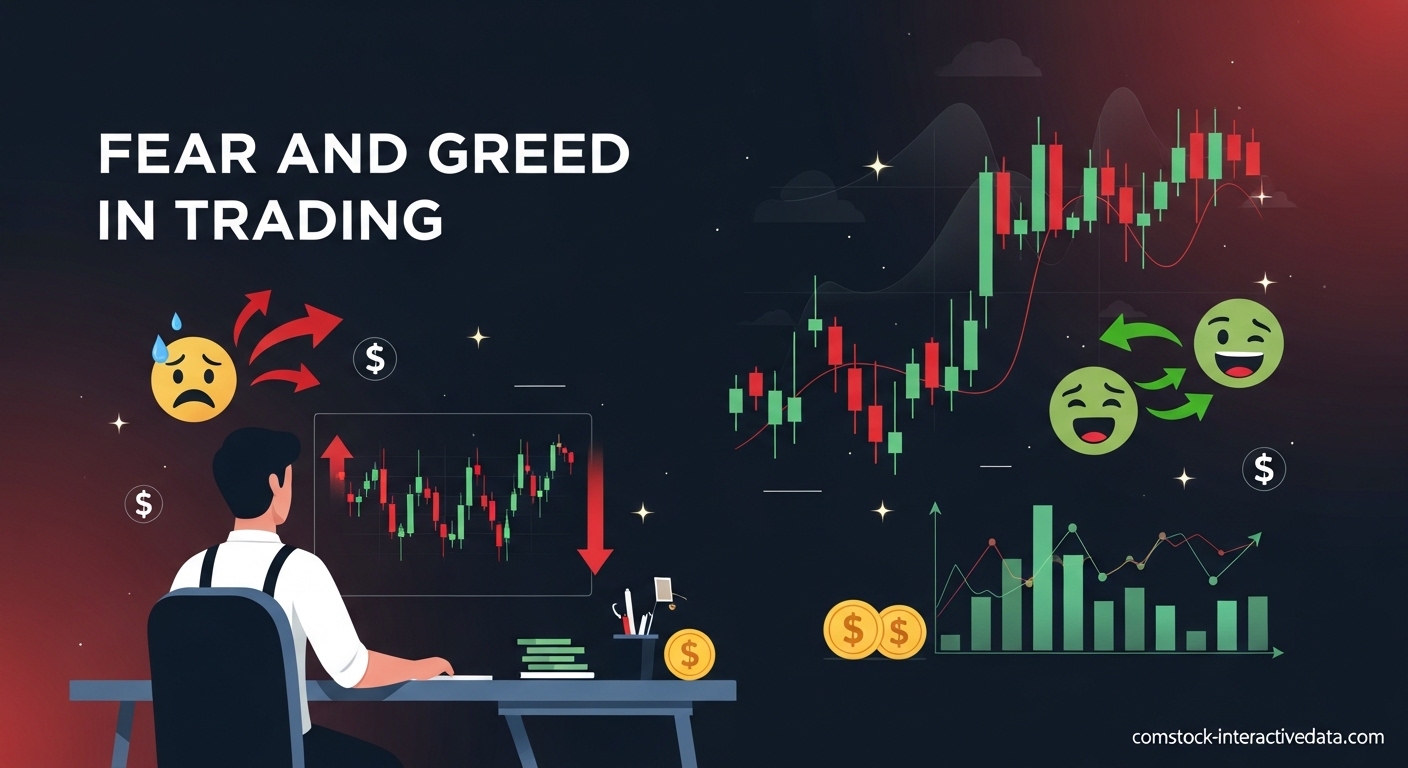
Trading is 80% psychology and 20% strategy. I learned this the hard way after blowing up my first account by ignoring the emotional side of trading. Fear and greed in trading are not just buzzwords thrown around by trading gurus—they are the two primary forces that drive every decision you make in the markets.
In this guide, I will show you exactly how these emotions impact your decisions, the specific signs to watch for, and proven strategies that successful traders use to stay disciplined. Whether you are a day trader, swing trader, or long-term investor, understanding fear and greed is the single most important skill you can develop.
Table of Contents
Fear and Greed in Trading: The Two Emotions Controlling Your Decisions
Fear and greed in trading create a constant tug-of-war in your mind. Fear whispers that you will lose everything, while greed promises unlimited riches. Both emotions hijack your rational thinking and lead to poor decisions that cost you money.
I have spent years studying behavioral finance and interviewing successful traders. The pattern is always the same: traders who master their emotions consistently outperform those with better technical skills but poor emotional control. Your trading psychology is the foundation upon which all other skills rest.
The markets are designed to trigger these emotions. Flashing red numbers, sudden price spikes, and social media hype all work together to push you toward emotional reactions. Recognizing when fear or greed is taking over is the first step toward trading success.
What Is Fear in Trading?
Fear in trading is the emotional response to perceived threats in the market. It activates your fight-or-flight instinct, causing you to avoid risk even when the opportunity is valid. This biological response evolved to keep us safe from physical danger, but it works against us in financial markets.
When fear takes over, your body releases cortisol and adrenaline. Your heart rate increases. Your breathing becomes shallow. These physical changes directly impact your cognitive function, making it harder to analyze charts objectively or stick to your trading plan.
I remember sitting frozen in front of my screen during the COVID crash in March 2020. Every instinct screamed to sell everything. But the traders who made fortunes that year were the ones who recognized their fear and stuck to their systems anyway.
Three Ways Fear Manifests in Trading
Fear does not always look like panic. Sometimes it disguises itself as caution or over-analysis. Understanding these three common manifestations will help you spot fear before it destroys your trades.
Paralysis by Analysis happens when you stare at charts for hours, unable to pull the trigger. You convince yourself you need more confirmation, more indicators, more certainty. The trade passes you by while you wait for perfect conditions that never come.
Panic Selling occurs when you exit winning positions at the first sign of a pullback. You fear the profit will disappear, so you take small gains instead of letting winners run. This behavior destroys your risk-reward ratio over time.
Hesitation to Enter is fear dressed up as risk management. You identify a perfect setup, but you hesitate. The entry point passes. Then you chase the trade at a worse price, turning a good trade into a bad one.
FOMO: Fear in Disguise
Fear of Missing Out (FOMO) is actually a form of fear, not greed as many traders believe. When you see a stock pumping 50% in a day, you fear being left behind. You fear watching others get rich while you sit on the sidelines.
FOMO causes you to enter trades without proper analysis. You abandon your strategy because the pain of missing out feels worse than the pain of a bad trade. This emotional trap destroys more accounts than any market crash.
One trader in the Reddit community described it perfectly: “Big candlesticks trigger greedy entries.” But the root cause is actually fear—the fear that this opportunity will never come again.
What Is Greed in Trading?
Greed in trading is the excessive desire for more profit, beyond what your strategy or risk management allows. It pushes you to take bigger risks, hold positions too long, and ignore warning signs that would normally send you to cash.
From a neuroscience perspective, greed activates the brain’s reward centers. The anticipation of profit releases dopamine, creating a feedback loop similar to addiction. Winning trades make you feel invincible. You start taking larger positions, convinced you have mastered the market.
The dot-com bubble of 2000 and the Bitcoin peak of late 2017 were both driven by greed. Rational investors abandoned fundamentals, convinced that prices would rise forever. The ones who made money were those who recognized when greed had taken over the market and exited early.
Four Ways Greed Destroys Your Trading
Greed manifests in specific behaviors that are easy to identify once you know what to look for. Here are the four most destructive patterns I see in my coaching work with traders.
Overtrading occurs when you trade too frequently, chasing small moves for quick profits. Each trade costs you commissions and spreads. Overtrading drains your account through a thousand small cuts while providing the illusion of action.
Ignoring Risk Management happens when you skip stop losses or increase position sizes because you feel confident. Greed tells you that this trade is different. You start risking 5% or 10% per trade instead of your normal 1-2%.
Chasing Profits is the practice of entering trades after they have already moved significantly. You see a stock up 20% and buy anyway, hoping for another 20%. This puts you in weak positions with poor risk-reward ratios.
Overleveraging means using too much margin or leverage. Greed makes you believe you can safely handle larger positions. One bad move wipes out weeks or months of gains.
The Neuroscience of Trading Greed
Your brain’s reward system is not designed for trading. When you anticipate profits, your nucleus accumbens releases dopamine. This creates a pleasurable sensation that you want to repeat.
The problem is that this reward system does not distinguish between good trades and bad trades. A profitable gamble feels the same as a profitable strategy. Over time, your brain associates trading with pleasure, creating cravings similar to addiction.
This is why traders struggle to stop after a winning streak. The dopamine high makes you feel invincible. You keep trading even when your edge is gone, driven by the biological desire for more rewards.
How Fear Impacts Your Trading Decisions?
Fear impacts your trading decisions by triggering protective mechanisms that are inappropriate for financial markets. Your brain treats a dropping stock price like a charging predator, activating the same survival circuits.
When fear takes over, your peripheral vision literally narrows. You focus only on the immediate threat—the red candle in front of you—while missing the bigger picture. This tunnel vision causes you to exit positions that are still valid or avoid entries that meet your criteria.
Forum traders often describe this as “trading with emotion will destroy you—fear makes you hesitate, hope makes you hold losers.” The fear of loss becomes a self-fulfilling prophecy as you make poor decisions trying to avoid it.
10 Signs Fear Is Affecting Your Trading
Recognizing fear early is essential for maintaining discipline. Watch for these ten warning signs in your own behavior.
- You check your positions every few minutes even though you have alerts set
- You move stop losses wider when price approaches them
- You exit winning trades immediately when they show any pullback
- You avoid taking valid setups because the market “feels uncertain”
- You reduce position size below your plan because of recent losses
- You hesitate to enter even when all criteria are met
- You wake up thinking about your trades or check them at night
- You change your strategy after every losing trade
- You blame external factors (manipulation, algos, bad luck) for losses
- You feel physical anxiety when about to enter a trade
If you recognize three or more of these signs, fear is controlling your trading decisions. The solution is not to eliminate fear completely—that is impossible. Instead, you need systems that execute despite fear.
How Greed Impacts Your Trading Decisions?
Greed impacts your trading decisions by overriding your risk management with promises of larger rewards. It convinces you that normal returns are not enough and that you need to take bigger risks to succeed.
The dangerous thing about greed is that it feels good. Unlike fear, which creates obvious discomfort, greed feels like confidence. You tell yourself you are being aggressive and decisive. In reality, you are abandoning the rules that keep you safe.
One forum trader summarized it brutally: “Trading is a war—FEAR breaks you, GREED steals your money.” Both emotions destroy accounts, but greed does it with a smile on your face while you convince yourself you are making smart decisions.
10 Signs Greed Is Affecting Your Trading
Watch for these ten warning signs that greed has taken control of your decision-making process.
- You increase position size after a winning streak
- You remove stop losses because you are “sure” about the trade
- You add to losing positions to average down
- You take trades that do not meet your criteria because they look exciting
- You hold positions past your profit target hoping for more
- You trade during news events for bigger moves
- You feel disappointed with normal winning trades
- You revenge trade immediately after a loss to make it back
- You check your P&L constantly and celebrate unrealized gains
- You tell others about your trades before they are closed
Three or more of these signs indicate that greed is driving your decisions. The antidote is a mechanical trading plan that removes discretion during emotional moments.
The Fear and Greed Index Explained 2026
The CNN Fear and Greed Index measures market sentiment by analyzing seven different indicators. It provides a single score from 0 to 100 that tells you whether fear or greed is currently dominating the market.
Understanding this index helps you recognize when the broader market is being driven by emotion. Extreme fear often signals buying opportunities, while extreme greed warns of potential corrections. The index does not predict tops or bottoms, but it helps you understand the emotional context of the current market.
Some traders use specific thresholds for decisions. One forum member shared their strategy: “Buy when fear is less than 18, sell when greed is greater than 88.” This systematic approach removes emotional guesswork from timing decisions.
The Seven Indicators Behind the Index
The Fear and Greed Index combines these seven metrics to calculate the overall sentiment score.
Market Momentum measures the S&P 500 versus its 125-day moving average. When the index is significantly above this average, greed is high. When below, fear dominates.
Stock Price Strength looks at the number of stocks hitting 52-week highs versus 52-week lows on the NYSE. More highs indicate greed; more lows indicate fear.
Stock Price Breadth analyzes trading volumes in rising stocks versus declining stocks. Strong breadth with high volume in rising stocks signals greed.
Put and Call Options examines the ratio of put options to call options. High put volume indicates fear as investors seek protection. High call volume indicates greed and speculation.
Market Volatility uses the VIX index, often called the fear gauge. Low VIX readings suggest complacency and greed, while high readings indicate fear.
Safe Haven Demand measures whether investors are moving money into bonds versus stocks. High bond demand signals fear and risk aversion.
Junk Bond Demand looks at the spread between junk bond yields and investment-grade yields. Narrow spreads indicate greed as investors chase yield without demanding proper risk premiums.
Fear and Greed Index Score Interpretation
Use this framework to interpret the current Fear and Greed Index reading.
| Score Range | Sentiment | Typical Market Behavior |
|---|---|---|
| 0-24 | Extreme Fear | Capitulation, panic selling, potential buying opportunity |
| 25-39 | Fear | Cautious sentiment, selective buying, defensive positioning |
| 40-60 | Neutral | Mixed signals, follow your individual strategy |
| 61-75 | Greed | Optimism, momentum chasing, consider taking profits |
| 76-100 | Extreme Greed | Euphoria, bubble conditions, high risk of correction |
Remember that the index can stay in extreme territory for extended periods. Extreme greed does not mean sell immediately, and extreme fear does not mean buy blindly. Use it as a sentiment check, not a trading signal.
Crypto Fear and Greed Index
Cryptocurrency markets have their own Fear and Greed Index that works similarly but accounts for crypto-specific factors like Bitcoin dominance and social media sentiment. Crypto markets are more volatile, so the index swings more dramatically.
Crypto traders often see extreme readings above 90 or below 10. These extreme swings create opportunities for patient traders who can buy when others are terrified and sell when others are euphoric.
Proven Strategies to Manage Fear and Greed
Managing fear and greed requires both psychological techniques and mechanical systems. You cannot eliminate emotions, but you can create structures that prevent them from destroying your account.
The traders who last are the ones who develop processes. As one experienced trader wrote: “The ones who last don’t chase feelings. They execute a process.” This mindset shift from outcome-focused to process-focused trading is the key to emotional control.
Here are the strategies that have worked for me and the successful traders I have studied over 2026.
Create a Written Trading Plan
Your trading plan is your emotional anchor. It should define exactly which setups you take, your entry criteria, position sizing rules, stop loss placement, and profit targets. Write it down. Review it daily before trading.
When fear or greed arise, refer to your plan. If the trade meets your criteria, take it. If it does not, skip it. The plan removes the emotional decision-making that destroys accounts.
Include specific rules for emotional states. For example: “If I have two consecutive losses, I take a 30-minute break. If I feel anxious, I reduce position size by 50%.” These rules protect you from yourself.
Use Mechanical Position Sizing
Position sizing is your primary risk management tool. Risk a fixed percentage of your account on each trade—typically 1-2% for most traders. Never risk more than you have predetermined, regardless of how confident you feel.
Mechanical position sizing removes greed from the equation. You cannot take excessive risk because your rules prevent it. Calculate your position size before entering, not after you are already emotionally invested.
Consider reducing position size when you are experiencing emotional difficulty. Trading smaller allows you to work through psychological challenges without significant financial damage.
Implement Hard Stop Losses
Set your stop loss before entering every trade. Place it at a technical level that invalidates your thesis, not at a dollar amount you are willing to lose. Once set, do not move it except to lock in profits.
Stop losses are your insurance policy against emotional decisions. They prevent the common trap of holding losers too long while hoping they recover. Accept that some trades will hit your stop—that is part of the business.
Use bracket orders that include your stop and target when entering. This automation removes the need for emotional decisions during the trade.
Keep a Trading Journal
A trading journal tracks not just your P&L but also your emotional state and adherence to your plan. After each trade, record what you felt, whether you followed your rules, and what you learned.
Review your journal weekly. Look for patterns. Do you lose more when you are tired? Do you overtrade after winning streaks? Your journal reveals the emotional triggers that sabotage your trading.
Here is a simple template to use:
- Date and time of trade
- Symbol and setup type
- Entry and exit prices
- Position size and risk amount
- Emotional state before, during, and after
- Did you follow your plan? (Yes/No)
- What would you do differently?
Practice Breathing Techniques
Your physical state directly impacts your decision-making. When you notice fear or greed arising, use breathing techniques to activate your parasympathetic nervous system and restore clear thinking.
Try box breathing: inhale for four counts, hold for four, exhale for four, hold for four. Repeat for one minute. This technique is used by Navy SEALs to maintain focus under stress and works equally well for traders.
Before making any trading decision, take three deep breaths. This brief pause interrupts emotional momentum and gives your rational brain time to engage.
Focus on Process Over Outcome
Judge yourself on whether you followed your plan, not on whether the trade made money. A good trade that loses money is still a good trade if you followed your rules. A bad trade that makes money is still a bad trade that will eventually destroy your account.
This mindset shift is difficult but essential. You cannot control market outcomes. You can control your adherence to process. Focus on what you can control, and the results will follow over time.
Set daily process goals rather than profit goals. For example: “Today I will take only A+ setups” or “Today I will not move any stop losses.” These goals are achievable regardless of market conditions.
Why Trading Psychology Determines Your Success?
Your trading psychology is the single most important factor in your long-term success. Strategy matters, but psychological execution matters more. A mediocre strategy followed with discipline outperforms a perfect strategy executed emotionally.
Consider the research from DailyFX that analyzed 30 million trades. They found that traders were right on direction more than 50% of the time but still lost money overall. Why? Poor risk management driven by fear and greed. Traders let losers run and cut winners short because of emotional decision-making.
The successful traders I have interviewed share one common trait: emotional resilience. They have all blown up accounts, experienced massive drawdowns, and faced the psychological warfare of the markets. They succeeded because they developed the mental fortitude to keep going.
Building Emotional Resilience
Emotional resilience is not something you are born with. It is built through deliberate practice and exposure to difficulty. Each emotional challenge you face and overcome makes you stronger for the next one.
Start by trading smaller size than you can afford. This reduces the emotional intensity of each trade, allowing you to practice proper decision-making without extreme financial pressure. Gradually increase size as your emotional control improves.
Develop a support network of other traders. Trading is isolating, and isolation amplifies emotional problems. Find a community where you can share experiences, discuss challenges, and get perspective when your emotions are distorted.
Frequently Asked Questions
How does fear impact decision-making?
Fear activates the fight-or-flight response, causing traders to hesitate on entries, exit winning positions prematurely, or avoid taking valid setups. Physically, fear releases cortisol and adrenaline that narrow focus and impair rational analysis. Fear-driven decisions prioritize avoiding short-term discomfort over long-term profitability.
How does greed influence our decision-making?
Greed activates the brain’s reward centers, releasing dopamine that creates a pleasurable anticipation of profits. This drives traders to overtrade, ignore stop losses, chase moving prices, and take excessive risks. Greed feels like confidence, making it particularly dangerous because traders do not recognize they are being emotional.
How do fear and greed influence investors’ buying decisions?
Fear causes investors to avoid buying even when analysis supports it, or to buy only after extensive hesitation that results in poor entry prices. Greed drives investors to buy after significant price increases have already occurred, chasing momentum without proper risk assessment. Both emotions lead to buying at suboptimal times based on emotional rather than rational criteria.
How does greed affect trading?
Greed affects trading by causing overtrading, position sizes beyond risk limits, removal of stop losses, holding positions too long for extra profits, and revenge trading after losses. It creates a feedback loop where winning trades increase confidence excessively, leading to larger risks that eventually result in significant drawdowns or account blowups.
Conclusion: Master Your Emotions, Master Your Trading
Fear and greed in trading are not enemies to be eliminated—they are natural human responses that must be managed. The goal is not to become emotionless but to create systems and habits that keep emotions from controlling your decisions.
Start today by creating your written trading plan and beginning a trading journal. These two tools alone will transform your emotional relationship with trading. Focus on process over outcomes, and remember the wisdom from experienced traders: the ones who last execute a process, not chase feelings.
Your journey to emotional mastery in trading begins with a single step. Take that step now, and build the psychological foundation that will support your trading success for years to come.