
When Robinhood launched commission-free stock trading in 2013, it sparked a revolution. Millions of investors flocked to platforms promising zero-cost trades, leaving traditional brokerages scrambling to eliminate their $7-10 per-trade fees. By 2026, commission-free trading has become the industry standard.
But here’s the uncomfortable truth: free trading isn’t actually free. When you place a trade without paying a commission, you’re still paying. Just not in a way that’s immediately visible on your statement.
The mechanism that makes this possible is called payment for order flow (PFOF). It’s a behind-the-scenes arrangement worth billions of dollars annually, and it affects every retail investor who clicks “buy” or “sell” on their brokerage app. Understanding how payment for order flow works will help you make smarter decisions about where to invest and how to trade.
In this guide, I’ll explain exactly how brokers make money from order flow, why this practice generates so much controversy, and what it means for your portfolio. Whether you’re trading stocks, options, or simply holding index funds, PFOF impacts your financial life more than most investors realize.
Table of Contents
Key Takeaways
Before diving into the mechanics, here are the essential points about payment for order flow:
- Payment for order flow (PFOF) is the compensation brokerage firms receive from market makers for routing client trade orders to them instead of to public exchanges
- Market makers pay brokers fractions of a penny per share to execute retail trades, profiting from the bid-ask spread
- Zero-commission trading is enabled by PFOF revenue — brokers generate income without charging explicit trading fees
- Controversy centers on conflict of interest — critics argue brokers may prioritize PFOF payments over securing the best execution for your trades
- The EU banned PFOF completely in 2026, with full phase-out required by June 2026, while US regulators continue debating stricter rules
What Is Payment for Order Flow?
Payment for order flow (PFOF) is the compensation a broker receives from market makers for routing client trade orders to them instead of to public exchanges. Brokerage firms receive fractions of a penny per share, generating revenue that enables commission-free trading.
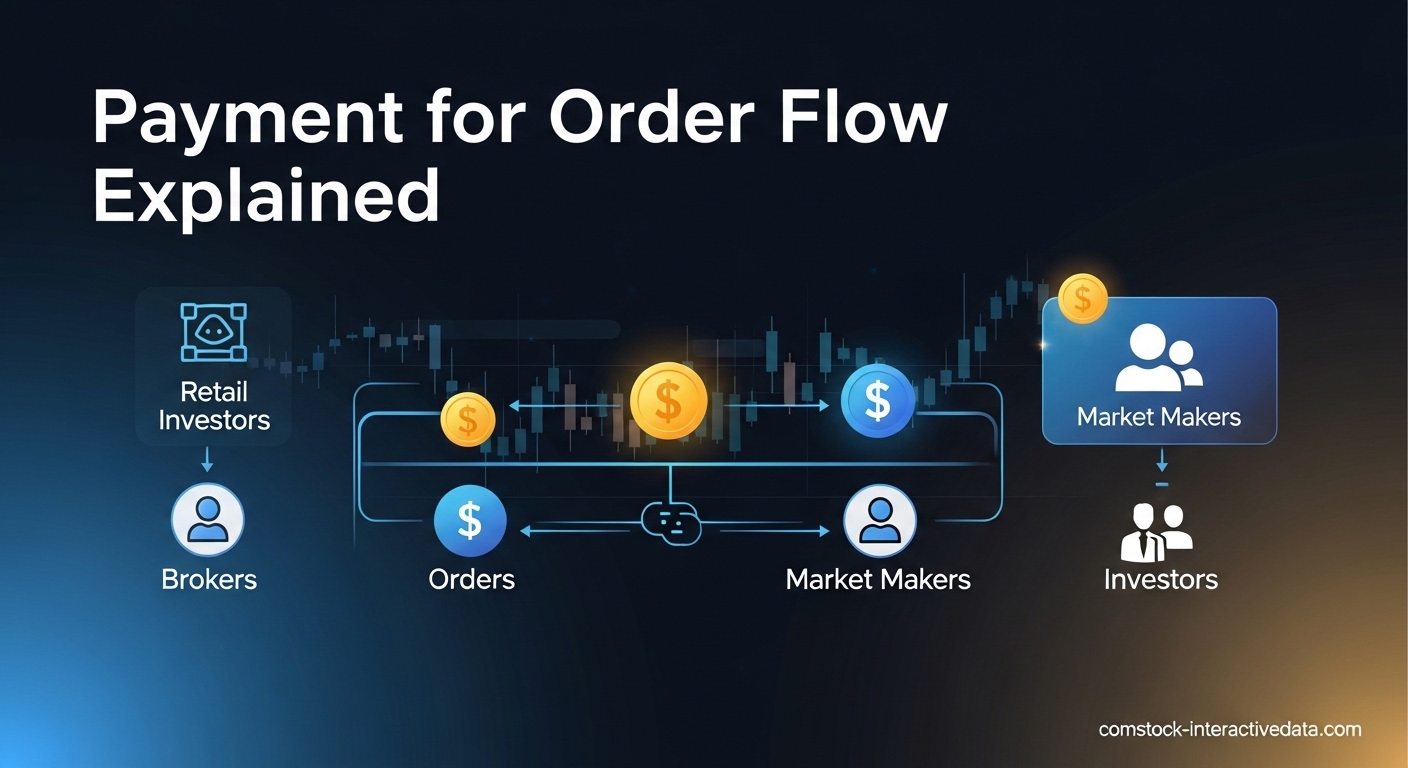
When you place a trade through your brokerage app, your order doesn’t go directly to the stock exchange. Instead, your broker routes it to a market maker — a specialized financial firm that executes trades. That market maker pays your broker for the privilege of handling your order. These payments, while tiny on a per-share basis (often just $0.001 to $0.0035 per share), add up to hundreds of millions of dollars annually for large brokerages.
The practice has an interesting history. Believe it or not, Bernie Madoff — yes, that Bernie Madoff — helped pioneer payment for order flow in the 1980s. His firm was among the first to pay brokers for routing orders, arguing that internalizing retail trades reduced exchange fees and created efficiencies. While Madoff’s subsequent criminal activities cast a shadow over anything associated with him, the PFOF model he helped develop became the industry standard.
For retail investors, PFOF matters because it’s the hidden engine behind commission-free trading. Without these payments, brokers would need to charge trading fees to remain profitable. Understanding this trade-off — free trades versus potential execution quality concerns — is essential for making informed investment decisions.
How Does Payment for Order Flow Work?
To understand payment for order flow, you need to follow your trade from the moment you click “submit” to its final execution. Here’s the step-by-step process:
Step 1: You Place Your Trade
When you decide to buy 100 shares of Apple stock through your brokerage app, you submit a market order. You expect to pay the current market price and receive your shares almost instantly.
Step 2: Your Broker Routes the Order
Instead of sending your order to the New York Stock Exchange or NASDAQ, your broker routes it to a preferred market maker — typically Citadel Securities, Virtu Financial, or another electronic trading firm. This routing decision is based on pre-existing agreements where these market makers pay your broker for order flow.
Step 3: The Market Maker Executes Your Trade
The market maker executes your trade, often internally matching it against other orders or using its inventory. Market makers are required by SEC regulations to provide “best execution” and match or beat the NBBO — the National Best Bid and Offer, which represents the best available price across all exchanges.
Step 4: The Market Maker Pays Your Broker
Here’s where PFOF comes in. For routing your order to them, the market maker pays your broker a small rebate — typically fractions of a penny per share. For options contracts, these payments are significantly higher, often around $0.40 to $0.65 per contract.
How Market Makers Profit: The Bid-Ask Spread
Market makers pay for your order flow because they can profit from the bid-ask spread. The bid is the highest price someone will pay for a stock; the ask is the lowest price someone will sell it for. The difference between these prices is the spread.
For example, if Apple stock has a bid of $175.00 and an ask of $175.02, the spread is $0.02. When you place a market order to buy, you typically pay the ask price. The market maker may have acquired those shares at or near the bid price, capturing the spread as profit. With millions of retail orders flowing through their systems, these tiny profits compound into substantial revenue.
Real-World Example: Following a $10,000 Trade
Let’s say you invest $10,000 in a popular ETF. Your broker routes this to a market maker who pays $0.0015 per share in PFOF rebates. If you’re buying at $50 per share, that’s 200 shares.
Your broker earns $0.30 from this trade ($0.0015 x 200 shares). That seems trivial, but consider that large brokers handle millions of trades daily. Robinhood reported over $800 million in PFOF revenue in a recent year — all from these fractional payments adding up across millions of transactions.
What Are Market Makers and Why Do They Pay for Orders?
Market makers are specialized financial firms that provide liquidity to markets by continuously quoting buy and sell prices for stocks and options. They profit from the bid-ask spread while bearing the risk of holding inventory and facilitating trades.
The Major Players in Market Making
Two firms dominate retail market making in the United States: Citadel Securities and Virtu Financial. Together, they handle the vast majority of retail order flow routed through PFOF arrangements.
Citadel Securities, a separate entity from Citadel’s hedge fund business, is the largest retail market maker. They execute trades for most major brokerages using PFOF, including Robinhood, Schwab, and TD Ameritrade. Virtu Financial is the second-largest player, handling significant volume across multiple brokerage platforms.
Why Retail Order Flow Is Valuable
Market makers pay for retail order flow because it’s generally considered “less toxic” than institutional order flow. Retail investors tend to trade in smaller sizes, make less informed decisions on average, and don’t have the sophisticated strategies that institutions use to predict price movements.
This means market makers can internalize retail orders with lower risk of adverse selection — the risk that the counterparty knows something they don’t. They can match retail buy orders against retail sell orders internally, capturing the spread without taking on directional market risk.
Internalization: How Market Makers Handle Your Orders
When a market maker receives your order, they have several options. They can internalize it — matching it against opposing orders from other retail traders or against their own inventory. They can also route it to exchanges if they can’t provide a better price internally.
The SEC requires that market makers provide “best execution” — meaning they must match or beat the NBBO price available on public exchanges. Many market makers actually provide slight price improvement — executing your trade at a fractionally better price than the NBBO — which they use to justify their PFOF arrangements.
Payment for Order Flow: Options vs Equities
While PFOF applies to both stock and options trading, the economics differ dramatically between these asset classes. Understanding these differences helps explain why some brokers push options trading so aggressively.
Options PFOF Rates Are Significantly Higher
Payment for order flow rates for options are substantially higher than for equities. While equity trades generate rebates of $0.001 to $0.0035 per share, options contracts generate rebates of $0.40 to $0.65 per contract.
This difference exists because options markets have wider bid-ask spreads and less transparency than equity markets. The complexity of options pricing gives market makers more opportunity to profit, allowing them to pay higher rebates to brokers.
Why Options Generate More PFOF Revenue
For brokers, options trading is significantly more profitable than stock trading. A single options trade generates roughly 100-200 times more PFOF revenue than an equivalent equity trade. This explains why commission-free brokers heavily promote options trading through their platforms.
Consider this comparison: if you buy 100 shares of a $50 stock, your broker might earn $0.15 in PFOF. But if you buy one options contract (representing 100 shares), your broker could earn $0.50 or more. The revenue difference is substantial, which creates incentives for brokers to encourage options trading even when it may not be suitable for all investors.
Equities PFOF: Lower Rates but Higher Volume
While per-share PFOF rates for equities are lower, the volume of equity trading is much higher. Major brokers still generate significant PFOF revenue from stock trades, particularly from high-volume meme stocks and popular ETFs that retail investors trade frequently.
The combination of equity and options PFOF revenue allows brokers to offer completely commission-free trading across both asset classes while building highly profitable businesses. Robinhood reported that approximately 70% of their transaction-based revenue comes from options PFOF, despite options representing a smaller portion of total trades.
Impact on Trading Decisions
Understanding PFOF differences should influence how you think about trading costs. If you’re an options trader, you’re generating substantial PFOF revenue for your broker with every trade. If you’re a buy-and-hold stock investor making a few trades per year, your PFOF impact is minimal.
For active traders, particularly those trading options frequently, the cumulative PFOF revenue your broker earns from your activity is significant. This doesn’t necessarily mean you should change your strategy — but it does mean you should understand the economics behind your broker’s business model.
Why Is Payment for Order Flow Controversial?
Despite enabling commission-free trading, payment for order flow generates significant controversy among regulators, academics, and investor advocates. The criticism centers on a fundamental conflict of interest.
The Core Conflict of Interest
When your broker routes your order to a market maker that pays them, they face an inherent conflict. Their financial interest lies in maximizing PFOF revenue. Your interest lies in getting the best possible execution price. These interests may not align.
Brokers are required by law to provide “best execution” for their clients. But “best execution” isn’t always synonymous with “best price.” Factors like execution speed and likelihood of completion also count. Critics argue that PFOF creates incentives for brokers to prioritize high-paying market makers over public exchanges where prices might be better.
Best Execution Concerns
Academic research has examined whether PFOF leads to worse execution prices for retail investors. A notable study from the London Business School found that retail investors might pay slightly higher trading costs due to PFOF arrangements, though the magnitude of this effect is debated.
SEC Chair Gary Gensler has expressed concerns about PFOF, stating that the practice raises questions about whether brokers are truly fulfilling their best execution obligations. In 2021, the SEC released a report on meme stock trading that highlighted PFOF concerns, though it stopped short of calling for an outright ban.
The Robinhood Case Study
Robinhood has become the public face of PFOF controversy. In 2020, the company paid a $65 million SEC settlement for misleading customers about its PFOF arrangements and failing to deliver best execution. The SEC found that Robinhood’s execution quality was worse than competitors, costing customers millions in hidden trading costs.
Public disclosures reveal that 65-80% of Robinhood’s revenue comes from PFOF payments. This heavy reliance on order flow payments makes the company’s “free trading” model possible — but also makes them particularly vulnerable to criticism about conflicts of interest.
Payment for Order Flow and Meme Stocks
The meme stock phenomenon of 2021 brought PFOF into mainstream awareness. When trading in GameStop and AMC surged, market makers like Citadel Securities profited enormously from the volatility. Retail traders began questioning whether PFOF arrangements created incentives for market makers to profit from their order flow during periods of high volatility.
The controversy intensified when Robinhood restricted trading in meme stocks during peak volatility. While the company cited clearinghouse requirements, critics questioned whether PFOF relationships influenced the decision. The incident highlighted concerns about market structure and the power dynamics between brokers, market makers, and retail investors.
Regulatory Landscape and the Future of PFOF
Payment for order flow operates under complex regulatory oversight. Understanding these rules helps investors know their rights and how to check their broker’s practices.
SEC Rule 606: Disclosure Requirements
SEC Rule 606 requires brokers to disclose their order routing practices quarterly. These reports reveal which market makers receive their order flow and how much payment they receive. You can find these reports on your broker’s website, typically in a “disclosures” or “legal” section.
Reviewing Rule 606 reports is the best way to understand your broker’s PFOF arrangements. The reports show payment rates per share or contract, giving you insight into how your broker generates revenue from your trades.
SEC Rule 605: Execution Quality Reporting
Rule 605 requires market centers (including market makers) to report execution quality statistics monthly. These reports allow comparison of execution quality across different venues. However, the complexity of these reports makes them difficult for average investors to interpret meaningfully.
FINRA Oversight
The Financial Industry Regulatory Authority (FINRA) also oversees PFOF practices, conducting examinations of broker-dealers to ensure compliance with best execution obligations. FINRA has brought enforcement actions against firms for failing to adequately supervise order routing practices.
The EU Ban on PFOF
In a significant development, the European Union banned payment for order flow completely. The ban was finalized in 2026 with full phase-out required by June 2026. European regulators concluded that PFOF creates unacceptable conflicts of interest and that retail investors benefit from direct exchange access rather than market maker intermediation.
This ban eliminates commission-free trading as Europeans have known it. European brokers are returning to explicit commission models or seeking alternative revenue sources. The EU decision represents the most significant regulatory pushback against PFOF globally.
Will Payment for Order Flow Be Banned in the US?
The question of whether the US will follow the EU’s lead remains open. SEC Chair Gary Gensler has indicated openness to banning or restricting PFOF, though no formal proposal has been made. The brokerage industry strongly opposes a ban, arguing it would force a return to commission-based trading that disadvantages small investors.
Any US ban would face significant political and legal challenges. The major brokerage firms and market makers have substantial resources to lobby against prohibition. A compromise approach — enhanced disclosure requirements or caps on PFOF payments — may be more likely than an outright ban.
How to Check If Your Broker Uses PFOF
To check your broker’s PFOF status, follow these steps:
- Visit your broker’s website and search for “Rule 606” or “order routing” in their disclosure section
- Download their quarterly Rule 606 report to see which market makers receive their order flow
- Review payment amounts listed per share (for equities) or per contract (for options)
- Compare execution quality reports if available from multiple brokers you’re considering
The Pros and Cons of Payment for Order Flow
Payment for order flow creates genuine benefits for many investors while raising legitimate concerns. Here’s a balanced assessment:
Benefits of PFOF
- Commission-free trading: PFOF enables zero-commission models that have democratized market access for small investors
- Price improvement: Market makers sometimes provide slightly better prices than public exchanges
- Enhanced liquidity: Market makers add liquidity to markets, particularly for less actively traded securities
- Fractional shares: The revenue model supports features like fractional share trading that benefit small investors
Drawbacks of PFOF
- Conflict of interest: Brokers may prioritize PFOF revenue over securing the best prices for customers
- Hidden costs: While invisible on statements, PFOF potentially results in slightly worse execution prices
- Lack of transparency: Many investors don’t understand that their “free” trades generate revenue for their broker
- Incentives for risky trading: High options PFOF rates create incentives for brokers to push complex products
Who Benefits Most from PFOF?
Small, buy-and-hold investors likely benefit from commission-free trading enabled by PFOF. The potential execution quality costs are minimal for infrequent traders, while avoiding explicit commissions provides clear savings.
Active traders, particularly options traders, face more significant PFOF impacts. The cumulative effect of execution quality differences matters more when trading frequently. These investors should carefully evaluate whether PFOF-based or non-PFOF brokers serve them better.
Which Brokers Use PFOF and Which Don’t?
Not all brokers rely on payment for order flow. Understanding which brokers use PFOF — and which don’t — helps you choose a platform aligned with your preferences.
Brokers That Use PFOF
Most major discount brokers generate significant revenue from payment for order flow:
- Robinhood: Generates 65-80% of revenue from PFOF, primarily from options trading
- Charles Schwab: Receives substantial PFOF revenue, though less dependent on it than pure-play brokers
- TD Ameritrade (now Schwab): Historically received significant PFOF payments, now integrated into Schwab
- E*TRADE (Morgan Stanley): Uses PFOF arrangements with major market makers
- Webull: Relies heavily on PFOF for revenue
Brokers That Don’t Use PFOF
Several brokers have built models that avoid PFOF entirely:
- Fidelity: The largest broker that doesn’t accept PFOF, routing orders directly to exchanges
- Public.com: A newer broker that explicitly rejected the PFOF model, offering tipping instead
Fidelity’s decision not to accept PFOF is notable given their scale. They’ve built a profitable business through other revenue streams including interest on cash balances, securities lending, and advisory services. This demonstrates that commission-free trading is possible without PFOF — though it requires alternative business models.
How to Choose Based on Your Trading Style?
If you’re a long-term investor making a few trades per year, execution quality differences from PFOF are likely negligible. The convenience and features of major brokers may outweigh any theoretical concerns.
If you’re an active trader, particularly in options, consider whether you prefer the explicit cost structure of non-PFOF brokers or the commission-free model with potential hidden execution costs. There’s no universally right answer — it depends on your trading frequency, volume, and philosophical preferences about payment transparency.
Frequently Asked Questions
How do brokerages make money from order flow?
Brokerages make money from order flow by routing customer trades to market makers who pay them for the privilege of executing those orders. These payments, called payment for order flow (PFOF), typically amount to fractions of a penny per share for stocks and $0.40-$0.65 per contract for options. Market makers profit from the bid-ask spread while brokers generate revenue without charging explicit trading commissions.
What is the 3-5-7 rule in trading?
The 3-5-7 rule is not directly related to payment for order flow. This term sometimes refers to position sizing rules or risk management guidelines in trading. In the context of PFOF discussions, investors should focus on understanding order routing practices and best execution requirements rather than arbitrary numerical rules.
Why is payment for order flow controversial?
Payment for order flow is controversial because it creates a conflict of interest between brokers and their customers. Brokers receive payments from market makers for routing orders, potentially incentivizing them to prioritize revenue over securing the best execution prices for clients. Critics argue this hidden compensation model obscures true trading costs and may result in worse prices for retail investors. The practice has drawn scrutiny from SEC officials and academic researchers questioning whether it truly serves investor interests.
Who pays Robinhood for order flow?
Citadel Securities pays Robinhood the majority of their order flow revenue, along with other market makers including Virtu Financial, Wolverine Securities, and Two Sigma Securities. Citadel alone accounts for roughly 50-60% of Robinhood’s total payment for order flow revenue. These market makers pay Robinhood fractions of a penny per share for equity orders and approximately $0.40-$0.65 per contract for options trades.
Will payment for order flow be banned?
The European Union banned payment for order flow in 2026 with full phase-out required by June 2026. In the United States, SEC Chair Gary Gensler has expressed openness to banning or restricting PFOF, though no formal proposal has been made. A US ban would face significant opposition from the brokerage industry and would likely require congressional action or extensive regulatory proceedings. Enhanced disclosure requirements or payment caps are more likely near-term outcomes than an outright US prohibition.
How is payment for order flow legal?
Payment for order flow is legal in the United States under current SEC and FINRA regulations. Brokers are required to provide ‘best execution’ for customer orders and disclose their order routing practices quarterly under Rule 606. The practice has been reviewed multiple times by regulators, including a comprehensive SEC study in 2000 that permitted its continuation with appropriate safeguards. While legal, PFOF operates under ongoing regulatory scrutiny and could face future restrictions.
How much does Schwab make from payment for order flow?
Charles Schwab generates hundreds of millions of dollars annually from payment for order flow. In recent disclosures, Schwab reported approximately $500-800 million in quarterly PFOF revenue, placing them among the largest recipients of order flow payments. Unlike Robinhood, Schwab has diversified revenue streams including net interest income and advisory fees, making them less dependent on PFOF as a percentage of total revenue.
Bottom Line
Payment for order flow is the hidden mechanism that makes commission-free trading possible. When you place a trade without paying a fee, your broker routes your order to a market maker who pays them for the privilege. These fractions-of-a-penny payments add up to billions in industry revenue annually.
The PFOF model creates a genuine trade-off. You benefit from zero-commission trading and the democratization of market access. You potentially face subtle execution quality costs and the knowledge that your broker profits from your activity in ways that aren’t immediately visible.
For most long-term investors, PFOF concerns are secondary to choosing a broker with solid research tools, reliable execution, and good customer service. For active traders, particularly in options, understanding your broker’s PFOF arrangements matters more — and you may prefer brokers like Fidelity that avoid the practice entirely.
The regulatory landscape continues evolving. The EU’s 2026 ban demonstrates that PFOF-free models are viable, even if they require different revenue structures. Whether the US follows suit remains uncertain, but informed investors should monitor these developments and understand exactly how payment for order flow affects their trades.