
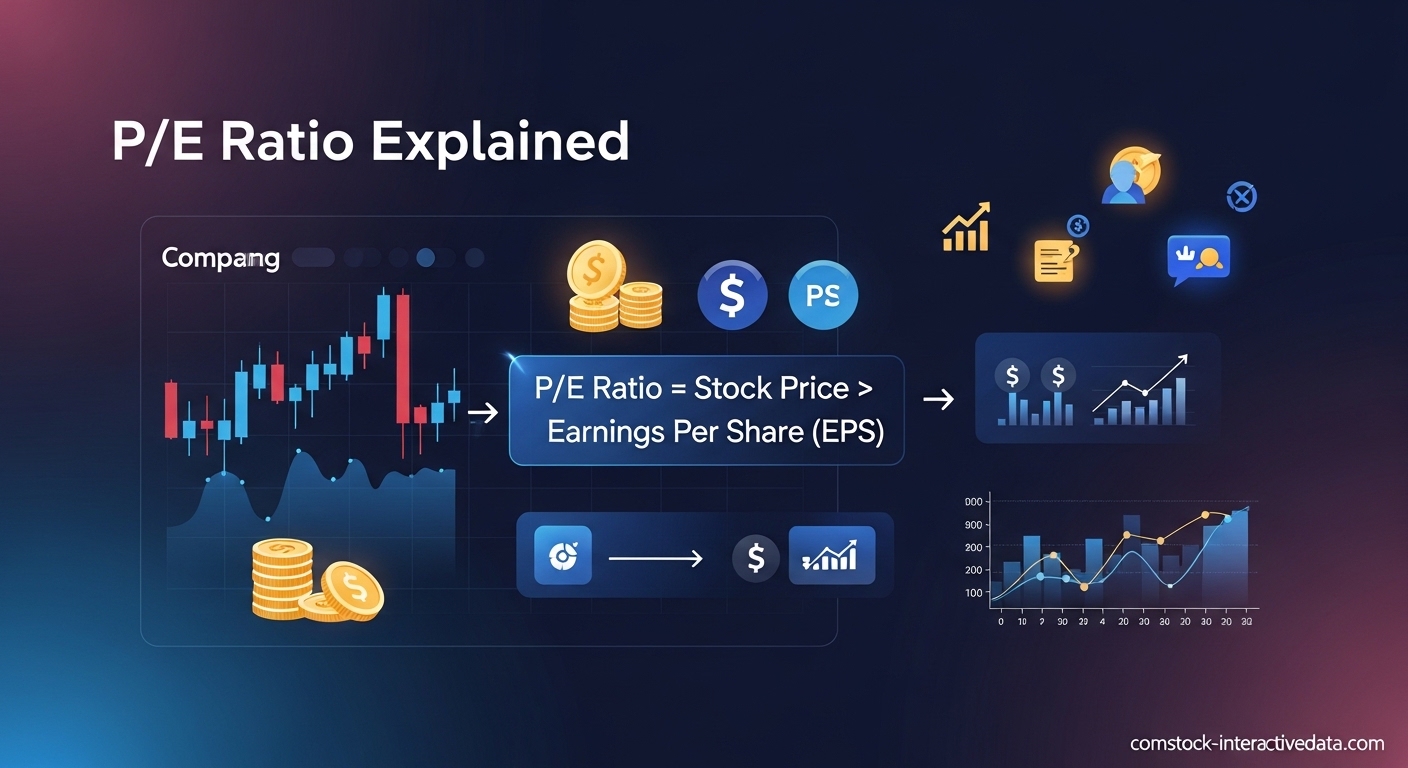
The price-to-earnings ratio, or P/E ratio, is the most widely used valuation metric in stock market investing. It tells you exactly how much investors are willing to pay for each dollar of a company’s earnings. Understanding how to calculate and interpret this ratio can transform your investment decisions from guesswork into informed analysis.
Warren Buffett, one of history’s most successful investors, has offered a critical perspective on P/E ratios. In his 2000 letter to shareholders, he cautioned that this metric alone doesn’t tell the complete story of a company’s value. This article will show you both the power and the limitations of the P/E ratio, giving you the practical knowledge to use it effectively.
Whether you’re evaluating your first stock or refining an existing portfolio, this guide will walk you through everything you need to know about the P/E ratio. By the end, you’ll understand not just how to calculate it, but when to trust it and when to look deeper.
Table of Contents
What Is the P/E Ratio?
The price-to-earnings ratio compares a company’s stock price to its earnings per share (EPS). This simple comparison reveals how the market values a company’s profitability. Think of it like shopping for groceries: just as you compare price per pound to judge value, the P/E ratio shows you the price per dollar of earnings.
When you see a P/E ratio of 20, it means investors are paying $20 for every $1 of annual earnings. A P/E of 15 means you’re paying $15 per dollar of earnings. This standardized metric allows you to compare valuations across different companies, industries, and time periods.
The ratio serves as a quick benchmark for determining whether a stock might be overvalued, undervalued, or fairly priced. However, the interpretation depends heavily on context including industry norms, growth prospects, and market conditions.
Key Takeaways About P/E Ratio
The P/E ratio provides an apples-to-apples comparison tool for stock valuations. Lower P/E ratios generally suggest better value, but context matters significantly. Growth companies typically command higher P/E ratios than mature businesses. The ratio works best when compared against industry averages and historical ranges.
P/E Ratio Formula and Calculation
Calculating the P/E ratio requires just two pieces of information: the current stock price and the company’s earnings per share. The formula is straightforward, but understanding where to find accurate data ensures your calculations are meaningful.
The Basic Formula
P/E Ratio = Stock Price / Earnings Per Share (EPS)
Both numbers must cover the same time period for accurate comparison. Most investors use the current stock price divided by the most recent 12 months of earnings, known as trailing twelve months or TTM.
Step 1: Find the Current Stock Price
The current stock price is the easiest input to locate. Check any financial website, your brokerage account, or a simple web search for the company’s ticker symbol. Use the most recent closing price or current market price for real-time analysis.
For example, if Company XYZ trades at $150 per share, this becomes your numerator in the P/E calculation.
Step 2: Determine Earnings Per Share
Earnings per share represents the company’s net income divided by its outstanding shares. You can find this figure in several places: the company’s most recent quarterly earnings report, financial websites like Yahoo Finance or Google Finance, or your broker’s research platform.
Look for diluted EPS rather than basic EPS. Diluted EPS accounts for all potential shares that could be created from stock options, convertible bonds, and other securities. This provides a more conservative and accurate measure.
Step 3: Calculate and Interpret
Divide the stock price by the EPS to get your P/E ratio. If Company XYZ trades at $150 with EPS of $7.50, the calculation is $150 / $7.50 = 20. This P/E of 20 means investors pay $20 for every $1 of annual earnings.
Real-World Example: Calculating P/E for Apple (AAPL)
Let’s walk through an actual calculation using Apple stock. In early 2026, Apple traded at approximately $185 per share. The company’s trailing twelve months earnings per share was approximately $6.75.
Using the formula: $185 / $6.75 = 27.4. Apple’s P/E ratio of approximately 27 tells us investors were paying $27.40 for every dollar of Apple’s earnings. Comparing this to the technology sector average helps determine whether this valuation seems reasonable.
Types of P/E Ratios
Not all P/E ratios are calculated the same way. Understanding the differences between trailing, forward, and relative P/E ratios is essential for accurate analysis. Each type serves a different purpose and can tell a different story about valuation.
| Type | Formula Basis | Best Used For | Reliability |
|---|---|---|---|
| Trailing P/E | Past 12 months actual earnings | Historical comparison, established companies | High (actual data) |
| Forward P/E | Analyst estimates for future earnings | Growth companies, future expectations | Medium (estimates vary) |
| Absolute P/E | Current price / current EPS | Quick screening, relative comparison | Depends on earnings quality |
| Relative P/E | Current P/E / Benchmark P/E | Long-term trend analysis | High with proper benchmarks |
Trailing P/E (TTM)
The trailing P/E uses earnings from the past twelve months. This is the most common P/E ratio you’ll encounter. It relies on actual reported earnings, making it objective and verifiable.
TTM stands for “trailing twelve months” and represents the sum of earnings from the most recent four quarters. This rolling calculation smooths out seasonal fluctuations and one-time events better than single-quarter data.
The main limitation of trailing P/E is that it looks backward. Fast-growing companies may have depressed historical earnings that don’t reflect their future potential. Similarly, struggling companies might show artificially high earnings from past glory days that won’t continue.
Forward P/E
The forward P/E ratio uses estimated future earnings rather than historical results. Analysts forecast next year’s earnings per share, and this estimate becomes the denominator in the calculation.
Forward P/E ratios are particularly useful for growth stocks where historical earnings understate future potential. A company investing heavily in expansion might show low or negative trailing earnings while having excellent forward prospects.
The risk with forward P/E is its dependence on analyst estimates. These predictions can be wrong, sometimes dramatically so. Always check multiple analysts’ estimates and understand the assumptions behind the numbers.
Absolute vs. Relative P/E
Absolute P/E simply divides current price by current earnings. Relative P/E compares the current P/E to a historical benchmark, such as the company’s average P/E over the past five or ten years.
A relative P/E of 1.2 means the stock trades at 20% above its historical average valuation. This context helps identify whether today’s P/E represents a true opportunity or just normal fluctuation.
How to Interpret P/E Ratios?
Understanding what a P/E ratio actually means separates successful investors from beginners. The number itself is meaningless without proper context and comparison frameworks.
High P/E Ratio: Growth Expectations
A high P/E ratio typically indicates that investors expect strong future growth. They are willing to pay a premium today for earnings that they believe will increase substantially tomorrow.
Technology companies often trade at P/E ratios of 30, 40, or even higher. Investors accept these valuations because they anticipate rapid earnings expansion that will eventually bring the ratio down to more normal levels.
However, high P/E ratios carry risk. If growth fails to materialize as expected, the stock price often falls sharply as the P/E contracts toward market averages.
Low P/E Ratio: Value Opportunity or Warning
A low P/E ratio might signal an undervalued stock with good potential returns. Value investors specifically seek companies trading below their intrinsic worth, often indicated by below-average P/E multiples.
But low P/E ratios can also be warning signs. The market might recognize problems that you haven’t discovered yet: declining sales, competitive threats, or management issues. This situation is known as a “value trap” – a stock that looks cheap for good reason.
Always investigate why a P/E ratio is low before assuming it represents a bargain.
What Is a Good P/E Ratio
The answer depends entirely on context. The S&P 500 has historically traded at an average P/E of approximately 20-25. However, different sectors operate within very different ranges.
Value investors often look for P/E ratios below 15, sometimes even below 10 for established companies with stable earnings. Growth investors might consider a P/E of 30 reasonable for a company doubling earnings annually.
Industry comparison matters more than absolute numbers. A P/E of 25 looks expensive for a utility company but might be cheap for a software business.
Sector Average P/E Ratios
Compare any stock’s P/E against its industry peers, not the overall market. Each sector has different growth prospects, capital requirements, and risk profiles that justify different valuation multiples.
| Sector | Typical P/E Range | Characteristics |
|---|---|---|
| Technology | 25-40 | High growth, innovation premium |
| Utilities | 12-18 | Stable, slow growth, dividends |
| Banks | 10-15 | Regulated, cyclical earnings |
| Healthcare | 18-28 | Defensive, aging demographics |
| Consumer Staples | 18-25 | Recession-resistant, steady |
| Energy | 10-20 | Cyclical, commodity-dependent |
| Real Estate (REITs) | Use P/FFO instead | Specialized accounting, depreciation |
Avoiding the Value Trap
A value trap occurs when a stock looks cheap based on P/E ratio but continues declining. The market correctly priced in deteriorating fundamentals that the low P/E doesn’t yet reflect.
Red flags for value traps include declining revenue, increasing competition, management departures, and industry disruption. Never buy solely because of a low P/E without understanding the full business picture.
Limitations and When P/E Doesn’t Work
The P/E ratio has significant limitations that every investor must understand. Blind reliance on this metric can lead to costly mistakes and missed opportunities.
Warren Buffett’s Critical View
In his 2000 letter to Berkshire Hathaway shareholders, Warren Buffett addressed the limitations of P/E ratios directly. He noted that the ratio can be misleading when earnings are temporarily depressed or inflated by non-recurring items.
Buffett emphasized that intrinsic value depends on future cash flows, not just current earnings. A business with durable competitive advantages deserves a higher valuation than the P/E ratio alone suggests.
Buffett and his partner Charlie Munger typically use P/E as a screening tool rather than a decision criterion. They rely more heavily on free cash flow analysis and return on invested capital when making investment decisions.
Negative and N/A P/E Ratios
When a company loses money, its P/E ratio becomes negative or displays as N/A. This doesn’t necessarily mean the company is worthless. Growth companies often operate at losses while building market share and infrastructure.
Amazon operated at losses for years while building its e-commerce and cloud computing dominance. Investors who avoided it due to negative P/E missed extraordinary returns. Other metrics become essential when P/E doesn’t apply.
Cyclical Companies and Distorted Earnings
Cyclical businesses like automakers, steel producers, and airlines experience dramatic earnings swings. Their P/E ratios can look lowest near market peaks (when earnings are temporarily high) and highest near troughs (when earnings collapse).
This counterintuitive pattern means low P/E ratios sometimes signal danger, not opportunity. For cyclical companies, use normalized earnings averages across multiple years rather than single-period results.
Companies with No Earnings
Many viable businesses have no current earnings. Biotech firms researching new drugs, technology startups building platforms, and companies undergoing major restructuring all lack positive earnings despite potential value.
For these situations, investors turn to alternative metrics: price-to-sales (P/S), price-to-book (P/B), or enterprise value to EBITDA. Each metric provides different insights that P/E cannot capture.
The PEG Ratio Alternative
The PEG ratio addresses one major P/E limitation by incorporating growth. It divides the P/E ratio by the expected annual earnings growth rate. A PEG below 1.0 often suggests undervaluation, while above 2.0 may indicate overvaluation.
This simple adjustment helps compare companies with different growth profiles. A P/E of 30 looks expensive until you learn the company grows 40% annually, yielding an attractive PEG of 0.75.
Practical Applications
Knowing how to use P/E ratios in real investment decisions separates theory from practice. These applications will help you integrate this metric into your analysis workflow.
Stock Screening Strategies
Use P/E ratio as an initial filter to narrow your research universe. Screen for stocks with P/E ratios between 10 and 25 to find reasonably valued companies. Adjust the range based on your strategy and market conditions.
Combine P/E screens with other criteria: minimum market capitalization, dividend yield requirements, or debt-to-equity limits. Multi-factor screening produces higher quality results than P/E alone.
Most brokerages and financial websites offer free stock screeners. Set up regular scans and review the results weekly to discover new opportunities.
Finding P/E on Broker Platforms
Every major brokerage platform displays P/E ratios prominently. On Fidelity, look under the “Quote” page “Key Statistics” section. Charles Schwab shows P/E on the stock summary page under “Valuation.”
Robinhood displays P/E in the “Stats” section of each stock’s detail page. E*Trade and TD Ameritrade (now part of Schwab) include P/E in their fundamental data sections. Most platforms show both trailing and forward P/E when available.
Google Finance and Yahoo Finance offer free P/E data for quick checks without logging into your brokerage. These sources update throughout the trading day.
Historical Comparison Approach
Compare a stock’s current P/E to its five-year or ten-year average. This reveals whether the stock trades at a premium or discount to its own history.
Johnson & Johnson might typically trade at a P/E of 18. If it currently trades at 14, this suggests potential undervaluation assuming the business fundamentals remain intact.
Services like Morningstar and Value Line provide historical P/E ranges for most stocks. This context proves invaluable for timing entry and exit decisions.
Combining P/E with Other Metrics
Smart investors never rely on P/E alone. Combine it with these complementary metrics for comprehensive analysis:
Price-to-book (P/B) ratio adds balance sheet perspective. Return on equity (ROE) measures earnings quality. Debt-to-equity assesses financial risk. Free cash flow yield shows actual cash generation.
When multiple valuation metrics align, your investment thesis strengthens. Conflicting signals suggest the need for deeper investigation.
FAQ: P/E Ratio Questions Answered
What is a good P/E ratio to invest in?
A good P/E ratio depends on the industry and growth prospects. For value investing, look for P/E ratios below 15-20 compared to sector averages. Growth stocks may justify P/E ratios of 25-40 if earnings growth supports the valuation. Always compare against industry peers and historical averages rather than using absolute numbers.
Is a high or low P/E ratio better?
Neither is inherently better. Low P/E ratios may indicate undervaluation but can signal problems (value traps). High P/E ratios suggest growth expectations but carry risk if those expectations aren’t met. The best P/E ratio aligns with the company’s actual growth trajectory and competitive position.
What did Warren Buffett say about the P/E ratio?
In his 2000 shareholder letter, Warren Buffett cautioned that P/E ratios can mislead when earnings are temporarily inflated or depressed. He prefers analyzing intrinsic value based on future cash flows rather than relying solely on current earnings multiples. Buffett uses P/E as a screening tool but makes final decisions based on comprehensive business analysis.
Does Warren Buffett use the P/E ratio?
Yes, but not as a primary decision tool. Buffett and Charlie Munger use P/E ratios to screen for potentially interesting investments. However, their final investment decisions rely more heavily on free cash flow analysis, return on invested capital, competitive moats, and management quality. They view P/E as one input among many.
Is a 75 P/E ratio good?
A P/E of 75 is generally considered high and risky for most companies. Such valuations typically only make sense for extremely high-growth companies expanding rapidly. Even then, a 75 P/E leaves little room for error. Most conservative investors avoid P/E ratios above 40 unless exceptional circumstances justify the premium.
What is a good P/E ratio for value stocks?
Value investors typically seek P/E ratios below 15, sometimes below 10 for established companies. The historical S&P 500 average of 20-25 provides context. However, value requires more than a low P/E. Look for companies with stable earnings, reasonable debt, and durable competitive advantages trading below their historical average P/E.
What is the P/E ratio explained simply?
The P/E ratio shows how much you pay for each dollar of a company’s annual earnings. Divide the stock price by earnings per share. A P/E of 20 means paying $20 for $1 of yearly profit. It helps compare whether stocks are expensive or cheap relative to their earnings power.
What does a negative P/E ratio mean?
A negative P/E ratio indicates the company is losing money rather than earning profits. This occurs when earnings per share is negative. Negative P/E ratios don’t necessarily mean a stock is worthless. Growth companies often operate at losses while building their business. Use alternative metrics like price-to-sales or enterprise value for unprofitable companies.
What is the average P/E ratio of the S&P 500?
The S&P 500 has historically traded at an average P/E ratio between 20 and 25. However, this average fluctuates significantly based on interest rates, economic conditions, and investor sentiment. In 2026, the market P/E varies around this historical norm. Individual sectors within the index trade at very different multiples.
Forward P/E vs trailing P/E: which is better?
Trailing P/E uses actual past earnings and offers reliability. Forward P/E uses analyst estimates and works better for growth companies. Trailing P/E suits established companies with stable earnings. Forward P/E helps evaluate companies where future earnings differ significantly from past results. Use both for complete analysis.
Conclusion
The price-to-earnings ratio remains one of the most valuable tools for stock market investors. When used correctly, it provides quick insight into market sentiment and relative valuation. Understanding how to calculate, interpret, and contextualize P/E ratios will improve your investment decision-making significantly.
Remember the key principles from this guide. Always compare P/E ratios against industry peers and historical averages. Understand the difference between trailing and forward P/E, and when each applies. Recognize the limitations Warren Buffett emphasized, particularly for cyclical companies and growth situations.
Most importantly, never make investment decisions based solely on P/E ratio. Use it as a starting point for deeper analysis, combining it with other financial metrics, qualitative factors, and your own judgment. The P/E ratio opens the door to understanding stock valuation, but walking through that door requires comprehensive research and disciplined thinking.
Start applying what you’ve learned today. Check the P/E ratios of stocks you own or are considering. Compare them to their sectors and histories. This simple practice will sharpen your investment instincts and help you identify opportunities others might miss.