
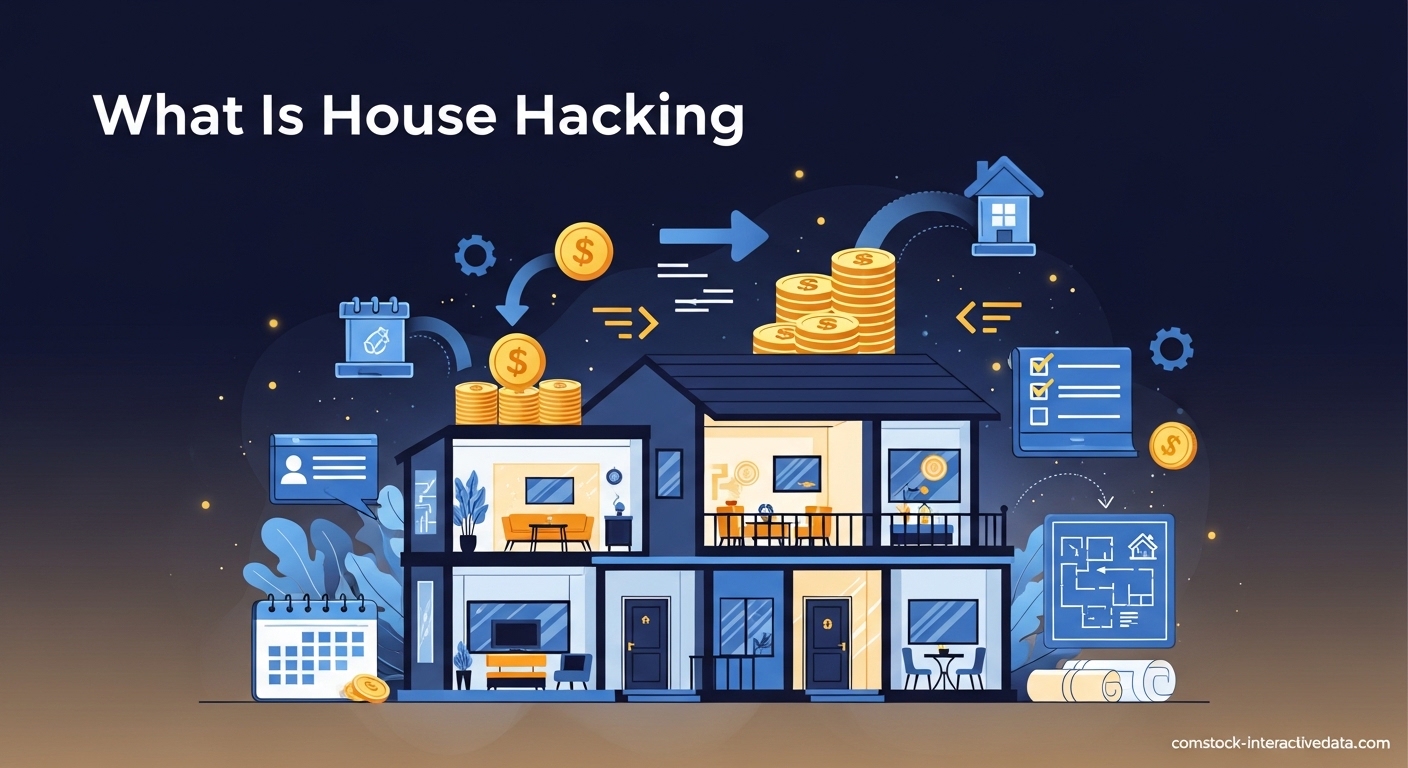
House hacking is a real estate investment strategy where you purchase a property, live in one part of it, and rent out the remaining space to generate income that covers or reduces your mortgage payment. It turns your primary residence into a wealth-building asset while someone else helps pay your way to financial freedom.
In this complete guide, I will show you exactly how house hacking works and why it remains one of the most powerful entry points into real estate investing. You will learn specific strategies that work in 2026, real numbers from actual scenarios, and the exact steps to get started even if you have never owned property before.
I have spent months researching this strategy across forums, speaking with successful house hackers, and analyzing market data. What I discovered changed how I think about building wealth through real estate.
Table of Contents
What Is House Hacking?
House hacking involves buying a property and using rental income from tenants to cover your housing costs. You live in one portion of the property while renting out the other portions to generate cash flow.
The term originated from the real estate investing community as a creative solution to expensive housing markets. Instead of treating your home as a pure expense, house hacking transforms it into an income-producing asset.
Most people buy homes and pay the full mortgage themselves. House hackers take a different approach. They structure their purchase so tenants, roommates, or short-term guests contribute toward the monthly costs.
How Does House Hacking Work?
The mechanics are straightforward. You purchase a property as your primary residence, which unlocks better financing terms than investment properties require. Then you generate rental income from portions of that property.
For example, you might buy a duplex and live in one unit while renting the other. Or you could purchase a single-family home and rent out spare bedrooms. Some investors build accessory dwelling units (ADUs) on their property for additional rental income.
The rental income you collect reduces or completely eliminates your out-of-pocket housing expenses. Meanwhile, you build equity as the mortgage gets paid down and the property potentially appreciates in value.
Why House Hacking Works for Building Wealth?
House hacking accelerates wealth building through four powerful mechanisms working simultaneously. Understanding these helps you see why this strategy outperforms traditional homeownership.
1. Someone Else Pays Your Mortgage
The core principle of house hacking is simple: let tenants cover your housing costs. When rental income matches or exceeds your mortgage payment, you live for free while building equity.
Even partial coverage makes a dramatic difference. Cutting your housing expense by 50% frees up hundreds of dollars monthly for investing, debt payoff, or other wealth-building activities.
2. Equity Accumulation Without the Cost
Every mortgage payment builds your net worth through principal reduction. With house hacking, your tenants effectively make those payments for you.
Over five years, a typical house hack could build $30,000 to $60,000 in equity through principal paydown alone. This happens while you pay little or nothing out of pocket for housing.
3. Real Estate Appreciation
Property values tend to increase over time. While appreciation rates vary by market, historical averages show 3-5% annual increases in most areas.
On a $300,000 property, 4% annual appreciation equals $12,000 in additional equity per year. Combined with principal paydown, your net worth grows significantly without active effort.
4. Gateway to Real Estate Investing
House hacking provides hands-on landlord experience with reduced risk. You learn property management, tenant screening, and maintenance while living on-site to handle issues directly.
This experience proves invaluable when expanding to additional investment properties. Lenders view successful house hackers as lower-risk borrowers for future real estate loans.
6 Proven House Hacking Strategies That Work
Not all house hacks look the same. Depending on your market, budget, and lifestyle preferences, different strategies may work better for your situation. Here are six approaches that have worked for thousands of investors.
1. Multifamily Property House Hack
The classic house hack involves purchasing a duplex, triplex, or fourplex and living in one unit. This approach offers the most privacy since you have separate living spaces.
Multifamily properties often generate enough rental income to cover the entire mortgage payment. Many house hackers in duplex situations live completely rent-free while building equity.
FHA loans work particularly well for this strategy. You can purchase a multifamily property with just 3.5% down, living in one unit and renting the others immediately.
2. Room Rental House Hack
For single-family homes, renting spare bedrooms offers an accessible entry point. Many house hackers purchase three or four-bedroom homes and rent out two rooms to housemates.
This strategy works best for younger investors comfortable with shared living arrangements. Room rentals typically command $600 to $1,200 per month depending on your market.
The income potential is significant. Renting two rooms at $800 each generates $1,600 monthly. This often covers the majority of a mortgage payment on a modest home.
3. Accessory Dwelling Unit (ADU)
An ADU is a separate living space on your property, such as a converted garage, basement apartment, or detached cottage. These units rent for $800 to $2,000 monthly depending on size and location.
Many investors purchase homes with existing ADUs or add them after purchase. The construction costs often pay for themselves within two to three years through rental income.
Local zoning laws vary significantly for ADUs. Check municipal regulations before pursuing this strategy, as some areas restrict or prohibit additional dwelling units.
4. Short-Term Rental House Hack
Platforms like Airbnb and VRBO enable short-term rental income from spare rooms or separate units. This approach often generates higher nightly rates than traditional long-term leases.
Short-term rentals require more active management. Cleaning, guest communication, and turnover preparation demand time and attention. However, the income potential often justifies the effort.
Some house hackers combine strategies, renting spare rooms on Airbnb while maintaining a separate living area for themselves. This maximizes income while preserving privacy.
5. Live-In Flip Strategy
The live-in flip involves purchasing a property needing renovation, completing improvements while living there, then selling for profit. This combines house hacking with active value creation.
Using an FHA 203(k) renovation loan, you can finance both the purchase and repairs with just 3.5% down. This opens opportunities in neighborhoods with fixer-upper properties.
Most owner-occupants must live in the property for at least one year before selling to satisfy lender requirements. Plan your renovation timeline accordingly to maximize value without rushing.
6. Alternative Space Rental
Beyond living spaces, consider renting garages, storage sheds, parking spots, or yard space. These lower-maintenance options generate income without the complexity of tenant relationships.
Parking spaces in urban areas rent for $100 to $300 monthly. Storage space in garages or sheds commands $50 to $150 monthly. While smaller individually, these add up to meaningful contributions toward your mortgage.
This strategy works well combined with other approaches. Rent a spare room plus garage storage for maximum income without significantly increased management burden.
Real Numbers: A House Hacking Example
Let me walk you through a realistic example using actual numbers. This scenario illustrates how house hacking builds wealth through multiple channels simultaneously.
The Property
Sarah purchases a duplex for $350,000 using an FHA loan with 3.5% down. Her down payment is $12,250. The property has two identical two-bedroom units.
Her monthly mortgage payment including principal, interest, taxes, insurance, and mortgage insurance equals $2,400. She lives in Unit A and rents Unit B.
The Income and Expenses
Unit B rents for $1,600 monthly. After accounting for vacancy (5%), maintenance reserves ($100 monthly), and property management costs she handles herself, her net rental income is $1,420 per month.
Sarah’s out-of-pocket housing cost drops to just $980 monthly ($2,400 mortgage minus $1,420 rental income). Previously she paid $1,400 to rent an apartment.
Five-Year Wealth Building Results
After five years, Sarah’s wealth has grown through three mechanisms. First, she saved $25,200 in housing costs compared to her previous rent ($420 monthly savings times 60 months).
Second, her mortgage principal balance decreased by $32,000 through regular payments. This equity buildup happened while she paid less out-of-pocket than she would have renting.
Third, assuming 4% annual appreciation, her property value increased to approximately $426,000. Her total equity position after five years: $88,000 in appreciation plus $32,000 in principal paydown minus her $12,250 down payment equals $107,750 in net wealth.
All this from an initial investment of $12,250. That represents an exceptional return on investment achieved through the power of house hacking.
Financing Options for House Hacking
Choosing the right financing makes or breaks your house hacking success. Primary residence loans offer significant advantages over investment property financing, making your strategy possible with less capital.
FHA Loans: The Beginner’s Best Friend
Federal Housing Administration loans require only 3.5% down payment, making them ideal for first-time house hackers. You can purchase properties with up to four units as long as you live in one.
The catch? You will pay mortgage insurance premiums (MIP) for the life of the loan. However, the low down payment requirement often outweighs this cost, especially when rental income covers your payment.
FHA loans also work for renovation projects through the 203(k) program. Finance both purchase and repairs with the same low down payment requirement.
VA Loans: Zero Down for Veterans
Veterans and active military members can use VA loans with zero down payment. This powerful benefit removes the biggest barrier to house hacking for those who qualify.
VA loans also skip mortgage insurance entirely, reducing monthly costs compared to FHA alternatives. You can reuse this benefit multiple times throughout your life.
The funding fee (typically 2.3% for first-time use) can be rolled into the loan. With no down payment required, a veteran could start house hacking with just closing costs out of pocket.
Conventional Loans
Conventional mortgages require higher down payments (typically 5-20%) but avoid mortgage insurance once you reach 20% equity. They work well for house hackers with more cash available.
Conventional loans offer more flexibility after the initial owner-occupancy period. You can move out and convert to a full rental property more easily than with government-backed loans.
Conventional financing also avoids the FHA’s strict property condition requirements. This opens opportunities for properties needing work that FHA appraisers might flag.
The Owner-Occupancy Requirement
All primary residence loans require you to live in the property for a specific period. FHA and conventional loans typically require 12 months of occupancy.
Violating this requirement constitutes mortgage fraud with serious consequences. Plan to genuinely live in the property before converting it to a full investment or refinancing.
After satisfying the occupancy requirement, you can move out and rent your former unit. Many house hackers repeat this process, building a portfolio of properties over time.
Pros and Cons of House Hacking
House hacking offers tremendous benefits but comes with real challenges. Understanding both sides helps you make an informed decision about whether this strategy fits your situation.
Advantages of House Hacking
Reduced or eliminated housing costs top the benefit list. Living for free while building equity accelerates your path to financial independence faster than traditional saving and investing.
You gain valuable landlord experience with reduced risk. Living on-site means you can address tenant issues immediately and monitor your property directly.
Primary residence financing provides better terms than investment property loans. Lower down payments, better interest rates, and more lenient qualification requirements make entry possible.
House hacking builds your real estate portfolio foundation. Many successful investors started with a house hack that eventually became their first pure rental property.
Challenges and Drawbacks
Tenant management demands time and emotional energy. Late rent payments, maintenance requests, and neighbor conflicts become your responsibility as the landlord.
Shared living situations sacrifice privacy. Whether through roommates in a single-family home or adjacent tenants in a duplex, you live closer to your renters than traditional landlords.
HOA restrictions may limit your options. Some homeowners associations prohibit or severely restrict rentals, short-term guests, or ADUs.
Market risks affect your primary residence. If property values decline, your home and investment lose value simultaneously. You also face vacancy risks that could leave you covering the full mortgage.
2026 Market Considerations
Current market conditions require adjusted expectations. Interest rates have increased from historic lows, making mortgage payments higher than in previous years.
House hacking remains viable but requires more careful analysis. The goal has shifted from “living for free” to “making ownership workable” through partial rental income coverage.
Rental demand remains strong in most markets, supporting house hacking fundamentals. However, run your numbers conservatively with realistic rent estimates and adequate vacancy reserves.
How to Start House Hacking: A 5-Step Process
Ready to implement house hacking yourself? Follow this proven process that has worked for thousands of successful investors.
Step 1: Assess Your Financial Readiness
Review your credit score, savings, and debt-to-income ratio. Most lenders require 620+ credit score for FHA loans and 43% or lower debt-to-income ratio.
Calculate your available down payment and closing cost reserves. Even with 3.5% down FHA loans, you need additional funds for closing costs and emergency reserves.
Step 2: Choose Your House Hacking Strategy
Based on your market, budget, and lifestyle preferences, select the approach that fits your situation. Consider multifamily properties for maximum privacy or room rentals for lower entry costs.
Research local rental rates to understand income potential. Look at comparable rentals on Craigslist, Zillow, or Facebook Marketplace in your target area.
Step 3: Find the Right Property
Work with a real estate agent experienced in investment properties. They can help identify properties suitable for your chosen strategy and connect you with lender resources.
Run the numbers on every potential property. Calculate mortgage payments, estimated rental income, vacancy reserves, maintenance costs, and property management fees if applicable.
Step 4: Secure Financing and Close
Get pre-approved before making offers. Pre-approval strengthens your position with sellers and helps you move quickly when you find the right property.
Complete inspections thoroughly. With rental income dependent on property condition, identify potential issues before closing to avoid surprise repair costs.
Step 5: Prepare and Execute Your Rental Strategy
Prepare your rental space before marketing. Clean thoroughly, address maintenance items, and ensure everything meets local housing codes.
Screen tenants carefully. Run credit and background checks, verify income, and check references. One bad tenant can eliminate your house hacking benefits.
Document everything with written leases. Even when renting to friends or housemates, formal agreements prevent misunderstandings and protect both parties.
Tax Implications of House Hacking
Understanding tax obligations ensures you report income correctly and claim all available deductions. Proper tax planning maximizes your house hacking returns.
Rental Income Reporting
You must report rental income on Schedule E of your tax return. This applies whether you rent a separate unit, spare rooms, or short-term through platforms like Airbnb.
However, you only report income from the rented portion. If you rent one room in a four-bedroom house, you allocate expenses proportionally rather than claiming the entire property as a rental.
Deductible Expenses
Rental property deductions reduce your taxable rental income. Common deductions include property taxes, insurance, maintenance, repairs, utilities (if included in rent), and property management fees.
Mortgage interest on the rented portion is also deductible. When renting part of your primary residence, allocate the mortgage interest based on square footage or room count.
Depreciation Benefits
Rental property owners can depreciate the building value over 27.5 years. This non-cash deduction reduces taxable income without requiring actual expense.
Depreciation applies only to the rented portion of your property. Work with a tax professional to calculate correct allocations and maximize legitimate deductions.
Keep detailed records of all income and expenses. Separate bank accounts for rental activity simplify tracking and provide clear documentation if audited.
House Hacking Alternatives for Non-Homeowners
Not ready to buy property? Several alternatives let you apply house hacking concepts without homeownership.
Rent Hacking (Subleasing)
Rent a larger property than you need and sublease spare rooms. This requires landlord permission and careful lease review, but can reduce your effective rent to zero.
Real Estate Crowdfunding
Platforms like Fundrise, RealtyMogul, and YieldStreet let you invest in real estate with minimal capital. While not true house hacking, these provide real estate exposure and passive income.
REITs (Real Estate Investment Trusts)
Publicly traded REITs offer liquid real estate investments. You can buy shares through any brokerage account, receiving dividends from commercial and residential property portfolios.
House Hacking Partnerships
Partner with a homeowner who wants to house hack but lacks time or expertise. You handle property management in exchange for reduced rent or profit sharing.
Frequently Asked Questions About House Hacking
What is house hacking?
House hacking is a real estate investment strategy where you purchase a property, live in one part of it, and rent out the remaining space to generate income that covers or reduces your mortgage payment. Common approaches include buying a duplex and renting one unit, renting spare rooms in your home, or adding an accessory dwelling unit for rental income.
Is house hacking still profitable in 2026?
House hacking remains profitable in 2026, though expectations should adjust for current market conditions. While rising interest rates have increased mortgage payments, strong rental demand in most markets still supports the strategy. Success requires careful property selection, conservative financial projections, and realistic expectations about partial rather than complete mortgage coverage.
How long do I need to live in a house hack property?
Most primary residence loans require 12 months of owner occupancy. FHA and conventional mortgages both typically mandate one year of living in the property as your primary residence. Violating this requirement can constitute mortgage fraud. After satisfying the occupancy period, you can move out and convert the entire property to rentals if desired.
Do you pay taxes on house hacking income?
Yes, rental income from house hacking is taxable and must be reported on Schedule E of your tax return. However, you can deduct expenses related to the rental portion including mortgage interest, property taxes, insurance, maintenance, and depreciation. The rented portion of your property essentially operates as a rental business for tax purposes.
Can I house hack a single-family home?
Absolutely. Single-family house hacking typically involves renting spare bedrooms to housemates or creating an accessory dwelling unit (ADU). Many successful house hackers purchase three or four-bedroom homes, live in one room, and rent the others. Room rentals often generate $600 to $1,200 monthly per room depending on your market.
What is the 3 3 3 rule in real estate?
The 3 3 3 rule suggests having three months of reserves, a 3% interest rate buffer, and three exit strategies when evaluating real estate investments. For house hacking specifically, this means maintaining three months of mortgage payments in reserves, stress-testing your numbers at rates 3% higher than current levels, and having three plans for handling vacancies or market changes.
Conclusion: Start Building Wealth Through House Hacking
What Is House Hacking and How Can It Help You Build Wealth? Now you have the complete answer. House hacking transforms your largest expense into a wealth-building engine by letting others contribute to your mortgage while you build equity.
The strategy works through multiple wealth-building mechanisms: rental income reducing your housing costs, principal paydown building equity, potential appreciation increasing your net worth, and landlord experience opening doors to larger real estate portfolios.
Whether you choose a multifamily property, room rentals, an ADU, or another strategy, the fundamentals remain the same. Purchase as a primary residence for better financing, generate rental income to cover costs, and let time and tenants build your wealth.
House hacking remains accessible in 2026 for those willing to run the numbers carefully and commit to the process. The barrier to entry is lower than most real estate investing strategies, making it the ideal starting point for building wealth through property ownership.
Your next step is assessing your financial readiness and choosing the strategy that fits your situation. The wealth you build through house hacking could become the foundation for a lifetime of financial independence.