
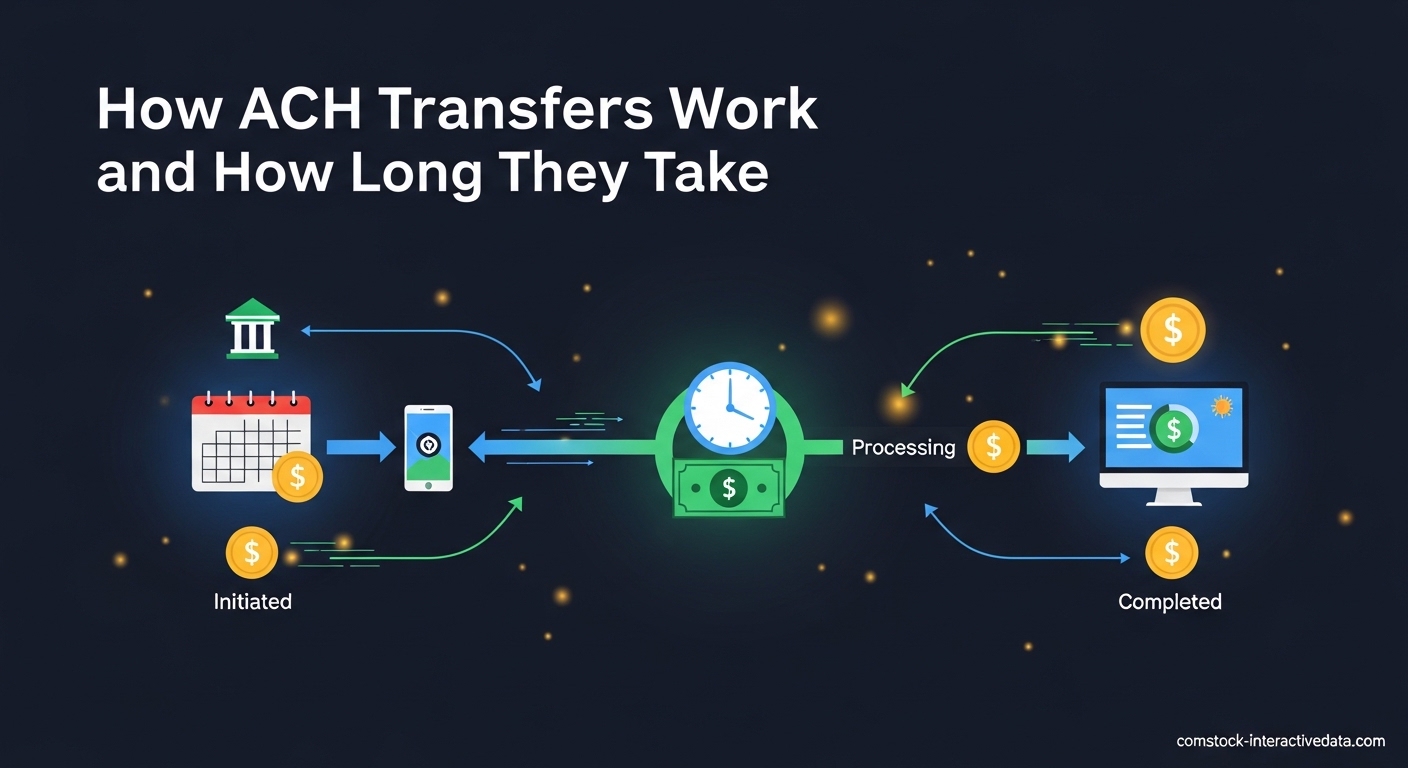
ACH transfers typically take 1-3 business days to complete, though the exact timing depends on when you initiate the transfer, your bank’s cutoff times, and whether you use standard or same-day ACH processing. Understanding how the Automated Clearing House (ACH) Network operates helps you plan payments, avoid late fees, and choose the right transfer method for your needs.
In this guide, I will explain exactly how ACH transfers work, why they take the time they do, and what you can do to speed them up. Whether you are waiting for a paycheck to clear, sending rent to your landlord, or managing business vendor payments, this article covers everything you need to know about ACH timing in 2026.
Table of Contents
Key Takeaways
- Standard ACH transfers take 1-3 business days; same-day ACH processes within hours
- ACH transfers use batch processing through the ACH Network, not real-time transfers
- Bank cutoff times (typically 2-4 PM local time) determine when processing begins
- Weekends and federal holidays delay ACH processing until the next business day
- ACH deposits typically post by 9:00 AM on the settlement date, though some banks credit earlier
- ACH transfers cost less than wire transfers but take longer to settle
What Is an ACH Transfer?
An ACH transfer is an electronic money transfer between bank accounts through the Automated Clearing House (ACH) Network. This network acts as a centralized system that processes batches of transactions between financial institutions, handling everything from direct deposits and bill payments to peer-to-peer transfers and business vendor payments.
The ACH Network is managed by Nacha, the National Automated Clearing House Association, which establishes the rules and standards that all participating banks must follow. In 2026, the ACH Network processes over 30 billion transactions annually, moving more than $76 trillion dollars between accounts. This makes ACH the backbone of electronic payments in the United States.
Unlike wire transfers that move money individually in real-time, ACH transfers are collected into batches and processed at specific intervals throughout the day. This batch processing approach keeps costs low but introduces the timing delays many users find frustrating. When you initiate an ACH transfer, you are essentially adding your transaction to a queue that will be processed during the next available batch window.
How Long Do ACH Transfers Take?
Standard ACH transfers take 1-3 business days to complete from initiation to final settlement. The timeline breaks down as follows: Day 1 involves the originating bank batching your request and sending it to an ACH operator; Day 2 includes the ACH operator processing the transaction and forwarding it to the receiving bank; Day 3 covers the receiving bank posting the funds to the destination account.
However, many transfers complete in just 1-2 business days depending on timing. If you initiate a transfer early in the day before your bank’s cutoff time, the batching happens the same day and settlement may occur by the next business day. Transfers initiated after the cutoff time get pushed to the next batch cycle, adding a day to the timeline.
Same-day ACH offers a faster alternative. Introduced in 2016 and expanded in subsequent years, same-day ACH processes transactions within hours rather than days. There are three same-day ACH processing windows each business day, allowing funds to settle by 1:00 PM, 5:00 PM, or 8:00 PM local time depending on when the transfer was submitted.
Standard ACH vs Same-Day ACH
| Feature | Standard ACH | Same-Day ACH |
|---|---|---|
| Processing Time | 1-3 business days | Same business day (hours) |
| Daily Windows | Multiple batch cycles | 3 specific windows |
| Transaction Limits | Typically $100,000+ | $1,000,000 per transaction |
| Availability | All banks | Most major banks (check with yours) |
| Cost | Usually free for consumers | $0.50-$5.00 fee common |
| Best For | Non-urgent payments | Time-sensitive transfers |
How ACH Transfers Work?
The ACH transfer process involves four distinct steps that happen behind the scenes between when you click “send” and when the money actually arrives. Understanding this process explains why ACH transfers cannot be instant despite our expectations for immediate digital transactions.
Step 1: Initiation
The process begins when you or a business initiates a transfer. This might happen through your bank’s online portal, a payment app, a payroll system, or a bill payment service. You provide the recipient’s routing number, account number, the transfer amount, and authorization for the transaction.
Step 2: Batching at the ODFI
Your bank, known as the Originating Depository Financial Institution (ODFI), collects ACH requests throughout the day. Rather than sending each transaction individually, the ODFI bundles them into batches. These batches are typically created at specific cutoff times, often between 2:00 PM and 4:00 PM local time, though this varies by bank.
Step 3: Processing by ACH Operators
The ODFI sends batched transactions to one of two ACH operators: the Federal Reserve Bank or the Electronic Payments Network (EPN). These operators act as central clearing facilities that route transactions between banks. They validate the transactions, check for errors, and prepare them for delivery to the receiving banks.
Step 4: Settlement at the RDFI
Finally, the receiving bank, called the Receiving Depository Financial Institution (RDFI), receives the transaction. The RDFI posts the funds to the recipient’s account during the next settlement window. This posting typically happens overnight, which is why ACH deposits often appear early in the morning on the settlement date.
ACH Credits vs ACH Debits
ACH transactions fall into two categories that work slightly differently. ACH credits push money into an account, while ACH debits pull money out of an account.
ACH credits include direct deposits like payroll, tax refunds, and transfers you initiate to send money to someone else. When your employer sends your paycheck via direct deposit, that is an ACH credit pushing funds into your account.
ACH debits include automatic bill payments, subscription charges, and transfers where you authorize a business to pull funds from your account. When you set up autopay for your electric bill, the utility company initiates an ACH debit to pull money from your checking account.
From a timing perspective, ACH credits often post faster than debits because the receiving bank has more incentive to make funds available quickly. Debits may face additional verification steps to prevent fraud and overdrafts.
Factors That Affect ACH Transfer Timing
Several variables determine exactly how long your specific ACH transfer will take. Understanding these factors helps you plan better and avoid surprises when money does not arrive as quickly as expected.
Initiation Time and Bank Cutoff Times
The time of day you initiate a transfer matters significantly. Every bank establishes cutoff times that determine which batch your transfer joins. If you submit a transfer before the morning cutoff (often around 10:00 AM), it might process that same day. Transfers submitted after the afternoon cutoff (typically 2:00-4:00 PM) wait until the next business day’s batch.
Weekends and Federal Holidays
The ACH Network only processes transactions on business days. Transfers initiated on Friday after the cutoff time, Saturday, or Sunday do not begin processing until Monday. Federal holidays also pause processing, creating additional delays during holiday weeks.
Batch Processing Schedules
Each bank sets its own batch processing schedule. Some banks process multiple batches per day, while others consolidate into fewer batches. Banks with more frequent batch schedules generally offer faster ACH settlement times.
Same-Day ACH Availability
Not all banks offer same-day ACH, and those that do may have specific requirements. You might need to initiate the transfer through specific channels, pay an additional fee, or meet cutoff times earlier than standard ACH windows.
Account Verification Holds
For new payees or large transfers, banks may place additional holds for fraud prevention. These security reviews can add 1-2 business days to the standard timeline, particularly for business accounts or transfers over $10,000.
ACH Transfer Timing by Major Bank
One of the most common frustrations users express is the lack of specific timing information from their banks. Based on publicly available documentation and user reports, here are the typical ACH processing schedules for three major U.S. banks.
Chase ACH Transfer Timing
Chase processes standard ACH transfers in 1-3 business days. For incoming ACH deposits, Chase typically posts funds by 9:00 AM Eastern Time on the settlement date. Chase offers same-day ACH for business banking customers, with cutoff times at 11:00 AM, 3:00 PM, and 5:00 PM Eastern Time for the three daily processing windows. Personal banking customers can access same-day ACH through Chase QuickPay with Zelle for smaller transfers.
Bank of America ACH Transfer Timing
Bank of America generally completes standard ACH transfers within 3 business days. Incoming ACH deposits typically post overnight and appear in accounts by 8:00 AM local time. Bank of America supports same-day ACH for business customers with cutoff times at 10:45 AM, 2:45 PM, and 4:45 PM Eastern Time. The bank charges a fee for same-day processing that varies by account type and relationship level.
Wells Fargo ACH Transfer Timing
Wells Fargo processes standard ACH transfers in 1-2 business days for most transactions. ACH deposits typically post by 8:30 AM Pacific Time on the settlement date. Wells Fargo offers same-day ACH through its business banking platform with cutoff times at 9:00 AM, 1:00 PM, and 3:00 PM Pacific Time. Personal banking customers can use Wells Fargo SurePay for faster person-to-person transfers.
| Bank | Standard ACH Time | Typical Posting Time | Same-Day Cutoff Times |
|---|---|---|---|
| Chase | 1-3 business days | 9:00 AM ET | 11:00 AM, 3:00 PM, 5:00 PM ET |
| Bank of America | 3 business days | 8:00 AM local | 10:45 AM, 2:45 PM, 4:45 PM ET |
| Wells Fargo | 1-2 business days | 8:30 AM PT | 9:00 AM, 1:00 PM, 3:00 PM PT |
Always check with your specific bank for the most current cutoff times and availability, as these schedules can change.
ACH vs Wire Transfer: Key Differences
Choosing between ACH and wire transfers depends on your priorities for speed, cost, and security. While both move money between accounts electronically, they serve different purposes and come with different trade-offs.
| Feature | ACH Transfer | Wire Transfer |
|---|---|---|
| Speed | 1-3 business days (same-day available) | Same day (minutes to hours) |
| Cost | Usually free for consumers; $0.20-$1.50 for businesses | $15-$50 outgoing; $0-$15 incoming |
| Transaction Limits | $100,000+ typical; $1M for same-day | $100,000+ to millions |
| Reversibility | Can be reversed in certain circumstances | Generally irreversible once sent |
| Security | Secure with Nacha rules and verification | Very secure but higher fraud risk due to speed |
| Best Use Cases | Payroll, bills, recurring payments, non-urgent transfers | Large purchases, real estate, international, urgent payments |
| International | U.S. only | Available domestically and internationally |
| Processing | Batch processing | Real-time individual processing |
For most everyday transfers, ACH offers the better value. You save money and gain the ability to reverse errors. Wires make sense when timing matters more than cost, such as closing on a home purchase or sending emergency funds.
Costs and Fees for ACH Transfers
One of ACH’s biggest advantages is its low cost compared to other payment methods. For consumers, ACH transfers are typically free. Your bank does not charge you to receive direct deposits or to initiate standard transfers between your accounts or to external accounts.
Businesses pay more for ACH processing, though rates remain significantly lower than credit card or wire transfer fees. Business ACH costs typically range from $0.20 to $1.50 per transaction depending on volume and banking relationship. High-volume processors may negotiate even lower rates.
Same-day ACH usually carries an additional fee, often between $0.50 and $5.00 per transaction. Some banks bundle same-day ACH into premium account packages, while others charge per-use fees. Always check your account agreement or contact your bank to understand same-day ACH pricing.
ACH return fees represent another potential cost. If an ACH transfer fails due to insufficient funds, closed accounts, or invalid account numbers, banks often charge return fees ranging from $2 to $25 per occurrence. Businesses initiating ACH debits may face higher return fees than those receiving credits.
Benefits of Using ACH Transfers
ACH transfers have become the dominant electronic payment method for good reason. They offer distinct advantages for both businesses and consumers that make them preferable to checks, wires, and cards for many use cases.
For Businesses
Businesses benefit from ACH’s low transaction costs, which run significantly cheaper than credit card processing fees. A business processing 1,000 payments monthly might save thousands of dollars by using ACH instead of cards. The ability to set up recurring payments improves cash flow predictability and reduces late payment issues.
ACH also reduces administrative overhead. Electronic records integrate easily with accounting software, eliminating manual check deposit trips and paper record storage. The reversibility of ACH transfers provides a safety net for errors, though this feature should not be relied upon as a primary risk management strategy.
For Consumers
Consumers enjoy the convenience of automatic bill pay, direct deposit, and easy person-to-person transfers without fees. ACH eliminates check writing, stamp purchases, and trips to the bank. The security features built into the ACH Network protect consumers from many types of fraud.
ACH also provides better record keeping than cash or checks. Every transaction creates an electronic trail that appears on bank statements, making budgeting and tax preparation easier. The ability to schedule recurring payments helps avoid late fees and maintain good credit.
Pros of ACH Transfers
- Low cost or free for consumers
- Secure with multiple verification layers
- Reversible in case of errors
- Supports recurring automated payments
- Convenient electronic record keeping
Cons of ACH Transfers
- Slower than wire transfers
- Weekend and holiday delays
- Cutoff time restrictions
- Potential for return fees
- U.S. only (no international transfers)
How to Expedite ACH Transfers?
While you cannot make standard ACH transfers instant, several strategies help speed up processing and ensure your money arrives as quickly as possible.
Use Same-Day ACH When Available
If your bank offers same-day ACH and the transaction justifies the fee, use it. Same-day ACH can settle funds within hours rather than days. Contact your bank to confirm availability and pricing for same-day processing.
Submit Before Cutoff Times
Learn your bank’s cutoff times and submit transfers well before them. A transfer submitted at 9:00 AM typically processes faster than one submitted at 4:00 PM. For fastest standard ACH processing, submit transfers first thing in the morning on business days.
Avoid Weekends and Holidays
Plan transfers to avoid weekends and federal holidays. If you need funds available by Friday, initiate the transfer by Tuesday or Wednesday morning to account for the 1-3 day processing window. Transfers initiated on Friday often do not settle until Tuesday of the following week.
Verify Account Information
Double-check routing and account numbers before submitting transfers. Errors cause delays, returns, and potential fees. For business transfers, consider using ACH verification services that confirm account validity before processing.
Consider Alternative Transfer Methods
For truly urgent transfers, consider wire transfers or payment apps like Zelle, Venmo, or Cash App. These services operate outside the ACH Network and offer faster settlement, though they come with different limitations and fee structures.
Security and Fraud Prevention
The ACH Network incorporates multiple security layers to protect users from fraud and errors. Nacha establishes strict rules that all participants must follow, including encryption standards, authentication requirements, and monitoring protocols.
ACH transfers benefit from reversibility. Unlike wires that cannot be recalled once sent, ACH credits can be reversed in certain circumstances such as duplicate entries or erroneous amounts. ACH debits carry specific consumer protections under Regulation E, which allows consumers to dispute unauthorized debits within 60 days.
Banks monitor ACH transactions for suspicious patterns. Unusual transaction sizes, frequencies, or destinations may trigger security reviews that delay processing but protect against fraud. Businesses initiating ACH debits must maintain proper authorization documentation and follow Nacha’s return code procedures.
Common ACH return codes indicate why transfers fail. Code R01 means insufficient funds, R02 indicates a closed account, and R03 signals no account exists for the provided number. Understanding these codes helps resolve issues quickly when transfers do not complete as expected.
Common Use Cases for ACH Transfers
ACH transfers support a wide range of financial activities that touch nearly every aspect of personal and business finance. Understanding these use cases helps you recognize when ACH is the right choice for your needs.
Payroll direct deposit represents the most common ACH use case. Employers use ACH credits to push paychecks directly into employee accounts, eliminating paper checks and ensuring timely payment. Over 93% of Americans receive their paychecks via ACH direct deposit.
Bill payments make up another major category. Consumers use ACH debits to automate mortgage, utility, insurance, and subscription payments. Businesses use ACH to pay vendors, suppliers, and contractors on net-30 or net-60 terms.
Tax payments and refunds flow through the ACH Network. The IRS uses ACH for direct deposit of tax refunds and accepts ACH debits for tax payments through its EFTPS system. State tax agencies similarly rely on ACH for revenue collection and refund distribution.
Peer-to-peer transfers increasingly use ACH infrastructure. While apps like Venmo and Cash App provide instant user experiences, the underlying fund movements often settle through ACH between the app provider and user bank accounts.
Government benefits including Social Security, unemployment, and disability payments distribute via ACH. This ensures reliable, timely delivery of critical income to millions of recipients.
Frequently Asked Questions
Do ACH transfers go through immediately?
No, ACH transfers do not go through immediately. Standard ACH transfers take 1-3 business days to complete because they use batch processing rather than real-time transfer. Same-day ACH can process within hours if initiated before cutoff times, but this service typically requires additional fees and is not instant like wire transfers or payment apps.
How long does a $10,000 wire transfer take?
Domestic wire transfers typically complete within 24 hours, often same-day if initiated before the bank’s cutoff time (usually 2:00-4:00 PM local time). International wire transfers take 1-5 business days depending on the destination country, intermediary banks involved, and compliance verification requirements. Unlike ACH transfers, wires process individually in real-time rather than through batch processing.
Are ACH transfers over $10,000 reported to the IRS?
ACH transfers over $10,000 are not automatically reported to the IRS solely based on the transfer amount. However, banks file Currency Transaction Reports (CTRs) for cash transactions exceeding $10,000. ACH transfers may be reviewed if they trigger suspicious activity monitoring systems, such as unusual patterns, structuring to avoid reporting thresholds, or connections to known fraud. Normal legitimate transfers, regardless of amount, proceed without IRS notification.
What time will my ACH deposit hit?
ACH deposits typically post by 9:00 AM local time on the settlement date. However, many banks provide provisional credit earlier, sometimes as early as 12:00 AM Eastern Time (9:00 PM Pacific Time the night before). Exact timing varies by bank; Chase typically posts by 9:00 AM ET, Bank of America by 8:00 AM local time, and Wells Fargo by 8:30 AM PT. Check your bank’s specific schedule for the most accurate expectation.
Conclusion
ACH transfers remain the backbone of electronic payments in the United States because they balance cost, security, and convenience effectively. Understanding how ACH transfers work and how long they take helps you plan financial transactions with confidence. Remember the key principles: standard ACH takes 1-3 business days, same-day ACH offers faster settlement for a fee, weekends and holidays cause delays, and each bank maintains specific cutoff times that affect processing speed.
For most everyday transactions, ACH offers the best combination of low cost and reasonable speed. Use wire transfers only when timing is critical and you cannot wait for ACH settlement. Plan ahead when possible, submit transfers before cutoff times, and choose same-day ACH when you need funds to move quickly.
As payment technology evolves, the gap between ACH speed and real-time transfers continues to narrow. Same-day ACH expansion and potential future improvements to the ACH Network will make electronic payments even more efficient. For now, understanding the batch processing system and planning accordingly ensures your ACH transfers arrive when you need them.