
I remember staring at my first crypto exchange screen, completely overwhelmed by the green and red numbers flashing across the screen. Terms like “order book,” “bid-ask spread,” and “trading pairs” felt like a foreign language. If you are feeling the same way right now, you are not alone.
This guide will walk you through exactly how crypto exchanges work without the technical jargon. You will learn what happens when you click that “buy” button, where your money goes, and how to choose an exchange that won’t disappear with your funds.
By the end, you will understand the mechanics behind every cryptocurrency transaction and feel confident making your first trade. Let’s start with the basics.
Table of Contents
What Is a Cryptocurrency Exchange?
A cryptocurrency exchange is a digital marketplace where buyers and sellers trade cryptocurrencies like Bitcoin and Ethereum. Think of it like a stock exchange, but instead of trading company shares, you are trading digital assets.
The exchange acts as an intermediary between you and the person on the other side of your trade. Without an exchange, you would need to find someone willing to sell you Bitcoin, negotiate a price, and hope they actually send the coins after you pay them.
Most exchanges support hundreds of different cryptocurrencies and allow you to trade between digital assets or convert traditional money (called “fiat currency”) into crypto. The largest exchanges process billions of dollars in transactions every single day.
How Do Crypto Exchanges Work?
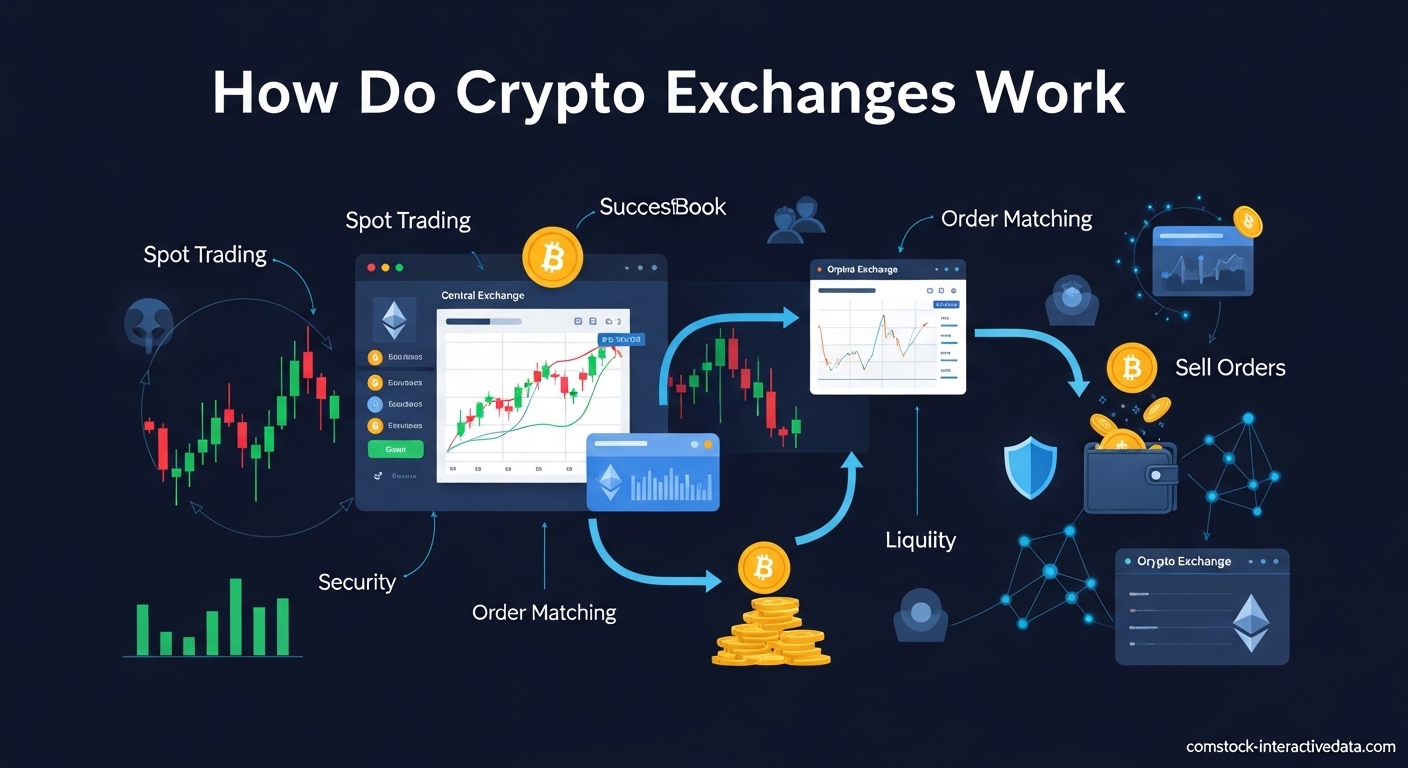
At their core, crypto exchanges work by matching people who want to buy with people who want to sell. This matching process happens automatically through technology that most users never see.
The Order Book Explained
Every exchange maintains something called an order book. This is essentially a real-time list of everyone who wants to buy a specific cryptocurrency and everyone who wants to sell it.
When you want to buy Bitcoin at a specific price, your order gets added to the buy side of the order book. When someone wants to sell at that same price (or lower), the exchange’s matching engine connects your orders automatically.
The order book displays prices in what is called a “trading pair.” You will see notations like BTC/USD or ETH/BTC. This simply means you are trading one asset for another. In BTC/USD, you are buying Bitcoin with US Dollars.
The Matching Engine
The matching engine is the software that pairs buy orders with sell orders. It operates 24 hours a day, seven days a week, because cryptocurrency markets never close.
When you place a market order (buying or selling immediately at the best available price), the matching engine finds the closest matching order and executes the trade instantly. When you place a limit order (buying or selling only at a specific price), your order waits in the book until someone accepts your price.
Types of Orders
Understanding order types is essential for using any exchange effectively. Here are the three main types beginners should know:
Market orders execute immediately at the current market price. Use these when you want to buy or sell right now regardless of small price fluctuations.
Limit orders let you set a specific price you are willing to pay or accept. The order only executes if the market reaches your price. This gives you price control but no guarantee the trade will happen.
Stop-loss orders automatically sell your crypto if the price drops to a certain level. These help limit losses when markets move against you.
Types of Cryptocurrency Exchanges
Not all exchanges work the same way. There are three main types, each with different trade-offs between convenience, security, and control.
Centralized Exchanges (CEX)
Centralized exchanges are the most common type. Companies like Coinbase, Binance, and Kraken operate as middlemen between buyers and sellers. They hold your funds in their wallets and process all transactions on their servers.
The main advantage of CEX platforms is convenience. They offer user-friendly interfaces, customer support, and high trading volume that ensures your orders execute quickly. Most also allow you to deposit traditional currency directly from your bank account.
The downside is trust. When you use a centralized exchange, you are trusting that company to safeguard your funds. If they get hacked, go bankrupt, or turn out to be fraudulent, you could lose your money. This is not theoretical. The Mt. Gox hack in 2014 lost 850,000 Bitcoins, and the FTX collapse in 2022 wiped out billions in customer funds.
Decentralized Exchanges (DEX)
Decentralized exchanges operate without a central authority. Instead of a company holding your funds, trades happen directly between users through smart contracts on a blockchain.
When you use a DEX like Uniswap or PancakeSwap, you connect your personal wallet directly to the platform. Your crypto never leaves your control. The exchange simply facilitates the swap between assets using automated protocols.
The benefits include privacy (often no KYC required), self-custody of funds, and resistance to censorship. However, DEX platforms are more complex to use, offer no customer support, and can have higher fees during network congestion. They also typically only support crypto-to-crypto trading, not fiat deposits.
Hybrid Exchanges
Hybrid exchanges attempt to combine the best of both worlds. They offer the user-friendly interface and fiat support of centralized exchanges while giving users more control over their private keys.
These are less common but growing in popularity as the industry matures. They aim to solve the custody problem of CEX platforms while maintaining accessibility for everyday users.
CEX vs DEX vs Hybrid: Comparison
| Feature | Centralized (CEX) | Decentralized (DEX) | Hybrid |
|---|---|---|---|
| Custody of Funds | Exchange holds your crypto | You hold your crypto | Varies by platform |
| Ease of Use | Beginner-friendly | Requires technical knowledge | Moderate |
| Fiat Support | Yes (bank deposits) | No (crypto only) | Usually yes |
| KYC Required | Yes | No | Usually yes |
| Customer Support | Available | None | Limited |
| Speed | Fast (internal matching) | Slower (blockchain confirmation) | Moderate |
| Security Risk | Exchange hack/bankruptcy | Smart contract bugs | Varies |
Understanding Exchange Business Models
Crypto exchanges are businesses that need to make money. Understanding how they earn revenue helps you minimize the fees you pay.
The primary revenue source is trading fees. Every time you buy or sell, the exchange takes a small percentage of the transaction. These fees typically range from 0.1% to 0.5% per trade, though some platforms charge more for smaller transactions.
Exchanges also make money through the bid-ask spread. This is the small difference between the price buyers are willing to pay and the price sellers are willing to accept. Market makers profit from this spread, and exchanges often participate in market making themselves.
Additional fees include withdrawal fees (when you move crypto off the exchange), deposit fees (for certain payment methods), and currency conversion fees (when trading between different fiat currencies).
Some exchanges also offer premium services like advanced trading tools, lower fees for high-volume traders, or staking rewards where you earn interest on crypto held on the platform.
Security Measures and Fund Safety
Security should be your top priority when choosing and using a crypto exchange. The unfortunate reality is that billions of dollars have been lost to exchange hacks and failures.
Cold Storage vs Hot Wallets
Exchanges store customer funds in two types of wallets. Hot wallets are connected to the internet and hold the small portion of funds needed for daily withdrawals. Cold storage means keeping crypto offline in hardware devices or paper wallets that hackers cannot access remotely.
Reputable exchanges keep the vast majority of customer funds (often 95% or more) in cold storage. When you see an exchange advertise “98% of funds in cold storage,” this is what they mean.
Two-Factor Authentication (2FA)
Always enable two-factor authentication on any exchange account. This adds a second verification step when logging in or withdrawing funds, typically through an app on your phone.
SMS-based 2FA is better than nothing, but authenticator apps like Google Authenticator or Authy are significantly more secure. SIM swap attacks can compromise SMS verification, while authenticator apps are tied to your physical device.
Insurance and Regulation
Some exchanges carry insurance policies that protect customer funds against hacks or theft. Others maintain proof-of-reserves, publicly demonstrating they hold enough crypto to cover all customer deposits.
Regulatory compliance also matters. In the United States, look for exchanges registered with FinCEN (Financial Crimes Enforcement Network). Registration does not guarantee safety, but it means the exchange follows certain reporting and compliance standards.
Lessons from Mt. Gox and FTX
History provides harsh lessons about exchange risk. Mt. Gox was the largest Bitcoin exchange in 2014 when hackers stole 850,000 bitcoins. Customers lost their funds, and the bankruptcy process took nearly a decade to resolve partially.
More recently, FTX collapsed in 2022 when it was revealed that the company had been using customer deposits for risky trading bets. Billions in customer funds vanished overnight. The founder now faces criminal charges.
These cases illustrate why you should never treat exchanges like banks. Only keep funds on an exchange that you are actively trading. For long-term holdings, move crypto to a personal wallet where you control the private keys.
Crypto Exchange vs Wallet: Understanding the Difference
Many beginners confuse exchanges with wallets. While exchanges provide wallet functionality, they are fundamentally different tools designed for different purposes.
An exchange wallet is a temporary holding area provided by the platform. The exchange controls the private keys. You have an account balance displayed on their website, but you do not technically own the crypto in the same way you would with a personal wallet.
A personal wallet gives you complete control over your private keys. No company can freeze your account, block your transactions, or lose your funds through bankruptcy. However, you are also solely responsible for security. If you lose your recovery phrase, your crypto is gone forever.
| Aspect | Exchange Wallet | Personal Wallet |
|---|---|---|
| Private Key Control | Exchange controls keys | You control keys |
| Convenience | Easy trading | Requires more steps to trade |
| Recovery Options | Password reset available | No recovery if phrase is lost |
| Censorship Resistance | Exchange can freeze accounts | No one can block transactions |
| Best For | Active trading | Long-term storage |
How to Get Started: Step-by-Step Guide
Ready to make your first trade? Here is a practical walkthrough for getting started with a centralized exchange, which is the recommended starting point for beginners.
Step 1: Choose Your Exchange
Start with an established, well-reviewed exchange that operates in your country. Look for platforms with strong security track records, reasonable fees, and good customer support. Popular beginner-friendly options include Coinbase, Kraken, and Gemini.
Check that the exchange is properly licensed in your jurisdiction. In the US, verify FinCEN registration. Read recent user reviews to identify any ongoing issues with withdrawals or customer service.
Step 2: Create and Secure Your Account
Sign up with your email and create a strong, unique password. Never reuse passwords from other websites. Enable two-factor authentication immediately before depositing any funds.
Verify that you can access your 2FA backup codes and store them securely. If you lose access to your 2FA device without backup codes, recovering your account becomes extremely difficult.
Step 3: Complete KYC Verification
KYC stands for “Know Your Customer.” Legitimate exchanges require identity verification to comply with anti-money laundering laws. You will need to upload a photo ID and sometimes proof of address.
This process usually takes a few minutes to a few days. Do not deposit funds until your verification is complete, as you may not be able to withdraw without it.
Step 4: Deposit Funds
Most beginners start by depositing fiat currency. Link your bank account or debit card, or use a wire transfer for larger amounts. Bank transfers typically have lower fees than card payments.
Start with a small amount you can afford to lose while learning. Even $50 is enough to understand how everything works without significant risk.
Step 5: Make Your First Trade
Navigate to the trading section and select a trading pair. For beginners, BTC/USD (Bitcoin to US Dollars) or ETH/USD (Ethereum to US Dollars) are common starting points.
Enter the amount you want to buy. For your first trade, use a market order for simplicity. Review the total cost including fees, then confirm the purchase.
Congratulations. You just made your first cryptocurrency purchase. The Bitcoin or Ethereum will appear in your exchange wallet within seconds to minutes.
Step 6: Consider Your Storage Strategy
If you plan to hold this crypto for months or years, consider moving it to a personal wallet. If you will trade frequently, leaving it on the exchange may be more convenient.
Never invest more than you can afford to lose. Cryptocurrency prices are extremely volatile, and beginners often buy at peaks and sell during panic drops.
Beginner Mistakes to Avoid
After analyzing thousands of forum discussions and personal stories, I have identified the most common and costly mistakes beginners make with crypto exchanges.
Leaving large amounts on exchanges. Only keep what you are actively trading. The FTX collapse proved that even seemingly legitimate exchanges can fail catastrophically. For long-term holdings, use a hardware wallet.
Ignoring fee structures. Small trading fees add up quickly. A 0.5% fee on every trade means you are down 1% just from buying and selling once. Check withdrawal fees too. Some exchanges charge exorbitant amounts to move your crypto elsewhere.
Falling for fake exchanges. Scammers create websites that look identical to legitimate exchanges. Always type the URL directly or use bookmarks. Never click exchange links from emails or social media messages.
Not understanding order types. Market orders are simple but can result in unexpected prices during volatile periods. Limit orders give you price control but may not execute immediately.
Skipping two-factor authentication. Every day, people lose funds because they did not enable 2FA and their password was compromised in a data breach from another website.
Emotional trading. Crypto markets are volatile. Prices can swing 10% or more in a single day. Set your strategy before buying, and do not panic sell during normal price corrections.
Frequently Asked Questions
How does a crypto exchange make money?
Crypto exchanges primarily earn revenue through trading fees charged on each transaction, typically 0.1% to 0.5% of the trade value. They also profit from bid-ask spreads, withdrawal fees, deposit fees for certain payment methods, and premium services like advanced trading tools or staking rewards.
Which crypto exchange is best for beginners?
Coinbase, Kraken, and Gemini are consistently recommended for beginners due to their user-friendly interfaces, strong security records, regulatory compliance, and educational resources. Look for exchanges with simple buying processes, responsive customer support, and transparent fee structures.
What is the difference between CEX and DEX?
CEX (Centralized Exchange) platforms are operated by companies that hold your funds and process trades on their servers. DEX (Decentralized Exchange) platforms operate without a central authority, allowing peer-to-peer trades through smart contracts while you maintain control of your private keys. CEX offers convenience and fiat support, while DEX provides privacy and self-custody.
Are crypto exchanges safe?
Reputable crypto exchanges implement security measures including cold storage for most funds, two-factor authentication, and insurance coverage. However, exchanges carry inherent risks from hacks, bankruptcy, or fraud. Only keep funds on exchanges that you are actively trading, and use personal wallets for long-term storage.
How do crypto exchanges match orders?
Exchanges use automated matching engines that pair buy orders with sell orders based on price and timing. When you place a market order, the engine finds the best available match and executes immediately. For limit orders, your request waits in the order book until a matching order appears at your specified price.
Should I keep my crypto on an exchange or in a wallet?
Keep crypto on an exchange only if you are actively trading. For long-term holdings, transfer to a personal wallet where you control the private keys. This protects you from exchange hacks, bankruptcies, and freezes. The trade-off is convenience versus security.
Conclusion
Understanding how crypto exchanges work transforms the intimidating world of cryptocurrency into something manageable. You now know that exchanges are simply marketplaces that match buyers with sellers, using order books and matching engines to execute trades automatically.
Remember the key distinctions between centralized and decentralized exchanges. CEX platforms offer convenience but require trust, while DEX platforms give you control but demand more technical knowledge. For most beginners, starting with a reputable centralized exchange makes sense, but never treat these platforms as banks.
The history of Mt. Gox and FTX serves as a constant reminder that exchanges can fail. Keep only what you need for active trading on these platforms. Move long-term holdings to personal wallets where you control the private keys. Enable two-factor authentication everywhere. And never invest more than you can afford to lose.
Your first trade may feel daunting, but every experienced crypto user started exactly where you are now. Take it slow, start small, and prioritize learning over profit. The crypto market will still be here when you are ready.