
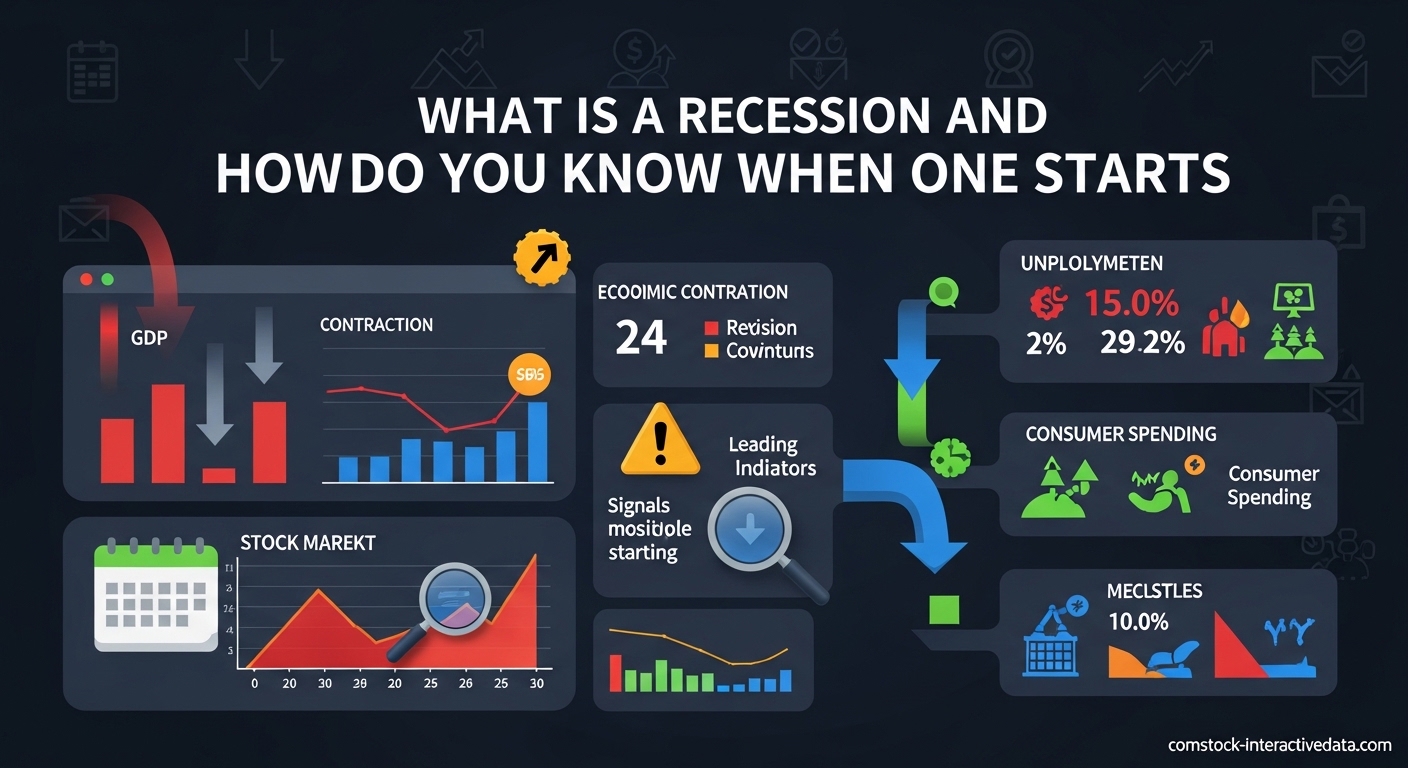
A recession is a significant, widespread, and prolonged decline in economic activity that affects the entire economy. According to the National Bureau of Economic Research, a recession begins when the economy reaches its peak of activity and ends when the economy reaches its trough. Understanding what is a recession and how to recognize when one starts can help you protect your finances, make smarter career decisions, and avoid panic during economic uncertainty.
In this guide, I will break down exactly how economists define recessions, the warning signs that signal one is coming, and who has the authority to declare when a recession officially starts. I have researched economic data spanning back to 1854, analyzed patterns from the 2008 financial crisis and the 2020 pandemic recession, and studied how the NBER makes its determinations to give you clear, actionable information.
Table of Contents
How Is a Recession Defined?
The National Bureau of Economic Research defines a recession as “a significant decline in economic activity that is spread across the economy and that lasts more than a few months.” A recession begins when the economy reaches a peak of activity and ends when the economy reaches its trough. The NBER looks at multiple indicators rather than relying on a single metric.
Many people believe the “two consecutive quarters of negative GDP growth” rule is the official definition. While this rule of thumb is commonly cited by media outlets, it is not how the NBER actually determines recessions. The two-quarter rule comes from a 1974 New York Times article by Julius Shiskin, then Commissioner of the Bureau of Labor Statistics, who proposed it as a rough guideline. The NBER rejected this simplified approach because it misses important nuances about the depth and breadth of economic decline.
Why the Two-Quarter Rule Falls Short
The two-quarter rule can produce both false positives and false negatives. The 2020 pandemic recession lasted just two months but was clearly a severe economic contraction. By contrast, some periods with two negative quarters did not involve widespread economic pain across multiple sectors. The NBER examines real GDP, real income, employment, industrial production, and wholesale-retail sales to determine if a recession has occurred.
A genuine recession must be significant, meaning the decline is substantial rather than minor. It must be widespread, affecting multiple sectors of the economy rather than just one industry. And it must be prolonged, lasting more than a few months rather than representing a brief dip. These three criteria are why the NBER waits for data confirmation rather than making real-time declarations.
Signs and Indicators of a Recession
Recognizing recession warning signs requires monitoring several key economic indicators that tend to move together during economic contractions. Here are the primary signals economists watch to determine when a recession starts:
Gross Domestic Product (GDP)
Real GDP measures the total value of goods and services produced in the economy, adjusted for inflation. When real GDP declines for multiple months, it signals that economic output is shrinking. The NBER focuses on real GDP rather than nominal GDP because it removes inflation effects to show true production changes.
Employment and Unemployment
Nonfarm payrolls and the unemployment rate are among the most watched recession indicators. Rising unemployment typically confirms that businesses are cutting back. However, the unemployment rate is a lagging indicator, meaning it often rises after a recession has already started rather than predicting one.
The Sahm Rule, developed by economist Claudia Sahm, provides a reliable recession indicator based on unemployment. When the three-month moving average of the national unemployment rate rises by 0.50 percentage points or more relative to its low during the previous 12 months, the economy has typically entered a recession. This rule has successfully identified every U.S. recession since 1970 without producing false positives.
Real Personal Income
Income growth adjusted for inflation shows whether consumers have more or less purchasing power. Declining real income means households can afford fewer goods and services, which reduces consumer demand and can trigger a downward economic spiral. The NBER tracks this metric closely because income supports spending, which drives roughly 70% of the U.S. economy.
Industrial Production
This measures output from factories, mines, and utilities. Declining industrial production signals reduced business activity and typically precedes broader economic weakness. Manufacturing is sensitive to economic changes, making this an early warning indicator.
Consumer Confidence and Spending
The Conference Board Consumer Confidence Index and retail sales data reveal whether households feel secure enough to spend money. When confidence drops, consumers postpone major purchases and reduce discretionary spending. This behavior change can trigger or deepen a recession as businesses respond to falling demand with layoffs and investment cuts.
The Yield Curve
An inverted yield curve, where short-term interest rates exceed long-term rates, has predicted nearly every U.S. recession since 1955. This inversion signals that investors expect economic weakness ahead. While not perfect, the yield curve is one of the most reliable leading indicators available to economists.
Early Warning Signs to Watch Personally
Individual households often notice recession signals before official declarations. Watch for these practical indicators: mass layoffs in specific industries, hiring freezes at major employers, friends or family struggling to find work, reduced hours at your job, local businesses closing, increased credit card debt among your network, declining home prices in your area, and stock market volatility lasting weeks or months. Google search trends for “unemployment benefits” and “bankruptcy” also spike before official recession announcements.
Who Decides When a Recession Starts?
The National Bureau of Economic Research determines when recessions begin and end in the United States. Specifically, the NBER’s Business Cycle Dating Committee, composed of eight economists from leading universities, makes these declarations. The committee includes experts from Stanford, MIT, Columbia, and other prestigious institutions who specialize in macroeconomic research.
The committee waits to declare recessions until sufficient data confirms the economic contraction. This means they announce recessions retroactively, often months after the actual start date. For example, the 2020 recession began in February but was not declared until June 8. The 2007-2009 recession started in December 2007 but was not announced until a full year later in December 2008.
Why the Delay Matters
The retroactive declaration process frustrates people who want immediate answers about the economy. However, the NBER prioritizes accuracy over speed. Announcing a recession prematurely could trigger unnecessary panic, while missing a real recession could delay policy responses. The committee revises data multiple times before making definitive calls, ensuring their determinations become the official historical record.
Other countries have similar organizations. The Centre for Economic Policy Research dates euro area business cycles. The OECD tracks global recession patterns. These organizations coordinate to identify synchronized global recessions that affect multiple major economies simultaneously.
What Causes a Recession?
Recessions have multiple triggers, and economists disagree about which factors matter most. Understanding these different theories helps explain why predicting recessions remains difficult even for experts.
Economic Shocks
Unexpected events can disrupt economic activity suddenly. The COVID-19 pandemic triggered a two-month recession in 2020 as lockdowns halted economic activity worldwide. Oil price shocks, wars, natural disasters, and terrorist attacks can all trigger recessions by disrupting supply chains, destroying wealth, or reducing confidence.
Asset Bubbles and Financial Crises
When asset prices rise far above fundamental values, the eventual correction can devastate the economy. The 2008 financial crisis followed a housing bubble where home prices became disconnected from incomes. When the bubble burst, it triggered bank failures, credit freezes, and a severe global recession. Economist Hyman Minsky developed the “Minsky Moment” theory describing how financial stability breeds risk-taking that eventually causes crisis.
Overheating Economies
When economic growth exceeds sustainable levels, inflation rises and the Federal Reserve typically raises interest rates to cool things down. If the Fed raises rates too aggressively, it can trigger a recession by making borrowing too expensive for businesses and consumers. This happened in the early 1980s when the Fed raised rates above 19% to fight inflation, causing back-to-back recessions in 1980 and 1981-1982.
Structural Economic Changes
Major shifts in how economies function can cause temporary recessions during adjustment periods. Deindustrialization, technological disruption, demographic shifts, and trade pattern changes all create winners and losers that can temporarily reduce overall economic output.
Debt and Financial Instability
High levels of household, corporate, or government debt make economies vulnerable to shocks. When debt service becomes unsustainable, defaults cascade through the financial system. The 2008 crisis demonstrated how interconnected modern finance can transmit problems globally within days.
How Long Do Recessions Last?
Since 1945, U.S. recessions have averaged 11 months according to NBER data. The Great Depression of 1929-1933 lasted 43 months, making it the longest in U.S. history. The shortest recession was the 2020 pandemic contraction, lasting just two months from February to April.
Post-World War II recessions have generally been shorter and less severe than those before 1945. The 2007-2009 Great Recession lasted 18 months, making it the longest since the Depression. The 2001 dot-com recession lasted 8 months. The 1990-1991 recession lasted 8 months. The 1981-1982 recession lasted 16 months.
Why Modern Recessions Are Shorter?
Several factors explain the trend toward shorter recessions. The Federal Reserve has developed better tools for responding to crises. Automatic stabilizers like unemployment insurance kick in quickly to support consumer spending. International cooperation helps prevent financial contagion. Modern economies are more service-based rather than manufacturing-based, making them somewhat less volatile.
However, the 2008 crisis demonstrated that modern finance can create new vulnerabilities. Complex derivatives, global interconnectedness, and shadow banking systems can transmit shocks faster than regulators can respond. The 2026 economic environment presents its own unique challenges that may affect recession duration.
Recession vs Depression: What’s the Difference?
While recessions and depressions both represent economic contractions, the difference lies in severity, duration, and scope. A recession becomes a depression when the decline is much deeper, lasts much longer, and affects the global economy rather than just one country.
The 2007-2009 recession was severe but not a depression because GDP declined roughly 4.3% and recovery began within 18 months. By contrast, the Great Depression saw GDP fall 30%, unemployment reach 25%, and the downturn persist for over a decade globally. The 2008 crisis came close to depression territory, with some economists calling it the “Great Recession” to acknowledge its severity.
There is no official threshold separating recessions from depressions. The NBER does not separately classify depressions, and the term is used subjectively by economists and historians rather than as a technical category. In practice, any economic contraction resembling the 1930s in severity would be called a depression regardless of formal definitions.
What Happens During a Recession?
Recessions affect individuals differently depending on their industry, age, wealth, and location. Manufacturing and construction typically suffer first and most severely. Service industries like healthcare and education are more recession-resistant. Young workers and recent graduates often struggle to find initial employment. Workers nearing retirement may see their savings decline just when they need them.
During a recession, you will typically see rising unemployment as businesses cut costs. Consumer spending falls as worried households save more. Stock markets decline, reducing wealth and retirement account values. Home sales slow down. Credit becomes harder to obtain as banks become risk-averse. Government tax revenues fall while spending on safety net programs rises.
Some people experience recession effects before official declarations. Friends lose jobs. Local stores close. Raises and bonuses disappear. The technical definition may lag behind lived experience by months or even years. This disconnect between personal experience and official data explains much of the confusion about whether we are in a recession.
How to Prepare for a Recession?
Preparing for a recession does not mean predicting one perfectly. It means building financial resilience so you can weather economic storms regardless of when they arrive. Here are practical steps anyone can take:
1. Build an Emergency Fund
Save three to six months of living expenses in a liquid, accessible account. This fund prevents you from going into debt or liquidating investments during temporary income loss. Keep this money in high-yield savings accounts or money market funds where it remains safe and available.
2. Reduce High-Interest Debt
Pay down credit cards and personal loans while the economy is strong. During recessions, credit becomes harder to obtain and more expensive. Lower monthly obligations give you flexibility if income drops.
3. Diversify Your Investments
Spread investments across different asset classes, sectors, and geographic regions. Rebalance regularly to maintain your target allocation. Avoid panic selling during market downturns, which locks in losses. Historical data shows markets recover from recessions, though timing varies.
4. Develop In-Demand Skills
Recession-resistant skills include healthcare, technology, education, and essential services. Consider certifications or training that make you more valuable to employers. Multiple income streams provide additional security if one source fails.
5. Review and Reduce Spending
Examine your budget for discretionary expenses you could cut if necessary. Practice living below your means before a recession forces you to. This builds the habit and proves you can do it.
6. Where to Keep Money Safe
During recessions, Treasury bonds, high-quality corporate bonds, and cash equivalents generally hold value better than stocks. FDIC-insured bank accounts protect up to $250,000 per depositor. Avoid speculative investments and anything you cannot afford to lose.
Frequently Asked Questions
What are the first signs of a recession?
The earliest recession signs include an inverted yield curve, declining industrial production, falling consumer confidence, rising unemployment claims, reduced business investment, slowing retail sales, and credit tightening by banks. Individual households may notice hiring freezes, reduced work hours, friends struggling to find jobs, and local businesses closing before official recession declarations occur.
How long do recessions usually last?
Since 1945, U.S. recessions have averaged 11 months according to NBER data. The shortest was the 2020 pandemic recession at two months. The longest post-war recession was the 2007-2009 Great Recession at 18 months. Modern recessions tend to be shorter than pre-1945 depressions due to better Federal Reserve policy responses and automatic economic stabilizers.
Who gets hit first in a recession?
Manufacturing and construction workers typically experience layoffs first, followed by retail and hospitality employees. Young workers and recent graduates face hiring freezes that delay career starts. Workers in cyclical industries tied to discretionary spending face higher unemployment than those in essential services like healthcare and education. Geographic regions dependent on single industries suffer concentrated impacts.
Where is your money safest during a recession?
FDIC-insured savings accounts and Treasury securities are the safest places during recessions. High-quality bonds and defensive stocks in consumer staples and utilities tend to hold value better than growth stocks. Diversified index funds recover over time despite temporary declines. Avoid speculative investments, high-risk bonds, and any assets you might need to sell at a loss.
How to prepare for a recession in 2026?
Build an emergency fund covering 3-6 months of expenses, reduce high-interest debt, diversify investments across asset classes, develop recession-resistant skills, and review spending for potential cuts. Focus on financial flexibility rather than timing predictions. Maintain employability through continuous learning and networking. Consider defensive positioning in your investment portfolio if nearing retirement.
Are we currently in a recession?
As of 2026, the NBER Business Cycle Dating Committee has not declared an official recession. Monitor real-time indicators including the Sahm Rule, yield curve, unemployment trends, and GDP growth. Remember that recession declarations come retroactively, so official confirmation may lag actual economic changes by several months. Focus on preparation rather than prediction.
Final Thoughts
Understanding what is a recession and how you know when one starts empowers you to make better financial decisions without succumbing to fear. The NBER’s definition focuses on significant, widespread, and prolonged economic decline across multiple indicators. Official declarations come retroactively, so watching leading indicators like the yield curve, Sahm Rule, and industrial production provides earlier warning than waiting for formal announcements.
Recessions are a normal part of the business cycle. Since 1854, the U.S. economy has experienced 34 recessions and recovered from each one. While the next recession is inevitable, its timing remains unpredictable. Your best strategy is preparing for financial resilience rather than trying to time economic cycles perfectly. Build your emergency fund, reduce debt, diversify investments, and develop skills that remain valuable in any economy. These steps will serve you well whether the next recession arrives in 2026 or years later.