
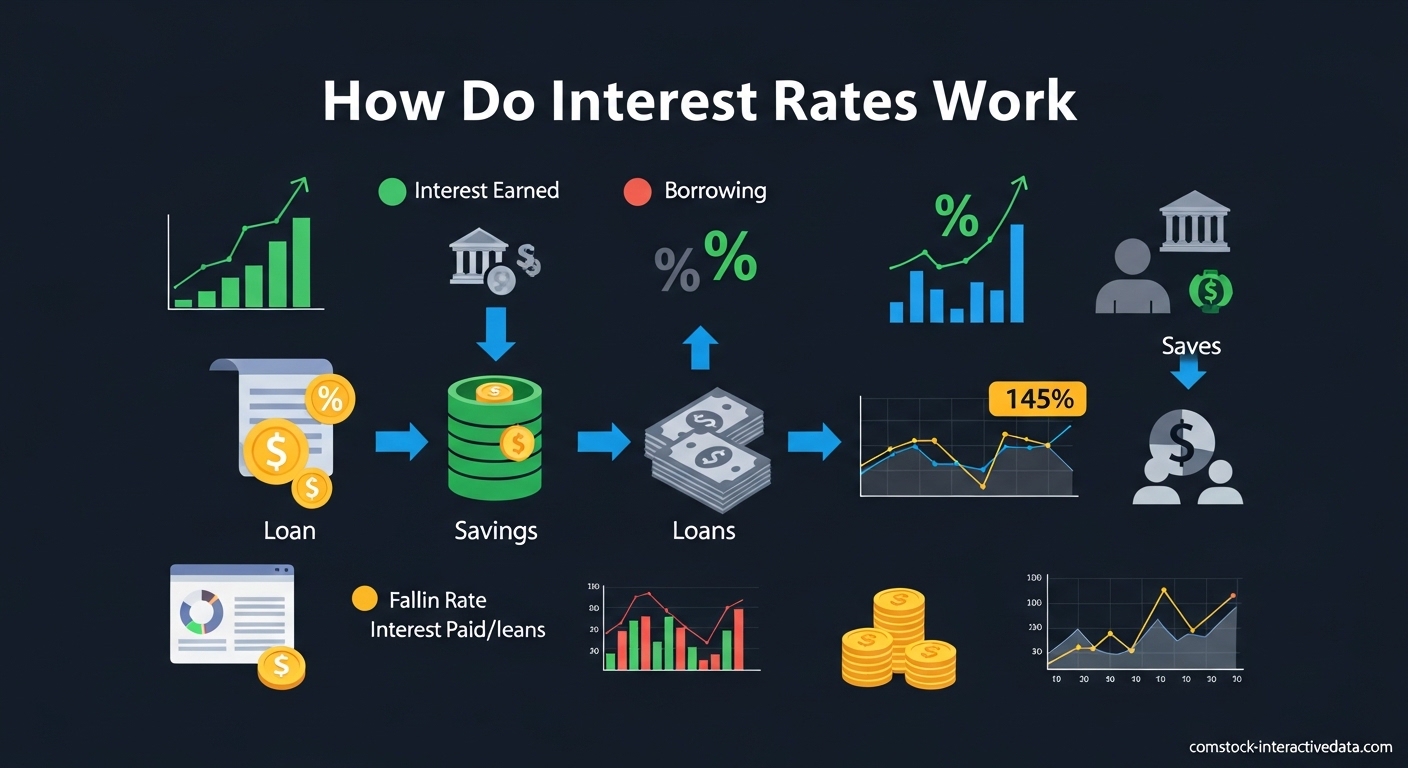
Interest rates are the price of money. When you borrow, you pay interest as the cost of using someone else’s cash. When you save or invest, you earn interest as the reward for letting others use your money.
Understanding how do interest rates work is one of the most practical pieces of financial knowledge you can have. Our team has spent years analyzing economic data and helping readers make sense of how these rates affect everything from mortgage payments to retirement savings. I have personally tracked rate cycles through multiple economic environments and seen firsthand how small percentage changes translate into life-altering financial impacts.
In this guide, I will explain exactly how interest rates function, who sets them, and why they impact your daily life in ways you might not expect. By the end, you will have the knowledge to make smarter decisions about borrowing, saving, and investing.
Table of Contents
Key Takeaways
Before diving into the details, here are the essential points you need to remember:
- Interest rates represent the cost of borrowing money, expressed as a percentage of the principal amount you borrow or save
- The Federal Reserve sets a benchmark rate that influences all other rates in the economy, from mortgages to credit cards
- Higher rates make borrowing more expensive but increase earnings on savings accounts and certificates of deposit
- Lower rates encourage spending and investment but reduce returns on conservative savings vehicles
- Understanding how interest compounds can save or cost you thousands of dollars over time
What Are Interest Rates? A Simple Definition
Interest rates are the percentage of a loan amount that a lender charges a borrower for the use of money. When you see a rate advertised, it tells you how much extra you will pay on top of the original amount borrowed. This percentage is typically calculated on an annual basis, which is why you see the term APR (Annual Percentage Rate) on loan offers.
From the opposite perspective, interest rates also represent the return you earn when you deposit money into a savings account, buy a certificate of deposit (CD), or invest in bonds. The bank or institution pays you interest for the privilege of using your funds to make loans to other customers.
The concept is ancient. Money lenders in civilizations thousands of years old charged for the use of currency. Today the mechanics are more sophisticated, but the fundamental principle remains unchanged. You pay for access to capital you do not currently have, or you earn for providing capital others need.
What Does a 4% Interest Rate Mean?
A 4% interest rate means you will pay or earn $4 for every $100 over a specified period, typically one year. If you borrow $10,000 at 4% annual interest, you will owe $400 in interest after one year in addition to repaying the original $10,000 principal.
If you deposit $10,000 in a savings account earning 4% APY, you will earn approximately $400 in interest over 12 months. The exact amount depends on compounding frequency. Daily compounding yields slightly more than annual compounding. This is why current rate environments matter so much for your financial decisions.
The rate applies to the outstanding balance. As you pay down a loan, the interest portion of each payment decreases. Early in a mortgage, most of your payment goes to interest. Late in the loan term, most goes to principal. This is the amortization process at work.
Two Sides of the Same Coin
Every interest rate transaction involves two parties. The borrower pays the rate as a cost. The lender receives it as income. Banks act as middlemen, paying interest to depositors while charging higher rates to borrowers, with the difference being their profit margin.
Your credit score significantly affects the rates you qualify for. A borrower with excellent credit might secure a mortgage at 6%, while someone with poor credit could pay 9% or more for the same loan amount. This difference of 3 percentage points on a $300,000 mortgage equals over $200 per month in additional payments, totaling more than $70,000 extra over the life of the loan.
Risk drives these differences. Lenders charge higher rates to borrowers more likely to default. They verify income, check credit histories, and assess debt-to-income ratios before setting your specific rate. The advertised rates you see are typically reserved for the most qualified applicants.
How Do Interest Rates Work? The Mechanics Explained
Interest works through two primary mechanisms: simple interest and compound interest. Understanding the difference between these can save or earn you thousands of dollars over time. The distinction matters whether you are building wealth through savings or managing debt responsibly.
Our team has analyzed thousands of financial products over the years. The most expensive mistake we see is ignoring how interest compounds against you on debt while failing to leverage compounding in your favor for savings. Let me break down exactly how each system works.
Simple Interest: The Basics
Simple interest is calculated only on the original principal amount. The formula is straightforward: Interest equals Principal multiplied by Rate multiplied by Time. In mathematical notation, this appears as I equals P times R times T.
Here is a concrete example. You deposit $5,000 in a simple interest savings account earning 3% annually. After one year, you earn $150 in interest. After five years, you earn $750 total. The interest never earns additional interest. It is calculated only on that original $5,000 every single year.
Simple interest appears most commonly in short-term loans, some auto loans, and certain savings bonds. It is straightforward to calculate and predict. However, most modern financial products use compound interest because it better reflects the time value of money.
Compound Interest: The Eighth Wonder of the World
Compound interest calculates interest on both the principal and the accumulated interest from previous periods. This creates exponential growth that accelerates over time. Albert Einstein reportedly called compound interest the eighth wonder of the world, and for good reason.
Using the same $5,000 at 3% annual interest compounded yearly, here is how it differs from simple interest:
Year one: You earn $150 on $5,000, giving you $5,150.
Year two: You earn 3% on $5,150, not just the original $5,000. That equals $154.50. Your total becomes $5,304.50.
Year three: You earn 3% on $5,304.50, which is $159.14. Your total grows to $5,463.64.
After five years of compounding, you have $5,796.37. Compare that to $5,750 with simple interest. That extra $46.36 might seem small, but over decades the gap becomes enormous. After 30 years, the compound account holds $12,136 while the simple interest account holds just $9,500. That is a difference of over $2,600 on a modest $5,000 initial deposit.
How Compound Interest Works on Loans
Compound interest can work against you when you carry credit card debt. If you owe $5,000 on a credit card charging 18% APR and only make minimum payments, the interest compounds monthly against you.
Each month, the issuer adds interest to your balance. Next month, they charge interest on that new higher balance. This is why credit card debt can spiral out of control so quickly. A $5,000 balance can take over 15 years to pay off if you only make minimum payments, costing you thousands in interest.
Let me show you the math. At 18% APR compounded daily (typical for credit cards), your balance grows by approximately 1.5% monthly. Making only minimum payments of $125 per month, you will pay nearly $7,000 total over 15 years to eliminate a $5,000 debt. That is $2,000 in pure interest, and you lose the opportunity to earn returns on that money instead.
Frequency Matters: Daily, Monthly, or Yearly Compounding
The more frequently interest compounds, the faster your money grows or your debt increases. A savings account with daily compounding will yield slightly more than one with monthly compounding at the same stated rate.
The formula for compound interest with different frequencies is: Final Amount equals Principal times (1 plus Rate divided by n) raised to the power of (n times t). Here n represents compounding periods per year and t represents years.
Most high-yield savings accounts compound daily. Most CDs compound monthly or daily. Credit cards typically compound daily, which is why carrying a balance becomes expensive so rapidly. Student loans usually compound monthly. Mortgages typically compound monthly but handle payments differently through amortization.
Types of Interest Rates You Should Know
Not all interest rates work the same way. Understanding the different types helps you choose the right financial products and avoid costly mistakes. Our team has seen borrowers lose thousands by selecting the wrong rate type for their situation.
Fixed vs Variable Interest Rates
Fixed rates remain constant throughout the loan term. Your monthly payment never changes. This predictability makes budgeting easier and protects you from rising rates. When you lock in a fixed mortgage at 6%, you pay that same rate in year one and year thirty.
Variable rates fluctuate based on market conditions. They usually start lower than fixed rates but can increase significantly over time. Most credit cards have variable rates tied to the prime rate. When the Fed raises rates, your credit card APR follows within one or two billing cycles.
Mortgages illustrate this choice clearly. A 30-year fixed mortgage locks in your rate for three decades. An adjustable-rate mortgage (ARM) might offer 5.5% for five years, then adjust annually based on market indexes. If rates rise, your payment jumps. If rates fall, your payment drops. In 2026, many buyers face this exact decision as they weigh the certainty of fixed rates against the initial savings of ARMs.
APR vs APY: Understanding the Difference
APR stands for Annual Percentage Rate. It represents the yearly cost of borrowing including interest and certain fees. Lenders must disclose APR by law, making it useful for comparing loan offers. The APR gives you the true cost of borrowing, incorporating origination fees, points, and other charges.
APY stands for Annual Percentage Yield. It reflects the actual return on savings accounts and CDs, accounting for compound interest. APY will always be slightly higher than the stated interest rate when compounding occurs more than annually.
Here is why this matters. A savings account advertising 4% interest compounded monthly actually delivers 4.07% APY due to compounding. When shopping for savings products, compare APY figures. When comparing loans, look at APR. This distinction ensures you are comparing apples to apples across different institutions and products.
Prime Rate and Benchmark Rates
The prime rate is the interest rate banks charge their most creditworthy corporate customers. It serves as a benchmark for many consumer loans, including credit cards, home equity lines of credit, and auto loans. When you see a credit card advertised at “prime plus 9.99%,” your rate depends on the current prime rate.
Banks typically set their prime rate at 3 percentage points above the federal funds rate. When the Federal Reserve raises or lowers its benchmark rate, the prime rate moves in tandem. This is why credit card APRs adjust shortly after Fed announcements. In 2026, the prime rate has moved significantly as the Fed adjusted its policy stance.
Other important benchmarks include the Secured Overnight Financing Rate (SOFR), which replaced LIBOR for many derivatives and loans. Treasury yields also serve as benchmarks, particularly for mortgage rates which track the 10-year Treasury note closely.
Short-Term vs Long-Term Rates
Short-term rates apply to loans and investments with durations under one year. These include Treasury bills, money market accounts, and short-term CDs. They typically follow the federal funds rate closely and change quickly when the Fed adjusts policy.
Long-term rates apply to multi-year commitments like 10-year Treasury bonds and 30-year mortgages. These rates reflect expectations about future inflation and economic growth, not just current Fed policy. Mortgage rates often move before Fed announcements as traders anticipate policy changes.
The relationship between short and long-term rates creates the yield curve. A normal yield curve slopes upward, with longer maturities paying higher rates. An inverted curve, where short-term rates exceed long-term rates, often signals economic recession concerns. Our team watches the yield curve closely as a leading indicator of economic conditions.
Who Determines Interest Rates? The Federal Reserve Explained
The Federal Reserve, America’s central bank, sets the federal funds rate. This is the rate banks charge each other for overnight loans. While consumers cannot borrow at this rate directly, it serves as the foundation for virtually all other interest rates in the economy. Understanding the Fed’s role helps you anticipate rate changes and plan accordingly.
The Federal Reserve System was created in 1913 to provide a safer, more flexible, and more stable monetary and financial system. Today it conducts monetary policy through the Federal Open Market Committee (FOMC), manages bank supervision, and maintains financial stability.
The Federal Open Market Committee (FOMC)
The FOMC meets eight times per year to set monetary policy. This committee includes the seven members of the Board of Governors plus five of the twelve regional Federal Reserve Bank presidents. Their decisions move markets and affect household finances worldwide.
When the FOMC announces a rate change, financial institutions adjust their prime rate within hours. Consumer products follow within days to weeks. Mortgage rates often move in anticipation of Fed decisions, sometimes shifting before the official announcement. This is why financial news outlets obsess over Fed communications and meeting minutes.
The Chair of the Federal Reserve holds regular press conferences after FOMC meetings. Every word is analyzed for hints about future policy direction. Markets can swing hundreds of points based on subtle changes in the Chair’s language about economic conditions or policy intentions.
From Fed Decision to Your Wallet: The Transmission Chain
The path from a Fed decision to your monthly payment follows a predictable cascade. First, the Fed announces a change to the federal funds rate target. Second, banks immediately adjust their prime lending rate. Third, variable-rate products like credit cards and HELOCs update their APRs. Fourth, mortgage rates adjust based on bond market reactions. Fifth, deposit rates at banks gradually change, typically more slowly than lending rates.
The entire process takes between one day and one month depending on the product. Credit cards adjust within one to two billing cycles. Mortgages react within hours through bond market movements. Savings accounts might take weeks to reflect changes, as banks are slower to increase payouts than to raise lending rates. This asymmetry benefits banks, who capture wider spreads during rate transitions.
I have tracked this transmission chain through multiple rate cycles. The pattern is remarkably consistent. Borrowers feel the pain quickly when rates rise. Savers wait longer to see benefits. When rates fall, the opposite occurs: borrowers wait for refinancing opportunities while savers see immediate reductions in their earnings.
Why Does the Fed Change Rates?
The Federal Reserve has a dual mandate from Congress: maintain maximum employment and keep prices stable. Interest rates are their primary tool for achieving both goals. This dual mandate creates constant tension because actions that help one goal may hurt the other.
When inflation runs too hot, the Fed raises rates. Higher borrowing costs slow down spending and investment. This cools the economy and brings inflation back toward the 2% target. When unemployment rises and growth stalls, the Fed cuts rates to stimulate borrowing, spending, and hiring.
In 2026, the Fed continues monitoring economic indicators including the Consumer Price Index, unemployment reports, and GDP growth to guide their rate decisions. Each FOMC meeting statement is analyzed word-by-word by economists and traders for hints about future policy direction. The dot plot showing individual committee members’ rate expectations receives particular attention.
Why Do Interest Rates Matter? Real-World Impact
Interest rates are not abstract economic concepts. They directly affect your monthly budget, long-term wealth, and major life decisions. Here is how they touch different areas of your financial life.
Our team has spoken with thousands of readers about their financial situations. The stories we hear consistently show how rate changes alter life trajectories. A family buys a bigger home when rates drop. A retiree postpones retirement when CD income falls. A business owner expands when financing is cheap. These are real impacts on real lives.
Impact on Mortgages and Home Buying
A one percentage point change in mortgage rates alters your purchasing power dramatically. On a $400,000 30-year fixed mortgage, the difference between 6% and 7% equals approximately $260 per month. Over the loan’s lifetime, that adds up to over $93,000 in additional interest.
Higher rates reduce how much house you can afford. When rates drop, home buyers rush to lock in low rates, often driving up home prices. When rates spike, demand softens and prices may stabilize or fall. This relationship makes interest rates one of the biggest factors in housing market cycles. I have seen this pattern repeat through multiple economic cycles.
Refinancing activity explodes when rates fall. Homeowners who purchased at higher rates can save hundreds monthly by refinancing to lower rates. However, refinancing involves closing costs typically ranging from 2% to 6% of the loan amount. The break-even period usually takes two to three years, so refinancing only makes sense if you plan to stay in the home longer than that.
Impact on Credit Cards and Consumer Debt
The average credit card APR hovers between 20% and 24% in 2026. These rates are already high, but they rise further when the Fed increases benchmark rates. Carrying a balance becomes increasingly expensive. Our team strongly recommends paying off credit card debt before building significant savings, as the interest rate differential heavily favors debt elimination.
A $10,000 credit card balance at 22% APR costs you approximately $2,200 per year in interest if you make no payments toward principal. If rates climb to 25%, that annual cost increases by $300. This is why paying down high-interest debt should be a priority when rates are rising. The math is unforgiving.
Balance transfer cards offering 0% introductory APR can provide temporary relief. However, these promotional rates expire, usually after 12 to 21 months. After that, the regular APR applies, often at market rates. Transfers also typically incur a fee of 3% to 5% of the transferred amount. These tools require discipline to use effectively.
Impact on Savings and Certificates of Deposit
Rising rates benefit savers. High-yield savings accounts that paid 0.5% in 2021 now offer 4% or more in 2026. A $50,000 emergency fund earns $2,000 annually at 4% compared to just $250 at 0.5%. This difference transforms the economics of emergency funds and short-term savings.
CDs become more attractive too. A 12-month CD might pay 4.5% APY, locking in your rate regardless of future Fed cuts. CDs are FDIC-insured up to $250,000, making them essentially risk-free for principal protection. The trade-off is liquidity: withdrawing early typically triggers an interest penalty.
Online banks generally offer significantly higher rates than traditional brick-and-mortar institutions. Without physical branches to maintain, online banks pass savings to customers through better rates. The difference can exceed 3 percentage points. A $100,000 balance earns $4,000 annually at 4% but only $100 at 0.1%. Over five years, that gap exceeds $19,500.
Impact on Investments and Bonds
When interest rates rise, bond prices fall. This inverse relationship confuses many investors but follows simple logic. If you own a bond paying 3% and new bonds pay 5%, nobody wants your 3% bond unless you sell it at a discount.
Stock markets also react to rate changes. Higher rates increase borrowing costs for companies, potentially reducing profits. They also make bonds more competitive with stocks for investor dollars. When rates fall, stocks often rally as borrowing becomes cheaper and future earnings look more valuable in present terms.
Fixed-income investments face particular pressure in rising rate environments. Bond funds can lose value as their holdings decline in price. Individual bonds held to maturity avoid this price fluctuation, assuming the issuer does not default. Our team advises investors to understand duration risk before buying bond funds in a rising rate environment.
Impact on Everyday Prices and the Economy
This is the connection many people miss. Interest rates affect the prices you pay at grocery stores, gas stations, and retail shops. When rates rise, businesses face higher costs to finance inventory, equipment, and expansion. They often pass these costs to consumers through higher prices.
However, when the Fed raises rates specifically to fight inflation, the goal is actually to slow price increases. Higher borrowing costs reduce consumer demand. With fewer buyers competing for goods, price pressures ease. The effect takes 6 to 18 months to fully materialize in the economy. This lag explains why rate hikes continue even after inflation shows signs of moderating.
Business investment also responds to rates. When borrowing is cheap, companies expand, build factories, and hire workers. When rates rise, they delay projects and freeze hiring. These decisions ripple through employment markets and wage growth. In 2026, we are observing this dynamic as businesses recalibrate expansion plans in response to higher financing costs.
Factors That Influence Interest Rates
While the Federal Reserve controls short-term benchmark rates, broader market forces determine the actual rates you receive on loans and savings. Understanding these factors helps you anticipate rate movements and position your finances accordingly.
Our economic monitoring team tracks dozens of indicators that influence rate expectations. Here are the most important factors driving rate changes in today’s markets.
Inflation: The Primary Driver
Lenders demand compensation for inflation erosion. If inflation runs at 3% annually, a lender charging 4% interest only gains 1% in real purchasing power. When inflation expectations rise, interest rates follow. This relationship is fundamental to bond markets.
The Fed watches the Personal Consumption Expenditures (PCE) price index and Consumer Price Index (CPI) closely. When these inflation measures exceed the 2% target, rate hikes typically follow. When inflation falls below target, rate cuts become more likely. In 2026, the Fed’s inflation fight has been the dominant driver of rate policy.
Inflation expectations become self-fulfilling prophecies. If workers expect prices to rise 3%, they demand 3% raises. If businesses expect 3% cost increases, they raise prices 3%. Breaking these expectations requires credible central bank commitment to price stability.
Employment and Economic Growth
Strong job markets signal economic health but also potential wage inflation. When unemployment drops below sustainable levels, the Fed may raise rates preemptively to prevent an overheating economy. The non-farm payrolls report releases monthly and immediately moves markets.
GDP growth rates also influence policy. Robust growth supports higher rates. Stagnant or negative growth pressures the Fed to cut rates and stimulate activity. Quarterly GDP reports receive intense scrutiny for hints about future policy direction.
The concept of “maximum sustainable employment” guides Fed thinking. This level changes over time based on demographic and structural factors. The Fed relies on research to estimate this level rather than targeting any specific unemployment number.
Supply and Demand for Credit
Like any market, credit responds to supply and demand. When many borrowers seek loans simultaneously, rates tend to rise. When banks have excess deposits and limited lending opportunities, they lower rates to attract borrowers. This dynamic operates within the constraints set by Fed policy.
International capital flows matter too. Foreign investment in U.S. bonds affects Treasury yields. When global investors seek dollar-denominated assets, bond prices rise and yields (interest rates) fall. When they flee to other markets, yields spike. Geopolitical events and relative economic performance drive these flows.
The U.S. dollar’s status as the global reserve currency creates persistent demand for Treasuries. This demand helps keep U.S. rates lower than they might otherwise be. However, this advantage is not guaranteed forever and depends on continued confidence in American economic and political stability.
How to Navigate Changing Interest Rates: Practical Strategies
You cannot control interest rates, but you can control how you respond to them. Here are practical strategies our team has developed for different rate environments. These approaches have helped thousands of readers optimize their finances regardless of which direction rates move.
Strategies for Rising Rate Environments
When rates climb, prioritize debt elimination. Pay off variable-rate debt first, especially credit cards and HELOCs. Consider locking in fixed rates through refinancing before rates rise further. If you have an ARM, calculate the break-even point for converting to fixed.
Maximize savings opportunities. Move excess cash from checking accounts to high-yield savings or CDs. Build a CD ladder by purchasing CDs with staggered maturity dates. This lets you benefit from current high rates while maintaining periodic access to your money. In 2026, we have advised many readers to take advantage of 4%+ CD rates while they remain available.
Postpone major purchases if possible. A home or car bought six months later at a lower rate saves thousands. If you must buy now, choose fixed-rate financing. Avoid ARMs when rates are clearly in an upward trend unless you plan to sell or refinance within the fixed period.
Strategies for Falling Rate Environments
When rates decline, refinancing becomes attractive. Our rule of thumb: refinancing makes sense if you can reduce your rate by at least 0.75 percentage points and plan to stay in the home long enough to recover closing costs. Calculate your break-even point before committing.
Lock in rates when you find favorable terms. Prepayment penalties are rare now, so refinancing again later is always an option if rates drop further. The risk of waiting is that economic conditions change and rates reverse course.
Consider adjustable-rate mortgages only when fixed rates are high and you expect rates to fall. Otherwise, the predictability of fixed rates usually wins. ARMs make most sense for borrowers who plan to sell or refinance within the initial fixed period.
CD Laddering: A Rate-Agnostic Strategy
CD laddering works in any rate environment. Divide your savings into equal portions. Buy CDs with staggered maturities: 6 months, 12 months, 18 months, and 24 months. As each CD matures, reinvest it at the longest term.
This approach provides regular access to portions of your money while capturing higher long-term rates. It also averages out rate fluctuations over time. You never have all your money locked in at once, and you never have everything earning low short-term rates.
For example, with $20,000, you might put $5,000 each into 6-month, 12-month, 18-month, and 24-month CDs. When the 6-month CD matures, roll it into a new 24-month CD. You always have money maturing every six months, providing flexibility while maximizing returns.
When to Lock vs Float Your Rate
Mortgage shoppers face a choice: lock your rate immediately or let it float hoping for better terms. Rate locks typically last 30 to 60 days and cost nothing at most lenders. Extensions may incur fees if your closing delays.
Lock when rates are at or near historical lows. Float when rates have been rising rapidly and you believe they may stabilize or fall before closing. Our team generally recommends locking once you have a signed purchase contract. The potential savings from floating rarely justify the risk of rates rising.
For refinances, you have more flexibility since you are not at risk of losing a purchase. Monitor rate trends and economic news. If the Fed signals a pause in rate hikes, floating might make sense. If inflation data surprises to the upside, lock immediately.
Historical Context: Interest Rate Trends Over Time
Understanding historical patterns helps you evaluate whether current rates are genuinely “high” or “low.” Context matters for financial planning. The rates you see today may seem extreme compared to recent memory, but history tells a different story.
The Volatile 1970s and 1980s
In 1981, the federal funds rate peaked at 19.1%. Mortgage rates hit 18.5%. These extremes resulted from aggressive Fed action under Chairman Paul Volcker to crush double-digit inflation. Borrowing was prohibitively expensive, but savers with CDs earned spectacular returns.
These rates seem impossible today, but they shaped an entire generation’s financial behavior. People saved more, borrowed less, and avoided debt like the plague. The trauma of high inflation and rates influenced policy for decades afterward.
My grandparents bought their home in the early 1980s with a 16% mortgage. They celebrated when they refinanced to 12%. Today’s 7% mortgages would have seemed like a gift to that generation. Perspective matters when evaluating rate environments.
The Great Moderation: 1990s to Early 2000s
From the mid-1990s through 2007, rates normalized. The federal funds rate ranged between 3% and 6.5%. Mortgage rates hovered between 6% and 8%. This stability fueled economic growth and the housing boom. Many current homeowners obtained mortgages in this range.
Many financial products we take for granted today, like predictable 30-year fixed mortgages at reasonable rates, became standard during this period. Investors became comfortable with steady returns and moderate inflation.
The period was not without volatility. The dot-com crash brought rate cuts. The 9/11 attacks triggered emergency reductions. But the overall trend was toward stability and moderate rates by historical standards.
The Zero Lower Bound: 2008 to 2015
After the 2008 financial crisis, the Fed slashed rates to near zero. The federal funds rate stayed between 0% and 0.25% for seven years. Mortgage rates dropped below 4%. Savers earned essentially nothing. This unprecedented period created a new normal for many borrowers.
This period created winners and losers. Homeowners refinanced and saved billions. Retirees dependent on CD income saw their returns vanish. Stocks soared as cheap money flooded markets. Wealth inequality increased as asset owners benefited while savers suffered.
The phrase “there is no alternative” (TINA) to stocks became common. With bond yields near zero, investors poured money into equities, driving valuations higher regardless of fundamentals.
The Pandemic Era and 2026 Environment
COVID-19 brought rates back to zero in 2020. Mortgage rates hit historic lows near 2.5%. Inflation remained subdued until supply chain disruptions and stimulus spending triggered price surges in 2021. The Fed initially called inflation “transitory,” delaying rate hikes.
The Fed responded with the fastest rate hiking cycle in four decades. From March 2022 through 2026, the federal funds rate climbed from near zero to over 5%. Mortgage rates topped 8% briefly before settling into their current range. This adjustment has been painful for borrowers accustomed to ultra-low rates.
Rate cycles typically last several years. Historical patterns suggest the current elevated rate environment will persist until inflation convincingly returns to the Fed’s 2% target. Planning for rates to remain higher for longer is the prudent approach. Do not expect a quick return to the zero-rate world of 2020-2021.
Frequently Asked Questions About Interest Rates
What are interest rates and why do they matter?
Interest rates represent the cost of borrowing money or the return on savings and investments, expressed as a percentage of the principal amount. They matter because they influence how much you pay for mortgages, cars, and credit cards, how much you earn on savings, and the overall health of the economy. When rates change, millions of financial decisions adjust accordingly.
How much interest will I earn on $500,000 in a year?
At a 4% APY, $500,000 earns $20,000 in one year. At 5% APY, you earn $25,000. The exact amount depends on your account’s interest rate and compounding frequency. A high-yield savings account at 4.5% compounded daily yields approximately $23,023 annually. CDs might offer slightly higher guaranteed rates if you lock up the money for a fixed term.
Will we ever see a 3% mortgage rate again?
3% mortgage rates were a product of extraordinary circumstances: the 2008 financial crisis response and COVID-19 pandemic emergency measures. While not impossible, returning to 3% would likely require a severe economic recession or major financial crisis that forces the Fed to slash rates aggressively. Most economists predict mortgage rates will remain in the 5% to 7% range for the foreseeable future.
What does a 4% interest rate mean?
A 4% interest rate means you pay or earn $4 per year for every $100 of principal. On a $10,000 loan, you pay $400 in annual interest. On a $10,000 savings deposit, you earn $400 in annual interest. The rate is always expressed as an annual percentage unless specifically stated otherwise.
How much interest will $100,000 make in a savings account?
At 4% APY, $100,000 earns $4,000 in one year. At 5% APY, you earn $5,000. High-yield online savings accounts in 2026 typically offer between 4% and 5% APY. Over five years at 4.5% compounded daily, $100,000 grows to approximately $125,230. Traditional brick-and-mortar banks often pay just 0.01%, yielding only $10 annually on the same amount.
Is 4.5% a good mortgage rate?
In historical context, 4.5% is an excellent mortgage rate. The 30-year average since 1971 is approximately 7.7%. However, after the 2020-2021 period of sub-3% rates, 4.5% feels high to recent buyers. Whether it is good depends on your personal timeline. If you plan to stay in the home long-term, locking in 4.5% fixed beats waiting indefinitely for potentially lower rates that may never materialize.
Conclusion: How Do Interest Rates Work and Why Do They Matter
Understanding how do interest rates work empowers you to make better financial decisions. You now know that rates represent the cost of borrowing and the reward for saving. You understand how simple and compound interest calculations affect your wealth over time. You recognize who sets rates and why they change.
The knowledge in this guide helps you evaluate mortgage offers, choose between savings products, and navigate changing economic conditions. Whether you are buying a home, building an emergency fund, or planning retirement, interest rates will shape your strategy.
Our team recommends reviewing your current loans and savings accounts quarterly. Compare your rates to current market offerings. Small differences in percentage points compound into significant dollar amounts over years. Stay informed about Federal Reserve announcements and understand how they might affect your financial plans in the months ahead. The time you invest in understanding interest rates will pay dividends throughout your financial life.