
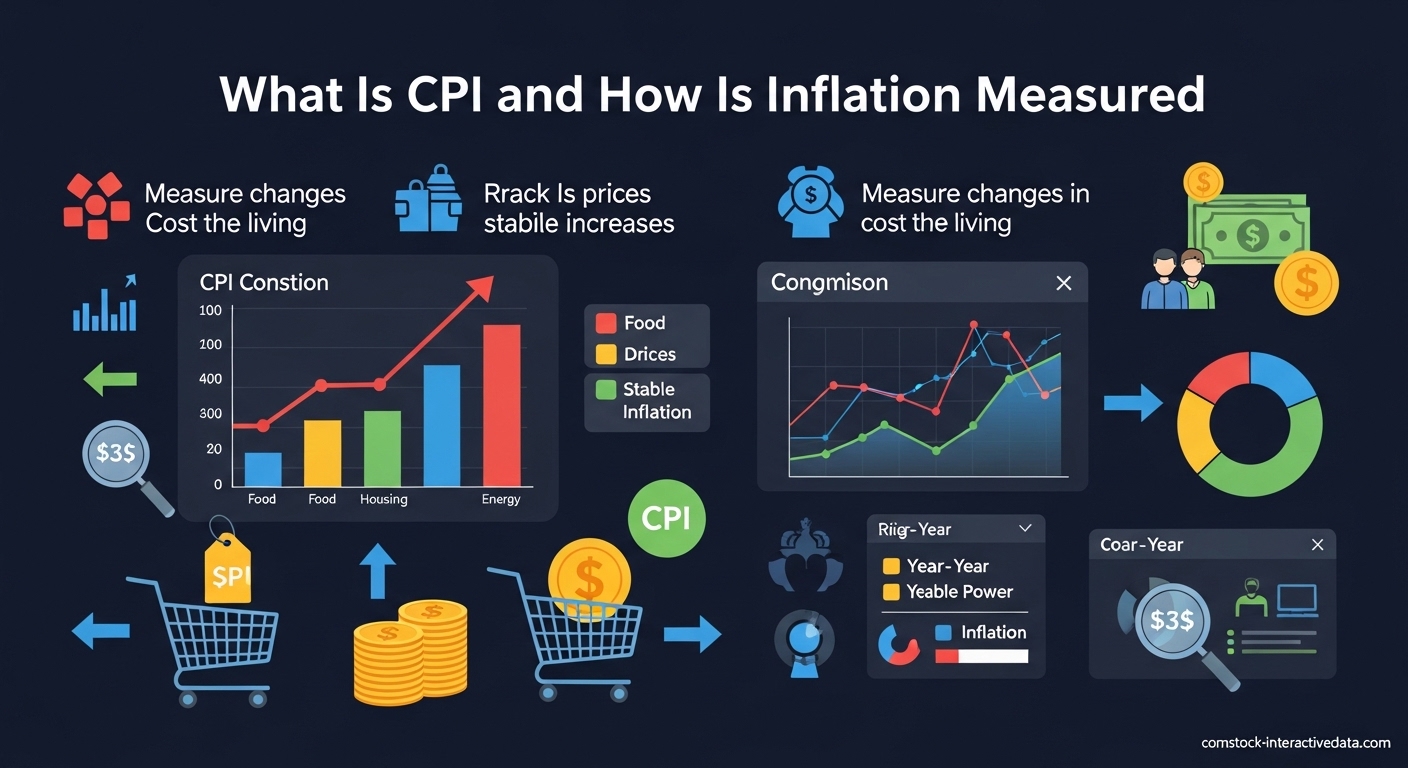
Every time you fill up your gas tank or buy groceries, you notice prices changing. That change in prices is what economists call inflation. The Consumer Price Index, or CPI, is the most widely used measure of inflation in the United States. Understanding what CPI is and how inflation is measured can help you make smarter financial decisions, from negotiating your salary to planning for retirement.
In this guide, we will break down exactly what CPI means, who calculates it, and how it affects your daily life. You will learn how the Bureau of Labor Statistics collects prices from 80,000 data points each month to track inflation. We will also cover why your personal inflation experience might differ from the official numbers.
Table of Contents
What Is CPI in Simple Terms?
The Consumer Price Index (CPI) is a measure of the average change over time in the prices paid by urban consumers for a market basket of consumer goods and services. Think of it like a shopping cart filled with hundreds of items that typical households buy regularly. The BLS tracks how the total cost of this cart changes from month to month and year to year.
The market basket includes everything from housing and food to medical care and entertainment. The BLS assigns each category a weight based on how much of the average consumer’s budget it represents. Housing costs, for example, make up over 40 percent of the basket because that is what most people spend the most on.
When the CPI goes up, it means the same basket of goods costs more than it did before. When it goes down, your purchasing power has increased. A CPI value of 300 today compared to a base of 100 in 1984 means prices have tripled since then.
The Bureau of Labor Statistics Role
The U.S. Bureau of Labor Statistics (BLS) has calculated the CPI every month since 1913. Over 450 BLS employees collect price data from about 23,000 retail and service establishments across 75 urban areas. They also gather housing data from roughly 50,000 residential properties.
This massive data collection effort ensures the CPI reflects real price movements across the country. The BLS releases new CPI data at 8:30 a.m. Eastern Time on a set schedule each month, usually around the middle of the month.
How Is CPI Calculated? A Step-by-Step Guide
Calculating CPI involves comparing current prices to a base period. The current base period is 1982 to 1984, with an average index value set at 100. The basic formula divides the cost of the market basket in the current period by the cost in the base period, then multiplies by 100.
Let us walk through a simplified example to make this concrete. Imagine a tiny market basket with just three items: coffee, bread, and gasoline.
Step 1: Establish Base Period Prices
In our base year, coffee costs $5 per pound, bread costs $3 per loaf, and gasoline costs $3 per gallon. These are our reference points. We assign each item a weight based on spending patterns. Let us say consumers spend 30 percent on coffee, 20 percent on bread, and 50 percent on gasoline.
Step 2: Collect Current Prices
2026 rolls around, and prices have changed. Coffee now costs $6 per pound, bread is $3.60 per loaf, and gasoline is $3.50 per gallon. The BLS data collectors record these new prices from actual stores and gas stations.
Step 3: Calculate the Weighted Index
We calculate price relatives for each item. Coffee rose from $5 to $6, so its price relative is 120. Bread went from $3 to $3.60, giving a relative of 120. Gasoline increased from $3 to $3.50, making its relative approximately 117.
Now we apply the weights. Multiply each price relative by its weight: coffee (120 x 0.30 = 36), bread (120 x 0.20 = 24), gasoline (117 x 0.50 = 58.5). Add these together: 36 + 24 + 58.5 = 118.5.
Step 4: Determine the Inflation Rate
The CPI index value is 118.5, meaning prices have risen 18.5 percent since the base period. To find the year-over-year inflation rate, compare this month’s index to the same month last year. If last year’s index was 115, the inflation rate is (118.5 – 115) / 115 x 100 = 3.04 percent.
This weighted average approach ensures items that matter most to household budgets influence the overall index more heavily. The actual CPI uses thousands of items and sophisticated statistical adjustments, but the core concept remains the same.
What Is in the CPI Basket? Categories and Weights
The CPI market basket contains eight major groups of goods and services. Each group has a weight reflecting its share of typical consumer spending. The BLS updates these weights every two years based on Consumer Expenditure Surveys.
Housing: The Biggest Slice (42-44%)
Housing dominates the CPI basket, accounting for over 42 percent of the total weight. This category includes rent, owners’ equivalent rent, utilities, and household furnishings. Shelter costs alone represent about 34 percent of the entire index.
The BLS measures housing costs differently for renters and homeowners. For renters, it tracks actual rent paid. For homeowners, it uses owners’ equivalent rent of primary residence. This estimates what homeowners would pay to rent their own homes, removing the investment component of home prices.
Food and Beverages (13-14%)
Food accounts for roughly 13 percent of the basket, split between food at home (groceries) and food away from home (restaurants). This category includes everything from breakfast cereal to alcoholic beverages. Food prices can be volatile due to weather, crop yields, and global commodity markets.
Transportation (16-18%)
Transportation represents about 17 percent of the basket. This includes vehicle purchases, gasoline, motor oil, car insurance, maintenance, and public transit. Gasoline prices are particularly volatile and can swing the entire transportation category significantly from month to month.
Medical Care (8-9%)
Medical care has grown from about 5 percent of the basket in the 1960s to roughly 8 percent today. It includes hospital services, physician visits, prescription drugs, and medical equipment. Health insurance is treated separately in the CPI methodology.
Other Categories
The remaining categories each account for smaller portions. Recreation covers entertainment, pets, and sporting goods at about 5 percent. Education and communication includes tuition, computers, and phone services at roughly 6 percent. Apparel accounts for about 3 percent. Other goods and services, which includes tobacco, haircuts, and funeral expenses, makes up the remainder.
These weights reflect average spending across all urban consumers. Your personal basket might look very different. If you live in Manhattan and do not own a car, transportation might be 5 percent of your budget, not 17 percent.
Types of CPI: CPI-U vs CPI-W vs C-CPI-U
The BLS publishes three main versions of the CPI. Each serves different purposes and covers different populations. Understanding which one you are looking at matters for interpreting the data correctly.
CPI-U: All Urban Consumers
The CPI for All Urban Consumers covers approximately 93 percent of the total U.S. population. It includes professionals, self-employed, poor, unemployed, and retired people in urban or metropolitan areas. This is the headline inflation number you see in news reports. When someone says inflation was 3 percent last month, they are almost always referring to CPI-U.
CPI-W: Urban Wage Earners and Clerical Workers
The CPI for Urban Wage Earners and Clerical Workers covers about 29 percent of the population. To be included, households must earn more than half their income from clerical or wage occupations and have at least one earner employed for 37 weeks or more during the previous 12 months. This group has historically experienced slightly different inflation rates than the general population.
C-CPI-U: Chained Consumer Price Index
The Chained CPI adjusts for substitution behavior. When beef prices rise, some consumers switch to chicken. Traditional CPI assumes consumers keep buying the same basket. C-CPI-U accounts for these substitutions, typically showing slightly lower inflation rates. This index has been proposed for Social Security COLA calculations but remains controversial.
| Type | Population Covered | Primary Use | Typical Inflation Rate |
|---|---|---|---|
| CPI-U | 93% of population | Headline inflation, general reference | Standard reference rate |
| CPI-W | 29% of population | Some union contracts, specific adjustments | Usually similar to CPI-U |
| C-CPI-U | Same as CPI-U | Cost-of-living adjustments, budget scoring | Usually 0.25-0.5% lower |
For most purposes, CPI-U is the relevant measure. The Federal Reserve watches this number closely when setting monetary policy. Your cost-of-living adjustment for Social Security, however, uses a specific variant of CPI-W.
How CPI Data Is Collected Each Month?
The BLS employs a massive ongoing survey operation to collect CPI data. This process runs continuously throughout the year with data collectors visiting stores and calling service providers across the country.
The Price Collection Process
Each month, BLS data collectors record approximately 80,000 price quotes. They visit or call about 23,000 retail and service establishments across 75 urban areas. These areas range from New York and Los Angeles to smaller cities like Anchorage and Honolulu. The sample represents all urban consumers across different regions and city sizes.
Data collectors follow strict protocols to ensure consistency. They identify the specific item to price, record its characteristics, and note the price. If a store is out of stock or stops carrying an item, the collector finds a substitute and flags it for quality adjustment review.
Housing Data Collection
The housing component works differently. The BLS surveys roughly 50,000 residential units on a staggered schedule. Each unit enters the sample and stays for six months, then drops out for six months, then returns for another six months. This rotation provides both continuity and fresh samples.
Housing data collectors contact property owners, managers, or tenants to gather rent information. They record contract rent, utilities included, and any changes since the last survey. For homeowners, they estimate what the property would rent for.
Seasonal Adjustments
The BLS publishes both seasonally adjusted and unadjusted CPI figures. Seasonal adjustment removes predictable price patterns that occur at the same time every year. Gasoline prices typically rise in summer driving season. Apparel goes on sale in January and July. Fresh produce prices fluctuate with harvest seasons.
The adjusted figures help economists see underlying inflation trends without seasonal noise. The unadjusted figures reflect what consumers actually pay. Both are useful depending on your purpose. The year-over-year inflation rate uses unadjusted data for accurate comparisons.
How CPI Affects Your Money: Real-World Applications
CPI numbers are not just abstract statistics. They directly impact your wallet, your investments, and your retirement planning. Multiple systems use CPI as an automatic adjustment mechanism.
Federal Reserve Monetary Policy
The Federal Reserve has a dual mandate: maximum employment and stable prices. The Fed defines stable prices as 2 percent annual inflation, typically measured by a related index called the Personal Consumption Expenditures (PCE) price index. However, CPI-U heavily influences their decisions and public communication.
When CPI inflation runs above 2 percent, the Fed raises interest rates to cool the economy. Higher rates make borrowing more expensive, slowing spending and investment. When inflation falls below target, the Fed may cut rates to stimulate growth. Your mortgage rate, car loan, and credit card interest all connect back to CPI-driven Fed decisions.
Social Security COLA Adjustments
Social Security benefits automatically adjust based on CPI-W changes. The Cost-of-Living Adjustment (COLA) uses the third-quarter average CPI-W from the current year compared to the same period in the previous year. If the index rises 3 percent, benefits increase 3 percent.
For 2026, this mechanism affects over 71 million Americans receiving Social Security or Supplemental Security Income. A 3 percent COLA on an average $1,900 monthly benefit means an extra $57 per month, or $684 per year. Over a 20-year retirement, COLAs compound significantly to maintain purchasing power.
Tax Bracket Indexing
The IRS adjusts federal income tax brackets, standard deductions, and other tax parameters using the Chained CPI. This indexing prevents bracket creep, where inflation pushes your nominal income into higher tax brackets even though your real purchasing power has not increased.
Without CPI indexing, a 5 percent raise during 5 percent inflation would push you into a higher tax bracket even though you cannot buy more goods. The adjustment ensures you only pay more taxes if your real income genuinely rises.
Wage Negotiations and Rent Increases
Many union contracts include COLA clauses tying wage increases to CPI changes. Landlords may reference local CPI data when setting annual rent increases. Some pension plans adjust payouts based on inflation rates. Understanding CPI helps you evaluate whether these adjustments are fair and adequate.
Your purchasing power declines when inflation exceeds your wage growth. If CPI rises 4 percent and you receive a 2 percent raise, you can buy 2 percent less than before. This invisible pay cut affects millions of workers during high inflation periods.
CPI vs Other Inflation Measures
CPI is the most famous inflation measure, but it is not the only one. Economists and policymakers use several complementary indicators to get a complete picture of price trends.
Producer Price Index (PPI)
The PPI measures price changes from the perspective of sellers rather than buyers. It tracks wholesale prices at three stages: crude goods, intermediate goods, and finished goods. PPI often signals future CPI movements. If wholesale prices rise, consumer prices typically follow within months.
The BLS also calculates the PPI using the same base period and similar methodology. However, PPI includes goods and services sold to businesses, not just consumers. This makes it broader in scope but less directly relevant to household budgets.
Personal Consumption Expenditures (PCE) Price Index
The Federal Reserve prefers the PCE price index for monetary policy decisions. The Bureau of Economic Analysis calculates PCE from business surveys rather than consumer surveys. The baskets differ somewhat, with PCE covering medical care paid by employers and government programs that CPI misses.
PCE also uses a chained formula that adjusts for consumer substitution, similar to C-CPI-U. This typically produces slightly lower inflation readings than CPI-U. The Fed targets 2 percent PCE inflation, which historically translates to roughly 2.25 percent CPI inflation.
Core vs Headline Inflation
Both CPI and PCE come in core and headline versions. Headline inflation includes all items, including food and energy. Core inflation excludes food and energy prices due to their volatility. Economists prefer core inflation for assessing underlying trends, though consumers obviously care about food and gas prices.
When headline inflation exceeds core inflation, it usually means energy or food prices are temporarily spiking. This happened in 2022 when gasoline prices surged. When core inflation exceeds headline, it suggests broader price pressures throughout the economy.
Why Your Personal Inflation Might Differ from CPI?
You have probably noticed that your personal experience of price changes does not always match the official CPI numbers. This is not a conspiracy or miscalculation. It reflects the inherent challenge of creating one average measure for hundreds of millions of diverse consumers.
Different Spending Patterns
CPI represents average spending across all urban households. Your budget likely differs from this average. If you have paid off your mortgage, housing might represent 10 percent of your spending rather than 42 percent. If you commute 50 miles daily, gasoline matters more to you than the average person.
A retiree on Medicare spends differently than a family with young children. A tech worker in San Francisco has different expenses than a teacher in Ohio. The CPI cannot capture these individual variations. It is a broad average, not a personalized inflation calculator.
The Housing Cost Debate
Many critics argue CPI understates housing cost inflation. The index uses owners’ equivalent rent rather than actual home prices or mortgage costs. During periods of rapid home price appreciation, like 2020-2022, the CPI housing component rose more slowly than actual purchase prices.
This matters because housing is the largest CPI category. If it is understated, overall inflation may appear lower than many households experience. However, the BLS argues that home prices include investment returns, not just consumption costs, so excluding them is methodologically correct.
Quality Adjustments
When products improve, the BLS adjusts prices downward to reflect the increased value. A $1,000 smartphone today does far more than a $500 smartphone from five years ago. The BLS might record this as a price decrease after quality adjustment.
Some critics argue these adjustments understate actual costs. You still pay $1,000 even if the phone is better. You cannot buy the old, simpler version anymore. This forced upgrade dynamic means quality adjustments may not reflect consumer reality.
Substitution Bias
Traditional CPI tracks a fixed basket of goods. When beef prices rise, the index assumes you keep buying beef. In reality, you might switch to chicken. This means the CPI potentially overstates inflation by ignoring consumer adaptation.
The Chained CPI (C-CPI-U) attempts to fix this by tracking actual consumer substitutions. It typically shows 0.25 to 0.5 percentage points lower inflation than standard CPI. Whether this represents a more accurate picture or an underestimate depends on your perspective.
Limitations and Criticisms of CPI
The CPI has served as America’s primary inflation gauge for over a century. However, like any statistical measure, it has limitations. Understanding these helps you interpret CPI data appropriately.
Not a True Cost-of-Living Index
The BLS explicitly states that CPI is not a cost-of-living index. It measures price changes for a fixed basket of goods and services. A true cost-of-living index would measure how much spending must change to maintain a constant standard of living. These are similar but distinct concepts.
Lifestyle changes complicate cost-of-living measurement. If streaming services replace cable TV, is that the same living standard? If people buy more experiences and fewer things, how do you compare? CPI sidesteps these questions by tracking specific items regardless of consumer preferences.
Geographic Variations
National CPI averages mask significant regional differences. San Francisco and New York have experienced much higher housing inflation than Detroit or Cleveland. The BLS publishes regional CPI data, but headline numbers use national averages.
If you live in a high-inflation metro area, national CPI understates your experience. Conversely, residents of low-inflation areas may feel prices rising faster than the index suggests. The BLS collects data from 75 urban areas, but most smaller towns and rural areas are not directly surveyed.
New Product Introduction Lag
CPI updates its basket every two years based on Consumer Expenditure Surveys. This creates a lag in capturing new products and services. Smartphones took years to fully enter the CPI basket after becoming ubiquitous. Streaming services, ride-sharing, and food delivery apps faced similar delays.
During these lag periods, price decreases from new technologies are not fully captured. The basket may also miss spending shifts toward new categories. The BLS has shortened update cycles over time but cannot eliminate this lag entirely.
Income Group Differences
Different income groups face different inflation rates. Lower-income households spend a higher percentage on food, housing, and transportation. They cannot easily substitute toward cheaper alternatives when prices rise. Higher-income households have more flexibility and benefit more from quality improvements.
Research suggests that lower-income households often experience higher effective inflation than the official CPI indicates. Their spending concentrates in categories with above-average price increases. CPI represents the average, but no household is truly average.
Frequently Asked Questions
What is the current CPI rate today?
The BLS releases CPI data monthly at 8:30 a.m. Eastern Time. As of 2026, you can find the latest rate on the BLS website or financial news sources. The most recent data typically covers the previous month. For 2026, check the BLS CPI news release page for the current inflation rate percentage.
How much will $50,000 be worth in 30 years with inflation?
Assuming a 3 percent annual inflation rate, $50,000 today would have the purchasing power of approximately $20,550 in 30 years. At 2 percent inflation, it would be worth about $27,600 in today’s dollars. This demonstrates why long-term financial planning must account for inflation erosion.
What is CPI inflation in simple words?
CPI inflation measures how much more expensive a standard shopping basket of goods and services becomes over time. When CPI rises, your dollars buy less. When it falls, they buy more. It is the government’s way of tracking whether life is getting more or less expensive for average consumers.
Is it better if CPI is high or low?
Moderate CPI growth around 2 percent annually is considered ideal. Very high CPI means rapid inflation that erodes savings and creates economic instability. Very low or negative CPI suggests deflation, which discourages spending and investment as people wait for lower prices. The Federal Reserve targets stable, predictable low inflation rather than zero.
What does CPI tell you about inflation?
CPI measures consumer price inflation specifically. It tells you how much more expensive consumer goods and services have become compared to a previous period. Rising CPI indicates inflation. Falling CPI indicates deflation. The percentage change in CPI over 12 months is the most commonly cited inflation rate.
Why is 2 percent inflation a good thing?
The Federal Reserve targets 2 percent inflation because it provides a buffer against deflation while remaining predictable for economic planning. Moderate inflation encourages spending and investment rather than hoarding cash. It also allows real wages to adjust downward during recessions without requiring nominal pay cuts. Most major central banks have adopted similar 2 percent targets.
Conclusion: What Is CPI and How Is Inflation Measured
Understanding what CPI is and how inflation is measured empowers you to make better financial decisions. The Consumer Price Index represents one of the most important economic indicators affecting everyday life. From Social Security benefits to mortgage rates, CPI influences countless financial outcomes.
The BLS calculates CPI by tracking prices for a market basket of goods and services across 75 urban areas. Housing, food, and transportation dominate the index, reflecting typical household budgets. While your personal inflation experience may differ from the official numbers, CPI provides a consistent benchmark for tracking price trends over time.
As you navigate 2026 and beyond, keep an eye on CPI releases. Compare wage growth to inflation to ensure your purchasing power increases. Factor inflation into retirement planning to maintain your standard of living. Understanding CPI transforms abstract economic news into actionable financial intelligence.