
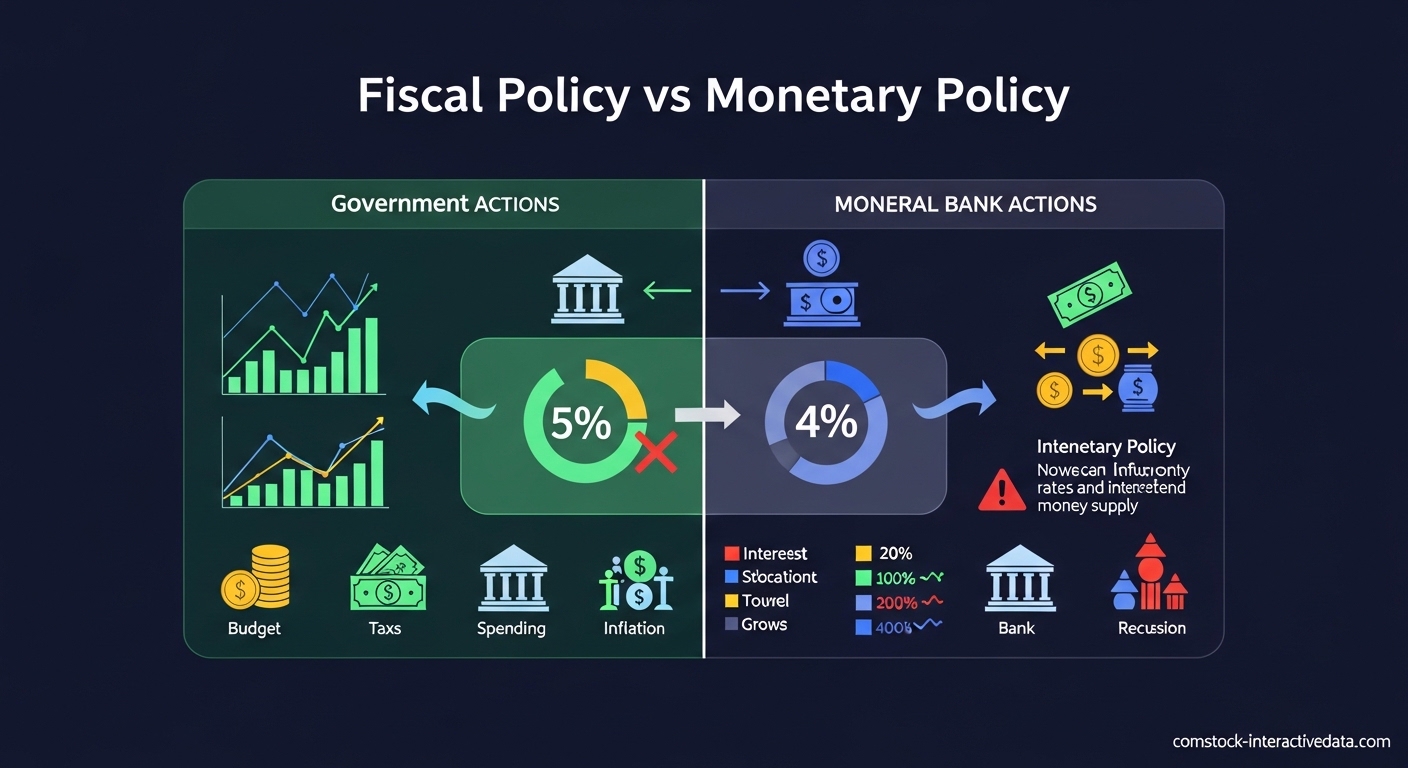
Monetary policy refers to the actions of central banks, including the Federal Reserve, to achieve macroeconomic policy objectives such as price stability, full employment, and stable economic growth. Fiscal policy refers to the tax and spending policies of the federal government, set by Congress and the Administration.
Understanding the difference between fiscal policy and monetary policy matters for everyone. These twin engines drive the economy forward, affect your mortgage rates, influence job opportunities, and determine how much you pay at the grocery store. When you hear about the Federal Reserve raising interest rates or Congress debating stimulus packages, you are hearing about these policies in action.
In this guide, I will break down exactly how each policy works, who controls them, and what they mean for your daily life. We will explore the tools each policy uses, examine real-world examples from history, and clarify common misconceptions. By the end, you will understand not just what distinguishes these policies, but how they interact to shape the economic world around us.
Table of Contents
What Is Monetary Policy?
Monetary policy encompasses the actions central banks take to manage the money supply and interest rates in an economy. In the United States, the Federal Reserve serves as the central bank and carries the primary responsibility for conducting monetary policy.
The Federal Reserve operates under what economists call a dual mandate. This means Congress has directed the Fed to pursue two main goals simultaneously: maximum employment and stable prices. The Fed also promotes moderate long-term interest rates as part of its broader mission to maintain a healthy economy.
One of the most important aspects of monetary policy is its independence from direct political control. While Congress established the Federal Reserve and can amend its mandate, day-to-day monetary policy decisions rest with the Federal Open Market Committee (FOMC). The FOMC meets eight times per year to assess economic conditions and determine appropriate policy actions. This insulation from political pressure allows the Fed to make decisions based on economic data rather than short-term political considerations.
The Federal Reserve influences the economy primarily through its control over interest rates and the money supply. When the Fed wants to stimulate economic activity, it can lower interest rates to make borrowing cheaper for businesses and consumers. When inflation threatens, the Fed can raise rates to slow down economic activity and cool price increases. These decisions ripple through the entire financial system, affecting everything from credit card rates to business investment decisions.
Tools of Monetary Policy: How the Federal Reserve Influences the Economy
The Federal Reserve wields several powerful tools to implement monetary policy. Understanding these instruments helps clarify how the central bank actually affects the economy in practice.
Open Market Operations
Open market operations represent the Fed’s most frequently used tool. Through these operations, the Federal Reserve buys and sells government securities in the open market. When the Fed purchases securities from banks, it injects money into the banking system, increasing the money supply and putting downward pressure on interest rates. When the Fed sells securities, it removes money from circulation, tightening the money supply and pushing rates higher.
This tool offers precision and flexibility. The Fed can conduct open market operations daily, making small adjustments as economic conditions warrant. The FOMC sets a target for the federal funds rate, and open market operations help achieve that target.
Reserve Requirements
Reserve requirements dictate how much cash banks must hold in reserve against their deposits. By lowering reserve requirements, the Fed frees up money for banks to lend, effectively increasing the money supply. Raising reserve requirements has the opposite effect, restricting lending capacity and tightening the money supply.
In practice, the Fed rarely changes reserve requirements because even small adjustments can have dramatic effects on bank operations. As of 2026, the reserve requirement stands at zero percent for most banks, a change implemented during the pandemic to support lending.
The Discount Rate
The discount rate is the interest rate the Federal Reserve charges banks for short-term loans from the Fed’s discount window. Banks borrow from the discount window when they need additional reserves, though this occurs less frequently since the 2008 financial crisis.
Changes to the discount rate signal the Fed’s policy stance to the market. A lower discount rate encourages banks to borrow more, increasing the money supply. A higher rate discourages borrowing, tightening conditions.
The Federal Funds Rate
Perhaps the most watched economic indicator, the federal funds rate represents the interest rate banks charge each other for overnight loans of reserve balances. While the Fed does not directly set this rate, it targets a specific range through open market operations.
The federal funds rate serves as a benchmark for countless other interest rates throughout the economy. When the Fed raises the federal funds rate target, mortgage rates, car loans, and credit card interest typically follow. When the Fed lowers the target, borrowing becomes cheaper across the economy.
Quantitative Easing and Other Unconventional Tools
During extraordinary economic circumstances, the Federal Reserve employs unconventional tools like quantitative easing. This involves large-scale purchases of longer-term securities, including mortgage-backed securities and Treasury bonds, to directly lower long-term interest rates.
The Fed deployed quantitative easing during the 2008 financial crisis and again during the COVID-19 pandemic. These programs dramatically expanded the Fed’s balance sheet and helped stabilize financial markets when conventional tools proved insufficient.
What Is Fiscal Policy?
Fiscal policy refers to the government’s decisions regarding taxation and spending to influence economic conditions. Unlike monetary policy, which focuses on money supply and interest rates, fiscal policy directly affects the economy through changes in government revenue and expenditure.
In the United States, fiscal policy stems from the legislative branch. Congress holds the constitutional power to tax and spend, making it the primary body for fiscal decisions. The President and Administration propose budgets and policy priorities, but Congress must pass appropriations bills and tax legislation. This separation of powers means fiscal policy often involves extensive political negotiation and compromise.
The goals of fiscal policy generally align with broader economic objectives. Governments use fiscal tools to stimulate economic growth during recessions, cool overheating economies, redistribute income, and fund public goods and services. The direct nature of fiscal policy means its effects can be more immediately visible to citizens than monetary policy actions.
Fiscal policy decisions carry significant political implications. Tax increases and spending cuts often face public opposition, while tax cuts and new spending programs tend to be politically popular. This political dimension can create tension between short-term political incentives and long-term economic needs, sometimes leading to delayed or suboptimal policy responses.
Tools of Fiscal Policy: How Congress and Government Shape Economic Activity
Fiscal policy operates through two primary levers: taxation and government spending. Lawmakers can pull these levers in various combinations to achieve desired economic outcomes.
Taxation Policy
Tax policy represents one of the most powerful fiscal tools. By adjusting tax rates, Congress directly affects how much disposable income households and businesses retain. Tax cuts put more money in people’s pockets, potentially stimulating consumption and investment. Tax increases reduce disposable income, slowing economic activity but potentially funding government programs or reducing deficits.
Fiscal policymakers can target tax changes to specific groups or behaviors. Corporate tax rates affect business investment decisions. Individual income tax rates influence consumer spending. Capital gains taxes impact investment behavior. Tax credits for specific activities, like renewable energy investment or education expenses, steer economic activity toward policy priorities.
Government Spending
Direct government spending provides another major fiscal policy tool. When the government purchases goods and services, it directly increases aggregate demand in the economy. Infrastructure projects, defense spending, and government operations all represent fiscal policy in action.
Spending multipliers can amplify the effects of fiscal stimulus. When the government pays a construction company to build a highway, that company hires workers and purchases materials. Those workers spend their wages at local businesses, creating additional economic activity. This ripple effect means a dollar of government spending can generate more than a dollar of total economic activity.
Transfer Payments
Transfer payments represent government expenditures that provide money to individuals without receiving goods or services in return. Social Security benefits, unemployment insurance, and welfare payments all fall into this category.
Transfer payments serve dual purposes. They provide social insurance and reduce poverty, but they also function as automatic stabilizers for the economy. During recessions, unemployment insurance payments automatically increase as more people lose jobs, helping maintain consumer spending even as employment falls. This automatic response helps cushion economic downturns without requiring new legislation.
Stimulus Packages and Fiscal Stimulus
During severe economic crises, governments deploy comprehensive stimulus packages combining multiple fiscal tools. These packages typically include tax rebates, increased spending on infrastructure, extended unemployment benefits, and aid to state and local governments.
The effectiveness of fiscal stimulus depends on how quickly Congress can pass legislation and how rapidly the funds reach the economy. Direct payments to households work faster than infrastructure projects, which require planning and contracting before spending actually occurs. This implementation lag represents one of the challenges facing fiscal policy.
Fiscal Policy vs Monetary Policy: Key Differences at a Glance
While both fiscal and monetary policy aim to promote economic stability and growth, they differ fundamentally in their mechanisms, implementation, and effects. The following comparison highlights the critical distinctions.
| Characteristic | Monetary Policy | Fiscal Policy |
| Controlling Authority | Federal Reserve (central bank) | Congress and the Administration |
| Primary Tools | Interest rates, money supply, reserve requirements | Taxation, government spending, transfer payments |
| Implementation Speed | Relatively fast (FOMC meets 8 times yearly, can act between meetings) | Slow (requires legislative process and presidential approval) |
| Political Independence | Independent from direct political pressure | Highly political, subject to partisan debates |
| Primary Goals | Price stability, maximum employment, moderate interest rates | Economic growth, employment, income redistribution, public services |
| Impact on Budget | Does not directly affect government deficit or debt | Directly affects government deficit and national debt |
| Effectiveness Lag | 6-18 months (interest rate changes take time to affect economy) | Varies by tool: immediate for transfers, longer for infrastructure |
The most fundamental difference lies in who makes the decisions. Monetary policy rests with appointed central bankers who can act quickly based on economic data. Fiscal policy requires the democratic process, with elected officials debating and voting on tax and spending measures. This distinction shapes how each policy responds to economic challenges.
Expansionary vs Contractionary Policy: Stimulating or Cooling the Economy
Both fiscal and monetary policy can be deployed in expansionary or contractionary modes. Understanding these orientations clarifies how policymakers respond to different economic conditions.
Expansionary Monetary Policy
Expansionary monetary policy aims to stimulate economic growth and combat unemployment. The Federal Reserve implements expansionary policy by lowering interest rates, reducing reserve requirements, or engaging in quantitative easing. These actions increase the money supply and make borrowing cheaper.
Lower interest rates encourage businesses to invest in new equipment and facilities. Consumers find mortgages, car loans, and credit cards more affordable. The increased spending and investment boost aggregate demand, creating jobs and economic growth. However, expansionary policy can lead to inflation if the economy overheats.
Contractionary Monetary Policy
Contractionary monetary policy, also called restrictive policy, seeks to reduce inflation and cool an overheating economy. The Fed implements contractionary policy by raising interest rates, increasing reserve requirements, or selling securities to reduce the money supply.
Higher interest rates make borrowing more expensive, discouraging business investment and consumer spending. This reduction in aggregate demand slows economic growth and reduces inflationary pressures. The Federal Reserve has pursued contractionary monetary policy aggressively since 2026 to combat the highest inflation in four decades.
Expansionary Fiscal Policy
Expansionary fiscal policy involves tax cuts, increased government spending, or both to stimulate economic activity. When Congress passes tax cuts, households and businesses have more disposable income to spend and invest. When government increases spending on infrastructure, defense, or social programs, it directly adds to aggregate demand.
The American Rescue Plan of 2021 represented a massive expansionary fiscal effort, sending direct payments to households, extending unemployment benefits, and providing aid to state and local governments. This followed earlier stimulus measures in 2020 to combat pandemic economic effects.
Contractionary Fiscal Policy
Contractionary fiscal policy involves tax increases, spending cuts, or both to reduce aggregate demand and control inflation or deficits. By reducing disposable income through higher taxes or removing government spending from the economy, policymakers can slow economic activity.
Contractionary fiscal policy is politically difficult to implement. Voters generally oppose tax increases and spending cuts, making elected officials reluctant to deploy these tools even when economically appropriate. This political reality gives monetary policy an advantage when the economy requires cooling.
Real-World Examples: How Fiscal and Monetary Policy Worked in History
History provides clear illustrations of how these policies work in practice. Examining specific episodes reveals both the potential and limitations of fiscal and monetary tools.
The Great Depression (1930s)
The Great Depression represents a case study in policy failure followed by eventual success. Initially, the Federal Reserve failed to provide adequate monetary stimulus as banks failed and the money supply contracted. This monetary policy failure exacerbated the economic collapse.
The Roosevelt administration eventually deployed expansionary fiscal policy through the New Deal programs. Government spending on infrastructure, jobs programs, and social support helped reverse the economic decline. However, full recovery required the massive fiscal stimulus of World War II spending, which finally restored full employment.
The 1970s Stagflation Crisis
The 1970s presented a unique challenge: high inflation combined with stagnant growth and high unemployment, a condition called stagflation. Traditional Keynesian fiscal policy, designed to address either inflation or unemployment but not both simultaneously, proved ineffective.
Federal Reserve Chairman Paul Volcker ultimately broke the inflation spiral through aggressive contractionary monetary policy. By raising interest rates to unprecedented levels in the early 1980s, Volcker caused a recession but succeeded in crushing inflation expectations. This episode demonstrated the power of monetary policy to address price stability, even at the cost of short-term economic pain.
The 2008 Financial Crisis
The 2008 financial crisis saw unprecedented coordination between fiscal and monetary policy. The Federal Reserve dropped interest rates to near zero and deployed quantitative easing for the first time on a large scale. These monetary measures stabilized financial markets and kept credit flowing.
Congress complemented monetary action with fiscal stimulus through the Troubled Asset Relief Program (TARP) and the American Recovery and Reinvestment Act. TARP provided financial system support, while the Recovery Act funded infrastructure, tax cuts, and aid to states. Together, these policies prevented a deeper depression, though recovery proved slower than hoped.
The COVID-19 Pandemic Response (2020-2023)
The COVID-19 pandemic triggered the most aggressive combined policy response in history. The Federal Reserve cut rates to zero, launched massive quantitative easing, and established lending facilities to support financial markets. These actions prevented the liquidity crisis that could have turned a health emergency into a financial catastrophe.
Congress passed multiple fiscal stimulus packages totaling several trillion dollars. The CARES Act provided direct payments, enhanced unemployment benefits, and Paycheck Protection Program loans to businesses. Subsequent legislation extended these supports. This combined fiscal and monetary response supported household incomes and prevented widespread business failures during lockdowns.
The Inflation Surge and Policy Response (2026 Context)
Following the pandemic, inflation surged to levels not seen in four decades. This created a policy dilemma as the economy still needed support but prices were rising too quickly. The Federal Reserve responded with aggressive contractionary monetary policy, raising interest rates at the fastest pace in modern history starting in 2022.
Fiscal policy played a more complicated role during this period. Some economists argued that continued government spending exacerbated inflation, while others maintained that necessary investments in infrastructure and climate transition required sustained fiscal support. This tension between competing priorities illustrates the ongoing challenges of economic management.
How Fiscal and Monetary Policy Work Together (and Sometimes Conflict)
Ideally, fiscal and monetary policy complement each other, with both tools aligned toward shared economic goals. In practice, coordination is not guaranteed, and the policies sometimes work at cross-purposes.
Coordinated Stimulus
The most effective policy responses occur when fiscal and monetary authorities move in the same direction. During the 2008 crisis and the COVID-19 pandemic, both the Federal Reserve and Congress deployed expansionary measures simultaneously. This one-two punch provided maximum economic support when it was most needed.
When the Fed lowers interest rates while Congress cuts taxes and increases spending, the combined effect on aggregate demand can exceed what either policy could achieve alone. This coordination was evident during the initial COVID-19 response, where monetary and fiscal actions together prevented a much deeper economic collapse.
Policy Conflicts
Conflicts arise when fiscal and monetary policies pull in opposite directions. If Congress increases spending and cuts taxes while the Fed raises interest rates to fight inflation, the policies partially offset each other. The fiscal stimulus increases demand while the monetary contraction tries to reduce it.
Such conflicts can also arise from political tensions. An administration pursuing expansionary fiscal policy for political reasons may find the independent Federal Reserve responding with contractionary monetary policy to prevent overheating. This dynamic creates uncertainty for businesses and investors trying to plan for the future.
Response Lags and Timing Challenges
Both policies face implementation and effect lags, but of different types. Monetary policy decisions take effect relatively quickly but work through the economy with a lag of 6 to 18 months. Fiscal policy implementation lags are longer due to the legislative process, but some fiscal tools like direct payments work faster once enacted.
These different timing patterns complicate coordination. By the time Congress passes fiscal stimulus, the economy may have already recovered due to monetary policy actions, potentially leading to overheating. Or monetary tightening may take effect just as fiscal support reaches the economy, blunting the impact of both.
Debt Monetization Concerns
A particularly sensitive issue arises when monetary policy effectively finances fiscal deficits. When the Federal Reserve purchases large quantities of government bonds, some critics argue this amounts to printing money to fund government spending. This concern became prominent during the massive quantitative easing programs following 2008 and during COVID-19.
The Fed maintains these purchases are monetary policy tools aimed at interest rate and liquidity management, not fiscal financing. However, the distinction blurs when the central bank holds trillions in government debt. This debate over monetary-fiscal interactions remains active among economists and policymakers in 2026.
What These Policies Mean for Your Wallet: Impact on Everyday Americans
Abstract economic policy becomes concrete when you understand how it affects daily life. Both fiscal and monetary policy directly impact household finances in multiple ways.
How Monetary Policy Affects You
When the Federal Reserve changes interest rates, the effects reach your wallet quickly. Mortgage rates track the federal funds rate and longer-term Treasury yields. In 2026, mortgage rates have fluctuated significantly as the Fed raised rates to combat inflation, affecting home affordability for millions of potential buyers.
Credit card interest rates typically adjust within one or two billing cycles after Fed rate changes. Savers see impacts on certificates of deposit and savings account yields, though banks often lag in raising rates paid to depositors. Stock markets react immediately to monetary policy announcements, affecting retirement accounts and investment portfolios.
How Fiscal Policy Affects You
Fiscal policy affects households through taxes and government programs. Changes in income tax rates directly impact take-home pay. Tax credits for education, childcare, or home improvements can provide thousands in savings for qualifying families.
Government spending decisions affect job markets directly and indirectly. Infrastructure projects create construction jobs. Defense spending supports manufacturing and technology sectors. Education funding affects both employment in schools and the quality of workforce preparation. Transfer payments like Social Security and unemployment insurance provide direct income support.
Watching Policy as an Investor and Saver
Understanding policy trends helps with personal financial planning. When monetary policy turns contractionary, interest-sensitive investments like bonds may lose value while rate hikes can pressure stock valuations. Cash and short-term instruments become more attractive as rates rise.
Fiscal policy changes can create sector-specific opportunities. Infrastructure spending benefits construction and materials companies. Tax policy changes affect corporate profitability and consumer discretionary income. Keeping track of legislative developments helps investors position portfolios appropriately.
Frequently Asked Questions
Is there a difference between fiscal and monetary policy?
Yes, there is a fundamental difference. Monetary policy refers to actions by central banks like the Federal Reserve to manage money supply and interest rates. Fiscal policy refers to government decisions about taxation and spending. Monetary policy is implemented by the independent Federal Reserve, while fiscal policy is set by elected officials in Congress and the Administration.
What are examples of monetary policy?
Examples include the Federal Reserve raising or lowering the federal funds rate, conducting open market operations to buy or sell government securities, adjusting reserve requirements for banks, and implementing quantitative easing programs. In 2026, the Fed’s series of interest rate increases to combat inflation represents a clear example of contractionary monetary policy.
Is the president monetary or fiscal policy?
The President is primarily associated with fiscal policy, not monetary policy. The President proposes budgets, recommends tax policy changes, and signs or vetoes fiscal legislation passed by Congress. Monetary policy remains independent from the executive branch and is conducted by the Federal Reserve. However, the President does nominate Federal Reserve Board members, subject to Senate confirmation.
Which policy is better during a recession?
Both policies are typically deployed during recessions, and they work best when coordinated. Monetary policy can act faster since the Federal Reserve can cut interest rates immediately. Fiscal policy takes longer to implement but can provide more direct support through unemployment benefits and stimulus payments. Historical evidence from 2008 and 2020 shows that using both policies together produces the strongest economic response.
How quickly do these policies take effect?
Monetary policy decisions by the Federal Reserve take effect immediately in financial markets, but their full economic impact typically takes 6 to 18 months to work through the economy. Fiscal policy implementation varies: direct payments to households work within weeks, while infrastructure spending may take months or years to fully materialize due to planning and contracting requirements.
Can fiscal and monetary policy conflict?
Yes, fiscal and monetary policy can conflict when they pull the economy in opposite directions. For example, if Congress increases spending and cuts taxes while the Federal Reserve raises interest rates to fight inflation, the policies partially offset each other. Such conflicts create economic uncertainty and can reduce the effectiveness of both policy approaches.
Conclusion
Fiscal policy and monetary policy represent the twin pillars of macroeconomic management. Monetary policy, controlled by the Federal Reserve, influences the economy through interest rates and money supply management. Fiscal policy, set by Congress and the Administration, operates through taxation and government spending decisions.
The key differences extend beyond tools to include speed, political independence, and budgetary impact. Monetary policy can respond faster but works with a time lag. Fiscal policy requires legislative consensus but can deliver targeted support directly to households and businesses. Understanding Fiscal Policy vs Monetary Policy helps you interpret economic news, anticipate changes affecting your finances, and engage more effectively in civic discussions about the economy.
As you follow economic developments in 2026 and beyond, watch how these policies interact. When the Fed announces rate decisions or Congress debates spending packages, you will now understand the mechanisms at work and their potential impact on jobs, prices, and your personal financial situation.