
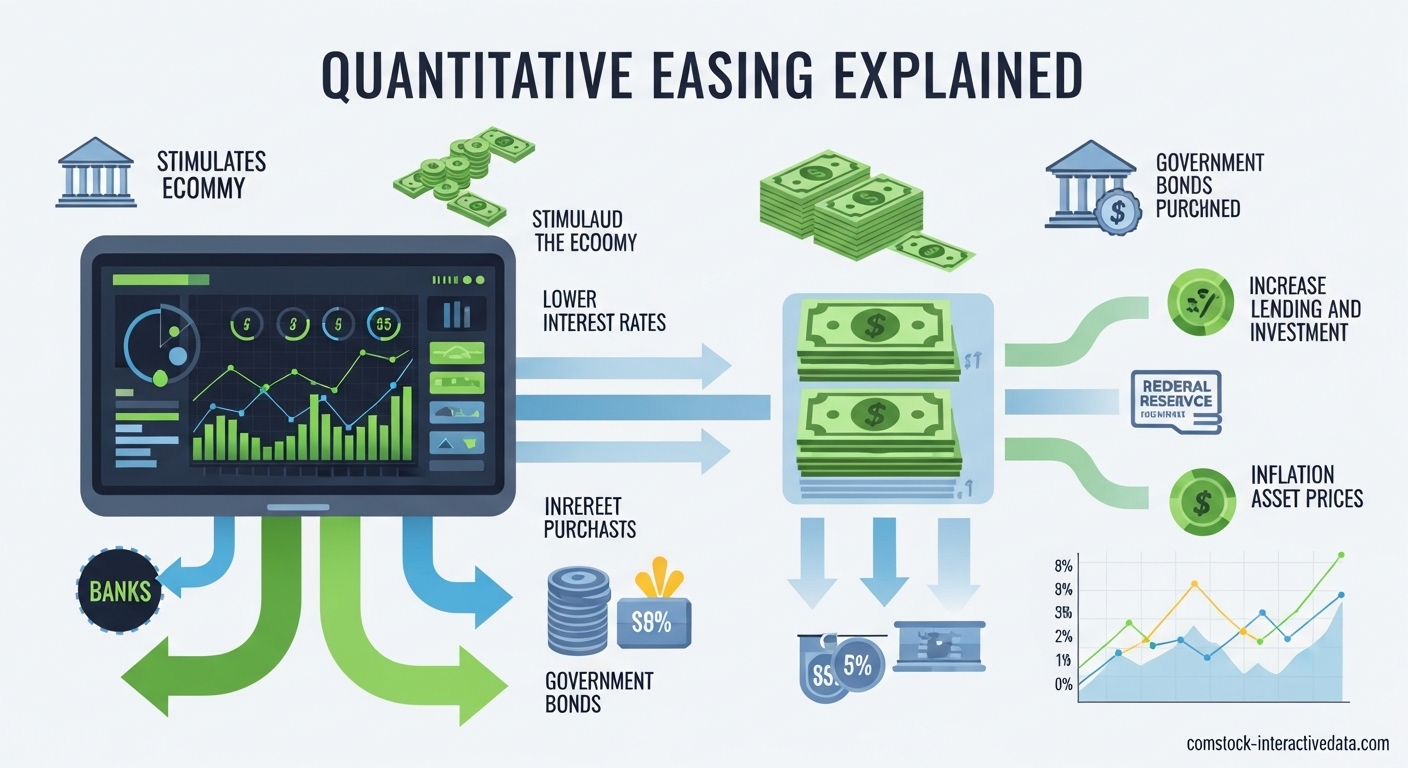
Quantitative easing is a monetary policy tool where central banks purchase government securities to increase the money supply, lower interest rates, and stimulate economic growth when traditional rate cuts are ineffective. The Federal Reserve and other central banks worldwide use this unconventional approach to combat severe economic downturns, financial crises, and deflationary pressures when conventional policy tools reach their limits.
Understanding quantitative easing explained in practical terms matters for anyone who invests in stocks, owns a home with a mortgage, saves for retirement, or simply wants to grasp how government decisions affect their daily financial life. When the Fed implements QE, it triggers ripple effects through interest rates, asset prices, and currency values that touch every corner of the economy.
In this comprehensive guide, you will learn exactly how quantitative easing works step by step, why the Federal Reserve deploys this powerful tool, what happened during the 2008 financial crisis and COVID-19 pandemic responses, and whether QE poses risks to your financial future. We will address the most common misconception head-on: is QE simply printing money? And we will explore how quantitative easing affects mortgage rates, stock prices, and the value of your savings.
Table of Contents
What Is Quantitative Easing?
Quantitative easing represents a form of unconventional monetary policy that central banks employ when traditional interest rate cuts can no longer stimulate economic activity. Under normal conditions, central banks like the Federal Reserve adjust short-term interest rates to influence borrowing costs throughout the economy. When rates are already near zero and the economy still struggles, policymakers turn to QE as an additional stimulus mechanism.
The name “quantitative easing” refers to the quantity of money the central bank creates and injects into the financial system. Unlike standard monetary policy that focuses on the price of money (interest rates), QE targets the quantity of money circulating through the economy. The central bank creates new money electronically and uses it to purchase financial assets, primarily government bonds and mortgage-backed securities, from banks and financial institutions.
The Federal Reserve holds a unique position as the central bank of the United States. Congress established the Fed in 1913 to provide the nation with a safer, more flexible, and more stable monetary and financial system. The Fed operates independently within government, making decisions based on economic data rather than political pressure. This independence allows the Federal Reserve to implement quantitative easing when necessary, even during politically sensitive periods.
QE differs fundamentally from traditional open market operations in both scale and intent. Regular monetary policy involves modest adjustments to short-term rates through small-scale securities transactions. Quantitative easing involves massive, sustained purchases of longer-term assets designed to directly lower long-term interest rates and flood the banking system with reserves. The scale can reach trillions of dollars, far exceeding routine monetary operations.
How Does Quantitative Easing Work?
The Federal Reserve implements quantitative easing through a specific, repeatable process that flows from money creation through asset purchases to interest rate impacts. Understanding this step-by-step mechanism clarifies how QE transmits through the financial system to ultimately affect ordinary borrowers, savers, and investors.
Step 1: The Fed Creates Reserves Electronically
The Federal Reserve does not print physical currency to fund quantitative easing. Instead, the Fed creates money electronically by crediting the reserve accounts that commercial banks hold at the Federal Reserve. These reserve accounts function like checking accounts for banks, holding funds that institutions use to settle transactions with one another.
When the Federal Reserve decides to purchase securities, it simply increases the balance in the seller’s reserve account. No physical money changes hands. The transaction occurs entirely within the Federal Reserve’s digital ledger system. This electronic money creation happens instantly and can scale to any size the central bank deems necessary.
Step 2: The Fed Purchases Securities from Banks
The Federal Reserve conducts large-scale asset purchases in the secondary market, buying government bonds and mortgage-backed securities from primary dealers, commercial banks, and other financial institutions. The Fed conducts these transactions through its trading desk at the New York Federal Reserve Bank.
The Federal Reserve primarily purchases two types of assets during QE: Treasury securities issued by the U.S. government and mortgage-backed securities (MBS) backed by pools of home loans. Treasury securities include Treasury bills (short-term, under one year), Treasury notes (medium-term, 2-10 years), and Treasury bonds (long-term, 30 years). MBS represent ownership claims on packages of mortgage payments from homeowners.
Step 3: Sellers Receive Payment in Reserves
When the Federal Reserve purchases a security from a bank or financial institution, the Fed pays for that asset by crediting the seller’s reserve account at the Federal Reserve. The bank essentially trades a bond for an increase in its reserve balance.
This process increases the total amount of reserves in the banking system. Banks now hold more deposits at the Federal Reserve than before. These excess reserves exceed what banks are required to hold based on their deposit liabilities. The surge in reserves provides banks with additional liquidity and capacity to extend new loans.
Step 4: Increased Demand Lowers Bond Yields
The Federal Reserve’s massive bond purchases increase demand for Treasury securities and mortgage-backed securities. Basic supply and demand mechanics drive up bond prices when a large new buyer enters the market with billions or trillions of dollars to spend.
Bond prices and yields move in opposite directions. When bond prices rise due to increased demand from the Fed, the yields (interest rates) on those bonds fall. The Federal Reserve’s purchases specifically target longer-term bonds, which directly reduces long-term interest rates throughout the economy.
Step 5: Lower Interest Rates Stimulate Economic Activity
As Treasury and MBS yields decline, these lower rates transmit through the financial system to affect borrowing costs for consumers, businesses, and governments. Mortgage rates tied to Treasury yields fall, making homes more affordable. Corporate bond rates decline, encouraging business investment. Government borrowing costs drop, freeing fiscal space for public spending.
Lower interest rates reduce the reward for saving while decreasing the cost of borrowing. This dynamic encourages households to spend rather than save, businesses to invest in expansion rather than hold cash, and governments to invest in infrastructure rather than pay down debt. The combined effect stimulates aggregate demand throughout the economy.
Step 6: The Fed Expands Its Balance Sheet
Throughout the QE process, the Federal Reserve’s balance sheet expands dramatically. The Fed’s assets (the bonds it purchased) increase, matched by a corresponding increase in its liabilities (the reserve accounts of commercial banks). This balance sheet expansion gives quantitative easing its name, as the Fed is literally easing financial conditions by increasing the quantity of assets it holds.
The Federal Reserve’s balance sheet grew from under $1 trillion before the 2008 financial crisis to over $8 trillion following the COVID-19 pandemic response. This expansion represents the total magnitude of quantitative easing implemented during these crisis periods.
When and Why Does the Fed Use QE?
The Federal Reserve reserves quantitative easing for extraordinary economic circumstances when conventional monetary policy loses effectiveness. The central bank deploys QE during severe recessions, financial crises, and deflationary periods when the economy requires substantial stimulus beyond what standard rate cuts can provide.
The most common trigger for quantitative easing occurs when the Federal Reserve has already reduced its benchmark federal funds rate to near zero, hitting what economists call the “zero lower bound.” At this point, the Fed cannot cut rates further using conventional tools. QE provides an alternative mechanism to ease financial conditions even when short-term rates cannot go lower.
Financial crises create another scenario requiring QE. During the 2008 financial crisis, credit markets froze as banks stopped lending to each other and to businesses. The Federal Reserve implemented QE to restore liquidity to dysfunctional markets, purchasing mortgage-backed securities when no private buyers would touch them. This intervention stabilized the financial system and prevented a complete collapse of credit markets.
Deflationary spirals represent a third situation where the Fed turns to quantitative easing. When prices fall persistently, consumers delay purchases expecting even lower prices tomorrow, while debt burdens grow heavier in real terms. Japan faced this scenario throughout the 1990s and 2000s, leading the Bank of Japan to pioneer QE programs. The Federal Reserve watches for similar deflationary signals in the U.S. economy.
The Federal Reserve also considers QE when credit crunches threaten economic growth. If banks become unwilling to lend due to fear of losses or regulatory constraints, QE injects liquidity directly into the financial system. The additional reserves give banks more capacity to lend, while the Fed’s asset purchases can specifically target impaired markets like mortgage-backed securities.
The Goals of Federal Reserve QE Programs
The Federal Reserve pursues three primary objectives when implementing quantitative easing. First, maximum employment: QE aims to stimulate economic activity and job creation by lowering borrowing costs for businesses and households. Second, price stability: by preventing deflation and targeting moderate inflation (historically 2%, though the Fed adjusted this framework in 2026), QE maintains purchasing power and encourages spending. Third, moderate long-term interest rates: by directly purchasing longer-term securities, QE lowers rates that affect mortgages, business loans, and government borrowing.
Real-World Examples of Quantitative Easing
Quantitative easing moved from theoretical monetary policy tool to practical economic intervention during the 2008 financial crisis. Since then, the Federal Reserve has deployed QE during multiple crisis periods, each implementation refining the approach and revealing both capabilities and limitations.
QE1: The 2008 Financial Crisis Response
In November 2008, as Lehman Brothers collapsed and the global financial system teetered on the brink, the Federal Reserve announced its first quantitative easing program. The Fed committed to purchasing $600 billion in mortgage-backed securities and agency debt, marking a dramatic expansion beyond traditional monetary policy.
By March 2009, the Federal Reserve expanded QE1 substantially, increasing total purchases to $1.75 trillion including $300 billion in Treasury securities. This expansion came as the unemployment rate surged toward 10% and the economy shed hundreds of thousands of jobs monthly. The Fed’s balance sheet ballooned from under $900 billion to over $2 trillion during this first QE episode.
QE1 succeeded in stabilizing financial markets. The TED spread, which measures credit risk in the interbank lending market, fell from crisis peaks above 400 basis points to under 50 basis points by mid-2009. Mortgage rates declined from over 6% to around 5%, providing relief to homeowners and supporting a fragile housing market.
QE2: 2010-2011 Economic Support
As economic growth slowed in mid-2010 and deflation concerns emerged, the Federal Reserve launched QE2 in November 2010. This program involved $600 billion in Treasury security purchases over eight months. Unlike QE1, which targeted distressed mortgage markets, QE2 focused exclusively on Treasury securities to lower long-term interest rates broadly.
QE2 sparked significant controversy and criticism. Some economists argued the program risked igniting inflation. Others worried about currency devaluation and international tensions. The Federal Reserve defended the program as necessary insurance against deflation and a stagnant recovery. Economic growth accelerated modestly during the QE2 period, though attributing this solely to QE remains debated.
QE3: Open-Ended Purchases 2012-2014
The Federal Reserve launched QE3 in September 2012 with a novel approach: open-ended purchases without a predetermined total amount. The Fed committed to buying $40 billion in mortgage-backed securities monthly until the labor market improved substantially. This “QE-infinity” approach removed uncertainty about when purchases would end.
In December 2012, the Fed expanded QE3 to include $45 billion in monthly Treasury purchases, bringing total monthly purchases to $85 billion. The program continued until October 2014, with the Federal Reserve gradually tapering purchases as economic conditions improved. By the end of QE3, the Fed’s balance sheet exceeded $4.5 trillion.
QE3 coincided with sustained job growth and a declining unemployment rate. The economy added over 200,000 jobs monthly during the QE3 period, and the unemployment rate fell from 8.1% to 5.8%. However, wage growth remained sluggish and many workers dropped out of the labor force, complicating assessments of QE3’s full impact.
The COVID-19 Pandemic Response
In March 2020, as COVID-19 shutdowns triggered an economic collapse of unprecedented speed, the Federal Reserve implemented the most aggressive quantitative easing program in history. The Fed announced plans to purchase Treasury securities and mortgage-backed securities “in the amounts needed to support smooth market functioning and effective transmission of monetary policy to broader financial conditions.”
The Federal Reserve purchased over $2 trillion in securities within weeks of the March 2020 announcement. Monthly purchases reached $120 billion ($80 billion Treasuries, $40 billion MBS) and continued at this pace through late 2021. The Fed’s balance sheet exploded from $4 trillion to over $8 trillion, doubling the scale of QE from the entire 2008-2014 period in a matter of months.
The COVID-19 QE program differed fundamentally from earlier iterations. Beyond Treasuries and MBS, the Federal Reserve purchased corporate bonds and even corporate bond exchange-traded funds through emergency lending facilities. This expansion into private credit markets represented a historic expansion of the Fed’s role in financial markets.
International Examples: Japan, UK, and ECB
The Bank of Japan pioneered quantitative easing, implementing programs starting in 2001 that continue to this day. Japan’s experience demonstrates both the power and limits of QE. Despite decades of asset purchases and a balance sheet exceeding 100% of GDP, Japan has struggled to achieve consistent 2% inflation. The BoJ’s ongoing commitment to QE shows that central banks can maintain these programs for extended periods.
The European Central Bank launched its own quantitative easing program in 2015, purchasing over 2.6 trillion euros in assets through 2018. When economic conditions deteriorated in 2019 and again during COVID-19, the ECB restarted and expanded QE. The Bank of England has also deployed QE multiple times, including during the 2008 crisis, the 2016 Brexit vote, and the COVID-19 pandemic.
Is Quantitative Easing the Same as Printing Money?
This question generates more confusion than perhaps any other aspect of quantitative easing. The short answer is that QE resembles money printing in some ways but differs fundamentally in others. Understanding this distinction clarifies both how QE works and why it does not necessarily cause immediate hyperinflation.
Quantitative easing does create new money electronically, which superficially looks like printing money. The Federal Reserve increases the monetary base by crediting bank reserve accounts, expanding the total quantity of central bank money in existence. This expansion of the monetary base is what critics point to when calling QE “money printing.”
However, QE differs from traditional money printing in crucial ways. When governments literally print money to fund spending (historically seen in hyperinflationary episodes like Weimar Germany or Zimbabwe), the new currency directly enters circulation through government spending on goods, services, and wages. This immediately increases the money supply available to consumers and businesses, creating instant inflationary pressure.
Quantitative easing, by contrast, initially creates money that sits in bank reserve accounts at the Federal Reserve. These reserves do not circulate in the broader economy as spendable cash. For QE to cause inflation, banks must lend out these reserves, borrowers must spend the loan proceeds, and this money must change hands multiple times through the economy.
The velocity of money explains why QE does not automatically cause inflation. Velocity measures how quickly money circulates through the economy. During recessions and financial crises, velocity typically drops as households save more, businesses invest less, and banks lend cautiously. The Federal Reserve can increase the quantity of money through QE, but if that money sits idle in reserve accounts rather than circulating, it creates minimal inflationary pressure.
QE also differs from money printing because the Federal Reserve can reverse it through quantitative tightening. When the Fed sells the bonds it purchased during QE, it destroys the money it created, reducing bank reserves and contracting the monetary base. This reversibility makes QE fundamentally different from permanent money creation.
The Economic Impacts of Quantitative Easing
Quantitative easing transmits through the economy through multiple channels, affecting everything from mortgage rates to stock prices to currency values. Understanding these impacts helps investors, homeowners, and savers anticipate how Federal Reserve policy affects their financial situations.
Impact on Interest Rates and Borrowing Costs
The Federal Reserve’s QE purchases directly lower long-term interest rates by increasing demand for Treasury securities and mortgage-backed securities. When the Fed buys these assets, bond prices rise and yields fall. Because many consumer and business interest rates benchmark against Treasury yields, these declines transmit through the economy.
Research from the Federal Reserve Bank of New York suggests that the first round of QE lowered 10-year Treasury yields by approximately 50-100 basis points (0.5-1.0 percentage points). Subsequent rounds had smaller but still significant effects. These rate reductions make borrowing cheaper for the government, businesses, and households.
How QE Affects Mortgage Rates
Quantitative easing has particularly powerful effects on mortgage rates. The Federal Reserve’s purchases of mortgage-backed securities directly support the mortgage market by providing a guaranteed buyer for these securities. When the Fed buys MBS, it increases demand for the bonds backed by home loans, which drives down mortgage rates.
During the COVID-19 pandemic response, the Federal Reserve’s massive MBS purchases contributed to mortgage rates falling below 3% for the first time in history. These record-low rates triggered a refinancing boom that saved homeowners billions in interest payments and supported a surge in home purchases. When the Fed announced plans to taper MBS purchases in 2026, mortgage rates began rising in anticipation of reduced Fed support.
QE and Stock Market Performance
Quantitative easing typically boosts stock prices through multiple mechanisms. Lower interest rates reduce the discount rate investors use to value future corporate earnings, making stocks more attractive relative to bonds. QE also improves corporate profitability by reducing borrowing costs and stimulating economic activity.
During QE periods, stock markets have generally performed well. The S&P 500 rose over 60% during the QE1 and QE2 periods. The COVID-19 QE program coincided with one of the fastest stock market recoveries in history, with major indexes reaching new highs within months of the March 2020 crash. However, critics argue this stock market boost primarily benefits wealthy investors who own the majority of equities, potentially exacerbating wealth inequality.
Effects on Inflation and Deflation
The Federal Reserve implements QE partly to prevent deflation, which can be more damaging than moderate inflation. By increasing the money supply and stimulating economic activity, QE aims to maintain positive inflation near the Fed’s 2% target. Following the 2008 crisis and during the COVID-19 pandemic, QE helped prevent the deflationary spirals that crippled economies during the Great Depression.
However, QE can also contribute to inflation when economic conditions change. The Federal Reserve faced criticism in 2021-2022 as inflation surged to 40-year highs, with some economists arguing that excessive QE combined with fiscal stimulus overheated the economy. The lag between QE implementation and inflation effects makes calibrating these programs challenging for policymakers.
Currency Impacts and International Effects
Quantitative easing typically weakens a country’s currency relative to others. As the Federal Reserve increases the supply of dollars through QE, the dollar’s value relative to other currencies often declines. This depreciation makes U.S. exports more competitive on global markets while increasing the cost of imported goods.
QE also affects emerging markets and global capital flows. When the Federal Reserve implements QE, the lower interest rates push investors to seek higher returns abroad, sending capital flows into emerging economies. When QE ends and U.S. rates rise, this process reverses, potentially causing currency crises in developing nations. The “taper tantrum” of 2013 demonstrated these risks when emerging market currencies plunged on signals that the Fed might reduce QE.
Risks, Criticisms and Limitations of QE
While quantitative easing has proven effective at stabilizing financial markets during crises, the policy generates significant criticism and carries substantial risks. Understanding these limitations provides a balanced perspective on when and how the Federal Reserve should deploy this powerful tool.
Inflation Risk and Asset Price Bubbles
The most obvious risk of quantitative easing is inflation. Creating new money to purchase assets could theoretically flood the economy with excess liquidity, driving up prices throughout the economy. While this risk remained largely theoretical during the 2008-2014 QE programs, the post-COVID inflation surge demonstrated that QE can contribute to price instability when combined with supply disruptions and fiscal stimulus.
Asset price bubbles represent another inflationary risk. Rather than flowing broadly through the economy, QE-created liquidity often concentrates in financial assets, driving stock and bond prices to elevated levels. Critics argue that QE programs have created bubble conditions in various asset classes, setting the stage for future crashes when the Fed withdraws support.
Wealth Inequality Concerns
Perhaps the most persistent criticism of quantitative easing involves its effects on wealth inequality. QE works primarily by boosting asset prices, which disproportionately benefits wealthy households who own the majority of stocks and bonds. Meanwhile, ordinary workers see limited direct benefits from QE while potentially facing higher housing costs and future inflation.
Research from the Federal Reserve Bank of San Francisco found that while QE succeeded in stimulating economic growth, it also increased wealth inequality by boosting asset prices faster than wages. The top 10% of households by wealth own approximately 90% of stocks, meaning stock market gains from QE flow overwhelmingly to the already wealthy.
Market Distortion and Dependency
Critics argue that prolonged QE distorts financial markets by suppressing the price signals that normally guide capital allocation. When the Federal Reserve becomes the largest buyer of Treasury securities and mortgage-backed securities, market prices no longer reflect genuine supply and demand from private investors. This distortion can lead to misallocation of capital and encourage excessive risk-taking.
Market dependency on Fed support represents another concern. After years of QE, markets may become addicted to central bank purchases, panicking at any suggestion of withdrawal. The 2013 taper tantrum and the 2022 market volatility when the Fed began quantitative tightening demonstrate this dependency. Central banks face difficulty exiting QE programs without triggering market disruptions.
Currency Devaluation and International Tensions
Quantitative easing can weaken a nation’s currency, which creates both domestic and international complications. Currency depreciation makes imports more expensive, potentially driving up consumer prices. Internationally, aggressive QE by one country can force trading partners to respond with their own easing to prevent their currencies from appreciating too much.
During the QE2 period in 2010-2011, several emerging market nations including Brazil and China criticized the Federal Reserve for engaging in a “currency war” that hurt their export competitiveness. These tensions illustrate how unilateral QE decisions by the world’s largest central bank can ripple through the global economy.
Stagflation and Exit Difficulties
The nightmare scenario for quantitative easing involves stagflation: high inflation combined with stagnant economic growth. If QE creates inflation without generating real economic growth, central banks face an impossible dilemma. Raising rates to fight inflation deepens the stagnation, while continuing stimulus worsens inflation.
Exiting QE presents another challenge. The Federal Reserve eventually needs to reduce its balance sheet through quantitative tightening, either by selling assets or letting them mature without reinvestment. Either approach risks disrupting markets, raising rates, and potentially triggering the very recession that QE was meant to prevent. The Fed’s cautious approach to QT in 2026 reflects these concerns.
Quantitative Easing vs Quantitative Tightening
Understanding quantitative easing requires also understanding its opposite: quantitative tightening. These two policies represent opposite ends of the Federal Reserve’s balance sheet management toolkit, with QE expanding the balance sheet to stimulate the economy and QT contracting it to cool economic activity.
Quantitative tightening reverses the QE process. Instead of purchasing securities from banks, the Federal Reserve allows assets on its balance sheet to mature without reinvesting the proceeds, or actively sells securities back to the market. As these securities leave the Fed’s balance sheet, the corresponding reserves in the banking system also disappear, reducing liquidity and putting upward pressure on interest rates.
| Aspect | Quantitative Easing (QE) | Quantitative Tightening (QT) |
|---|---|---|
| Direction | Fed buys securities | Fed lets securities mature or sells them |
| Balance Sheet | Expands | Contracts |
| Bank Reserves | Increases | Decreases |
| Interest Rates | Downward pressure | Upward pressure |
| Economic Goal | Stimulate growth, prevent deflation | Cool inflation, normalize policy |
| Used When | Recession, crisis, zero lower bound | Recovery, inflation concerns |
| Market Effect | Supports asset prices | Can pressure asset prices |
| Examples | 2008-2014, 2020-2022 | 2017-2019, 2022-present |
The Federal Reserve first attempted QT in 2017-2019, gradually allowing its balance sheet to shrink by not reinvesting all proceeds from maturing securities. This initial experiment ended abruptly in 2019 when money markets seized up, forcing the Fed to resume asset purchases. The episode revealed how dependent financial markets had become on abundant Fed-provided liquidity.
Following the COVID-19 QE surge that pushed the Fed’s balance sheet over $8 trillion, the Federal Reserve began QT again in 2022. This tightening cycle coincided with aggressive interest rate hikes to combat inflation. Markets closely monitor the pace of QT, as faster balance sheet reduction could drain liquidity from the financial system and trigger volatility.
Frequently Asked Questions About Quantitative Easing
Does quantitative easing stimulate the economy?
Yes, quantitative easing stimulates the economy by lowering interest rates, increasing liquidity, and encouraging borrowing and investment. Research from the Federal Reserve and academic institutions generally confirms that QE successfully supported economic growth during the 2008 financial crisis and COVID-19 pandemic. However, the magnitude and timing of effects remain debated among economists. QE works best when combined with appropriate fiscal policy and when financial markets are functioning properly to transmit the Fed’s actions to the broader economy.
What does the Fed do during quantitative easing?
During quantitative easing, the Federal Reserve purchases large quantities of government bonds and mortgage-backed securities from banks and financial institutions. The Fed pays for these assets by electronically crediting the sellers’ reserve accounts, effectively creating new money. This process increases the monetary base, lowers long-term interest rates, and provides banks with additional liquidity. The Fed typically announces specific purchase amounts and target assets, then conducts these transactions through its trading desk at the New York Federal Reserve Bank.
How can the Fed stimulate the economy?
The Federal Reserve can stimulate the economy through several tools: lowering the federal funds rate to reduce short-term borrowing costs, implementing quantitative easing to lower long-term rates and increase liquidity, using forward guidance to signal future policy intentions, and adjusting reserve requirements for banks. The Fed can also provide emergency lending to financial institutions during crises. These tools work by making borrowing cheaper, encouraging spending and investment, supporting asset prices, and maintaining confidence in the financial system.
Is QE a good thing for the economy?
QE provides significant benefits during crises by preventing financial system collapse, avoiding deflation, and supporting economic recovery. The programs implemented during 2008 and COVID-19 likely prevented much worse economic outcomes. However, QE also carries risks including potential inflation, asset bubbles, wealth inequality, and market distortion. Whether QE is ‘good’ depends on the economic context, implementation details, and how well the Fed manages the exit. Most economists view QE as a necessary but imperfect tool for extreme circumstances.
What is quantitative easing easily explained?
Quantitative easing is when the central bank creates new money to buy government bonds and other financial assets. This increases the money supply, lowers interest rates, and makes it easier for businesses and households to borrow and spend. Think of it as the central bank injecting liquidity directly into the financial system when normal interest rate cuts are no longer effective. The goal is to stimulate economic activity during severe downturns or financial crises.
Is QT coming to an end?
The status of quantitative tightening depends on current Federal Reserve policy and economic conditions. The Fed adjusts QT pace based on inflation data, employment figures, and financial market stability. Investors should monitor Federal Open Market Committee statements and meeting minutes for the latest guidance on balance sheet policy. Historically, the Fed has slowed or paused QT when markets become stressed or when the economy needs additional support. The central bank maintains flexibility to adjust QT speed as conditions warrant.
Does QE weaken a currency?
Quantitative easing typically weakens a country’s currency by increasing the supply of that currency relative to others. As the central bank creates new money to purchase assets, this expanded supply can drive down the currency’s value in foreign exchange markets. A weaker currency makes exports more competitive but raises the cost of imports. During the 2010-2011 QE2 period, several emerging market nations criticized the Fed for weakening the dollar and creating competitive disadvantages. However, currency effects depend on whether other central banks are also implementing QE.
Was QE a mistake?
Most economists and policymakers believe quantitative easing was necessary and successful in preventing worse outcomes during the 2008 financial crisis and COVID-19 pandemic. Without QE, the economy likely would have experienced deeper recessions, higher unemployment, and potential deflation. However, critics argue that prolonged QE created asset bubbles, worsened wealth inequality, and made markets dependent on Fed support. The post-COVID inflation surge led some to question whether the Fed maintained QE too long. Overall, QE appears to have been appropriate for crisis periods but raises questions about exit timing and prolonged use.
Conclusion
Quantitative easing explained in full reveals both the power and complexity of this unconventional monetary policy tool. The Federal Reserve has deployed QE during the most severe economic crises of modern times, from the 2008 financial meltdown to the COVID-19 pandemic shutdown. These programs succeeded in stabilizing financial markets, preventing deflation, and supporting economic recovery when traditional policy tools reached their limits.
The step-by-step mechanism of QE shows how the Federal Reserve creates money electronically, purchases securities from banks, increases reserves in the financial system, and ultimately lowers interest rates to stimulate borrowing and investment. This process affects everyone who holds a mortgage, invests in stocks, or saves for the future, making understanding QE essential for informed financial decision-making.
However, quantitative easing also carries significant risks and limitations. Inflation concerns, asset bubble creation, wealth inequality effects, market distortion, and the challenges of eventual exit all temper enthusiasm for this policy tool. The post-COVID inflation surge demonstrated that QE is not without costs, and the Federal Reserve must carefully calibrate both implementation and withdrawal to maximize benefits while minimizing harm.
For investors, homeowners, and anyone interested in how Federal Reserve policy affects their financial life, monitoring QE programs and understanding their mechanics provides valuable insight. As central banks around the world continue refining these tools, quantitative easing will remain a critical component of the modern monetary policy toolkit for responding to economic crises and managing financial stability.