
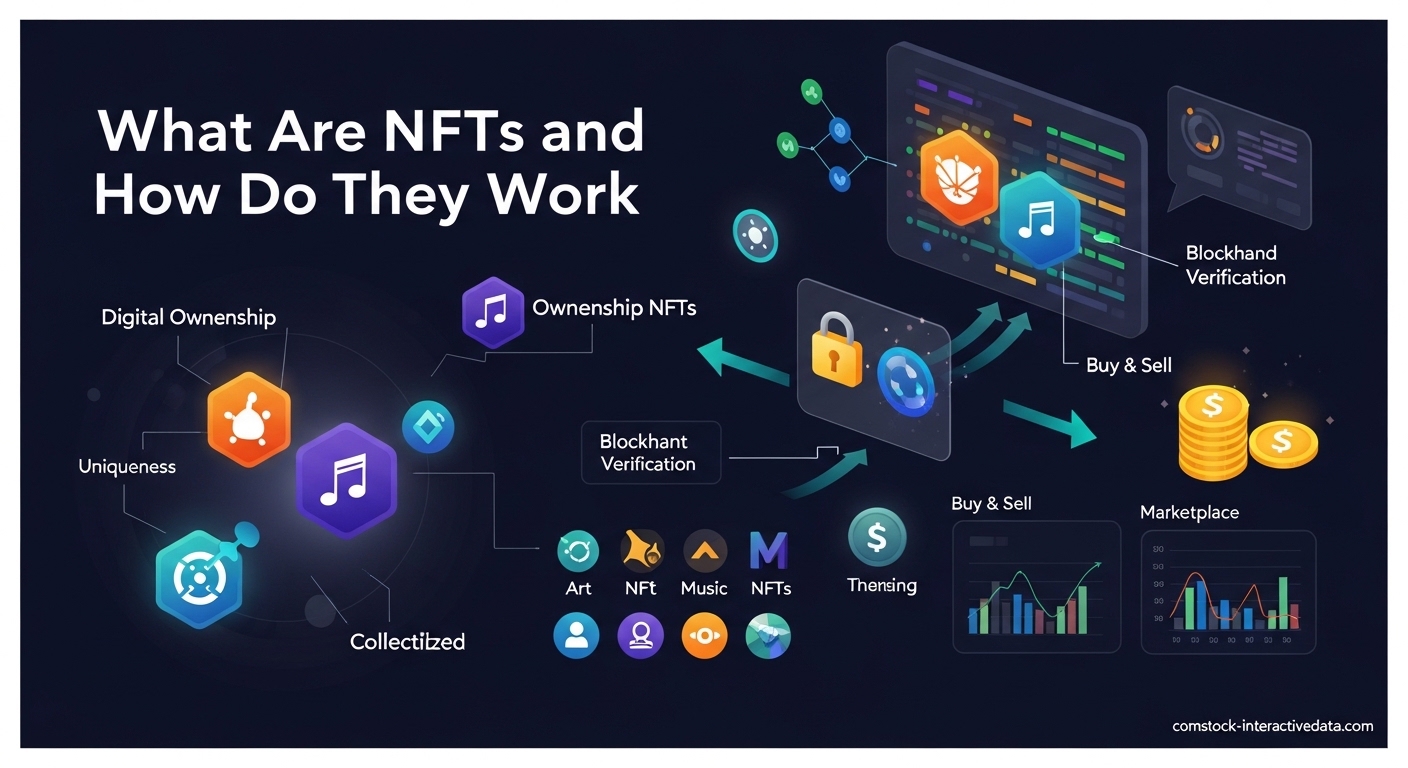
NFTs (non-fungible tokens) are unique digital certificates of ownership stored on a blockchain that cannot be replicated or exchanged on a one-to-one basis. They represent one-of-a-kind digital assets like artwork, collectibles, music, or virtual items.
I remember when I first heard about NFTs back in 2021. Everyone was talking about digital art selling for millions, and honestly, it sounded like a scam. But after spending months researching how they actually work, I realized NFTs solve a real problem that has plagued digital creators for decades.
The problem was simple but devastating. Before NFTs, if you created a digital image or song, anyone could copy it infinitely. There was no way to prove who created it first or who owned the original. NFTs changed that by creating a permanent, verifiable record of ownership using blockchain technology.
Table of Contents
What Are NFTs?
An NFT is a unique digital identifier recorded on a blockchain that certifies ownership and authenticity of a specific asset. Unlike regular computer files that can be copied endlessly, each NFT has distinct information that makes it one-of-a-kind and traceable to a single owner.
The term “non-fungible” simply means the token cannot be exchanged equally with another item. Think of it like a painting versus a dollar bill. If I trade you my dollar for your dollar, we both have the same thing. But if I trade you my original Picasso for your different original Picasso, we now own completely different assets with different values.
NFTs work on blockchain networks like Ethereum, Solana, and Bitcoin (through Ordinals). The blockchain acts as a public ledger that records every transaction, making ownership history transparent and impossible to fake. When someone buys an NFT, the blockchain updates to show they are now the owner.
Each NFT contains metadata that describes what it represents. This could include the artist’s name, creation date, a link to the digital file, and sometimes unlockable content only the owner can access. The actual image or file often lives on decentralized storage like IPFS, while the NFT on the blockchain points to that location.
NFTs vs Cryptocurrencies: The Key Difference
Many beginners confuse NFTs with cryptocurrencies like Bitcoin or Ethereum. They are related but fundamentally different. Cryptocurrencies are fungible tokens, meaning each unit is identical and interchangeable. One Bitcoin equals one Bitcoin anywhere in the world.
NFTs are non-fungible, meaning each token is unique with its own value and characteristics. You cannot trade one NFT for another and expect an equal exchange. This uniqueness is exactly what makes them valuable for representing rare or one-of-a-kind items.
The analogy I find most helpful compares NFTs to physical collectibles. A Pokemon card collection works similarly to NFTs. Some cards are common (fungible in a sense), while holographic first editions are rare and valuable (non-fungible). The blockchain simply digitizes this concept and makes ownership provable without needing a physical card grading service.
How Do NFTs Work?
NFTs operate through a combination of blockchain technology, smart contracts, and token standards. Understanding these three elements explains how digital ownership actually functions in practice.
The Role of Blockchain
A blockchain is essentially a distributed database maintained by thousands of computers worldwide. Every transaction gets recorded in blocks that link together chronologically. Once recorded, altering a transaction would require changing every subsequent block across the entire network, making fraud virtually impossible.
When someone creates or “mints” an NFT, that action gets recorded permanently on the blockchain. The record includes the creator’s wallet address, a unique token ID, and metadata about the asset. Anyone can view this information using a blockchain explorer, creating complete transparency around ownership history.
Smart Contracts Explained
Smart contracts are self-executing programs stored on the blockchain that automatically enforce the rules of NFT ownership and transfer. They handle the technical heavy lifting without requiring intermediaries like banks or lawyers.
These contracts define what happens when an NFT sells. They can automatically distribute payment to the seller, transfer the token to the buyer, and even send royalties to the original creator. This automation eliminates delays and reduces costs compared to traditional asset transfers.
The Minting Process
Minting is the process of creating a new NFT and registering it on the blockchain. Here is how it works step by step.
Step 1: The creator prepares their digital file (image, audio, video, or other format) and uploads it to decentralized storage or IPFS.
Step 2: They connect their crypto wallet to an NFT marketplace like OpenSea or a minting platform.
Step 3: They fill in the NFT details including title, description, properties, and any unlockable content.
Step 4: They pay a network fee called “gas” to process the transaction on the blockchain.
Step 5: The smart contract creates the unique token ID and records it on the blockchain, officially minting the NFT.
Most NFTs use the ERC-721 standard on Ethereum, which defines the basic functionality for unique tokens. There is also ERC-1155, which supports both fungible and non-fungible tokens in a single contract, useful for gaming items where you might want 100 identical swords.
Brief History of NFTs
NFTs did not appear overnight. Their development spans over a decade of blockchain innovation.
2014-2016: The Early Experiments
The concept started with “Colored Coins” on the Bitcoin blockchain in 2014. These were small amounts of Bitcoin marked to represent other assets. While limited, they proved the concept of representing non-monetary value on a blockchain.
2017: CryptoKitties Breakthrough
CryptoKitties launched on Ethereum in late 2017 and became the first mainstream NFT application. These digital cats could be bred, collected, and traded. The game became so popular it congested the entire Ethereum network, proving both the demand for digital collectibles and the scalability challenges of blockchain.
2021: The Mainstream Explosion
NFTs exploded into public consciousness during 2021. Beeple sold a digital artwork for $69 million at Christie’s auction house. Bored Ape Yacht Club launched and became a status symbol among celebrities. NBA Top Shot brought sports collectibles to the blockchain. By year end, NFT trading volume exceeded $25 billion.
2022-Present: Maturation and Diversification
The market cooled significantly after 2021’s peak, but NFT technology found more practical applications. Major brands like Starbucks, Nike, and Reddit launched NFT programs focused on utility rather than speculation. The technology matured beyond JPEGs into ticketing, identity verification, and digital membership systems.
What Are NFTs Used For?
NFT technology enables numerous applications across industries. Here are the primary use cases 2026.
- Digital Art and Collectibles: Artists sell original digital works with verifiable scarcity, while collectors buy unique pieces with proven ownership history.
- Gaming Items: Players truly own in-game assets like skins, weapons, and characters that can be traded or used across compatible games.
- Virtual Real Estate: Platforms like Decentraland and The Sandbox sell parcels of digital land where owners can build experiences and monetize visitors.
- Music and Media: Musicians release songs as NFTs, giving fans ownership rights and direct revenue streams while eliminating middlemen.
- Event Tickets: Tickets become NFTs that prevent counterfeiting, enable resale with royalties to organizers, and serve as digital memorabilia after events.
- Domain Names: Services like ENS (Ethereum Name Service) sell blockchain-based domain names that replace complex wallet addresses with readable names.
- Identity and Credentials: Universities issue diplomas as NFTs, companies verify employee credentials, and individuals control their own identity data.
- POAPs (Proof of Attendance Protocol): Digital badges proving attendance at events, conferences, or special occasions.
How to Buy and Sell NFTs?
Getting started with NFTs requires a few basic steps. I walked several friends through this process, and the learning curve is manageable once you understand the fundamentals.
Setting Up a Wallet
You need a crypto wallet that supports NFTs. MetaMask is the most popular option for Ethereum-based NFTs. Phantom works well for Solana. These wallets store your private keys securely and connect to marketplaces.
When creating a wallet, you receive a “seed phrase” of 12 or 24 words. Write these down physically and store them somewhere safe. Never share this phrase with anyone. Anyone with your seed phrase controls your entire wallet and everything in it.
Choosing a Marketplace
Different marketplaces specialize in different types of NFTs. OpenSea is the largest general marketplace supporting multiple blockchains. Magic Eden dominates Solana NFTs. Blur caters to high-volume traders. Foundation focuses on curated digital art.
Understanding Gas Fees
Every transaction on the blockchain requires paying network fees called gas. These fees vary based on network congestion. During busy periods, minting an NFT might cost $50 in gas fees. During quiet times, it might cost $5. Layer 2 solutions like Polygon and Arbitrum offer significantly lower fees.
Buying Safely
Before purchasing any NFT, verify the collection is legitimate. Check the contract address matches the official source. Look at trading volume and holder distribution. Read the project’s social media and Discord community. Scammers create fake collections that mimic popular projects, so vigilance matters.
Benefits of NFTs
NFTs offer several advantages over traditional digital and physical asset systems.
Provenance and Authenticity
The blockchain creates an immutable record of ownership history. Buyers can verify an item’s authenticity instantly without trusting a third party. Artists can prove they created a work first, solving copyright disputes definitively.
Creator Royalties
Smart contracts enable automatic royalty payments to creators whenever their work resells. An artist who mints an NFT might receive 10% of every future sale in perpetuity. This transforms how creative professionals earn income from their work.
Global Accessibility
Anyone with internet access can participate in NFT markets regardless of geographic location. This democratizes access to art markets, collectibles, and investment opportunities that previously required connections, galleries, or significant capital.
Fractional Ownership
High-value NFTs can be divided into smaller shares, allowing multiple people to own portions of expensive assets. This opens investment in blue-chip digital art or real estate to smaller investors.
Concerns and Risks
NFTs are not without legitimate criticisms. Addressing these concerns honestly builds trust with readers.
Environmental Impact
Early NFT criticism focused heavily on energy consumption. Proof-of-work blockchains like Ethereum (before its 2022 merge) consumed significant electricity. However, Ethereum’s transition to proof-of-stake reduced energy usage by 99.95%. Solana and other modern chains use minimal energy. Most NFT activity now occurs on environmentally efficient networks.
Market Volatility
NFT prices can fluctuate wildly. An NFT purchased for $10,000 might be worth $1,000 next month. The market remains speculative, and many projects fail entirely. Only spend money you can afford to lose completely.
Scams and Security Risks
The NFT space attracts scammers. Common schemes include fake minting websites that steal wallet contents, phishing emails claiming to be marketplaces, and fraudulent collections impersonating popular projects. Never click suspicious links. Always verify contract addresses independently.
Copyright Confusion
Buying an NFT typically grants ownership of the token, not necessarily copyright to the underlying artwork. Unless explicitly stated, you cannot reproduce or commercially use the art. Many buyers misunderstand this distinction, leading to legal disputes.
Frequently Asked Questions
Can I convert NFT to real money?
Yes, you can sell NFTs on marketplaces like OpenSea or Blur for cryptocurrency, which can then be converted to fiat currency through exchanges like Coinbase. However, there is no guarantee your NFT will sell or retain value. The market determines prices, and many NFTs become worthless.
How much does 1 NFT cost?
NFT prices range from free to millions of dollars. Entry-level NFTs on affordable blockchains like Polygon might cost $1-50 plus gas fees. Premium collections like Bored Ape Yacht Club start at tens of thousands. The cost depends on the project, rarity, demand, and blockchain used.
Are any NFTs still valuable?
Yes, established collections with strong communities and utility retain value in 2026. Projects like CryptoPunks, Art Blocks, and select blue-chip collections maintain significant floor prices. However, the speculative bubble of 2021 has largely deflated, and most NFTs created during that period lost substantial value.
How much is $1.00 NFT worth in dollars?
An NFT listed at $1.00 would theoretically sell for one dollar, but additional costs apply. You must pay gas fees for the blockchain transaction, which can range from $0.01 on Layer 2 networks to $50+ on Ethereum mainnet during congestion. The total cost would be $1.00 plus these network fees.
Why would anyone pay for an NFT when I can screenshot it?
You can screenshot an NFT image just as you can photograph the Mona Lisa, but you do not own the original. The NFT proves ownership of the authentic digital asset on the blockchain. Ownership confers potential benefits like community access, royalties, or resale rights that screenshots cannot provide.
Is an NFT the same as cryptocurrency?
No. Cryptocurrencies are fungible and interchangeable like dollar bills. NFTs are non-fungible and unique like original artworks. They both use blockchain technology but serve different purposes.
How do NFT royalties work?
When artists mint NFTs, they can set royalty percentages in the smart contract, typically 5-10%. Every time the NFT resells on compatible marketplaces, the smart contract automatically sends that percentage to the creator’s wallet. This happens instantly without requiring invoicing or trust.
Are NFTs safe to invest in?
NFTs are high-risk speculative assets. While the underlying blockchain technology is secure, the market is volatile, scams are common, and many projects fail. Treat NFTs as experimental technology rather than stable investments. Never invest more than you can afford to lose completely.
Conclusion
NFTs represent a fundamental shift in how we establish ownership of digital assets. They use blockchain technology and smart contracts to create verifiable scarcity and provenance in a digital world where copying is effortless.
The technology has evolved significantly since the CryptoKitties craze of 2017. While the speculative frenzy of 2021 has subsided, practical applications continue emerging in gaming, ticketing, identity verification, and creator monetization.
Understanding what are NFTs and how they work empowers you to participate in this evolving digital economy. Whether you are an artist seeking new revenue streams, a collector interested in digital items, or simply curious about blockchain technology, NFTs offer a tangible entry point into web3 concepts.
Approach NFTs with appropriate caution. The technology is sound, but the market remains immature and risky. Start small, learn continuously, and never invest money you cannot afford to lose. The future of digital ownership is being built now, and understanding NFTs prepares you for what comes next.