
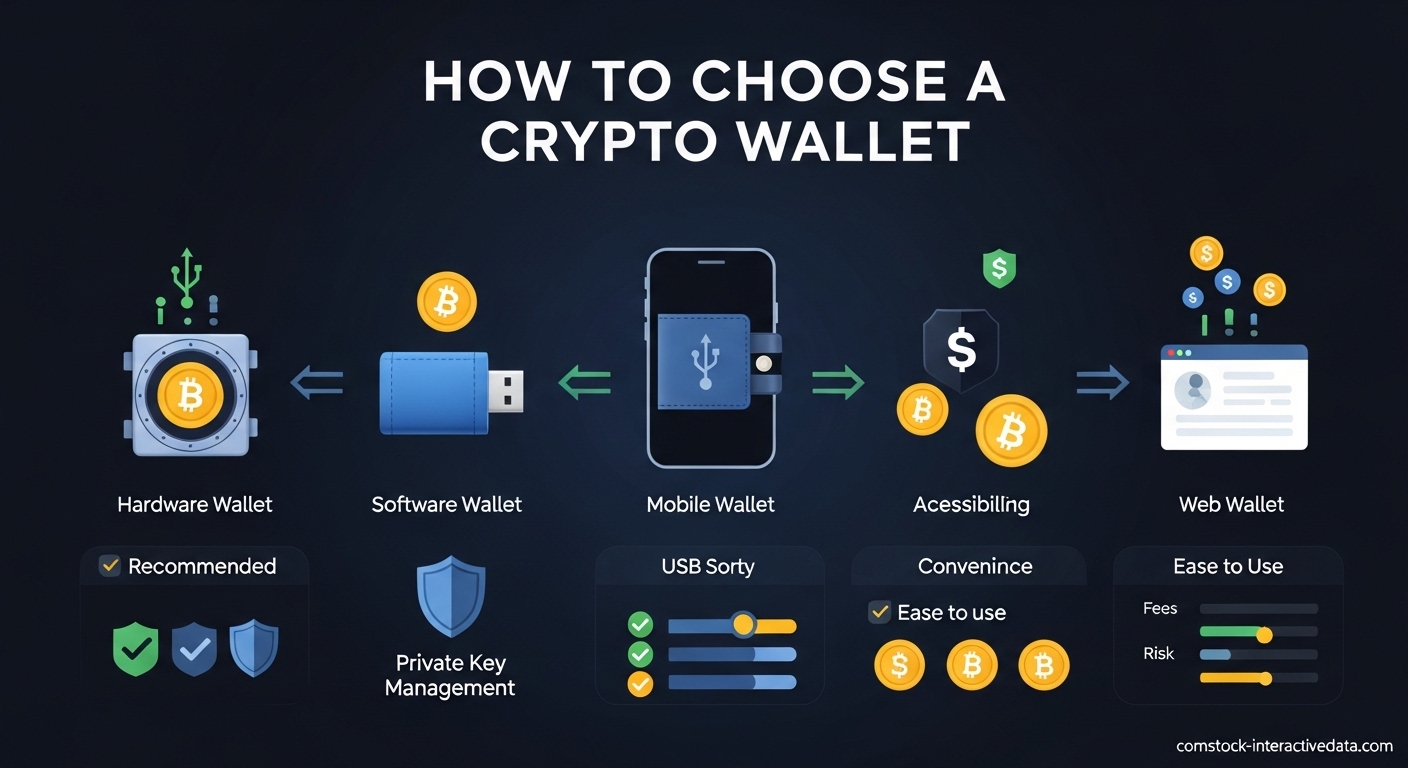
Choosing the right crypto wallet is one of the most important decisions you’ll make as a cryptocurrency owner. Your wallet doesn’t actually store your digital coins—instead, it holds the private keys that prove you own the crypto sitting on the blockchain. Making the wrong choice could mean losing access to your investments through hacking, forgotten passwords, or misplaced devices.
Hot wallets stay connected to the internet for easy access and trading, while cold wallets remain offline for maximum security against cyber threats. The decision between these two cryptocurrency wallet types depends on how much you own, how often you trade, and your comfort level with technology.
In this guide, I’ll walk you through everything you need to know about how to choose a crypto wallet for your specific situation. You’ll learn exactly what hot and cold wallets are, how they differ, which one fits your needs, and how to set them up properly.
Table of Contents
Quick Summary: Key Takeaways
Hot wallets connect to the internet and work best for frequent trading and daily transactions. Cold wallets stay offline and provide superior protection for long-term storage of significant crypto holdings.
Here are the essential differences at a glance:
- Hot wallets offer convenience and quick access but face higher hacking risks
- Cold wallets provide maximum security but cost money ($50-$200) and require more steps to use
- Most experienced crypto users employ both wallet types together
- Your choice should depend on how much crypto you own and how actively you trade
- Backing up your seed phrase properly matters more than which wallet type you pick
If you hold under $1,000 in crypto and trade frequently, start with a reputable hot wallet. If you own over $10,000 worth of cryptocurrency or plan to hold for years, invest in a cold wallet immediately.
What Is a Crypto Wallet?
A crypto wallet is software or hardware that stores your private keys—the cryptographic passwords that let you access and manage your cryptocurrency on the blockchain. Contrary to what many beginners think, wallets don’t actually hold your coins. Your Bitcoin, Ethereum, or other crypto lives on the blockchain permanently. Your wallet simply proves you own it.
Every wallet contains two essential components: a public key and a private key. Your public key works like an email address—share it freely so people can send you crypto. Your private key acts like your email password—never share it with anyone because it controls access to your funds.
When you want to send cryptocurrency, your wallet uses your private key to sign the transaction digitally. This signature proves to the blockchain network that you authorized the transfer. Without your private key, no one can move your funds—not even you.
Most wallets also generate a seed phrase (also called a recovery phrase) when you first set them up. This sequence of 12 or 24 words serves as a master backup for your private keys. Write these words down on paper, store them somewhere safe, and never store them digitally. If your phone breaks or your hardware wallet gets lost, this seed phrase restores access to everything.
Wallets fall into two main custody categories. Custodial wallets mean a company holds your private keys—like keeping money at a bank. Coinbase, Binance, and Robinhood operate this way. Non-custodial wallets put you in complete control of your keys. MetaMask, Ledger, and Trezor follow this model. The crypto community often repeats the phrase “not your keys, not your coins” to emphasize the risks of custodial storage.
What Is a Hot Wallet?
Hot wallets are cryptocurrency storage solutions that maintain constant internet connectivity. Because they stay online, they allow instant access to your funds for trading, payments, and transfers. Think of a hot wallet like the physical wallet you carry daily—easily accessible but more vulnerable to theft.
These wallets run as software on internet-connected devices. Your smartphone, laptop, or web browser hosts the application that manages your keys. This connectivity enables real-time interaction with blockchain networks, decentralized applications (dApps), and cryptocurrency exchanges.
When you initiate a transaction, the hot wallet signs it using your private keys and broadcasts it to the network immediately. There’s no waiting period or additional steps. This frictionless experience makes hot wallets ideal for active traders, DeFi participants, and anyone who spends cryptocurrency regularly.
The trade-off for this convenience is security exposure. Because hot wallets remain connected to the internet, they face constant threats from hackers, malware, and phishing attacks. A compromised device or malicious app could potentially access your keys and drain your funds within minutes.
Types of Hot Wallets
Hot wallets come in several formats, each suited to different user preferences and security needs. Understanding these options helps you select the right tool for your crypto activities.
Mobile Wallets run as smartphone apps and offer maximum portability. Trust Wallet, Coinbase Wallet, and BlueWallet dominate this category. These work perfectly for in-person payments, scanning QR codes at stores, and checking your portfolio on the go. Most support biometric security like fingerprint or face recognition.
Desktop Wallets install on your computer and typically offer more features than mobile versions. Exodus, Electrum, and Atomic Wallet provide comprehensive portfolio tracking, built-in exchange functions, and advanced security settings. These suit users who manage significant holdings from a home office.
Web Wallets operate through your browser without downloading software. MetaMask leads this category as the essential gateway to Ethereum and other EVM-compatible blockchains. Phantom serves the Solana ecosystem. These excel at connecting to decentralized exchanges, NFT marketplaces, and yield farming platforms.
Browser Extensions function as add-ons to Chrome, Firefox, or Brave. MetaMask started as an extension before expanding to mobile. These integrate seamlessly with Web3 websites, allowing one-click connections to trading platforms and DeFi protocols. They remain the most popular choice for serious DeFi users.
Exchange Wallets live on cryptocurrency trading platforms like Coinbase, Binance, and Kraken. While convenient for active trading, these represent custodial storage—the exchange controls your private keys. Use these only for funds you actively trade, not for long-term holdings.
Pros and Cons of Hot Wallets
Hot wallets dominate the crypto landscape because they solve the accessibility problem. Understanding their strengths and weaknesses helps you use them appropriately.
Advantages:
- Free to download and use—no upfront purchase required
- Instant access to funds for trading, payments, or transfers
- User-friendly interfaces designed for beginners
- Seamless integration with DeFi platforms and NFT marketplaces
- Multi-currency support in a single application
Disadvantages:
- Constant internet exposure creates hacking vulnerability
- Device theft or malware can compromise your keys
- Phishing attacks specifically target hot wallet users
- Less suitable for storing large amounts long-term
I keep about 20% of my crypto in hot wallets for daily use and trading. The rest sits in cold storage. This hybrid approach balances convenience with security without costing me anything extra.
What Is a Cold Wallet?
Cold wallets store cryptocurrency private keys completely offline, eliminating internet-based attack vectors. These devices or paper documents never connect to the internet during normal operation, creating an air-gapped security environment that hackers cannot penetrate remotely.
The fundamental principle behind cold storage is simple: if your private keys never touch an internet-connected device, remote hackers cannot steal them. This makes cold wallets the gold standard for securing significant cryptocurrency holdings over extended periods.
Cold wallets generate and store your private keys within a secure hardware environment or on physical paper. When you need to send crypto, you either connect the device temporarily to an internet-enabled computer (for hardware wallets) or manually enter keys (for paper wallets). The signing process happens within the secure environment, and only the signed transaction—not your private keys—exposes itself to the internet.
This security model explains why institutional investors, crypto whales, and long-term holders overwhelmingly prefer cold storage. Exchanges like Coinbase and Gemini keep the vast majority of customer funds in cold wallets for exactly this reason.
Types of Cold Wallets
Several cold storage options exist, ranging from sophisticated hardware devices to simple paper printouts. Each offers different trade-offs between security, convenience, and cost.
Hardware Wallets represent the most popular cold storage solution. These USB-like devices contain secure chips that generate and store private keys internally. The current market leaders include:
- Ledger Nano X – Bluetooth-enabled with mobile support, stores up to 100 apps simultaneously, priced around $149
- Ledger Nano S Plus – Budget-friendly option with USB-C connection, supports 5,500+ cryptocurrencies, priced around $79
- Trezor Model T – Touchscreen interface with open-source firmware, supports 1,000+ coins, priced around $179
- Trezor Safe 3 – Latest model with secure element chip, priced around $79
- Tangem – Card-shaped wallet using NFC technology with no battery required, priced around $55 per card
- KeepKey – Large screen for easy verification, shaped uniquely with chrome metal body, priced around $49
Hardware wallets typically cost between $50 and $200 depending on features and brand. This investment pays for itself immediately if it prevents even a single theft incident.
Paper Wallets provide the simplest cold storage method. You generate a key pair using an offline computer, print the public and private keys (often as QR codes), and store the paper securely. While free to create, paper wallets carry significant risks—paper deteriorates, ink fades, and physical theft becomes a concern. Most security experts now recommend hardware wallets over paper.
Air-Gapped Computers represent the most extreme cold storage option. Users dedicate an old laptop or computer that never connects to the internet, installing wallet software and generating keys in this isolated environment. This approach offers maximum security but requires significant technical knowledge to execute properly.
Deep Cold Storage refers to advanced institutional solutions involving geographically distributed vaults, multi-signature requirements, and physical security measures. BitGo, Fidelity Digital Assets, and similar custody providers specialize in these enterprise-grade systems.
Pros and Cons of Cold Wallets
Cold wallets command respect in the crypto community for good reason. However, they introduce friction that doesn’t suit every user.
Advantages:
- Immune to remote hacking attempts and online malware
- Physical possession provides clear ownership and control
- Supports very large holdings without security degradation
- Many hardware wallets offer recovery options if devices break
- Institutional-grade security available to individual users
Disadvantages:
- Upfront cost of $50-$200 for quality hardware wallets
- Slower access to funds—requires physical device connection
- Learning curve for proper setup and operation
- Physical loss or damage risks (mitigated by seed phrase backups)
- Less convenient for frequent trading or DeFi participation
One common misconception addresses the question: why shouldn’t you hold crypto in a cold wallet? Actually, you absolutely should for long-term storage. The real limitation is that cold wallets make quick trades impossible. If you need daily access to your crypto, keeping everything in cold storage creates impractical friction.
What About Warm Wallets?
Warm wallets occupy the middle ground between hot and cold storage, offering a compromise that many users find ideal. These wallets maintain internet connectivity but implement additional security measures that exceed standard hot wallet protection.
The defining characteristic of warm wallets involves how they handle private keys. While hot wallets store keys directly on internet-connected devices, warm wallets use various techniques to add security layers. Multi-signature requirements, hardware security modules, and threshold signature schemes distinguish warm wallets from purely hot alternatives.
Institutional custody solutions from BitGo, Fireblocks, and Coinbase Prime exemplify warm wallet architecture. These systems keep keys online for transaction speed but distribute them across multiple secure environments, requiring several parties or devices to approve any transfer. No single point of failure can compromise the entire wallet.
For individual users, certain multi-signature software wallets approach warm status. Electrum and BlueWallet support multi-sig setups where transactions require approval from multiple devices or people. This approach adds security without hardware wallet costs.
Warm wallets suit users who need faster access than cold storage allows but hold too much value to risk in simple hot wallets. Active traders with substantial portfolios, small investment funds, and businesses accepting crypto payments often prefer this middle path.
Hot Wallet vs Cold Wallet: Complete Comparison
Understanding the specific differences between wallet types helps you make an informed decision. This comparison breaks down every key factor.
| Feature | Hot Wallet | Cold Wallet |
|---|---|---|
| Internet Connection | Always connected | Offline/air-gapped |
| Security Level | Good (software protection) | Excellent (physical isolation) |
| Cost | Free | $50-$200 for hardware |
| Convenience | Instant access anywhere | Requires physical device |
| Transaction Speed | Immediate | 2-5 minutes to connect/sign |
| Hacking Risk | Moderate to high | Minimal (physical theft only) |
| Best For | Active trading, small amounts | Long-term storage, large holdings |
| Setup Difficulty | Beginner-friendly | Moderate learning curve |
| Multi-Currency | Yes (most support 100+ coins) | Yes (hardware supports thousands) |
| DeFi/NFT Access | Excellent | Limited (possible with some models) |
| Recovery Options | Seed phrase | Seed phrase + device replacement |
| Physical Durability | N/A (software) | Hardware can break/lose |
The fundamental trade-off becomes clear: hot wallets sacrifice maximum security for maximum convenience, while cold wallets sacrifice convenience for security. Neither choice is inherently correct—it depends entirely on your specific situation.
Which Crypto Wallet Should You Choose?
Selecting between hot and cold wallets requires honest assessment of your crypto habits, holdings, and technical comfort. Consider these decision factors carefully.
How much cryptocurrency do you own?
If your total crypto value stays below $1,000, a reputable hot wallet provides sufficient security. The cost of a hardware wallet ($79-$149) represents too large a percentage of your holdings to justify. Once your portfolio exceeds $5,000-$10,000, cold wallet protection becomes economically sensible. Above $50,000, cold storage becomes essential.
How frequently do you trade or spend?
Active traders making multiple transactions weekly need hot wallet accessibility. Constantly connecting a hardware wallet to execute trades defeats the purpose and introduces security risks through repeated connections. Long-term holders who check prices monthly but never sell fit cold wallets perfectly.
What is your technical comfort level?
Hardware wallets require understanding device setup, firmware updates, and proper seed phrase management. If technology intimidates you, start with a user-friendly hot wallet like Coinbase Wallet or Trust Wallet. These guide you through setup with clear instructions and customer support. As you gain confidence, migrate to cold storage.
What is your budget for security?
Hot wallets cost nothing upfront. Quality hardware wallets run $50-$200 depending on features. Consider this an insurance premium protecting your investment. Just as you wouldn’t skip homeowner’s insurance on a valuable house, don’t skip hardware wallet protection on valuable crypto.
What are your security priorities?
If you lose sleep imagining exchange hacks or phishing attacks stealing your crypto, cold storage provides peace of mind. The physical possession of your keys eliminates most common attack vectors. If convenience matters more than absolute security, hot wallets serve you better.
Using Hot and Cold Wallets Together
The most effective crypto security strategy employs both wallet types simultaneously. This hybrid approach, recommended by security professionals and institutional custodians alike, allocates your holdings based on usage patterns.
Here’s how to split your crypto between wallet types:
Keep 70-80% of your holdings in cold storage. These represent your long-term investments, your “HODL” stack that you don’t plan to touch for months or years. This majority stays completely offline, immune to market panic selling and remote hacks.
Store 20-30% in hot wallets for active use. This portion handles daily transactions, trading opportunities, DeFi yield farming, and NFT purchases. By limiting hot wallet exposure to a minority of your holdings, potential losses from security incidents remain contained.
Maintain a clear separation between wallets. Your cold wallet should never connect to risky DeFi protocols or unfamiliar exchanges. Reserve it exclusively for receiving funds and occasional large transfers. Your hot wallet accepts the risks of active crypto participation.
Transferring between wallets requires planning. When your hot wallet balance runs low, connect your hardware device and refill it from cold storage. When your hot wallet grows beyond your comfort level, send excess to cold storage. These periodic rebalancing sessions take minutes but maintain optimal security.
I personally keep about 15% of my crypto in MetaMask for DeFi activities, another 10% in a mobile wallet for convenience, and the remaining 75% split between two hardware wallets stored in separate physical locations. This setup cost me roughly $250 in hardware but lets me sleep soundly regardless of market volatility or hacking news.
Getting Started: Basic Setup Steps
Setting up your first crypto wallet intimidates many beginners, but the process proves straightforward with proper guidance. Follow these steps for each wallet type.
Setting Up a Hot Wallet:
Step 1: Download your chosen wallet application from the official app store or website. Verify you’re using the authentic software—check reviews, developer information, and official social media links. Scammers create fake wallet apps constantly.
Step 2: Create a new wallet when prompted. The app generates your seed phrase—a critical 12 or 24 word sequence. Write these words down on paper immediately. Store this paper somewhere safe, waterproof, and fire-resistant. Never screenshot or photograph your seed phrase.
Step 3: Verify your seed phrase by entering the words in the requested order. This confirms you recorded them correctly. Complete any additional security settings like PIN codes or biometric locks.
Step 4: Fund your wallet by purchasing crypto through the app’s built-in exchange or transferring from an external source. Start with a small test amount to confirm everything works before moving larger sums.
Setting Up a Cold (Hardware) Wallet:
Step 1: Purchase your hardware wallet directly from the manufacturer (Ledger, Trezor, etc.) or authorized retailers. Avoid third-party sellers on marketplaces where devices might be tampered with. Expect delivery in 3-7 days.
Step 2: Unbox the device and connect it to your computer using the provided cable. Download the manufacturer’s official software (Ledger Live, Trezor Suite) from their website—not from search results where fake software appears.
Step 3: Initialize the device following on-screen prompts. The device generates your seed phrase internally and displays it word by word on its screen. Write these words down carefully on the included recovery sheet or quality paper. Verify each word—you cannot recover this sequence if lost.
Step 4: Create a PIN code (typically 4-8 digits) that you’ll enter each time you use the device. Never use obvious combinations like birthdays or sequential numbers.
Step 5: Store your seed phrase in a secure location separate from the hardware device. Consider a fireproof safe or safety deposit box. Some users split the phrase across two locations for additional security.
Recovery Process:
If your wallet breaks, gets lost, or becomes inaccessible, your seed phrase restores everything. For hot wallets, simply install the same wallet software on a new device and select “Import Wallet” or “Restore” during setup. Enter your seed phrase in the correct order.
For hardware wallets, purchase a replacement device (any brand supporting your cryptocurrency), initialize it, and select “Restore from Recovery Phrase” instead of creating a new wallet. Enter your saved seed phrase, and your balances reappear immediately. The blockchain never forgets your holdings—your seed phrase simply proves ownership.
Test your backup before trusting it completely. Initialize a new wallet, transfer a tiny amount of crypto, then practice restoring that wallet using only your seed phrase. Confirm the funds appear. This exercise takes 10 minutes but validates your security system.
Best Practices for Crypto Storage
Following security best practices protects your digital assets regardless of which wallet type you choose. These habits separate successful crypto holders from victims of theft and loss.
1. Never share your seed phrase with anyone—not support staff, not friends, not family. Legitimate wallet providers never ask for your recovery phrase. Anyone requesting these words attempts to steal your funds.
2. Enable two-factor authentication (2FA) on every exchange account and hot wallet supporting it. Use authenticator apps like Google Authenticator or Authy rather than SMS-based 2FA, which SIM-swapping attacks can compromise.
3. Keep software updated. Wallet developers release security patches regularly. Enable automatic updates or check monthly for new versions. Outdated software contains known vulnerabilities hackers actively exploit.
4. Verify hardware wallet authenticity before first use. Check for tamper-evident seals, verify the device runs genuine firmware through manufacturer software, and confirm the packaging matches official descriptions. Counterfeit hardware wallets steal funds immediately upon activation.
5. Use strong, unique passwords for every crypto-related account. Password managers like Bitwarden or 1Password generate and store complex passwords securely. Never reuse passwords across multiple platforms.
6. Store seed phrases offline only. Paper remains the gold standard for recovery phrase storage. Metal seed phrase backup devices (Cryptosteel, Billfodl) offer fire and water resistance. Never store seed phrases in cloud storage, email drafts, or password managers.
7. Consider geographic distribution for significant holdings. Store copies of your seed phrase in two separate physical locations—your home safe and a safety deposit box, for example. This protects against localized disasters like fires or floods.
8. Test your recovery process annually. Practice restoring your wallet on a spare device to confirm your backups work. This reveals problems before they become catastrophic failures.
9. Beware of phishing attacks. Scammers create fake wallet websites, send fraudulent support emails, and build replica apps. Always access wallets by typing URLs directly or using bookmarks—not through search results or email links.
10. Keep hot wallet balances modest. Treat hot wallets like the cash you carry daily—enough for regular needs but not your entire net worth. Move excess to cold storage immediately.
Frequently Asked Questions
Should I have a cold wallet or hot wallet for crypto?
Most crypto users benefit from having both. Use a hot wallet for active trading, daily transactions, and small amounts you need quick access to. Use a cold wallet for long-term storage of significant holdings over $5,000-$10,000. If you only own small amounts under $1,000 or are just starting out, a hot wallet suffices initially. As your holdings grow, add cold storage for the majority of your funds while keeping a hot wallet for convenience.
Is the Coinbase wallet a hot or cold wallet?
Coinbase Wallet is a hot wallet. It operates as software on your internet-connected device, storing private keys locally while maintaining connectivity to the blockchain. This non-custodial wallet differs from keeping funds on Coinbase exchange, which also functions as hot storage but with Coinbase controlling your keys. For cold storage, Coinbase offers institutional custody services, but individual users seeking cold wallets should purchase hardware devices like Ledger or Trezor.
Why shouldn’t you hold crypto in a cold wallet?
This question contains a misconception—you absolutely should hold crypto in cold wallets for long-term security. The limitations of cold wallets include slower access to funds, inability to participate in quick trading or DeFi activities, upfront hardware costs of $50-$200, and requirement to keep a physical device secure. For these reasons, active traders keep only their long-term holdings in cold storage while maintaining hot wallets for daily operations. The inconvenience of connecting hardware devices makes cold wallets unsuitable for frequent transactions.
Is Robinhood a hot wallet?
Yes, Robinhood operates as a hot wallet system, specifically a custodial hot wallet. When you buy crypto through Robinhood, the company holds your private keys on their internet-connected infrastructure. You don’t receive actual cryptocurrency wallet access—you own a contractual claim to crypto assets Robinhood stores. This differs from self-custody hot wallets like MetaMask where you control your keys. Robinhood’s hot wallet structure enables instant trading but means you cannot transfer crypto to external wallets or use your funds in DeFi applications.
How much does a hardware wallet cost?
Quality hardware wallets cost between $50 and $200 depending on brand and features. Entry-level options like Trezor Safe 3 and Tangem cards start around $55-$79. Mid-range devices like Ledger Nano S Plus cost approximately $79. Premium models like Ledger Nano X and Trezor Model T run $149-$179, offering additional features like Bluetooth connectivity, larger screens, or touchscreen interfaces. Consider this cost as insurance—spending $79 to protect $10,000+ in crypto represents excellent value.
What happens if I lose my hardware wallet?
Losing your hardware wallet device does not mean losing your cryptocurrency, provided you saved your seed phrase during setup. Purchase a replacement hardware wallet (any brand), select the restore option during initialization, and enter your recovery phrase. Your full balance reappears immediately. The seed phrase—not the physical device—proves ownership of your crypto on the blockchain. This is why protecting your written seed phrase matters more than protecting the device itself. Keep your recovery phrase stored separately from your hardware wallet.
Can I use hot and cold wallets together?
Yes, using both wallet types together represents best practice for crypto security. Store 70-80% of your holdings in cold wallets for maximum protection of long-term investments. Keep 20-30% in hot wallets for active trading, daily transactions, DeFi participation, and convenience. Periodically transfer between wallets to maintain your desired allocation—moving excess from hot to cold when balances grow, or refilling hot wallets from cold storage when running low. This hybrid approach balances security with accessibility.
Conclusion
Learning how to choose a crypto wallet requires understanding your personal needs and balancing security with convenience. Hot wallets serve active traders and daily users with free, instant access to blockchain networks. Cold wallets protect serious investors with offline security worth every penny of the $50-$200 investment.
Neither choice needs to be permanent. Start with a reputable hot wallet like MetaMask or Trust Wallet as you learn the basics. When your portfolio grows beyond $5,000-$10,000, add a hardware wallet from Ledger or Trezor. Eventually, you’ll likely use both together—the hybrid approach that experienced crypto holders have adopted worldwide.
The most important factor isn’t which wallet type you pick first. It’s backing up your seed phrase properly and keeping it safe. A hot wallet with a secured recovery phrase beats a cold wallet with a lost one. Take wallet security seriously from day one, and your crypto journey in 2026 will start on solid ground.