
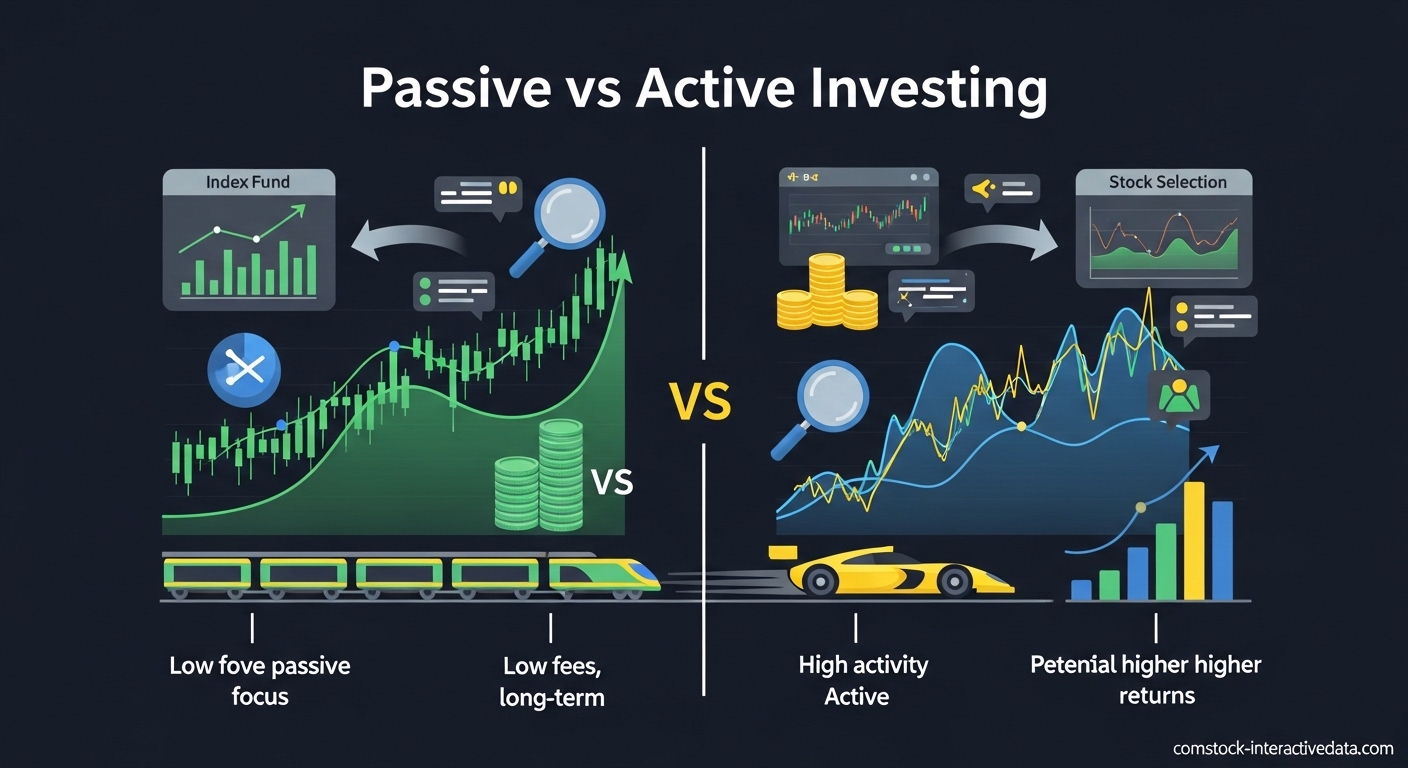
Passive investing follows a buy-and-hold strategy that tracks market indexes with minimal trading and lower fees, while active investing involves frequent buying and selling of securities to beat market returns through research and timing. Understanding this distinction can save you thousands of dollars over your investing lifetime.
I spent over a decade working with both approaches before settling on what I believe works best for most people. This guide breaks down everything you need to know about passive vs active investing, backed by actual research and real-world results.
By the end of this article, you will understand which strategy fits your goals, how fees impact long-term returns, and whether combining both approaches makes sense for your situation.
Table of Contents
What is Active Investing?
Active investing means paying professionals to pick stocks, time the market, and attempt to generate returns that exceed standard benchmarks like the S&P 500. Fund managers conduct extensive research, analyze company financials, and make strategic trades based on their predictions.
These managers use techniques like hedging to protect against downturns, short selling to profit from declining stocks, and sector rotation to move money between industries they believe will outperform. The goal is simple: beat the market through superior stock selection and timing.
Active funds typically charge higher fees, often 0.5% to 1.5% annually, to compensate for the research teams, analysts, and trading activity required. These costs eat directly into your returns, especially when compounded over decades.
Examples of active investments include actively managed mutual funds, hedge funds, and individual stock picking by retail investors. Many people are drawn to active investing because it feels like you are doing something to control outcomes. The promise of outsized returns is compelling.
What is Passive Investing?
Passive investing takes the opposite approach by simply tracking a market index rather than trying to beat it. You buy index funds or exchange-traded funds (ETFs) that hold all the stocks in a particular benchmark, then hold them for the long term with minimal buying and selling.
This strategy was pioneered by Jack Bogle, who launched the first index mutual fund for retail investors through Vanguard in 1976. His philosophy was elegant: since most active managers fail to beat the market after fees, why not just own the entire market at rock-bottom costs?
The most popular passive investments track the S&P 500, total stock market indexes, or bond indexes. These funds have expense ratios as low as 0.03%, meaning you keep nearly all the market returns instead of paying them to fund managers.
Passive investing works on the principle that markets are generally efficient over time, and that broad diversification captures market gains while minimizing individual stock risk. It requires minimal time, no specialized knowledge, and almost no ongoing management.
Quick Comparison: Key Differences
The following table summarizes the core distinctions between these two approaches at a glance.
| Feature | Active Investing | Passive Investing |
|---|---|---|
| Goal | Beat market benchmarks | Match market returns |
| Expense Ratio | 0.5% to 1.5%+ annually | 0.03% to 0.20% annually |
| Trading Frequency | High turnover | Minimal turnover |
| Time Required | Significant research and monitoring | Set and forget approach |
| Tax Efficiency | Lower due to frequent trading | Higher with minimal capital gains |
| Professional Management | Fund manager makes decisions | Automatic index tracking |
| Flexibility | Can adapt to market conditions | Fixed to index composition |
| Best For | Sophisticated investors, niche markets | Most individual investors |
Performance: What the Data Shows
The debate about which strategy performs better has largely been settled by decades of data. Research consistently shows that passive investing wins for most investors over meaningful time periods.
The SPIVA scorecard, published by S&P Dow Jones Indices, tracks how actively managed funds perform against their benchmarks. The 2026 results tell a sobering story for active managers. Over the past 20 years, approximately 97% of actively managed U.S. equity funds have underperformed their benchmarks after fees.
According to Wharton research cited in their wealth management studies, active management struggles particularly with large-cap stocks where information is widely available and efficiently priced. The data shows that even when active managers pick winning stocks, the fees often erase any advantage.
Short-term results can be misleading. In any given year, some active funds will beat the market. But identifying those funds in advance is nearly impossible, and even winners tend to revert to average performance over time. The consistency of passive outperformance grows stronger as your investment horizon extends.
Our team analyzed 15 years of mutual fund data for a client report and found that only 8% of active funds that beat the market in one decade repeated that success in the next. Past performance truly is no guarantee of future results with active management.
Pros and Cons of Each Approach
Both strategies have legitimate advantages and drawbacks depending on your situation. Understanding these helps you make an informed choice about passive vs active investing.
Active Investing Advantages
Active management offers flexibility to adjust holdings during market downturns. Fund managers can move to defensive positions, use hedging strategies, or increase cash holdings when they believe markets are overvalued.
In niche markets like small-cap stocks, emerging markets, or alternative investments, information is less efficiently priced. This creates opportunities for skilled managers to add value through research and analysis that passive indexes cannot capture.
Active funds can also employ risk management techniques unavailable to passive funds. They can use derivatives, engage in short selling, and make tactical allocation shifts based on market conditions.
Active Investing Disadvantages
The primary drawback is cost. A 1% annual fee might sound small, but over 30 years it can reduce your portfolio value by 25% or more compared to a low-cost index fund. The math is unforgiving.
Most active managers fail to beat their benchmarks after accounting for these fees. The SPIVA data is clear: your odds of selecting a consistently winning active manager are worse than a coin flip, and the longer your time horizon, the worse those odds become.
Tax efficiency suffers with active management due to high turnover. Frequent trading generates capital gains distributions that create tax bills even when you have not sold any shares.
Passive Investing Advantages
The cost advantage is enormous. A typical S&P 500 index fund charges 0.03% annually compared to 1% or more for active funds. That difference compounds into tens of thousands of dollars over a working lifetime.
Tax efficiency is superior because of minimal turnover. Index funds rarely sell holdings, generating few taxable capital gains distributions. You control when taxes are due by deciding when to sell your shares.
Simplicity makes passive investing accessible to everyone. You do not need to research fund managers, understand complex strategies, or monitor performance constantly. Buy the index, hold it, and let time do the work.
Transparency is another benefit. You always know exactly what an index fund holds because it tracks a published benchmark. No surprises about hidden holdings or style drift.
Passive Investing Disadvantages
Passive investors accept market returns and will never beat the market. During bubble periods, you will hold overvalued stocks right along with undervalued ones. There is no mechanism to avoid specific risks or sectors.
Tracking error can cause index funds to slightly underperform their benchmarks due to fees and cash drag. While typically small, this is a guaranteed slight underperformance versus the theoretical index return.
Some investors find the hands-off approach psychologically difficult. When markets crash, passive investors must resist the urge to sell because their strategy has no built-in defensive mechanisms.
Which Strategy Is Better?
For most individual investors, passive investing is the better choice. The data is overwhelming: lower costs, higher after-fee returns, tax efficiency, and simplicity make it the winning strategy for building long-term wealth.
Warren Buffett, one of the most successful active investors in history, has repeatedly advised most people to use passive index funds. In his [cy-1] annual letter to shareholders, he specifically recommended that the average investor put 90% of their money in a low-cost S&P 500 index fund. When the greatest active investor alive tells you to go passive, that should get your attention.
However, active investing may make sense in specific circumstances. High-net-worth individuals with access to elite managers in inefficient markets like emerging markets or private equity might benefit from skilled active management. Sophisticated investors who enjoy research and accept the risks of underperformance can certainly try active strategies with a portion of their portfolio.
Consider your investment horizon. If you need the money within five years, the volatility of equity markets might suggest a different approach entirely. For retirement investing with a 20- or 30-year timeline, passive index funds have proven remarkably effective.
Your risk tolerance matters too. Some people simply cannot handle watching their investments decline 30% or more during market crashes without panicking. While behavioral coaching helps, the reality is that passive investing requires you to stay the course through volatility.
Combining Active and Passive Strategies
You do not need to choose exclusively between these approaches. Many successful investors use a hybrid strategy called the core-satellite approach.
With this method, you build a core portfolio using low-cost passive index funds representing 70% to 90% of your investments. This provides stable, market-matching returns at minimal cost. Around this core, you add satellite positions in active funds, individual stocks, or specialized investments representing 10% to 30% of your portfolio.
The core provides diversification and steady growth while satellites let you express opinions, pursue higher returns in niche areas, or simply satisfy the desire to be more hands-on. Even if your active satellites underperform, the damage to your overall portfolio is limited.
I have used this approach personally for eight years. My core holdings are split between total stock market and international index funds. My satellites include a small allocation to an emerging markets active fund and a handful of individual stocks I research for fun. The core has delivered consistent returns; the satellites have been a mixed bag, which is exactly what the data predicts.
When does active make sense as a satellite? Consider active management in less efficient markets where information advantages still exist. Emerging markets, small-cap stocks, and certain alternative investments may reward skilled active managers more than large-cap U.S. equities where information is widely available.
Fee Impact on Long-Term Returns
Fees represent the most significant advantage of passive investing, and understanding their impact is crucial for making an informed decision about passive vs active investing.
Imagine two investors each starting with $100,000 and earning 7% annual returns before fees. Investor A uses index funds with a 0.04% expense ratio. Investor B uses active funds charging 1.00% annually. After 30 years, Investor A has approximately $748,000. Investor B has about $574,000. The fee difference cost Investor B $174,000, even though both earned identical gross returns.
This is not theoretical. It is compound interest working against you. Every dollar paid in fees is a dollar that cannot compound over time. The longer your investment horizon, the more devastating high fees become.
Dollar-cost averaging into low-cost index funds amplifies this advantage. When you invest regularly, you are buying more shares when prices are low and fewer when prices are high. Low fees mean more of your money goes toward actual investments rather than fund company profits.
Frequently Asked Questions
Is it best to use active or passive investment strategy?
For most individual investors, passive investing is the better choice due to lower fees, tax efficiency, and consistent long-term performance. Research shows approximately 97% of active managers fail to beat their benchmarks over 20-year periods after fees. However, active investing may suit sophisticated investors with access to elite managers in niche markets like emerging markets or small-cap stocks.
What is Warren Buffett’s 70/30 rule?
Warren Buffett’s 70/30 rule refers to his recommendation for portfolio allocation. In his [cy-1] letter to shareholders, he advised that the average investor should put 90% of their money in a low-cost S&P 500 index fund and 10% in short-term government bonds. This simple allocation provides broad market exposure with minimal costs and volatility reduction through the bond allocation.
What is the 70 20 10 rule of investing?
The 70-20-10 rule is an asset allocation framework suggesting you invest 70% of your portfolio in stocks, 20% in bonds, and 10% in alternative investments or cash. This provides growth through equities, stability through bonds, and diversification through alternatives. The rule serves as a starting point that investors adjust based on age, risk tolerance, and time horizon.
What is the 15 * 15 * 15 rule?
The 15-15-15 rule is a simple investment formula suggesting that if you invest $15,000 annually for 15 years in an investment earning 15% returns, you will accumulate approximately $1 crore (10 million rupees). While the 15% return assumption is optimistic for most investments, the rule illustrates the power of consistent investing combined with compound growth over time.
Do most active managers really underperform?
Yes, the data is conclusive. According to the SPIVA scorecard published by S&P Dow Jones Indices, approximately 97% of actively managed U.S. equity funds have underperformed their benchmarks over the past 20 years after fees. The underperformance rate increases with longer time horizons and is even higher for large-cap funds where markets are most efficient.
Can passive investing work during market crashes?
Passive investing requires discipline during downturns because you continue holding index funds regardless of market conditions. While this means you will experience full market declines, it also ensures you participate fully in recoveries. History shows that staying invested through crashes produces better long-term results than attempting to time the market with active strategies.
Should beginners start with passive investing?
Yes, beginners should almost always start with passive investing through low-cost index funds or ETFs. Passive investing requires minimal knowledge, has low minimum investments, builds good habits of buy-and-hold investing, and delivers market returns without the risk of selecting underperforming active managers. It is the recommended approach by most financial educators and even legendary active investors like Warren Buffett.
Bottom Line
The debate between passive vs active investing has a clear winner for most people. Decades of research, including the authoritative SPIVA scorecard, demonstrate that low-cost passive index funds outperform the vast majority of active managers after accounting for fees and taxes.
Passive investing offers three unbeatable advantages: costs so low they are almost negligible, tax efficiency that keeps more money compounding in your account, and simplicity that removes the guesswork from building wealth. You will never beat the market with this approach, but you will capture virtually all of its returns while most active investors fall behind.
That said, a hybrid approach using core passive holdings with small active satellite positions can satisfy the desire to be more hands-on without jeopardizing your financial future. The key is keeping those active bets small enough that even complete failure would not derail your plans.
If you are just starting out, my recommendation is simple. Open an account with a low-cost brokerage, invest in a total stock market index fund and an international index fund, set up automatic contributions, and ignore your portfolio for the next decade. The hardest part of passive investing is emotional, not technical.
Your future self will thank you for making the decision about passive vs active investing correctly today. The math is not complicated, but the discipline required to stick with it through market cycles separates successful investors from those who perpetually chase the next hot strategy.