
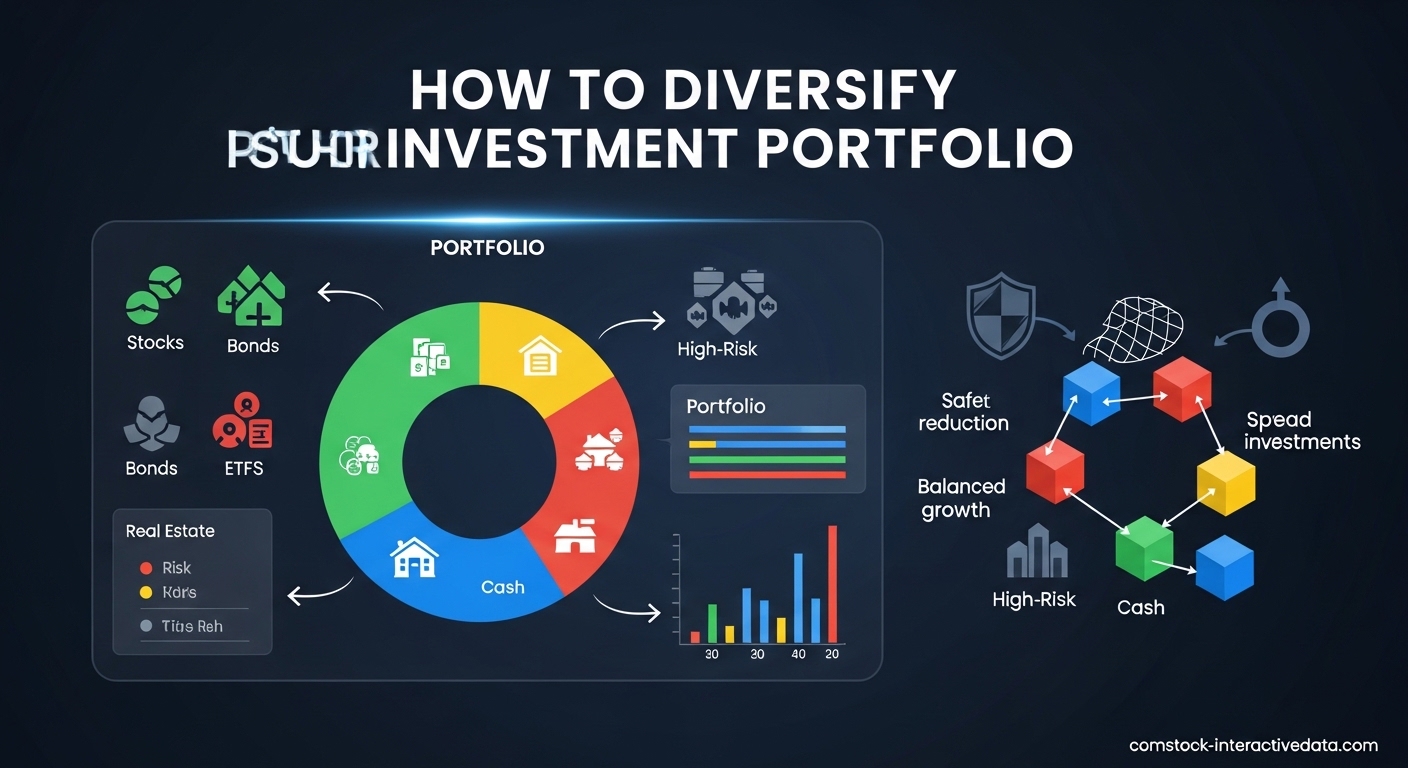
Building wealth through investing requires more than picking winning stocks. The most successful investors understand that protecting your capital matters just as much as growing it. That is why learning how to diversify your investment portfolio stands as one of the most critical skills you can develop.
I have spent years studying different investment approaches, and one truth remains constant: a well-diversified portfolio helps you weather market storms while capturing growth opportunities. This guide will walk you through exactly what diversification means, why it works, and how to build a portfolio that matches your goals and risk tolerance.
Whether you are just starting with your first $500 or managing a six-figure portfolio, the principles outlined here will help you make smarter investment decisions. By the end of this guide, you will have a clear action plan for creating a portfolio that spreads risk intelligently across different investments.
Table of Contents
What Is Portfolio Diversification?
Portfolio diversification is the practice of spreading your investments across different asset types, sectors, and geographies to reduce risk. Rather than putting all your money into one stock or asset class, you distribute it across multiple investments that respond differently to market conditions.
Think of diversification like a street vendor who sells both umbrellas and sunglasses. On rainy days, umbrella sales soar while sunglasses lag. On sunny days, the opposite happens. By selling both products, the vendor ensures steady income regardless of the weather. Your investment portfolio works the same way. When one asset class struggles, another typically performs better, smoothing your overall returns.
The goal is not to eliminate risk entirely, but to manage it intelligently. Different investments carry different types of risk, and those risks often move in opposite directions. By combining assets with low correlation (investments that do not move in lockstep), you reduce the chance that a single event wipes out significant portions of your wealth.
Why You Need to Diversify Your Investment Portfolio?
Diversification protects you from the single biggest threat to long-term wealth: concentration risk. When you concentrate your investments in one company, sector, or asset class, you amplify both potential gains and potential losses. History shows us repeatedly what happens when investors ignore this principle.
During the 2008-2009 financial crisis, investors heavily concentrated in financial stocks saw their portfolios decimated. Meanwhile, those with diversified holdings including bonds, international stocks, and alternative assets experienced smaller drawdowns and faster recoveries. A diversified 60/40 stock-to-bond portfolio lost roughly half as much as an all-stock portfolio during that crisis period.
Beyond crash protection, diversification delivers more consistent returns over time. While a concentrated portfolio might post spectacular gains in bull markets, it typically suffers devastating losses in downturns. Over full market cycles, diversified portfolios often outperform because they avoid the massive setbacks that destroy compounded returns. A 50% loss requires a 100% gain just to break even, making capital preservation crucial for long-term success.
Additionally, diversification reduces emotional decision-making. When your entire portfolio swings wildly with every market move, you are more likely to panic sell at the worst possible times. A diversified portfolio experiences smaller fluctuations, helping you stick with your long-term strategy through market turbulence.
How to Build a Diversified Portfolio: Step-by-Step Guide
Now that you understand the why, let us walk through the exact steps to build your own diversified portfolio. Our team has refined this process while helping hundreds of investors create sensible allocation strategies.
Step 1: Define Your Investment Goals and Time Horizon
Start by clarifying what you are investing for and when you need the money. Retirement in 30 years calls for a very different approach than a home purchase in five years. Write down your specific goals, dollar amounts needed, and target dates. Your time horizon and goal flexibility determine how much risk you can reasonably take.
Step 2: Assess Your Risk Tolerance Honestly
Be brutally honest about how much volatility you can stomach. Ask yourself: if my portfolio dropped 30% next month, would I sell everything or buy more? Your risk tolerance combines your financial ability to absorb losses (time horizon and income stability) with your psychological comfort with volatility. Many investors overestimate their risk tolerance until they experience their first major loss.
Step 3: Choose Your Target Asset Allocation
Based on your goals and risk tolerance, select a stock-to-bond ratio that fits your profile. Young investors with stable incomes might choose 80-90% stocks, while those nearing retirement might select 40-50% stocks. This allocation becomes your North Star for building the rest of your portfolio.
Step 4: Select Specific Investments
Choose low-cost index funds or ETFs that give you broad exposure to each asset class. For US stocks, consider a total market fund like VTI. For international exposure, look at VXUS. For bonds, BND provides broad fixed-income coverage. These three funds alone give you exposure to over 10,000 securities worldwide.
Step 5: Implement Across Your Accounts
Fill your tax-advantaged accounts (401k, IRA, Roth IRA) first before taxable brokerage accounts. Place tax-inefficient investments like bonds in tax-sheltered accounts when possible. Consider your entire portfolio across all accounts as one unified allocation rather than treating each account separately.
Step 6: Set Up Your Rebalancing Schedule
Decide in advance when and how you will rebalance back to your target allocation. Whether you choose annual rebalancing or threshold-based triggers (rebalancing when any asset class drifts 5% from target), having a predetermined plan prevents emotional decisions during market volatility.
Understanding Asset Allocation Strategies
Asset allocation, the division of your portfolio between different asset classes, drives more than 90% of portfolio performance variability according to research. Getting this decision right matters far more than picking individual stocks or timing the market.
The Classic 60/40 Portfolio
The 60/40 allocation, holding 60% stocks and 40% bonds, has served as the gold standard for moderate investors for decades. This balance provides significant growth potential through equities while offering stability and income through fixed income. During the volatile 2026 market environment, this allocation has continued delivering steady returns with manageable drawdowns.
The 60/40 portfolio works because stocks and bonds typically have low correlation. When economic growth disappoints, bonds often rally as interest rates fall. When inflation concerns rise, stocks may struggle while bonds face headwinds. This push-and-pull creates smoother portfolio performance than either asset class alone.
Age-Based Allocation Formula
A simple rule of thumb suggests subtracting your age from 110 to determine your stock allocation. A 30-year-old would hold 80% stocks (110 – 30 = 80), while a 60-year-old would hold 50% stocks. This automatically reduces risk as you approach retirement when you have less time to recover from market setbacks.
However, personal circumstances matter more than formulas. If you have a stable pension or significant other assets, you might maintain higher stock allocations longer. Conversely, if you need portfolio withdrawals in the near future, a more conservative stance makes sense regardless of age.
Conservative, Moderate, and Aggressive Profiles
Conservative investors prioritize capital preservation over growth, typically allocating 30-40% to stocks and 60-70% to bonds and cash. This suits retirees drawing income from their portfolios or anyone with a low risk tolerance.
Moderate investors balance growth and stability with 50-70% stock allocations. This profile fits most working adults building retirement wealth with 10-20 year time horizons.
Aggressive investors maximize growth potential with 80-100% stock allocations, accepting higher volatility for better long-term return prospects. This approach suits young investors with decades until retirement and stable income sources.
Diversifying Across Asset Classes
True diversification requires exposure across multiple asset classes, each serving different roles in your portfolio. Let us examine the major categories and how they fit together.
Stock Market Diversification
Stocks provide long-term growth but come with higher volatility. Within your stock allocation, spread holdings across:
Size categories: Large-cap stocks offer stability and dividends, mid-cap stocks balance growth and stability, and small-cap stocks provide higher growth potential with added volatility. A typical breakdown might allocate 60-70% to large-cap, 20-30% to mid-cap, and 10% to small-cap.
Investment styles: Growth stocks focus on companies expanding rapidly, while value stocks target undervalued companies trading below their intrinsic worth. Including both styles ensures you capture returns regardless of which market environment dominates.
Sectors: Spread exposure across technology, healthcare, financial services, consumer goods, industrials, and utilities. No single sector should dominate your portfolio since different industries lead at different economic cycle stages.
Bond Diversification
Bonds provide income, stability, and diversification from stocks. Within your bond allocation, consider:
Duration: Short-term bonds (1-5 years) offer less interest rate risk but lower yields. Long-term bonds (10+ years) provide higher yields but greater price sensitivity to rate changes. Intermediate bonds balance these tradeoffs.
Credit quality: Government bonds carry virtually no default risk but offer lower yields. Investment-grade corporate bonds add slightly higher yields with minimal credit risk. High-yield bonds offer even higher yields but with meaningful default risk.
Geography: US Treasury bonds provide safety during crises. International bonds add currency diversification and exposure to different interest rate environments.
Alternative Investments
Alternative assets can further diversify beyond traditional stocks and bonds:
Real Estate Investment Trusts (REITs) provide exposure to commercial real estate without direct property ownership. They often move differently from stocks and offer inflation protection through rent increases.
Commodities like gold and oil provide inflation hedges and crisis protection. Gold particularly tends to rise when confidence in traditional assets falls.
Cryptocurrency represents a highly speculative alternative asset with extreme volatility. Limit exposure to 1-5% of your portfolio if you choose to include it at all.
Geographic and Sector Diversification
Global diversification protects you from country-specific risks while opening opportunities in faster-growing economies. A portfolio concentrated entirely in US stocks misses half the world’s investment opportunities.
Geographic Diversification: US and International
A globally diversified portfolio typically allocates 50-70% to US stocks and 30-50% to international markets. Within international, split between developed markets (Europe, Japan, Australia) and emerging markets (China, India, Brazil, and other growing economies).
US investors often exhibit home-country bias, dramatically overweighting domestic stocks. However, international markets frequently outperform US markets for extended periods. The 2000s decade saw international stocks crush US returns, while the 2010s favored American markets. No one can consistently predict which region will lead, making global diversification essential.
Simple implementation: hold a total US stock market fund like VTI alongside a total international fund like VXUS. These two funds give you exposure to companies across 40+ countries.
Diversification by Market Capitalization
Market capitalization (company size) significantly impacts risk and return characteristics. Large-cap companies worth over $10 billion offer stability but slower growth. Small-cap companies under $2 billion provide higher growth potential with greater volatility.
Research suggests small-cap stocks have historically delivered higher returns than large-caps over long periods, though with much bumpier rides. Including exposure across the size spectrum captures these premium returns while reducing concentration in any single company tier.
Sector Diversification
Economic sectors perform differently depending on interest rates, economic growth, and consumer behavior. Technology thrives during growth periods with low rates. Utilities and consumer staples hold up better during recessions. Financials benefit from rising rates. Energy responds to commodity prices.
Spreading investments across all major sectors ensures your portfolio does not crater when one industry faces headwinds. Target-date funds and total market index funds automatically provide this diversification.
The Role of ETFs and Mutual Funds in Diversification
For most investors, individual stock picking represents an expensive distraction. Exchange-traded funds (ETFs) and mutual funds provide instant diversification with minimal effort and cost.
The Three-Fund Portfolio Approach
The Bogleheads community, following Vanguard founder John Bogle’s philosophy, popularized a beautifully simple three-fund portfolio:
US Total Stock Market (VTI or VTSAX): Covers the entire US stock market from large to small companies across all sectors. This single fund holds over 4,000 stocks.
Total International Stock Market (VXUS or VTIAX): Provides exposure to developed and emerging international markets across thousands of companies worldwide.
Total Bond Market (BND or VBTLX): Offers broad exposure to US government and investment-grade corporate bonds across maturities.
With just these three holdings, you achieve exposure to tens of thousands of securities worldwide. Adjust the percentages between them based on your risk tolerance and goals.
Target-Date Funds for Hands-Off Investors
If managing even three funds feels overwhelming, target-date funds offer complete diversification in a single investment. These funds automatically adjust their stock-to-bond ratio as you approach the target retirement date, becoming more conservative over time.
A 2055 target-date fund might hold 90% stocks today, gradually shifting to 50% stocks by 2055 and 30% stocks a decade later. The fund handles rebalancing, asset allocation adjustments, and diversification across asset classes automatically.
Cost Considerations
Expense ratios, the annual fees charged by funds, directly reduce your returns. A fund charging 1% annually costs you $1,000 per year on a $100,000 investment. Over decades, high fees compound into massive wealth destruction.
Index funds from Vanguard, Fidelity, and Schwab typically charge 0.03-0.20% annually, while actively managed funds often charge 0.50-1.50%. Stick with low-cost index funds for the core of your portfolio.
How to Rebalance Your Portfolio?
Building a diversified portfolio is not a one-time task. Markets move, and your carefully planned allocation drifts over time. Rebalancing restores your target weights and maintains appropriate risk levels.
When Should You Rebalance
Two main approaches determine when to rebalance:
Calendar-based rebalancing: Review and adjust your portfolio annually, semi-annually, or quarterly. Annual rebalancing strikes a good balance between maintaining target allocations and minimizing transaction costs.
Threshold-based rebalancing: Rebalance whenever any asset class drifts 5-10 percentage points from its target. If your stock allocation rises from 60% to 70% during a bull market, you sell stocks and buy bonds to restore balance.
Research suggests threshold-based rebalancing may slightly improve returns by forcing you to sell high and buy low, though the difference is modest compared to calendar rebalancing.
Rebalancing Methods
Sell overperforming assets and buy underperforming ones to restore balance. During a stock market boom, sell some stock funds and purchase bond funds with the proceeds. During a bond rally, do the opposite.
Direct new contributions to underweight asset classes. If stocks have risen above target, direct new 401k contributions entirely to bonds until balance is restored. This method avoids realizing capital gains in taxable accounts.
Tax-Efficient Rebalancing Strategies
Rebalancing in tax-advantaged accounts (401k, IRA) triggers no tax consequences, making them ideal for frequent adjustments. In taxable accounts, consider these strategies:
Rebalance using new money and dividends rather than selling existing positions. Harvest tax losses during market downturns to offset gains from rebalancing. Use appreciated stock donations to charity instead of cash, avoiding capital gains taxes.
Some investors maintain separate allocations for tax-advantaged and taxable accounts, placing tax-inefficient bonds in sheltered accounts while holding stocks in taxable accounts. This asset location strategy adds complexity but can improve after-tax returns.
Common Diversification Mistakes to Avoid
Even well-intentioned investors often sabotage their diversification efforts through common errors. Learn from these mistakes to build a more resilient portfolio.
Over-Diversification: The Di-Worse-ification Trap
While diversification reduces risk, you can have too much of a good thing. Holding 50 different funds does not provide more protection than holding 5-10 carefully selected ones. It simply adds complexity, higher costs, and likely overlaps between holdings.
Research suggests 8-12 positions across different asset classes typically capture 90% of diversification benefits. Beyond 20 holdings, additional positions provide minimal risk reduction while increasing monitoring burden and expense ratios.
I have seen investors create portfolios with 30+ individual stocks and funds, mistakenly believing more equals better. In reality, they often own multiple funds holding the same underlying companies, paying multiple layers of fees for the same exposure.
Ignoring Correlation Between Holdings
Diversification only works when your holdings do not move in lockstep. Owning five different large-cap US growth funds provides little real diversification if they all hold similar companies. Similarly, holding both an S&P 500 index fund and a total stock market fund adds complexity without meaningful risk reduction since they share 80%+ overlap.
True diversification requires holdings with low correlation. When stocks crash, bonds often rise or hold steady. When US markets struggle, international markets sometimes thrive. Check the correlation between your holdings to ensure you are actually spreading risk.
Chasing Performance and Timing the Market
Many investors destroy diversification by constantly shifting money to whatever performed best recently. Last year’s winners often become next year’s losers. A disciplined rebalancing strategy forces you to sell high and buy low, but it requires emotional discipline many investors lack.
Market timing attempts usually backfire. Investors who sold stocks during the March 2020 crash missed the subsequent 70%+ rally. Those who piled into tech stocks in 2021 suffered brutal drawdowns in 2022. Stick with your target allocation through market cycles rather than making emotional shifts.
Diversification Strategies by Life Stage
Your optimal diversification strategy evolves as you move through different life stages. What makes sense at 25 differs dramatically from appropriate strategies at 55.
Your 20s and 30s: Aggressive Growth Phase
With decades until retirement, you can afford significant volatility for higher long-term returns. A 90-100% stock allocation makes sense, heavily weighted toward growth-oriented investments. You have time to recover from market crashes and should prioritize building wealth over protecting it.
Emphasize small-cap and international stocks, which offer higher return potential with greater volatility. You can ride out their bumps while your portfolio is relatively small.
Your 40s and 50s: Balanced Accumulation
As retirement approaches within 15-20 years, gradually reduce risk. Shift toward a 60-80% stock allocation, adding more bonds for stability. Your portfolio has grown larger, making volatility more painful, but you still need growth to reach retirement goals.
This stage requires careful monitoring of your progress toward retirement savings targets. If you are behind, you might maintain more aggressive allocations. If ahead, consider locking in gains with a more conservative stance.
Nearing Retirement: Capital Preservation
Within 5-10 years of retirement, prioritize protecting what you have built. A 40-60% stock allocation balances growth needs with downside protection. Sequence-of-returns risk, the danger of major losses right before withdrawals begin, becomes your primary concern.
Build a bond ladder or cash reserve covering 2-3 years of expenses to avoid selling stocks during market downturns early in retirement.
In Retirement: Income Generation
During retirement, your portfolio shifts from accumulation to distribution. A 30-50% stock allocation provides growth to outpace inflation while bonds and cash generate income for withdrawals. The exact allocation depends on withdrawal rate, other income sources, and legacy goals.
Consider annuities or dividend-focused strategies to generate reliable income streams alongside your diversified portfolio withdrawals.
FAQs
What is the best way to diversify my investment portfolio?
The best way is to start with a three-fund portfolio using low-cost index funds: a total US stock market fund like VTI, a total international stock fund like VXUS, and a total bond market fund like BND. This gives you exposure to thousands of securities across asset classes and geographies with just three holdings. Rebalance annually to maintain your target allocation.
What is Warren Buffett’s 70/30 rule?
Warren Buffett’s 70/30 rule suggests maintaining a portfolio allocation of approximately 70% stocks and 30% bonds. This provides growth potential from equities while offering stability and income through fixed-income investments. Buffett has recommended this allocation as a simple, effective strategy for most investors, particularly those seeking a balance between growth and capital preservation.
What is the 70 20 10 rule for investing?
The 70/20/10 rule divides investments into three buckets: 70% in stable, long-term holdings like blue-chip stocks and bonds, 20% in growth-oriented investments such as mid-cap stocks or emerging markets, and 10% in speculative or higher-risk opportunities. This creates a balanced approach with most capital preserved in safer assets while allowing for growth and exploration with smaller portions.
What are the 4 funds Dave Ramsey recommends?
Dave Ramsey recommends a four-fund portfolio: 25% in growth stock mutual funds, 25% in growth and income funds, 25% in aggressive growth funds, and 25% in international funds. He suggests avoiding bonds in favor of 100% stock allocation for investors with longer time horizons and higher risk tolerance, though many financial advisors recommend including some bond exposure for stability.
How many funds should I hold to be properly diversified?
Most investors achieve adequate diversification with 3-8 funds. Research shows that holding 8-12 positions across different asset classes typically provides true diversification benefits. Beyond 15-20 funds, you risk di-worse-ification where additional holdings add complexity without meaningful risk reduction. A simple three-fund portfolio with total market index funds often outperforms more complex setups.
Conclusion
Learning how to diversify your investment portfolio is one of the most important steps you can take toward building lasting wealth. The principles outlined in this guide provide a roadmap for creating a portfolio that balances growth potential with risk management.
Remember that successful investing is not about finding the next hot stock or timing market peaks and valleys. It is about building a sensible, diversified portfolio aligned with your goals and risk tolerance, then sticking with it through market cycles. The three-fund portfolio using low-cost index funds gives most investors everything they need for diversification without unnecessary complexity.
Start today by assessing your current holdings. Are you truly diversified across asset classes, geographies, and sectors? Or have you inadvertently concentrated risk in a few popular investments? Use the step-by-step guide in this article to build or refine your portfolio for 2026. Your future self will thank you for the time you invested in getting diversification right.