
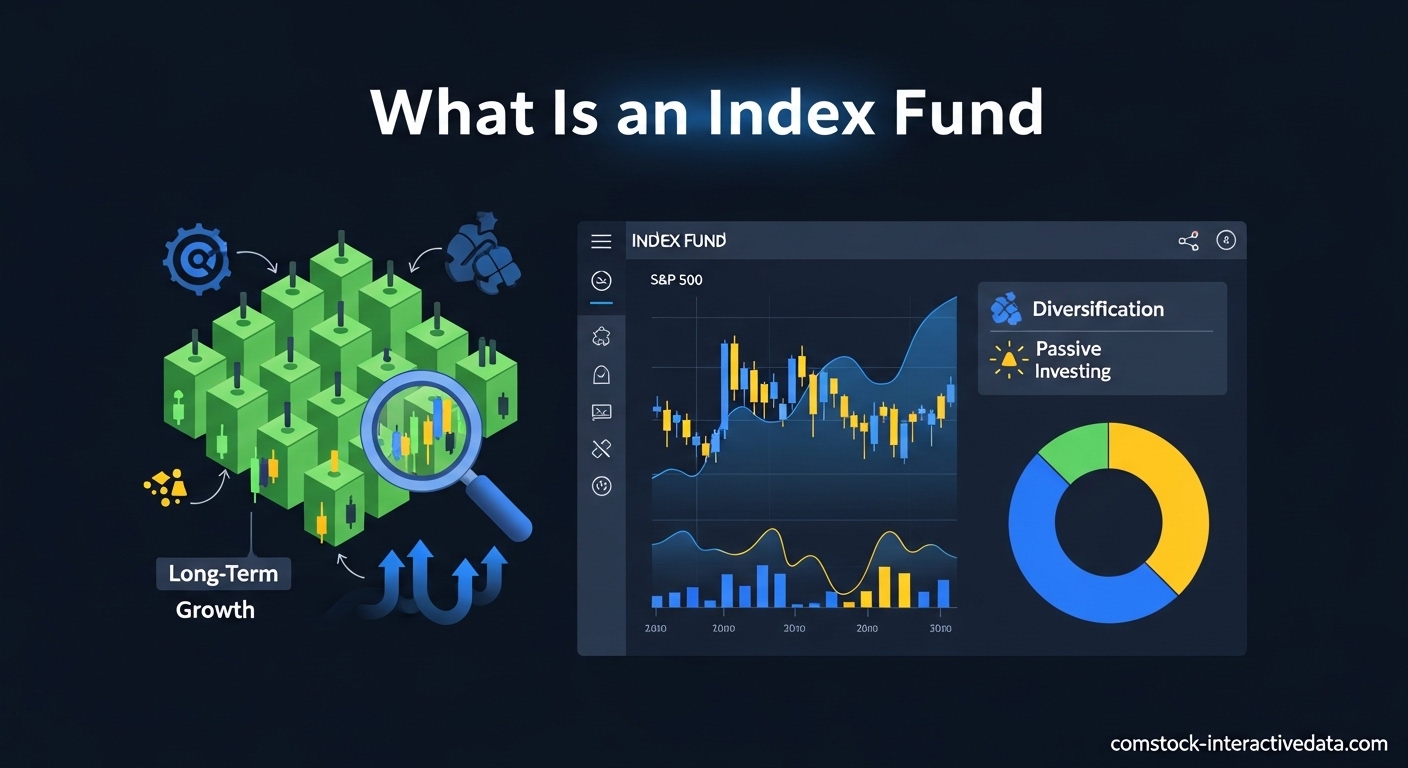
Learning what is an index fund could be the single most important step you take toward building wealth. When I started investing 15 years ago, index funds completely changed how I thought about money, the stock market, and growing my retirement savings.
An index fund is a type of investment that tracks the performance of a specific collection of stocks or bonds. Instead of trying to pick individual winners, you own a small piece of hundreds or thousands of companies at once. This simple approach has helped millions of ordinary people become successful investors without needing Wall Street expertise.
In this guide, I’ll explain exactly how index funds work, why they’ve become the go-to choice for smart investors, and how you can start using them to grow your own money. By the end, you’ll understand why everyone from beginners to billionaires relies on this straightforward investing strategy.
Table of Contents
What Is an Index Fund?
An index fund is a pooled investment vehicle designed to replicate the performance of a specific market index. Think of it like buying a sampler platter at a restaurant – instead of choosing just one dish, you get small portions of many different items.
When you invest in an index fund, your money is combined with money from thousands of other investors. The fund then uses that pool of cash to buy all (or a representative sample) of the stocks or bonds in a particular index. You don’t own the individual stocks directly – you own shares of the fund itself.
The most popular index funds track the S&P 500, which represents 500 of the largest companies in the United States. When you buy an S&P 500 index fund, you instantly own a tiny slice of companies like Apple, Microsoft, Amazon, and hundreds of others. If the overall market goes up, your investment grows. If it drops, your investment follows.
The Key Difference: Passive vs Active Management
Traditional mutual funds use active management, meaning a professional fund manager picks stocks they think will outperform the market. These managers research companies, analyze trends, and try to beat the benchmark through superior stock selection.
Index funds use passive management. Nobody is picking winners or timing the market. The fund simply buys and holds all the stocks in the index, adjusting only when the index itself changes. This hands-off approach dramatically reduces costs while typically delivering better long-term results than most actively managed alternatives.
Index Funds Come in Two Main Flavors
You can invest in index funds through either mutual funds or exchange-traded funds (ETFs). An index mutual fund is priced once per day after markets close. You buy directly from the fund company at that day’s net asset value.
An index ETF trades throughout the day on stock exchanges just like individual stocks. You can buy or sell anytime during market hours, and prices fluctuate based on supply and demand. Both structures track the same underlying indexes – the difference is mainly in how you buy and sell them.
How Does an Index Fund Work?
Understanding how an index fund works helps you appreciate why this approach is so powerful. The mechanics are surprisingly simple once you break them down into steps.
First, the fund manager identifies which index to track. This could be the S&P 500, the total U.S. stock market, international markets, bonds, or any other collection of securities. The fund then purchases shares of every company in that index, weighted according to each company’s market capitalization.
Market-cap weighting means larger companies make up a bigger portion of the fund. If Apple represents 7% of the S&P 500 by value, an S&P 500 index fund will allocate roughly 7% of its portfolio to Apple stock. This automatic weighting ensures your investment always reflects the actual composition of the market.
The Rebalancing Process
Indexes change periodically. Companies get added or removed, stock prices fluctuate, and market capitalizations shift. Index funds handle these changes through a process called rebalancing.
When a company leaves an index, the fund sells that stock. When a new company joins, the fund buys it. When stock prices change, the fund adjusts holdings to maintain proper weightings. This happens automatically without human judgment calls about whether a stock is “good” or “bad.”
Most major index funds rebalance quarterly or when significant index changes occur. The turnover rate – how often stocks are bought and sold – typically stays under 5% annually for broad market index funds. Low turnover means lower transaction costs and fewer taxable events.
Dividends and Income Distribution
Many stocks in an index pay dividends. When companies distribute profits to shareholders, the index fund collects all those payments. The fund then passes them along to you, the investor.
You typically have two choices for handling dividends. You can receive them as cash payments deposited to your account. Or you can reinvest them automatically to buy more fund shares. Reinvesting dividends supercharges long-term growth through the magic of compound returns.
At the end of each trading day, the fund calculates its net asset value (NAV). This represents the total value of all holdings divided by the number of shares outstanding. NAV is what mutual fund investors pay or receive when buying or selling shares.
Tracking Error: When Funds Deviate Slightly
No index fund perfectly matches its benchmark 100% of the time. Small differences emerge due to fees, cash holdings, timing of transactions, and sampling techniques (for funds that hold a representative sample rather than every stock).
The difference between fund performance and index performance is called tracking error. A well-run index fund typically shows tracking error of less than 0.1% annually. Higher tracking error suggests management issues worth investigating before you invest.
Types of Index Funds
The index fund universe has expanded dramatically since the first one launched in 1976. Today you can find an index fund tracking almost any segment of the market you want exposure to.
Stock Index Funds
Broad stock market index funds represent the most popular category. These track major market benchmarks and give you exposure to hundreds or thousands of companies simultaneously.
Total market index funds aim to represent the entire U.S. stock market – large companies, mid-sized companies, and small companies all in one fund. The Vanguard Total Stock Market Index Fund and Fidelity ZERO Total Market Index Fund are popular examples that hold over 3,000 stocks each.
S&P 500 index funds focus specifically on the 500 largest U.S. companies. While not the total market, these 500 companies represent about 80% of the total U.S. stock market value. Many investors use S&P 500 funds as their core stock holding.
International Index Funds
You can also invest in companies outside the United States through international index funds. Developed market funds track companies in Europe, Japan, Australia, and other established economies. Emerging market funds focus on faster-growing economies like China, India, and Brazil.
Global index funds combine U.S. and international stocks in predetermined ratios. A common allocation is 60% U.S. stocks and 40% international stocks, though you can find funds with different splits based on your preferences.
Bond Index Funds
Stock index funds aren’t the only option. Bond index funds track collections of fixed-income securities. These provide stability and income to balance the volatility of stocks in your portfolio.
Total bond market index funds hold a mix of government bonds, corporate bonds, and mortgage-backed securities. Treasury index funds focus specifically on U.S. government debt. Corporate bond index funds invest in debt issued by companies. Each offers different risk and return characteristics.
Specialized and Sector Index Funds
Beyond broad market funds, you can find index funds targeting specific industries or investment styles. Technology index funds track the tech sector. Healthcare index funds focus on medical companies. Real estate index funds invest in REITs that own commercial properties.
There are also factor-based index funds that target specific characteristics like value stocks (companies trading at low prices relative to earnings), growth stocks (fast-growing companies), or dividend-paying stocks. These let you tilt your portfolio toward specific investment styles while maintaining the low-cost index approach.
Benefits of Investing in Index Funds
Index funds have grown from a niche product to the dominant investment vehicle for good reason. The benefits are substantial and well-documented through decades of research and real-world performance.
Dramatically Lower Costs
The most immediate benefit is cost. Active mutual funds typically charge annual expense ratios between 0.5% and 1.5%. Index funds routinely charge under 0.1%, with some as low as 0.015%.
Here’s what that means in real dollars. On a $100,000 investment over 30 years, a 1% annual fee costs you roughly $165,000 in lost growth compared to a 0.1% fee. That difference could fund years of retirement. Fidelity’s ZERO funds actually charge 0% expense ratios on certain index products.
Instant Diversification
Building a diversified portfolio of individual stocks requires buying hundreds of companies and tens or hundreds of thousands of dollars. An index fund gives you that same diversification for the price of a single share.
When you buy a total market index fund, you own a piece of essentially every publicly traded U.S. company. If one company fails – even a giant like Enron or Lehman Brothers – the impact on your portfolio is minimal because your money is spread across thousands of other holdings.
Consistent Market-Matching Performance
Index funds don’t try to beat the market – they aim to match it. While that sounds uninspiring, decades of data show that most active managers fail to outperform their benchmarks after accounting for fees.
The SPIVA (S&P Indices Versus Active) scorecard tracks this comparison. Over the past 15 years, more than 90% of large-cap active fund managers underperformed the S&P 500. After fees, the average active fund trails its benchmark by roughly 1% annually. Index funds capture nearly 100% of the market’s return, minus tiny tracking errors.
Tax Efficiency
Index funds generate fewer taxable events than active funds. Because they rarely sell holdings (only when the index changes), capital gains distributions are minimal. You’re primarily taxed only when you sell your fund shares, giving you control over timing.
Active funds with high turnover can generate significant capital gains each year, even if the fund’s overall value declined. You’re forced to pay taxes on gains you never actually received as cash. Index funds largely avoid this problem.
Simplicity and Time Savings
You don’t need to research individual companies, analyze financial statements, or worry about timing the market. Once you select your funds, the strategy runs itself. This simplicity leads to better long-term behavior because you’re less tempted to make emotional trading decisions during market volatility.
Our team has seen countless investors sabotage their returns by overtrading, chasing hot stocks, or panic-selling during downturns. Index investing removes many of these behavioral traps.
Potential Drawbacks and Risks
Index funds aren’t perfect, and honest discussion requires addressing their limitations. Understanding these drawbacks helps you make informed decisions and set realistic expectations.
No Downside Protection
Index funds provide no shelter during market crashes. When the S&P 500 drops 20%, your S&P 500 index fund drops 20% right alongside it. There’s no manager making defensive moves or shifting to cash to protect your capital.
This full market exposure works against you during bear markets. From peak to trough in the 2008 financial crisis, the S&P 500 fell 57%. Index fund investors experienced that entire decline. Active managers at least have the theoretical ability to reduce exposure before major drops.
You’ll Never Beat the Market
By design, index funds deliver average market returns minus small fees. You’ll never outperform the benchmark you track. If the market returns 8% annually over the next decade, your index fund will return roughly 7.9% after fees.
Some investors find this limitation psychologically difficult. They want the possibility of finding the next Apple or Amazon before it skyrockets. Index funds eliminate that possibility entirely in exchange for consistency and reliability.
Limited Customization
Index funds offer zero flexibility. You can’t exclude companies you dislike for ethical reasons. You can’t overweight sectors you believe will outperform. You can’t adjust holdings based on changing market conditions.
If you have strong convictions about avoiding tobacco companies, oil producers, or weapons manufacturers, pure index funds don’t accommodate those preferences. You’d need to supplement with specialized ESG (environmental, social, governance) funds or individual stock selections.
Index Funds vs Actively Managed Funds
The debate between index and active management has raged for decades, but the data increasingly favors the passive approach. Understanding the differences helps you choose the right strategy for your goals.
| Factor | Index Funds | Actively Managed Funds |
|---|---|---|
| Management Style | Passive – tracks an index | Active – manager picks stocks |
| Average Expense Ratio | 0.03% – 0.20% | 0.50% – 1.50% |
| Turnover Rate | Under 5% annually | 50% – 100%+ annually |
| Performance Goal | Match the market | Beat the market |
| Long-term Success Rate | Captures full market return | 90%+ underperform benchmarks |
| Tax Efficiency | Highly tax-efficient | Generates more taxable events |
| Transparency | Holdings published daily | Holdings reported quarterly |
The SPIVA scorecard provides the most comprehensive comparison of active versus passive performance. Over rolling 15-year periods, between 85% and 95% of active managers in most categories fail to beat their benchmarks after fees. The longer the time horizon, the worse active performance becomes.
Does this mean active management is worthless? Not entirely. Some niche categories like high-yield bonds, emerging market debt, or specialized international equities show better active success rates. And certain investors value the potential for downside protection during crashes, even if it means higher costs and lower average returns.
Index Funds vs ETFs: What’s the Difference?
Many beginners confuse index funds with ETFs, or use the terms interchangeably. While related, these are distinct concepts that you should understand before investing.
An index fund is an investment strategy that tracks a market index. An ETF is a specific structure for packaging investments. Many ETFs are index funds, but not all index funds are ETFs, and not all ETFs track indexes.
| Feature | Index Mutual Funds | Index ETFs |
|---|---|---|
| Trading | Once daily after market close | Throughout market hours like stocks |
| Pricing | Net asset value (NAV) at close | Market price (may differ from NAV) |
| Minimum Investment | Often $1,000 – $3,000 | Price of one share (under $500) |
| Automation | Easy automatic investing | Requires manual orders |
| Expense Ratios | Slightly higher on average | Often slightly lower |
| Dividend Reinvestment | Automatic and seamless | May require manual setup |
| Tax Efficiency | Good | Slightly better (creation/redemption process) |
From a practical standpoint, both mutual fund and ETF versions of the same index perform nearly identically over time. The choice usually comes down to convenience. If you want to set up automatic monthly investments, mutual funds work better. If you prefer trading flexibility and lower minimums, ETFs might suit you.
Many investors use a mix – mutual funds for their core holdings with automatic investing, and ETFs for more tactical positions or specific market segments.
How to Start Investing in Index Funds?
Getting started with index fund investing is simpler than most people expect. Follow these steps to build your portfolio with confidence.
Step 1: Choose Your Account Type
First, decide where your investments will live. A 401(k) through your employer offers tax advantages and often includes quality index fund options. An IRA (Traditional or Roth) provides additional tax benefits with more investment choices. A taxable brokerage account offers maximum flexibility but no special tax treatment.
Most beginners should max out employer 401(k) matches first (that’s free money), then consider an IRA, and only then use taxable accounts. The tax advantages compound significantly over decades.
Step 2: Open a Brokerage Account
If you don’t have access to index funds through work, open an account with a low-cost brokerage. Vanguard, Fidelity, Schwab, and E*Trade all offer excellent index fund lineups with zero commissions on ETF trades.
Look for brokers with broad index fund selections, low or no minimum investments, automatic investing options, and good customer service. The differences between major brokers are smaller than marketing suggests – any established low-cost provider works well for beginners.
Step 3: Select Your Index Funds
For most beginners, a simple three-fund portfolio covers all bases: a total U.S. stock market index fund, a total international stock index fund, and a total bond market index fund. This combination gives you global stock diversification plus stability from bonds.
A common starting allocation for younger investors is 60% U.S. stocks, 20% international stocks, and 20% bonds. As you age, gradually shift more toward bonds for stability. Target-date index funds handle this rebalancing automatically based on your planned retirement year.
Step 4: Set Up Automatic Investing
The key to successful index fund investing is consistency. Set up automatic transfers from your checking account to your investment account each month. This approach, called dollar-cost averaging, removes emotion from investing and ensures you buy more shares when prices are low and fewer when prices are high.
Even $100 or $200 monthly makes a meaningful difference over time. The habit matters more than the amount when you’re starting out. Increase contributions as your income grows.
Popular Index Fund Examples and Performance
While we can’t predict future returns, historical performance data shows why index funds have become the default choice for long-term investors. Here are some of the most widely held options and their track records.
The Vanguard S&P 500 ETF (VOO) and mutual fund equivalent (VFIAX) are the gold standard for large-cap index investing. With expense ratios of just 0.03%, these funds have tracked the S&P 500 with minimal tracking error for decades. Over the past 10 years ending 2026, VOO has delivered annualized returns of approximately 12-13%.
Fidelity’s ZERO Total Market Index Fund (FZROX) charges literally 0% in fees. It tracks approximately 3,000 U.S. stocks spanning large, mid, and small companies. The zero expense ratio makes it nearly impossible to beat on cost grounds alone.
For broader diversification, the Vanguard Total World Stock ETF (VT) combines U.S. and international markets in a single fund. It holds over 9,000 stocks from dozens of countries, giving you truly global exposure. The expense ratio sits at 0.07%.
On the bond side, the Vanguard Total Bond Market Index Fund (VBTLX) provides exposure to thousands of U.S. government and corporate bonds. It serves as a portfolio stabilizer, though returns are typically much lower than stocks – around 4-5% annually over long periods.
Common Beginner Mistakes to Avoid
After helping hundreds of new investors get started, I’ve seen the same errors repeat. Avoiding these common pitfalls can save you thousands of dollars and years of frustration.
Chasing Past Performance
New investors often look at last year’s top-performing funds and pour money into them. This approach consistently fails because yesterday’s winners rarely repeat. Last year’s hot sector often becomes this year’s disappointment. Choose funds based on low costs and appropriate diversification, not recent returns.
Overcomplicating Your Portfolio
Beginners sometimes buy 10 or 15 different funds thinking more equals better diversification. In reality, three to five well-chosen index funds provide all the diversification most investors need. Adding complexity increases costs, creates rebalancing headaches, and often reduces returns through overlap.
Paying Attention to Short-Term Noise
The financial media reports daily market movements as if they’re meaningful. A 2% drop becomes “stocks plunge” and a 2% gain becomes “markets surge.” These daily fluctuations are irrelevant noise for long-term investors. Checking your portfolio monthly is plenty; daily checking leads to emotional decisions you’ll regret.
Abandoning Strategy During Downturns
The biggest risk to index fund investors isn’t market crashes – it’s their own behavior during crashes. Selling after a 30% decline locks in permanent losses that decades of compounding may never recover. History shows markets recover from every crash, but many investors don’t recover from their own panic.
Frequently Asked Questions
How do index funds make you money?
Index funds generate returns through two mechanisms: capital appreciation and dividends. As the underlying stocks in the index increase in value, the fund’s share price rises. Additionally, most companies in major indexes pay quarterly dividends, which the fund distributes to investors or reinvests. Over long periods, the combination of rising stock prices and reinvested dividends has historically produced average annual returns of 7-10% for broad stock market index funds.
How much is $500 a month invested for 10 years?
Investing $500 monthly for 10 years at an average 8% annual return grows to approximately $91,000. Your total contributions equal $60,000, meaning investment gains contribute about $31,000. This assumes consistent monthly investing through market ups and downs using dollar-cost averaging. Actual results vary based on market performance during your specific 10-year period.
What if I invested $1000 in S&P 500 10 years ago?
A $1,000 investment in an S&P 500 index fund 10 years ago would have grown to approximately $3,200 by 2026, assuming dividends were reinvested. This represents roughly a 12% annualized return, though past performance doesn’t guarantee future results. The exact figure depends on the specific fund chosen and whether dividends were reinvested.
What are the top 5 index funds?
The five most popular index funds by assets under management are: 1) Vanguard 500 Index Fund (VFIAX/VOO) tracking the S&P 500, 2) Vanguard Total Stock Market Index Fund (VTSAX/VTI) covering the entire U.S. market, 3) SPDR S&P 500 ETF Trust (SPY) the oldest and most traded S&P 500 ETF, 4) Vanguard Total Bond Market Index Fund (VBTLX/BND) for bond exposure, and 5) Vanguard Total International Stock Index Fund (VTIAX/VXUS) for global diversification outside the U.S.
Are index funds safe?
Index funds are as safe as the markets they track, which means they carry market risk. Unlike bank accounts, index funds aren’t FDIC insured and can lose value. However, index funds are generally safer than individual stocks due to diversification across hundreds or thousands of holdings. For long-term investors with time horizons over 10 years, broad market index funds have historically been safe investments despite short-term volatility.
Can you lose money in an index fund?
Yes, you can absolutely lose money in an index fund. When the stock market declines, index funds follow it down. During the 2008 financial crisis, S&P 500 index funds lost over 50% of their value. However, historically, patient investors who held through downturns recovered and profited over subsequent years. The key is maintaining a long-term perspective and avoiding panic selling during temporary declines.
Conclusion
Learning what is an index fund opens the door to one of the most powerful tools for building long-term wealth. These simple investment vehicles offer instant diversification, rock-bottom costs, tax efficiency, and market-matching returns that historically outperform most professional money managers.
The beauty of index fund investing lies in its simplicity. You don’t need to pick winning stocks, time the market, or pay expensive advisors. By owning a piece of the entire market, you benefit from the collective growth of thousands of companies working to increase their value over time.
If you’re ready to start investing, choose a low-cost brokerage, select a broad market index fund that matches your goals, set up automatic contributions, and let time and compound growth do the heavy lifting. The hardest part is often just getting started – but once you do, you’ll join millions of investors who have built wealth through this proven, time-tested approach.