
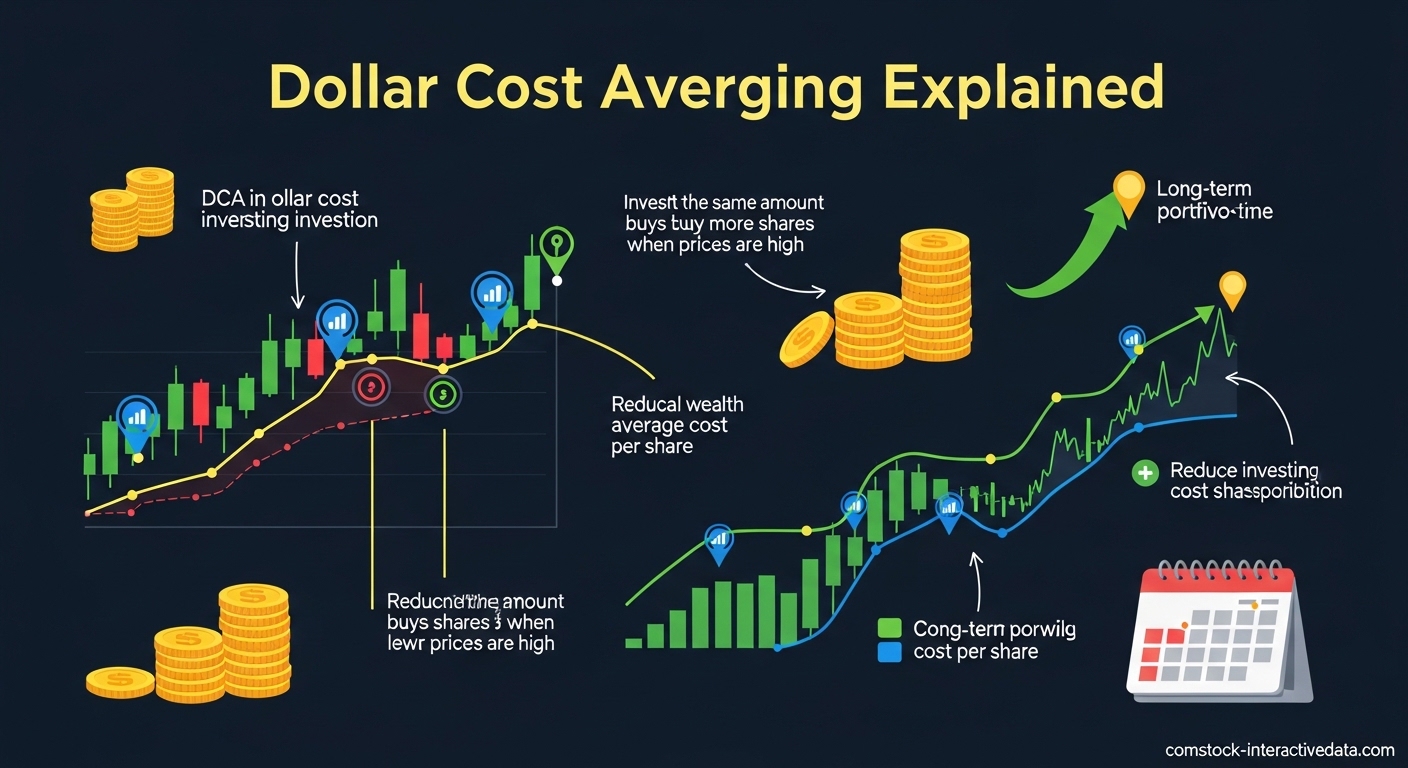
Dollar cost averaging is a simple yet powerful investment strategy where you invest a fixed dollar amount at regular intervals, regardless of market conditions. This approach helps reduce the impact of market volatility on your portfolio while removing the stress of trying to time the market perfectly. In this guide, I will explain exactly how dollar cost averaging works, why it matters for your financial future, and how you can implement it starting today. Whether you are building a retirement nest egg or just starting your investment journey, understanding this strategy will help you make smarter decisions with your money.
Table of Contents
What Is Dollar-Cost Averaging?
Dollar-cost averaging (DCA) is an investment strategy where you invest the same amount of money at consistent intervals, whether the market is up or down. Instead of investing a large sum all at once, you spread your investments over time.
The core concept is straightforward. You choose a fixed dollar amount, say $500, and invest that same amount every month into the same investment, such as an index fund or individual stock. When prices are high, your $500 buys fewer shares. When prices drop, your $500 buys more shares. Over time, this averages out your cost per share.
Many investors already practice DCA without realizing it. If you contribute to a 401(k) or IRA with automatic payroll deductions, you are using dollar-cost averaging. This passive approach takes the emotion out of investing decisions and builds wealth steadily without requiring constant attention.
The term originated from the concept of averaging your purchase costs across different market prices. Rather than trying to buy at the perfect moment, you accept that you will buy at various prices and trust that the average will work out favorably over time. This strategy is particularly popular among long-term investors who prioritize consistency over timing.
How Dollar-Cost Averaging Works?
Understanding how DCA works mechanically helps you see why it is effective. Let me walk through the process step by step so you can visualize exactly what happens to your money.
The Basic Process
Step 1 is selecting your investment amount. Choose an amount you can consistently invest without straining your budget. This might be $100, $500, or $1,000 depending on your income. Step 2 is setting your schedule. Monthly contributions align with most pay cycles, but weekly or biweekly schedules work equally well. Step 3 is automation. Set up automatic transfers so you never have to decide whether to invest this month.
The magic happens automatically once your system is in place. When markets fall, your fixed investment buys more shares. When markets rise, you own more shares that benefit from the appreciation. This smooths out your average cost over time without requiring any action from you.
A Concrete Example
Let me show you exactly how this works with real numbers. Imagine you invest $1,000 monthly into a stock index fund over five months with fluctuating prices.
Month 1: Share price is $50. Your $1,000 buys 20 shares.
Month 2: Price drops to $40. Your $1,000 buys 25 shares.
Month 3: Price falls further to $25. Your $1,000 buys 40 shares.
Month 4: Price recovers to $50. Your $1,000 buys 20 shares.
Month 5: Price jumps to $100. Your $1,000 buys 10 shares.
After five months, you have invested $5,000 total and own 115 shares. Your average cost per share is $43.48 ($5,000 divided by 115 shares). If you had invested the full $5,000 in Month 1 at $50 per share, you would own only 100 shares with an average cost of $50.
By dollar-cost averaging, you accumulated 15 extra shares during the price dips. When the price reached $100 in Month 5, your 115 shares are worth $11,500 compared to the lump sum investor’s $10,000. This is the power of buying more when prices are low.
Market Timing Elimination
The key advantage of DCA is that you stop trying to predict the market. You do not need to analyze whether stocks are overvalued or undervalued. You do not need to read economic forecasts or earnings reports. Your investment happens automatically regardless of market conditions.
This eliminates the paralysis that affects many new investors. They wait for the perfect entry point that never comes. Markets rise, and they wait for a pullback. Markets fall, and they wait for the bottom. DCA breaks this cycle by making investing a habit rather than a decision.
Benefits of Dollar-Cost Averaging
DCA offers several advantages that make it attractive for both new and experienced investors. Here are the key benefits that explain why this strategy has stood the test of time:
1. Removes emotional decision-making. You do not need to decide whether now is a good time to invest. The schedule runs automatically, preventing panic selling during downturns or FOMO buying during peaks. Emotions are the enemy of investing returns.
2. Reduces market timing risk. No one can consistently predict market tops and bottoms. Studies show that even professional investors fail at market timing more often than they succeed. DCA ensures you are always participating, so you do not miss growth periods by sitting on the sidelines.
3. Builds disciplined investing habits. Consistency matters more than timing. Regular contributions create a wealth-building routine that compounds over decades. The habit of automatic investing often matters more than the amount you invest.
4. Makes investing accessible with limited capital. You do not need $10,000 to start. Even $100 monthly gets you into the market and building equity immediately. This democratizes investing for people at all income levels.
5. Smooths volatility impact. By buying at various price points, you avoid the risk of investing everything at a market peak. Your average cost reflects a range of market conditions rather than one potentially unfortunate moment.
6. Lowers stress during market crashes. When prices drop, DCA investors see opportunity rather than disaster. Your next scheduled purchase will buy more shares at discount prices. This mindset shift helps you stay invested during scary periods.
7. Works with any investment type. DCA works equally well with index funds, ETFs, individual stocks, or mutual funds. You can apply this strategy to retirement accounts, taxable brokerage accounts, or college savings plans.
Who Should Use Dollar-Cost Averaging?
Dollar-cost averaging suits specific investor profiles particularly well. Understanding whether you fit these categories helps determine if DCA is right for your situation.
Beginner investors benefit tremendously from DCA. If you are just starting out, the simplicity of automatic investing helps you build confidence without worrying about complex market analysis. You can begin with small amounts and increase contributions as your income grows. The learning curve is minimal.
Long-term retirement savers should strongly consider DCA. If you are contributing to a 401(k), IRA, or similar retirement account over 20 to 30 years, consistent monthly investments smooth out the many market cycles you will experience. Our team has observed that retirement accounts using automatic DCA contributions tend to see more consistent growth over multi-decade periods.
Anyone with regular income but no large lump sum finds DCA practical. Most people receive paychecks biweekly or monthly rather than receiving large windfalls. DCA aligns naturally with how income actually flows into your household.
Investors prone to emotional decision-making need the structure DCA provides. If you have sold investments in panic during past downturns or bought impulsively during bubbles, the automated discipline of DCA protects you from yourself. The system removes your emotions from the equation.
Those entering volatile markets may prefer DCA over lump sum investing. If you are nervous about current market conditions or valuations, spreading your entry over several months can provide peace of mind even if it slightly reduces expected returns.
Dollar-Cost Averaging vs Lump Sum Investing
A common question is whether DCA beats investing a lump sum all at once. The answer depends on market conditions and your personal situation. Both approaches have valid use cases.
Lump sum investing means putting all available capital into the market immediately. Statistically, lump sum investing produces better returns about two-thirds of the time because markets generally trend upward over time. Your money spends more time in the market, which historically means more growth.
However, lump sum carries higher risk. If you invest $50,000 the day before a 20% market crash, you immediately lose $10,000 on paper. That psychological blow can cause poor decisions. Many investors who experience this either panic sell at a loss or become too fearful to invest again.
DCA reduces regret and stress. If markets drop after you start DCA, your future purchases benefit from lower prices. If markets rise, you celebrate the gains on shares you already own. Either outcome feels acceptable psychologically.
When to choose each strategy: If you have a large lump sum and strong emotional resilience, lump sum investing often wins mathematically. If you value peace of mind, have limited capital, or are entering the market during volatile periods, DCA provides a safer psychological path with nearly comparable long-term results.
Comparison summary:
Lump Sum Investing: Better returns ~67% of the time. Higher short-term volatility risk. Requires emotional discipline. Best for windfalls and inheritances.
Dollar-Cost Averaging: Better returns ~33% of the time (in falling markets). Lower emotional stress. Automatic discipline. Best for regular income and nervous investors.
The Bogleheads community, known for evidence-based investing wisdom, notes that DCA is primarily a behavioral tool rather than a mathematical optimization. It keeps you investing when you otherwise might freeze with fear.
How Often Should You Invest with DCA?
One question that confuses many new investors is the optimal frequency for DCA contributions. Weekly, biweekly, or monthly? The differences are smaller than you might expect.
Monthly contributions work well for most people because they align with monthly salary cycles. You can set up automatic transfers shortly after payday, ensuring money moves to investments before lifestyle spending absorbs it. This is the most common approach for 401(k) contributions.
Biweekly contributions suit those paid on a biweekly schedule. This matches 26 pay periods annually rather than 12 monthly contributions, which can slightly improve returns through more frequent market participation. The mathematical advantage is modest but real.
Weekly contributions offer the most price averaging but provide minimal mathematical advantage over monthly. The difference in outcomes between weekly and monthly DCA over long periods is typically less than 1% annually. Weekly investing requires more transaction tracking.
The best frequency is the one you will actually follow. Choose a schedule that matches your pay cycle and feels sustainable. Consistency matters far more than optimizing the interval. If monthly feels manageable, do monthly. If weekly automated transfers of $100 feel painless, choose weekly.
Factors to consider: Transaction fees (if any), minimum investment requirements, your pay schedule, and administrative convenience. Most modern brokerages and retirement plans have eliminated transaction fees, making frequent small contributions practical.
Frequently Asked Questions
Is dollar-cost averaging actually good?
Yes, dollar-cost averaging is a solid strategy for most investors, especially beginners. It reduces emotional stress, builds consistent investing habits, and smooths out market volatility. While lump sum investing may produce slightly better returns statistically, DCA helps prevent poor decisions during market downturns and makes investing accessible with limited capital.
Does Warren Buffett use dollar-cost averaging?
Warren Buffett has expressed support for the principles behind DCA through his advice to regularly buy quality investments over time. While Buffett makes large strategic acquisitions as well, he has publicly recommended that average investors systematically purchase index funds regardless of market conditions. His famous quote about being greedy when others are fearful aligns with the DCA mindset of continuing investments during market drops.
What is the 70 20 10 investment strategy?
The 70-20-10 strategy refers to asset allocation, not dollar-cost averaging. It suggests investing 70% in stocks, 20% in bonds, and 10% in alternative investments. This differs from DCA, which is about the timing and frequency of contributions. You can combine both strategies by using DCA to systematically invest into a 70-20-10 portfolio allocation.
How can you benefit from dollar-cost averaging as an investor?
You benefit from DCA through reduced stress, automatic discipline, and smoothed entry prices. The strategy removes the pressure of timing the market perfectly. During market declines, your fixed contributions buy more shares at discount prices. Over decades, this consistent approach typically outperforms investors who try to time the market but end up missing the best days.
Is dollar-cost averaging just a psychological trick?
Some investors describe DCA as a psychological tool to prevent panic during market drops. While this is partially true, the benefits extend beyond mental comfort. DCA genuinely reduces the risk of investing at market peaks and creates forced savings discipline. The behavioral benefits are real advantages, not tricks. As forum discussions note, DCA helps you avoid freaking out and making poor decisions during volatility.
Conclusion
Dollar cost averaging explained simply is this: invest consistently, ignore market noise, and let time work in your favor. The strategy removes the two biggest obstacles most investors face: emotional decision-making and market timing anxiety. By investing fixed amounts at regular intervals, you automatically buy more when prices are low and benefit from long-term market growth.
Whether you are building retirement wealth through a 401(k) or starting your first investment account, DCA provides a proven framework for steady progress. The key is starting now and staying consistent. Your future self will thank you for the disciplined habits you build today.