
When you first start learning about currency trading, one question quickly becomes essential: how do forex brokers work and why does it matter for your success? A forex broker is the gateway between you and the global currency market, but not all brokers operate the same way. Understanding their business models, revenue sources, and potential conflicts of interest can save you from costly mistakes and help you choose a partner that aligns with your trading goals.
In this guide, I will explain exactly how forex brokers function, from the moment you click “buy” or “sell” to how your order reaches the market. You will learn about the different types of brokers, how they make money, and what red flags to watch for when selecting a broker. Whether you are completely new to trading or looking to switch providers, this guide will give you the knowledge to make an informed decision.
Table of Contents
What Is a Forex Broker?
A forex broker is a financial services company that acts as an intermediary between retail traders and the global foreign exchange market. Without a broker, individual traders cannot access the interbank market where currencies are traded in massive volumes between banks, institutions, and governments. Think of a broker as your connection point to this vast network, providing the technology, liquidity access, and infrastructure needed to participate in currency trading.
Brokers earn their keep by facilitating your trades and providing essential services like trading platforms, leverage, market analysis, and educational resources. They pool orders from thousands of retail clients and route them to liquidity providers or internalize them depending on their business model. This arrangement allows small retail traders to compete in a market that moves over $7 trillion daily.
The broker you choose affects everything from the prices you pay to the speed of your execution and the safety of your funds. Not all brokers are created equal, and understanding their underlying mechanics is the first step toward protecting yourself and optimizing your trading experience.
How Do Forex Brokers Work?
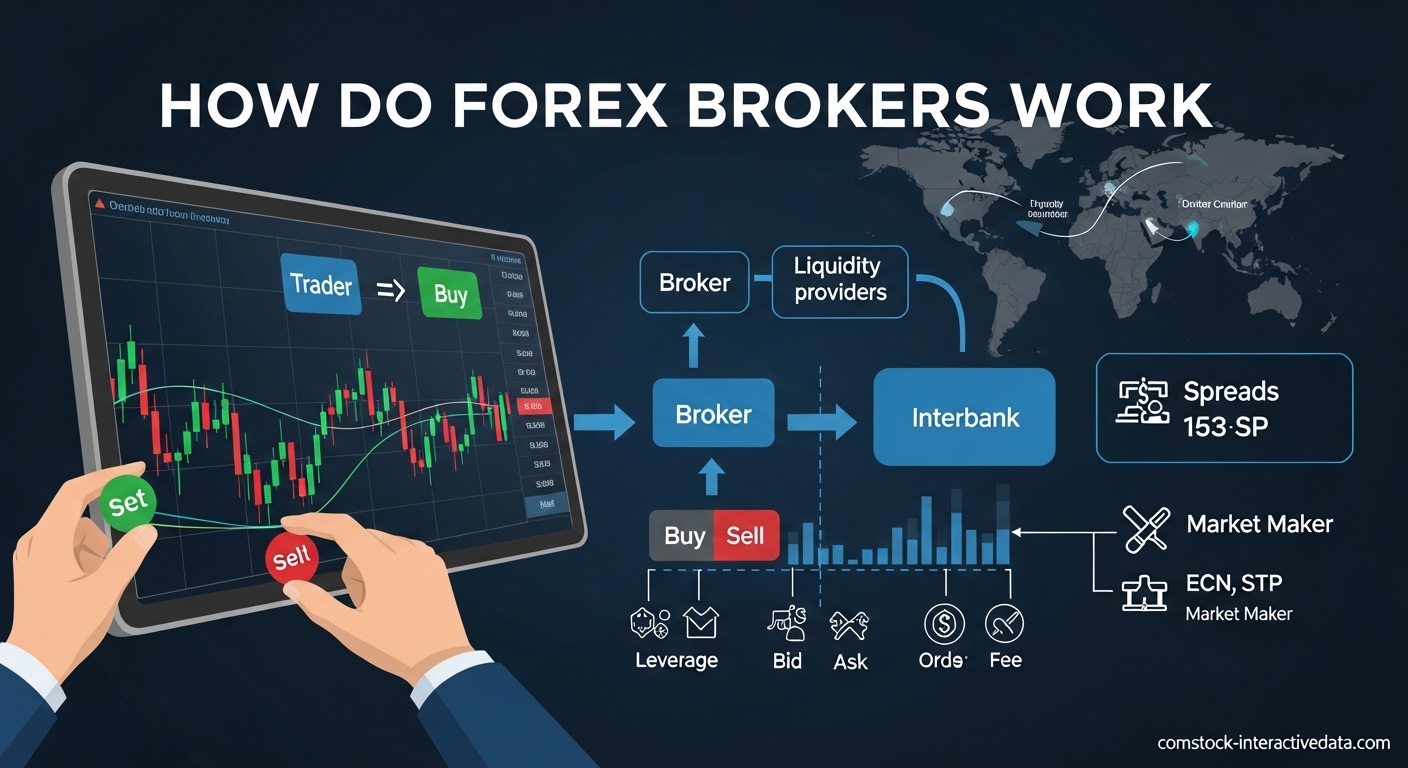
Forex brokers operate as sophisticated intermediaries that bridge the gap between small retail traders and the massive interbank foreign exchange market. When you open a trade, your broker processes the order, provides leverage if requested, and either routes your trade to external liquidity providers or handles it internally. This process happens in milliseconds, but understanding what happens behind the scenes helps you evaluate execution quality and spot potential conflicts of interest.
The basic workflow starts when you open your trading platform and see currency pair prices streaming in real-time. These quotes come from the broker’s connections to liquidity providers or from their own pricing engine. When you decide to enter a position, your broker must decide how to handle that order based on their business model, risk management policies, and current market conditions.
Brokers also provide essential infrastructure that makes retail trading possible. They offer leverage, allowing you to control larger positions than your account balance would normally permit. They handle the technical complexity of connecting to multiple liquidity sources. They also manage regulatory compliance, segregated client funds, and the software platforms you use to analyze markets and execute trades.
The Order Execution Process
Understanding what happens when you click “buy” or “sell” demystifies the trading process and reveals how brokers handle your orders. Here is the step-by-step journey from your click to market execution:
Step 1: Price Quote Reception
Your trading platform receives a continuous stream of bid and ask prices from the broker’s pricing feed. These quotes represent the best available prices from liquidity providers or the broker’s own pricing engine.
Step 2: Order Submission
When you click to open a position, your order travels from your platform to the broker’s order management system. The system validates that you have sufficient margin and that the order meets size and pricing requirements.
Step 3: Order Routing Decision
The broker’s system determines how to handle your order. A-book brokers route to external liquidity providers. B-book brokers may take the opposite side of your trade internally. Hybrid brokers make this decision based on various factors including trade size, asset class, and your trading history.
Step 4: Execution and Confirmation
If routed externally, your order joins the liquidity provider’s order book and executes against available counter-parties. If internalized, the broker becomes your counter-party directly. You receive confirmation showing your entry price, position size, and any costs like spread or commission.
Step 5: Position Management
Your open position is monitored by both you and the broker. The broker tracks your margin usage, calculates swap fees if you hold overnight, and maintains the position until you close it or get stopped out.
Each step involves potential slippage, requotes, or execution delays depending on market volatility and your broker’s technology infrastructure. Understanding this flow helps you set realistic expectations and choose brokers with superior execution capabilities.
Forex Broker Business Models
Not all forex brokers make money the same way or handle your orders using the same methods. The industry operates on three primary business models: A-book, B-book, and hybrid. Each model has distinct implications for order execution, pricing transparency, and potential conflicts of interest. Understanding these differences is crucial for selecting a broker that aligns with your trading style and ethical expectations.
The business model a broker uses determines whether they profit from your trading activity directly or simply earn fees for facilitating your access to the market. Some traders prefer the transparency of A-book execution, while others appreciate the price stability B-book brokers can offer during volatile periods. There is no universally “best” model, but there are significant differences you should understand.
Here is a detailed breakdown of each business model and what it means for you as a trader.
A-Book vs B-Book vs Hybrid: What’s the Difference?
The distinction between A-book and B-book brokers represents one of the most important concepts for retail traders to grasp. These terms describe how brokers handle the risk associated with client trades and directly impact execution quality, pricing, and trust.
A-Book Brokers (Straight-Through Processing)
A-book brokers route all client orders directly to external liquidity providers like banks, hedge funds, and other institutions. They act purely as intermediaries, earning money from spreads or commissions without taking the opposite side of your trades. When you profit, the broker does not lose money because they never held the opposing position. This model offers greater transparency and eliminates the conflict of interest inherent in B-book operations.
B-Book Brokers (Market Makers)
B-book brokers internalize client orders by taking the opposite side of trades themselves. When you buy EUR/USD, the broker sells it to you from their own inventory or book. This means your profit is their loss, and vice versa. B-book brokers can offer benefits like guaranteed fills and stable spreads during volatile periods. However, this model creates an inherent conflict of interest since the broker profits when clients lose money.
Hybrid Brokers
Most major brokers today operate hybrid models, routing some orders externally while internalizing others. They typically A-book large orders or trades from consistently profitable traders, while B-booking smaller orders from less experienced clients. This allows brokers to manage risk while maximizing profitability. The challenge for traders is that you rarely know which bucket your order falls into.
| Feature | A-Book (STP) | B-Book (Market Maker) | Hybrid |
|---|---|---|---|
| Order Handling | Routed to liquidity providers | Internalized by broker | Mix of both methods |
| Conflict of Interest | Minimal – broker is intermediary | Present – broker profits from losses | Varies by order |
| Spreads | Variable, market-driven | Fixed or controlled by broker | Depends on routing |
| Execution During News | May experience slippage | Typically more stable | Variable |
| Requotes | More common in volatile markets | Less common | Mixed |
| Scalping Allowed | Usually yes | Often restricted | Depends on policy |
When choosing between these models, consider your trading style. Scalpers and high-frequency traders often prefer A-book execution for direct market access. Beginners might appreciate the stability B-book brokers offer. Long-term swing traders may find either model acceptable if the broker is reputable and regulated.
The most important factor is transparency. Quality brokers clearly disclose their business model and execution policies. Be wary of brokers that obscure how they handle orders or change execution types without notice.
How Do Forex Brokers Make Money?
Understanding broker revenue streams helps you evaluate whether their interests align with yours and identify potential conflicts. Forex brokers generate income through several methods, with the primary sources being spreads, commissions, and various account fees. B-book brokers have an additional revenue stream: trading profits when clients lose money on internalized positions.
The spread is the most common revenue source. This is the difference between the bid price (what buyers pay) and ask price (what sellers receive). When you enter a trade, you start with a small loss equal to the spread. For example, if EUR/USD shows 1.0850/1.0852, the 2-pip spread represents the broker’s profit on that transaction. Spreads vary by currency pair, market volatility, and broker type.
Commission-based brokers charge a fixed fee per lot traded rather than marking up spreads. This model often appeals to high-volume traders who can benefit from raw spreads near zero. The commission structure is transparent, but you must factor both the commission and any remaining spread into your cost calculations.
Swap rates or rollover fees represent another revenue source. When you hold a position overnight, you either pay or receive interest based on the interest rate differential between the two currencies in the pair. Brokers often mark up these rates, keeping a portion as profit while passing the rest to market participants. Swap fees can significantly impact long-term traders and those using carry trade strategies.
Additional fees may include inactivity charges, withdrawal fees, deposit processing fees, and premium services like advanced charting or data feeds. While these are usually minor compared to spread and commission costs, they add up over time and should factor into your broker selection.
For B-book brokers, the profit-from-losses model creates the most significant conflict of interest. When a B-book broker internalizes your losing trade, they profit from your loss. This does not necessarily mean they manipulate prices against you, but it does mean their financial incentive runs counter to your success. Reputable B-book brokers manage this conflict through fair execution policies and regulatory oversight, but the structural conflict remains.
Types of Forex Brokers
Beyond business models, forex brokers can be categorized by their market access methods and dealing desk operations. The three main types are ECN (Electronic Communication Network), STP (Straight-Through Processing), and Market Makers. Each offers different levels of market depth, execution speed, and pricing transparency.
These classifications often overlap with A-book and B-book designations, but they focus more on technical infrastructure and order routing rather than risk management philosophy. Understanding these types helps you match broker capabilities with your specific trading requirements.
ECN, STP, and Market Maker Comparison
ECN Brokers
ECN brokers provide direct access to the interbank market through electronic communication networks. They aggregate price quotes from multiple liquidity providers and display the best available bid and ask prices in a centralized order book. ECN brokers typically offer the tightest spreads during normal market conditions and the deepest market depth, showing you actual available liquidity at each price level. They charge fixed commissions per trade rather than marking up spreads, making their pricing transparent and often lower for active traders.
The main advantage of ECN brokers is true market access. Your orders interact with other market participants including banks, institutions, and other traders. This eliminates conflicts of interest and provides the fairest possible pricing. However, ECN execution can be more expensive for small traders due to minimum commission charges, and spreads may widen significantly during volatile periods or major news events.
STP Brokers
STP (Straight-Through Processing) brokers route client orders directly to liquidity providers without human intervention or dealing desk interference. Like A-book brokers, they do not take the opposite side of trades but instead pass them to external market makers. STP brokers may work with single or multiple liquidity providers, with multi-bank setups generally offering better pricing and execution.
STP execution is typically faster than ECN because orders route directly to liquidity providers rather than entering a centralized matching engine. Spreads are usually fixed or variable depending on the broker’s agreements with liquidity providers. While STP brokers do not profit from client losses, their revenue depends on volume, meaning they benefit from active traders regardless of whether those traders win or lose.
Market Makers (Dealing Desk)
Market makers operate dealing desks that internalize client flow and provide liquidity by taking the opposite side of trades. They create their own market for clients, setting prices and guaranteeing execution. This model allows them to offer stable spreads, fixed pricing, and instant execution even when external markets are volatile.
The dealing desk model has advantages for beginners and those trading in smaller sizes. You get consistent pricing, no requotes in normal conditions, and often lower minimum deposit requirements. However, the conflict of interest is structural. Market makers may implement restrictions on profitable strategies like scalping, and some disreputable operators have been known to manipulate prices or delay execution against successful traders.
| Broker Type | Market Access | Typical Spreads | Commissions | Best For |
|---|---|---|---|---|
| ECN | Direct interbank access | Raw (0.0-0.5 pips) | Fixed per lot | Scalpers, high volume |
| STP | Liquidity provider network | Variable (1-2 pips) | None or low | Day traders, swing traders |
| Market Maker | Internal dealing desk | Fixed (2-3 pips) | Bundled in spread | Beginners, small accounts |
Your choice depends on trading style, account size, and priorities. Active traders paying close attention to execution costs often prefer ECN or STP brokers. Beginners valuing stability and simplicity may find market makers more suitable. Regardless of type, prioritize regulation, reputation, and transparent execution policies.
Key Services Forex Brokers Provide
Modern forex brokers offer far more than simple order execution. They provide comprehensive trading ecosystems including platforms, analytical tools, educational resources, and support services. Evaluating these offerings alongside execution quality helps you find a broker that supports your growth as a trader.
Trading Platforms
The trading platform is your primary interface with the markets. MetaTrader 4 and MetaTrader 5 remain industry standards, offering robust charting, automated trading through Expert Advisors, and extensive indicator libraries. Some brokers develop proprietary platforms with unique features like advanced risk management tools, social trading integration, or sophisticated order types. Mobile trading apps have become essential, allowing you to monitor and manage positions from anywhere.
Charting and Analysis Tools
Quality charting software enables technical analysis through multiple timeframes, drawing tools, and technical indicators. Many brokers provide premium charting packages at no extra cost, including TradingView integration or proprietary analysis platforms. Real-time news feeds, economic calendars, and market analysis help fundamental traders stay informed about events affecting currency markets.
Educational Resources
Leading brokers invest heavily in trader education, offering webinars, video courses, articles, and even one-on-one coaching. These resources range from basic forex introductions to advanced strategy development and risk management. Demo accounts allow you to practice trading with virtual funds, testing strategies and familiarizing yourself with platforms before risking real capital.
Account Types
Brokers typically offer multiple account tiers suited to different experience levels and capital sizes. Standard accounts suit most retail traders, while premium or VIP accounts offer reduced spreads, dedicated support, and additional services for high-volume clients. Micro and cent accounts allow beginners to trade with minimal risk using smaller position sizes.
Customer Support
Responsive customer support becomes crucial when technical issues arise or you need account assistance. Quality brokers offer 24/5 or 24/7 support through live chat, phone, and email. Support quality varies significantly between brokers, so test response times and knowledge levels before committing significant funds.
Regulation and Why It Matters
Regulatory oversight separates legitimate forex brokers from potential scams and provides crucial protections for retail traders. Regulated brokers must meet strict capital requirements, maintain segregated client funds, submit to regular audits, and follow fair dealing practices. Understanding regulatory frameworks helps you identify trustworthy brokers and understand your rights as a client.
Major Regulatory Bodies
Different regions have established regulatory agencies overseeing forex brokers. The Financial Conduct Authority (FCA) in the UK, the Australian Securities and Investments Commission (ASIC) in Australia, and the National Futures Association (NFA) and Commodity Futures Trading Commission (CFTC) in the United States represent some of the most respected regulators globally. These bodies enforce strict standards including capital adequacy, client fund segregation, and fair marketing practices.
The Cyprus Securities and Exchange Commission (CySEC) regulates many European brokers under MiFID II guidelines, while other significant regulators include the Financial Services Authority (FSA) in Japan, the Monetary Authority of Singapore (MAS), and various national regulators across Europe and beyond. Generally, brokers regulated by Tier-1 authorities in major financial centers offer the strongest protections.
How Regulation Protects Traders
Regulated brokers must keep client funds in segregated accounts separate from company operating funds. This ensures your money remains protected even if the broker faces financial difficulties. Many jurisdictions offer compensation schemes that reimburse clients if a regulated broker becomes insolvent. The FSCS in the UK, for example, covers eligible claims up to GBP 85,000 per person.
Regulators also enforce fair dealing standards, requiring transparent pricing, honest marketing, and proper dispute resolution procedures. Regulated brokers must provide clear risk warnings and cannot make unrealistic promises about trading returns. Violations can result in substantial fines, license revocation, or criminal prosecution.
Verifying Regulatory Status
Always verify a broker’s regulatory claims directly through the regulator’s website rather than trusting marketing materials. Every regulated broker has a license number you can check against public databases. Be wary of brokers claiming “registration” rather than “regulation,” as registration often means minimal oversight compared to full licensing.
Unregulated or offshore brokers operating without proper licensing present significant risks. While some may be legitimate businesses in jurisdictions with lighter regulations, others are outright scams designed to steal client funds. The protection difference between a properly regulated broker and an unregulated operation is enormous and should be a primary factor in your selection process.
How to Choose a Forex Broker?
Selecting the right forex broker requires evaluating multiple factors beyond spreads and commissions. Your broker becomes your trading partner, and the wrong choice can cost you money through poor execution, hidden fees, or worse. Here is a systematic approach to evaluating potential brokers.
Step 1: Verify Regulation
Start by checking regulatory status through official regulator websites. Prioritize Tier-1 regulators in established financial centers. Avoid unregulated brokers unless you fully understand and accept the risks involved. A regulated broker with a 10-year track record offers more security than a new unregulated operation promising amazing conditions.
Step 2: Evaluate Execution Quality
Test execution through a demo account before committing real funds. Pay attention to slippage during volatile periods, requote frequency, and order rejection rates. Quality brokers execute market orders promptly at or near quoted prices. Be suspicious of brokers where demo execution seems artificially perfect compared to live account performance.
Step 3: Calculate Total Trading Costs
Spreads and commissions are obvious, but also consider swap rates, inactivity fees, withdrawal charges, and deposit processing costs. Calculate what your typical monthly trading would cost at each broker you are considering. A broker with slightly higher spreads but no commissions might be cheaper for your trading style than a raw spread plus commission model.
Step 4: Test the Trading Platform
Spend time with the broker’s platform to ensure it meets your needs. Check charting capabilities, indicator availability, order type variety, and ease of use. If you rely on automated trading, verify that the platform supports your Expert Advisors or algorithms. Mobile app quality matters if you plan to monitor positions away from your desk.
Step 5: Assess Customer Support
Contact support with questions before opening an account. Evaluate response speed, knowledge depth, and language capabilities. Test support during market hours when you will most need assistance. A broker with poor support becomes frustrating quickly when technical issues arise.
Step 6: Review Account Terms
Read the fine print regarding margin requirements, stop-out levels, leverage restrictions, and any trading strategy limitations. Some brokers prohibit scalping, hedging, or automated trading. Ensure the account terms align with how you intend to trade.
Take your time with this process. Opening a brokerage account should be a deliberate decision based on thorough research, not a rushed choice based on a flashy advertisement or bonus offer.
Red Flags: Warning Signs of Problematic Brokers
Forex scams and problematic brokers unfortunately exist, preying on newcomers eager to profit from currency trading. Learning to spot warning signs protects you from losing money to unscrupulous operators. Here are the major red flags that should prompt immediate caution.
Unregulated Operations
Any broker operating without proper regulation from a recognized financial authority poses significant risk. While some offshore jurisdictions have legitimate lighter regulations, complete lack of oversight means no protection for your funds. Always verify regulatory claims independently before depositing money.
Unrealistic Promises
Be extremely wary of brokers promising guaranteed returns, “risk-free” trading, or specific profit percentages. Forex trading involves substantial risk, and no legitimate broker can guarantee profits. Marketing materials suggesting easy riches or showing only winning trades are classic scam tactics.
Excessive Leverage
While leverage amplifies both gains and losses, extreme leverage offerings (500:1, 1000:1, or higher) often indicate questionable operations. Responsible regulators cap leverage at reasonable levels (30:1 to 50:1 for major pairs) to protect retail traders. Excessive leverage is designed to encourage overtrading and rapid account depletion.
Withdrawal Problems
Legitimate brokers process withdrawal requests promptly according to their stated policies. Difficulty withdrawing funds, excessive verification requirements when withdrawing, or delays beyond stated timeframes are serious warning signs. Search online for withdrawal complaints before opening an account.
Price Manipulation
If you notice prices on your broker’s platform consistently diverging from market rates shown on independent sources, manipulation may be occurring. Strange price spikes that hit stop losses but do not appear elsewhere, or requotes that always work against your position, suggest dishonest practices.
Pressure Tactics
Legitimate brokers do not employ aggressive sales tactics, push you to deposit more funds, or offer “account managers” who trade on your behalf. Be suspicious of unsolicited calls pressuring you to fund an account or increase position sizes. Professional brokers provide information and let you make informed decisions.
Unclear Business Model
Quality brokers clearly explain their execution model, business structure, and how they make money. If you cannot determine whether a broker is A-book, B-book, or hybrid, or if they avoid questions about order execution, consider it a warning sign. Transparency matters in financial services.
When you encounter these red flags, walk away regardless of how attractive their trading conditions appear. The cost of dealing with a problematic broker far exceeds any potential savings on spreads or commissions.
Frequently Asked Questions
Is $100 enough to start forex?
What is the 3 5 7 rule in forex?
Can ChatGPT give forex signals?
Can I teach myself forex trading?
Do forex brokers trade against their clients?
Are forex brokers safe?
How do I know if my broker is A-book or B-book?
Why do spreads vary between brokers?
Conclusion
Understanding how do forex brokers work empowers you to make informed decisions about who to trust with your trading capital. The key insights from this guide should stay with you as you evaluate potential brokers: business models matter, regulation protects, transparency builds trust, and total trading costs determine profitability more than advertised spreads alone.
A-book brokers routing orders to liquidity providers offer the most transparent execution without conflicts of interest. B-book brokers providing internal liquidity can offer stability but create structural misalignment between their profits and your success. Hybrid models are common but require extra scrutiny to understand when your orders go where.
Your next steps should include verifying regulation for any broker you consider, testing execution through demo accounts, calculating total trading costs for your specific strategy, and watching for red flags that signal problematic operations. Take time with this decision. The right broker becomes a long-term partner in your trading journey, while the wrong choice can cost you money, time, and confidence.
Forex trading offers tremendous opportunities for those who approach it with knowledge and discipline. Now that you understand how brokers operate behind the scenes, you are better equipped to find a partner that supports your success rather than undermining it. Start with a demo account, develop your skills, and never risk more than you can afford to lose. The markets will always be there when you are ready to trade with real capital.