
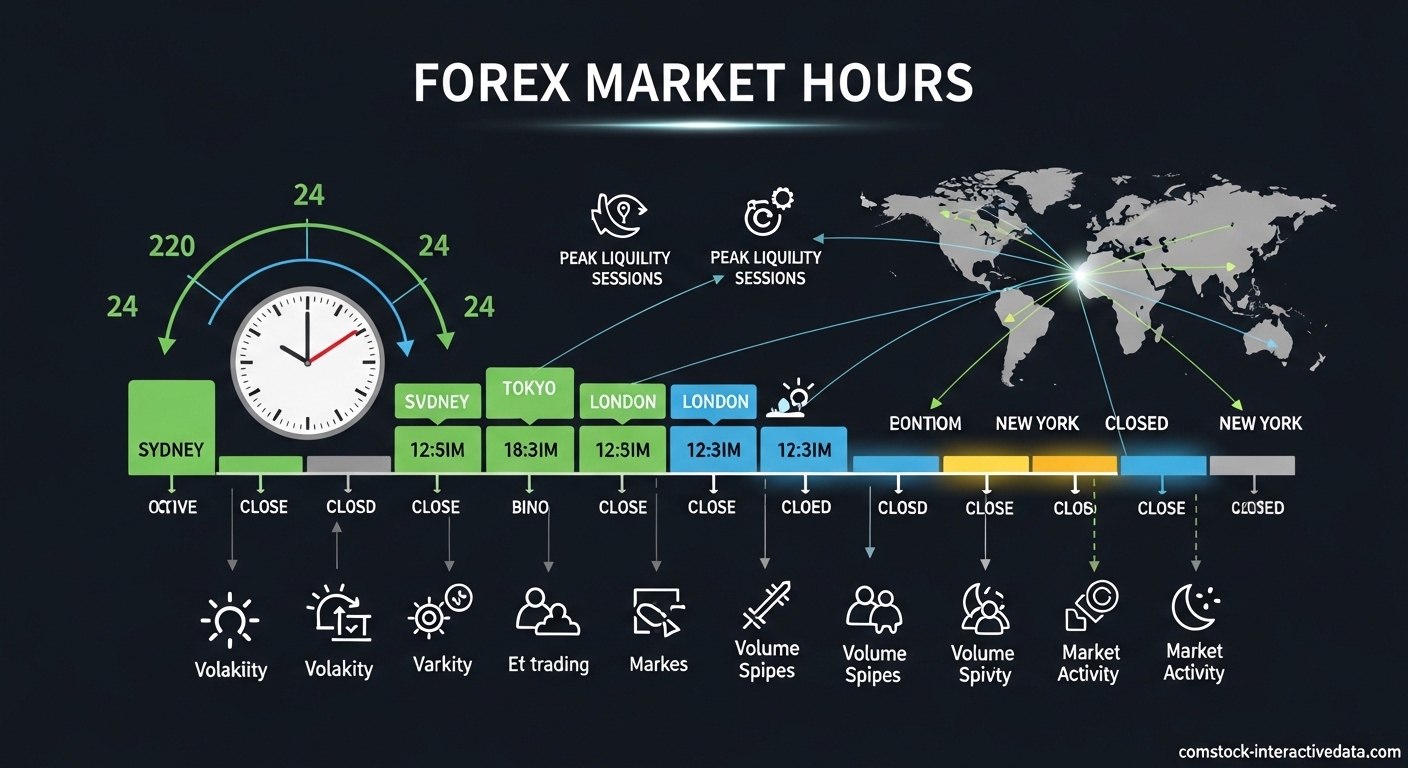
The forex market operates 24 hours a day, five days a week, opening at 10pm UTC on Sunday when the Sydney session begins and closing at 10pm UTC on Friday when the New York session ends. This continuous operation makes forex unique among financial markets, allowing traders worldwide to participate at any time during the trading week. Understanding forex market hours is essential because trading activity, liquidity, and volatility vary significantly depending on which session is active and when sessions overlap.
Table of Contents
What Are Forex Market Hours?
Forex market hours refer to the continuous 24-hour trading period during weekdays when the global foreign exchange market remains open for trading. Unlike stock exchanges that operate during fixed business hours, the forex market spans across multiple time zones through four major financial centers.
The market follows a 24/5 schedule because it is decentralized. When one major financial center closes, another opens, creating seamless trading opportunities around the clock. According to the Bank for International Settlements, the forex market processes over $7.5 trillion in daily trading volume, making it the largest and most liquid financial market in the world.
Time zone conversion creates the most confusion for traders. The standard reference is UTC (Coordinated Universal Time), though some brokers and platforms use GMT (Greenwich Mean Time). During daylight saving time periods, EST (Eastern Standard Time) becomes EDT (Eastern Daylight Time), shifting session start and end times by one hour. I recommend using UTC as your baseline and converting to your local time for consistency.
The Four Major Forex Trading Sessions
The global forex market operates through four primary trading sessions named after the major financial centers that drive activity. Each session has distinct characteristics, currency pair preferences, and volatility patterns that traders must understand to optimize their strategies.
Sydney Session (Asian-Pacific)
The Sydney session opens the trading week at 10pm UTC on Sunday and runs until 7am UTC on Monday through Friday. This session establishes the early price action for the week and sets the tone for Asian market sentiment. It is the smallest of the four major sessions by trading volume but plays a crucial role in establishing weekly trends.
Trading volume during the Sydney session is typically lower compared to London or New York. The Australian dollar (AUD) and New Zealand dollar (NZD) see the most activity during these hours. Currency pairs like AUD/USD and NZD/USD often show clearer trend formations due to reduced market noise.
Traders seeking lower volatility environments often prefer this session for its calmer price action. Economic data from Australia and New Zealand releases during these hours, creating movement opportunities in regional pairs. The Sydney session also serves as a bridge between the quiet weekend and the more active Tokyo session.
Tokyo Session (Asian)
The Tokyo session operates from 12am to 9am UTC and represents the primary Asian trading window. Japan remains one of the largest forex trading centers globally, and the yen influences activity significantly during these hours.
USD/JPY and EUR/JPY typically experience their highest trading volume during the Tokyo session. The Bank of Japan occasionally intervenes in currency markets during this period, creating sudden volatility spikes. Economic data releases from Japan, China, and Australia also drive price movements.
Many traders overlook the Asian session, but it offers excellent opportunities for those who understand its unique characteristics. The session tends to respect technical levels more consistently than volatile London hours. Carry trade unwinding often occurs during Tokyo hours, creating sustained trends in yen pairs.
London Session (European)
The London session runs from 8am to 5pm UTC and represents the most liquid and volatile trading period in forex. London has historically served as the global financial hub, and approximately 43% of all forex transactions occur during European hours.
EUR/USD, GBP/USD, and EUR/GBP see exceptional liquidity during the London session. Spreads tighten significantly, often reaching their narrowest levels of the day. Major economic releases from the European Central Bank and Bank of England typically occur during these hours.
The session begins with a volatility spike as European institutions enter the market, creating excellent opportunities for breakout traders. Afternoon hours often see profit-taking and position adjustments before the New York session opens. London serves as the bridge between the quieter Asian session and the active American session.
New York Session (North American)
The New York session operates from 1pm to 10pm UTC and brings the US dollar into focus. As the world’s primary reserve currency, USD pairs dominate activity during American trading hours.
Major US economic indicators including non-farm payrolls, CPI data, and Federal Reserve announcements drive significant volatility. USD pairs like USD/CAD, USD/CHF, and USD/JPY experience heightened activity. The New York afternoon often sees lower liquidity as European traders close positions.
The session opens with high energy as US institutional traders enter the market. Morning hours overlap with London, creating the most active trading window of the day. Afternoon hours become quieter as traders prepare for the daily close at 10pm UTC.
Forex Trading Session Overlaps
Session overlaps create the most dynamic trading periods in forex. When two major financial centers operate simultaneously, trading volume increases dramatically, spreads narrow, and price movements become more pronounced.
Sydney-Tokyo Overlap (12am-7am UTC)
The Sydney and Tokyo markets share seven hours of simultaneous operation. While this overlap generates increased activity compared to Sydney alone, it remains relatively quiet compared to European overlaps. AUD/JPY and NZD/JPY benefit most from this period, often showing cleaner technical patterns than during busier sessions.
This overlap suits traders who prefer slower, more deliberate price action. False breakouts are less common, and support and resistance levels tend to hold more reliably. The overlap begins quietly and builds momentum as Tokyo institutions join the market.
Tokyo-London Overlap (8am-9am UTC)
This one-hour window creates a brief but significant volatility increase as European traders enter while Asian markets wind down. GBP/JPY and EUR/JPY frequently experience sharp movements during this transition.
The limited duration means traders must act quickly to capitalize on momentum shifts. Price gaps occasionally occur as the higher-volume London session overwhelms Asian liquidity. This overlap often establishes the direction for the subsequent London morning.
London-New York Overlap (1pm-4pm UTC)
The London-New York overlap represents the most important trading window in forex. During these four hours, approximately 70% of daily forex volume occurs, making it the most liquid and volatile period of the trading day.
EUR/USD, GBP/USD, and USD/CHF show exceptional movement with tightest spreads. Experienced traders consistently rank this overlap as the best time to trade forex. Price action becomes more predictable, trend strength increases, and execution quality improves.
Major economic releases from both Europe and the US often fall within this window, amplifying volatility further. This overlap sees the highest concentration of algorithmic trading activity, contributing to rapid price movements.
Best Times to Trade Forex
Ranking the best times to trade forex depends on your trading style, currency pair preferences, and risk tolerance. Historical data and trader experiences reveal clear patterns for optimal trading windows.
1. London-New York Overlap (1pm-4pm UTC)
This period offers the highest liquidity and most predictable price movements. EUR/USD and GBP/USD frequently move 40-60 pips during this window compared to 20-30 pips during quieter sessions.
Day traders and scalpers particularly benefit from the increased volatility and tighter spreads. Breakout strategies perform exceptionally well during these hours. News traders find abundant opportunities with frequent economic releases.
2. Early London Session (8am-11am UTC)
The first three hours of London trading capture European institutional activity and often establish the day’s trend direction. GBP pairs and EUR pairs show strongest performance.
Breakout strategies work exceptionally well during this period as the market digests overnight Asian price action. False breakouts are less common than during overlap hours. Range traders can identify key levels before the New York volatility begins.
3. Early New York Session (1pm-3pm UTC)
The New York open overlaps with late London hours, creating sustained high liquidity. US economic releases typically publish at 1:30pm UTC, generating immediate volatility spikes.
USD pairs and commodities like gold see significant activity. This period suits traders who prefer trading US dollar fundamentals. The combination of European and American participation creates excellent trading conditions.
Best Days for Forex Trading
Tuesday, Wednesday, and Thursday historically produce the largest average pip movements compared to Monday or Friday. Mondays often show range-bound price action as markets digest weekend news.
Fridays can experience profit-taking and position squaring that creates choppy conditions. Holiday-shortened weeks typically show reduced volatility across all sessions. Mid-week trading provides the most consistent opportunities.
Average Pip Movement by Trading Session
Historical pip movement data helps traders understand which sessions offer the most opportunity for their preferred currency pairs. The following table shows average daily ranges based on 2026 market data:
| Currency Pair | Sydney | Tokyo | London | New York | London-NY Overlap |
|---|---|---|---|---|---|
| EUR/USD | 25 pips | 35 pips | 55 pips | 45 pips | 65 pips |
| GBP/USD | 28 pips | 38 pips | 65 pips | 52 pips | 78 pips |
| USD/JPY | 22 pips | 45 pips | 48 pips | 42 pips | 58 pips |
| AUD/USD | 35 pips | 32 pips | 38 pips | 35 pips | 42 pips |
| USD/CHF | 20 pips | 28 pips | 48 pips | 45 pips | 58 pips |
| EUR/GBP | 15 pips | 22 pips | 45 pips | 38 pips | 52 pips |
| GBP/JPY | 38 pips | 55 pips | 85 pips | 72 pips | 95 pips |
This data demonstrates why the London-New York overlap provides superior trading conditions for most major pairs. Cross pairs involving European and Asian currencies show particular strength during the Tokyo-London transition.
Worst Times to Trade Forex
Knowing when NOT to trade proves equally important for protecting capital. Certain periods consistently show poor trading conditions that increase risk while reducing profit potential.
Friday Afternoon (After 8pm UTC)
As the New York session winds down and approaches the 10pm UTC close, liquidity evaporates rapidly. Spreads widen dramatically, sometimes doubling or tripling normal levels.
Weekend risk increases as unexpected geopolitical events can cause significant gaps when markets reopen Sunday evening. Many professional traders close all positions before 8pm UTC on Fridays. Holding trades over the weekend exposes accounts to gap risk that cannot be managed.
Sunday Evening (10pm-11pm UTC)
The Sydney session open often features price gaps from weekend news events. Liquidity remains thin for the first hour, making execution unpredictable.
Many professional traders avoid this period entirely, waiting for Tokyo to open at 12am UTC before entering positions. Weekend gaps can exceed 50 pips on volatile pairs. Stop losses may not execute at expected levels due to low liquidity.
Late Asian Session (6am-8am UTC)
The hours between Tokyo’s close and London’s open represent the quietest period in forex. Price action becomes choppy and range-bound, with many currency pairs moving sideways.
Breakout attempts often fail, trapping traders in false moves. Spreads may widen temporarily as liquidity transitions between sessions. This period suits only the most patient range traders.
Holiday Periods
Major holidays reduce participation across all sessions. Christmas and New Year weeks show significantly reduced volume. Japanese Golden Week in April creates thin conditions in yen pairs.
US Thanksgiving week often features erratic price action. August sees reduced European participation during summer holidays. Trading during these periods requires reduced position sizes and wider stop losses.
Weekend Gap Risks and Sunday Open
Weekend gaps represent one of the most dangerous risks in forex trading. When the Sydney session opens at 10pm UTC Sunday, prices may gap significantly from Friday’s 10pm UTC close.
These gaps occur because exchange rates continue adjusting to news and events even when markets are closed. Geopolitical developments, natural disasters, and major economic announcements over the weekend create imbalances that resolve immediately upon market open.
GBP/JPY and other volatile cross pairs frequently gap 30-50 pips between sessions. EUR/USD and USD/JPY typically show smaller but still significant gaps. Traders holding positions through the weekend accept gap risk that cannot be hedged or managed.
I recommend closing all positions before Friday’s market close unless you have specific weekend holding strategies. If you must hold, reduce position size significantly and ensure your account has adequate margin to withstand potential gaps against your position.
Daylight Saving Time and Time Zone Considerations
Daylight saving time creates significant confusion among forex traders, particularly during transition periods when different countries change clocks on different dates. The United States and United Kingdom do not synchronize their DST changes.
US daylight saving time begins on the second Sunday in March and ends on the first Sunday in November. UK daylight saving time begins on the last Sunday in March and ends on the last Sunday in October.
During these mismatched periods, the London-New York overlap shifts by one hour. The two-week periods in March and October/Oftenovember create temporary session time changes that confuse many traders. Your broker’s server time may differ from actual market times during these transitions.
I recommend maintaining a trading journal that tracks session times in your local timezone. Many trading platforms now include session indicators that automatically adjust for DST changes. Mobile apps like Forex Hours or market session clocks can help track when sessions open and close in real-time.
Best Currency Pairs for Each Session
Selecting appropriate currency pairs for each trading session improves results significantly. Each session favors different pairs based on regional economic activity and institutional participation.
Sydney Session Pairs
AUD/USD and NZD/USD show strongest performance during Australian hours. These pairs often establish clear trends that persist into the Tokyo session. Asian equity market movements influence these pairs significantly.
EUR/AUD and GBP/AUD provide opportunities for those trading against the Australian dollar. Gold and silver, priced in USD, often see early movement during Sydney hours. These pairs suit traders preferring moderate volatility with clearer technical patterns.
Tokyo Session Pairs
USD/JPY dominates Tokyo trading volume as Japanese institutions manage currency exposure. EUR/JPY and GBP/JPY provide excellent volatility for traders comfortable with wider spreads. AUD/JPY benefits from both Australian and Japanese participation.
Cross yen pairs often trend more consistently during Tokyo hours than during volatile London sessions. The Nikkei 225 index correlation influences yen pair movements significantly. Carry trade dynamics create sustained trends worth following.
London Session Pairs
EUR/USD reaches peak liquidity during London hours with tightest spreads of the day. GBP/USD and EUR/GBP see exceptional movement driven by European economic data. USD/CHF benefits from European institutional flows through Switzerland.
These major pairs offer the best execution quality for day traders and scalpers. Breakout strategies work particularly well during the volatile London morning. News traders find abundant opportunities with frequent European Central Bank communications.
New York Session Pairs
USD/CAD responds strongly to US economic data and oil price movements. USD pairs generally show increased volatility during American hours. Commodity currencies like AUD and NZD often reverse London trends during New York hours.
US dollar index futures influence all USD pairs during this session. Canadian economic releases at 1:30pm UTC create movement in CAD pairs. Late afternoon often sees position squaring and profit-taking.
Trading Schedule for Part-Time Traders
Many forex traders maintain day jobs and cannot monitor markets during optimal trading hours. Creating a sustainable part-time trading schedule requires matching available time with suitable sessions.
For US-based traders with evening availability, the Asian session provides excellent opportunities. Sydney opens at 5pm EST (6pm EDT), allowing trades after work hours. Tokyo continues through midnight, providing several hours of active trading.
Early risers on the US East Coast can catch the London open at 3am EST (4am EDT). This early morning session offers high liquidity before the workday begins. European traders have natural advantages accessing both London and New York sessions.
I recommend selecting one primary session that aligns with your schedule rather than attempting to trade all sessions poorly. Focus on 2-3 currency pairs most active during your available hours. Set price alerts for key levels to avoid constant chart monitoring.
Forex Market Hours FAQ
What are the best hours to trade forex?
The best hours to trade forex are during the London-New York overlap from 1pm to 4pm UTC. This period offers the highest liquidity, tightest spreads, and most predictable price movements. The early London session (8am-11am UTC) and early New York session (1pm-3pm UTC) also provide excellent trading conditions.
What is the 3 5 7 rule in forex?
The 3 5 7 rule in forex is a risk management framework suggesting traders risk no more than 3% of account balance per trade, use 5:1 maximum leverage, and limit daily losses to 7% of total capital. This rule helps protect accounts from significant drawdowns during losing streaks.
What is the 5 3 1 rule in forex?
The 5 3 1 rule in forex trading involves trading only 5 currency pairs to maintain expertise, using 3 trading strategies maximum to avoid confusion, and trading during 1 specific session that aligns with your schedule and strategy. This focused approach improves consistency and results.
Is it possible to make $1000 a day in forex?
Making $1000 a day in forex is possible but requires substantial capital and experience. A trader would need approximately $50,000 to $100,000 in account balance, risking 1-2% per trade with a solid strategy. Most successful traders focus on consistent percentage returns rather than fixed dollar amounts.
What are market hours for forex?
Forex market hours run 24 hours a day, five days a week, from 10pm UTC Sunday to 10pm UTC Friday. The market operates through four major sessions: Sydney (10pm-7am UTC), Tokyo (12am-9am UTC), London (8am-5pm UTC), and New York (1pm-10pm UTC).
What is the most profitable time to trade forex?
The most profitable time to trade forex is the London-New York overlap between 1pm and 4pm UTC. This period combines the highest liquidity with greatest volatility, creating optimal conditions for capturing price movements. EUR/USD and GBP/USD typically see their largest daily ranges during these hours.
Conclusion
Understanding forex market hours transforms how you approach currency trading. The 24-hour market operates through four major sessions, with the London-New York overlap providing the best trading conditions for most strategies. By aligning your trading schedule with high-liquidity periods and avoiding low-volume windows, you improve execution quality and profit potential.
Remember that forex market hours vary slightly based on daylight saving time changes and your broker’s specific server times. Track session openings in your local timezone, focus on the currency pairs most active during your available trading hours, and maintain strict risk management regardless of when you trade. Consistent application of these principles positions you for long-term success in the world’s largest financial market.