
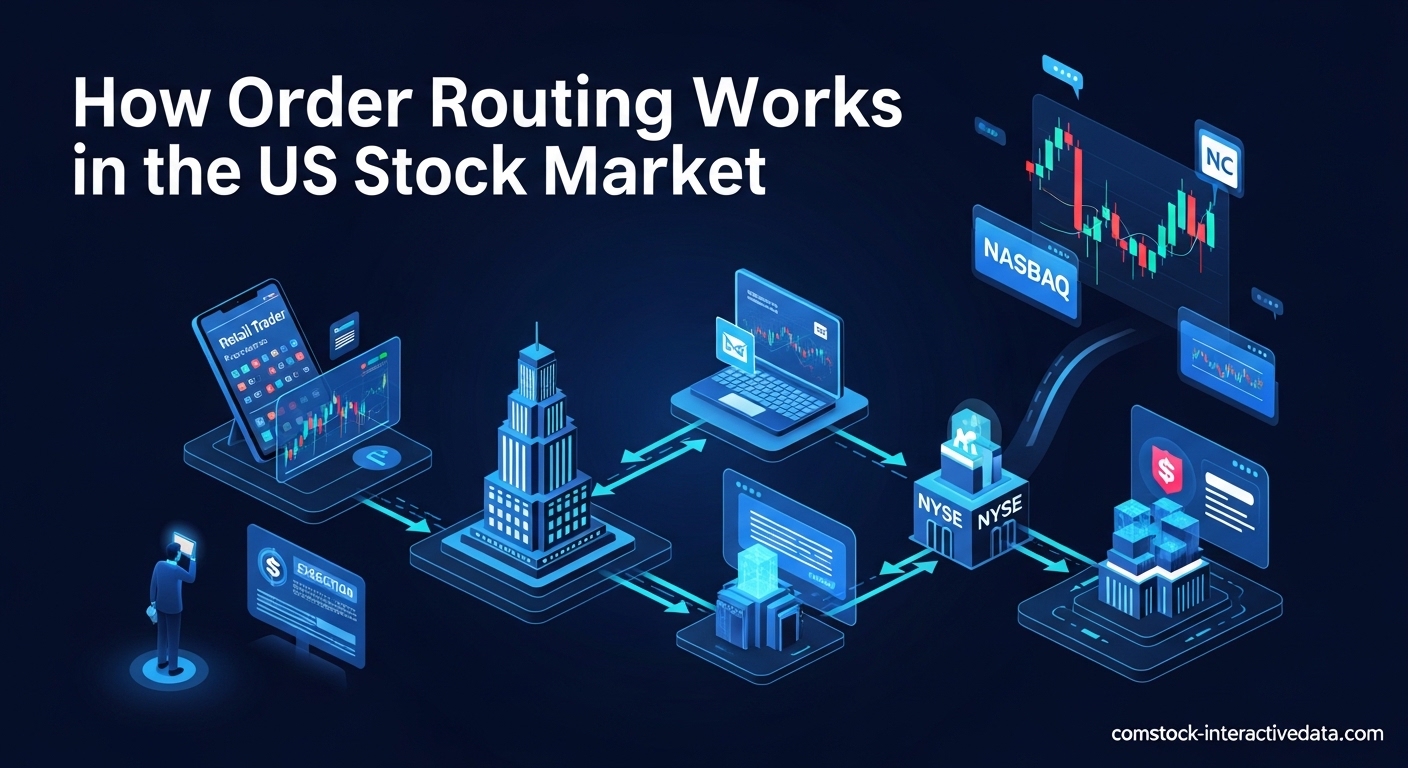
When you click “buy” or “sell” in your brokerage app, that order embarks on a journey through a complex network of exchanges, electronic communication networks, and market makers before it’s executed. This process, called order routing, determines whether you get the best price, fastest fill, or better execution quality. I’ve spent years studying market microstructure, and understanding how order routing works in the US stock market can give you valuable insights into your trading performance.
Table of Contents
What is Order Routing in the US Stock Market?
Order routing is the process by which a buy or sell order in the stock market is transmitted from your broker to an executing venue (exchange, ECN, or market maker) for fill. When you submit an order, your broker’s routing system evaluates the order type, size, and your specified preferences, then selects the best available execution destination based on price, liquidity, and speed.
The order routing system acts as a sophisticated traffic manager for your trades. It doesn’t simply send your order to one place. Instead, it analyzes multiple venues simultaneously to find optimal execution conditions. This matters because different venues offer different liquidity levels, fee structures, and execution probabilities.
Active traders particularly benefit from understanding order routing. The venue where your order lands affects your fill price, speed, and overall trading costs. Retail investors should also care because routing practices can significantly impact execution quality, especially for larger orders or during volatile market conditions.
How Order Routing Works Step-by-Step?
Let me walk you through exactly what happens from the moment you submit an order until it’s executed.
Step 1: Order Submission
When you click buy or sell, your order first hits your broker’s order management system. This initial step captures all the critical details: the stock symbol, order type (market or limit), number of shares, and any special instructions like “all or none” or “fill or kill.”
Step 2: Smart Order Router Evaluation
Your broker’s smart order router (SOR) immediately evaluates multiple factors. It checks the National Best Bid and Offer (NBBO) to find the best available prices across all U.S. exchanges. The SOR also considers liquidity at each venue, historical fill rates, and your specific routing preferences if you’ve set any.
Step 3: Venue Selection
Based on this evaluation, the router selects the optimal execution venue. For a market order, it might route to the exchange with the best price. For a limit order, it might choose a venue with higher liquidity to increase fill probability. The router might also split your order across multiple venues to get the best overall execution.
Step 4: Execution and Confirmation
The chosen venue executes your order, and you receive confirmation almost instantly. This entire process typically takes milliseconds for retail orders. Professional trading systems execute even faster, often measured in microseconds.
The routing decision happens automatically for most retail traders. However, understanding this process helps you make informed choices about broker selection and order types. Different brokers use different routing algorithms, which can lead to different execution outcomes for identical orders.
Types of Brokers and How They Route Orders
Not all brokers route orders the same way. The type of broker you use significantly impacts where your orders end up and the execution quality you receive. Let me break down the main categories.
Direct Market Access (DMA) Brokers
DMA brokers give you direct access to exchanges and ECNs without intermediaries. When you place an order through a DMA broker, it goes straight to the exchange or venue you specify. These brokers cater to active traders who want control over execution and transparency in routing.
With DMA, you can see exactly where your order is routed and often choose specific destinations. You’ll typically pay per-share commissions, but you gain access to advanced order types, routing options, and real-time market data. Popular DMA brokers include Interactive Brokers, Lightspeed, and CenterPoint Securities.
Discount and Retail Brokers
Discount brokers like Robinhood, Webull, and Charles Schwab use smart routing systems that automatically select execution venues. Many of these brokers receive payment for order flow (PFOF), meaning market makers pay them for the right to execute your orders.
This routing model keeps commission costs low or zero for retail traders. However, it means your orders typically go to wholesale market makers like Citadel Securities or Virtu Financial rather than directly to exchanges. These market makers often provide price improvement, but the practice has drawn scrutiny from regulators.
Full-Service Brokers
Full-service brokers offer research and advisory services alongside trading execution. Their routing practices vary, but many use internal execution desks or partner with specific market makers. These brokers typically charge higher commissions and cater to long-term investors rather than active traders.
Choosing Between Broker Types
For most retail investors, discount brokers offer sufficient execution quality. However, active traders and those trading in large sizes might benefit from DMA and direct routing control. Consider your trading frequency, average order size, and desire for routing transparency when choosing a broker.
Order Routing Execution Venues Explained 2026
Your order can be routed to several types of venues in the U.S. market structure. Each has distinct characteristics that affect execution quality.
Registered Exchanges
The U.S. has 16 registered stock exchanges, including the NYSE, NASDAQ, CBOE, BATS, and IEX. These public exchanges display bids and offers openly, providing transparent pricing. Exchanges compete for order flow by offering different fee structures, rebates, and execution speed.
The NYSE uses a designated market maker system with human specialists, while NASDAQ relies entirely on electronic matching. IEX stands out by implementing a 350-microsecond speed bump to level the playing field between fast and slow traders.
Electronic Communication Networks (ECNs)
ECNs are automated systems that match buy and sell orders electronically. They display the best available bids and offers and allow traders to post orders directly. ECNs typically offer rebates for adding liquidity (posting limit orders) and charge fees for taking liquidity (market orders).
Popular ECNs include ARCA, BZX, and EDGX. Many retail brokers’ smart routers route limit orders to ECNs to capture rebates, which can help offset trading costs. ECN orders must still comply with NBBO pricing rules.
Dark Pools and Alternative Trading Systems (ATS)
Dark pools are private trading venues that don’t display quotes publicly. They allow institutional investors to trade large blocks without revealing their intentions to the broader market. While dark pools can offer price improvement for large orders, they lack transparency and may result in worse executions for smaller orders.
About 40% of U.S. stock trading volume occurs off-exchange in dark pools and ATS platforms. Your broker might route orders to these venues, especially for larger trades or during after-hours sessions.
Wholesale Market Makers
Market makers like Citadel Securities, Virtu Financial, and Two Sigma internalize many retail orders. They pay brokers for order flow and often execute at better than the NBBO, providing price improvement. However, critics argue this arrangement creates conflicts of interest and may not always result in best execution.
Smart Order Routing Systems Explained 2026
Smart order routers are the brains behind modern order routing. These sophisticated algorithms evaluate multiple venues simultaneously to optimize execution quality.
What Smart Order Routers Evaluate
A smart order router considers several factors when routing your order. Price is primary, but the router also evaluates liquidity depth, execution probability, and historical fill rates at each venue. For limit orders, the router might prioritize venues with higher fill probability even if the price is slightly worse.
Speed matters too. High-frequency trading strategies might route to the fastest venues, while larger orders might prioritize venues that can handle more size without moving the market. The router also factors in your specific order type and any routing preferences you’ve set.
Order Type Differences
Market orders typically route to venues with the best displayed price. Your broker’s router seeks immediate execution, often prioritizing speed and liquidity over other factors.
Limit orders receive different treatment. The router might route to venues with higher fill probability for your limit price, especially if you’re posting away from the current market. Many routers also consider rebate opportunities, routing limit orders to ECNs that pay for posted liquidity.
NBBO Compliance
All smart routers must comply with Regulation NMS, specifically Rule 611 (the Order Protection Rule). This prevents trade-throughs, meaning your order can’t execute at a worse price than what’s available on another exchange. The router must check the NBBO before routing, ensuring you receive at least the nationally available best price.
Order Routing Fees, Rebates, and Costs
Order routing involves a complex fee structure that affects your trading costs. Understanding these fees helps you choose the right routing strategy.
Maker-Taker Model
Most U.S. exchanges use the maker-taker model. When you post a limit order that adds liquidity to the book (making), you receive a small rebate. When you send a market order that removes liquidity (taking), you pay a small fee.
For example, NASDAQ might charge $0.30 per 100 shares for taking liquidity while paying $0.20 per 100 shares for adding liquidity. These amounts seem small, but they add up for active traders. Many smart routers automatically route limit orders to capture these rebates.
Inverted Exchange Model
Some exchanges like IEX and NASDAQ BX use the inverted or taker-maker model. They charge for posting liquidity and pay for removing it. This structure encourages traders to bring orders to the exchange rather than passively posting.
ECN Rebates
ECNs typically offer the most generous rebates for posted liquidity. Active traders who use limit orders can earn significant rebates, reducing their effective commission costs. Some brokers pass these rebates directly to traders, while others keep them as revenue.
Payment for Order Flow Economics
In the PFOF model, market makers pay brokers for retail order flow. Market makers profit from the bid-ask spread and any informational advantage. Brokers profit from the PFOF payments. Retail traders often receive zero commissions and sometimes price improvement.
Critics argue this creates a conflict of interest. Your broker might route to the market maker paying the most rather than the one providing the best execution. Proponents counter that PFOF enables zero-commission trading and that market makers often improve upon NBBO prices.
Order Routing Regulations and Investor Protection
The SEC has established rules to ensure fair order routing practices and protect investors. Understanding these regulations helps you evaluate your broker’s routing practices.
SEC Rule 606
Rule 606 requires brokers to disclose their order routing practices quarterly. Your broker must publish information about where they route orders, execution quality at each venue, and any payment for order flow arrangements. You can typically find this information in the “execution quality” or “order routing” section of your broker’s website.
This transparency lets you see exactly where your orders go and how they perform. If your broker routes primarily to one market maker, Rule 606 disclosures will reveal this. Review these disclosures periodically to ensure your broker’s routing practices align with your interests.
Regulation NMS
Regulation NMS (National Market System) modernized U.S. stock market structure. Rule 611, the Order Protection Rule, prevents trade-throughs by requiring orders to route to the exchange with the best price. This ensures you receive at least the NBBO on your trade.
Rule 605 requires exchanges to report execution quality metrics monthly. This data lets you compare how different venues perform for various order types and sizes. Active traders use this information to choose optimal routing destinations.
Best Execution Obligations
Brokers have a fiduciary duty to seek best execution for client orders. Best execution doesn’t mean the absolute best price every time. Instead, it means the broker must consider price, speed, likelihood of execution, and overall cost when routing orders.
If your broker’s routing practices consistently result in poor executions, you might have grounds for complaint. FINRA provides a dispute resolution process for investors who believe their broker violated best execution obligations.
Checking Your Broker’s Routing Practices
You can usually find Rule 606 disclosures on your broker’s website. Look for sections titled “Order Routing,” “Execution Quality,” or “Trade Execution.” Some brokers provide detailed breakdowns showing execution quality by order type, size, and venue.
If you’re concerned about PFOF, check whether your broker accepts payment for order flow and which market makers they use. This information should be clearly disclosed in broker agreements and order routing disclosures.
Order Routing Best Practices for Traders
Based on my research and trader feedback from forums, here are practical tips for optimizing your order routing.
Know Your Broker’s Routing Practices
Review your broker’s Rule 606 disclosures quarterly. Understanding where your orders route helps you assess execution quality. If you trade actively, consider whether your broker’s routing aligns with your trading style.
Consider Direct Market Access for Active Trading
If you trade frequently or in larger sizes, DMA gives you control over routing. Direct routing to preferred exchanges can improve execution quality for certain strategies. However, balance this against per-share commissions that might exceed the benefits.
Use Limit Orders When Possible
Limit orders give you price protection and may qualify for ECN rebates. While market orders guarantee execution, limit orders let you specify your price and often receive better fills. Volatile stocks particularly benefit from limit orders to avoid slippage.
Be Aware of PFOF Implications
Zero-commission brokers often accept payment for order flow. While this doesn’t automatically mean poor execution, understand the trade-off. If you trade in size or actively, compare execution quality across brokers and consider whether PFOF affects your fills.
Monitor Execution Quality
Pay attention to your execution prices compared to the NBBO at order entry. Consistently poor fills might indicate routing problems. Many brokers provide execution quality reports showing how your trades performed relative to market conditions.
Frequently Asked Questions About Order Routing
What is order routing in trading?
Order routing is the process by which a buy or sell order in the stock market is transmitted from your broker to an executing venue (exchange, ECN, or market maker) for fill. When you submit an order, your broker’s routing system evaluates the order type, size, and your specified preferences, then selects the best available execution destination based on price, liquidity, and speed.
How does smart order routing work?
Smart order routing systems evaluate multiple execution venues simultaneously when you submit an order. The router checks the National Best Bid and Offer (NBBO) across all U.S. exchanges, considers liquidity at each venue, and factors in your order type and preferences. It then routes to the venue offering the best combination of price, speed, and execution probability, sometimes splitting orders across multiple venues for optimal execution.
What is the difference between DMA and discount brokers?
DMA (Direct Market Access) brokers provide direct access to exchanges and ECNs, allowing traders to control where orders route. They typically charge per-share commissions but offer transparency and routing options. Discount brokers use smart routing systems that automatically select venues, often receive payment for order flow, and usually offer zero-commission trading. DMA suits active traders wanting control, while discount brokers work well for most retail investors.
How do ECNs work in stock trading?
ECNs (Electronic Communication Networks) are automated systems that match buy and sell orders electronically outside traditional exchanges. They display bids and offers publicly and allow traders to post orders directly. ECNs typically use a maker-taker model, paying rebates for orders that add liquidity (posted limit orders) and charging fees for orders that remove liquidity (market orders). This structure encourages traders to provide liquidity to the market.
What are order routing rebates?
Order routing rebates are small payments made to traders or brokers when orders add liquidity to the market. Most U.S. exchanges and ECNs use a maker-taker model where posting limit orders (making) earns a rebate, while market orders (taking) pay a small fee. These rebates typically range from $0.10 to $0.30 per 100 shares and can reduce effective trading costs for active traders who use limit orders.
What is payment for order flow (PFOF)?
Payment for order flow is a practice where market makers pay brokers for the right to execute retail customer orders. Market makers like Citadel Securities and Virtu Financial pay brokers per share for order flow, then profit from the bid-ask spread when executing these orders. This practice enables zero-commission trading but has drawn scrutiny for potential conflicts of interest. Critics argue brokers might route to venues paying the most rather than providing the best execution.
Can I choose where my orders are routed?
It depends on your broker. DMA brokers typically allow you to specify routing destinations like specific exchanges or ECNs. Some advanced trading platforms also offer directed routing options. However, most discount and retail brokers use smart routing that automatically selects venues. You may be able to choose between smart routing and direct routing on some platforms, but options vary significantly between brokers. Check your broker’s order entry interface for routing controls.
Conclusion
Understanding how order routing works in the US stock market gives you valuable insight into your trading execution. From the moment you click buy or sell, your order travels through a sophisticated system of smart routers, exchanges, ECNs, and market makers before execution. The venue where your order lands affects your fill price, speed, and overall trading costs.
Whether you’re a casual investor or active trader, knowing your broker’s routing practices helps you make informed decisions. Review Rule 606 disclosures, consider whether DMA makes sense for your trading style, and use limit orders when appropriate to improve execution quality. Order routing might seem like behind-the-scenes plumbing, but it directly impacts your trading results.