
Understanding how to choose the right strike price can make or break your options trading results. After analyzing thousands of trades, I’ve found that strike price selection is where most beginners lose money unnecessarily.
The strike price determines everything about your option: its cost, profit potential, breakeven point, and probability of success. Pick wrong, and you’re fighting an uphill battle before the trade even begins.
In this guide, I’ll explain what a strike price is, how it affects your trades, and give you a proven framework for choosing the right one every time. Whether you’re buying calls or puts, speculating or hedging, these principles apply.
Table of Contents
What Is a Strike Price?
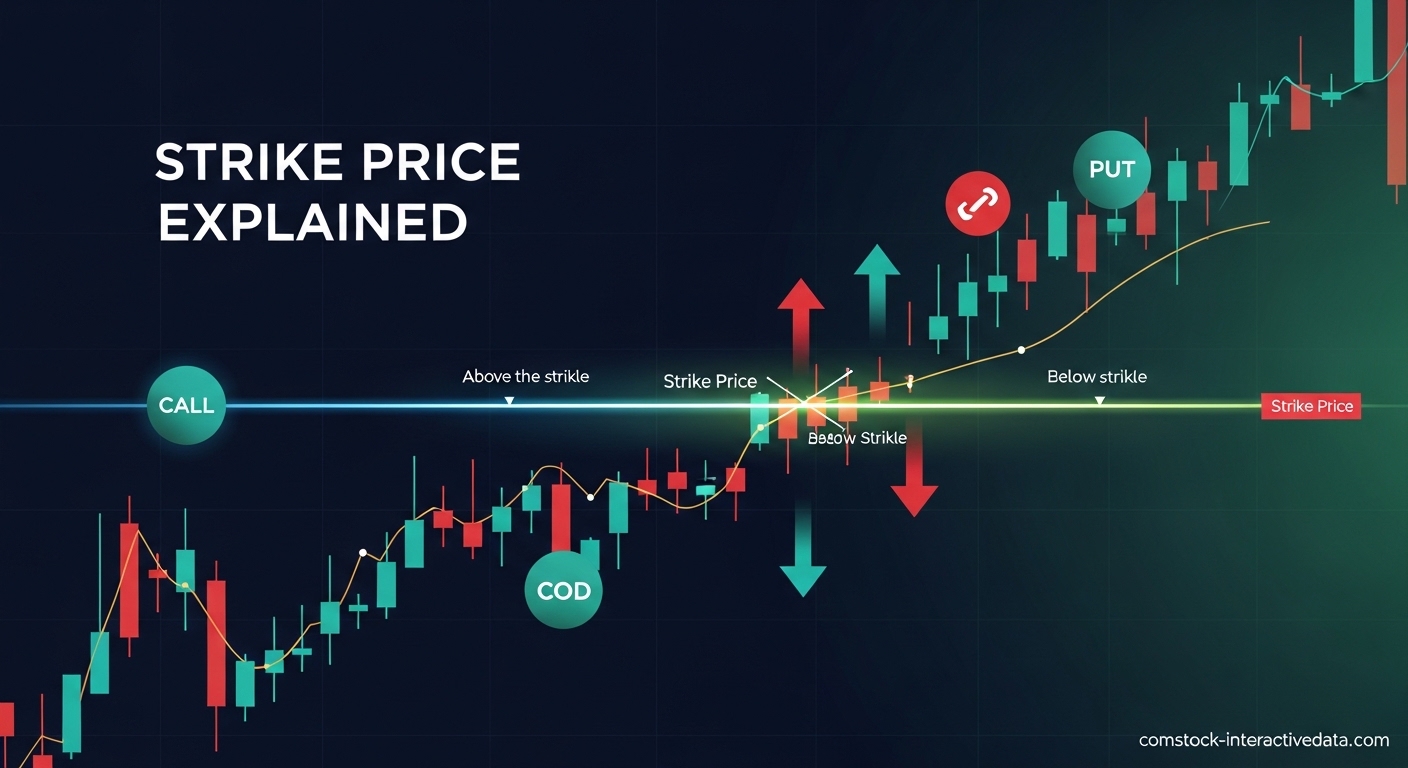
A strike price is the predetermined price at which an option holder can buy (for call options) or sell (for put options) the underlying asset when exercising the option. It’s also called the exercise price, and it’s set when the option contract is created.
Here’s how it works in practice: if you own a call option with a $50 strike price on XYZ stock, you have the right to buy shares at $50 regardless of what the stock is actually trading for. If XYZ rallies to $60, you can exercise your option and buy at $50, instantly gaining $10 per share in value.
For put options, it works in reverse. A $50 put gives you the right to sell shares at $50. If XYZ falls to $40, you can sell at $50, capturing that $10 difference.
The strike price stays fixed throughout the option’s life, but the underlying stock price moves constantly. This relationship between the strike price and current stock price determines whether your option has value and how much it costs upfront.
Understanding Moneyness: ITM, ATM, and OTM
Options traders categorize strike prices based on their relationship to the current stock price. This concept, called “moneyness,” is fundamental to choosing the right strike price.
In-the-Money (ITM) options have intrinsic value. For calls, ITM means the strike price is below the current stock price. For puts, ITM means the strike is above the stock price. ITM options cost more but have a higher probability of profit.
At-the-Money (ATM) options have strike prices closest to the current stock price. These strike prices offer a balance between cost and probability, making them popular for many strategies.
Out-of-the-Money (OTM) options have no intrinsic value. Call OTM strikes are above the stock price; put OTM strikes are below it. OTM options cost less but have lower probability of ending up profitable at expiration.
Here’s a practical example: if XYZ stock is trading at $100, a $95 call is ITM, a $100 call is ATM, and a $105 call is OTM. Each strike price offers a different risk-reward profile based on how far it is from the current price.
How Strike Price Affects Option Premium?
The strike price you choose directly impacts how much you pay for the option. This upfront cost, called the premium, varies dramatically based on moneyness.
ITM options have the highest premiums because they already have intrinsic value. You’re paying for real value that exists right now, not just potential future value. This higher cost reduces your percentage returns but increases your probability of success.
ATM options typically cost less than ITM but more than OTM. Their value comes almost entirely from time value and volatility rather than intrinsic worth. This middle ground makes them attractive for many traders.
OTM options are the cheapest because they have no intrinsic value—only time value. You can buy more contracts with less capital, which creates leverage. However, this low cost comes with a significantly lower probability of the option being profitable at expiration.
Understanding this premium relationship is crucial. Cheap options aren’t necessarily better deals. They’re cheap for a reason—lower probability of success. The strike price you choose determines where you sit on this cost-versus-probability spectrum.
Delta and Probability: The Hidden Key
One of the most powerful tools for choosing strike prices is delta, an option Greek that measures how much an option’s price moves relative to the stock price. But delta also tells you something equally important: the approximate probability of the option expiring in-the-money.
An option with a 0.50 delta has roughly a 50% chance of expiring ITM. A 0.30 delta option has about a 30% chance. This probability insight transforms how you approach strike selection.
ITM options typically have deltas above 0.50 (sometimes up to 0.80 or higher), reflecting their high probability of success. ATM options usually hover around 0.50 delta, indicating roughly even odds. OTM options have deltas below 0.50, dropping to 0.10 or less for far OTM strikes.
From the forums, experienced traders consistently recommend using delta as your probability guide. A 0.70 delta call option has about a 70% chance of being profitable at expiration. This concrete probability helps you make informed decisions instead of guessing.
When I’m choosing strike prices, I look at delta first. It tells me my realistic chances of success. If I want high probability trades, I choose higher delta strikes. If I’m willing to accept lower odds for potentially larger percentage gains, I go with lower delta strikes.
How to Choose the Right Strike Price?
After years of trading and analyzing what works, I’ve developed a step-by-step framework for choosing strike prices. This approach eliminates guesswork and helps you select strikes aligned with your goals.
Step 1: Define Your Trading Goal
Are you speculating on a big move? Generating income through option selling? Hedging existing positions? Your goal determines which strike prices make sense. Speculators often use OTM options for leverage, income sellers typically use OTM strikes for premium collection, and hedgers need ITM protection.
Step 2: Assess Your Probability Comfort
What probability of success do you need? Conservative traders prefer ITM options with 70-80% delta. Moderate traders often choose ATM strikes around 0.50 delta. Aggressive traders might select OTM options with 30-40% delta for higher potential returns. Be honest about your risk tolerance.
Step 3: Check Liquidity
Narrow bid-ask spreads eat your profits before the trade begins. Stick to strikes with tight spreads and high open interest. As a general rule, avoid strike prices that look illiquid—you’ll pay more entering and lose more exiting.
Step 4: Consider Time to Expiration
Longer-dated options give the stock more time to move, which affects optimal strike selection. For short-term trades, ATM or slightly OTM often works well. For longer-term positions, you might choose ITM for more delta exposure with less time decay risk.
Step 5: Calculate Breakeven
Before entering any trade, know your breakeven point. For calls, breakeven is strike price plus premium paid. For puts, it’s strike price minus premium paid. Make sure the stock needs to move a realistic distance to reach this point.
Most experienced traders recommend starting with ATM strikes and having a specific reason to deviate. If you go ITM, know you’re paying more for higher probability. If you go OTM, understand you’re accepting lower odds for cheaper entry cost.
Strike Price Selection by Trading Strategy
Different strategies require different strike price approaches. Let me break down what works based on common trading objectives.
For speculation on directional moves, consider your conviction level and time horizon. High conviction, short-term trades often work well with slightly ITM options—you get good delta exposure without paying the full ITM premium. Lower conviction or longer time frames might favor ATM or slightly OTM strikes to reduce capital at risk.
For income generation through selling options (covered calls, cash-secured puts), strike selection balances premium income against probability of assignment. OTM strikes offer lower premiums but lower assignment risk. ATM strikes pay more but increase assignment chances. Choose based on whether you want to keep your shares or are happy to sell them.
For hedging existing positions, ITM options provide the most protection but cost more. If you’re insuring against a crash, you might accept the higher cost for real protection. ATM hedges cost less but provide less cushion. The right choice depends on how much protection you need versus how much you’re willing to pay.
Beginners should generally stick to ATM or slightly ITM options. Yes, they cost more. But they also have higher delta and better probability of success. As you gain experience, you can experiment with OTM strikes for specific situations. The forums are filled with traders who lost money buying cheap OTM options that expired worthless—learn from their mistakes.
Common Mistakes When Choosing Strike Prices
I’ve seen traders repeat the same strike price mistakes over and over. Avoiding these errors alone can dramatically improve your results.
The “lottery ticket” mindset is the most common beginner error. Traders buy far OTM options because they’re cheap, hoping for a massive move that rarely comes. These options usually expire worthless. Cheap isn’t better if the probability is near zero.
Ignoring liquidity is another costly mistake. Narrow strike prices with wide bid-ask spreads put you behind before the trade starts. Always check open interest and spread width before choosing less popular strikes.
Misunderstanding probability leads to poor expectations. Many traders buy OTM options not realizing they might only have a 20-30% chance of success. Use delta to understand your real odds, then decide if those odds are worth the cost.
Overlooking time decay is particularly damaging for OTM options. As expiration approaches, OTM options lose value rapidly even if the stock moves in your direction. Factor time decay into your strike selection, especially for shorter-term trades.
Not having a deviation reason is a mistake forum traders consistently mention. The smart approach: start with ATM, then have a specific, fact-based reason to go ITM or OTM. “It’s cheaper” isn’t a good reason. “I need 80% delta for this hedge” is.
Frequently Asked Questions
How to decide which strike price to buy?
Start by determining your trading goal and risk tolerance. For higher probability trades, choose in-the-money or at-the-money strikes with delta above 0.50. If you’re willing to accept lower odds for potential larger percentage gains, out-of-the-money options with lower delta might work. Always check liquidity and calculate your breakeven point before entering any trade.
How to select the correct strike price?
The correct strike price matches your strategy objectives. Speculators often use at-the-money or slightly out-of-the-money for leverage. Income sellers typically choose out-of-the-money strikes for premium collection with lower assignment risk. Hedgers usually prefer in-the-money protection. Use delta as your probability guide—higher delta means higher chance of success but higher cost.
What is the 3 5 7 rule in trading?
The 3 5 7 rule refers to strike price selection based on days to expiration. For options expiring in under 30 days, choose strikes within $3 of the current price. For 30-60 day options, stay within $5. For longer-term options over 60 days, you can extend to $7 or more. This rule helps ensure your option has enough time to reach the strike price while maintaining reasonable probability.
Do you want a high or low strike price?
It depends on your position and outlook. Call buyers generally want lower strike prices (in-the-money or at-the-money) for higher probability and delta. Put buyers typically want higher strike prices for the same reasons. However, if you’re selling options for income, you want out-of-the-money strikes—higher for calls, lower for puts—to reduce assignment risk while collecting premium.
What happens when an option hits the strike price before expiration?
Nothing automatic happens when the stock price reaches the strike price. The option doesn’t exercise itself. You can still choose to exercise or sell the option. However, reaching the strike price is significant because at-the-money options have maximum time value, which accelerates time decay as expiration approaches. This is why many traders close or roll positions when the stock reaches the strike price.
Conclusion
Choosing the right strike price isn’t complicated, but it does require a systematic approach. Start with your trading goal, assess your probability comfort using delta, check liquidity, and always know your breakeven before entering any trade.
The framework I’ve shared works because it balances cost with probability. ITM options offer high probability but lower percentage returns. OTM options provide leverage but lower odds. ATM strikes often represent the sweet spot for many strategies.
Remember the wisdom from experienced traders: start with ATM strikes, then have a specific reason to deviate. Avoid the lottery ticket mentality of buying far OTM options just because they’re cheap. Use delta to understand your real chances of success.
Options trading offers tremendous leverage and flexibility, but only when you choose strike prices wisely. Apply this framework to your next trade, and you’ll see immediate improvements in your decision-making and results.