
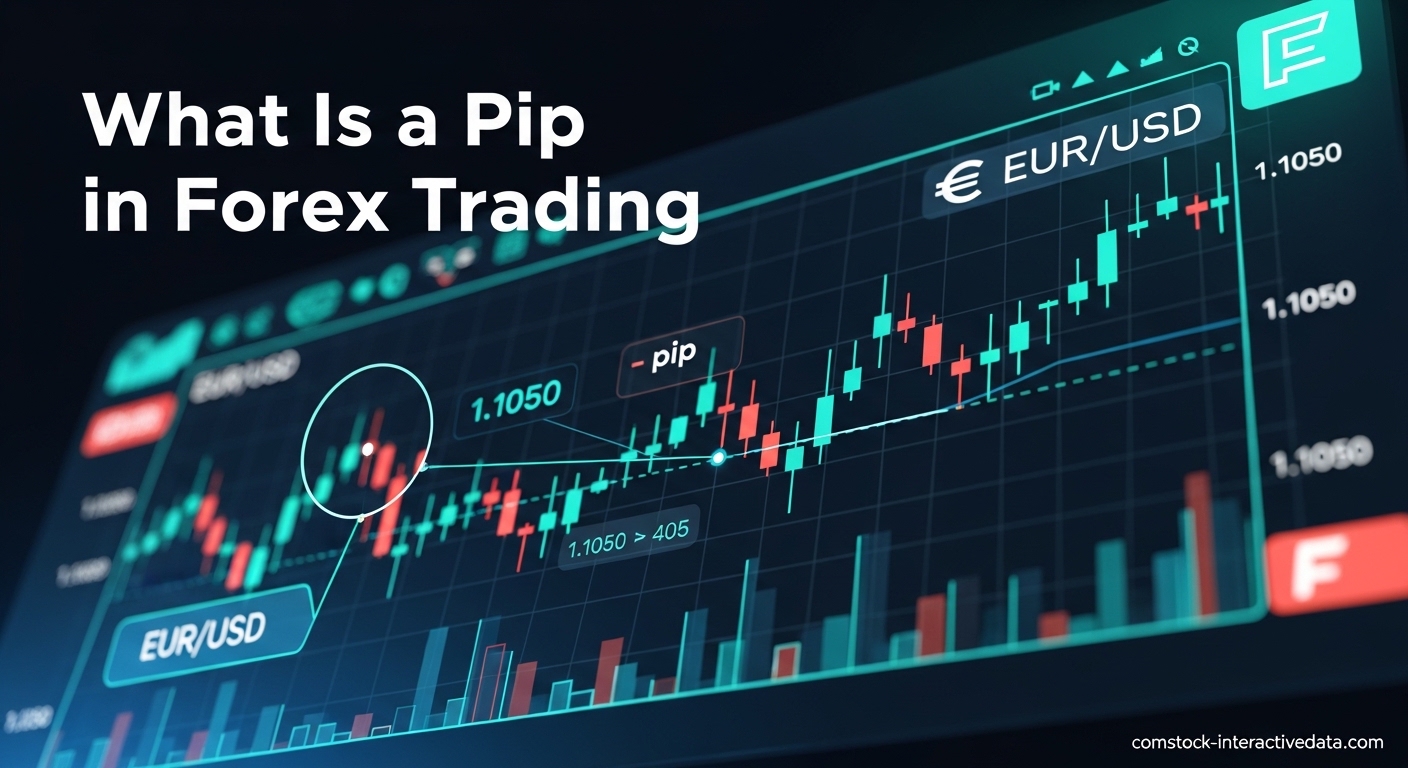
A pip (Percentage in Point) is the smallest unit of price movement in forex trading, representing the fourth decimal place (0.0001) in most currency pairs. When EUR/USD moves from 1.1050 to 1.1051, that 0.0001 change equals one pip. Pips measure the change in value between two currencies and are essential for calculating profit, loss, and trading costs.
Understanding what is a pip in forex trading is fundamental for anyone starting their journey in currency markets. Without pips, there would be no standardized way to measure forex price movements or quantify gains and losses. This guide breaks down everything you need to know about pips, from basic definitions to practical calculations you’ll use every day.
Table of Contents
What Is a Pip in Forex Trading?
A pip stands for “Percentage in Point” or sometimes “Price Interest Point,” and it’s the standardized unit for measuring price changes in currency pairs. For most forex pairs, a pip represents the fourth decimal place. This means one pip equals 0.0001 of the quote currency.
Here’s a practical example. If EUR/USD moves from 1.1050 to 1.1051, that’s a one pip movement. The price increased by 0.0001, which equals exactly one pip. Traders use pips to discuss price movements in a standardized way, regardless of the actual exchange rate.
The term “pip” gives forex traders a common language. Instead of saying “the currency pair moved by 0.0001,” traders simply say “it moved one pip.” This shorthand makes communication clearer and more efficient in the fast-paced forex market.
The JPY Exception: Two Decimal Places
Japanese Yen pairs work differently. For currency pairs involving JPY, such as USD/JPY or EUR/JPY, a pip is the second decimal place instead of the fourth. This is because the yen’s value is much lower compared to other major currencies.
For example, if USD/JPY moves from 145.30 to 145.31, that’s a one pip movement. The 0.01 change equals one pip for yen pairs. This exception trips up many beginners, so it’s worth noting early.
The reason for this difference lies in the historical exchange rates. When the yen was introduced to forex markets, it traded at much higher values relative to the dollar. Using two decimal places made more sense for practical trading purposes, and the convention has remained.
Why Pips Matter in Forex Trading?
Pips serve several critical functions in forex trading. They allow traders to measure price movements consistently, calculate profit and loss, determine position sizes, and assess trading costs through the spread.
Every forex price movement is measured in pips. Your gains and losses are counted in pips. The spread you pay to enter a trade is quoted in pips. Risk management calculations use pips. In short, pips are the foundation of forex trading mathematics.
Understanding Pips vs. Pipettes
While a pip is the fourth decimal place, many forex brokers now offer pricing that includes a fifth decimal place. These smaller units are called “pipettes” or “fractional pips.” One pipette equals 0.1 of a pip, or 0.00001 of the quote currency.
For example, if EUR/USD is quoted at 1.10503 instead of 1.1050, that last digit (3) represents three pipettes. This allows for more precise pricing and can benefit traders through tighter spreads.
Pipettes became more common as forex trading became electronic and competitive. Brokers started offering fractional pip pricing to advertise tighter spreads. A spread of 1.5 pips sounds better than 2 pips, even though the difference is minimal.
For beginners, it’s important to know pipettes exist, but don’t let them confuse your core understanding of pips. Most forex education and discussion still focuses on whole pips. Pipettes are simply a refinement, not a replacement for the standard pip measurement.
How to Calculate Pip Value?
Calculating pip value is a skill every forex trader needs. The pip value tells you how much money each pip movement is worth for your specific trade size. Here’s the formula for standard currency pairs (where USD is the quote currency):
Pip Value = (One Pip / Exchange Rate) × Position Size
Let’s work through a concrete example. Say you’re trading EUR/USD with one standard lot (100,000 units). The current exchange rate is 1.1050.
One pip = 0.0001
Pip Value = (0.0001 / 1.1050) × 100,000 = $9.05
In this case, each pip movement is worth approximately $9.05. If the market moves 10 pips in your favor, you’ve gained about $90.50. If it moves 10 pips against you, you’ve lost $90.50.
Calculating Pip Value for USD/JPY
The JPY pair exception affects pip value calculations too. For USD/JPY, the formula uses 0.01 as the pip value instead of 0.0001:
Pip Value = (0.01 / Exchange Rate) × Position Size
If USD/JPY is trading at 145.30 and you have one standard lot (100,000 units):
Pip Value = (0.01 / 145.30) × 100,000 = $6.88
Notice how the pip value differs from EUR/USD. This is why you can’t assume all pips are worth the same amount. The exchange rate and the currency pair both affect the dollar value of each pip.
When Your Account Currency Differs?
If your trading account is in a different currency than the quote currency, you need an extra conversion step. For example, if your account is in GBP but you’re trading EUR/USD:
1. Calculate the pip value in USD (as shown above)
2. Convert that amount to GBP using the current GBP/USD rate
This adds complexity, which is why many beginners prefer starting with accounts denominated in USD or aligning their account currency with their most-traded pairs.
Pip Value and Lot Sizes
The size of your trading position dramatically affects pip value. Forex trading uses standardized lot sizes, and understanding these is crucial for proper risk management.
A standard lot equals 100,000 units of the base currency. With one standard lot on EUR/USD, each pip is worth approximately $10 (depending on the exchange rate).
A mini lot equals 10,000 units. With one mini lot, each pip is worth approximately $1. This is ten times smaller than a standard lot, making it more suitable for beginners or smaller accounts.
A micro lot equals 1,000 units. With one micro lot, each pip is worth approximately $0.10. This allows for very precise position sizing and is excellent for learning or testing strategies.
Here’s a quick reference for EUR/USD pip values at different lot sizes:
- Standard Lot (100,000 units): ~$10 per pip
- Mini Lot (10,000 units): ~$1 per pip
- Micro Lot (1,000 units): ~$0.10 per pip
Is 1 pip 10 dollars? Only if you’re trading a full standard lot on a pair where USD is the quote currency, and even then, the exact amount varies slightly with the exchange rate. For mini lots, 1 pip is roughly $1. For micro lots, 1 pip is about $0.10.
Pips and Profit/Loss
Understanding how pips translate to real money is essential for realistic trading expectations. The relationship between pips and profit/loss depends entirely on your position size.
Let’s look at a concrete example. Say you buy EUR/USD at 1.1050 with one mini lot (10,000 units). The price then moves to 1.1060. That’s a 10-pip movement in your favor.
10 pips × $1 per pip = $10 profit
Now let’s say you had traded a standard lot instead. The same 10-pip movement would be worth:
10 pips × $10 per pip = $100 profit
This example shows why position sizing is so important. The same market movement produces dramatically different results depending on how many units you’re trading.
How Many Pips to Make $100?
This is a common question from beginners, and the answer depends on your lot size. With a standard lot, you need 10 pips to make approximately $100. With a mini lot, you need 100 pips to make $100. With a micro lot, you need 1,000 pips to make $100.
This illustrates the trade-off between lot size and pip movements. Larger lots mean more profit per pip but also more risk. Smaller lots require larger pip movements for significant profit but offer more safety and flexibility.
I’ve seen many forum posts from confused traders who caught what seemed like a big move but only made a few dollars. In one case, a trader bought GBPAUD at 1.98603 and sold at 1.98964 with a 0.02 lot size. They only made $6.46 and wondered if something was wrong. The calculation was correct—they had a small position size on a volatile pair. Understanding pip values beforehand prevents this kind of confusion.
Understanding Spread in Pips
The spread is the difference between the bid price (what buyers pay) and the ask price (what sellers receive). Spreads are always measured in pips, and they represent the cost of entering a trade.
For example, if EUR/USD is quoted at 1.1050/1.1052, the spread is 2 pips. This means you start every trade 2 pips down. You need the market to move 2 pips in your favor just to break even.
Spreads vary between brokers and currency pairs. Major pairs like EUR/USD typically have the tightest spreads (often 1-2 pips). Exotic pairs can have spreads of 20 pips or more.
When calculating potential trades, always factor in the spread. If you’re targeting a 10-pip profit but the spread is 2 pips, you only need an 8-pip movement after entry. However, if you’re limiting risk to a 10-pip stop loss, the 2-pip spread effectively gives you only 8 pips of protection.
Common Beginner Mistakes to Avoid
Understanding what is a pip in forex trading helps you avoid several costly mistakes that trip up new traders.
Forgetting the JPY Exception: Many beginners automatically assume all currency pairs use the fourth decimal place. This leads to massive errors when trading yen pairs. Always check if JPY is involved—if it is, pips are at the second decimal place.
Assuming Fixed Pip Values: Thinking “1 pip always equals $10” is dangerous. This is only true for standard lots on specific pairs. Pip values change with lot size, exchange rate, and currency pair. Always calculate based on your specific trade parameters.
Ignoring Exchange Rate Impact: The pip value isn’t constant—it changes as the exchange rate changes. This is especially relevant for pairs where your account currency isn’t the quote currency. Small exchange rate shifts can affect your profit/loss calculations.
Confusing Pips, Points, and Pipettes: Some platforms use “points” instead of “pips,” and the terminology can get messy. In most contexts, 1 pip = 10 points = 100 pipettes. Stick with pips for clarity, and always confirm which unit your platform is using.
Not Calculating Pip Value Before Trading: Entering a trade without knowing what each pip is worth for your position size is risky. You should always know your dollar risk per pip before opening any position.
Practice Makes Perfect
The best way to solidify your understanding of pips is through practice. Most forex brokers offer demo accounts where you can trade with virtual money. Use this opportunity to practice calculating pip values and tracking profit/loss in real-time.
Start with a simple exercise. Open a demo trade with one mini lot on EUR/USD. Watch how the price moves and calculate your profit or loss in pips. Then convert those pips to dollars using the pip value formula. Do this repeatedly until the calculations become second nature.
As you practice, you’ll develop an intuitive sense for pip movements. You’ll start recognizing that a 20-pip daily range is typical for EUR/USD, while GBP/JPY might move 100+ pips in the same session. This market awareness is invaluable for any trader.
Frequently Asked Questions
What is a pip in forex trading?
A pip (Percentage in Point) is the smallest unit of price movement in forex trading, representing the fourth decimal place (0.0001) in most currency pairs. For JPY pairs, a pip is the second decimal place (0.01). Pips measure the change in value between two currencies and are used to calculate profit, loss, and trading costs.
Is 1 pip 10 dollars?
Not necessarily. 1 pip equals $10 only when trading a full standard lot (100,000 units) on currency pairs where USD is the quote currency. For a mini lot (10,000 units), 1 pip equals approximately $1. For a micro lot (1,000 units), 1 pip equals about $0.10. The pip value depends on your position size and the specific currency pair.
How many pips to make $100 forex?
The number of pips needed to make $100 depends on your lot size. With a standard lot, you need approximately 10 pips to make $100. With a mini lot, you need 100 pips to make $100. With a micro lot, you need 1,000 pips to make $100. Always calculate based on your specific position size and currency pair.
How to calculate pips in forex trading for beginners?
To calculate pips, identify the decimal place change. For most pairs, count the fourth decimal place. If EUR/USD moves from 1.1050 to 1.1051, that’s 1 pip (0.0001 change). For JPY pairs like USD/JPY, count the second decimal place. A move from 145.30 to 145.31 equals 1 pip (0.01 change). To calculate pip value in dollars, use the formula: (One Pip / Exchange Rate) × Position Size.
What is a pipette in forex?
A pipette, also called a fractional pip, is one-tenth of a pip. It represents the fifth decimal place (0.00001) in currency pair pricing. While a standard pip is the fourth decimal place, pipettes allow for more precise pricing and tighter spreads. Many brokers now display prices with pipettes to show more granular movements.
Conclusion
Understanding what is a pip in forex trading is one of the first and most important lessons for any currency trader. Pips provide the standardized measurement system that makes forex trading possible. They allow you to quantify price movements, calculate profit and loss, manage risk, and determine position sizes.
Remember the key points: a pip is typically the fourth decimal place (0.0001), except for JPY pairs where it’s the second decimal place (0.01). Pip values depend on your lot size—standard lots (~$10/pip), mini lots (~$1/pip), and micro lots (~$0.10/pip). Always calculate pip value before entering trades, and don’t forget to account for the spread.
Practice calculating pips and pip values on a demo account before trading with real money. This foundation will serve you throughout your forex trading journey, helping you make more informed decisions and avoid costly mistakes.